
#FactCheck-AI-generated video of ‘giant hailstorm in Maharashtra’ falsely shared as real weather event
Executive Summary
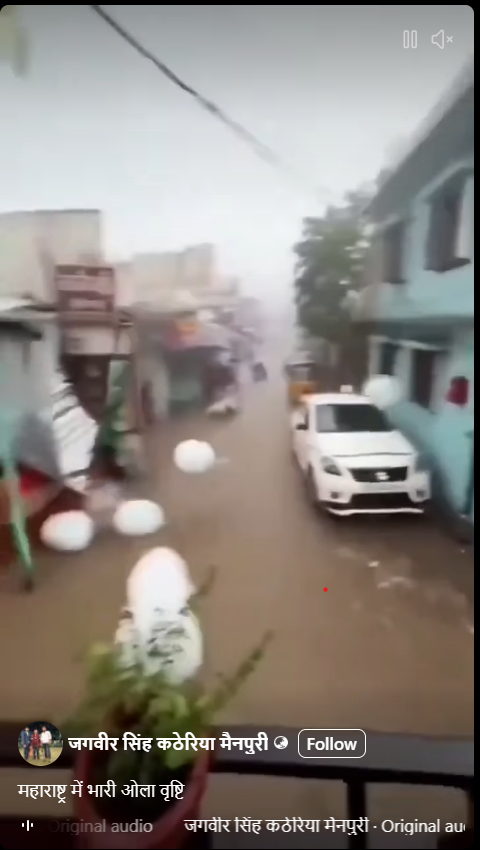
A video showing unusually large hailstones falling from the sky and damaging parked vehicles is being widely circulated on social media. Users are claiming that the video shows a severe hailstorm in Maharashtra amid the ongoing heatwave conditions in several parts of the country. CyberPeace Research Wing research found the claim to be false. The viral clip is not a real weather event and has been identified as AI-generated content.
Claim:
Social media users shared the video claiming it shows heavy hailstorm in Maharashtra, with captions suggesting widespread damage caused by extreme weather. https://www.facebook.com/reel/1741412617041722, https://archive.is/W2QxM
Fact Check:
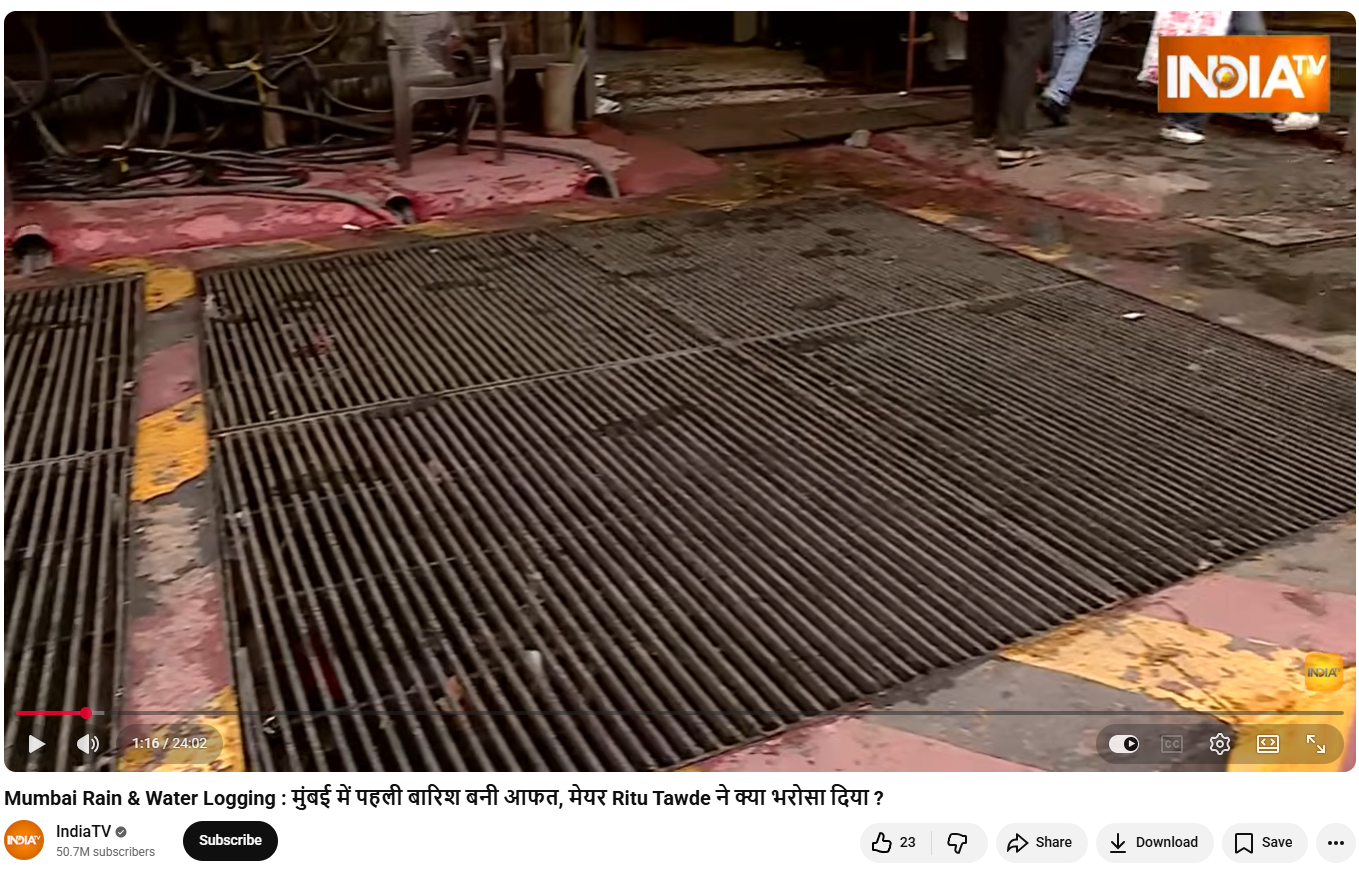
A reverse image search of keyframes from the viral video did not yield any credible media reports linking the visuals to any real hailstorm in Maharashtra or elsewhere.
https://www.youtube.com/watch?v=ZRsWLRowbao
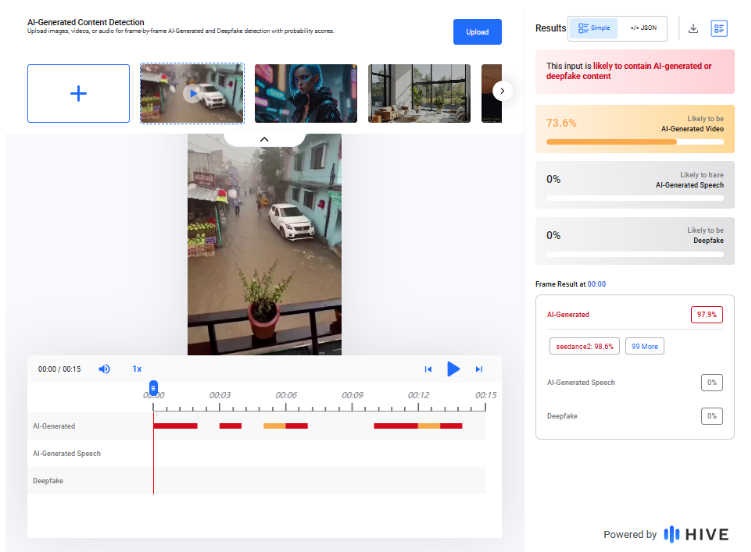
Closer examination of the video revealed multiple inconsistencies, including unnatural movement and unrealistic size and behavior of hailstones, which are commonly associated with AI-generated visuals. The video was further analysed using AI detection tools. Hive Moderation flagged the content as likely AI-generated.
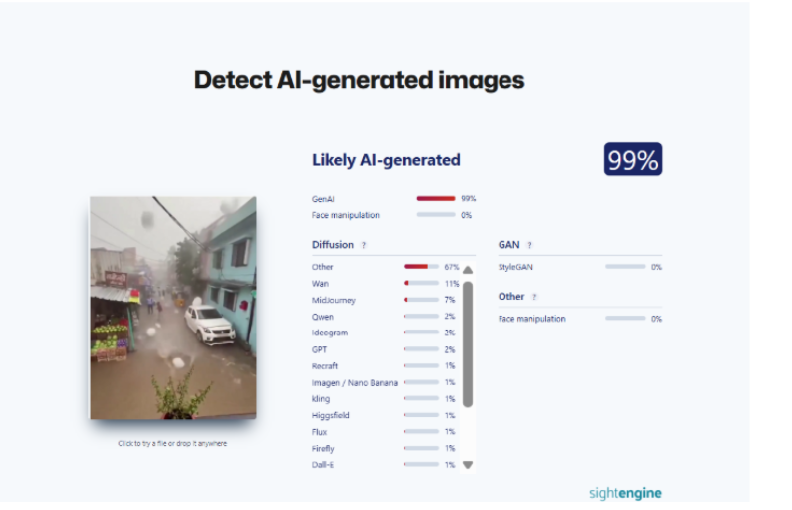
Similarly, Sightengine analysis indicated a 99% probability that the visuals were artificially created.
Conclusion:
The research confirms that the viral video claiming to show a massive hailstorm in Maharashtra is not real. The visuals are AI-generated and do not depict any actual weather event.

Related Blogs

Executive Summary:
Recent reports circulating on various social media platforms have falsely claimed that an air taxi prototype is operational and providing services between Amritsar, Chandigarh, Delhi, and Jaipur. These claims, accompanied by images and videos, have been widely shared, leading to significant public attention. However, upon conducting a thorough examination using reverse image search, it has been determined that the information is misleading and inaccurate. These assertions do not reflect the current reality and are not substantiated by credible sources

Claim:
The claim suggests that an air taxi prototype is already operational, servicing routes between Amritsar, Chandigarh, Delhi, and Jaipur. This assertion is accompanied by images of a futuristic aircraft, implying that such technology is currently being used to transport commercial passengers.

Fact Check:
The claim of air taxi and routes between Amritsar, Chandigarh, Delhi, and Jaipur has been found to be misleading. Also, so far, neither the Indian government nor the respective aviation authorities have issued any sort of public declarations nor industry insiders to claim any launch of any air taxi service. Further research followed a keyword-based search that directed us to a news report published in The Times of India on January 20, 2025. A similar post to the one seen in the viral video accompanied the report. It stated that Bengaluru-based aerospace startup Sarla Aviation launched its prototype air taxi called “Shunya” during the Bharat Mobility Global Expo. Under this plan, it looks to initiate electric flying taxis in Bangalore by 2028. This urban air transport program for India will be similar to what they are posting in this regard.

Conclusion:
The viral claim saying that there is an air taxi service in India between Amritsar, Chandigarh, Delhi, and Jaipur is entirely false. The pictures and information going viral are misleading and do not relate to any progress or implementation of air taxi technology in India. To date, there is no official confirmation or credible evidence that supports such a service. Information must be verified from reliable sources before it is believed or shared in order to prevent the spread of misinformation.
- Claim: A viral post claims an air taxi is operational between Amritsar, Chandigarh, Delhi, and Jaipur.
- Claimed On: Social Media
- Fact Check: False and Misleading

Introduction
Since the inception of the Internet and social media platforms like Facebook, X (Twitter), Instagram, etc., the government and various other stakeholders in both foreign jurisdictions and India have looked towards the intermediaries to assume responsibility for the content floated on these platforms, and various legal provisions showcase that responsibility. For the first time in many years, these intermediaries come together to moderate the content by setting a standard for the creators and propagators of this content. The influencer marketing industry in India is at a crucial juncture, with its market value projected to exceed Rs. 3,375 crore by 2026. But every industry is coupled with its complications; like in this scenario, there is a section of content creators who fail to maintain the standard of integrity and propagate content that raises concerns of authenticity and transparency, often violating intellectual property rights (IPR) and privacy.
As influencer marketing continues to shape digital consumption, the need for ethical and transparent content grows stronger. To address this, the India Influencer Governing Council (IIGC) has released its Code of Standards, aiming to bring accountability and structure to the fast-evolving online space.
Bringing Accountability to the Digital Fame Game
The India Influencer Governing Council (IIGC), established on 15th February, 2025, is founded with the objective to empower creators, advocate for fair policies, and promote responsible content creation. The IIGC releases the Code of Standard, not a moment too soon; it arrives just in time, a necessary safeguard before social media devolves into a chaotic marketplace where anything and everything is up for grabs. Without effective regulation, digital platforms become the marketplace for misinformation and exploitation.
The IIGC leads the movement with clarity, stating that the Code is a significant piece that spans across 20 crucial sections governing key areas such as paid partnership disclosures, AI-generated personas, content safety, and financial compliance.
Highlights from the Code of Standard
- The Code exhibits a technical understanding of the industry of content creation and influencer marketing. The preliminary sections advocate for accuracy, transparency, and maintaining credibility with the audience that engages with the content. Secondly, the most fundamental development is with regard to the “Paid Partnership Disclosure” included in Section 2 of the Code that mandates disclosure of any material connection, such as financial agreements or collaboration with the brand.
- Another development, which potently comes at a befitting hour, is the disclosure of “AI Influencers”, which establishes that the nature of the influencer has to be disclosed, and such influencers, whether fully virtual or partially AI-enhanced, must maintain the same standards as any human influencer.
- The code ranges across various other aspects of influencer marketing, such as expressing unpaid “Admiration” for the brand and public criticism of the brand, being free from personal bias, honouring financial agreements, non-discrimination, and various other standards that set the stage for a safe and fair digital sphere.
- The Code also necessitates that the platform users and the influencers handle sexual and sensitive content with sincere deliberation, and usage of such content shall be for educational and health-related contexts and must not be used against community standards. The Code includes various other standards that work towards making digital platforms safer for younger generations and impressionable minds.
A Code Without Claws? Challenges in Enforcement
The biggest obstacle to the effective implementation of the code is distinguishing between an honest promotion and a paid brand collaboration without any explicit mention of such an agreement. This makes influencer marketing susceptible to manipulation, and the manipulation cannot be tackled with a straitjacket formula, as it might be found in the form of exaggerated claims or omission of critical information.
Another hurdle is the voluntary compliance of the influencers with the advertising standards. Influencer marketing is an exercise in a borderless digital cyberspace, where the influencers often disregard the dignified standards to maximise their earnings and commercial motives.
The debate between self-regulation and government oversight is constantly churning, where experience tells us that overreliance on self-regulation has proven to be inadequate, and succinct regulatory oversight is imperative in light of social media platforms operating as a transnational commercial marketplace.
CyberPeace Recommendations
- Introduction of a licensing framework for influencers that fall into the “highly followed” category with high engagement, who are more likely to shape the audience’s views.
- Usage of technology to align ethical standards with influencer marketing practices, ensuring that misleading advertisements do not find a platform to deceive innocent individuals.
- Educating the audience or consumers on the internet about the ramifications of negligence and their rights in the digital marketplace. Ensuring a well-established grievance redressal mechanism via digital regulatory bodies.
- Continuous and consistent collaboration and cooperation between influencers, brands, regulators, and consumers to establish an understanding and foster transparency and a unified objective to curb deceptive advertising practices.
References
- https://iigc.org/code-of-standards/influencers/code-of-standards-v1-april.pdf
- https://legalonus.com/the-impact-of-influencer-marketing-on-consumer-rights-and-false-advertising/
- https://exhibit.social/news/india-influencer-governing-council-iigc-launched-to-shape-the-future-of-influencer-marketing/

Executive Summary:
A photoshopped image circulating online suggests Prime Minister Narendra Modi met with militant leader Hafiz Saeed. The actual photograph features PM Modi greeting former Pakistani Prime Minister Nawaz Sharif during a surprise diplomatic stopover in Lahore on December 25, 2015.
The Claim:
A widely shared image on social media purportedly shows PM Modi meeting Hafiz Saeed, a declared terrorist. The claim implies Modi is hostile towards India or aligned with terrorists.

Fact Check:
On our research and reverse image search we found that the Press Information Bureau (PIB) had tweeted about the visit on 25 December 2015, noting that PM Narendra Modi was warmly welcomed by then-Pakistani PM Nawaz Sharif in Lahore. The tweet included several images from various angles of the original meeting between Modi and Sharif. On the same day, PM Modi also posted a tweet stating he had spoken with Nawaz Sharif and extended birthday wishes. Additionally, no credible reports of any meeting between Modi and Hafiz Saeed, further validating that the viral image is digitally altered.


In our further research we found an identical photo, with former Pakistan Prime Minister Nawaz Sharif in place of Hafiz Saeed. This post was shared by Hindustan Times on X on 26 December 2015, pointing to the possibility that the viral image has been manipulated.
Conclusion:
The viral image claiming to show PM Modi with Hafiz Saeed is digitally manipulated. A reverse image search and official posts from the PIB and PM Modi confirm the original photo was taken during Modi’s visit to Lahore in December 2015, where he met Nawaz Sharif. No credible source supports any meeting between Modi and Hafiz Saeed, clearly proving the image is fake.
- Claim: Debunking the Edited Image Claim of PM Modi with Hafiz Saeed
- Claimed On: Social Media
- Fact Check: False and Misleading
