
#FactCheck-No Evidence India Returned Iranian Oil After Trump-Modi Call
Executive Summary
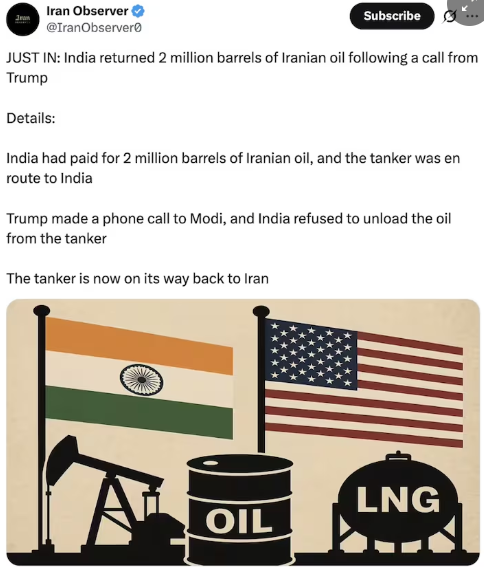
A claim circulating on social media alleges that India refused to unload crude oil from two Iranian tankers following a call between US President Donald Trump and Prime Minister Narendra Modi, after the US announced fresh restrictions on Iranian oil exports. However, research by the CyberPeace Research Wing found the claim to be misleading. The probe revealed that two supertankers carrying Iranian crude are currently anchored off India’s western and eastern coasts. No credible evidence or reports suggest that India refused to unload the cargo or sent the vessels back.
Claim
A user on X claimed that India returned 2 million barrels of Iranian crude oil after a phone call from Donald Trump. According to the post, India had already paid for the oil and the tanker was en route, but following the call with Narendra Modi, authorities refused to unload the shipment and sent the tanker back to Iran.
Fact Check
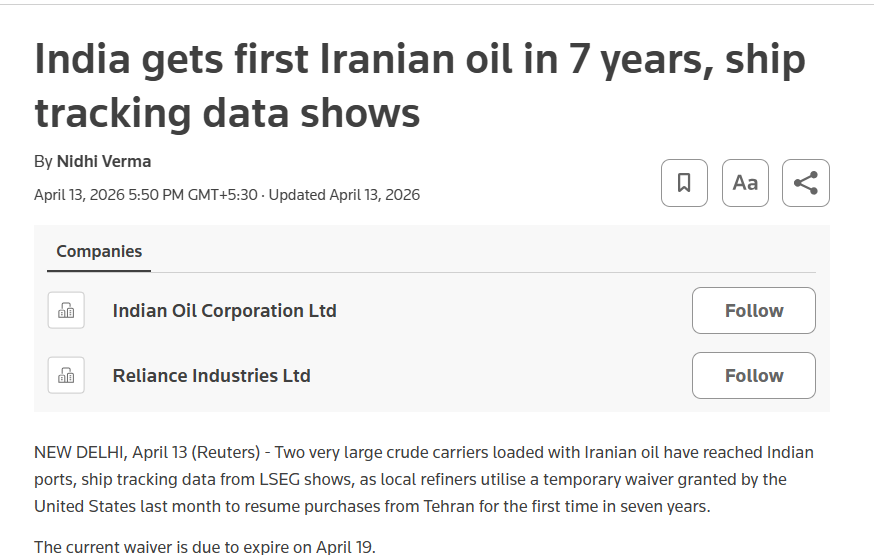
No credible national or international media reports were found to support the claim that India refused to accept Iranian oil or returned the tankers. Given the global scrutiny on oil shipments amid tensions in West Asia, any such development would have drawn widespread coverage. According to Reuters, two large crude carriers loaded with Iranian oil reached Indian ports on April 13. The Iran-flagged Felicity arrived near Sikka port in Gujarat, while the Curacao-flagged Jaya reached Paradip port in Odisha. The report noted that this marked the first purchase of Iranian oil by Indian refiners since 2019.
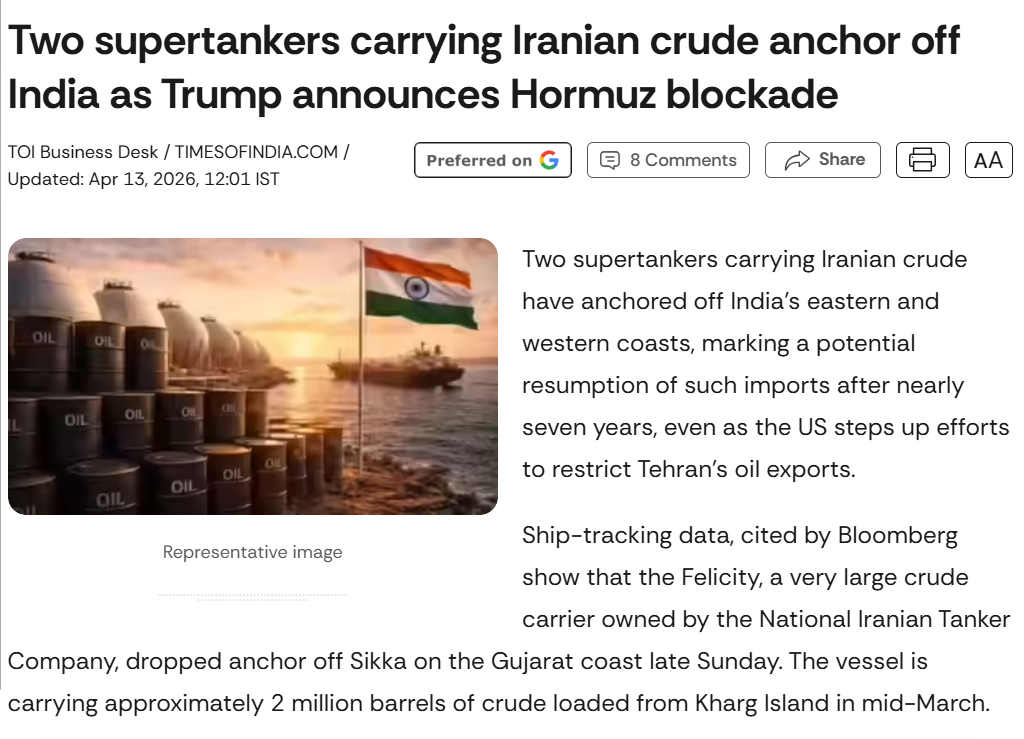
Further, The Times of India reported that Felicity, owned by the National Iranian Tanker Company, anchored off Sikka on April 12 carrying around 2 million barrels of crude loaded from Kharg Island in mid-March. The second tanker, Jaya, also anchored near Paradip around the same time, having departed with a similar volume of crude in late February. While the buyers of these cargoes have not been officially disclosed, Paradip port is primarily used by Indian Oil Corporation, while Sikka port is used by Reliance Industries and Bharat Petroleum Corporation.
Conclusion
The viral claim is false and misleading. Available evidence shows that the Iranian oil tankers are stationed near Indian ports, and there is no confirmation that India refused to unload the cargo or sent the vessels back.

Related Blogs
.webp)
Introduction
The scam involving "drugs in parcels' has resurfaced again with a new face. Cybercriminals impersonating and acting as FedEx, Police and various other authorities and in actuality, they are the perpetrators or bad actors behind the renewed "drugs in parcel" scam, which entails pressuring victims into sending money and divulging private information in order to escape fictitious legal repercussions.
Modus operandi
The modus operandi followed in this scam usually begins with a hacker calling someone on their cell phone posing as FedEx. They say that they are the recipients of a package under their name that includes illegal goods like jewellery, narcotics, or other items. The victim would feel afraid and apprehensive by now. Then there will be a video call with someone else who is posing as a police officer. The victim will be asked to keep the matter confidential while it is being investigated by this "fake officer."
After the call, they would get falsified paperwork from the CBI and RBI stating that an arrest warrant had been issued. Once the victim has fallen entirely under their sway, they would claim that the victim's Aadhaar has been used to carry out the unlawful conduct. They then request that the victim submit their bank account information and Aadhaar data for investigation. Subsequently, the hackers request that the victim transfer funds to a bank account for RBI validation. The victims thus submit money to the hackers believing it to be true for clearing their name.
Recent incidence:
In the most recent instance of a "drug-in-parcel" scam, an IT expert in Pune was defrauded of Rs 27.9 lakh by internet con artists acting as members of the Mumbai police's Cyber Crime Cell. The victim filed the First Information Report (FIR) in this matter at the police station. The victim stated that on November 11, 2023, the complainant received a call from a fraudster posing as a Mumbai police Cyber Crime Cell officer. The scammer falsely claimed to have discovered illegal narcotics in a package addressed to the complainant sent from Mumbai to Taiwan, along with an expired passport and an SBI card. To avoid arrest in a fabricated drug case, the fraudster coerced the complainant into providing bank account information under the guise of "verification." The victim, fearing legal consequences, transferred Rs 27,98,776 in ten online transactions to two separate bank accounts as instructed. Upon realizing the deception, the complainant reported the incident to the police, leading to an investigation.
In another such incident, the victim received an online bogus identity card from the scammers who had phoned him on the phone in October 2023. In an attempt to "clear the case" and issue a "no-objection certificate (NOC)," the fraudster persuaded the victim to wire money to a bank account, claiming to have seized narcotics in a shipment shipped from Mumbai to Thailand under his name. Fraudsters threatened to arrest the victim for mailing the narcotics package if money was not provided.
Furthermore, In August 2023, fraudsters acting as police officers and executives of courier companies defrauded a 25-year-old advertising student of Rs 53 lakh. They extorted money from her under the guise of avoiding legal action, which would include arrest, and informed her that narcotics had been discovered in a package she had delivered to Taiwan. According to the police, callers acting as police officers threatened to arrest the girl and forced her to complete up to 34 transactions totalling Rs 53.63 lakh from her and her mother's bank accounts to different bank accounts.
Measures to protect oneself from such scams
Call Verification:
- Be sure to always confirm the legitimacy of unexpected calls, particularly those purporting to be from law enforcement or delivery services. Make use of official contact information obtained from reliable sources to confirm the information presented.
Confidentiality:
- Use caution while disclosing personal information online or over the phone, particularly Aadhaar and bank account information. In general, legitimate authorities don't ask for private information in this way.
Official Documentation:
- Request official documents via the appropriate means. Make sure that any documents—such as arrest warrants or other government documents—are authentic by getting in touch with the relevant authorities.
No Haste in Transactions:
- Proceed with caution when responding hastily to requests for money or quick fixes. Creating a sense of urgency is a common tactic used by scammers to coerce victims into acting quickly.
Knowledge and Awareness:
- Remain up to date on common fraud schemes and frauds. Keep up with the most recent strategies employed by online fraudsters to prevent falling for fresh scam iterations.
Report Suspicious Activity:
- Notify the local police or other appropriate authorities of any suspicious calls or activities. Reports received in a timely manner can help investigations and shield others from falling for the same fraud.
2fA:
- Enable two-factor authentication (2FA) wherever you can to provide online accounts and transactions an additional degree of protection. This may lessen the chance of unwanted access.
Cybersecurity Software:
- To defend against malware, phishing attempts, and other online risks, install and update reputable antivirus and anti-malware software on a regular basis.
Educate Friends and Family:
- Inform friends and family about typical scams and how to avoid falling victim to fraud. A safer online environment can be achieved through increased collective knowledge.
Be skeptical
- Whenever anything looks strange or too good to be true, it most often is. Trust your instincts. Prior to acting, follow your gut and confirm the information.
By taking these precautions and exercising caution, people may lessen their vulnerability to scams and safeguard their money and personal data from online fraudsters.
Conclusion:
Verifying calls, maintaining secrecy, checking official papers, transacting cautiously, and keeping up to date are all examples of protective measures for protecting ourselves from such scams. Using cybersecurity software, turning on two-factor authentication, and reporting suspicious activity are essential in stopping these types of frauds. Raising awareness and working together are essential to making the internet a safer place and resisting the activities of cybercriminals.
References:
- https://indianexpress.com/article/cities/pune/pune-cybercrime-drug-in-parcel-cyber-scam-it-duping-9058298/#:~:text=In%20August%20this%20year%2C%20a,avoiding%20legal%20action%20including%20arrest.
- https://www.the420.in/pune-it-professional-duped-of-rs-27-9-lakh-in-drug-in-parcel-scam/
- https://www.newindianexpress.com/states/tamil-nadu/2023/oct/16/the-return-of-drugs-in-parcel-scam-2624323.html
- https://timesofindia.indiatimes.com/city/hyderabad/2-techies-fall-prey-to-drug-parcel-scam/articleshow/102786234.cms

Introduction
India’s digital growth journey has been moving at a tremendous pace. According to MeitY’s report, India’s digital economy is expected to rise to US$ 500 billion by 2025, up from US$ 200 billion in 2019. The digitisation drive that we are experiencing is likely to foster and boost a favourable business environment that will attract rapid investment and augment economic growth across sectors. This will, in turn, compel businesses to adopt digital platforms as solutions to meet customer expectations. Due to accelerated digitisation, cyber risks often deter business growth. Cybercrimes are becoming more rampant and complex and the costs associated with such breaches are not only increasing but also becoming more systemic.
Development of the Cyber Insurance Landscape
Digitization of businesses started in the 1980s with the use of mainframes. Personal computers entered the game and further modified the landscape from the 2000s along with LANs, the internet and the dot-com boom of the 2000s. In the late 1990s, cyber-insurance was developed as a risk management tool to ensure information security. Coverage was limited, and clients included SMEs in need of insurance to qualify for tenders, or community banks too small to hedge the risks of their online banking operations. The first cyber insurance policy was written in 1997 through AIG, against hacking as a third-party liability policy.
The current trends in the cyber insurance space are focused on the prevention of cyber risks, which by nature are hard to outline and constantly evolving. The result is that the buyers have limited clarity on the types of cyber risks covered under cyber insurance, and even lesser visibility on the scope and amount of optimum coverage. Unfamiliarity with the claim procedure and resolutions, ambiguous claim thresholds during settlements, and confusion around exclusions and coverage of regulatory fines and penalties under a purchased scheme further discourage potential buyers from seriously investing in cyber insurance products.
Key Factors in Cyber Insurance Evolution and Its Role in Risk Management
The cyber insurance market in India has three key influencing factors, namely the speed of achieving digital maturity, government initiatives to digitise and enforce stringent cyber laws, and the evolving landscape with technology giants and MNCs entering the cyber insurance domain. The latter are the catalyst for intensifying competition in this market.
Advancements in technology in terms of AI, machine learning, big data, robotics, blockchain, augmented and virtual reality, and IoT are expected to reshape the insurance industry and help reach untapped audiences in a more digital-forward manner. With the absence of a standard cyber insurance policy, regulators need to take the following variables into consideration while developing cyber insurance policies: the risk insured against, the scope of the loss covered and the limits/ sub-limits.
Challenges
With the complexity of cyber risks increasing exponentially the challenges to counter the same are growing too which is leading to gaps in the coverage offered for cyber threats. Resultantly, the compliance regulations are dependent on the risks which exist and cyber threat actors adopt new technologies faster and exploit them to their benefit. A lack of historical data and predictability in future cyber risks, the possibility of large overwhelming loss events, uncertainties among market participants about what is specifically covered under such policies, and legal battles over fundamental issues are some of the challenges identified.
Future Outlook/ Recommendations
India's cyber infrastructure requires a multi-faceted approach that involves collaboration between government, industry, and academia should be developed. Some recommendations are:
- Risk assessments should be a general practice and the cyber insurance policies should be simplified, clearing the mismatch between the premium paid and insurance coverage and there should be standard verbosity across cyber policy language.
- Promoting R&D tailored to India focused on education programs that have public-private partnerships and global collaborations to share threat intelligence, best practices, and expertise in critical infrastructure protection.
- Cyber insurance can also be promoted as compliance with the DPDP Act, which would lead to better development of cyber infrastructure and cyber hygiene practices.
- Regular updates to cyber insurance policies to ensure relevance and effectiveness. Insurers could create and offer holistic cyber insurance risk management plans.
Conclusion
According to a report by Deloitte in 2023, the cyber insurance market in India is expected to grow by 27-30 per cent in the coming years and it is currently valued at USD 50-60 million, while maintaining a steady 27-30 per cent CAGR in the past three years. The Indian cyber infrastructure’s nature is challenging, however, it offers opportunities for growth, innovation, and collaboration. A proactive approach, supported by robust policies, advanced technologies, and skilled professionals, will be essential to building a resilient cyber infrastructure capable of withstanding evolving threats.
Reference
- https://www2.deloitte.com/content/dam/Deloitte/nl/Documents/financial-services/deloitte-nl-fsi-demystifying-cyber-insurance-coverage-report.pdf
- https://www.dnaindia.com/business/report-what-s-cyber-liablity-insurance-and-why-you-may-need-it-2136556
- https://economictimes.indiatimes.com/industry/banking/finance/insure/cyber-insurance-gains-momentum-in-india-set-to-witness-exponential-growth-deloitte/articleshow/104189297.cms?from=mdr

Executive Summary:
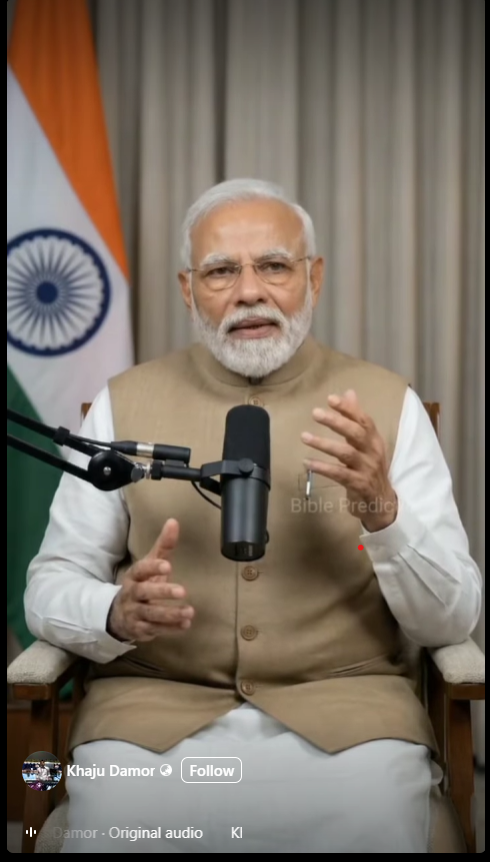
A video of Prime Minister Narendra Modi is going viral across multiple social media platforms. In the clip, PM Modi is purportedly heard praising Christianity and stating that only Jesus Christ can lead people to heaven.Several users are sharing and commenting on the video, believing it to be genuine. The CyberPeace researched the viral claim and found it to be false. The circulating video has been created using artificial intelligence (AI).
Claim:
On January 29, 2026, a Facebook user named ‘Khaju Damor’ posted the viral video of PM Modi. The post gained traction, with many users sharing and commenting on it as if it were authentic. (Links and archived versions provided)
Fact Check:
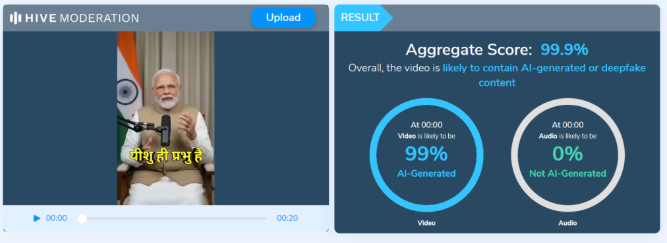
As part of our research , we first closely examined the viral video. Upon careful observation, several inconsistencies were noticed. The Prime Minister’s facial expressions and hand movements appeared unnatural. The lip-sync and overall visual presentation also raised suspicions about the clip being digitally manipulated. To verify this further, we analyzed the video using the AI detection tool Hive Moderation. The tool’s analysis indicated a 99% probability that the video was AI-generated.
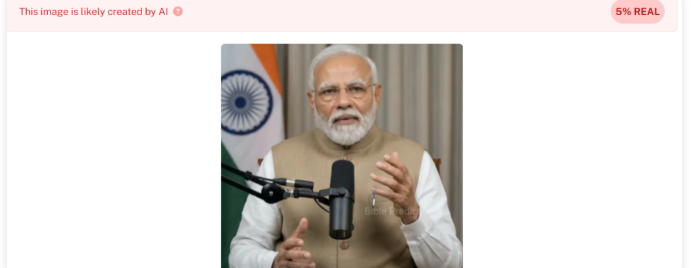
To independently confirm the findings, we also ran the clip through another detection platform, Undetectable.ai. Its analysis likewise indicated a very high likelihood that the video was created using artificial intelligence.
Conclusion:
Our research confirms that the viral video of Prime Minister Narendra Modi praising Christianity and making the alleged statement about heaven is fake. The clip has been generated using AI tools and does not depict a real statement made by the Prime Minister.
