
#FactCheck : Edited video falsely claims Dr. Vikas Divyakirti targeted Narendra Modi
Executive Summary
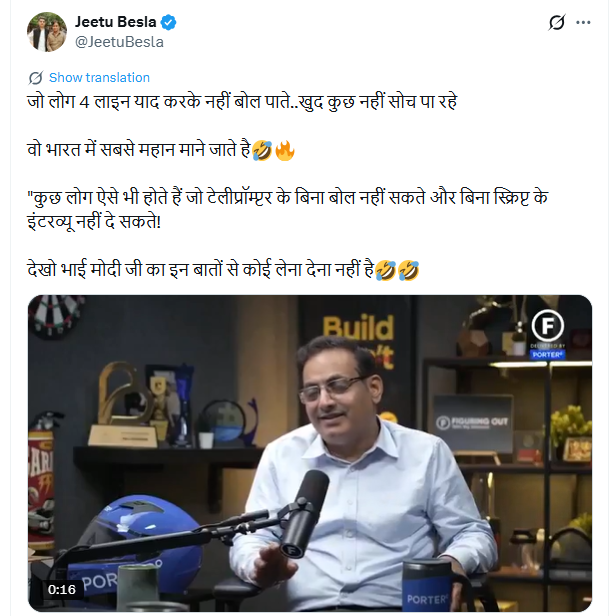
A video circulating on social media shows Dr. Vikas Divyakirti speaking during a podcast, where he is heard saying, “Those who cannot even memorise and speak four sentences are considered the greatest in India.” Several users are sharing the clip claiming that the remark was aimed at Narendra Modi. However, a research by CyberPeace found the claim to be misleading. The research revealed that the viral clip has been edited and shared out of context. In the original video, Divyakirti made the remarks in reference to film stars, not the Prime Minister.
Claim
On Facebook, a user shared the viral clip with an English caption alleging that Divyakirti criticised Modi, saying he cannot speak without a teleprompter or scripted interviews and has built a false image of greatness.

Similarly, another user shared the video on X, suggesting that people who cannot speak without a teleprompter are still considered great in India, indirectly linking the remark to Modi.
Fact Check
To verify the claim, we extracted keyframes from the viral video and conducted a reverse image search using Google Lens. This led us to the original video uploaded on the official YouTube channel of Raj Shamani.

At around the 3:55 mark, the same clip can be seen. During the conversation, Shamani asks whether building a larger-than-life perception actually benefits an individual. Responding to this, Dr. Vikas Divyakirti explains that film stars often have an exaggerated public image. He notes that many of the dialogues they are praised for are not written by them, but by others, and some even rely on teleprompters while speaking. He further adds that there are individuals who cannot even memorise and deliver four sentences or think independently, yet are regarded as great in India. He also mentions that many social media personalities use teleprompters, but audiences remain unaware and assume they possess exceptional knowledge.
Conclusion
The viral claim is misleading. The video has been edited and shared out of context. Dr. Vikas Divyakirti was referring to film stars and social media personalities, not Narendra Modi.

Related Blogs

Modern international trade heavily relies on data transfers for the exchange of digital goods and services. User data travels across multiple jurisdictions and legal regimes, each with different rules for processing it. Since international treaties and standards for data protection are inadequate, states, in an effort to protect their citizens' data, have begun extending their domestic privacy laws beyond their borders. However, this opens a Pandora's box of legal and administrative complexities for both, the data protection authorities and data processors. The former must balance the harmonization of domestic data protection laws with their extraterritorial enforcement, without overreaching into the sovereignty of other states. The latter must comply with the data privacy laws in all states where it collects, stores, and processes data. While the international legal community continues to grapple with these challenges, India can draw valuable lessons to refine the Digital Personal Data Protection Act, 2023 (DPDP) in a way that effectively addresses these complexities.
Why Extraterritorial Application?
Since data moves freely across borders and entities collecting such data from users in multiple states can misuse it or use it to gain an unfair competitive advantage in local markets, data privacy laws carry a clause on their extraterritorial application. Thus, this principle is utilized by states to frame laws that can ensure comprehensive data protection for their citizens, irrespective of the data’s location. The foremost example of this is the European Union’s (EU) General Data Protection Regulation (GDPR), 2016, which applies to any entity that processes the personal data of its citizens, regardless of its location. Recently, India has enacted the DPDP Act of 2023, which includes a clause on extraterritorial application.
The Extraterritorial Approach: GDPR and DPDP Act
The GDPR is considered the toughest data privacy law in the world and sets a global standard in data protection. According to Article 3, its provisions apply not only to data processors within the EU but also to those established outside its territory, if they offer goods and services to and conduct behavioural monitoring of data subjects within the EU. The enforcement of this regulation relies on heavy penalties for non-compliance in the form of fines up to €20 million or 4% of the company’s global turnover, whichever is higher, in case of severe violations. As a result, corporations based in the USA, like Meta and Clearview AI, have been fined over €1.5 billion and €5.5 million respectively, under the GDPR.
Like the GDPR, the DPDP Act extends its jurisdiction to foreign companies dealing with personal data of data principles within Indian territory under section 3(b). It has a similar extraterritorial reach and prescribes a penalty of up to Rs 250 crores in case of breaches. However, the Act or DPDP Rules, 2025, which are currently under deliberation, do not elaborate on an enforcement mechanism through which foreign companies can be held accountable.
Lessons for India’s DPDP on Managing Extraterritorial Application
- Clarity in Definitions: GDPR clearly defines ‘personal data’, covering direct information such as name and identification number, indirect identifiers like location data, and, online identifiers that can be used to identify the physical, physiological, genetic, mental, economic, cultural, or social identity of a natural person. It also prohibits revealing special categories of personal data like religious beliefs and biometric data to protect the fundamental rights and freedoms of the subjects. On the other hand, the DPDP Act/ Rules define ‘personal data’ vaguely, leaving a broad scope for Big Tech and ad-tech firms to bypass obligations.
- International Cooperation: Compliance is complex for companies due to varying data protection laws in different countries. The success of regulatory measures in such a scenario depends on international cooperation for governing cross-border data flows and enforcement. For DPDP to be effective, India will have to foster cooperation frameworks with other nations.
- Adequate Safeguards for Data Transfers: The GDPR regulates data transfers outside the EU via pre-approved legal mechanisms such as standard contractual clauses or binding corporate rules to ensure that the same level of protection applies to EU citizens’ data even when it is processed outside the EU. The DPDP should adopt similar safeguards to ensure that Indian citizens’ data is protected when processed abroad.
- Revised Penalty Structure: The GDPR mandates a penalty structure that must be effective, proportionate, and dissuasive. The supervisory authority in each member state has the power to impose administrative fines as per these principles, up to an upper limit set by the GDPR. On the other hand, the DPDP’s penalty structure is simplistic and will disproportionately impact smaller businesses. It must take into regard factors such as nature, gravity, and duration of the infringement, its consequences, compliance measures taken, etc.
- Governance Structure: The GDPR envisages a multi-tiered governance structure comprising of
- National-level Data Protection Authorities (DPAs) for enforcing national data protection laws and the GDPR,
- European Data Protection Supervisor (EDPS) for monitoring the processing of personal data by EU institutions and bodies,
- European Commission (EC) for developing GDPR legislation
- European Data Protection Board (EDPB) for enabling coordination between the EC, EDPS, and DPAs
In contrast, the Data Protection Board (DPB) under DPDP will be a single, centralized body overseeing compliance and enforcement. Since its members are to be appointed by the Central Government, it raises questions about the Board’s autonomy and ability to apply regulations consistently. Further, its investigative and enforcement capabilities are not well defined.
Conclusion
The protection of the human right to privacy ( under the International Covenant on Civil and Political Rights and the Universal Declaration of Human Rights) in today’s increasingly interconnected digital economy warrants international standard-setting on cross-border data protection. In the meantime, States relying on the extraterritorial application of domestic laws is unavoidable. While India’s DPDP takes measures towards this, they must be refined to ensure clarity regarding implementation mechanisms. They should push for alignment with data protection laws of other States, and account for the complexity of enforcement in cases involving extraterritorial jurisdiction. As India sets out to position itself as a global digital leader, a well-crafted extraterritorial framework under the DPDP Act will be essential to promote international trust in India’s data governance regime.
Sources
- https://gdpr-info.eu/art-83-gdpr/
- https://gdpr-info.eu/recitals/no-150/
- https://gdpr-info.eu/recitals/no-51/
- https://www.meity.gov.in/static/uploads/2024/06/2bf1f0e9f04e6fb4f8fef35e82c42aa5.pdf
- https://www.eqs.com/compliance-blog/biggest-gdpr-fines/#:~:text=ease%20the%20burden.-,At%20a%20glance,In%20summary
- https://gdpr-info.eu/art-3-gdpr/
- https://www.legal500.com/developments/thought-leadership/gdpr-v-indias-dpdpa-key-differences-and-compliance-implications/#:~:text=Both%20laws%20cover%20'personal%20data,of%20personal%20data%20as%20sensitive.

Executive Summary
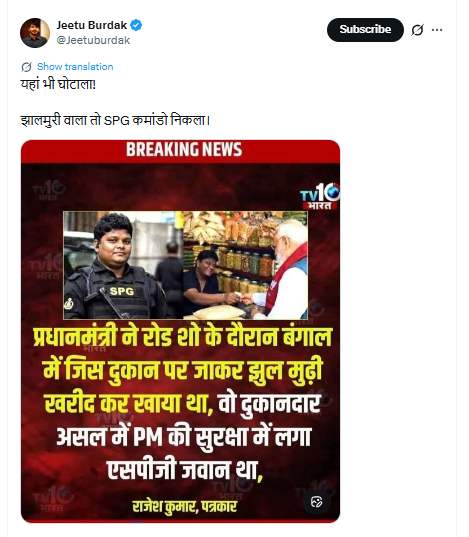
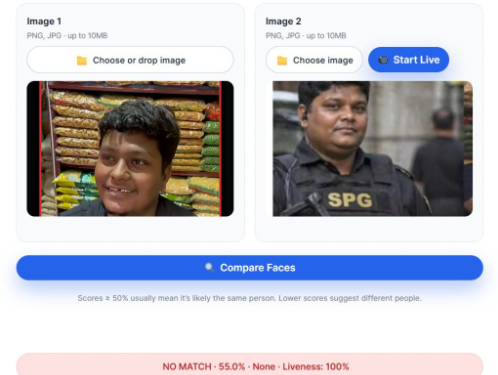
A collage of two images circulating on social media is falsely claiming that the street vendor who served jhalmuri to Prime Minister Narendra Modi during an election campaign in Jhargram was actually a personnel from the Special Protection Group (SPG). Research by the CyberPeace Research Wing found the claim to be false and misleading, indicating that it is being shared as part of election-related misinformation. The vendor and the SPG personnel seen in the viral collage are two different individuals.
Claim
An X (formerly Twitter) user, “@Jeetuburdak,” shared the viral collage on April 21, 2026, with the caption: “Another scam! The jhalmuri seller turned out to be an SPG commando.” The post quickly gained traction online.
Fact Check
A close examination of the two images used in the collage shows clear visual differences between the individuals. The person seen in SPG uniform does not match the street vendor who served food to the prime minister. Reverse image searches were conducted using multiple tools to trace the origin of the images. While no verifiable source was found linking the SPG personnel’s image to the vendor, several credible reports and videos featured the actual jhalmuri seller from the campaign event.
- https://x.com/ANI/status/2045859146508177911?s=20
- https://news24online.com/cities/kolkata/who-is-the-man-that-served-jhalmuri-to-pm-modi-know-his-daily-income-and-what-he-talked-about-with-pm/811123/
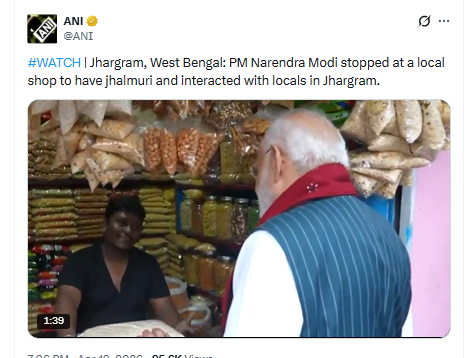
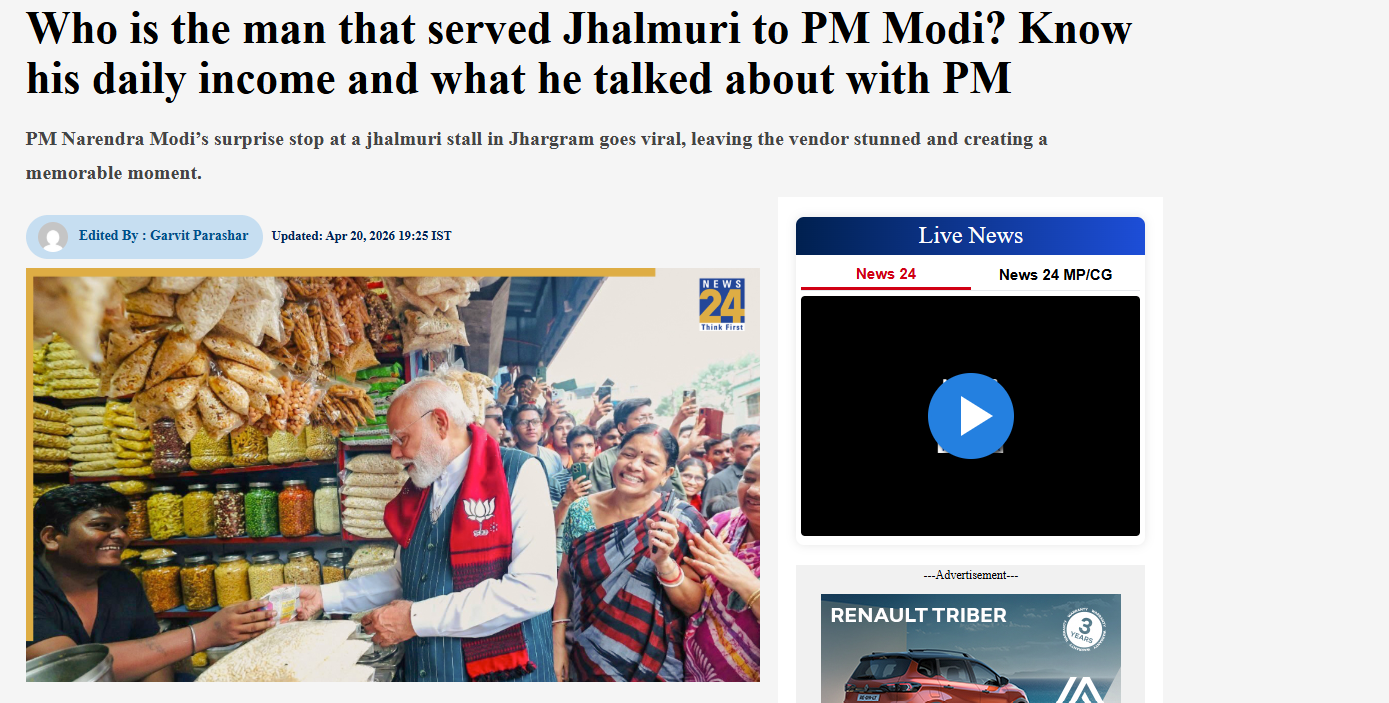
According to media reports, the prime minister briefly stopped at a roadside stall during the campaign in Jhargram and interacted with the vendor while enjoying jhalmuri. The vendor was later interviewed by multiple outlets, further confirming his identity as a local seller. Additionally, technical facial comparison analysis using online tools also indicated that the two individuals in the viral collage are not the same person.
Conclusion
The claim that the jhalmuri vendor was an SPG commando is false and misleading. The viral collage shows two different individuals, and there is no evidence to support the allegation.

Introduction
The Ministry of Electronics and Information Technology (MeitY) recently issued the “Email Policy of Government of India, 2024.” It is an updated email policy for central government employees, requiring the exclusive use of official government emails managed by the National Informatics Centre (NIC) for public duties. The policy replaces 2015 guidelines and prohibits government employees, contractors, and consultants from using their official email addresses on social media or other websites unless authorised for official functions. The policy aims to reinforce cybersecurity measures and protocols, maintain secure communications, and ensure compliance across departments. It is not legally binding, but its gazette notification ensures compliance and maintains cyber resilience in communications. The updated policy is also aligned with the newly enacted Digital Personal Data Protection Act, 2023.
Brief Highlights of Email Policy of Government of India, 2024
- The Email Policy of the Government of India, 2024 is divided into three parts namely, Part I: Introduction, Part II: Terms of Use, Part III: Functions, duties and Responsibilities, and with an annexe attached to it defining the meaning of certain organisation types in relation to this policy.
- The policy direct to not use NICeMail address for registering on any social media or other websites or mobile applications, save for the performance of official duties or with due authorisation from the authority competent.
- Under this new policy, “core use organisations” (central government departments and other government-controlled entities that do not provide goods or services on commercial terms) and its users shall use only NICeMail for official purposes.
- However, where the Core Use Organisation has an office or establishment outside India, to ensure availability of local communication channels under exigent circumstances may use alternative email services hosted outside India with all due approval.
- Core Use Organisations, including those dealing with national security, have their own independent email servers and can continue operating their independent email servers provided the servers are hosted in India. They should also consider migrating their email services to NICeMail Services for security and uniform policy enforcement.
- The policy also requires departments that currently use @gov.in or @nic.in to instead migrate to @departmentname.gov.in mail domains so that information sanctity and integrity can be maintained when officials are transferred from one department/ministry to another, and so that the ministry/department doesn’t lose access to the official communication. For this, the department or ministry in question must register the domain name with NIC. For instance, MeitY has registered the mail domain @meity.gov.in. The policy gives government departments six months time period complete this migration.
- The policy also makes distinction between (1) Organisation-linked email addresses and (2) Service-linked email addresses. The policy in respect of “organisation-linked email addresses” is laid down in paragraphs 5.3.2(a) and 5.4 to 5.6.3. And the policy in respect of “service-linked email addresses” is laid down in paragraphs 5.3.2(b) and 5.7 to 5.7.2 under the official document of said policy.
- Further, the new policy includes specific directives on separating the email addresses of regular government employees from those of contractors or consultants to improve operational clarity.
CyberPeace Policy Outlook
The revised Email Policy of the Government of India reflects the government’s proactive response to countering the evolving cybersecurity challenges and aims to maintain cyber resilience across the government department’s email communications. The policy represents a significant step towards securing inter government and intra-government communications. We as a cybersecurity expert organisation emphasise the importance of protecting sensitive data against cyber threats, particularly in a world increasingly targeted by sophisticated phishing and malware attacks, and we advocate for safe and secure online communication and information exchange. Email communications hold sensitive information and therefore require robust policies and mechanisms in place to safeguard the communications and ensure that sensitive data is shielded through regulated and secure email usage with technical capabilities for safe use. The proactive step taken by MeitY is commendable and aligned with securing governmental communication channels.
References:
- https://www.meity.gov.in/writereaddata/files/Email-policy-30-10-2024.pdf-(Official document for Email Policy of Government of India, 2024.
- https://www.hindustantimes.com/india-news/dont-use-govt-email-ids-for-social-media-central-govt-policy-for-employees-101730312997936.html#:~:text=Government%20employees%20must%20not%20use,email%20policy%20issued%20on%20Wednesday
- https://bwpeople.in/article/new-email-policy-issued-for-central-govt-employees-to-strengthen-cybersecurity-measures-537805
- https://www.thehindu.com/news/national/centre-notifies-email-policy-for-ministries-central-departments/article68815537.ece
