
#FactCheck-India Passport Ranking Claim Comparing 2014 and 2026 Rankings Is Misleading
Executive Summary
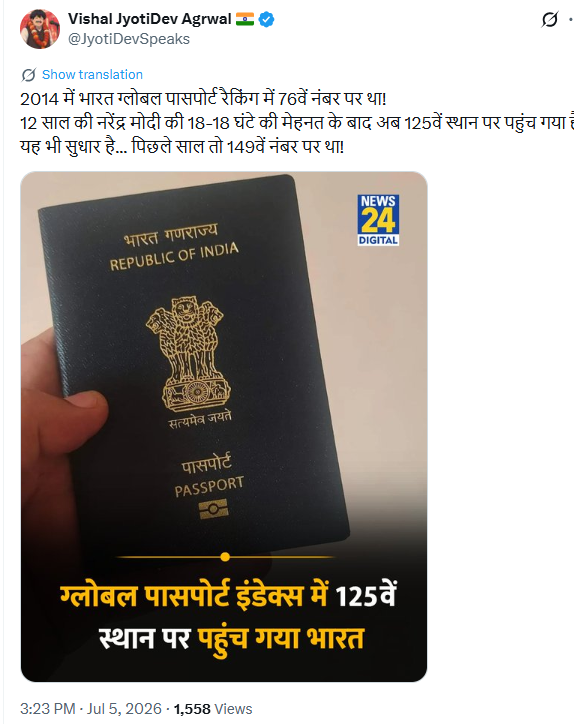
A claim is going viral on social media stating that India’s passport ranking has declined from the 76th position in 2014 to the 125th position this year. CyberPeace Research Wing’s research found the claim to be misleading. The two rankings mentioned in the viral claim were issued by different agencies. The 76th rank in 2014 was given by the Henley Passport Index, while the 125th rank this year was assigned by the Global Passport Index.
Claim
The viral claim states that India’s passport ranking, which was 76th in 2014, has fallen to the 125th position this year. The claim was shared on X (formerly Twitter) with a Hindi caption.
https://x.com/JyotiDevSpeaks/status/2073706900437508468
FactCheck
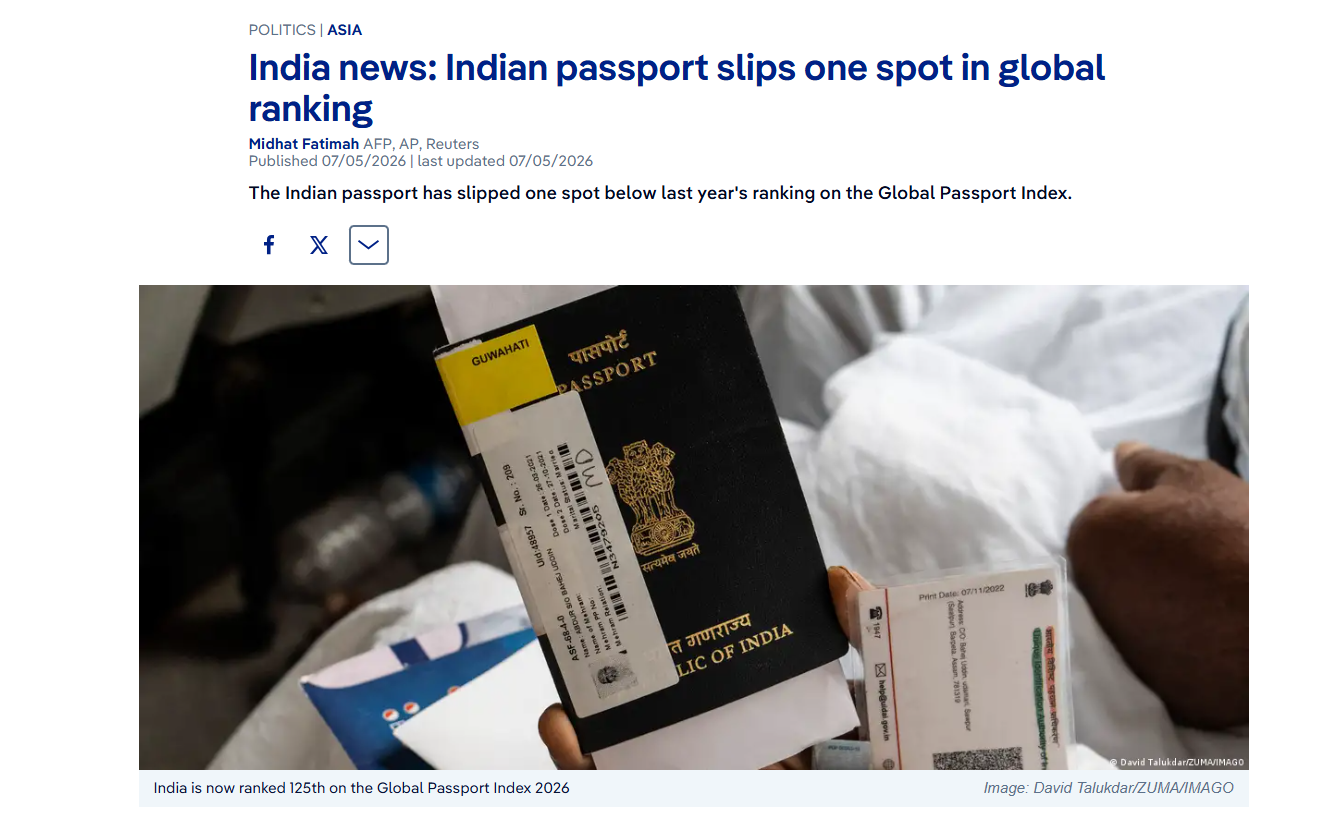
To verify the claim, we first searched relevant news reports and found that India’s passport has been ranked 125th in the latest Global Passport Index.
https://www.dw.com/en/india-news-indian-passport-slips-one-spot-in-global-ranking/live-77836287
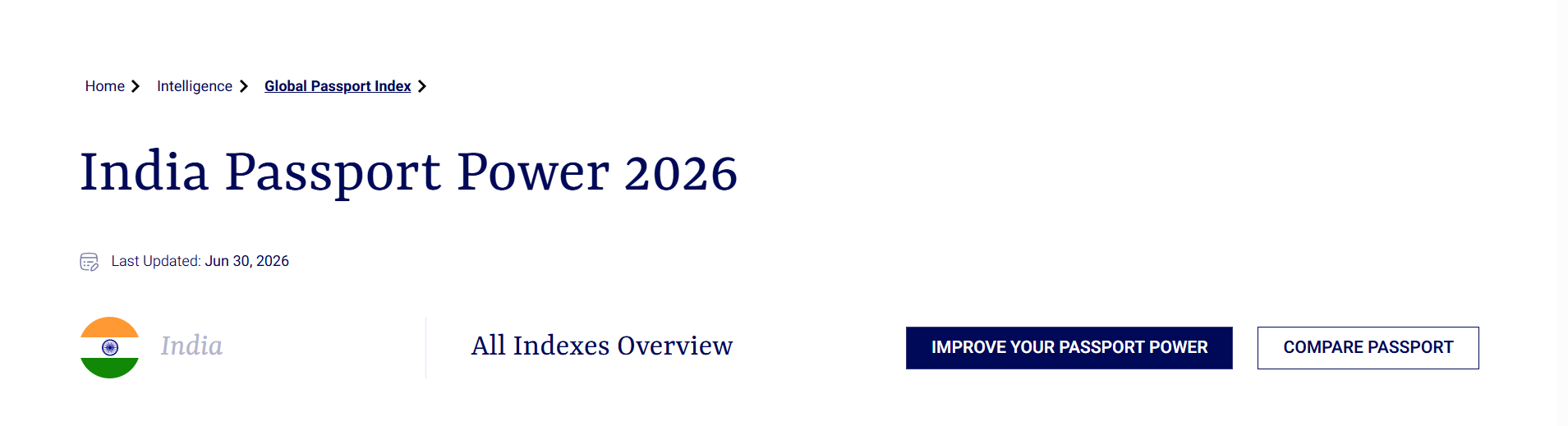
We then checked the official website of Global Citizen Solutions, the organization that publishes the Global Passport Index. The data available on the website confirms that India’s passport has been placed at the 125th position in the latest ranking.
https://www.globalcitizensolutions.com/passport-index/india/
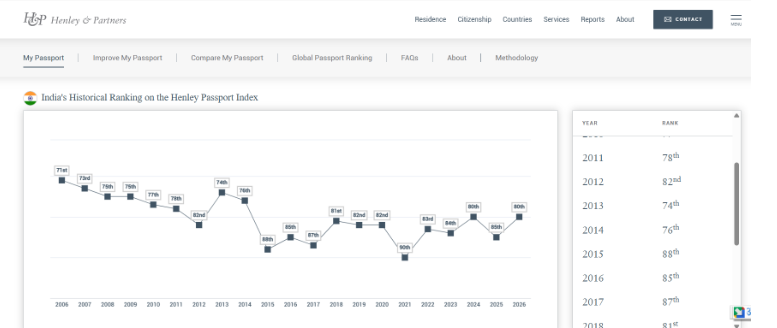
Further, we investigated which organization had ranked the Indian passport 76th in 2014. The search revealed that the ranking was issued by the Henley Passport Index, published by Henley & Partners. According to the information available on the Henley Global website, India’s passport was ranked 76th in 2014, while it stands at the 80th position in the 2026 Henley Passport Index. The rankings assigned to the Indian passport from 2006 to 2026 can be seen in the image below.
https://www.henleyglobal.com/passport-index
Conclusion
Our research found that the claim stating India’s passport ranking declined from 76th position to 125th position is misleading. The two rankings cited in the viral claim were issued by different organizations and cannot be compared directly. The 2014 ranking came from the Henley Passport Index, while the 125th position refers to the Global Passport Index.

Related Blogs
.webp)
Introduction
We were all stunned and taken aback when multiple photos of streets in the U.S. surfaced with heavily drugged individuals loosely sitting on the streets, victims of a systematically led drug operation that has recently become a target of the Trump-led “tariff” war, which he terms as a war on drug cartels. The drug is a synthetic opioid, fentanyl, which is highly powerful and addictive. The menace of this drug is found in a country that has Wall Street and the largest and most powerful economy globally. The serious implications of drug abuse are not about a certain economy; instead, it has huge costs to society in general. The estimated cost of substance misuse to society is more than $820 billion each year and is expected to continue rising.
On June 26, the International Day against Drug Abuse and Illicit Trafficking is observed globally. However, this war is waged daily for millions of people, not on streets or borders, but in bloodstreams, behind locked doors, and inside broken homes. Drug abuse is no longer a health crisis; it is a developmental crisis. The United Nations Office on Drugs and Crime has launched a campaign against this organised crime that says, “Break the Cycle’ attributing to the fact that de-addiction is hard for individuals.
The Evolving Drug Crisis: From Alleyways to Algorithms
The menace of Drug abuse and illicit trafficking has also taken strides in advancement, and what was once considered a street-side vice has made its way online in a faceless, encrypted, and algorithmically optimised sense. The online drug cartels operate in the shadows and often hide in plain sight, taking advantage of the privacy designed to benefit individuals. With the help of darknet markets, cryptocurrency, and anonymised logistics, the drug trade has transformed into a transnational, tech-enabled industry on a global scale. In an operation led by the U.S. Department of Justice’s Joint Criminal Opiod and Darknet Enforcement (JCODE) and related to Operation RapTor, an LA apartment was only to find an organised business centre that operated as a hub of one of the most prolific methamphetamine and cocaine distributors in the market. Aaron Pinder, Unit Chief of the FBI Hi-Tech Organised Crime Unit, said in his interview, “The darknet vendors that we investigate, they truly operate on a global scale.” On January 11, 2025, during the Regional Conference on “Drug Trafficking and National Security,” it was acknowledged how cryptocurrency, the dark web, online marketplaces, and drones have made drug trafficking a faceless crime. Reportedly, there has been a seven-fold increase in the drugs seized from 2004-14 to 2014-24.
India’s Response: Bridging Borders, Policing Bytes
India has been historically vulnerable due to its geostrategic placement between the Golden Crescent (Afghanistan-Iran-Pakistan) and Golden Triangle (Myanmar-Laos-Thailand), and confronts a fresh danger from “click-to-consume’ narcotics. Although India has always adopted a highly sensitised approach, it holds an optimistic future outlook for the youth. Last year, to commemorate the occasion of International Day against Drug Abuse and Illicit Trafficking, the Department of Social Justice & Empowerment organised a programme to engage individuals for the cause. The Indian authorities are often seen coming down heavily on the drug peddlers and cartels, and to aid the cause, the Home Minister Amit Shah inaugurated the new office complex of the NCB’s Bhopal zonal unit and extension of the MANAS-2 helpline to all 36 states and UTs. The primary objectives of this step are to evaluate the effectiveness of the Narcotics Coordination Mechanism (NCORD), assess the progress of states in fighting drug trafficking, and share real-time information from the National Narcotics Helpline ‘MANAS’ portal with the Anti-Narcotics Task Force (ANTF) of states and UTs.
The United Nation’s War on Narcotics: From Treaties to Technology
The United Nations Office on Drugs and Crime (UNODC) is leading the international response. It offers vital data, early warning systems, and technical support to the states fighting the drug problem. The UNODC incorporates cooperation in cross-border intelligence, overseeing the darknet activities, encouraging the treatment and harm reduction, and using anti-money laundering mechanisms to stop financial flows. India has always pledged its support to the UN led activities, and as per reports dated 26th March, 2025, India chaired the prestigious UN-backed Commission on Narcotic Drugs (CND) meeting held in vienna, wherein India highlighted the importance of opioids for medical purposes as well as the nation’s notable advancements in the field.
Resolution on June 26: From Commemoration to Commitment
Let June 26 be more than a date on the calendar- let it echo as a call to action, a day when awareness transforms into action, and resolve becomes resistance. On this day, CyberPeace resolves the following:
- To treat addicts as victims rather than criminals and to pitch for reforms to provide access to reasonably priced, stigma-free rehabilitation.
- To integrate anti-drug awareness into digital literacy initiatives and school curricula in order to teach frequently and early.
- To demand responsibility and accountability from online marketplaces and delivery services that unwittingly aid traffickers
- To tackle the demand side through employment, mental health services, and social protection, particularly for at-risk youth.
References
- https://www.gatewayfoundation.org/blog/cost-of-drug-addiction/#:~:text=The%20estimated%20cost%20for%20substance,Alcohol%3A%20%24249%20billion
- https://www.unodc.org/unodc/en/drugs/index-new.html
- https://www.fbi.gov/news/stories/global-operation-targets-darknet-drug-trafficking
- https://www.thehindu.com/news/national/dark-web-crypto-drones-emerge-as-challenges-in-fight-against-drug-trafficking-amit-shah/article69088383.ece
- https://www.pib.gov.in/PressReleaseIframePage.aspx?PRID=2028704
- https://www.newindianexpress.com/nation/2025/Mar/26/in-a-first-india-chairs-un-forum-on-narcotics-pledges-to-improve-access-to-pain-relief-and-palliative-care

Introduction
On April 30, 2025, the Supreme Court of India delivered a landmark judgment that cast a sharp light on one of the most overlooked yet pressing issues in modern governance—digital inequity. In a country that has a staggering 900 million Internet users, the ruling highlights a disheartening reality, a paradox that brings the “digital divide” to centre stage. While India may be the world’s second-largest online market, a significant segment of its population remains digitally disenfranchised. The judgment, delivered in response to two interconnected petitions, underscored that access to the internet is no longer a luxury but a lifeline integral to exercising fundamental rights. The court pointed out in clear terms that the government must build a digital ecosystem that is inclusive and accessible to all and attributed the right to digital access as an intrinsic part of the right to life and liberty under Article 21 as enshrined under the Indian Constitution.
Understanding the Context: What Prompted the Petitions?
The judgment springs out of two writ petitions, which sought instructions or guidelines for people with blindness or limited vision and acid attack survivors, respectively, to conduct digital Know Your Customer (KYC)/e-KYC/video KYC mandated by RBI’s KYC Master Directions, 2016, which were reserved for judgment on January 28. The court delivered the judgment on April 30, 2025, emphasising the fact that true inclusion in this digital era is confounded in an inclusive digital infrastructure, and it must provide reasonable accommodation to those who face impediments due to any disability or disfigurement.
In consonance with its view, it laid down various guidelines that ensure that all persons with disabilities or acid attack survivors are treated even when digital processes are involved in accordance with the provisions of the Right of Persons with Disabilities Act, 2016 (hereinafter referred to as “RPwD Act”)
Another major observation made by the Honourable SC judges is that the mode of facilitation of government services is through digital platforms, i.e., e-governance, and access to all these welfare schemes is the right of every citizen, irrespective of the fact that they suffer from any disability. The failure of the provisioning of e-governance of these facilities to these individuals is a gross failure of the objectives of these schemes.
Key Observations and Directives
The court directed the government to release fresh guidelines that establish alternative methods to conduct digital KYC/e-KYC for all persons who suffer any impairment, low vision, or disfigurement with greater sensitivity, particularly for acid-attack survivors. The court made its intention very clear that the right to digital access is intrinsic to the right to life and liberty. All the tasks that are included within the ambit of digital KYC, such as pen-on-paper signatures, screen signatures, and the brief window for OTP entry, create an inaccessible and exclusionary framework, violating not just the dignity but the legal rights granted protection under the RPwD Act, 2016. The ruling directs a fundamental reimagining of digital governance through the lens of inclusion, equality, and dignity.
Conclusion
The court is not mincing its words when it declares digital accessibility as a constitutional imperative; it has made it clear that bridging the digital divide is no longer optional but a legal duty. The decision marks the new beginning and a propeller of digital transformation, and a delightful amalgamation of digital access and the rights of people. The effect of this judgment will not be restricted to one class of people. Still, it will cater to all those individuals who face these obstacles on a daily basis due to the exclusionary nature of digital platforms.
References

The World Wide Web was created as a portal for communication, to connect people from far away, and while it started with electronic mail, mail moved to instant messaging, which let people have conversations and interact with each other from afar in real-time. But now, the new paradigm is the Internet of Things and how machines can communicate with one another. Now one can use a wearable gadget that can unlock the front door upon arrival at home and can message the air conditioner so that it switches on. This is IoT.
WHAT EXACTLY IS IoT?
The term ‘Internet of Things’ was coined in 1999 by Kevin Ashton, a computer scientist who put Radio Frequency Identification (RFID) chips on products in order to track them in the supply chain, while he worked at Proctor & Gamble (P&G). And after the launch of the iPhone in 2007, there were already more connected devices than people on the planet.
Fast forward to today and we live in a more connected world than ever. So much so that even our handheld devices and household appliances can now connect and communicate through a vast network that has been built so that data can be transferred and received between devices. There are currently more IoT devices than users in the world and according to the WEF’s report on State of the Connected World, by 2025 there will be more than 40 billion such devices that will record data so it can be analyzed.
IoT finds use in many parts of our lives. It has helped businesses streamline their operations, reduce costs, and improve productivity. IoT also helped during the Covid-19 pandemic, with devices that could help with contact tracing and wearables that could be used for health monitoring. All of these devices are able to gather, store and share data so that it can be analyzed. The information is gathered according to rules set by the people who build these systems.
APPLICATION OF IoT
IoT is used by both consumers and the industry.
Some of the widely used examples of CIoT (Consumer IoT) are wearables like health and fitness trackers, smart rings with near-field communication (NFC), and smartwatches. Smartwatches gather a lot of personal data. Smart clothing, with sensors on it, can monitor the wearer’s vital signs. There are even smart jewelry, which can monitor sleeping patterns and also stress levels.
With the advent of virtual and augmented reality, the gaming industry can now make the experience even more immersive and engrossing. Smart glasses and headsets are used, along with armbands fitted with sensors that can detect the movement of arms and replicate the movement in the game.
At home, there are smart TVs, security cameras, smart bulbs, home control devices, and other IoT-enabled ‘smart’ appliances like coffee makers, that can be turned on through an app, or at a particular time in the morning so that it acts as an alarm. There are also voice-command assistants like Alexa and Siri, and these work with software written by manufacturers that can understand simple instructions.
Industrial IoT (IIoT) mainly uses connected machines for the purposes of synchronization, efficiency, and cost-cutting. For example, smart factories gather and analyze data as the work is being done. Sensors are also used in agriculture to check soil moisture levels, and these then automatically run the irrigation system without the need for human intervention.
Statistics
- The IoT device market is poised to reach $1.4 trillion by 2027, according to Fortune Business Insight.
- The number of cellular IoT connections is expected to reach 3.5 billion by 2023. (Forbes)
- The amount of data generated by IoT devices is expected to reach 73.1 ZB (zettabytes) by 2025.
- 94% of retailers agree that the benefits of implementing IoT outweigh the risk.
- 55% of companies believe that 3rd party IoT providers should have to comply with IoT security and privacy regulations.
- 53% of all users acknowledge that wearable devices will be vulnerable to data breaches, viruses,
- Companies could invest up to 15 trillion dollars in IoT by 2025 (Gigabit)
CONCERNS AND SOLUTIONS
- Two of the biggest concerns with IoT devices are the privacy of users and the devices being secure in order to prevent attacks by bad actors. This makes knowledge of how these things work absolutely imperative.
- It is worth noting that these devices all work with a central hub, like a smartphone. This means that it pairs with the smartphone through an app and acts as a gateway, which could compromise the smartphone as well if a hacker were to target that IoT device.
- With technology like smart television sets that have cameras and microphones, the major concern is that hackers could hack and take over the functioning of the television as these are not adequately secured by the manufacturer.
- A hacker could control the camera and cyberstalk the victim, and therefore it is very important to become familiar with the features of a device and ensure that it is well protected from any unauthorized usage. Even simple things, like keeping the camera covered when it is not being used.
- There is also the concern that since IoT devices gather and share data without human intervention, they could be transmitting data that the user does not want to share. This is true of health trackers. Users who wear heart and blood pressure monitors have their data sent to the insurance company, who may then decide to raise the premium on their life insurance based on the data they get.
- IoT devices often keep functioning as normal even if they have been compromised. Most devices do not log an attack or alert the user, and changes like higher power or bandwidth usage go unnoticed after the attack. It is therefore very important to make sure the device is properly protected.
- It is also important to keep the software of the device updated as vulnerabilities are found in the code and fixes are provided by the manufacturer. Some IoT devices, however, lack the capability to be patched and are therefore permanently ‘at risk’.
CONCLUSION
Humanity inhabits this world that is made up of all these nodes that talk to each other and get things done. Users can harmonize their devices so that everything runs like a tandem bike – completely in sync with all other parts. But while we make use of all the benefits, it is also very important that one understands what they are using, how it is functioning, and how one can tackle issues should they come up. This is also important to understand because once people get used to IoT, it will be that much more difficult to give up the comfort and ease that these systems provide, and therefore it would make more sense to be prepared for any eventuality. A lot of times, good and sensible usage alone can keep devices safe and services intact. But users should be aware of any issues because forewarned is forearmed.
