
#FactCheck -AI-Generated Image Falsely Linked to Kotdwar Shop Controversy
Executive Summary
A dispute had recently emerged in Kotdwar, Uttarakhand, over the name of a shop. During the controversy, a local youth, Deepak Kumar, came forward in support of the shopkeeper. The incident subsequently became a subject of discussion on social media, with users expressing varied reactions. Meanwhile, a photo began circulating on social media showing a burqa-clad woman presenting a bouquet to Deepak Kumar. The image is being shared with the claim that All India Majlis-e-Ittehadul Muslimeen (AIMIM)’s women’s president, Rubina, welcomed “Mohammad Deepak Kumar” by presenting him with a bouquet. However, research conducted by the CyberPeace found the viral claim to be false. The research revealed that users are sharing an AI-generated image with a misleading claim.
Claim:
On social media platform Instagram, a user shared the viral image claiming that AIMIM’s women’s president Rubina welcomed “Mohammad Deepak Kumar” by presenting him with a bouquet. The link to the post, its archived version, and a screenshot are provided below.
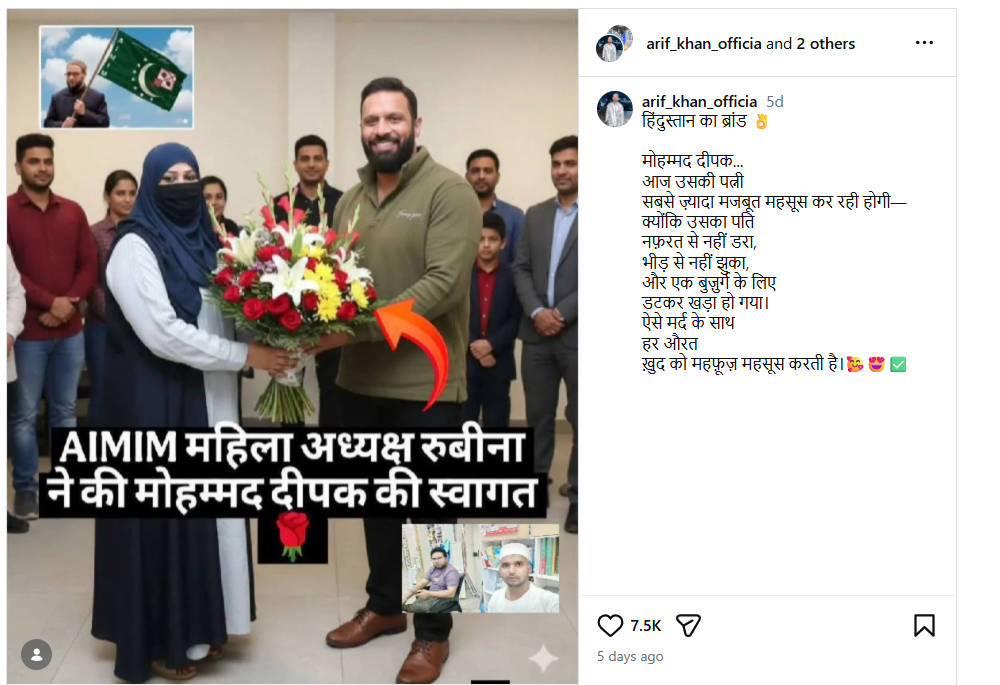
Fact Check:
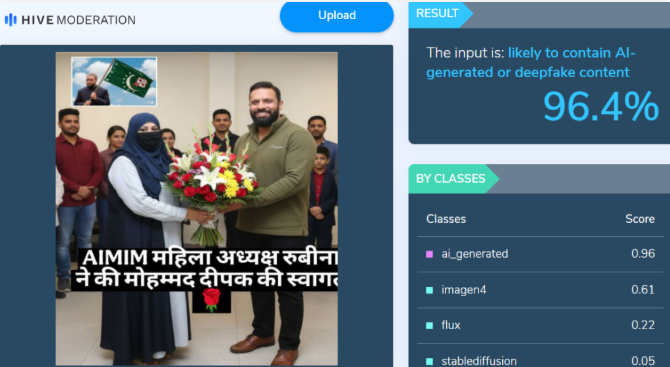
Upon closely examining the viral image, certain inconsistencies raised suspicion that it could be AI-generated. To verify its authenticity, the image was analysed using the AI detection tool Hive Moderation, which indicated a 96 percent probability that the image was AI-generated.
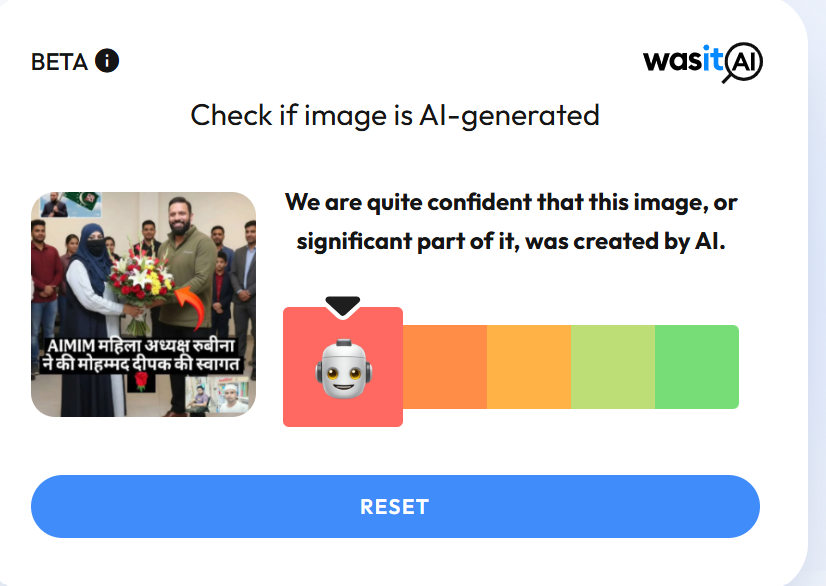
In the next stage of the research , the image was also analysed using another AI detection tool, Wasit AI, which likewise identified the image as AI-generated.
Conclusion
The research establishes that users are circulating an AI-generated image with a misleading claim linking it to the Kotdwar controversy.

Related Blogs
.webp)
Introduction
Picture a pickup truck moving at around 30 kilometres an hour down a straight country road outside Canberra. A journalist is driving it. Somewhere nearby, a researcher sits with a laptop, and without touching the vehicle, he switches the headlights off while it is still moving, in the dark, turns them back on, activates the wipers at full speed, sprays the windscreen washer, and plays sound through the cabin speakers. That scene, broadcast in September 2026 as part of an ABC Four Corners investigation into connected car security, is the starting point for a conversation that extends well beyond the one vehicle involved. (It was a commissioned cybersecurity demonstration, authorised and arranged by ABC's Four Corners as part of their journalistic investigation titled "Asleep at the Wheel.").
What the test actually found
The vehicle at the centre of the investigation was a BYD Shark 6, a plug-in hybrid pickup, which ABC's Four Corners programme provided to automotive cybersecurity researcher Dan Hreszczuk, co-founder of Canberra based Fortify Labs, for a two week authorised assessment. Hreszczuk later described the access point he found in notably simple terms: it did not require a password at all.
Over the course of the test, Hreszczuk demonstrated remote interaction with the vehicle's headlights, windscreen wipers, door locks, cabin speakers and infotainment display. He also tracked the vehicle's real time location and accessed its cabin microphone, which raised concerns beyond vehicle control and into personal surveillance, since a compromised in car microphone can expose private conversations rather than just dashboard functions. It is worth being precise about what the test did not reach. Hreszczuk said he could not access the brakes or the vehicle's cameras, describing those systems as well protected, and the demonstration did not amount to complete remote control of the vehicle.
Following the broadcast, BYD ran its own internal investigation and confirmed a software defect in the Shark 6's infotainment system. The company's engineers reproduced the access path and traced it to Android Debug Bridge, a standard Android development tool that is meant to be disabled in production vehicles but had been left reachable through the defect, alongside a separate route through the vehicle's CAN bus network. BYD has said it will issue an over the air software update to close the gap. Fortify Labs, for its part, stated its objective had been to simulate the kind of remote access a vehicle manufacturer itself typically holds over a connected car, and to demonstrate how that same level of access could be misused if it fell into the wrong hands.
This context matters because it distinguishes a controlled, authorised research exercise, conducted over two weeks with extended physical access to a single vehicle, from an active criminal compromise. No malware was involved, and no evidence has emerged of this technique being used against vehicles outside the test. The finding is nonetheless significant precisely because it shows what becomes possible once a single weak point in a vehicle's software stack is identified and deliberately explored.
The questions this raises, beyond one vehicle
The useful questions are structural ones. How is authentication actually enforced across every vehicle facing service, not just the ones a manufacturer assumes a researcher might look at? Are a vehicle's internal networks and external facing services properly segmented, so that compromising an infotainment system does not create an unobstructed path toward a vehicle's core control units? Are commands subject to strong authorisation and validation at every layer, rather than relying on obscurity or an assumption that a particular access route would be too obscure to find? Is the principle of least privilege consistently applied, so that a development tool left active in a production vehicle, as appears to have happened here, does not carry the same level of access a factory engineer would have? How are unusual remote behaviours actually detected and investigated in real time, rather than discovered after the fact through an external test? And how are vulnerabilities tracked and patched across a vehicle's entire operational lifecycle, given that a car, unlike a phone, is expected to remain in active use for well over a decade after it leaves the factory floor.
A rulebook already exists. The gap is enforcement, not ignorance
None of this had to be worked out from scratch after the Four Corners broadcast. The industry has had a binding answer to most of these questions sitting on the books since 2021, when the World Forum for Harmonization of Vehicle Regulations adopted UN Regulation No. 155, known in the industry simply as R155. It requires any manufacturer seeking vehicle type approval to run a certified Cybersecurity Management System covering the car's entire life, from the drawing board through production and all the way to the vehicle still being driven a decade later, and to pass a dedicated cybersecurity assessment before that vehicle type can legally go on sale. Since July 2024 the rule has applied not just to new vehicle designs but to every new vehicle rolling off the line, across more than sixty countries that are party to the underlying 1958 UNECE agreement, a list that includes the European Union, Japan, South Korea, and Australia itself.
That last detail is where the picture gets genuinely interesting, and where a simple story stops being quite so simple. Australia sits among the countries that have signed on to the UNECE framework R155 belongs to, yet coverage of the Four Corners investigation reported something that sounds contradictory at first glance: that Australia has no minimum cybersecurity standard actually governing cars sold in the country. Both things can be true at once. Being a party to the 1958 Agreement establishes that a country participates in the broader regulatory architecture; it does not automatically mean every regulation born out of that architecture has been separately adopted into domestic law and is being actively enforced at the point of sale. R155's own companion standard, ISO/SAE 21434, is the detailed engineering playbook manufacturers actually use to meet the regulation's requirements, walking through how to assess threats, design around them, and keep monitoring for new ones long after a vehicle has left the factory. A framework that comprehensive existing on paper is only as useful as a given market's willingness to actually require manufacturers to follow it before a car reaches a driveway, and that gap between a regulation existing globally and a regulation being enforced locally is arguably the more unsettling finding buried inside this story than the hack itself.
The broader lesson
The real takeaway from this test has very little to do with the particular badge on the vehicle involved. It is a demonstration of what happens when any one interface in a complex, connected system is left weaker than the rest of the architecture around it. As vehicles continue absorbing more software, more connectivity and more remote functionality, security boundaries cannot be treated as a feature added once at launch. They need to be designed deliberately, enforced consistently, and monitored continuously across the entire lifecycle of the vehicle and the ecosystem of backend services it depends on, because the cost of getting that wrong is no longer confined to a screen or a server. It now extends to the physical vehicle itself, and the people inside it.
References
- https://www.pakwheels.com/blog/byd-shark-6-hacked-during-cybersecurity-test-in-australia/
- https://securityaffairs.com/199460/hacking/a-byd-shark-6-hack-shows-the-risks-of-connected-cars.html
- https://autotalk.co.nz/byd-confirms-shark-6-software-defect-after-four-corners-hack-ota-fix-coming/
- https://www.carexpert.com.au/car-news/byds-own-shark-6-hacking-investigation-reveals-software-defect
- https://yourlifechoices.com.au/technology/the-connected-car-warning-behind-byds-shark-6-software-fix
- https://arnav.au/2026/09/22/byd-got-hacked-what-really-happened/
- https://pakobserver.net/byd-shark-6-hacked-in-security-test-as-researcher-gains-access-to-car-systems/
- https://www.femalefirst.co.uk/motoring/byd-issue-security-update-shark-6-after-hacking-concerns-1451532.html
- https://finitestate.io/blog/buckle-up-for-security-a-look-at-the-un-r155-regulation-for-connected-vehicles
- https://www.arteris.com/learn/un-r155-2/

Executive Summary:
A video from an India TV news show related to the Assam elections is going viral on social media. In the clip, anchor Meenakshi Joshi is allegedly seen claiming that there is a rift between the BJP and the RSS in Assam. The video further suggests that RSS chief Mohan Bhagwat wrote a letter to Prime Minister Narendra Modi stating that former Congress members have taken over the BJP, and that RSS volunteers would not work for the party in Assam. However, a research by the CyberPeace found that the viral video is edited and misleading. The original video contains no such claims.
Claim:
A social media user Ajit Singh shared the video on X with the caption:“The core idea of today’s BJP is to capture power by any means. We have been saying this for long, and now even RSS has accepted that BJP in Assam has been taken over by Congress mindset.”
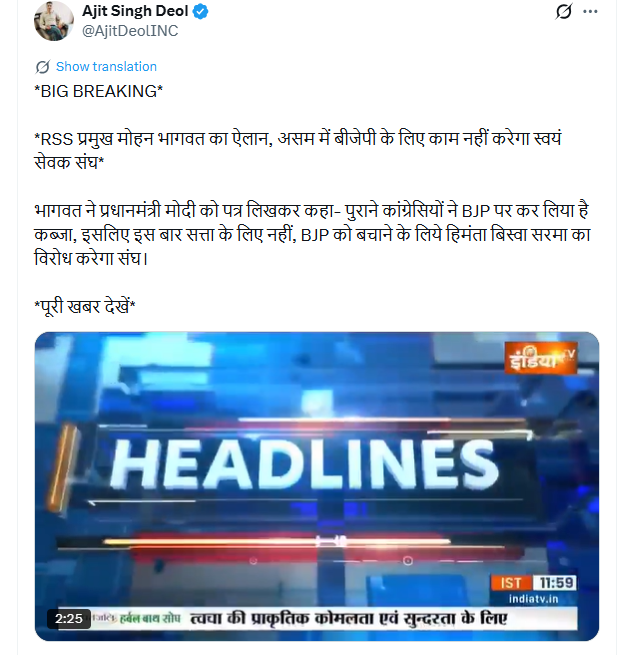
Fact Check:
To verify the claim, we searched relevant keywords about the alleged letter by RSS chief Mohan Bhagwat to Prime Minister Narendra Modi. However, we found no credible media reports supporting this claim. We then checked the YouTube channel of India TV but could not find the viral clip there. During the search, we did find a similar video from Meenakshi Joshi’s show. In the beginning of that video, the portion seen in the viral clip appears.
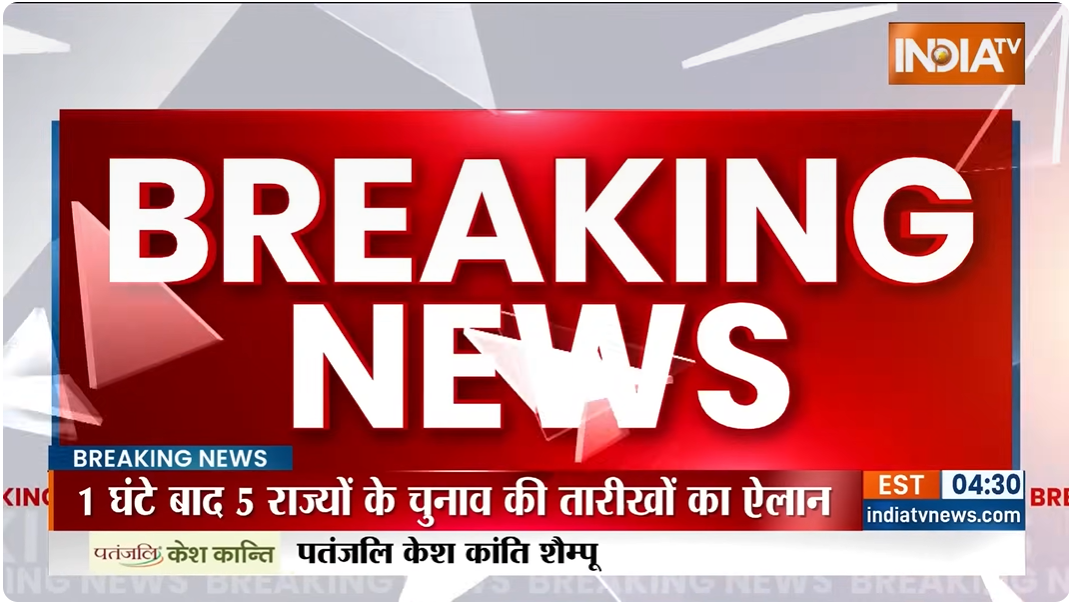
In the original video, the anchor is discussing the announcement of election dates in five states. There is no mention of any rift between the BJP and RSS in Assam.
Conclusion:
The viral India TV video claiming a rift between the BJP and RSS in Assam is edited and misleading. The original broadcast was about election dates in five states and did not include any such claims.
Executive Summary
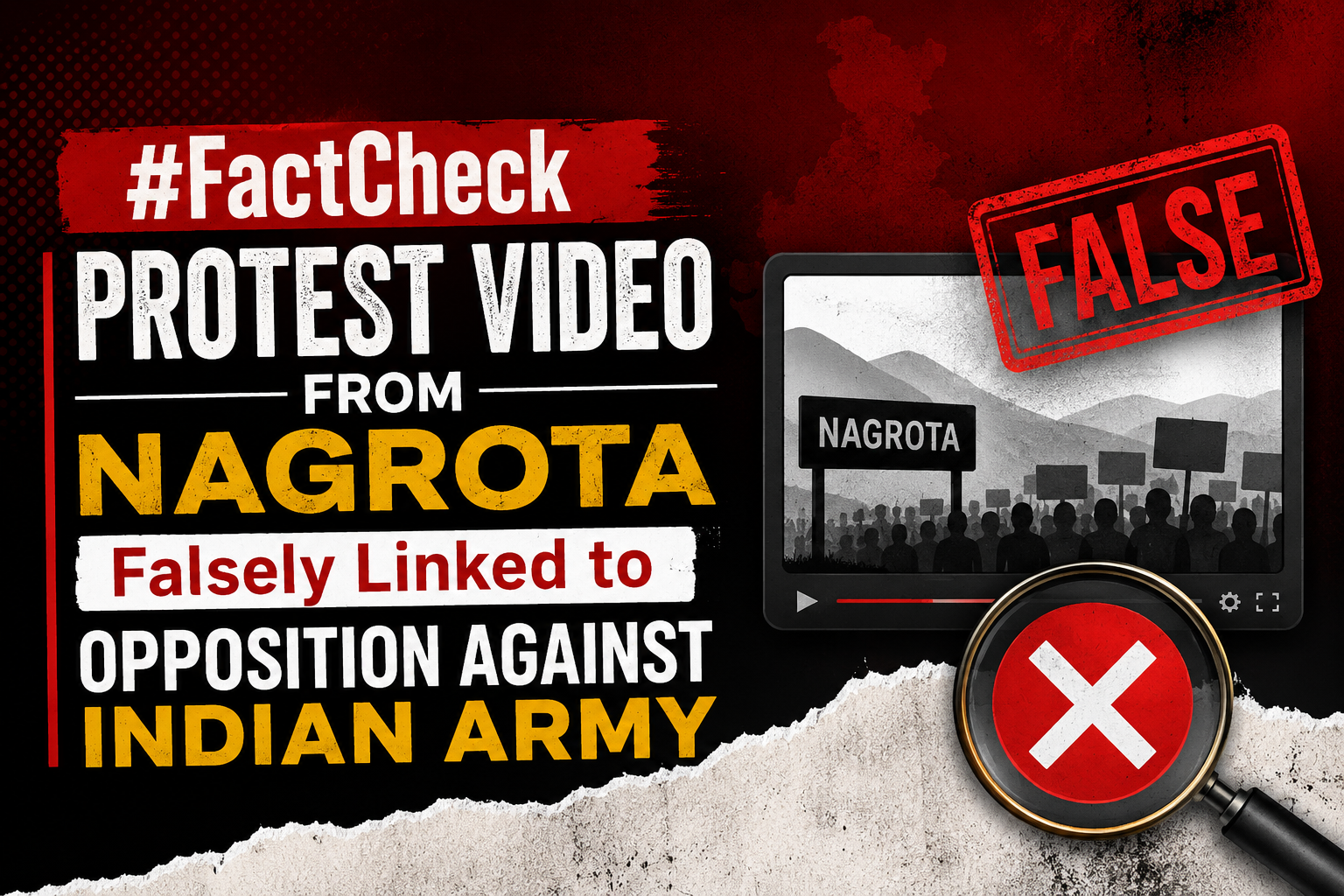
A video is being widely circulated on social media by Pakistani propaganda-linked users, showing a group of people protesting on a road. It is being claimed that protesters in Jammu & Kashmir stopped Indian Army personnel from entering Nagrota, indicating growing public opposition against the forces. Research by CyberPeace Research Wing found that the claim is misleading. The viral video is unrelated to any protest against the Indian Army.
Claim
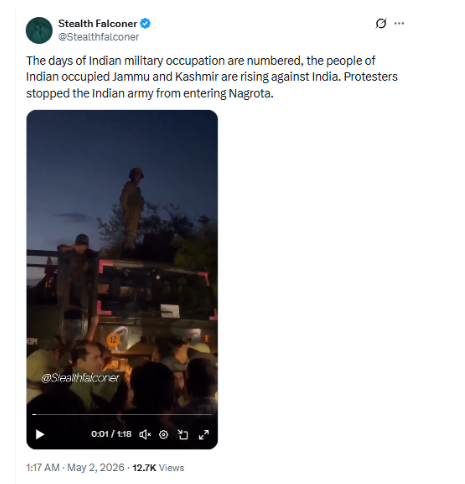
A user posted the video on X, claiming: “The days of Indian military occupation are numbered; people of Jammu & Kashmir have risen against India. Protesters stopped the Indian Army from entering Nagrota.”
- https://x.com/Stealthfalconer/status/2050301106623045758?s=20
Fact Check
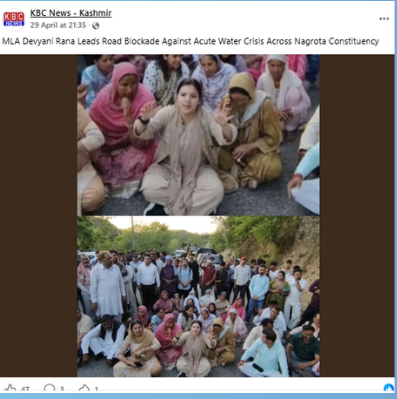
During the research, the CyberPeace Research Wing team found no evidence of any such incident where civilians blocked or opposed the Indian Army in Nagrota. Further probe led to a post by an X user “Defence News Of INDIA,” which contained the full version of the viral video. The accompanying information clarified that the protest took place in Dansal’s Badsu Panchayat area of Nagrota and was led by BJP MLA Devayani Rana.
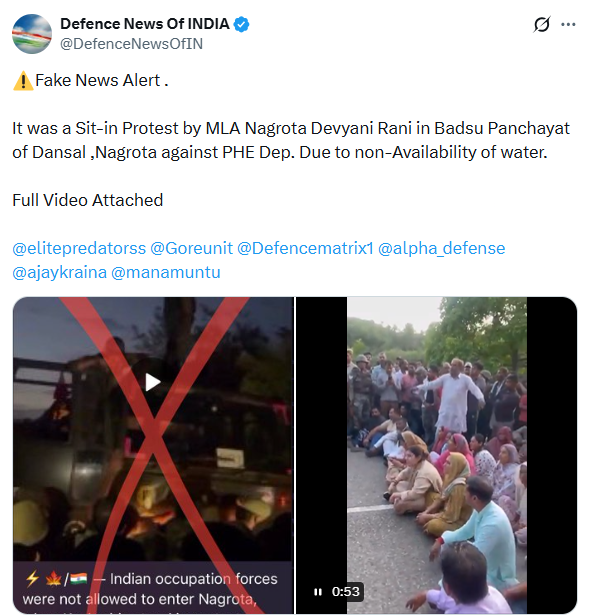
The protest was organized against the Public Health Engineering (PHE) Department over severe water shortage issues in the region. Locals, along with the MLA, staged a sit-in to highlight the lack of water supply.
We also found multiple media reports, including from KBC News – Kashmir and Jammu Links News, confirming that Devayani Rana led a road blockade protest in her constituency over water scarcity and accused the Jal Shakti Department of negligence and administrative failure. Additionally, videos of the same protest were available on social media platforms, including live streams shared from Devayani Rana’s official pages.
Conclusion
Our research confirms that the viral claim is false and misleading. The video does not show any protest against the Indian Army. It is actually from a demonstration led by Devayani Rana and local residents over water shortage issues in Nagrota.
