
#FactCheck- Viral video of burning ship falsely linked to US attack on vessel carrying Indian nationals in Oman waters
Executive Summary
Amid rising tensions in West Asia and concerns over the safety of Indian seafarers, a video showing a vessel engulfed in flames and thick black smoke is being widely circulated on social media. The clip is being shared with the claim that it depicts a US attack on a ship carrying Indian nationals in Omani waters. CyberPeace Research Wing research found the claim to be misleading. The viral video predates the incident it is being linked to and is not related to any recent attack.
Claim:
A Facebook user shared the video alleging that the United States attacked a ship carrying Indian citizens in the maritime region near Oman. The post has been widely circulated as part of the ongoing West Asia tensions. Facebook link: https://www.facebook.com/reel/3031094270427837, https://www.facebook.com/reel/3031094270427837

Fact Check:
A reverse image search of keyframes from the viral video led to several media reports published on 2 March 2026, which carried the same visuals seen in the circulating clip. The reports indicated that the footage showed a vessel targeted amid escalating tensions in the Strait of Hormuz, following restrictions on maritime movement in the region. https://www.ndtv.com/world-news/iran-targets-6th-ship-in-hormuz-strait-video-shows-billowing-smoke-11159019

Further research also found the same visuals in a Moneycontrol report published on 2 March 2026. The report clearly established that the footage is from an earlier incident and not linked to any recent developments. https://www.moneycontrol.com/world/indian-crew-member-killed-after-drone-boat-strikes-oil-tanker-off-oman-coast-first-indian-casualty-in-us-iran-tensions-article-13848303.html

Conclusion:
The research confirms that the viral video is not related to any recent US attack on a vessel carrying Indian nationals. The footage has been online since at least March 2026 and shows an earlier incident involving the oil tanker Skylight during tensions in the Strait of Hormuz. Hence, the claim being circulated on social media is misleading.

Related Blogs

Executive Summary
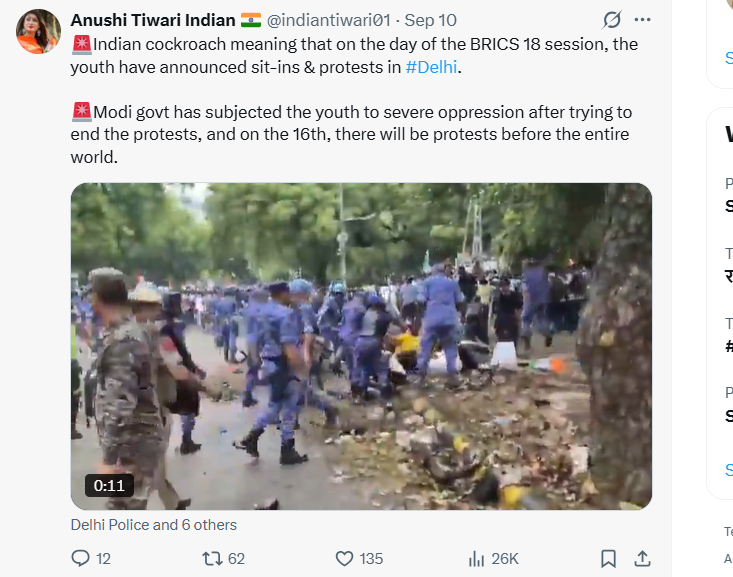
A video is being shared on social media with the claim that youths have announced sit-ins and protests in Delhi during the 18th BRICS Summit. The video is being shared with allegations that the Modi government attempted to suppress the protests and subjected the youth to severe oppression. It also claims that a large-scale protest would be held in Delhi on September 16. The video shows a large gathering of people, with police personnel seen taking action against them.
Research by CyberPeace found that the video is old and has been available online since at least July 20, 2026. According to earlier sources, the video shows police action against CJP protesters who were marching towards Parliament on July 20, 2026. Meanwhile, the 18th BRICS Summit is being held in New Delhi on September 12 and 13, 2026. Therefore, the old video is being misleadingly linked to police action during the BRICS Summit.
Claim:
A video is being shared on social media with the claim that youths have announced sit-ins and protests in Delhi during the 18th BRICS Summit and that the Modi government subjected them to severe oppression while attempting to suppress the protests.
https://x.com/indiantiwari01/status/2098058633825411110?s=20
FactCheck:
To verify the authenticity of the viral claim, we conducted a reverse image search of the keyframes from the video. During the search, we found the same video on the YouTube channel ANKIT'S PEACEFUL MIND, where it was published on July 20, 2026.
https://www.youtube.com/watch?v=uPsm9jueugY
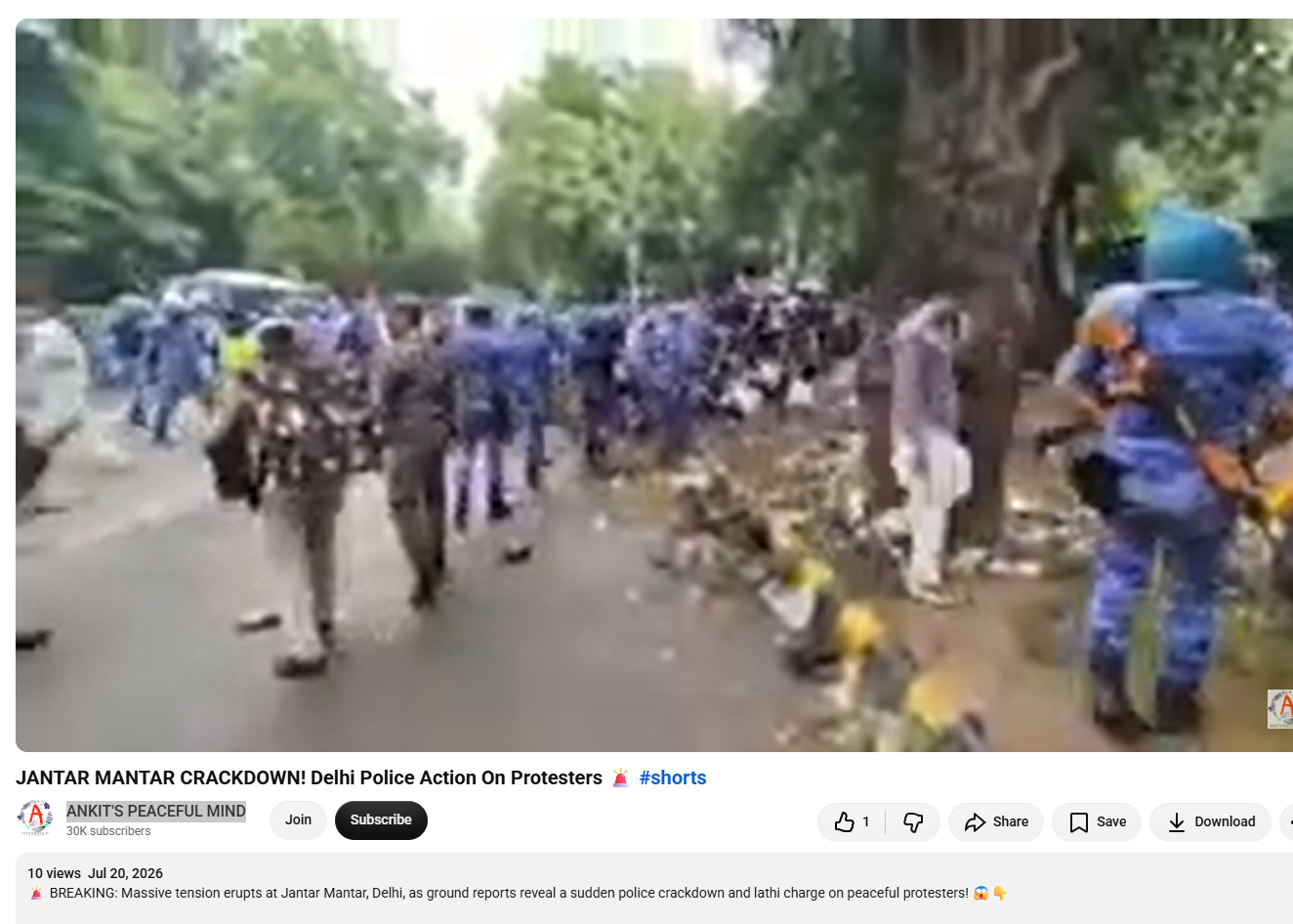
According to the video description, a tense situation unfolded at Jantar Mantar in Delhi, where police took action against people holding a peaceful protest and resorted to a lathi charge. The post claimed that thousands of youths, students and others had gathered in Delhi in support of environmental activist Sonam Wangchuk and the ongoing Ladakh movement. The situation reportedly escalated, leading to clashes between the protesters and the large number of security personnel deployed at the site.
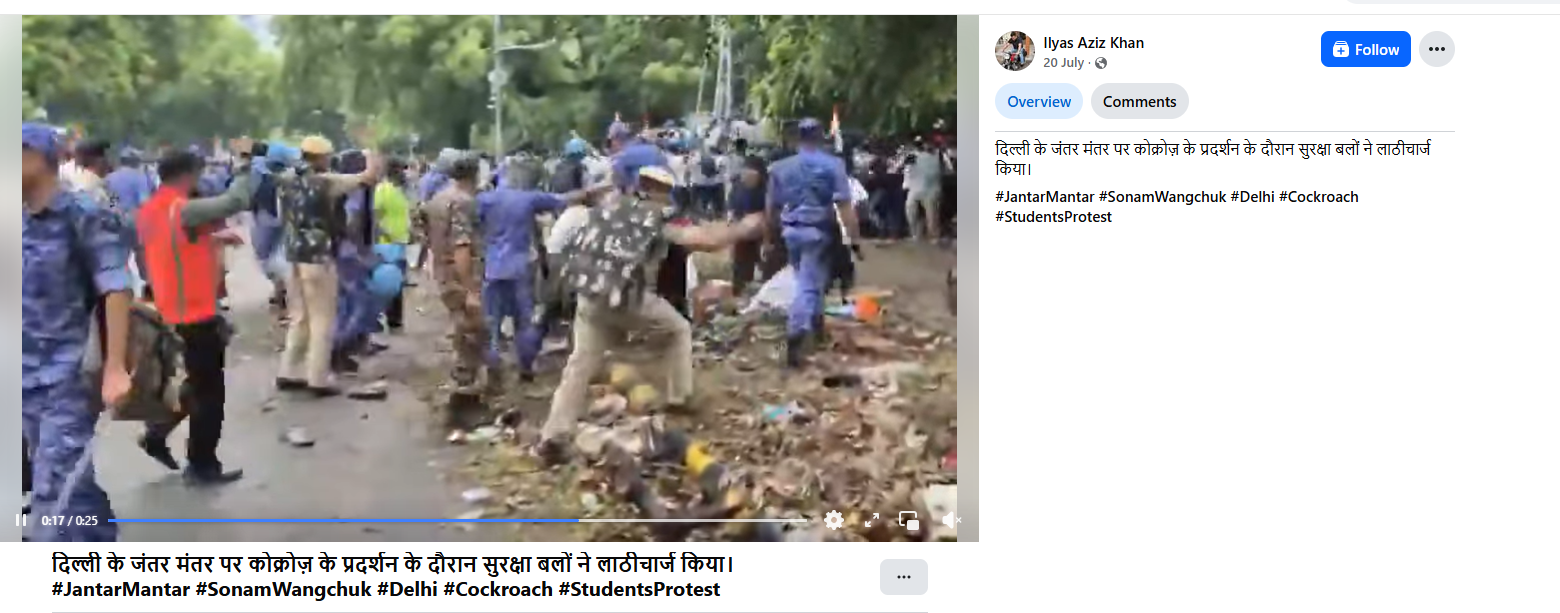
As part of the next step in our research, we found the same video on a Facebook page, where it was published on July 20. The video was also shared with the claim that security forces had resorted to a lathi charge against protesters during a CJP demonstration at Jantar Mantar in Delhi.
https://www.facebook.com/watch/?v=1583508539869113
Conclusion:
Our research found that the video being shared on social media is not related to any incident during the BRICS Summit. The video is old and has been available online since at least July 20, 2026. According to earlier sources, the video shows police action against CJP protesters who were marching towards Parliament on July 20. Meanwhile, the 18th BRICS Summit is being held in New Delhi on September 12 and 13, 2026. Therefore, sharing the old video as footage of police action against protesters during the BRICS Summit is misleading.

Executive Summary
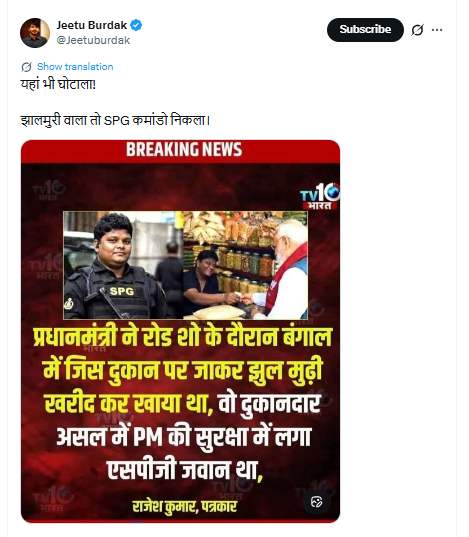
A collage of two images circulating on social media is falsely claiming that the street vendor who served jhalmuri to Prime Minister Narendra Modi during an election campaign in Jhargram was actually a personnel from the Special Protection Group (SPG). Research by the CyberPeace Research Wing found the claim to be false and misleading, indicating that it is being shared as part of election-related misinformation. The vendor and the SPG personnel seen in the viral collage are two different individuals.
Claim
An X (formerly Twitter) user, “@Jeetuburdak,” shared the viral collage on April 21, 2026, with the caption: “Another scam! The jhalmuri seller turned out to be an SPG commando.” The post quickly gained traction online.
Fact Check
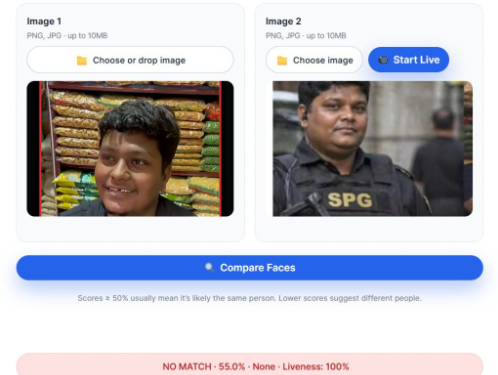
A close examination of the two images used in the collage shows clear visual differences between the individuals. The person seen in SPG uniform does not match the street vendor who served food to the prime minister. Reverse image searches were conducted using multiple tools to trace the origin of the images. While no verifiable source was found linking the SPG personnel’s image to the vendor, several credible reports and videos featured the actual jhalmuri seller from the campaign event.
- https://x.com/ANI/status/2045859146508177911?s=20
- https://news24online.com/cities/kolkata/who-is-the-man-that-served-jhalmuri-to-pm-modi-know-his-daily-income-and-what-he-talked-about-with-pm/811123/
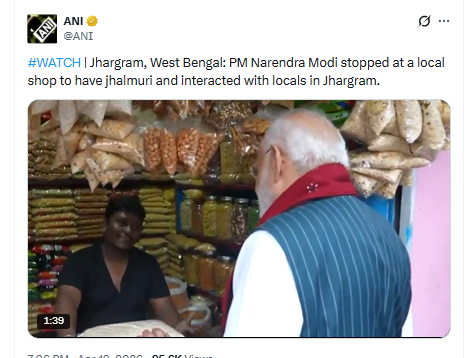
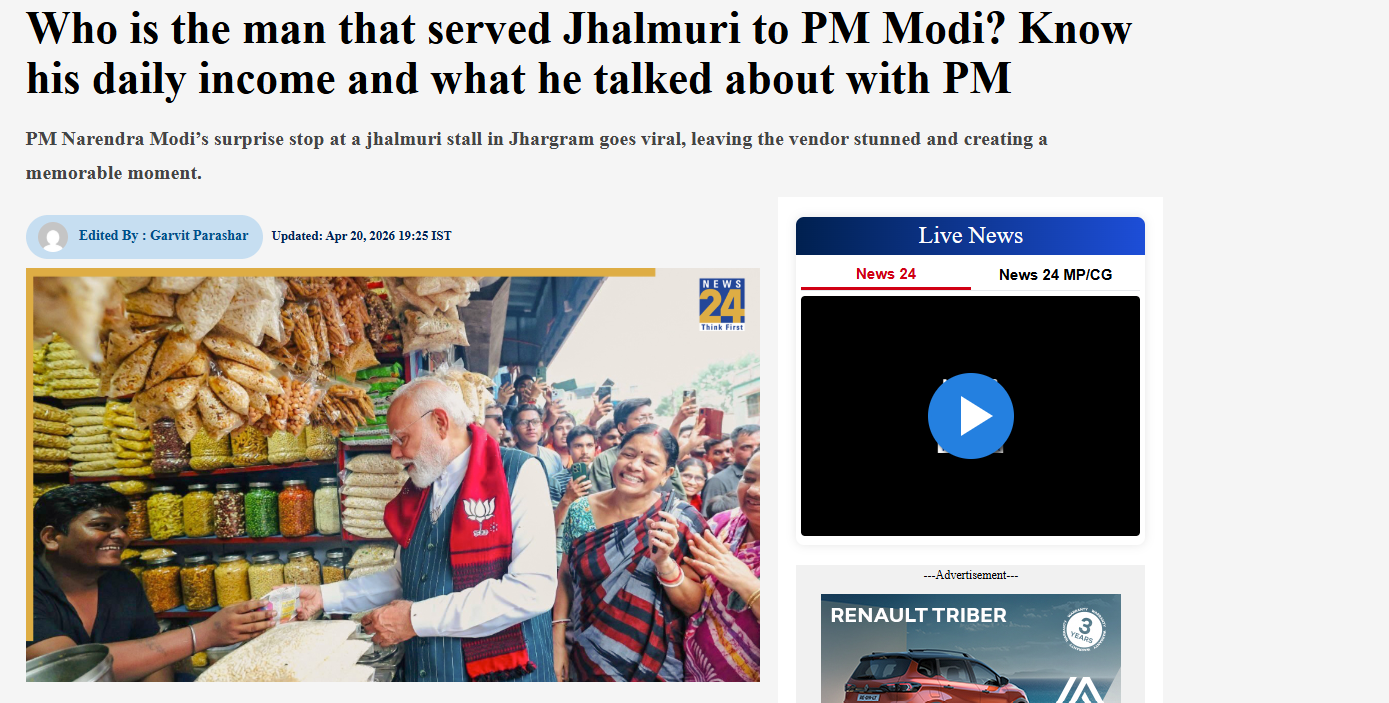
According to media reports, the prime minister briefly stopped at a roadside stall during the campaign in Jhargram and interacted with the vendor while enjoying jhalmuri. The vendor was later interviewed by multiple outlets, further confirming his identity as a local seller. Additionally, technical facial comparison analysis using online tools also indicated that the two individuals in the viral collage are not the same person.
Conclusion
The claim that the jhalmuri vendor was an SPG commando is false and misleading. The viral collage shows two different individuals, and there is no evidence to support the allegation.
.webp)
Introduction
In India, the rights of children with regard to protection of their personal data are enshrined under the Digital Personal Data Protection Act, 2023 which is the newly enacted digital personal data protection law of India. The DPDP Act requires that for the processing of children's personal data, verifiable consent of parents or legal guardians is a necessary requirement. If the consent of parents or legal guardians is not obtained then it constitutes a violation under the DPDP Act. Under section 2(f) of the DPDP act, a “child” means an individual who has not completed the age of eighteen years.
Section 9 under the DPDP Act, 2023
With reference to the collection of children's data section 9 of the DPDP Act, 2023 provides that for children below 18 years of age, consent from Parents/Legal Guardians is required. The Data Fiduciary shall, before processing any personal data of a child or a person with a disability who has a lawful guardian, obtain verifiable consent from the parent or the lawful guardian. Section 9 aims to create a safer online environment for children by limiting the exploitation of their data for commercial purposes or otherwise. By virtue of this section, the parents and guardians will have more control over their children's data and privacy and they are empowered to make choices as to how they manage their children's online activities and the permissions they grant to various online services.
Section 9 sub-section (3) specifies that a Data Fiduciary shall not undertake tracking or behavioural monitoring of children or targeted advertising directed at children. However, section 9 sub-section (5) further provides room for exemption from this prohibition by empowering the Central Government which may notify exemption to specific data fiduciaries or data processors from the behavioural tracking or target advertising prohibition under the future DPDP Rules which are yet to be announced or released.
Impact on social media platforms
Social media companies are raising concerns about Section 9 of the DPDP Act and upcoming Rules for the DPDP Act. Section 9 prohibits behavioural tracking or targeted advertising directed at children on digital platforms. By prohibiting intermediaries from tracking a ‘child's internet activities’ and ‘targeted advertising’ - this law aims to preserve children's privacy. However, social media corporations contended that this limitation adversely affects the efficacy of safety measures intended to safeguard young users, highlighting the necessity of monitoring specific user signals, including from minors, to guarantee the efficacy of safety measures designed for them.
Social media companies assert that tracking teenagers' behaviour is essential for safeguarding them from predators and harmful interactions. They believe that a complete ban on behavioural tracking is counterproductive to the government's objectives of protecting children. The scope to grant exemption leaves the door open for further advocacy on this issue. Hence it necessitates coordination with the concerned ministry and relevant stakeholders to find a balanced approach that maintains both privacy and safety for young users.
Furthermore, the impact on social media platforms also extends to the user experience and the operational costs required to implement the functioning of the changes created by regulations. This also involves significant changes to their algorithms and data-handling processes. Implementing robust age verification systems to identify young users and protect their data will also be a technically challenging step for the various scales of platforms. Ensuring that children’s data is not used for targeted advertising or behavioural monitoring also requires sophisticated data management systems. The blanket ban on targeted advertising and behavioural tracking may also affect the personalisation of content for young users, which may reduce their engagement with the platform.
For globally operating platforms, aligning their practices with the DPDP Act in India while also complying with data protection laws in other countries (such as GDPR in Europe or COPPA in the US) can be complex and resource-intensive. Platforms might choose to implement uniform global policies for simplicity, which could impact their operations in regions not governed by similar laws. On the same page, competitive dynamics such as market shifts where smaller or niche platforms that cater specifically to children and comply with these regulations may gain a competitive edge. There may be a drive towards developing new, compliant ways of monetizing user interactions that do not rely on behavioural tracking.
CyberPeace Policy Recommendations
A balanced strategy should be taken into account which gives weightage to the contentions of social media companies as well as to the protection of children's personal information. Instead of a blanket ban, platforms can be obliged to follow and encourage openness in advertising practices, ensuring that children are not exposed to any misleading or manipulative marketing techniques. Self-regulation techniques can be implemented to support ethical behaviour, responsibility, and the safety of young users’ online personal information through the platform’s practices. Additionally, verifiable consent should be examined and put forward in a manner which is practical and the platforms have a say in designing the said verification. Ultimately, this should be dealt with in a manner that behavioural tracking and targeted advertising are not affecting the children's well-being, safety and data protection in any way.
Final Words
Under section 9 of the DPDP Act, the prohibition of behavioural tracking and targeted advertising in case of processing children's personal data - will compel social media platforms to overhaul their data collection and advertising practices, ensuring compliance with stricter privacy regulations. The legislative intent behind this provision is to enhance and strengthen the protection of children's digital personal data security and privacy. As children are particularly vulnerable to digital threats due to their still-evolving maturity and cognitive capacities, the protection of their privacy stands as a priority. The innocence of children is a major cause for concern when it comes to digital access because children simply do not possess the discernment and caution required to be able to navigate the Internet safely. Furthermore, a balanced approach needs to be adopted which maintains both ‘privacy’ and ‘safety’ for young users.
References
- https://www.meity.gov.in/writereaddata/files/Digital%20Personal%20Data%20Protection%20Act%202023.pdf
- https://www.firstpost.com/tech/as-govt-of-india-starts-preparing-rules-for-dpdp-act-social-media-platforms-worried-13789134.html#google_vignette
- https://www.business-standard.com/industry/news/social-media-platforms-worry-new-data-law-could-affect-child-safety-ads-124070400673_1.html
