
#FactCheck-AI-Manipulated Video Falsely Attributes Statement on Operation Sindoor to Foreign Secretary Vikram Misri
Executive Summary
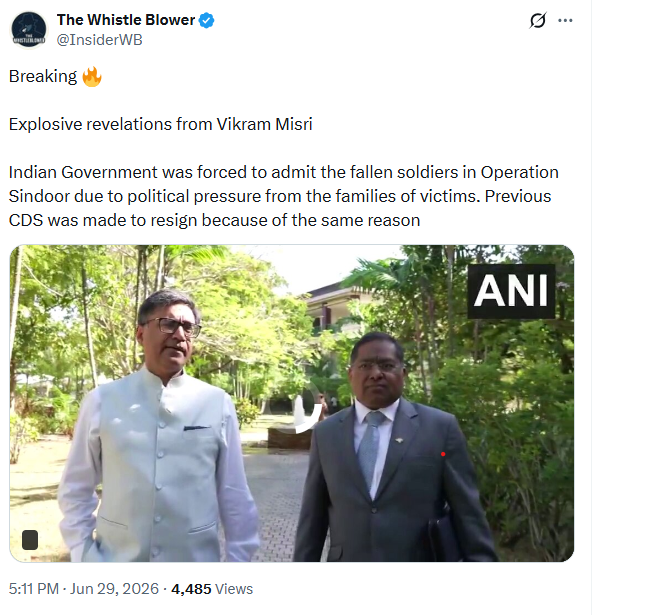
A video of Foreign Secretary Vikram Misri speaking to a reporter is being circulated on social media with the claim that he said the Indian government was forced to publicly acknowledge the soldiers killed during Operation Sindoor due to political pressure from the families of the deceased. Research conducted by the CyberPeace Research Wing found that the viral video had been manipulated using artificial intelligence (AI). Vikram Misri's voice was artificially cloned, meaning the audio heard in the clip is not genuine but has been generated and altered using AI technology.
Claim
The video was shared on X (formerly Twitter) with the following caption: "Breaking. Explosive revelations from Vikram Misri. Indian Government was forced to admit the fallen soldiers in Operation Sindoor due to political pressure from the families of victims. Previous CDS was made to resign because of the same reason."
https://x.com/InsiderWB/status/2071642756125008031
Fact Check
We conducted a reverse image search using Google Lens, which led us to a video uploaded on The Tribune's verified YouTube channel that matched the viral clip. In the original video, Vikram Misri clarified that the Government of India neither officially participated in, supported, nor was involved in any event related to India-Pakistan dialogue. He further stated that the government had taken no cognisance of such private events and that the retired dignitaries and diplomats present were expressing their personal views, not speaking on behalf of the Government of India.
https://www.youtube.com/watch?v=wCrv0Vcgp28

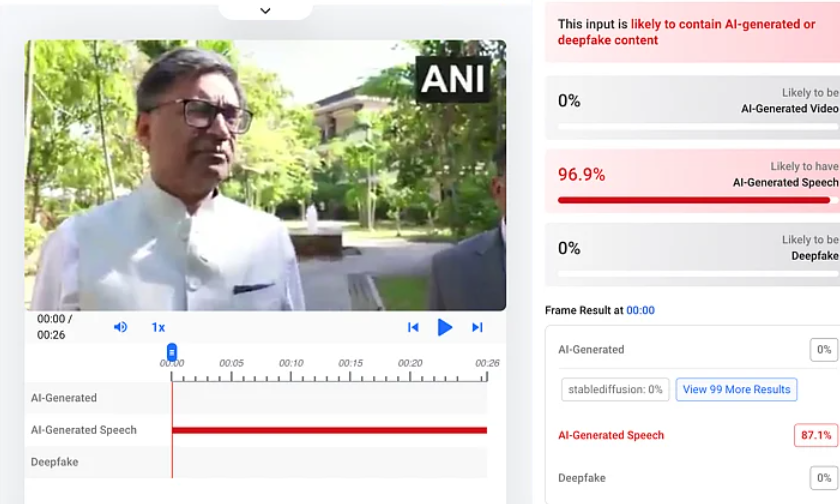
Since we found no evidence that Vikram Misri had ever made the statements attributed to him in the viral clip, we analysed the video using Hive Moderation's AI-generated content detection tool. The analysis indicated that the viral video is 96 per cent AI-generated.
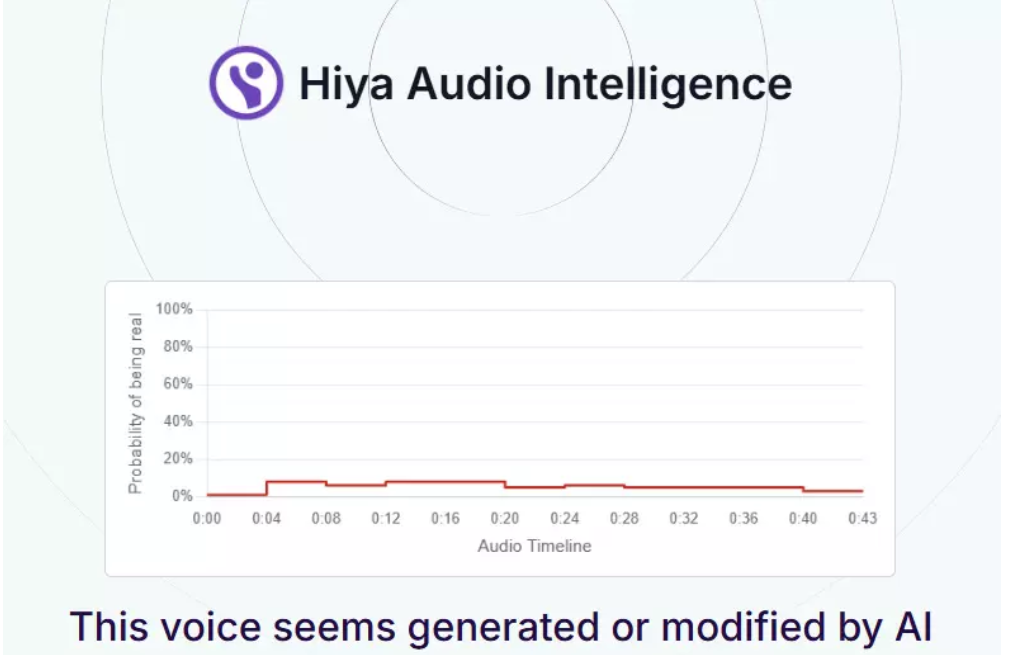
To further verify the claim, we analysed the audio using Hiya Audio Intelligence. The tool concluded that the voice in the viral video appears to have been generated or modified using artificial intelligence.
Conclusion
The viral video is misleading. Our research found that the video of Foreign Secretary Vikram Misri had been manipulated using artificial intelligence. He never made any statement claiming that the Indian government disclosed the names of soldiers killed during Operation Sindoor due to pressure from their families. Therefore, the viral claim is false.

Related Blogs

Executive Summary
The viral video, in which south actor Allu Arjun is seen supporting the Congress Party's campaign for the upcoming Lok Sabha Election, suggests that he has joined Congress Party. Over the course of an investigation, the CyberPeace Research Team uncovered that the video is a close up of Allu Arjun marching as the Grand Marshal of the 2022 India Day parade in New York to celebrate India’s 75th Independence Day. Reverse image searches, Allu Arjun's official YouTube channel, the news coverage, and stock images websites are also proofs of this fact. Thus, it has been firmly established that the claim that Allu Arjun is in a Congress Party's campaign is fabricated and misleading

Claims:
The viral video alleges that the south actor Allu Arjun is using his popularity and star status as a way of campaigning for the Congress party during the 2024 upcoming Lok Sabha elections.


Fact Check:
Initially, after hearing the news, we conducted a quick search using keywords to relate it to actor Allu Arjun joining the Congress Party but came across nothing related to this. However, we found a video by SoSouth posted on Feb 20, 2022, of Allu Arjun’s Father-in-law Kancharla Chandrasekhar Reddy joining congress and quitting former chief minister K Chandrasekhar Rao's party.

Next, we segmented the video into keyframes, and then reverse searched one of the images which led us to the Federation of Indian Association website. It says that the picture is from the 2022 India Parade. The picture looks similar to the viral video, and we can compare the two to help us determine if they are from the same event.

Taking a cue from this, we again performed a keyword search using “India Day Parade 2022”. We found a video uploaded on the official Allu Arjun YouTube channel, and it’s the same video that has been shared on Social Media in recent times with different context. The caption of the original video reads, “Icon Star Allu Arjun as Grand Marshal @ 40th India Day Parade in New York | Highlights | #IndiaAt75”

The Reverse Image search results in some more evidence of the real fact, we found the image on Shutterstock, the description of the photo reads, “NYC India Day Parade, New York, NY, United States - 21 Aug 2022 Parade Grand Marshall Actor Allu Arjun is seen on a float during the annual Indian Day Parade on Madison Avenue in New York City on August 21, 2022.”

With this, we concluded that the Claim made in the viral video of Allu Arjun supporting the Lok Sabha Election campaign 2024 is baseless and false.
Conclusion:
The viral video circulating on social media has been put out of context. The clip, which depicts Allu Arjun's participation in the Indian Day parade in 2022, is not related to the ongoing election campaigns for any Political Party.
Hence, the assertion that Allu Arjun is campaigning for the Congress party is false and misleading.
- Claim: A video, which has gone viral, says that actor Allu Arjun is rallying for the Congress party.
- Claimed on: X (Formerly known as Twitter) and YouTube
- Fact Check: Fake & Misleading

Introduction
Cyber financial offences in India have experienced an alarming surge both in terms of frequency and complexity. Be it phishing attacks or organised fraud syndicates, the nation has been facing a spurt in online financial threats, which leave the victims at their mercy because of procedural lags on the part of law enforcement agencies. To counter this, the Government of India has stepped up measures to create a Cyber-Secure Bharat, focusing on speedy resolution, accountability, and digital empowerment. A key move in this direction is the introduction of the e-Zero FIR initiative, brought forth by the Ministry of Home Affairs (MHA) with Union Home Minister Amit Shah at the helm. This newly developed digital-first system is expected to revolutionise the way cyber financial crimes, particularly those that result in high monetary losses, are handled and investigated.
What Is the e-Zero FIR Initiative?
The e-Zero FIR program is a technology-based platform that enables the automated registration of Zero FIRs for value cyber financial crimes. Led by the Indian Cybercrime Coordination Centre (I4C), Ministry of Home Affairs, the programme is now piloted in Delhi and aims to fill a pressing lacuna: the time lag involved in transitioning cybercrime complaints to First Information Reports (FIRs).
Complaints of financial frauds worth more than ₹10 lakh, reported through the National Cybercrime Reporting Portal (NCRP) or helpline number 1930, will be automatically turned into e-Zero FIRs under this scheme. Such electronic FIRs are directed to the e-Crime Police Station in Delhi, regardless of jurisdiction, and then relayed to the corresponding territorial cybercrime unit. Complainants can visit the cybercrime Police Station within 3 days and get the Zero FIR converted into a regular FIR.
Key Features of the Initiative
- Pilot Implementation in Delhi
Launched as a pilot project in Delhi, it will later serve as the first use case for the national rollout. The success of the pilot will determine its implementation in other states and Union Territories.
- Seamless Digital Integration
The project provides strong back-end integration between:
- NCRP (National Cybercrime Reporting Portal)
- e-FIR System (Delhi Police)
- CCTNS (Crime and Criminal Tracking Network & Systems – NCRB)
This integrated model enables complaints to pass smoothly between platforms and agencies.
- Zero FIR Auto-Registration and Routing
Now, for complaints lodged through 1930 or the National Cyber Crime Reporting Portal related to financial losses exceeding the threshold of ₹10 lakh, the system will automatically register a Zero FIR to the e-Crime Police Station of Delhi and then route it to the concerned territorial cybercrime police station, triggering immediate case processing.
- Victim-Centric Conversion Mechanism
Complainants are given 3 days from the time of filing to physically report to the police station and transform the e-Zero FIR into a conventional regular FIR under Section 173 (1) and 1(ii) of the newly enacted Bhartiya Nagrik Suraksha Sanhita (BNSS). This ensures legal redress is quicker and easier.
Impact and Significance: The CyberPeace View
The e-Zero FIR system is a significant change in India's cybercrime enforcement, offering quicker response times and improved recovery opportunities. Cyber fraud reported within the "golden hour" can boost recovery levels of financial fraud. The system also eliminates jurisdictional barriers and procedural bottlenecks, making it more victim-friendly. Union Home Minister Amit Shah emphasised the initiative's alignment with Prime Minister Narendra Modi's vision of a digitally resilient India. The system is a scalable national model of tech-based policing supported by organised digital workflows. The initiative allows for real-time analysis of fraud graphs and detection of fraud syndicates through identification and device-based clustering. This is a step towards more automated, context-aware cyber policing, focusing on AI, identity graphs, and velocity to prevent crimes. The system is a step towards a next-generation cyber law enforcement strategy, focusing on AI, identity graphs, and velocity.
Conclusion
The roll-out of the e-Zero FIR program is a turning point in India's battle against cybercrime. By marrying automation with inter-agency coordination and easy-to-use mechanisms, the government has eradicated one of the major stumbling blocks for victims, the delay in taking legal action. Though its pilot phase targets high-value financial frauds in Delhi, its potential for having a countrywide impact is vast. With digital transactions on the upswing and frauds getting more cunning, efforts like these are the key to making a safe, responsive, and victim-centric cyber environment. CyberPeace commends and welcomes this important move towards establishing a Cyber-Secure Bharat, wherein all citizens can make digital transactions with confidence.
References
- https://www.pib.gov.in/PressReleasePage.aspx?PRID=2129715
- https://www.mha.gov.in/en
- https://cybercrime.gov.in/
- https://www.ncrb.gov.in/
- https://economictimes.indiatimes.com/wealth/save/new-e-zero-fir-govt-launches-pilot-for-swift-action-against-cybercrimes-how-it-can-help-you/articleshow/121314437.cms?from=mdr
.webp)
Executive Summary:
A viral online video claims to show a Syrian prisoner experiencing sunlight for the first time in 13 years. However, the CyberPeace Research Team has confirmed that the video is a deep fake, created using AI technology to manipulate the prisoner’s facial expressions and surroundings. The original footage is unrelated to the claim that the prisoner has been held in solitary confinement for 13 years. The assertion that this video depicts a Syrian prisoner seeing sunlight for the first time is false and misleading.

Claim A viral video falsely claims that a Syrian prisoner is seeing sunlight for the first time in 13 years.


Factcheck:
Upon receiving the viral posts, we conducted a Google Lens search on keyframes from the video. The search led us to various legitimate sources featuring real reports about Syrian prisoners, but none of them included any mention of such an incident. The viral video exhibited several signs of digital manipulation, prompting further investigation.

We used AI detection tools, such as TrueMedia, to analyze the video. The analysis confirmed with 97.0% confidence that the video was a deepfake. The tools identified “substantial evidence of manipulation,” particularly in the prisoner’s facial movements and the lighting conditions, both of which appeared artificially generated.


Additionally, a thorough review of news sources and official reports related to Syrian prisoners revealed no evidence of a prisoner being released from solitary confinement after 13 years, or experiencing sunlight for the first time in such a manner. No credible reports supported the viral video’s claim, further confirming its inauthenticity.
Conclusion:
The viral video claiming that a Syrian prisoner is seeing sunlight for the first time in 13 years is a deep fake. Investigations using tools like Hive AI detection confirm that the video was digitally manipulated using AI technology. Furthermore, there is no supporting information in any reliable sources. The CyberPeace Research Team confirms that the video was fabricated, and the claim is false and misleading.
- Claim: Syrian prisoner sees sunlight for the first time in 13 years, viral on social media.
- Claimed on: Facebook and X(Formerly Twitter)
- Fact Check: False & Misleading

