
#FactCheck-AI-Generated Video Falsely Shows CRPF Trooper Criticizing PM Modi and BJP Government
Executive Summary
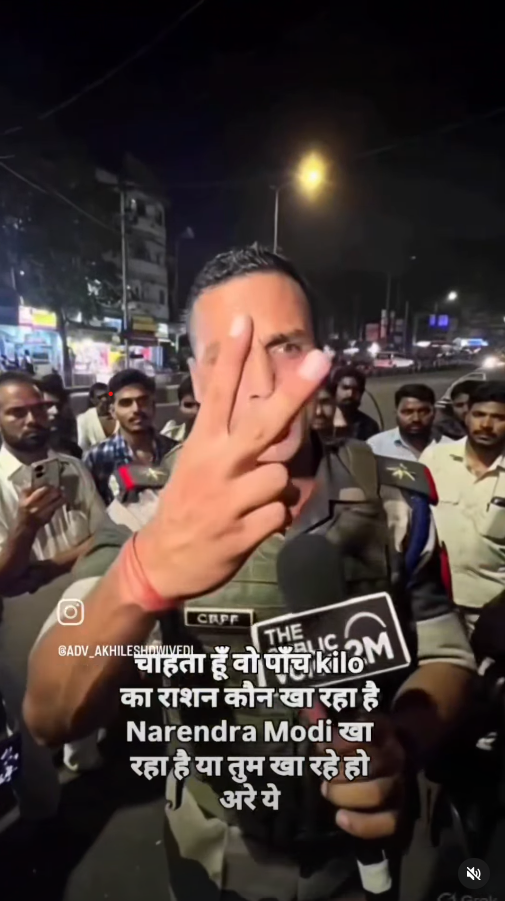
A video is being widely shared on social media showing a purported CRPF trooper accusing Prime Minister Narendra Modi and his government of corruption. In the video, the individual is also seen urging people to vote the BJP government out of power. CyberPeace Research Wing research found that the video was created using artificial intelligence (AI). There is no evidence that any CRPF personnel made such statements.
Claim
An Instagram user shared the viral video, claiming that a CRPF trooper was criticizing Prime Minister Narendra Modi and his government over corruption allegations. The post link, archived link, and screenshot are provided below. https://www.instagram.com/reels/DZ_dbj_SNTf/ , https://www.awesomescreenshot.com/video/53998219?key=46c661b505ba61d19e7d9be97a17c273
FactCheck
A closer examination of the video revealed several inconsistencies. The name tag on the uniform displayed only “CRPF,” which does not match the standard naming format used on official CRPF uniforms. Additionally, several faces visible in the background appeared blurred and distorted, which are common indicators of AI-generated content. We also noticed a visible Grok watermark in the bottom-right corner of the viral clip, suggesting that the video may have been generated or modified using artificial intelligence. Further analysis was conducted using Hive Moderation’s AI detection tool, which indicated the presence of AI-generated or deepfake elements in the video.
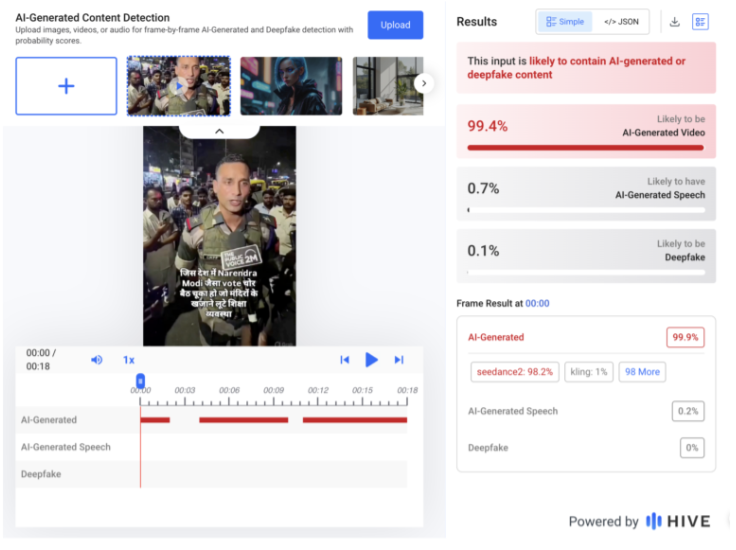
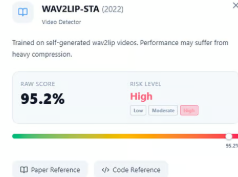
To further verify the authenticity of the clip, we analyzed it using Deepfake-O-Meter. The tool indicated a probability of more than 95 percent that the video was generated using artificial intelligence.
Conclusion
The viral video purportedly showing a CRPF trooper criticizing Prime Minister Narendra Modi and the BJP government is AI-generated. Multiple indicators, AI detection tools, and the clarification issued by the government’s PIB Fact Check confirm that the video is not authentic.

Related Blogs

Executive Summary
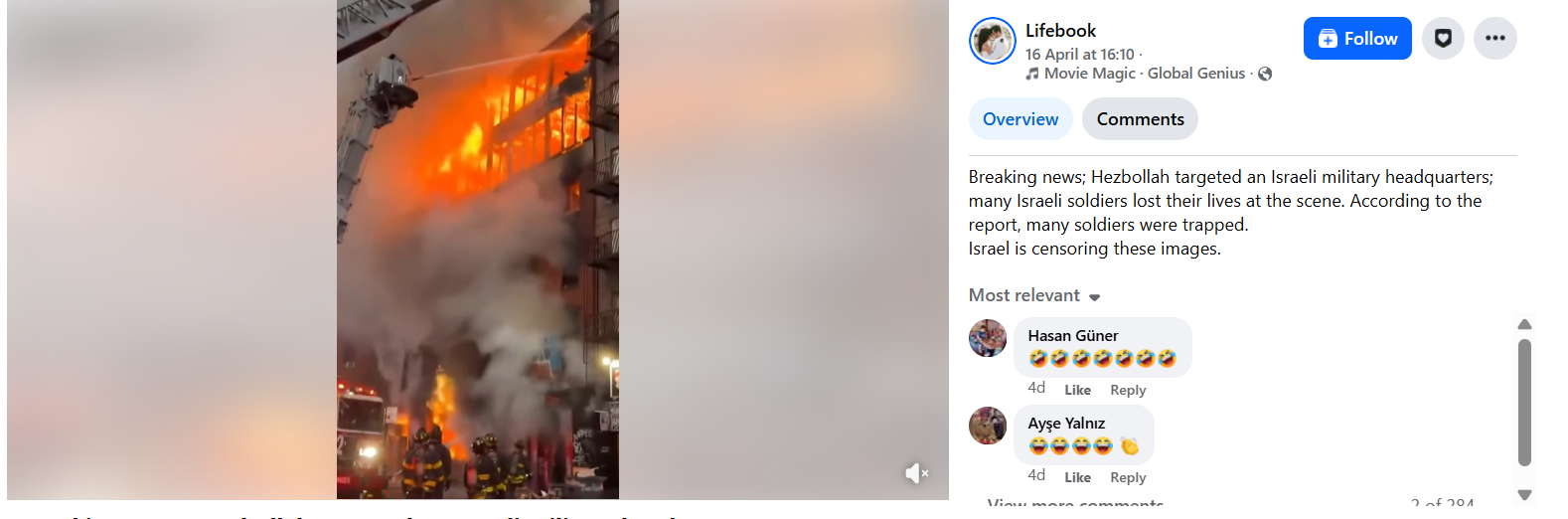
Despite a truce announced in mid-April, sporadic violence has continued between Israel and the Iran-backed Hezbollah in Lebanon. Meanwhile, a video circulating widely on social media shows a multi-storey building engulfed in flames, with users falsely linking it to the ongoing conflict. Posts sharing the clip claim it depicts a Hezbollah strike on an Israeli military headquarters, alleging that several soldiers were killed and that Israel is censoring visuals from the incident. However, research by the CyberPeace Research Wing found the claim to be misleading. The video is unrelated to the Israel-Hezbollah conflict. Verification shows that the footage actually captures a fire at an apartment building in New York City. Firefighters can be seen at the scene attempting to control the blaze.
Claim
A Facebook post shared on April 16, 2026, read: “Breaking news; Hezbollah targeted an Israeli military headquarters; many Israeli soldiers lost their lives at the scene… Israel is censoring these images.” The video has garnered more than 240,000 views.
- https://perma.cc/BQ6X-4LAT
- https://www.facebook.com/watch/?v=1283830349750737
Fact Check
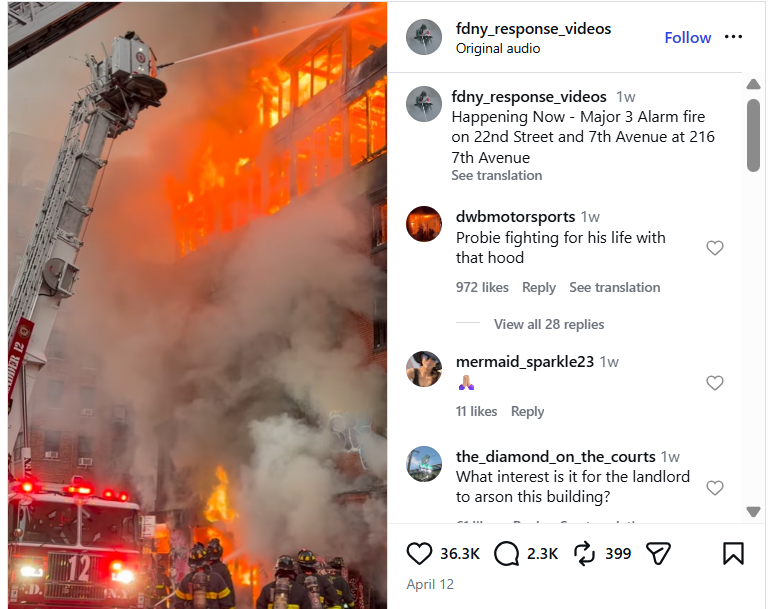
A reverse image search using keyframes from the viral clip led to a higher-quality version posted on April 12, 2026, by an Instagram account titled “FDNY response video.” The caption stated: “Happening now — Major 3 alarm fire on 22nd Street and 7th Avenue at 216 7th Avenue.”
- https://www.instagram.com/p/DXB0ePqjgGD/
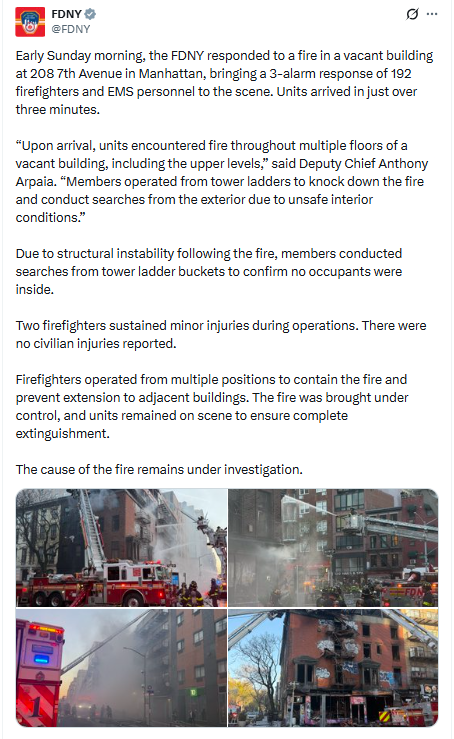
Further verification found that images of the same incident were shared on April 13, 2026, by the official X account of the New York City Fire Department. According to the post, no civilians were injured in the fire, although two firefighters sustained minor injuries while battling the blaze.
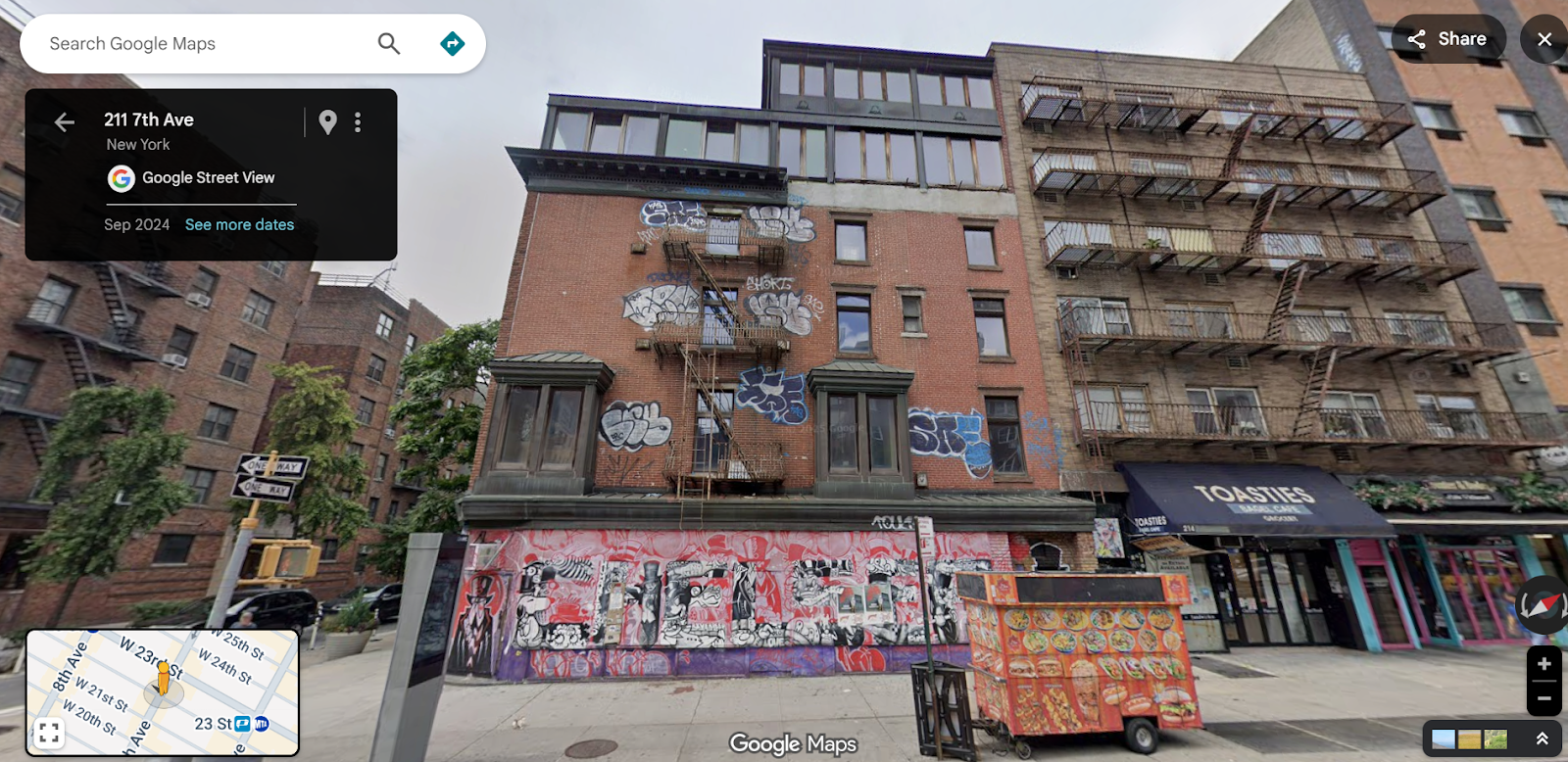
Using the location details mentioned in the posts, visible structures in the video were matched with Google Maps street imagery, confirming that the footage was indeed filmed in New York City.
Conclusion
The research establishes that the viral video is being shared with a false claim. It does not show any attack on an Israeli military facility but rather a residential building fire in New York City.
.webp)
Introduction
The link between social media and misinformation is undeniable. Misinformation, particularly the kind that evokes emotion, spreads like wildfire on social media and has serious consequences, like undermining democratic processes, discrediting science, and promulgating hateful discourses which may incite physical violence. If left unchecked, misinformation propagated through social media has the potential to incite social disorder, as seen in countless ethnic clashes worldwide. This is why social media platforms have been under growing pressure to combat misinformation and have been developing models such as fact-checking services and community notes to check its spread. This article explores the pros and cons of the models and evaluates their broader implications for online information integrity.
How the Models Work
- Third-Party Fact-Checking Model (formerly used by Meta) Meta initiated this program in 2016 after claims of extraterritorial election tampering through dis/misinformation on its platforms. It entered partnerships with third-party organizations like AFP and specialist sites like Lead Stories and PolitiFact, which are certified by the International Fact-Checking Network (IFCN) for meeting neutrality, independence, and editorial quality standards. These fact-checkers identify misleading claims that go viral on platforms and publish verified articles on their websites, providing correct information. They also submit this to Meta through an interface, which may link the fact-checked article to the social media post that contains factually incorrect claims. The post then gets flagged for false or misleading content, and a link to the article appears under the post for users to refer to. This content will be demoted in the platform algorithm, though not removed entirely unless it violates Community Standards. However, in January 2025, Meta announced it was scrapping this program and beginning to test X’s Community Notes Model in the USA, before rolling it out in the rest of the world. It alleges that the independent fact-checking model is riddled with personal biases, lacks transparency in decision-making, and has evolved into a censoring tool.
- Community Notes Model ( Used by X and being tested by Meta): This model relies on crowdsourced contributors who can sign up for the program, write contextual notes on posts and rate the notes made by other users on X. The platform uses a bridging algorithm to display those notes publicly, which receive cross-ideological consensus from voters across the political spectrum. It does this by boosting those notes that receive support despite the political leaning of the voters, which it measures through their engagements with previous notes. The benefit of this system is that it is less likely for biases to creep into the flagging mechanism. Further, the process is relatively more transparent than an independent fact-checking mechanism since all Community Notes contributions are publicly available for inspection, and the ranking algorithm can be accessed by anyone, allowing for external evaluation of the system by anyone.
CyberPeace Insights
Meta’s uptake of a crowdsourced model signals social media’s shift toward decentralized content moderation, giving users more influence in what gets flagged and why. However, the model’s reliance on diverse agreements can be a time-consuming process. A study (by Wirtschafter & Majumder, 2023) shows that only about 12.5 per cent of all submitted notes are seen by the public, making most misleading content go unchecked. Further, many notes on divisive issues like politics and elections may not see the light of day since reaching a consensus on such topics is hard. This means that many misleading posts may not be publicly flagged at all, thereby hindering risk mitigation efforts. This casts aspersions on the model’s ability to check the virality of posts which can have adverse societal impacts, especially on vulnerable communities. On the other hand, the fact-checking model suffers from a lack of transparency, which has damaged user trust and led to allegations of bias.
Since both models have their advantages and disadvantages, the future of misinformation control will require a hybrid approach. Data accuracy and polarization through social media are issues bigger than an exclusive tool or model can effectively handle. Thus, platforms can combine expert validation with crowdsourced input to allow for accuracy, transparency, and scalability.
Conclusion
Meta’s shift to a crowdsourced model of fact-checking is likely to have bigger implications on public discourse since social media platforms hold immense power in terms of how their policies affect politics, the economy, and societal relations at large. This change comes against the background of sweeping cost-cutting in the tech industry, political changes in the USA and abroad, and increasing attempts to make Big Tech platforms more accountable in jurisdictions like the EU and Australia, which are known for their welfare-oriented policies. These co-occurring contestations are likely to inform the direction the development of misinformation-countering tactics will take. Until then, the crowdsourcing model is still in development, and its efficacy is yet to be seen, especially regarding polarizing topics.
References
- https://www.cyberpeace.org/resources/blogs/new-youtube-notes-feature-to-help-users-add-context-to-videos
- https://en-gb.facebook.com/business/help/315131736305613?id=673052479947730
- http://techxplore.com/news/2025-01-meta-fact.html
- https://about.fb.com/news/2025/01/meta-more-speech-fewer-mistakes/
- https://communitynotes.x.com/guide/en/about/introduction
- https://blogs.lse.ac.uk/impactofsocialsciences/2025/01/14/do-community-notes-work/?utm_source=chatgpt.com
- https://www.techpolicy.press/community-notes-and-its-narrow-understanding-of-disinformation/
- https://www.rstreet.org/commentary/metas-shift-to-community-notes-model-proves-that-we-can-fix-big-problems-without-big-government/
- https://tsjournal.org/index.php/jots/article/view/139/57

Executive Summary
Even after the conclusion of the Cockroach Janata Party (CJP) protest at Delhi’s Jantar Mantar, several misleading claims related to the demonstration continue to circulate on social media. During the protests, multiple AI-generated videos, deepfakes and fabricated narratives were circulated with the intention of misleading users. CyberPeace Research Wing’s Fact Check Team investigated several such viral claims and found that many of the videos were digitally manipulated or created using artificial intelligence (AI). The research revealed that fake audio, misleading captions and altered visuals were used to falsely attribute statements to public figures, including police officials, military officers and Union ministers. The following are four major false claims debunked by the CyberPeace Research Wing:
Claim 1: Delhi Police DCP Sumit Jha resigned from IPS in support of student protests
A video of Delhi Police DCP Sumit Jha was widely shared on social media with the claim that he resigned from the Indian Police Service (IPS) in support of the student movement at Jantar Mantar. In the viral video, DCP Sumit Jha is allegedly heard saying that he was resigning from his post with immediate effect and could not remain part of a system that forced him to spread false information against students. The video was shared with the claim that Delhi Police DCP Sumit Jha resigned from his position to support protesting students.
Claim
An Instagram user shared the viral video on July 28, 2026, claiming that Delhi Police DCP Sumit Jha had resigned from his post in support of protesting students.
https://www.instagram.com/reel/DbUr6CPoB13/

Fact Check
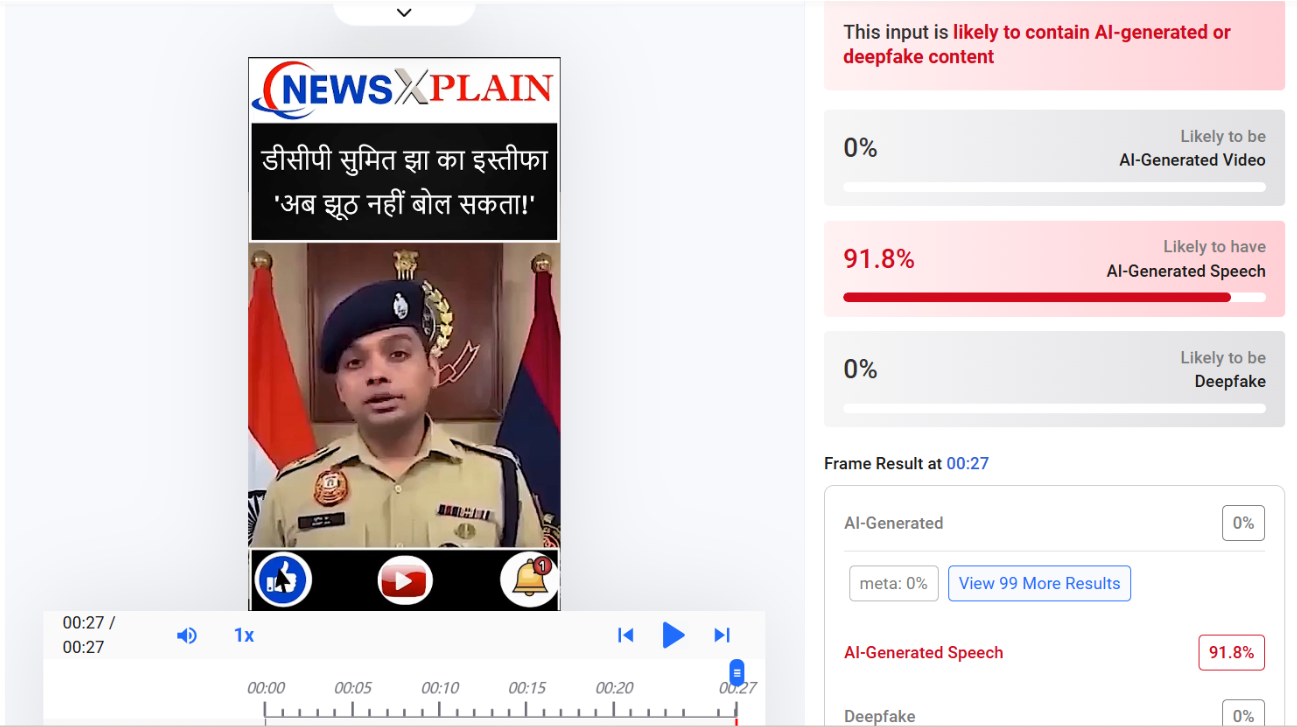
CyberPeace Research Wing’s research found the claim to be false. The research revealed that DCP Sumit Jha has not resigned from his position. The viral video was digitally manipulated by adding AI-generated audio to an original video shared by the Delhi Police on its official X account on July 23, 2026.
The video was further analysed using the AI detection tool HIVE Moderation. The tool’s analysis indicated that the audio used in the viral video had a 91.8 per cent probability of being AI-generated, confirming that the audio was artificially created and was not authentic.
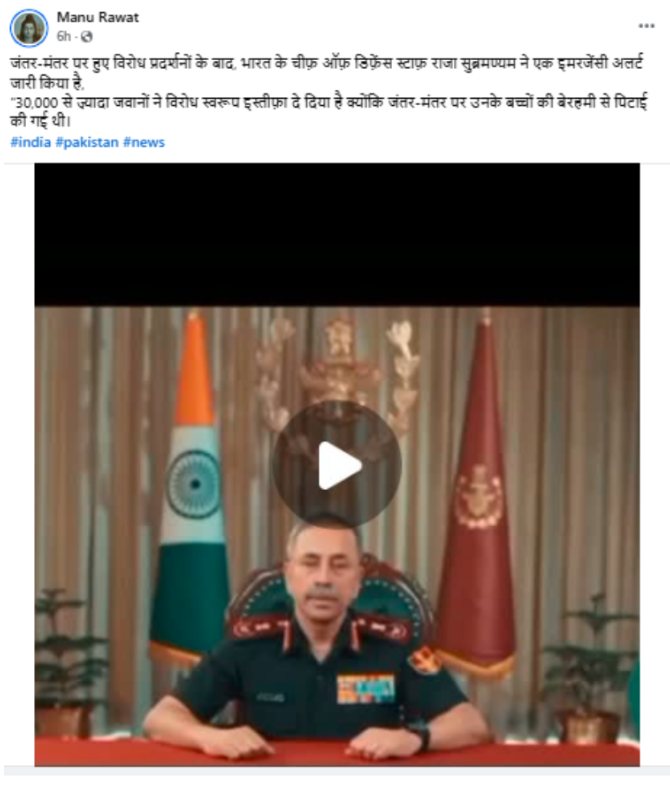
Claim 2: CDS Raja Subramani confirmed that more than 30,000 soldiers resigned over Jantar Mantar protests
A video featuring Chief of Defence Staff (CDS) General Raja Subramani was widely circulated on social media with the false claim that he confirmed the resignation of more than 30,000 Indian Army personnel following the Jantar Mantar protest. The viral video claimed that soldiers had refused to serve the government after police action against protesting students.
Claim
A Facebook user shared the video claiming: "After the protests at Jantar Mantar, India’s Chief of Defence Staff Raja Subramani has issued an emergency alert, saying that more than 30,000 soldiers have resigned in protest because their children were brutally beaten at Jantar Mantar."
Fact Check
CyberPeace Research Wing’s research found the claim to be false. The research revealed that the video featuring CDS Raja Subramani was digitally manipulated using AI-generated audio. The original video did not contain any statement related to soldiers resigning or the Jantar Mantar protest. Further research led us to the same video posted by the Instagram account myyouthindia, where CDS Raja Subramani can be seen extending his best wishes to teams participating in the 135th Indian Oil Durand Cup Football Tournament. https://www.instagram.com/reels/DbEGRGBsKv8/

The audio circulating with the viral video was falsely added to create a misleading narrative.
Claim 3: Defence Minister Rajnath Singh warned protesters of strict action
A video featuring Union Defence Minister Rajnath Singh was widely circulated on social media with the claim that he issued a strict warning against student protesters. In the viral clip, Singh was allegedly heard saying that the government would not tolerate “anarchy” and that strict action would be taken against those blocking roads, disturbing public order or damaging government property.
Claim
An X user (@ForumDefence) shared the video on July 22, 2026, claiming that Rajnath Singh had issued a warning regarding the ongoing student protest.

Fact Check
CyberPeace Research Wing’s research found the claim to be false.The original video available on Rajnath Singh’s official YouTube channel was digitally altered by adding AI-generated audio. The statement heard in the viral video was not made by the Defence Minister and was created using artificial intelligence. The viral video was also analysed using the AI detection tool HIVE Moderation. The analysis indicated that the speech used in the video had an 88.1 per cent probability of being AI-generated.

Claim 4: Piyush Goyal threatened to hang CJP supporters
A video of Union Minister Piyush Goyal was shared on social media with the false claim that he threatened protesters and called for two to three CJP supporters to be hanged to "teach the rest of them a lesson." In the AI-manipulated video, Goyal was allegedly heard saying: "To teach the CJP a lesson, we should hang two to three of its supporters so that they understand the real power of the government."
https://x.com/HinduReformer/status/2080367073117790288?s=20

Fact Check
CyberPeace Research Wing’s research found that the viral video was digitally manipulated using AI-generated audio. The original video, posted on the Press Trust of India’s official X account, showed Piyush Goyal discussing the government’s response to examination paper leaks and appealing for the issue to be resolved through dialogue. He made no remarks threatening protesters or calling for the execution of CJP supporters.
The audio and statements attributed to him in the viral video were fabricated using AI technology.

Conclusion
CyberPeace Research Wing’s research found that all four viral claims related to the CJP protest were false. The videos circulating on social media were either digitally manipulated or created using AI-generated audio to falsely attribute statements to public officials. The research highlights how AI-generated deepfakes and manipulated content are increasingly being used to spread misinformation during sensitive events.
