
#FactCheck: AI-Generated Video Falsely Claims Israelis Recited Hanuman Chalisa in Hebrew at Tel Aviv Concert
Executive Summary
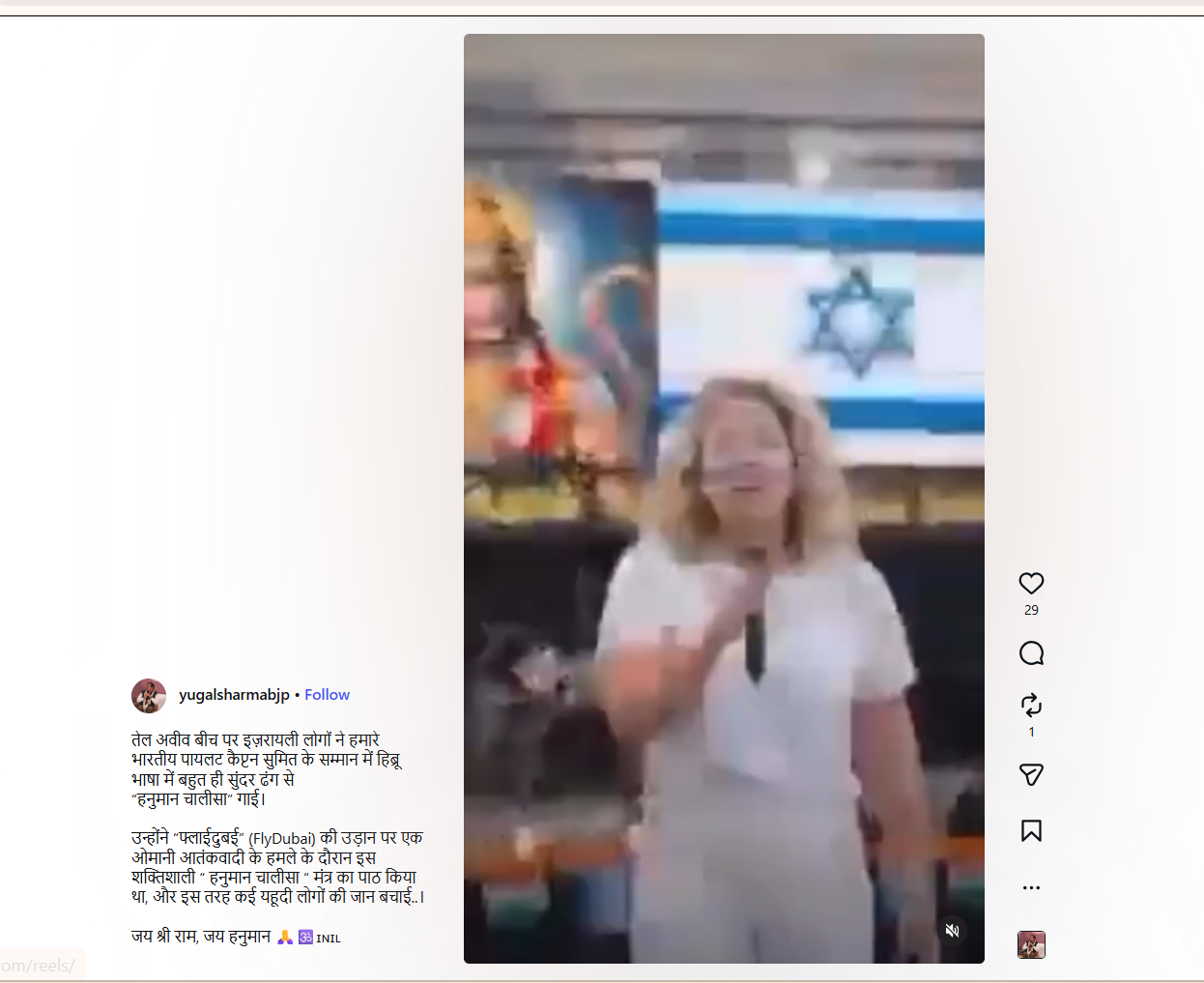
A video of a concert allegedly held on a beach in Tel Aviv, Israel, is circulating on social media. It is being shared with the claim that thousands of Israeli citizens recited the Hanuman Chalisa in Hebrew during the event.The post also links the event to Indian pilot Captain Smit Machhar, claiming that the programme was organised in his honour for saving the lives of passengers aboard a FlyDubai aircraft in September 2026.
CyberPeace Research found the viral claim to be false. Our research revealed that the video is AI-generated and is being shared with a misleading claim.
Claim
On October 27, 2026, an Instagram user shared the viral video with the caption: “On Tel Aviv beach, Israelis beautifully sang the Hanuman Chalisa in Hebrew in honour of our Indian pilot, Captain Sumit. He had recited this powerful ‘Hanuman Chalisa’ mantra during an attack by an Omani terrorist on a FlyDubai flight, thereby saving the lives of many Jewish people.” The post link, archive link and screenshot are provided below.
https://www.instagram.com/reels/De_r8uSzGuh/
Fact Check
To verify the viral claim, we conducted a Google search using relevant keywords. However, we did not find any credible media reports confirming the claim.
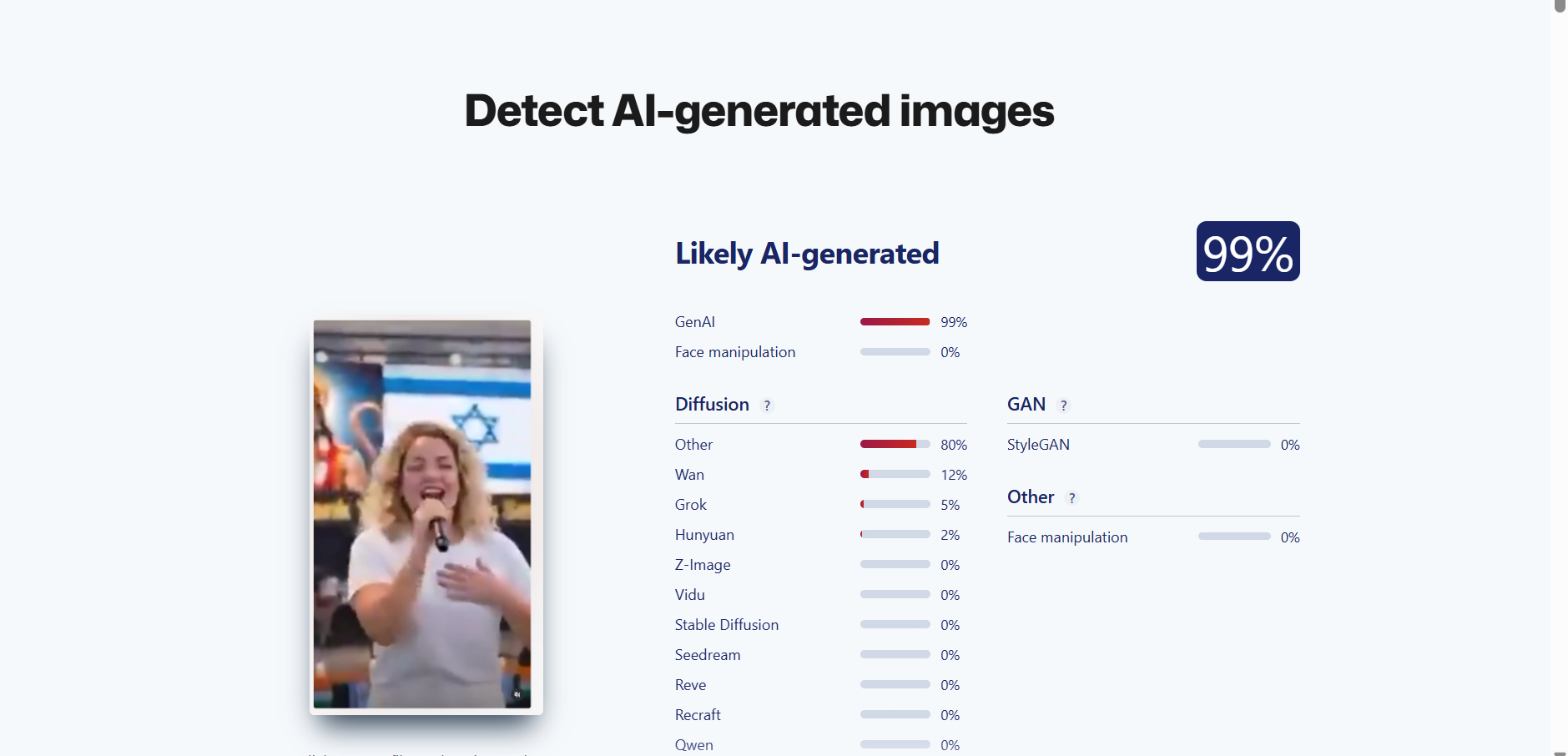
As part of our research, we scanned the viral video using the AI detection tool SIGHTENGINE. According to the results, the video is 99 per cent likely to be AI-generated.
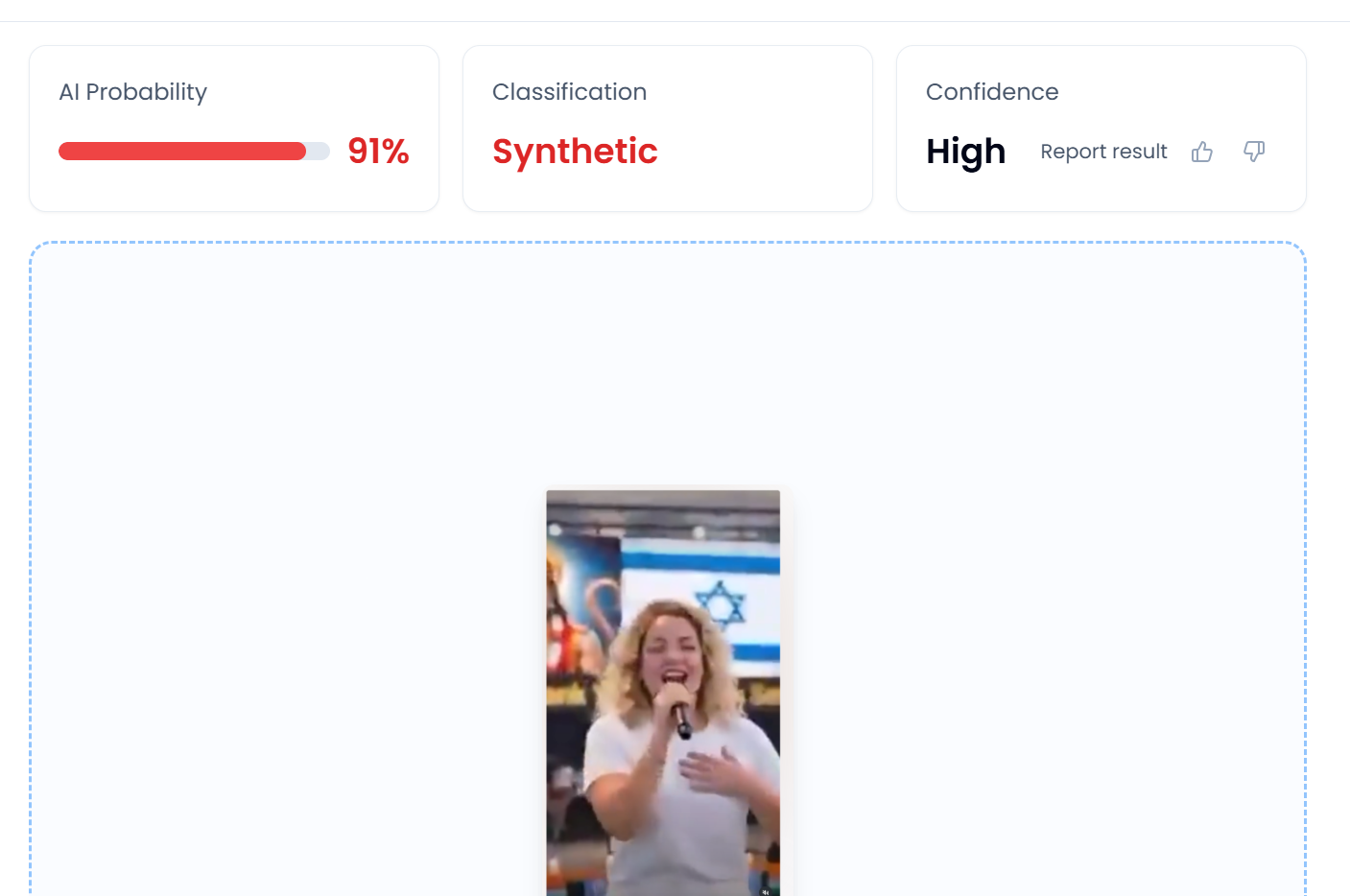
As part of our research, we scanned the viral video using the AI detection tool Truthscan. According to the results, the video is 91 per cent likely to be AI-generated.
Conclusion
Our research found that the viral video is AI-generated and is being shared with a misleading claim.

Related Blogs

Introduction
The commercialization of synthetic fraud has rapidly transformed from an abstract threat into a multi-billion-dollar shadow economy. As per the recent threat intelligence data from firms like identifAI, synthetic media and deepfakes now amounts to an estimated $40 billion in global financial fraud. The need for advanced coding skills are no longer required to bypass secure perimeters, as the Cybercriminals can now readily purchase real-time customised voice clones, face swapping software and other such identity morphing plugins from highly structured digital marketplaces.
The democratisation of advanced generative AI tools marks a fundamental pivot from traditional text-based phishing to real time synthetic fraud. Synthetic fraud operates on a heavily commercialized, “as a service” business model, by buying access to specialised tools developed by a smaller tier of highly skilled Engineers. According to the industry tracking, synthetic attacks are primarily split across three key mediums: audio-voice cloning (21.9%), Video Synthesis (42.7%), and identity morphing & fabrication (17.6%).
What does the data shows
The report finds that the United States is the largest target or source market (34.1%), followed by India (7.7%) and the UK (6.6%).Social media serves as the primary source for attackers to gather the personal audio and video data used in these schemes, with X accounting for 42.1% of reconnaissance activity and LinkedIn for 14.5% as executives’ public files are harvested.
While US generative AI-enabled fraud losses are projected by Deloitte to rise from $12.3 billion in 2023 to $40 billion by 2027, this trajectory is mirrored by Javelin’s 2025 estimate of $38 billion in total US identity fraud. Entrust’s 2026 finding that deepfakes account for one in five biometric fraud attempts, underscoring a consistent upward trend despite varying methodologies.
Emerging Trends
The landscape of digital fraud is shifting rapidly due to four emerging trends. Firstly, the industrialization of cybercrime allows attackers to use ready-made toolkits and virtual camera injection software to bypass biometric and identity checks. Second, these threats are targeting financial controls, moving past simple consumer hoaxes into remote onboarding and internal payment systems. Third, attackers are conducting reconnaissance at scale, using just seconds of public audio to clone executive voices. Finally, the rise of agentic AI means manipulated inputs can deceive automated software agents before a transaction even reaches the bank, shifting the primary security challenge from verifying identity to confirming data authenticity.
Risks and Implications
Bengaluru police data shows deepfake and “deep nude” cases rising from none in 2022 to 37 in 2025, with 32 recorded by 30 June 2026. Nationally, Indian Cybercrime Coordination Centre (I4C) data records 12.71 lakh cyber-fraud complaints and losses above Rs 10,178 crore in January–June 2026 (all fraud types, not deepfake-specific), driven by investment fraud, “digital arrest” scams and impersonation. An ORF survey found 47% of Indian adults had experienced or knew someone affected by an AI voice-cloning or deepfake scam, against a 25% global average. Recovery lags: of Rs 64,447 crore lost between 2021 and May 2026, about Rs 10,718 crore was frozen and only Rs 323 crore refunded.
Faces and voices have long served as informal proof of identity. Both identity systems and human instinct were built for a pre-generative era. identifAI argues that losses are being passed to consumers through higher banking fees and insurance premiums, and that the same attack works on hospitals and councils as readily as on banks.
As fakes proliferate, genuine evidence can be dismissed as fabricated. Deloitte’s 2025 survey, found nearly 70% of respondents worried about being deceived by synthetic content and nearly 60% struggling to tell it from human-made material.
Detection is necessary but not sufficient as detectors can lag generators, and vendors publishing market estimates have commercial interests. Any defence relying on a single classifier is brittle.
Policy Perspectives
India’s IT Rules amendment, notified on 10 February 2026 and effective from 20 February, brought “synthetically generated information” into the due-diligence framework: prominent labelling, provenance metadata, user declarations, and compressed takedown windows of as little as three hours for certain unlawful content and two hours for non-consensual intimate imagery.
As per EU’s AI Act, Article 50, applicable since 02 August 2026, requires deepfake disclosure, with fines up to EUR 15 million or 3% of worldwide turnover. In the US, identifAI points to the FTC Impersonation Rule and the TAKE IT DOWN Act, which points towards policy agenda in lieu of synthetic deception.
These measures matter, but a gap remains. Labelling regimes govern public content on compliant platforms, whereas fraud unfolds in private calls, messaging apps (mostly through Over-The-Top Platforms) and onboarding sessions where criminals will not label their output. Provenance rules reduce the supply of deceptive content; they do not authenticate a transaction. Financial-sector standards for onboarding verification, liability allocation and rapid fund recovery are the next policy frontier.
The Way Forward
For Organisations:
- Never let a single call or message authorise a transfer. Require callbacks to known numbers and dual approval for high-value or unusual payments.
- Layer identity defences: injection-attack detection, device and session signals, and deepfake detection embedded in workflows, not face matching alone.
- Limit executive media exposure and run realistic simulations in staff training.
For Individuals:
- Pause when urgency, secrecy and money appear together. Verify through a second channel, agree a family code word, and report quickly to 1930 or cybercrime.gov.in, as early reporting improves the chance of freezing funds.
For Policymakers and platforms:
- Harmonise provenance standards, set clear financial-sector verification obligations, speed up fund freezing and refunds, and invest in public digital literacy.
Conclusion
The $40 billion USD figure is an estimate, but the direction it describes is indisputable. Deepfakes have turned perception, once our most reliable tool, into an attack surface, and attackers are adapting faster than the controls built to stop them. While labelling and provenance rules help, they cannot authenticate a payment or an onboarding session on their own. Rebuilding digital trust requires moving from "trust what you see" to "trust what you can verify." This shift demands layered identity checks, out-of-band confirmation, and faster fund recovery, all backed by shared accountability across industry, regulators, and citizens.
References
- Bacudo, K. J. (2026, October 14). Deepfake fraud market hits USD $40 billion, report says. SecurityBrief Australia. https://securitybrief.com.au/story/deepfake-fraud-market-hits-usd-40-billion-report-says
- Entrust. (2025). 2026 identity fraud report. https://www.entrust.com/resources/reports/identity-fraud-report
- Investment frauds surge in Bengaluru. (2026, August 3). Deccan Herald. https://www.deccanherald.com/india/karnataka/bengaluru/investment-frauds-surge-in-bengaluru-4096890
- Javelin Strategy & Research. (2026, April 21). 2026 identity fraud study: The illusion of progress. https://javelinstrategy.com/node/35385
- Lalchand, S., Srinivas, V., Maggiore, B., & Henderson, J. (2024, May 29). Generative AI is expected to magnify the risk of deepfakes and other fraud in banking. Deloitte Insights. https://www.deloitte.com/us/en/insights/industry/financial-services/deepfake-banking-fraud-risk-on-the-rise.htm

Executive Summary
A video of Prime Minister Narendra Modi is being widely shared on social media, in which he appears to say that every woman would receive 1 gram of gold free against one Aadhaar card. The clip is being circulated with misleading claims suggesting a government scheme. Research by CyberPeace Research Wing found that the audio of Prime Minister Modi’s 2019 video was manipulated using AI technology and shared with a misleading claim.
Claim
An Instagram user shared the viral video claiming that PM Modi announced free gold for women.

Fact Check
To verify the claim, we conducted a keyword search on Google but found no credible media reports or official announcements supporting such a scheme. We then extracted keyframes from the viral clip and performed a reverse image search. This led us to the original video uploaded by DD News on February 24, 2019. In the authentic footage, PM Modi was addressing a public rally in Gorakhpur. At no point did he mention distributing gold to women.

Further examination of the viral clip raised suspicions of audio manipulation. We analyzed the speech using AI detection tool Hive Moderation, which indicated a 99% probability that the speech was AI-generated.

Conclusion
Our research found that the viral claim is false. The video uses footage from PM Modi’s 2019 speech, while the original audio appears to have been replaced using AI-generated voice technology to spread a misleading claim about free gold distribution.

Introduction
In a major policy shift aimed at synchronizing India's fight against cyber-enabled financial crimes, the government has taken a landmark step by bringing the Indian Cyber Crime Coordination Centre (I4C) under the ambit of the Prevention of Money Laundering Act (PMLA). In the notification released in the official gazette on 25th April, 2025, the Department of Revenue, Ministry of Finance, included the Indian Cyber Crime Coordination Centre (I4C) under Section 66 of the Prevention of Money Laundering Act, 2002 (hereinafter referred to as “PMLA”). The step comes as a significant attempt to resolve the asynchronous approach of different agencies (Enforcement Directorate (ED), State Police, CBI, CERT-In, RBI) set up under the government responsible for preventing and often possessing key information regarding cyber crimes and financial crimes. As it is correctly put, "When criminals sprint and the administration strolls, the finish line is lost.”
The gazetted notification dated 25th April, 2025, read as follows:
“In exercise of the powers conferred by clause (ii) of sub-section (1) of section 66 of the Prevention of Money-laundering Act, 2002 (15 of 2003), the Central Government, on being satisfied that it is necessary in the public interest to do so, hereby makes the following further amendment in the notification of the Government of India, in the Ministry of Finance, Department of Revenue, published in the Gazette of India, Extraordinary, Part II, section 3, sub-section (i) vide number G.S.R. 381(E), dated the 27th June, 2006, namely:- In the said notification, after serial number (26) and the entry relating thereto, the following serial number and entry shall be inserted, namely:— “(27) Indian Cyber Crime Coordination Centre (I4C).”.
Outrunning Crime: Strengthening Enforcement through Rapid Coordination
The usage of cyberspace to commit sophisticated financial crimes and white-collar crimes is a one criminal parallel passover that no one was looking forward to. The disenchanted reality of today’s world is that the internet is used for as much bad as it is for good. The internet has now entered the financial domain, facilitating various financial crimes. Money laundering is a financial crime that includes all processes or activities that are in connection with the concealment, possession, acquisition, or use of proceeds of crime and projecting it as untainted money. In the offence of money laundering, there is an intricate web and trail of financial transactions that are hard to track, as they are, and with the advent of the internet, the transactions are often digital, and the absence of crucial information hampers the evidentiary chain. With this new step, the Enforcement Directorate (ED) will now make headway into the investigation with the information exchange under PMLA from and to I4C, removing the obstacles that existed before this notification.
Impact
The decision of the finance ministry has to be seen in terms of all that is happening around the globe, with the rapid increase in sophisticated financial crimes. By formally empowering the I4C to share and receive information with the Enforcement Directorate under PMLA, the government acknowledges the blurred lines between conventional financial crime and cybercrime. It strengthens India’s financial surveillance, where money laundering and cyber fraud are increasingly two sides of the same coin. The assessment of the impact can be made from the following facilitations enabled by the decision:
- Quicker internet detection of money laundering
- Money trail tracking in real time across online platforms
- Rapid freeze of cryptocurrency wallets or assets obtained fraudulently
Another important aspect of this decision is that it serves as a signal that India is finally equipping itself and treating cyber-enabled financial crimes with the gravitas that is the need of the hour. This decision creates a two-way intelligence flow between cybercrime detection units and financial enforcement agencies.
Conclusion
To counter the fragmented approach in handling cyber-enabled white-collar crimes and money laundering, the Indian government has fortified its legal and enforcement framework by extending PMLA’s reach to the Indian Cyber Crime Coordination Centre (I4C). All the decisions and the brainstorming that led up to this notification are crucial at this point in time for the cybercrime framework that India needs to be on par with other countries. Although India has come a long way in designing a robust cybercrime intelligence structure, as long as it excludes and works in isolation, it will be ineffective. So, the current decision in discussion should only be the beginning of a more comprehensive policy evolution. The government must further integrate and devise a separate mechanism to track “digital footprints” and incorporate a real-time red flag mechanism in digital transactions suspected to be linked to laundering or fraud.
