
#FactCheck-AI-Manipulated Video Falsely Claims PM Modi Promised Free Gold for Women
Executive Summary
A video of Prime Minister Narendra Modi is being widely shared on social media, in which he appears to say that every woman would receive 1 gram of gold free against one Aadhaar card. The clip is being circulated with misleading claims suggesting a government scheme. Research by CyberPeace Research Wing found that the audio of Prime Minister Modi’s 2019 video was manipulated using AI technology and shared with a misleading claim.
Claim
An Instagram user shared the viral video claiming that PM Modi announced free gold for women.

Fact Check
To verify the claim, we conducted a keyword search on Google but found no credible media reports or official announcements supporting such a scheme. We then extracted keyframes from the viral clip and performed a reverse image search. This led us to the original video uploaded by DD News on February 24, 2019. In the authentic footage, PM Modi was addressing a public rally in Gorakhpur. At no point did he mention distributing gold to women.

Further examination of the viral clip raised suspicions of audio manipulation. We analyzed the speech using AI detection tool Hive Moderation, which indicated a 99% probability that the speech was AI-generated.

Conclusion
Our research found that the viral claim is false. The video uses footage from PM Modi’s 2019 speech, while the original audio appears to have been replaced using AI-generated voice technology to spread a misleading claim about free gold distribution.

Related Blogs
Executive Summary:
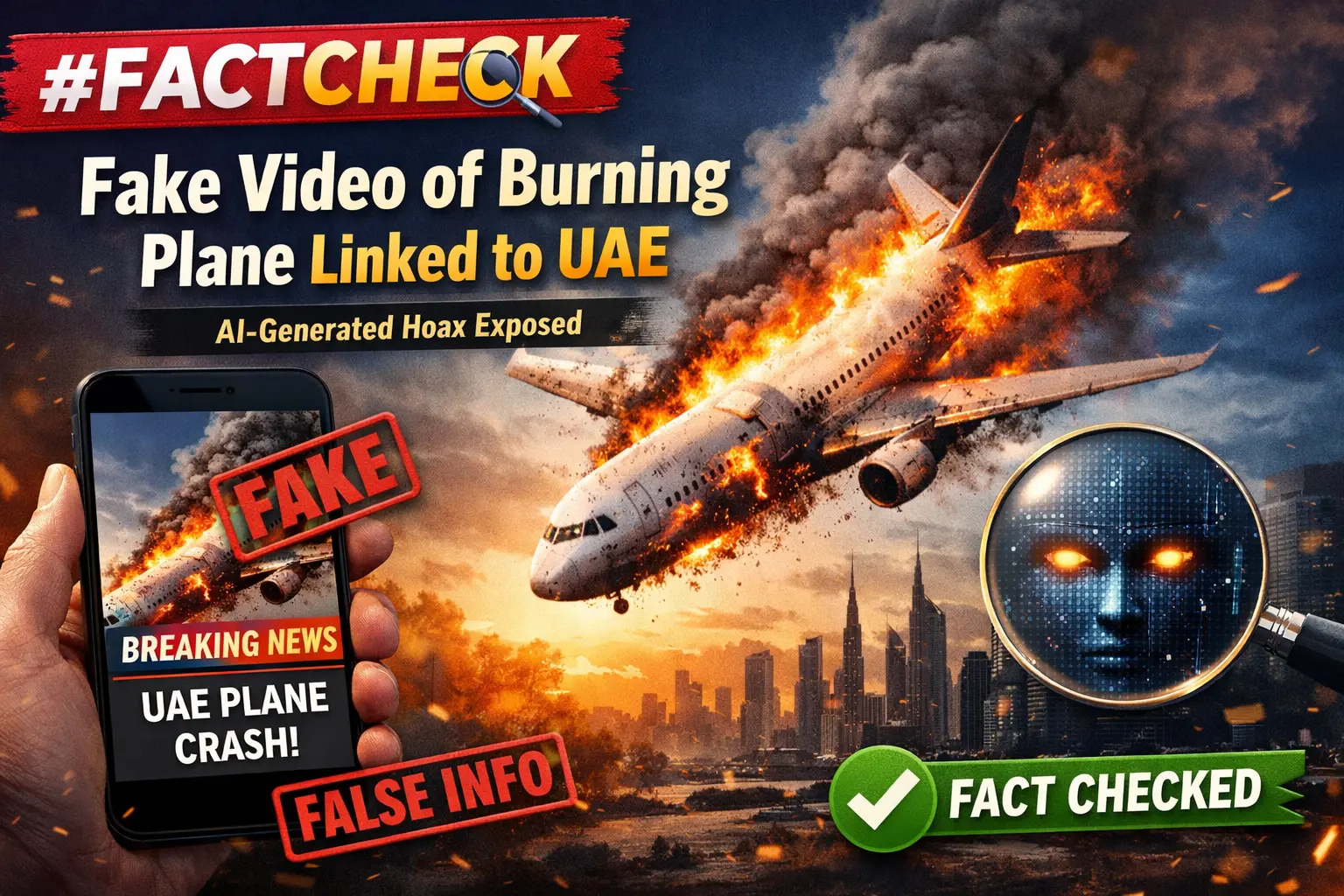
A video is being shared on social media showing an aircraft engulfed in massive flames on an airport runway. The video is being linked to the UAE. It is being claimed that a UAE airport was completely destroyed due to recent drone and missile attacks by Iran. Research by the CyberPeace found the viral claim to be false. Our research revealed that the viral video is not real, but AI-generated.
Claim:
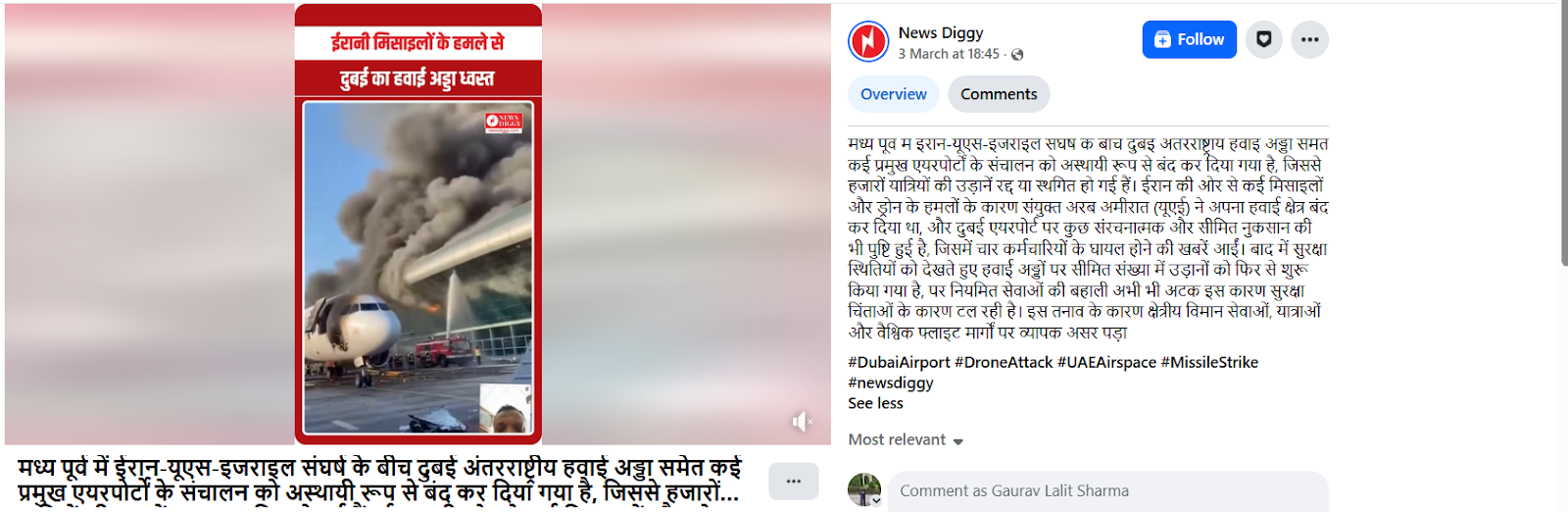
On social media platform Facebook, a user shared the viral video on March 3, 2026, and wrote, “Amid the Iran-US-Israel conflict in the Middle East, operations at several major airports, including Dubai International Airport, have been temporarily suspended, causing thousands of flight cancellations and delays. Due to multiple missile and drone attacks from Iran, the United Arab Emirates (UAE) had shut its airspace, and limited structural damage at Dubai Airport was also confirmed, with reports of four staff members being injured. Later, considering the security situation, a limited number of flights were resumed, but full operations are still delayed due to ongoing safety concerns. This tension has significantly impacted regional aviation, travel, and global flight routes.”
Fact Check:
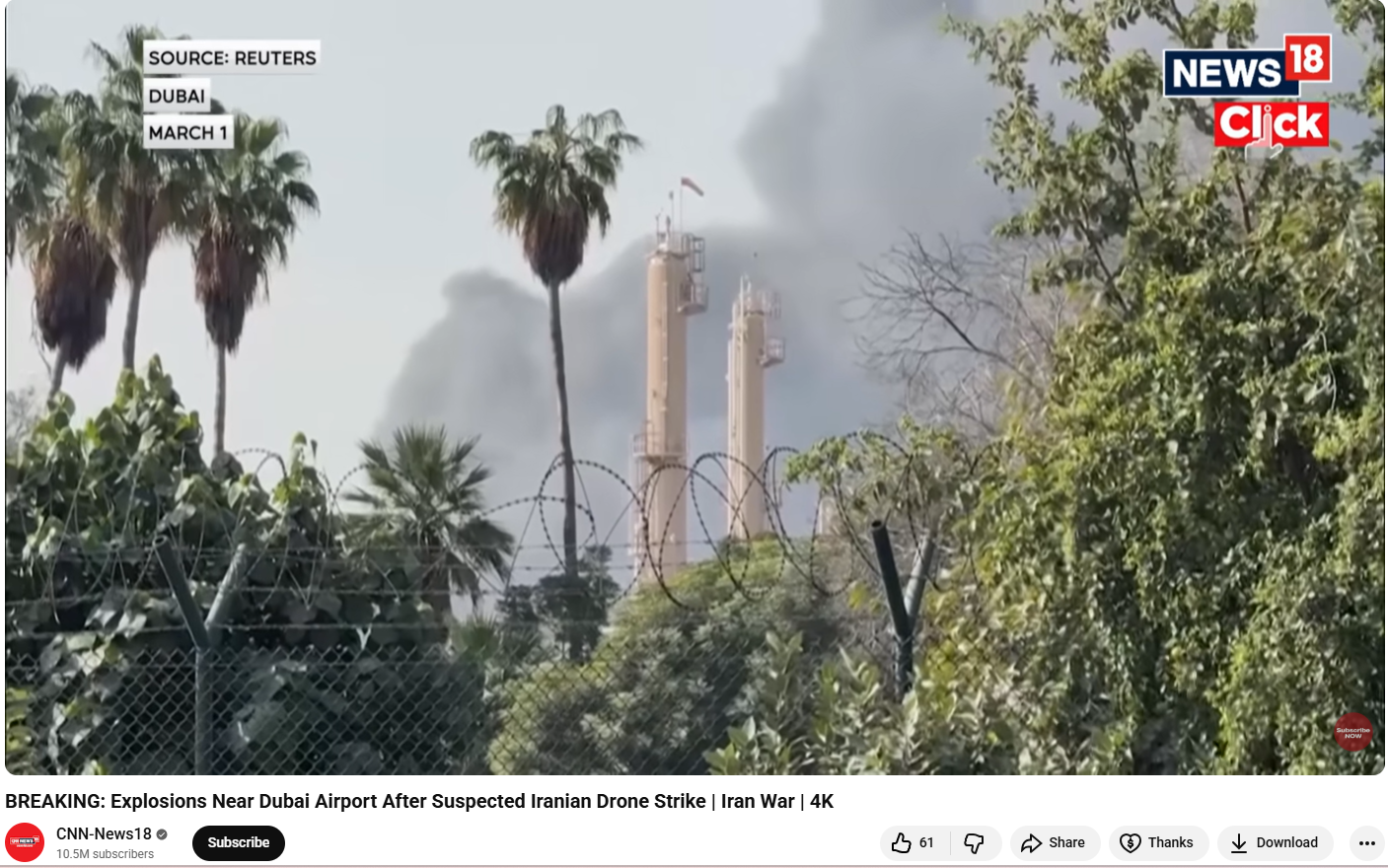
To verify the viral video, we searched relevant keywords on Google. However, we did not find any credible media report confirming the claim.However, we found a video report on the YouTube channel of CNN-News18 mentioning explosions near Dubai Airport after a suspected Iranian drone strike. But the visuals shown in that report are completely different from the viral video.
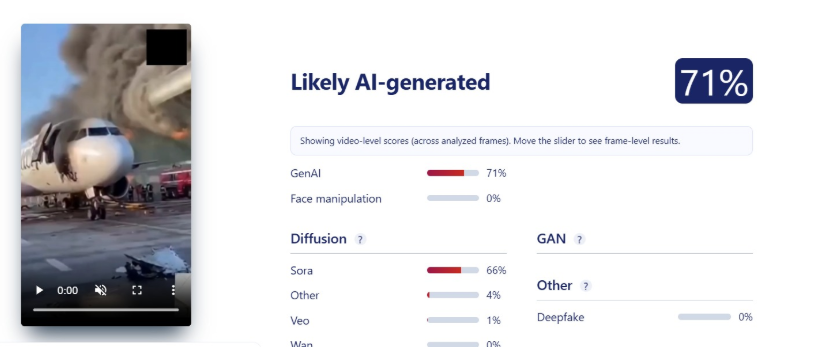
Upon closely examining the viral video, we noticed several inconsistencies, raising suspicion that it might be AI-generated. We then analyzed the video using the AI detection tool Sightengine. The results indicated that the video is 71 percent likely to be AI-generated.
Conclusion:
Our research found that the viral video is not real, but AI-generated.

Executive Summary:
On 20th May, 2024, Iranian President Ebrahim Raisi and several others died in a helicopter crash that occurred northwest of Iran. The images circulated on social media claiming to show the crash site, are found to be false. CyberPeace Research Team’s investigation revealed that these images show the wreckage of a training plane crash in Iran's Mazandaran province in 2019 or 2020. Reverse image searches and confirmations from Tehran-based Rokna Press and Ten News verified that the viral images originated from an incident involving a police force's two-seater training plane, not the recent helicopter crash.
Claims:
The images circulating on social media claim to show the site of Iranian President Ebrahim Raisi's helicopter crash.


Fact Check:
After receiving the posts, we reverse-searched each of the images and found a link to the 2020 Air Crash incident, except for the blue plane that can be seen in the viral image. We found a website where they uploaded the viral plane crash images on April 22, 2020.

According to the website, a police training plane crashed in the forests of Mazandaran, Swan Motel. We also found the images on another Iran News media outlet named, ‘Ten News’.
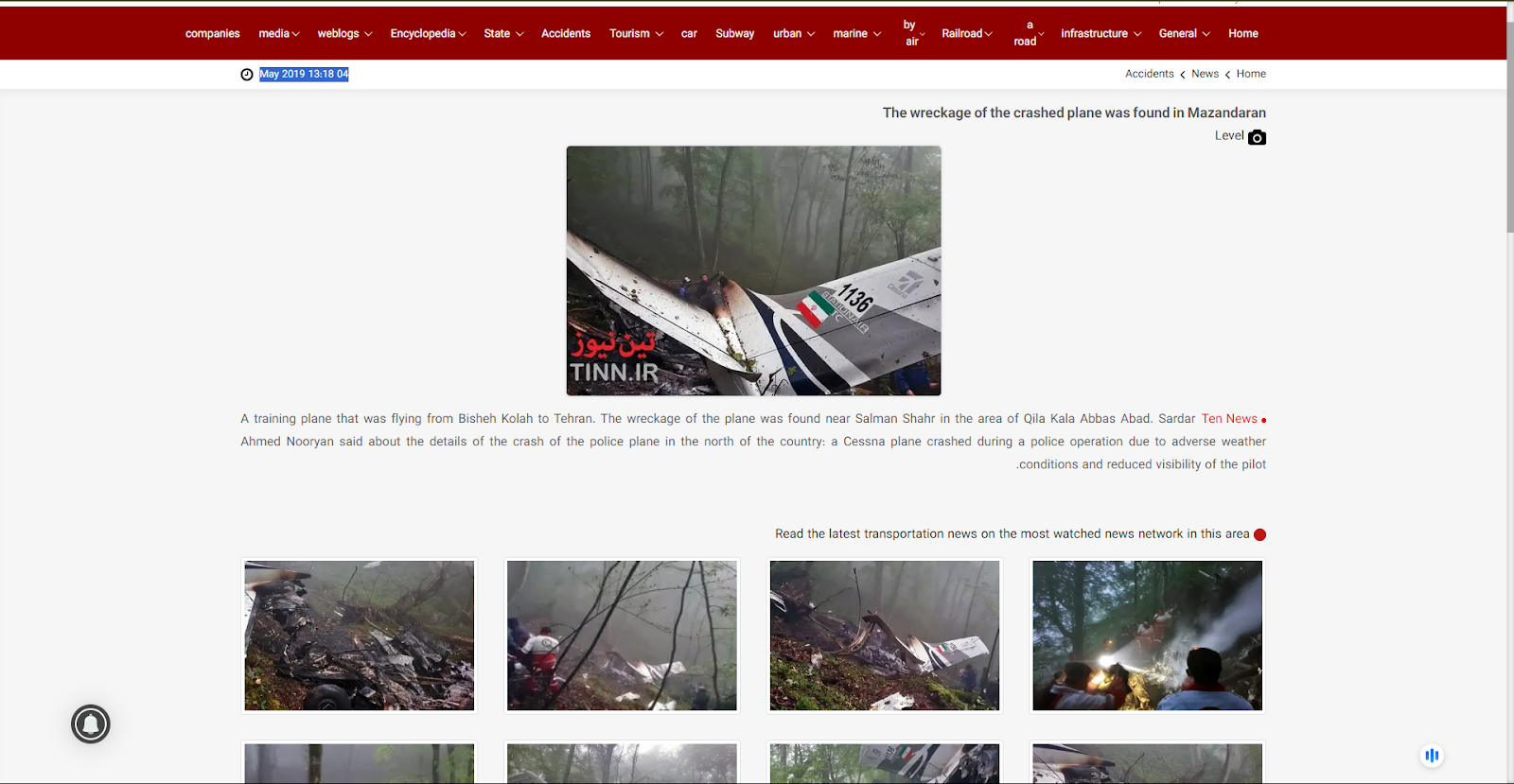
The Photos uploaded on to this website were posted in May 2019. The news reads, “A training plane that was flying from Bisheh Kolah to Tehran. The wreckage of the plane was found near Salman Shahr in the area of Qila Kala Abbas Abad.”
Hence, we concluded that the recent viral photos are not of Iranian President Ebrahim Raisi's Chopper Crash, It’s false and Misleading.
Conclusion:
The images being shared on social media as evidence of the helicopter crash involving Iranian President Ebrahim Raisi are incorrectly shown. They actually show the aftermath of a training plane crash that occurred in Mazandaran province in 2019 or 2020 which is uncertain. This has been confirmed through reverse image searches that traced the images back to their original publication by Rokna Press and Ten News. Consequently, the claim that these images are from the site of President Ebrahim Raisi's helicopter crash is false and Misleading.
- Claim: Viral images of Iranian President Raisi's fatal chopper crash.
- Claimed on: X (Formerly known as Twitter), YouTube, Instagram
- Fact Check: Fake & Misleading

Executive Summary
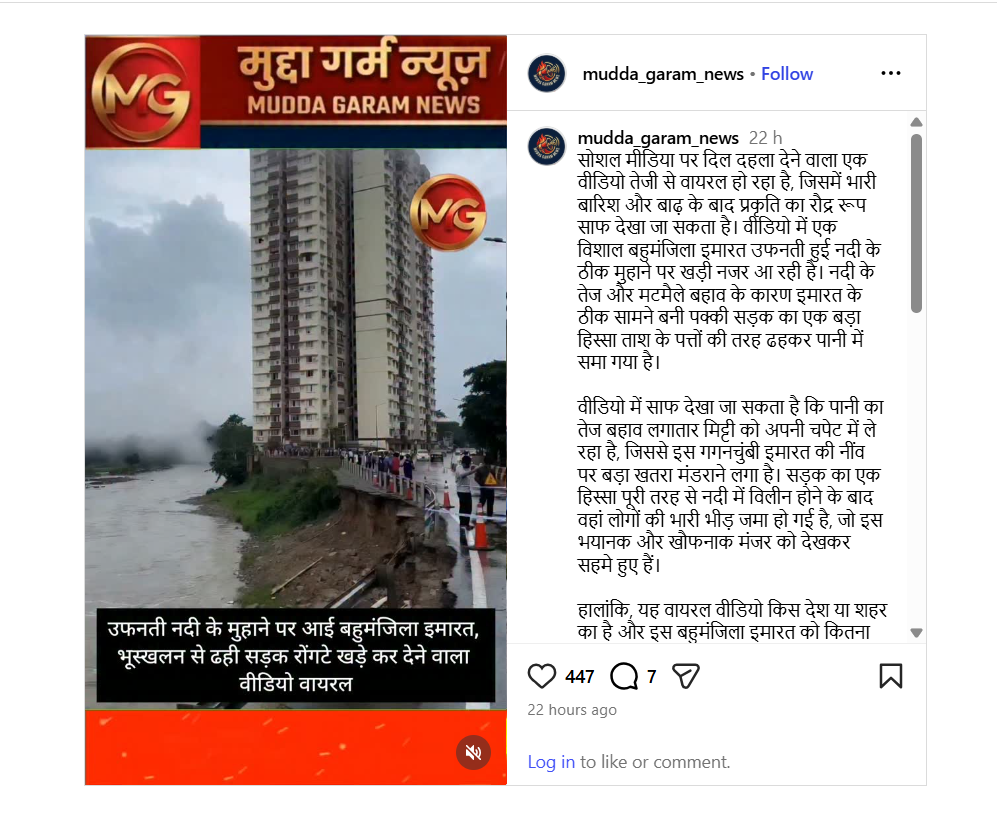
A video is being shared on social media showing a multi-storey building located beside what appears to be a river. A road runs alongside the building, with visible erosion and large cracks. A crowd of people can be seen standing near the edge of the road close to the building. Suddenly, the front portion of the building collapses into the water, followed moments later by the rear section tilting and falling into the river. As the building collapses, people are seen running in panic. The video is being shared with the claim that it shows a real incident in which a multi-storey building collapsed like a house of cards due to heavy rainfall, a swollen river, and severe erosion that also caused part of the road to cave in. CyberPeace Research Wing’s research found the viral claim to be false. Our research revealed that the video is not real. It was generated using Artificial Intelligence (AI) and is being circulated with a false claim.
Claim
An Instagram user shared the viral video on July 15, 2026, claiming that it shows a multi-storey building collapsing into a swollen river due to heavy rainfall and strong water currents, while part of the adjacent road also collapsed because of a landslide.
https://www.instagram.com/reel/DazTcrBCBrI/?utm_source=ig_web_button_share_sheet
Fact Check
To verify the claim, we extracted several keyframes from the viral video and conducted a reverse image search using Google Lens. During the research, we found no credible news reports, authentic videos, or reliable sources related to the incident. However, we found the same video uploaded on a YouTube Shorts channel named @mohammedalmekhlafiht1555. The channel's cover image describes the creator as an "AI & Automation Engineer." In addition, the descriptions of videos uploaded on the channel explicitly mention "Made With AI."
https://youtube.com/shorts/zFotETyAz8E?si=b6wj_eAG-nj7U1HE


We also carried out a detailed visual analysis of the footage. During the collapse, the front portion of the building falls into the water almost as a single block without breaking apart, which is highly unrealistic. After a brief pause, the rear section tilts and also falls almost intact onto the first section, without disintegrating despite the massive impact. The behaviour of people in the video also appears unnatural. Some individuals are seen running with their hands raised, while others inexplicably move toward the collapsing building and even jump into the water. Workers repairing the damaged road appear completely unaffected by the nearby collapse. In a real structural failure of this magnitude, buildings typically break apart into multiple sections, generating debris, dust, and strong shockwaves that would significantly affect nearby people.

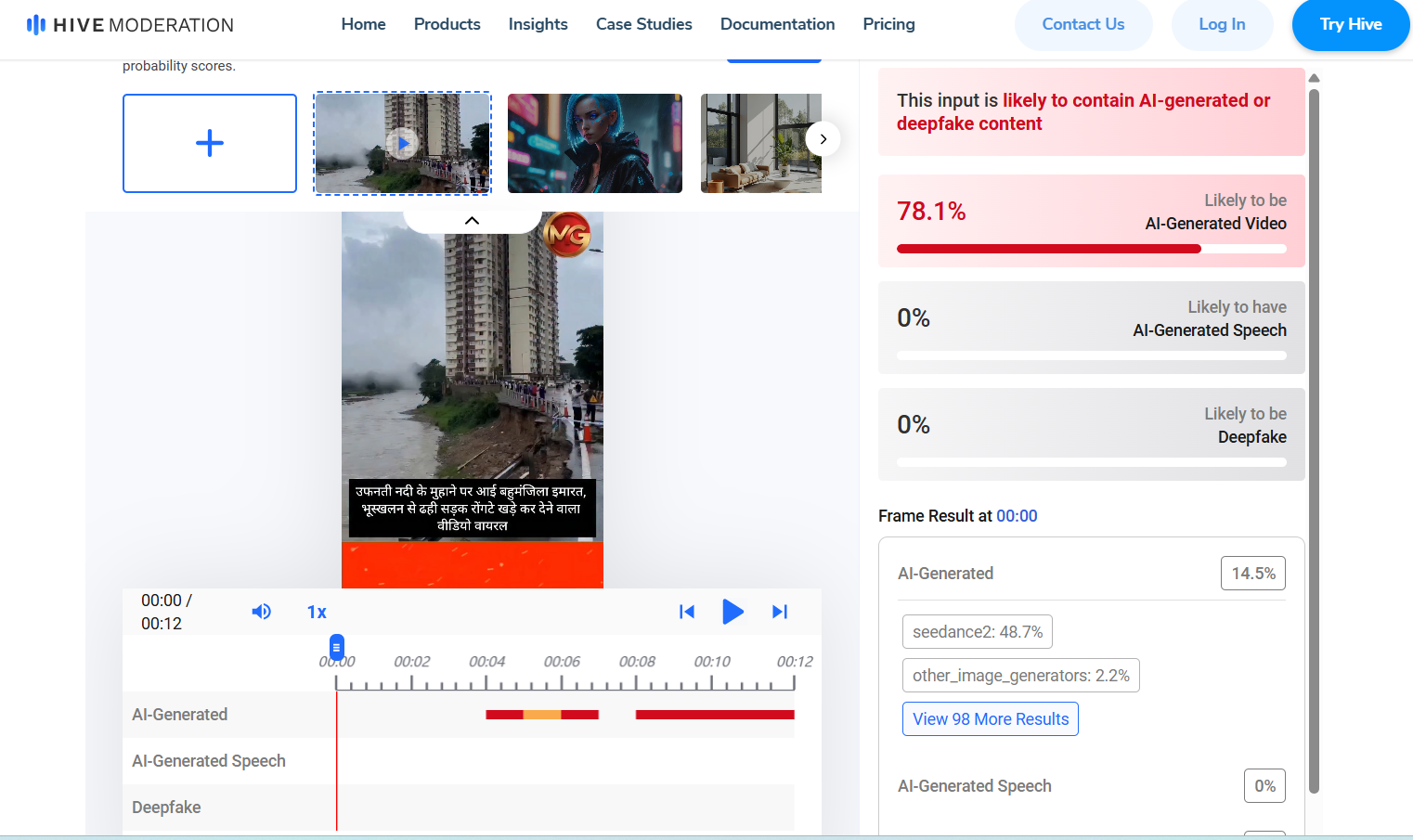
In the next stage of our research, we analysed the video using the AI detection tool Hive Moderation, which indicated a 78.1% probability that the video was AI-generated.
For additional verification, we also examined the video using AI or Not, which concluded that the footage has a 96% probability of being AI-generated.

Finally, we analysed the video using Wasit.AI, which also indicated a 75% probability that the video had been created using Artificial Intelligence.

Conclusion
Our research found that the viral video does not depict a real incident. It was generated using Artificial Intelligence and is being shared on social media with a false and misleading claim that it shows a multi-storey building collapsing into a river due to heavy rainfall and erosion.
