
#FactCheck: AI-Generated Video Falsely Shared as CCTV Footage of Seemapuri Building Collapse in Delhi
Executive Summary
A four-storey building collapsed in Seemapuri, Delhi, on October 7, 2026, killing five people. A video of a building collapsing is being widely shared on social media as CCTV footage of the incident. Some users are claiming that the video shows the building collapse in Seemapuri. CyberPeace Research found that the viral video was AI-generated. However, it is true that five people died after a building collapsed in Seemapuri, Delhi.
Claim
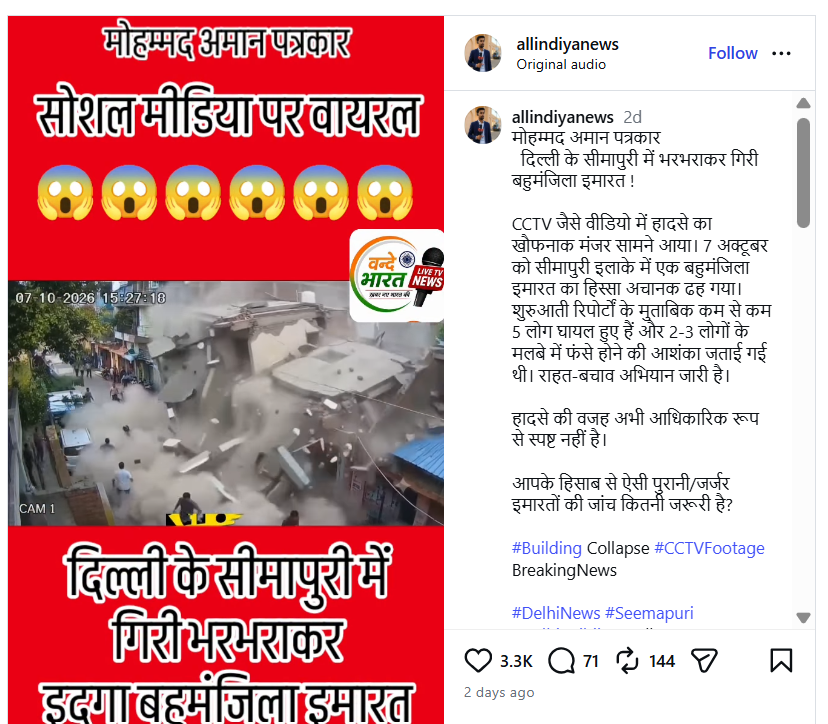
On October 8, 2026, Instagram user ‘allindiyanews’ posted a video (archive link) with the caption: “A multi-storey building collapsed in Seemapuri, Delhi. The horrifying moment of the accident has emerged in a CCTV-like video. On October 7, a portion of a multi-storey building suddenly collapsed in the Seemapuri area. According to initial reports, at least five people were injured, while two to three people were feared trapped under the debris. Rescue operations are underway. The cause of the incident has not yet been officially established. In your opinion, how important is it to inspect old and dilapidated buildings?”
https://www.instagram.com/allindiyanews/reel/DePIdTApNZw
Fact Check:
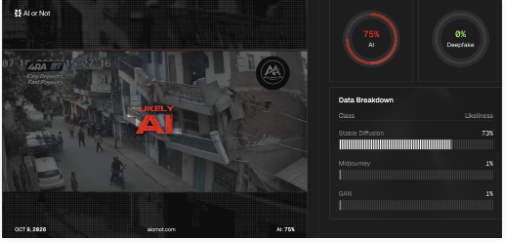
During our research, we closely examined the visuals and movements in the viral video and noticed several inconsistencies. The timer displayed in the video jumps from 15:27:16 to 15:27:12 and then changes to 15:27:18. Additionally, a motorcyclist who appears to be moving forward suddenly starts moving backward as the building collapses. These visual inconsistencies raised suspicions that the video could be AI-generated. We subsequently scanned the viral video using the AI detection tool AI or Not. According to the results, the video was identified as AI-generated.
Conclusion:
CyberPeace Research found that the viral video is AI-generated and does not show the actual building collapse in Seemapuri, Delhi. While the video is fabricated, the incident itself is real, as five people lost their lives in the collapse of a four-storey building in the area.

Related Blogs

Introduction:
With the rapid advancement in technologies, vehicles are also being transformed into moving data centre. There is an introduction of connectivity, driver assistance systems, advanced software systems, automated systems and other modern technologies are being deployed to make the experience of users more advanced and joyful. Software plays an important role in the overall functionality and convenience of the vehicle. For example, Advanced technologies like keyless entry and voice assistance, censor cameras and communication technologies are being incorporated into modern vehicles. Addressing the cyber security concerns in the vehicles the Ministry of Road Transport and Highways (MoRTH) has proposed standard Cyber Security and Management Systems (CSMS) rules for specific categories of four-wheelers, including both passenger and commercial vehicles. The goal is to protect these vehicles and their functions against cyber-attacks or vulnerabilities. This move will aim to ensure standardized cybersecurity measures in the automotive industry. These proposed standards will put forth certain responsibilities on the vehicle manufacturers to implement suitable and proportional measures to secure dedicated environments and to take steps to ensure cyber security.
The New Mandate
The new set of standards requires automobile manufacturers to install a new cybersecurity management system, which will be inclusive of protection against several cyberattacks on the vehicle’s autonomous driving functions, electronic control unit, connected functions, and infotainment systems. The proposed automotive industry standards aim to fortify vehicles against cyberattacks. These standards, expected to be notified by early next month, will apply to all M and N category vehicles. This includes passenger vehicles, goods carriers, and even tractors if they possess even a single electronic control unit. The need for enhanced cybersecurity in the automotive sector is palpable. Modern vehicles, equipped with advanced technologies, are highly prone to cyberattacks. The Ministry of Road Transport and Highways has thus taken a precautionary measure to safeguard all new-age commercial and private vehicles against cyber threats and vulnerabilities.
Cyber Security and Management Systems (CSMS)
The proposed standards by the Ministry of Road Transport and Highways (MoRTH) clarify that CSMS refers to a systematic risk-based strategy that defines organisational procedures, roles, and governance to manage and mitigate risks connected with cyber threats to vehicles, eventually safeguarding them from cyberattacks. According to the draft regulations, all manufacturers will be required to install a cyber security management system in their vehicles and provide the government with a certificate of compliance at the time of vehicle type certification.
Electrical vehicle charging system
Electric vehicle charging stations could also be susceptible and prone to cyber threats and vulnerabilities, which significantly requires to have in place standards to prevent them. It is highlighted that the Indian Computer Emergency Response Team (CERT-In), a designated authority to track and monitor cybersecurity incidents in India, had received reports of vulnerabilities in products and applications related to electric vehicle charging stations. Electric cars or vehicles becoming increasingly popular as the world shifts to green technology. EV owners may charge their cars at charging points in convenient spots. When you charge an EV at a charging station, data transfers between the car, the charging station, and the company that owns the device. This trail of data sharing and EV charging stations in many ways can be exploited by the bad actors. Some of the threats may include Malware, remote manipulation, and disturbing charging stations, social engineering attacks, compromised aftermarket devices etc.
Conclusion
Cyber security is necessary in view of the increased connectivity and use of software systems and other modern technologies in vehicles. As the automotive industry continues to adopt advanced technologies, it will become increasingly important that organizations take a proactive approach to ensure cybersecurity in the vehicles. A balanced approach between technology innovation and security measures will be instrumental in ensuring the cybersecurity aspect in the automotive industry. The recent proposed policy standard by the Ministry of Road Transport and Highways (MoRTH) can be seen as a commendable step to make the automotive industry cyber-resilient and safe for everyone.
References:
- https://economictimes.indiatimes.com/news/india/road-transport-ministry-proposes-uniform-cyber-security-system-for-four-wheelers/articleshow/105187952.cms
- https://www.financialexpress.com/business/express-mobility-cybersecurity-in-the-autonomous-vehicle-the-next-frontier-in-mobility-3234055/
- https://www.gktoday.in/morth-proposes-uniform-cyber-security-standards-for-four-wheelers/
- https://cybersecurity.att.com/blogs/security-essentials/the-top-8-cybersecurity-threats-facing-the-automotive-industry-heading-into-2023
Executive Summary
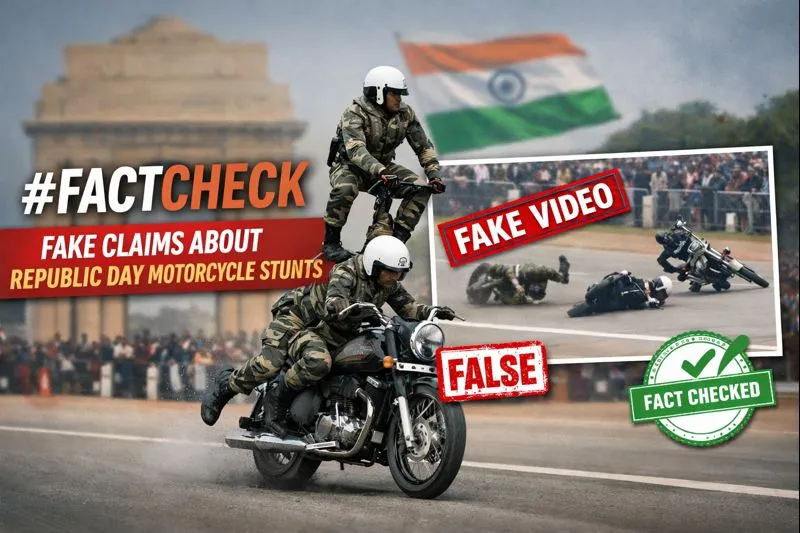
As India concluded its 77th Republic Day celebrations on January 26, 2026, with grandeur and patriotic enthusiasm along the iconic Kartavya Path, a video began circulating on social media claiming to show Indian security personnel failing to perform motorcycle stunts during the ceremonial parade. The short clip allegedly depicts soldiers attempting high-risk, synchronised motorcycle manoeuvres, only to lose balance and fall off their bikes. The visuals were widely shared online with mocking captions, suggesting incompetence during a nationally televised event. However, an research by the CyberPeace found that the video is not authentic and was digitally generated using artificial intelligence.
Claim
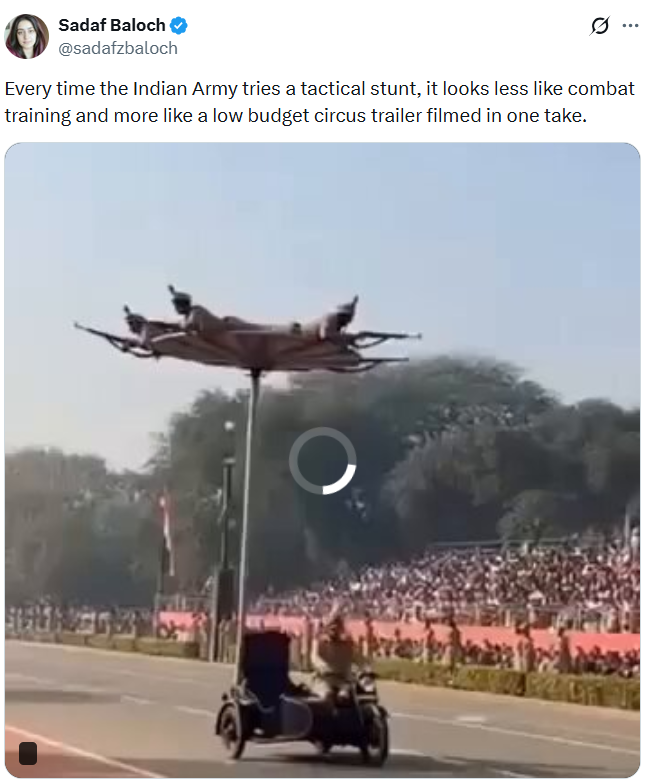
A Pakistan-based X user, Sadaf Baloch (@sadafzbaloch), shared the video on January 27, claiming it showed Indian security personnel failing to execute motorcycle stunts during the Republic Day parade held on January 26, 2026. While sharing the clip, the user wrote:“Every time the Indian Army tries a tactical stunt, it looks less like combat training and more like a low-budget circus trailer filmed in one take.”The post was widely circulated with similar narratives questioning the professionalism of Indian forces.
Here is the link and archive link to the post, along with a screenshot.
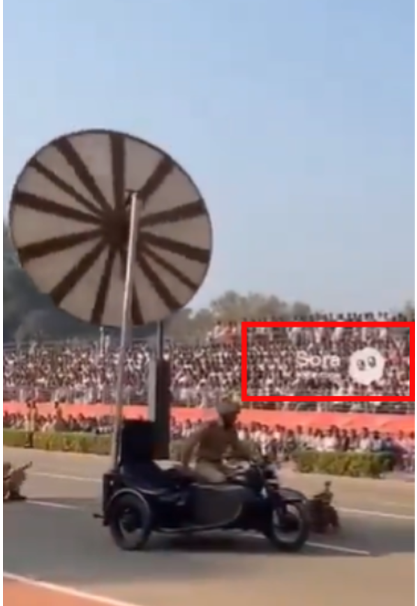
To verify the authenticity of the viral video, the Desk conducted a detailed frame-by-frame analysis. During the examination, a watermark linked to ‘Sora’—an AI text-to-video generation model was detected at the 00:05 timestamp. The presence of this watermark strongly indicated that the video was artificially generated and not recorded during a real-world event.
Fact Check:
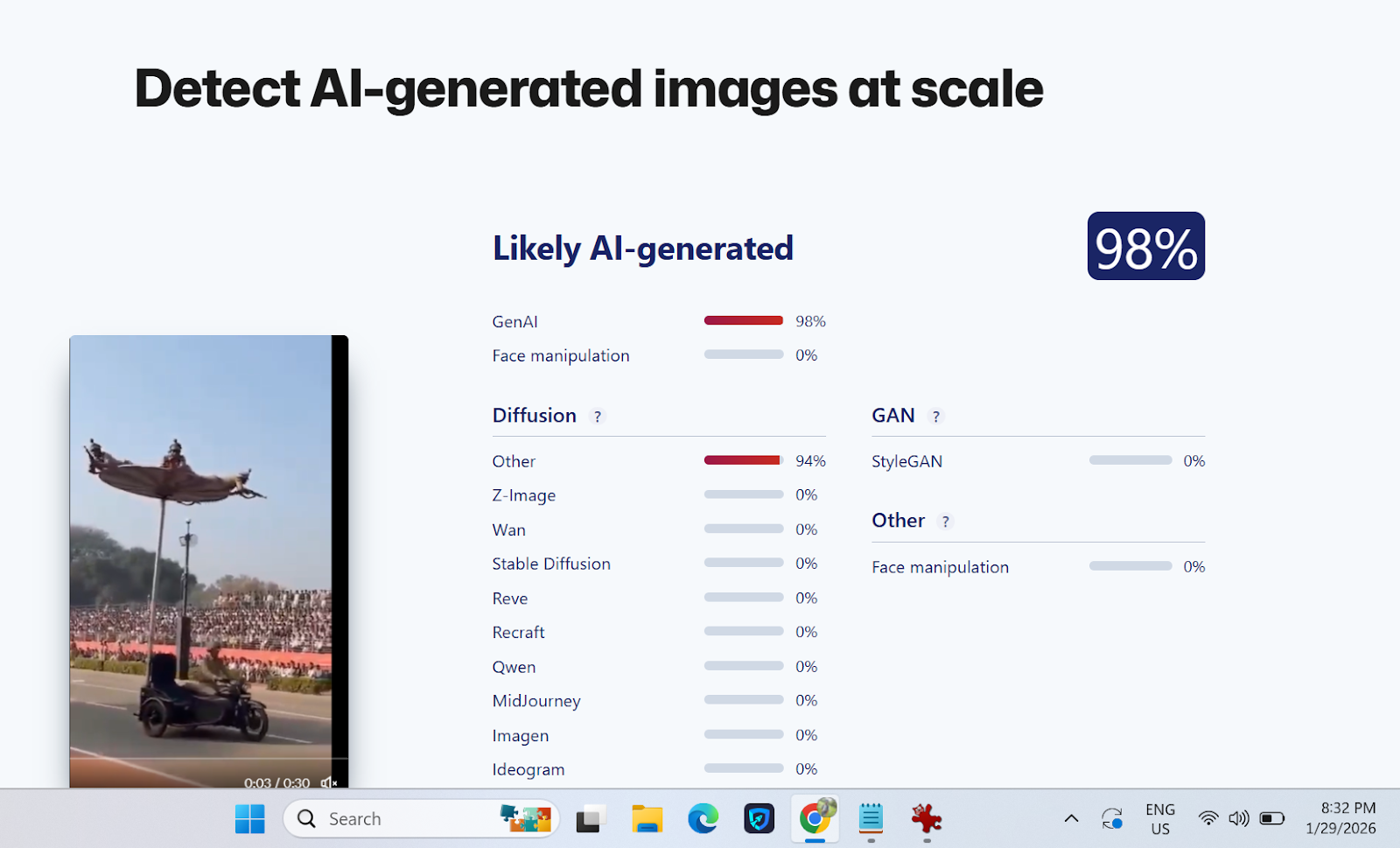
Further visual scrutiny revealed several inconsistencies commonly associated with AI-generated content. The background appeared unnatural and lacked realistic depth, while the movements and reactions of the security personnel looked mechanically exaggerated and inconsistent with real physics. Facial expressions and body motions during the alleged falls also appeared unrealistic. To strengthen the verification, the Desk analysed the clip using Sightengine, an AI-detection tool. The results showed a 98 per cent probability that the video contained AI-generated or deepfake elements.
Below is a screenshot of the result.
As part of the research , the Desk also conducted a customised keyword search and reviewed official coverage of the Republic Day parade. A full-length video broadcast by DD News on its official YouTube channel was examined. The footage showed joint CRPF and SSB motorcycle teams performing traditional daredevil stunts without any mishap. No incident resembling the viral claim was found in the official broadcast or in any credible media reports.
Here is the video link and a screenshot.

Conclusion
The CyberPeace research confirms that the viral video purportedly showing Indian security personnel failing to perform motorcycle stunts during the 77th Republic Day parade is AI-generated. The clip has been falsely circulated online as genuine content with the intent to mislead viewers and spread misinformation.
.webp)
Executive Summary:
Cyber incidents are evolving along with time, they are designed to attract and lure people through social networking sites and/or messaging services. In the recent past a spate of messages alleging that TRAI is offering ‘3 months free recharge with free voice calls and internet for 4g/5g with 200 GB free data’. These messages display the TRAI logo with attractive offers to trick the users into revealing their personal details. This blog discusses the functioning of this free mobile recharge scheme, its methods and guidelines on how to avoid such fake schemes. This blog explains the importance of vigilance and verification when receiving any links, emphasizing the need to report suspicious activities and educate others to prevent identity theft and protect personal information.
Claim:
The message circulated an enticing offer: free mobile recharge for 3 months which provides unlimited free voice calls with 200GB 4G/5G data with TRAI logo. The key characteristics of the false claims are
- Official Branding: The logo of TRAI has been viewed as a deceptive facade of credibility.
- Unrealistic Offers: It is accompanied by a free recharge , which is intended for an extended period indefinite period, like most fraudsters’ bait.
- Urgency and Exclusivity: The offer is for a limited time to make urgency forcing the receiver to take the offer without confirmation.
The Deceptive Scheme:
Organized systematically, the fraudulent campaign usually proceeds in several steps, all of which aim at extracting the victim’s personal data. Here’s a breakdown of the scheme:
1. Initial Contact: Such messages or calls reach the users’ inboxes or phone numbers through social media applications such as WhatsApp or through text messages. These messages further implies that the user was chosen for the special offer from TRAI, which elicits the interest of the user.
2. Information Request: To claim the purported offer, users are directed to a website or asked to reply with personal details, including:
- Phone number
- State of residence
- SIM provider details
This is useful for the scammers as they harvest information which can be used to conduct identity theft or sold to others on the shady part of the internet known as the ‘Dark Web’.
3. Fake Confirmation: After providing all the information, a congratulatory message appears on the screen showing that their phone number is eligible for the offer. The user is compelled to forward the message to many phone numbers through whatsapp to get the offer.
4. Pressure Tactics: The message often implies a sense of time constraint or fear which psychologically produces pressure to provide all the user information. For example, users are given messages such as that if they do not ‘act now’, they will lose their mobile service.
Analyzing the Fraudulent Campaign
The TRAI fraudulent recharge scheme case depicts that social engineering is used in cyber crimes. Here are some key aspects that characterize this campaign:
- Sophisticated Social Engineering
Scammers take advantage of the holders’ confidence in official bodies such as TRAI. By using official TRAI logos, official language they try to deceive even cautious people.
- Viral Spread
The user is compelled to share the given message to friends and groups; this is an excellent strategy to spread the scam. It not only spreads the fraudulent message but also tries to extract the details of other people.
- Technical Analysis

- Domain Name: SGOFF[.]CYOU
- Registry Domain ID: D472308342-CNIC
- Registrar WHOIS Server: whois.hkdns.hk
- Registrar URL: http://www.hkdns.hk
- Updated Date: 2024-07-24T18:50:48.0Z
- Creation Date: 2024-07-19T18:48:44.0Z
- Registry Expiry Date: 2025-07-19T23:59:59.0Z
- Registrar: West263 International Limited
- Registrar IANA ID: 1915
- Registrant State/Province: Anhui
- Registrant Country: CN
- Name Server: NORMAN.NS.CLOUDFLARE.COM
- Name Server: PAM.NS.CLOUDFLARE.COM
- DNSSEC: unsigned
Cloudflare Inc. is used to cover the scam. The real website always uses the older domain while this url has been registered recently which indicates that this link is a scam.

The graph indicates that some of the communicated files and websites are malicious.
CyberPeace Advisory and Best Practice:
In light of the growing threat posed by such scams, the Research Wing of CyberPeace recommend the following best practices to help users protect themselves:
1. Verify Communications: It is always advisable to visit the official site of the organization or call the official contact numbers of the company to speak to their customer care and clarify about the offers.
2. Do not share personal information: No genuine organization will call the people for personal information. Step carefully and do not provide personal information that will lead to identity theft when dealing with such offers.
3. Report Fraudulent Activity: If one receives any calls or messages that seem to be suspicious, then the user can report cyber crimes to the National Cyber Crime Reporting Portal on www. cybercrime. gov. in or call on 1930. Such scams are reportable and assist the authorities in tracking and fighting the vice.
4. Educate Others : Always raise awareness among friends by sharing these kinds of scams. Educating people helps to avoid them falling prey to such fraudulent schemes.
5. Use Reliable Resources : Always refer to official sources or websites for any kind of offers or promotions.
Conclusion:
The free recharge scheme for 3 months with the logo of TRAI is a fraudulent scam. There is no official information from TRAI or in their official website about this free recharge scheme. Though the scheme looks attractive, it is deceptive. Through this, the scammers are trying to collect personal details of the individual. Before clicking any links, it is necessary to check the authenticity of the information, report these kinds of incidents to spread awareness among people. Always be safe and be vigilant.
