
#FactCheck-AI-Generated Image Falsely Shared as Chinese Soldiers Capturing Indian Troops in Arunachal Pradesh
Executive Summary
A photograph is being widely circulated on social media with the claim that it shows Chinese soldiers blindfolding and escorting three Indian soldiers after entering 60 kilometres inside Arunachal Pradesh. The image is being shared as evidence of an alleged Chinese military intrusion into Indian territory.
CyberPeace Research Wing’s research found the claim to be false. Our research revealed that the viral image is AI-generated and has no connection to any real incident in Arunachal Pradesh. The Government of India and the Indian Army have also rejected claims of Chinese forces entering Indian territory.
Claim
An Instagram user, 'star8atik', shared the viral image on July 6, 2026, with the caption:"China has occupied 60 km of land in Arunachal Pradesh."
https://www.instagram.com/reel/Dac60uVtH4j

Fact Check
To verify the claim, we first performed a reverse image search using Google Lens. However, we did not find any authentic source or credible report linking the viral image to an actual incident involving Chinese troops in Arunachal Pradesh. We also conducted keyword-based searches on Google using terms related to the alleged Chinese incursion. The search yielded no credible news reports confirming that Chinese soldiers had captured Indian troops or entered 60 kilometres inside Arunachal Pradesh. We then closely examined the image and noticed several visual inconsistencies commonly associated with AI-generated content. The facial features and body proportions of the soldiers in the background appeared distorted and unnatural. Additionally, one of the Indian soldiers was shown with what appeared to be a Chinese flag patch on his arm, but its design and placement were inconsistent and visually flawed. These anomalies raised strong suspicions that the image had been generated using artificial intelligence. To verify this, we analysed the image using the AI detection tool Hive Moderation, which indicated a 98% probability that the image was AI-generated.
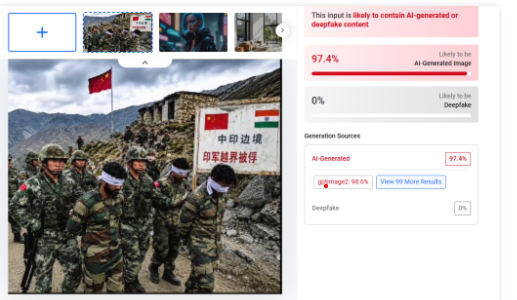
For additional verification, we also scanned the image using Undetectable AI, which found a 97% probability that the image had been digitally generated or manipulated using AI.

Conclusion
Our research found that the viral image claiming to show Chinese soldiers capturing Indian troops after entering Arunachal Pradesh is fake. The image is AI-generated and is being falsely circulated to support misleading claims of a Chinese military incursion. Furthermore, Union Minister Kiren Rijiju and the Indian Army have publicly rejected claims that Chinese forces entered Indian territory, making the viral claim baseless.

Related Blogs
.webp)
Introduction
Every domain of conflict has eventually had to learn restraint. The first Geneva Convention of 1864 grew out of one man's horror at what he saw after a single battle, and it rested on an idea that has since become the backbone of humanitarian law: even in war, there are things that must not be done to people. Cyberspace is the newest domain to face that test, and it is arguably the hardest. Code carries no uniform, an intrusion crosses borders without anyone noticing, and the same network can serve a soldier, a shopkeeper and a schoolchild at once. Whether the actor is a criminal group, an intelligence service or a military cyber unit, the consequences land on ordinary people. That is the case for a humanitarian approach to cyberspace, and it is why it has moved from a courtesy to a matter of national security.
Why the humanitarian lens matters to every nation
Cyberspace does not sort itself into civilian and military zones. The International Committee of the Red Cross (ICRC) has pointed out for years that military networks lean on civilian cyber infrastructure such as undersea cables, satellites and routers, while civilian supply chains and essential services run over the same channels. A cyber operation aimed at one can land on the other, and the ICRC has warned that incidental harm in this domain risks being widespread and crossing national borders.
It helps to separate three situations, because different rules govern each. Cybercrime, such as ransomware against a hospital, is a matter for criminal law and international police cooperation. Intrusion and espionage in peacetime fall under domestic law and the norms of responsible state behaviour agreed at the United Nations. Cyber operations during an armed conflict fall under international humanitarian law (IHL), which the ICRC and a growing number of states hold applies to cyber means just as it applies to any other weapon or method of warfare. Its core principles, humanity, necessity, proportionality and distinction, were linked to cyberspace in the 2021 report of the UN Group of Governmental Experts. Under those principles civilians and civilian infrastructure must not be attacked, and medical facilities enjoy special protection.
For a nation, the practical point is simpler. Its own hospitals, grids, water systems and payment networks are exactly the assets that erode first when restraint erodes. A country that argues for humanitarian limits is protecting itself as much as anyone else.
A lesson from Lebanon
The events of 17 and 18 September 2024 in Lebanon show what happens when everyday technology stops being trustworthy. On the first day, thousands of pagers detonated across the country within roughly an hour of each other. The next day, hand held radios followed. By the account UN High Commissioner for Human Rights Volker Türk gave the Security Council on 20 September, at least 37 people had been killed, including two children, and more than 3,400 had been injured in Lebanon alone. UN experts noted that medical personnel were among the dead.
Attribution in this case remained a matter of public allegation rather than official claim, and this piece does not try to settle it. What matters here is the method and how the UN read it legally. Türk told the Council that IHL prohibits booby traps in the form of apparently harmless portable objects designed and constructed to contain explosives, and that violence intended to spread terror among civilians is a war crime. He added that striking thousands of people simultaneously, without knowing who held the devices, where they were or who stood nearby, violates international human rights law and, where applicable, IHL. His summary was that this cannot become the new normal, and he called for an independent, thorough and transparent investigation.
The pager episode was physical, with explosives concealed in hardware, not malicious code. It belongs in a discussion of cyberspace because of how it worked: a compromised supply chain turned an ordinary civilian communication tool into a weapon. That is the same trust relationship every digital system depends on. When people cannot assume that the devices and software they use are what they appear to be, the line between civilian object and military instrument, the foundation of humanitarian law, survives on paper while wearing away in practice.
The Digital Emblem Project
What it is:Think of the red cross on a hospital roof or an ambulance. It tells anyone who sees it that the building or vehicle is protected and must not be attacked. The Digital Emblem is the same idea for computer systems. It is a digital marker, built on a cryptographic signature, that a protected server or network broadcasts to signal that it belongs to a medical or humanitarian organisation entitled to protection under international humanitarian law. The organisations allowed to use it are the same ones entitled to use the physical emblem.
What it aims to achieve:Its purpose is recognition. Someone probing a network cannot see a red cross, and may not realise they have entered a medical facility's systems or a Red Cross office. The digital emblem lets that fact be detected and verified by machines, so a military cyber unit or any other operator can recognise the system and avoid it. It does not create any new legal protection, and it does not replace cybersecurity. Like the physical emblem, it cannot stop an attack on its own. It makes existing protection visible.
Why it was created:The physical emblem has worked for more than 150 years, but it has no natural place online. Cyber operations are becoming a regular feature of armed conflict, and humanitarian bodies are targeted by criminals seeking money as well as by state linked actors. The ICRC learned this directly in 2022, when a breach of its own servers exposed the data of more than 515,000 people in vulnerable situations. It began researching a digital equivalent and, with ETH Zurich, developed a technical standard.
Where it stands today:The idea has moved from concept to working prototype. In October 2024, Resolution 2 was adopted at the International Conference of the Red Cross and Red Crescent, which includes all 196 states party to the Geneva Conventions, affirming that the duty to respect and protect medical services and humanitarian personnel applies to their use of information and communication technologies. In July 2026, the ICRC, with Microsoft's support, presented the emblem in Geneva and announced the next phase, with several national Red Cross societies already testing it. That phase is expected to take several years. Technical standards still need to be developed through bodies such as the International Telecommunication Union and the Internet Engineering Task Force, and international law would need to recognise the emblem formally, through an amendment to the Geneva Conventions framework or a new protocol.
For nations, the emblem offers a practical way to mark hospital and humanitarian networks as off limits, and it removes the excuse of not knowing when a marked system is attacked. That makes accountability clearer. It also supports the central argument of this piece: humanitarian principles only work in cyberspace if they can be seen and acted on, not just written down. Its success will depend on whether the people it addresses, state cyber forces and criminal groups alike, choose to honour it, which is why adoption and enforcement at national level will matter as much as the technology.
What nations can do now
None of this requires waiting for a new treaty. A country can publicly state its national position on how international law, including IHL, applies to cyber operations, since the ICRC itself treats the publication of national views as a form of capacity building. It can classify healthcare, humanitarian, water and energy networks as protected critical infrastructure in its national cyber strategy, and plan to adopt the digital emblem for its own hospitals as standards mature. It can invest in supply chain assurance for the devices and software that civilians and governments depend on, which is the most direct lesson of the Lebanon episode. It can ensure that military cyber units are trained in IHL and that cyber capabilities undergo legal review with an eye to humanitarian impact. And it can treat ransomware against hospitals as the serious crime it is, backed by international cooperation on evidence and victim protection.
Conclusion
A humanitarian approach to cyberspace is sometimes dismissed as idealism. It is closer to enlightened self interest. Every state relies on the reciprocal restraint that keeps hospitals, grids and communications networks out of the crossfire, and every state is, at some point, on the receiving end of the alternative. The Lebanon episode showed how quickly trust in ordinary technology can fail, and the Digital Emblem shows one way the international community is trying to rebuild it. Nations that commit early, in doctrine, in procurement and in practice, will help decide whether cyberspace develops guardrails or simply learns to live without them. The idea behind the first Geneva Convention was that even conflict has limits. Cyberspace is where that argument now needs to be made again.
References
- ICRC, "ICRC proposes digital red cross/crescent emblem to signal protection in cyberspace." https://www.icrc.org/en/document/icrc-proposes-digital-red-crosscrescent-emblem-signal-protection-cyberspace
- ETH Zurich, "Digital emblem for humanitarian law in cyberspace." https://ethz.ch/en/news-and-events/eth-news/news/2023/11/digital-emblem-for-humanitarian-law-in-cyberspace.html
- Digital Watch Observatory, "ICRC unveils digital emblem to protect humanitarian organisations online." https://dig.watch/updates/icrc-digital-emblem-cybersecurity
- Geneva Solutions, "ICRC and Microsoft launch digital emblem to prevent cyberattacks." https://genevasolutions.news/peace-humanitarian/icrc-and-microsoft-launch-digital-emblem-to-prevent-cyberattacks
- "Making humanitarian protection visible in cyberspace: The promise of the Digital Emblem." https://blogs.microsoft.com/on-the-issues/2026/07/09/making-humanitarian-protection-visible-in-cyberspace-the-promise-of-the-digital-emblem/
- ICRC Humanitarian Law and Policy Blog, "IHL's lighthouse: navigating towards a digital emblem." https://blogs.icrc.org/law-and-policy/2026/01/15/ihls-lighthouse-navigating-towards-a-digital-emblem/
- Digital Watch Observatory, "Building Trust and Protection for Essential Digital Services: From Standards to Deployment." https://dig.watch/event/wsis-forum-2026/building-trust-and-protection-for-essential-digital-services-from-standards-to-deployment
- UN OHCHR, "Exploding pagers and radios: A terrifying violation of international law, say UN experts." https://www.ohchr.org/en/press-releases/2024/09/exploding-pagers-and-radios-terrifying-violation-international-law-say-un
- UN OHCHR, "Disrespect for international law is a matter of international peace and security, High Commissioner Türk tells the UN Security Council." https://www.ohchr.org/en/statements-and-speeches/2024/09/disrespect-for-international-law-a-matter-of-international-peace-and-security-hc
- ASIL Insights, "Cyber Operations under International Humanitarian Law: Perspectives from the ICRC." https://asil.org/insights/volume-24-issue-11/
- Pager Attack in Lebanon, CyberPeace Blog https://cyberpeace.org/resources/blogs/pager-attack-in-lebanon

Executive Summary
A purported front page of The Hindu dated June 6, 1967, is being widely circulated on social media with the claim that then Prime Minister Indira Gandhi had urged Indians not to buy gold in any form and to follow “national discipline” by restricting gold consumption. The viral claim suggests that the appeal was part of the government’s efforts to conserve foreign exchange reserves, which were allegedly under severe pressure at the time. However, research conducted by CyberPeace Research Wing found the claim to be false. Our research revealed that the front page being circulated online is not authentic and has been digitally edited.
Claim
An X (formerly Twitter) user shared the viral newspaper clipping on May 12, 2026, and wrote:“In 1967, during a severe foreign exchange crisis, Indira Gandhi appealed to Indians not to buy gold.From ‘skip one meal’ to ‘don’t buy gold,’ Congress-era governance normalized shortages, restrictions, and sacrifice, while ordinary citizens paid the price for failed economic policies.”

Research
To verify the claim, we examined the official social media accounts of The Hindu. During the research, we found a post published on the publication’s official X account on May 12, 2026, clarifying that the viral image claiming to be the June 6, 1967 front page of The Hindu was digitally altered and not part of its official archives. The newspaper also urged readers to verify information carefully before sharing it online.

We also found an X post by B Kolappan, a journalist with The Hindu, who shared the original front page of the newspaper dated June 6, 1967, further exposing the viral image as fake.

For context, Prime Minister Narendra Modi, while addressing a public gathering on May 10, 2026, spoke about the possible economic impact of the ongoing conflict in the Middle East and advised people to avoid buying gold for a year, even during weddings or family functions. The viral claim appears to have resurfaced in this backdrop.

Conclusion
Our research found that the alleged 1967 front page of The Hindu circulating on social media is digitally edited and fake. There is no evidence that the viral newspaper page is authentic or part of The Hindu’s archival records.

Executive Summary:
A video circulating on social media claims to show a live elephant falling from a moving truck due to improper transportation, followed by the animal quickly standing up and reacting on a public road. The content may raise concerns related to animal cruelty, public safety, and improper transport practices. A detailed examination using AI content detection tools, visual anomaly analysis indicates that the video is not authentic and is likely AI generated or digitally manipulated.
Claim:
The viral video (archive link) shows a disturbing scene where a large elephant is allegedly being transported in an open blue truck with barriers for support. As the truck moves along the road, the elephant shifts its weight and the weak side barrier breaks. This causes the elephant to fall onto the road, where it lands heavily on its side. Shortly after, the animal is seen getting back on its feet and reacting in distress, facing the vehicle that is recording the incident. The footage may raise serious concerns about safety, as elephants are normally transported in reinforced containers, and such an incident on a public road could endanger both the animal and people nearby.

Fact Check:
After receiving the video, we closely examined the visuals and noticed some inconsistencies that raised doubts about its authenticity. In particular, the elephant is seen recovering and standing up unnaturally quickly after a severe fall, which does not align with realistic animal behavior or physical response to such impact.
To further verify our observations, the video was analyzed using the Hive Moderation AI Detection tool, which indicated that the content is likely AI generated or digitally manipulated.

Additionally, no credible news reports or official sources were found to corroborate the incident, reinforcing the conclusion that the video is misleading.
Conclusion:
The claim that the video shows a real elephant transport accident is false and misleading. Based on AI detection results, observable visual anomalies, and the absence of credible reporting, the video is highly likely to be AI generated or digitally manipulated. Viewers are advised to exercise caution and verify such sensational content through trusted and authoritative sources before sharing.
- Claim: The viral video shows an elephant allegedly being transported, where a barrier breaks as it moves, causing the animal to fall onto the road before quickly getting back on its feet.
- Claimed On: X (Formally Twitter)
- Fact Check: False and Misleading
