
#FactCheck: AI-Generated Bond Paper Falsely Linked to CJP Founder Abhijeet Dipke
Executive Summary
Amid the ongoing protests in Delhi, an image of a bond paper is being widely shared on social media. The image is being shared with the claim that it shows the bond allegedly submitted in court by Cockroach Janata Party (CJP) founder Abhijeet Dipke for his release. The purported bond mentions that Abhijeet Dipke would not participate in any protest in the future and that he had furnished a bail bond of Rs 50,000. CyberPeace Research found that the image of the bond paper being shared in connection with Abhijeet Dipke is not genuine, but was created using AI.
Claim
Amid the ongoing protests in Delhi, an image of a bond paper is being widely shared on social media. It is being claimed that the image shows the bond allegedly submitted in court by Cockroach Janata Party (CJP) founder Abhijeet Dipke for his release. The purported bond mentions that Abhijeet Dipke would not participate in any protest in the future and that he had furnished a bail bond of Rs 50,000.
https://www.facebook.com/photo/?fbid=122133387387390171&set=a.122113963941390171
https://ghostarchive.org/archive/C8SDb

Fact Check
In a post shared on X, the Delhi Police stated that Abhijeet Dipke, Ashutosh Ranka and Saurav Das were taken into preventive custody on October 10, 2026, under Sections 126/170 of the Bharatiya Nagarik Suraksha Sanhita (BNSS). According to the police, all legal procedures were followed, and the three were produced before the SEM court at Delhi Cantt on October 11, 2026. In its post, the Delhi Police also stated that a bail bond (surety bond) of ₹50,000 was furnished for a period of one year to maintain peace and good behaviour.
https://x.com/DelhiPolice/status/2109151954438136069
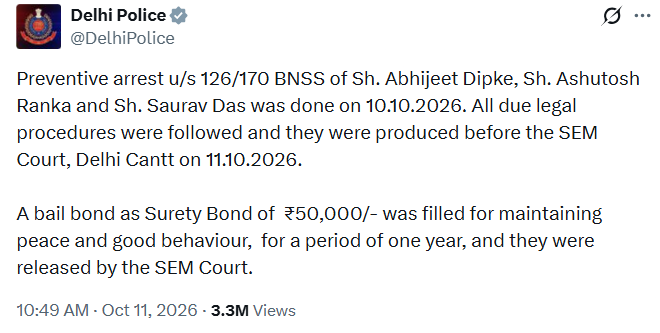
To verify the viral image of the bond paper, we examined the Delhi Police’s social media handles and searched other media reports. However, we did not find the viral image of the bond paper in any article or X post published by a credible source. We then closely examined the viral bond paper. During our analysis, we noticed a clear error. The spelling of “Satyamev Jayate” on the seal affixed to the document is incorrect. Based on this error, we suspected that the purported image of the bond paper being circulated on social media may have been created using AI.

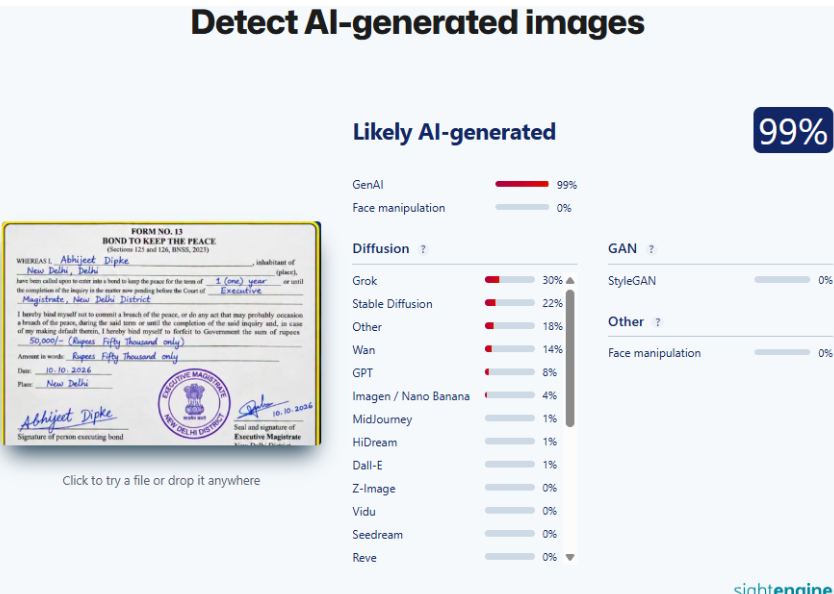
As the next step in our research, we used AI detection tools to analyse the viral image. We scanned the image using Sightengine, which indicated that the viral image is 99% likely to be AI-generated.
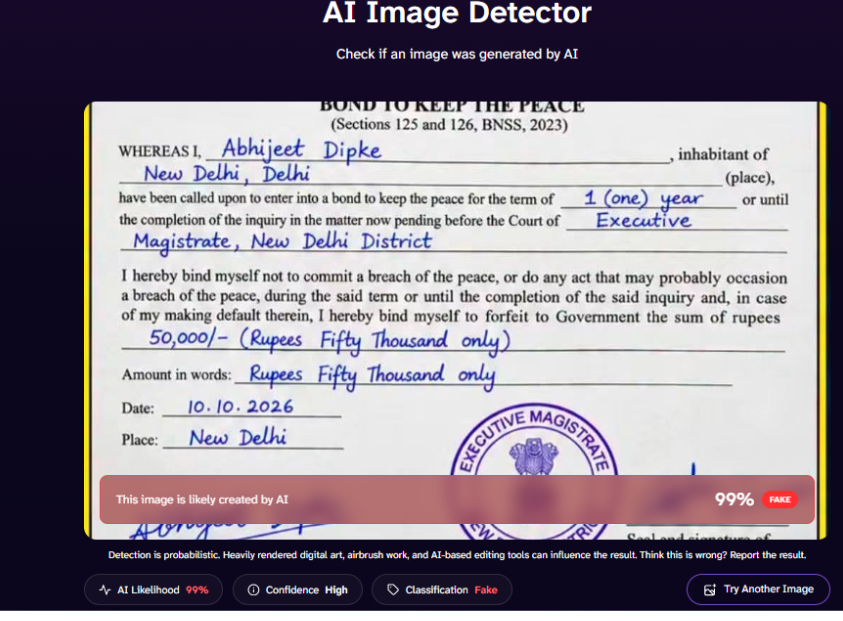
DeepAI, in its analysis, estimated a 99% likelihood that the viral bond paper was created using AI.
Conclusion
Our research found that the image of the bond paper being shared in connection with Abhijeet Dipke is not genuine but was created using AI.

Related Blogs

Introduction
In the labyrinthine world of cybersecurity, a new spectre has emerged from the digital ether, casting a long shadow over the seemingly impregnable orchards of Apple's macOS. This phantom, known as SpectralBlur, is a backdoor so cunningly crafted that it remained shrouded in the obscurity of cyberspace, undetected by the vigilant eyes of antivirus software until its recent unmasking. The discovery of SpectralBlur is not just a tale of technological intrigue but a narrative that weaves together the threads of geopolitical manoeuvring, the relentless pursuit of digital supremacy, and the ever-evolving landscape of cyber warfare.
SpectralBlur, a term that conjures images of ghostly interference and elusive threats, is indeed a fitting moniker for this new macOS backdoor threat. Cybersecurity researchers have peeled back the layers of the digital onion to reveal a moderately capable backdoor that can upload and download files, execute shell commands, update its configuration, delete files, and enter states of hibernation or sleep, all at the behest of a remote command-and-control server. Greg Lesnewich, a security researcher whose name has become synonymous with the relentless pursuit of digital malefactors, has shed light on this new threat that overlaps with a known malware family attributed to the enigmatic North Korean threat actors.
SpectralBlur similar to Lazarus Group’s KANDYKORN
The malware shares its DNA with KANDYKORN, also known as SockRacket, an advanced implant that functions as a remote access trojan capable of taking control of a compromised host. It is a digital puppeteer, pulling the strings of infected systems with a malevolent grace. The KANDYKORN activity also intersects with another campaign orchestrated by the Lazarus sub-group known as BlueNoroff, or TA444, which culminates in the deployment of a backdoor referred to as RustBucket and a late-stage payload dubbed ObjCShellz.
Recently, the threat actor has been observed combining disparate pieces of these two infection chains, leveraging RustBucket droppers to deliver KANDYKORN. This latest finding is another sign that North Korean threat actors are increasingly setting their sights on macOS to infiltrate high-value targets, particularly those within the cryptocurrency and blockchain industries. 'TA444 keeps running fast and furious with these new macOS malware families,' Lesnewich remarked, painting a picture of a relentless adversary in the digital realm.
Patrick Wardle, a security researcher whose insights into the inner workings of SpectralBlur have further illuminated the threat landscape, noted that the Mach-O binary was uploaded to the VirusTotal malware scanning service in August 2023 from Colombia. The functional similarities between KANDYKORN and SpectralBlur have raised the possibility that they may have been built by different developers with the same requirements. What makes the malware stand out are its attempts to hinder analysis and evade detection while using grant to set up a pseudo-terminal and execute shell commands received from the C2 server.
The disclosure comes as 21 new malware families designed to target macOS systems, including ransomware, information stealers, remote access trojans, and nation-state-backed malware, were discovered in 2023, up from 13 identified in 2022. 'With the continued growth and popularity of macOS (especially in the enterprise!), 2024 will surely bring a bevvy of new macOS malware,' Wardle noted, his words a harbinger of the digital storms on the horizon.
Hackers are beefing up their efforts to go after the best MacBooks as security researchers have discovered a brand new macOS backdoor which appears to have ties to another recently identified Mac malware strain. As reported by Security Week, this new Mac malware has been dubbed SpectralBlur and although it was uploaded to VirusTotal back in August of last year, it remained undetected by the best antivirus software until it recently caught the attention of Proofpoint’s Greg Lesnewich.
Lesnewich explained that SpectralBlur has similar capabilities to other backdoors as it can upload and download files, delete files and hibernate or sleep when given commands from a hacker-controlled command-and-control (C2) server. What is surprising about this new Mac malware strain though is that it shares similarities to the KandyKorn macOS backdoor which was created by the infamous North Korean hacking group Lazarus.
Just like SpectralBlur, KandyKorn is designed to evade detection while providing the hackers behind it with the ability to monitor and control infected Macs. Although different, these two Mac malware strains appear to be built based on the same requirements. Once installed on a vulnerable Mac, SpectralBlur executes a function that allows it to decrypt and encrypt network traffic to help it avoid being detected. However, it can also erase files after opening them and then overwrite the data they contain with zeros..
How to keep your Apple computers safe from hackers
As with the best iPhones, keeping your Mac up to date is the easiest and most important way to keep it safe from hackers. Hackers often prey on users who haven’t updated their devices to the latest software as they can exploit unpatched vulnerabilities and security flaws.
Checking to see if you're running the latest macOS version is quite easy. Just click on the Apple Logo in the top right corner of your computer, head to System Preferences and then click on Software Update. If you need a bit more help, check out our guide on how to update a Mac for more detailed instructions with pictures.
Even though your Mac has its own built-in malware scanner from Apple called xProtect, you should consider using one of the best Mac antivirus software solutions for additional protection. Paid antivirus software is often updated more frequently and you often also get access to other extras to help keep you safe online like a password manager or a VPN.
Besides updating your Mac frequently and using antivirus software, you must be careful online. This means sticking to trusted online retailers, carefully checking the URLs of the websites you visit and avoiding opening links and attachments sent to you via email or social media from people you don’t know. Likewise, you should also learn how to spot a phishing scam to know which emails you want to delete right away.
Conclusion
The thing about hackers and other cybercriminals is that they are constantly evolving their tactics and attack methods. This helps them avoid detection and allows them to devise brand-new ways to trick ordinary people. With the surge we saw in Mac malware last year, though, Apple will likely be working on beefing up xProtect and macOS to better defend against these new threats.
References
- https://www.scmagazine.com/news/new-macos-malware-spectralblur-idd-as-north-korean-backdoor
- https://www.tomsguide.com/news/this-new-macos-backdoor-lets-hackers-take-over-your-mac-remotely-how-to-stay-safe
- https://thehackernews.com/2024/01/spectralblur-new-macos-backdoor-threat.html

Executive Summary
Our research confirms that the viral image showing Iranian soldiers standing near a crashed helicopter is AI-generated and has no connection to any real-world event. It is being misleadingly shared online amid geopolitical tensions. Amid rising tensions between Iran, the United States, and Israel, a dramatic image is being widely shared on social media. The picture shows soldiers standing near the wreckage of a crashed helicopter in a desert, holding an Iranian flag. Users claim that Iranian forces shot down the aircraft. Research by CyberPeace Research Wing found that the viral image is fake and was created using AI tools.
Claim
A Facebook page named “Official Salman 09” shared the image on May 1, 2026, portraying it as a powerful symbol of victory in an ongoing conflict. The post suggested that the image reflected Iran’s military success and carried a broader political message amid regional tensions.
- https://www.facebook.com/photo/?fbid=909905332099201&set=a.522993370790401
- https://perma.cc/KCL8-7UDN

Fact Check
To verify the claim, we first conducted a reverse image search using Google Lens. The image did not appear on any credible news platforms, although it was widely circulating across social media—raising suspicion about its authenticity. We then analyzed the image using Google’s SynthID detector, which confirmed with high confidence that the image was generated using Google’s AI tools. SynthID is a technology designed to watermark and identify AI-generated content.

Further verification using AI detection tool Hive Moderation indicated a very high likelihood (up to 99.9%) that the image was AI-generated, with strong probability that it was created using Google’s Gemini.

Conclusion
Our research confirms that the viral image showing Iranian soldiers standing near a crashed helicopter is AI-generated and has no connection to any real-world event. It is being misleadingly shared online amid geopolitical tensions.
The Expanding Governance Challenge of Artificial Intelligence
Artificial intelligence (AI) systems are increasingly embedded in economic and social infrastructure. They are being adopted in financial services, healthcare diagnostics, hiring systems, and public administration. But while these systems improve efficiency and decision-making, they also introduce new forms of technological risk.
Unlike conventional software, AI systems learn patterns from data and continue to evolve as they run. This poses governance issues since risks can arise throughout the AI life cycle, whether at the coding level or in their implementation.
The latest regulatory frameworks, such as the European Union’s AI Act (EU AI Act) and the UNESCO Recommendation on the Ethics of Artificial Intelligence, note that responsible AI governance depends on the realisation of where risks emerge across the development process.
This article maps the AI system lifecycle, identifies the risks that emerge at each stage and evaluates the policy tools used to mitigate them using the lifecycle framework developed by the Organisation of Economic Co-operation and Development (OECD).
The Lifecycle of an AI System
AI systems are developed through a structured process that includes problem definition, dataset collection and preparation, model development, testing and validation, deployment, and monitoring.
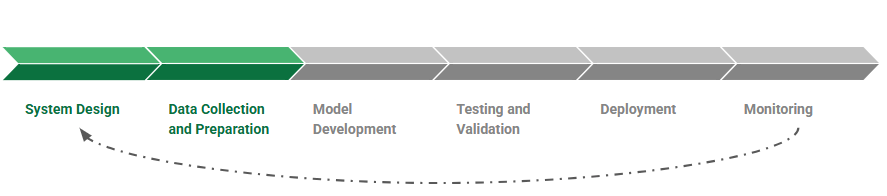
The OECD conceptualises this development process as the AI system lifecycle. Each stage entails various technical and administrative procedures, since choices made during these stages will dictate the goals and limits of an AI system. Further, the quality and representativeness of training sets will have a strong effect on the behaviour of models after implementation.
Since this is an iterative and not a linear procedure, risks can be introduced at each stage of the AI lifecycle. New data can be retrained into different models, and systems are regularly updated once they have been deployed, to address performance degradation, model errors, or unintended outputs. This iterative process means governance must address risks across the entire lifecycle, not just at deployment.
Where AI Risks Emerge
AI risks usually emerge earlier in the development process, especially in the phases when system objectives are formulated and training data are chosen. The EU AI Act and the UNESCO Recommendation on the Ethics of AI outline the following risks: bias and discrimination, privacy and data security violations, the absence of transparency in automated decision-making, and risks to fundamental rights.
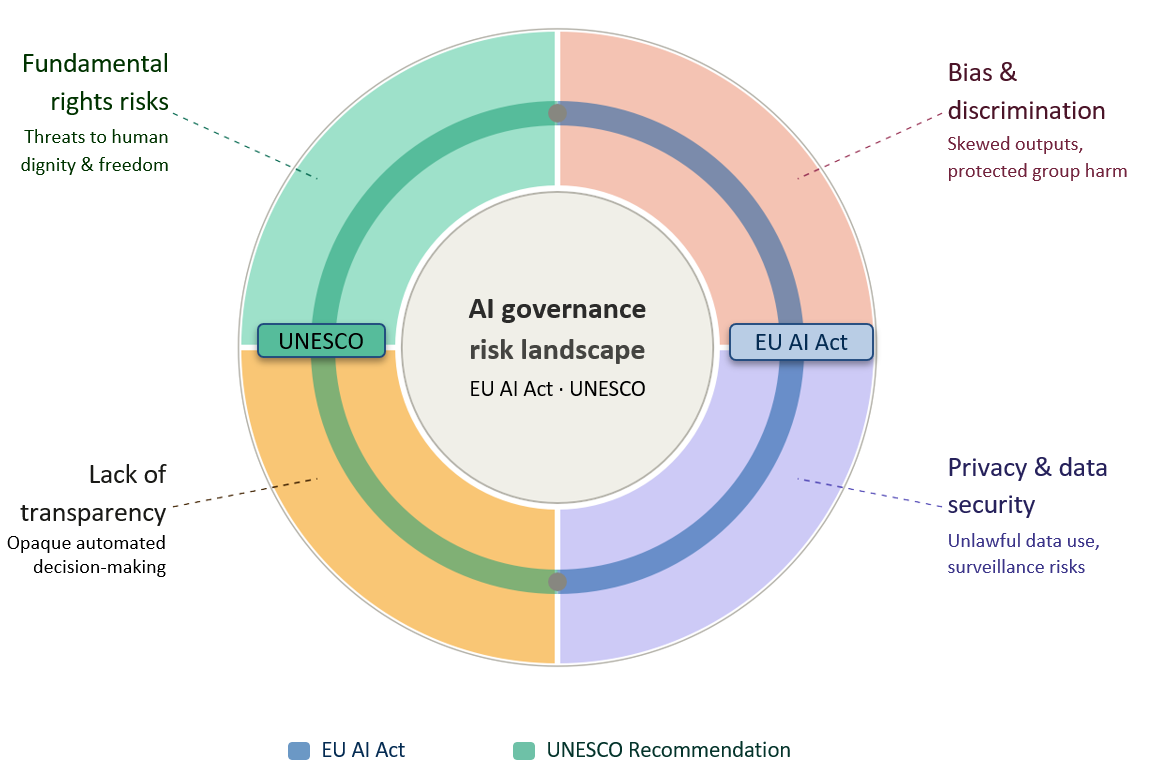
AI Governance Risk Landscape: Core Risk Categories Under International Frameworks
Risk categories jointly identified by the EU AI Act and UNESCO Recommendation on the Ethics of Artificial Intelligence
Outlining the risks throughout the AI lifecycle helps understand the areas where governance interventions are most necessary. For example, discriminatory outcomes often result from biased or unrepresentative training data, while safety failures are typically linked to inadequate testing before deployment. Risks such as misinformation arise post the development process, when generative AI systems are deployed at scale on digital platforms.
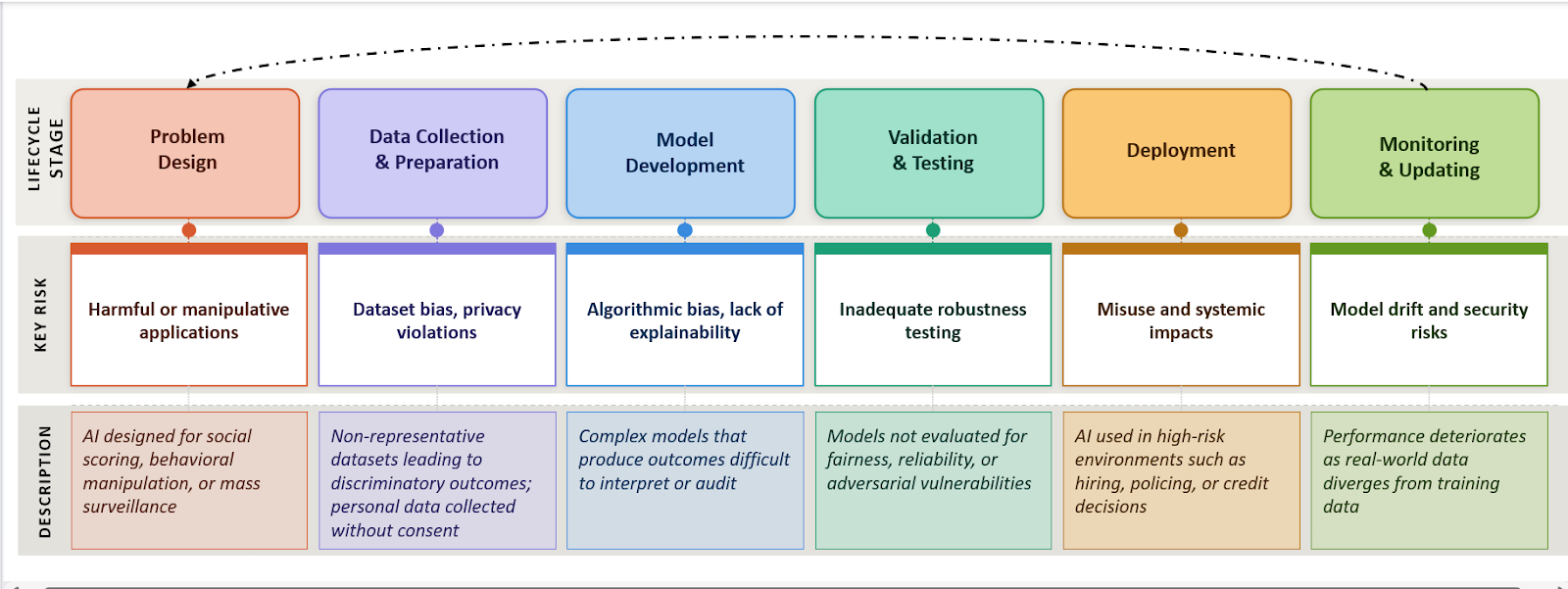
AI System Lifecycle: Key Risks at Each Stage
Risks identified per the EU AI Act and UNESCO Recommendation on the Ethics of AI
Understanding where risks emerge across the lifecycle explains why governance frameworks classify AI systems by risk and apply oversight at multiple stages.
Policy Tools for Mitigating AI Risks
Governments and international organisations have developed regulatory tools to help mitigate AI risks in the lifecycle. These tools are meant to make sure that AI technologies are identified as up to standard in safety, accountability and fairness prior to and after deployment.
For example, the OECD AI Policy Observatory recommends that governments adopt policy instruments such as risk evaluations, algorithmic auditing necessities, regulatory sandboxes, and transparency necessities of AI systems. The European Union’s Artificial Intelligence Act (AI Act) is one of the most comprehensive systems of governance that introduces a risk-oriented regulation strategy. It mandates adherence to requirements concerning data governance, documentation, human oversight, and robustness, and cybersecurity. Such requirements bring regulatory checkpoints to the lifecycle of AI systems.
Mapping these policy tools across the lifecycle illustrates how governance mechanisms can intervene at different stages of AI development.
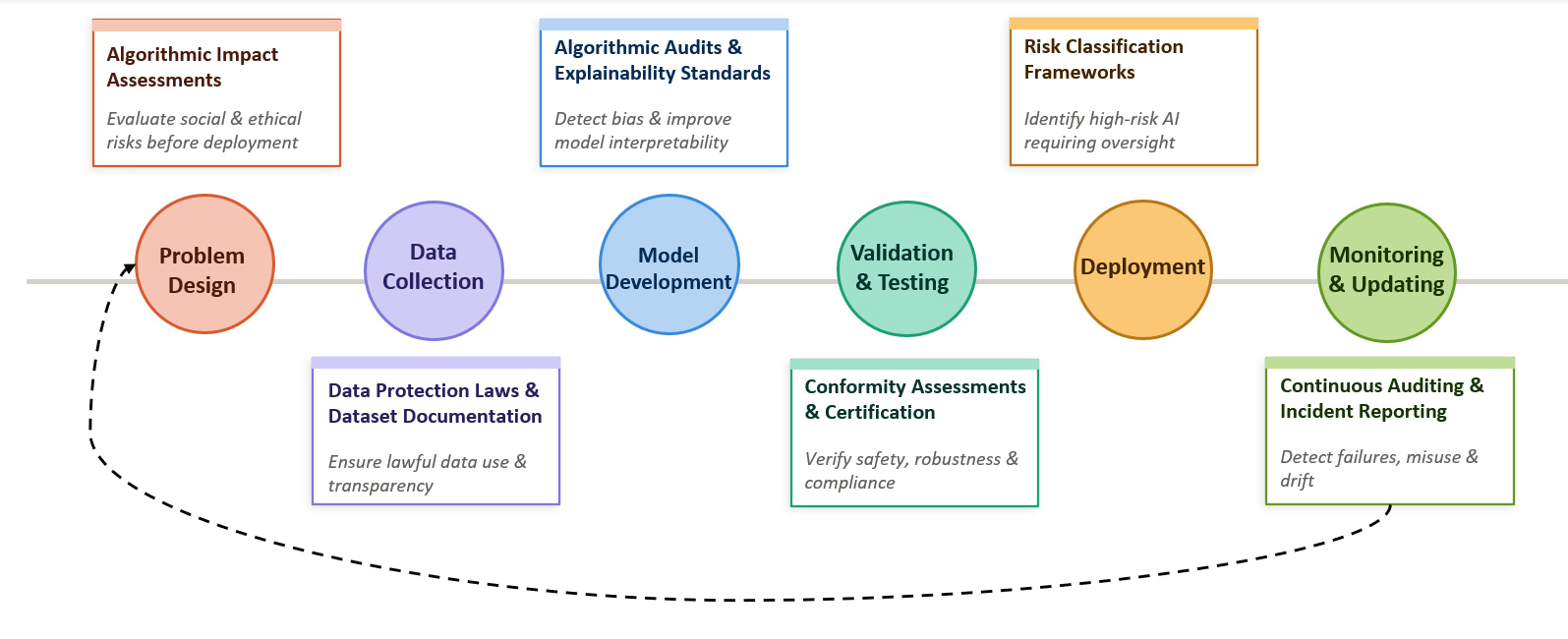
Governance Overlay: Policy Interventions Across the AI Lifecycle
Regulatory tools mapped at each stage of AI development per the EU AI Act and UNESCO Recommendation on the Ethics of AI
Several policy tools are directed at the risks that occur in the pre-developmental stages. In one example, algorithmic impact assessment has been applied in various jurisdictions to measure the possible consequences of automated decision systems on society before implementation. On the same note, the requirements of dataset documentation, including dataset transparency requirements and model cards, are aimed at enhancing accountability during the training and development stages of the AI systems. Therefore, lifecycle-based policy design allows regulators to intervene before harmful outcomes occur, rather than responding only after AI systems have caused damage in real-world environments.
The Policy Gap in AI Governance
The misalignment between risks and governance tools across the AI lifecycle indicates a critical structural gap in existing regulations. Numerous governance processes become activated after AI systems are classified as “high risk” or after they are implemented in the real world. But the most serious sources of damage have their roots in earlier stages of the development procedure.
An example is that prejudiced or unbalanced training data is almost inevitably a source of discriminative results in automated decision systems. When these types of models are applied in areas like staffing, credit rating, or in providing services to the public, such biases can quickly spread to large populations and undermine democratic rights. In the same way, the lack of transparency in model design might result in the fact that the regulator or individuals are affected by the decision-making process. This reflects a broader timing gap in AI governance, where risks originate during design and development, but regulatory intervention typically occurs only after deployment.
Analysis
1. Key risks originate before deployment: As depicted in the lifecycle mapping, the data collection and model development phase presents several significant governance risks as opposed to the deployment phase. Structural issues can be entrenched within AI systems even before they are deployed in practice due to bias in data sets, incomplete reporting of training sets, and obscured network designs.
2. Data governance is a primary point of vulnerability: Most of the instances of algorithmic discrimination listed above are associated with training material that is not representative of some population groups or is historical. Since machine learning models are optimisations of patterns that exist in datasets, these biases can be carried through the whole lifecycle and reproduced after deployment.
3. Regulatory approaches remain mismatched across jurisdictions: Different countries adopt varying approaches to AI governance, ranging from risk-based frameworks such as the EU AI Act to more sector-specific or voluntary guidelines in other regions. This divergence creates inconsistencies in safety, accountability, and enforcement standards, allowing risks to persist across borders and potentially undermining the protection of users in globally deployed AI systems.
4. Governance interventions remain uneven across the lifecycle: Whereas the various regulatory instruments aim at deployment and monitoring, fewer instruments systematically tackle the risks that are posed by the previous design and development phases.
Recommendations
1. Introduce mandatory lifecycle risk assessments: The regulatory systems need to demand systemic risk evaluation at the beginning of AI development, especially at the problem design and dataset selection phases. This would assist in detecting possible harmful applications in advance, before systems are constructed and installed.
2. Strengthen dataset governance standards: Training datasets must be supplemented with documentation as to their provenance, composition and limitations. Standardised documentation frameworks of data sets can assist in the discovery by regulators and auditors of the potential sources of bias or privacy threats.
3. Expand independent algorithmic auditing: AI systems can be assessed by regular third-party audits based on fairness, strength, and security weaknesses. The auditing mechanisms especially apply to high-risk systems employed in employment, finance or the public services.
4. Integrate continuous monitoring requirements: AI systems may be monitored regularly after implementation to identify model drift, unforeseen consequences, or abuse. Reporting systems can facilitate the process where the regulators can see the emerging risks and modify the governance systems.
Conclusion - The Need for Global AI Governance
Despite growing regulatory attention, global air governance remains fragmented. Different jurisdictions adopt varying approaches to risk classification, oversight, and enforcement, leading to inconsistencies in safety and accountability standards. Given that AI systems are often developed, deployed, and used across borders, this lack of coordination allows risks to persist beyond national regulatory frameworks.
Addressing these challenges requires a shift towards greater international cooperation and lifecycle-based governance. Developing shared standards, improving cross-border regulatory alignment, and embedding oversight across all stages of AI development will be essential to ensuring that AI systems are safe, transparent, and accountable in a globally interconnected environment.
References
- OECD AI lifecycle
- OECD AI system lifecycle description
- OECD AI governance lifecycle framework
- EU AI Act overview
- EU AI Act risk categories
- UNESCO Recommendation on the Ethics of AI
- AI governance lifecycle analysis
- OECD AI policy tools database
