
#FactCheck-AI-Generated Image of Virat Kohli and Anushka Sharma Falsely Shared as a Real Candid Moment
Executive Summary
A picture is rapidly going viral on social media, showing Indian cricketer Virat Kohli and actor Anushka Sharma having breakfast together. Users are sharing this photo, presenting it as a "candid" (real) moment. Research by the CyberPeace Research Wing revealed that the photo of Virat Kohli and Anushka Sharma having breakfast is completely fake. This image does not depict a real moment, but has been created using Artificial Intelligence (AI).
Claim
A picture is rapidly going viral on social media, showing Indian cricketer Virat Kohli and actor Anushka Sharma having breakfast together. Users are sharing this photo, presenting it as a "candid" (real) moment.
https://www.facebook.com/groups/1132434027856845/posts/1677540760012833/

Fact Check
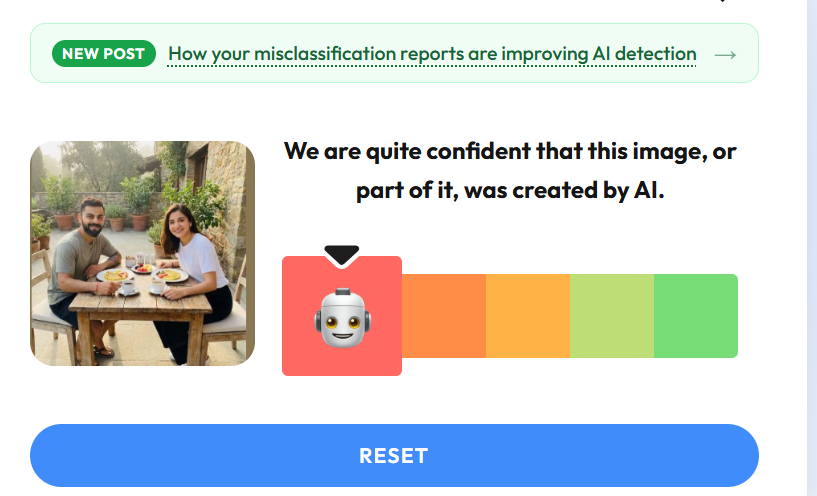
In our research, this image was found to be 'AI-generated'. When a reverse image search and keyword scan were conducted to verify this viral photo, no credible media reports, official photographs, or any such posts on the celebrity couple's official social media handles were found.
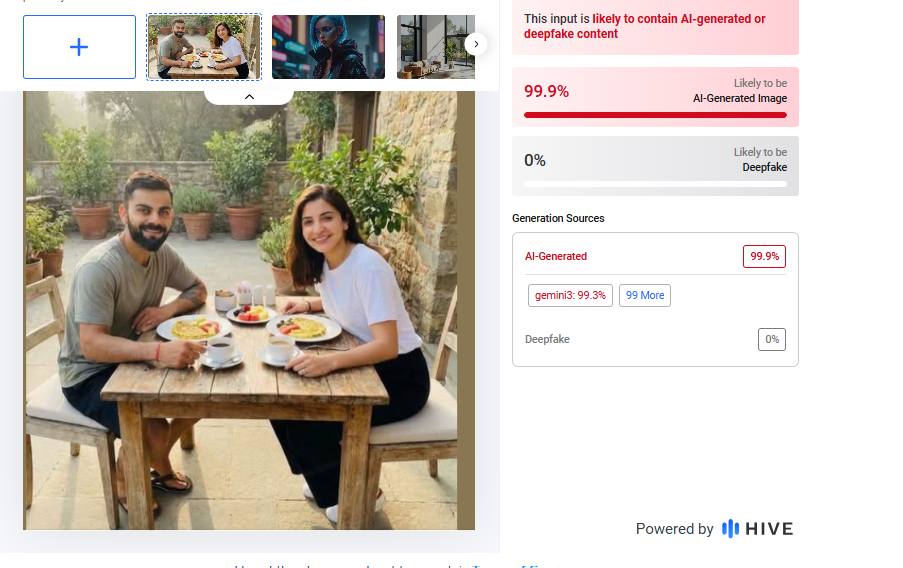
WASIT also confirmed that the image is 'AI-generated'.
Conclusion
Our research revealed that the photo of Virat Kohli and Anushka Sharma having breakfast is completely fake. This image does not depict a real moment, but has been created using Artificial Intelligence (AI).

Related Blogs
Introduction
Picture every paper trade document, such as bills of lading, certificates of origin, letters of credit, and packing lists, stacked one on top of another. By one industry estimate, the roughly four billion such documents in circulation each year would form a tower over 500 kilometres high, well past the edge of space. This absurd image reflects a simple truth, global trade has relied on paper for centuries, making transactions slow, expensive, and vulnerable to loss, forgery, and disputes.
Today, however, we complete many activities that once depended on paper through digital platforms. We open bank accounts through mobile applications, sign contracts electronically, file taxes online, and access government services through websites, all without handling a single physical document. Global trade is now undergoing a similar transformation. Yet, as trade moves online, the challenge is no longer managing stacks of paper, but protecting digital trade from cyber threats. The success of this transition will therefore depend as much on robust cybersecurity as on the adoption of digital technologies.
From Paper Trails to Platforms
For decades, an Indian exporter clearing a container needed physical stamps from customs, port authorities, banks, and multiple regulatory agencies, each on its own timeline. That has been changing under India's National Trade Facilitation Action Plan, now in its third iteration (NTFAP 3.0, 2024–27), which set out to close the remaining gaps in paperless trading systems. The shift shows up in international benchmarks: India's score on the UN's Global Survey on Digital and Sustainable Trade Facilitation has climbed sharply, with the institutional-cooperation component alone improving from under 67% to nearly 89% in recent rounds. A 2026 policy brief jointly released by ICRIER, RIS, and the Centre for WTO Studies concludes that India has achieved full implementation of domestic paperless trade measures, a rare distinction globally even as cross-border digitalisation continues to deepen.
The Building Blocks: ICEGATE to BharatTradeNet
This transformation rests on a stack of interlocking platforms. ICEGATE, the customs electronic data-interchange gateway, lets traders file declarations digitally rather than in person. SWIFT, the Single Window Interface for Facilitating Trade, connects multiple regulatory agencies so a trader deals with one portal instead of dozens. e-SANCHIT digitises supporting documents for customs clearance, cutting paperwork once attached to every consignment. Faceless assessment, rolled out under the CBIC's "Turant Customs" push, separates the assessing officer from the physical location of the goods, reducing scope for delay and discretion. The newest addition, BharatTradeNet, announced in the Union Budget 2025-26, is unified digital public infrastructure linking DGFT, GSTN, banks, shipping lines, and exporters on one platform for trade documentation and financing built to complement the Unified Logistics Interface Platform and align with international conventions.
None of this works without a legal backbone. India's proposed Trade Facilitation Bill aims to give electronic trade documents the same legal standing as paper ones, closing an interoperability gap that has long complicated cross-border recognition of digital records. Recent trade agreements have also begun embedding firmer commitments on paperless trade, a sign that digitalisation is no longer a back-office IT project but a live item in trade diplomacy.
What's at Stake Economically
The economic case is straightforward: paper costs money and time. Digitised customs and documentation shrink dwell times at ports, cut transaction costs, and reduce the discretion-driven delays that disproportionately hurt smaller firms. That matters for India's MSMEs, whose export contribution has grown from roughly ₹3.95 lakh crore to ₹12.39 lakh crore in recent years, aided by platforms such as the Government e-Marketplace and ONDC, which together have onboarded well over a million sellers. Electronics exports touched a record $47 billion in 2025, helped along by production-linked incentives and smoother compliance. With India's total merchandise exports crossing $714 billion in the first ten months of FY 2025-26, the efficiency gains from digitalisation compound across an ever-larger base and help Indian firms plug into global value chains that increasingly expect real-time, verifiable documentation rather than faxed certificates.
India's Regional Moment
Beyond its own backyard, India has regional aspirations. Following deliberations at the Asia-Pacific Trade Facilitation Forum and Paperless Trade Week 2026 in Bangkok last May, international experts were of the opinion that most of the necessary digital and regulatory infrastructure for India to join the UN Framework Agreement on Facilitation of Cross-Border Paperless Trade in Asia and the Pacific (CPTA – a treaty-based and intended to make paperless trade globally, not just internationally, interoperable) had been laid in place. Joining CPTA will also allow India to have a say on digital trade frameworks in the region and thus be a game-changer in integrating SAARC, ASEAN and global supply chains together while reducing costs of trade.
The Cybersecurity Imperative
The catch is that every portal, system and API that takes the place of a paper stamp has the potential to become an attack vector. The increase in overall ransomware activity reached more than 50% worldwide in 2025, and supply-chain attacks almost doubled. These types of attacks hit manufacturing, now a key part of India's export basket, hardest of all industrial ransomware attacks.
The notorious NotPetya attack in 2017, which effectively brought Maersk's worldwide shipping operations to a halt and shut down container movement at Mumbai's Jawaharlal Nehru Port, serves as a painful reminder that the compromise of even a single system can bring physical cargo movement within a network to a standstill.
For a trade ecosystem running on digital trust, the nature of risks include: ransomware that immobilizes ports and customs systems, supply-chain attacks that leverage a single trusted service provider to get access to dozens of downstream clients, data theft revealing shipment and financial data, impostor fraud to trick people into assuming the identity of a banks or exporter, modification of digital bills of lading, certificates of origin or other essential trade documents. When an original physical document is misplaced, it has no effect on anyone but its keeper. A corrupted digital file, on the other hand, can be stealthily changed and propagate across every system it touches instantly.
Building Trust by Design
It is a prerequisite to digital commerce to have these systems so they can even be trusted. This means a zero-trust architecture where all users and devices are authenticated rather than just assumed to be safe once you cross an organisational boundary; transport-level encryption; digital signatures & PKI for crypto-validating shipping documents; identity & access controls ensuring access to shipment data is limited to authorised persons; and anomaly detection to alert on intrusions before the problems can snowball. India's legal & policy framework for cybersecurity is indeed evolving, with the Digital Personal Data Protection Act, 2023 (and its rules finalised Jan 2025) obligating data fiduciaries & stipulating breaches must be reported within 6 hours to CERT-In; the National Cyber Security Reference Framework provides a foundational blueprint for digital public infrastructure, all under the stewardship of the National Critical Information Infrastructure Protection Centre, which monitors systems vital for the functioning of commerce.
Conclusion
India's digitised trade infrastructure from ICEGATE and SWIFT to e-SANCHIT, BharatTradeNet, and faceless customs has effectively brought it into the running for the title of regional digital trade leader. However, the success of this transformation will ultimately be measured not by the number of digital platforms it deploys, but by the trust, security, and resilience of the ecosystem that supports them. As trade becomes increasingly digital, robust cybersecurity will remain the foundation for protecting commercial data, maintaining confidence among trading partners, and ensuring that India's digital trade ambitions translate into sustainable economic growth.
Sources
- Cyble — Ransomware Attacks and Supply Chain Threats in 2025
- Chambers and Partners — Cybersecurity 2026: India
- Drishti IAS — Key Cyberthreats India is Facing and Key Measures India has Adopted to Strengthen Cybersecurity
- Protium — MSME Export Contribution Has Grown from ₹3.95 Lakh Crore to ₹12.39 Lakh Crore
- IBEF — India's E-commerce Boom: Growth, Trends & Future Prospects
- News on Air — India Achieves Record Electronics Exports of $47 Billion in 2025

Introduction
In the past few decades, technology has rapidly advanced, significantly impacting various aspects of life. Today, we live in a world shaped by technology, which continues to influence human progress and culture. While technology offers many benefits, it also presents certain challenges. It has increased dependence on machines, reduced physical activity, and encouraged more sedentary lifestyles. The excessive use of gadgets has contributed to social isolation. Different age groups experience the negative aspects of the digital world in distinct ways. For example, older adults often face difficulties with digital literacy and accessing information. This makes them more vulnerable to cyber fraud. A major concern is that many older individuals may not be familiar with identifying authentic versus fraudulent online transactions. The consequences of such cybercrimes go beyond financial loss. Victims may also experience emotional distress, reputational harm, and a loss of trust in digital platforms.
Why Senior Citizens Are A Vulnerable Target
Digital exploitation involves a variety of influencing tactics, such as coercion, undue influence, manipulation, and frequently some sort of deception, which makes senior citizens easy targets for scammers. Senior citizens have been largely neglected in research on this burgeoning type of digital crime. Many of our parents and grandparents grew up in an era when politeness and trust were very common, making it difficult for them to say “no” or recognise when someone was attempting to scam them. Seniors who struggle with financial stability may be more likely to fall for scams promising financial relief or security. They might encounter obstacles in learning to use new technologies, mainly due to unfamiliarity. It is important to note that these factors do not make seniors weak or incapable. Rather, it is the responsibility of the community to recognise and address the unique vulnerabilities of our senior population and work to prevent them from falling victim to scams.
Senior citizens are the most susceptible to social engineering attacks. Scammers may impersonate people, such as family members in distress, government officials, and deceive seniors into sending money or sharing personal information. Some of them are:
- The grandparent scam
- Tech support scam
- Government impersonation scams
- Romance scams
- Digital arrest
Protecting Senior Citizens from Digital Scams
As a society, we must focus on educating seniors about common cyber fraud techniques such as impersonation of family members or government officials, the use of fake emergencies, or offers that seem too good to be true. It is important to guide them on how to verify suspicious calls and emails, caution them against sharing personal information online, and use real-life examples to enhance their understanding.
Larger organisations and NGOs can play a key role in protecting senior citizens from digital scams by conducting fraud awareness training, engaging in one-on-one conversations, inviting seniors to share their experiences through podcasts, and organising seminars and workshops specifically for individuals aged 60 and above.
Safety Tips
In today's digital age, safeguarding oneself from cyber threats is crucial for people of all ages. Here are some essential steps everyone should take at a personal level to remain cyber secure:
- Ensuring that software and operating systems are regularly updated allows users to benefit from the latest security fixes, reducing their vulnerability to cyber threats.
- Avoiding the sharing of personal information online is also essential. Monitoring bank statements is equally important, as it helps in quickly identifying signs of potential cybercrime. Reviewing financial transactions and reporting any unusual activity to the bank can assist in detecting and preventing fraud.
- If suspicious activity is suspected, it is advisable to contact the company directly using a different phone line. This is because cybercriminals can sometimes keep the original line open, leading individuals to believe they are speaking with a legitimate representative. In such cases, attackers may impersonate trusted organisations to deceive users and gain sensitive information.
- If an individual becomes a victim of cybercrime, they should take immediate action to protect their personal information and seek professional guidance.
- Stay calm and respond swiftly and wisely. Begin by collecting and preserving all evidence—this includes screenshots, suspicious messages, emails, or any unusual activity. Report the incident immediately to the police or through an official platform like www.cybercrime.gov.in and the helpline number 1930.
- If financial information is compromised, the affected individual must alert their bank or financial institution without delay to secure their accounts. They should also update passwords and implement two-factor authentication as additional safeguards.
Conclusion: Collective Action for Cyber Dignity and Inclusion
Elder abuse in the digital age is an invisible crisis. It’s time we bring it into the spotlight and confront it with education, empathy, and collective action. Safeguarding senior citizens from cybercrime necessitates a comprehensive approach that combines education, vigilance, and technological safeguards. By fostering awareness and providing the necessary tools and support, we can empower senior citizens to navigate the digital world safely and confidently. Let us stand together to support these initiatives, to be the guardians our elders deserve, and to ensure that the digital world remains a place of opportunity, not exploitation.
REFERENCES -
- https://portal.ct.gov/ag/consumer-issues/hot-scams/the-grandparents-scam
- https://www.fbi.gov/how-we-can-help-you/scams-and-safety/common-frauds-and-scams/tech-support-scams
- https://consumer.ftc.gov/articles/how-avoid-government-impersonation-scam
- https://www.jpmorgan.com/insights/fraud/fraud-mitigation/helping-your-elderly-and-vulnerable-loved-ones-avoid-the-scammers
- https://www.fbi.gov/how-we-can-help-you/scams-and-safety/common-frauds-and-scams/romance-scams
- https://www.jpmorgan.com/insights/fraud/fraud-mitigation/helping-your-elderly-and-vulnerable-loved-ones-avoid-the-scammers

The UN established its first permanent Global Mechanism for cybersecurity which will begin operations in March 2026. The policy framework for Western countries exists because their current strategies are being developed. The situation in India presents greater complexity and higher levels of interest than any other country.
The Fence That Became a Vantage Point
The United Nations cybersecurity talks have seen India actively participate since their start. India brought its proposal for an open and inclusive multilateral framework which was supported by Western states who wanted to establish universal norms and responsible state behaviour but India did not accept their geopolitical viewpoint.
India did not support the Russia-led bloc which wanted a permanent open-ended working group that would focus only on plenary meetings and the country also rejected the European Union's Program of Action. India maintained its previous stance by supporting multilateralism as a general principle while showing hesitation about backing specific power structures.
The fence now provides an advantage because it no longer serves as a point of vulnerability. India's non-alignment provides him with operational power because the body operates through decision-making which requires all members to agree.
Sovereignty First, Norms Second
The digital sovereignty framework which defines India's long-standing cybersecurity diplomatic activities serves as the country's fundamental cybersecurity diplomatic framework. New Delhi has been reluctant to endorse frameworks that could constrain how it manages its own cyberspace, whether through content regulation, surveillance architecture, or incident response. The Indian government establishes its control over internet governance through its implementation of VPN regulations and CERT-In reporting requirements and data localization discussions.
The new Global Mechanism creates a situation which India must handle because it creates an uncommon diplomatic situation. The framework's five pillars, threats, norms, international law, confidence-building measures, and capacity-building, each carry embedded assumptions that don't sit neatly with India's domestic policy posture. India supports the norm which prohibits countries from attacking each other's critical infrastructure while developing offensive cyber abilities and keeping its cyber response strategies secret.
The Capacity-Building Opening
The Indian government has a definite interest in dedicated thematic group 2 which focuses on building cybersecurity capacity. India exists in two opposing states because it operates as a developing nation which lacks basic national cybersecurity systems while also maintaining advanced cyber defense capabilities. The donor table exists as a platform which gives India both funding rights and complete rights to speak for developing nations. India should serve as a connecting force for DTG 2 by sharing its experience with CERT-In development and its sectoral frameworks for finance and telecom and its National Cyber Coordination Centre programs which train cybersecurity professionals while requesting capacity-building programs that follow demand-based needs assessment and local context understanding and which do not include the typical restrictions that accompany Western technical assistance.
India has done this before in other multilateral settings. The organization maintains its independence through its role as a credible Global South representative which it uses to speak for the Global South without aligning with any particular alliance.
The DTG 1 Question: Critical Infrastructure and Strategic Ambiguity
The DTG 1 study about ICT security challenges shows how resilience and cooperation and stability work together as different themes but creates complex challenges for India.
The 2020 Mumbai power grid incident which some researchers attribute to Chinese state-linked actors has become one of three major attacks against India's critical infrastructure together with AIIMS Delhi incidents in 2022 and ongoing cyber intrusions into defence and government networks. The international standards which govern critical infrastructure protection require actual implementation from India because the country possesses vital national assets.
India has not yet established formal processes for cyberattack attribution while its officials avoid the norm-enforcement diplomacy which Western countries practice through their coordinated attribution and sanction procedures.
India must either develop deeper transparency about its operations or create specialized operational plans which can keep its needed information undercover if it wants to participate in DTG 1 about cross-border interdependencies and incident response collaboration. India will likely engage selectively, supporting the idea of critical infrastructure norms while resisting mechanisms that operationalise accountability.
Geopolitical Triangulation
The new Global Mechanism needs countries to implement their national policies because states must stop merely restating their positions. Multilateral cybersecurity forums operate as Geopolitical triangulation platforms for India. India's security system must protect its interests against its two main cyber adversaries which include China and Pakistan-based groups.
The US and EU strategic partnership between India and these Western governments requires India to show closer ties with democratic nations through its participation in international forums. The new Global Mechanism will require India to pursue its current position by participating in capacity-building activities while developing common norms through its work on general norms language.
India will maintain its current position between Western liberal order enforcement and Russia-China sovereignty-maximalist counter-narrative through its capacity-building activities and general norms language work.
What India Should Actually Do
The document establishes core argument which states early DTG development needs to be established for proper assessment of future results which applies to Indian territory and European territory. India has the credibility and technical foundation and diplomatic ties which enable it to establish itself as an agenda-setter who takes proactive actions instead of following others. India should take the following actions to achieve its goals: lead or co-lead DTG 2 discussions which focus on the capacity requirements of the Global South while advancing DG 1 areas that protect developing nations from actual threats and establish South-South cybersecurity agreements through this system which will help them bypass Western capacity development restrictions. The Global Mechanism offers an essential multilateral platform which provides advantages to countries that take initial actions. India has the ability to make an impact because it possesses strategic advantages which will be activated through its choice between active participation and total disengagement.
References
- http://interface-eu.org/publications/the-new-united-nations-mechanism-on-cybersecurity#a-european-strategy-for-the-dtgs
- https://disarmament.unoda.org/en/our-work/emerging-challenges/developments-field-information-and-telecommunications-context
- https://www.recordedfuture.com/research/redecho-targeting-indian-power-sector
- https://www.saikrishnaassociates.com/cert-in-issues-directions-for-information-security-practices-procedure-prevention-response-and-reporting-of-cyber-incidents/
