
#FactCheck:AI-Generated Audio Added to Real Sheikh Hasina Video to Spread False ‘United Bengal’ Claim
Executive Summary
A video clip carrying the logo of news channel Republic is being shared on social media. In the video, former Bangladesh Prime Minister Sheikh Hasina is allegedly heard saying, "If these radical Muslim terrorists do not back off from imposing terror-based governance over Bangladesh, our goal will be to finish them by any means. I will request Prime Minister Narendra Modi to make Bangla a single province by combining East and West Bengal. We will bring back a secular democracy, which I will lead in the future to restore Bangla to its secular roots." The CyberPeace Research Wing found that the visuals in the viral video are genuine, but the audio has been altered using artificial intelligence (AI) and is being circulated with a false claim.
Claim:
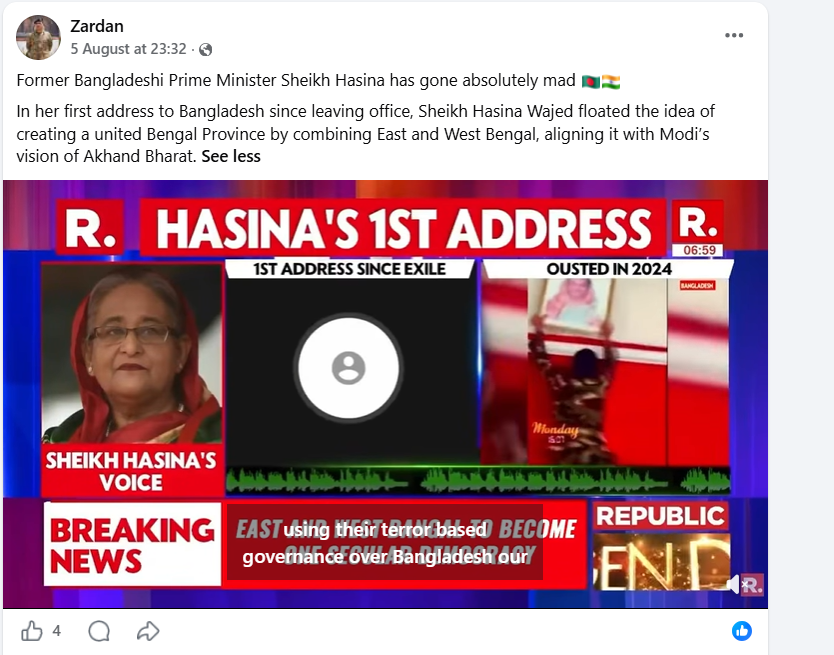
A Facebook user shared the video claiming that Sheikh Hasina proposed merging East and West Bengal to create a single province during her recent address. The link to the post, archive link, and screenshot are provided below.
https://www.facebook.com/reel/1567119714918951
FactCheck
During the research, several key frames from the viral video were extracted and a reverse image search was conducted using Google Lens. The search led us to the original video of Sheikh Hasina’s interaction available on the official social media accounts of Republic News. The link to the post and screenshot are provided below.
https://x.com/republic/status/2084999748755554323?ref_src=twsrc%5Etfw

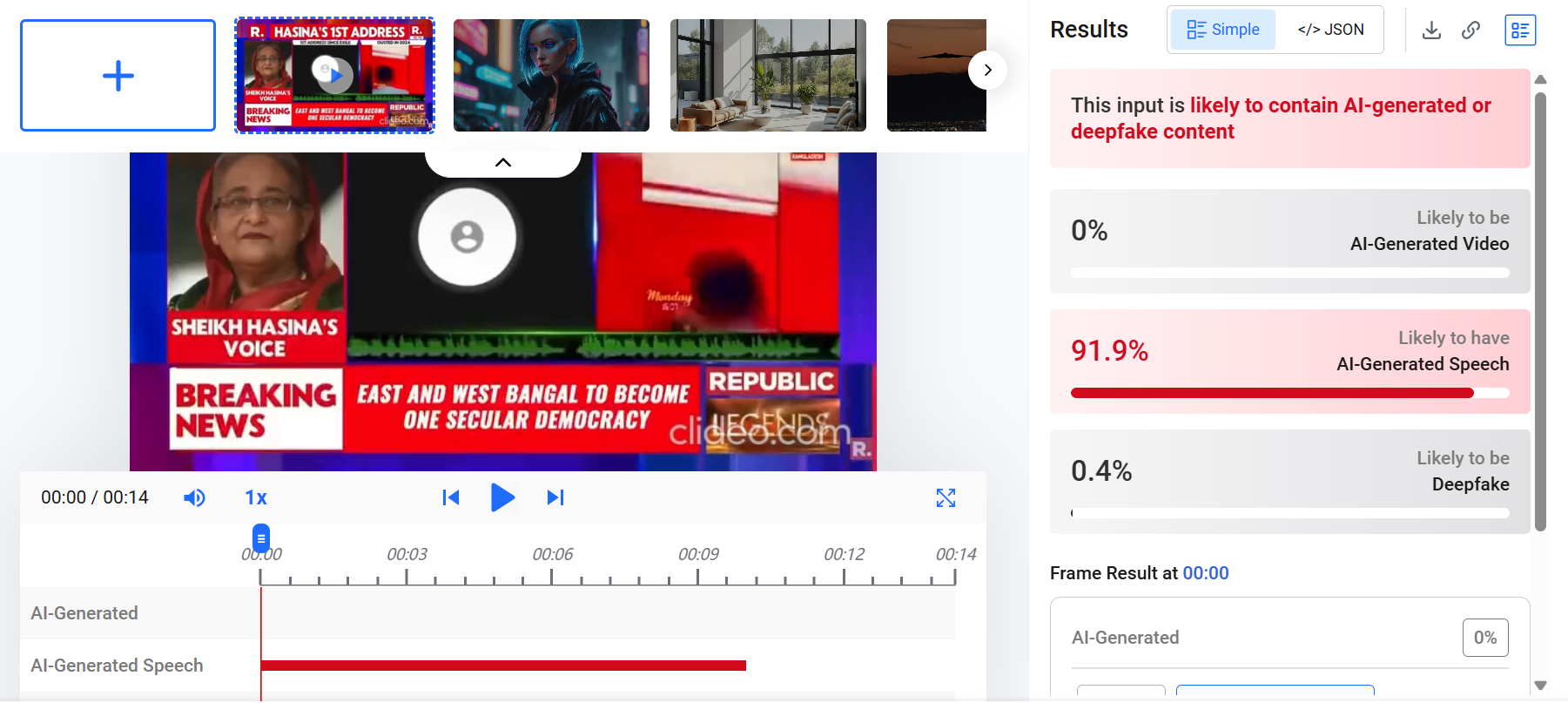
Republic shared the original video on its official X account on August 5, 2026. A comparison between the viral clip and the original footage revealed that the alleged statement about merging East and West Bengal into a single province does not appear anywhere in the authentic video. In the original video, Sheikh Hasina can be heard discussing the responsibilities of law enforcement agencies during periods of unrest. The controversial audio added to the viral clip is not part of the original recording. Further analysis of the viral video’s audio raised suspicion that it was AI-generated. The video was scanned using the AI detection tool Hive Moderation, which indicated a 91 per cent probability that the speech used in the viral video was AI-generated.
In the next step of the research, the viral audio was analysed using the Resemble AI tool. The results indicated that the audio was likely manipulated, suggesting that it had been altered using artificial intelligence (AI).

Conclusion:
The research found that the visuals used in the viral video are genuine, but the audio has been modified using AI and is being shared with a false claim. The claim that Sheikh Hasina spoke about merging East and West Bengal into a single province is false.

Related Blogs

A video circulating on social media claims to show former Indian cricketer Sachin Tendulkar commenting on England batter Joe Root’s batting feats. In the clip, Tendulkar is allegedly heard saying that if Joe Root continues scoring centuries, even his (Tendulkar’s) record would be broken. The video further claims that Tendulkar says if Root scores another century, he would give up the bat’s grip, after which the clip abruptly ends.
Users sharing the video are claiming that Sachin Tendulkar has taken a dig at Joe Root through this remark.
Cyber Peace Foundation’s research found the claim to be misleading. Our research clearly establishes that the viral video is not authentic but has been created using Artificial Intelligence (AI) tools and is being shared online with a false narrative.
CLAIM
On January 5, 2025, several users shared the viral video on Instagram, claiming it shows Sachin Tendulkar making remarks about Joe Root’s century-scoring spree.
(Post link and archive link available.)

FACT CHECK
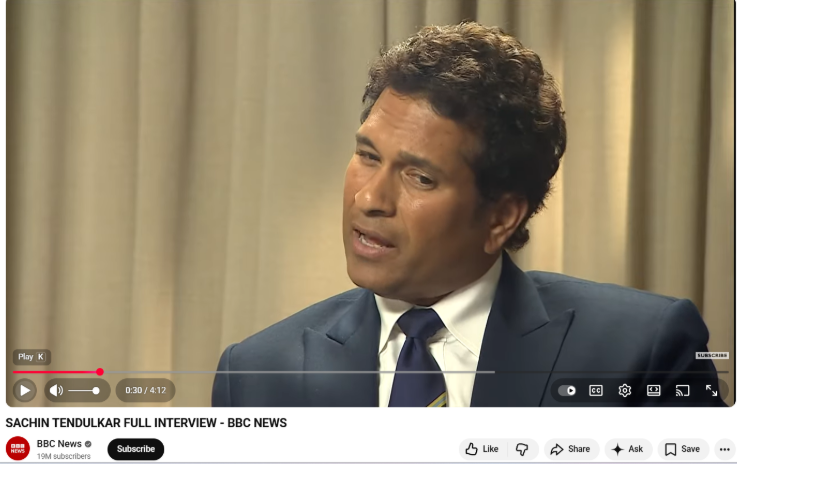
To verify the claim, we extracted keyframes from the viral video and conducted a Google Reverse Image Search. This led us to an interview of Sachin Tendulkar published on the official BBC News YouTube channel on November 18, 2013. The visuals from that interview match exactly with those seen in the viral clip.
This establishes that the visuals used in the viral video are old and have been repurposed with manipulated audio to create a misleading narrative.
Further, Joe Root made his Test debut in 2012. At that time, he had not scored multiple Test centuries and was nowhere close to Sachin Tendulkar’s record tally of hundreds. This timeline itself makes the viral claim factually incorrect.
(Link to the original BBC interview available.)
https://www.youtube.com/watch?v=v6Rz4pgR9UQ
Upon closely examining the viral clip, we noticed that Sachin Tendulkar’s voice sounded unnatural and inconsistent. This raised suspicion of audio manipulation.
We then ran the viral video through an AI detection tool, Aurigin AI. According to the results, the audio in the video was found to be 100 percent AI-generated, confirming that Tendulkar never made the statements attributed to him in the clip.

Conclusion
Our research confirms that the viral video claiming Sachin Tendulkar commented on Joe Root’s centuries is fake. The video has been created using AI-generated audio and misleadingly combined with visuals from a 2013 interview. Users are sharing this manipulated clip on social media with a false claim.

Executive Summary
A video showing a building collapse is going viral on social media. It is being shared as footage of a tragic incident that took place in Satya Niketan, Delhi. The video is accompanied by claims that it shows the building collapse in Satya Niketan. However, a research by CyberPeace’s Research Wing found that the viral video is not from the incident in Satya Niketan, Delhi. The research revealed that the video is actually from Moradabad, Uttar Pradesh, where a building collapsed on September 5, 2026. Clear similarities were found between the viral video and visuals from the incident in Moradabad. This confirms that an old video is being shared on social media with a false context, linking it to the incident in Satya Niketan, Delhi.
Claim:
A user shared the viral video on YouTube with the caption: “Major accident in Delhi! A five-storey building collapsed.”
https://www.youtube.com/shorts/1qeW-pFoMd4

Fact Check
While investigating the viral video, we conducted a reverse image search using its keyframes. This led us to the same video, which was uploaded on an Instagram account on September 5, 2026. The text visible in the video identified the location as Moradabad, Uttar Pradesh.
https://www.instagram.com/p/Dc54OW2SOh3/

In the next stage of our research, we found the video on Republic Bharat’s Instagram channel, where it was also identified as being from Moradabad.
https://www.instagram.com/reels/Dc8XTlpgaRL/

Based on the information gathered above, a keyword search led us to a report published by Dainik Bhaskar on September 5, 2026. The report also contained visuals matching those seen in the viral video. According to the Dainik Bhaskar report, on September 5, 2026, a four-storey dilapidated building collapsed in the Mughalpura area of Moradabad amid heavy rain, triggering panic in the area. However, the administration had sealed the building a day earlier after assessing its condition. The incident took place at around 3 p.m. The building was owned by a man named Sarfaraz Ali.
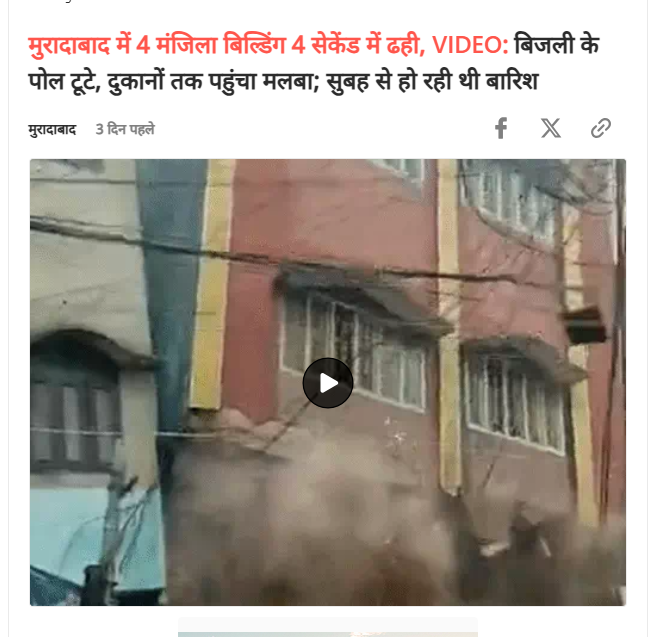
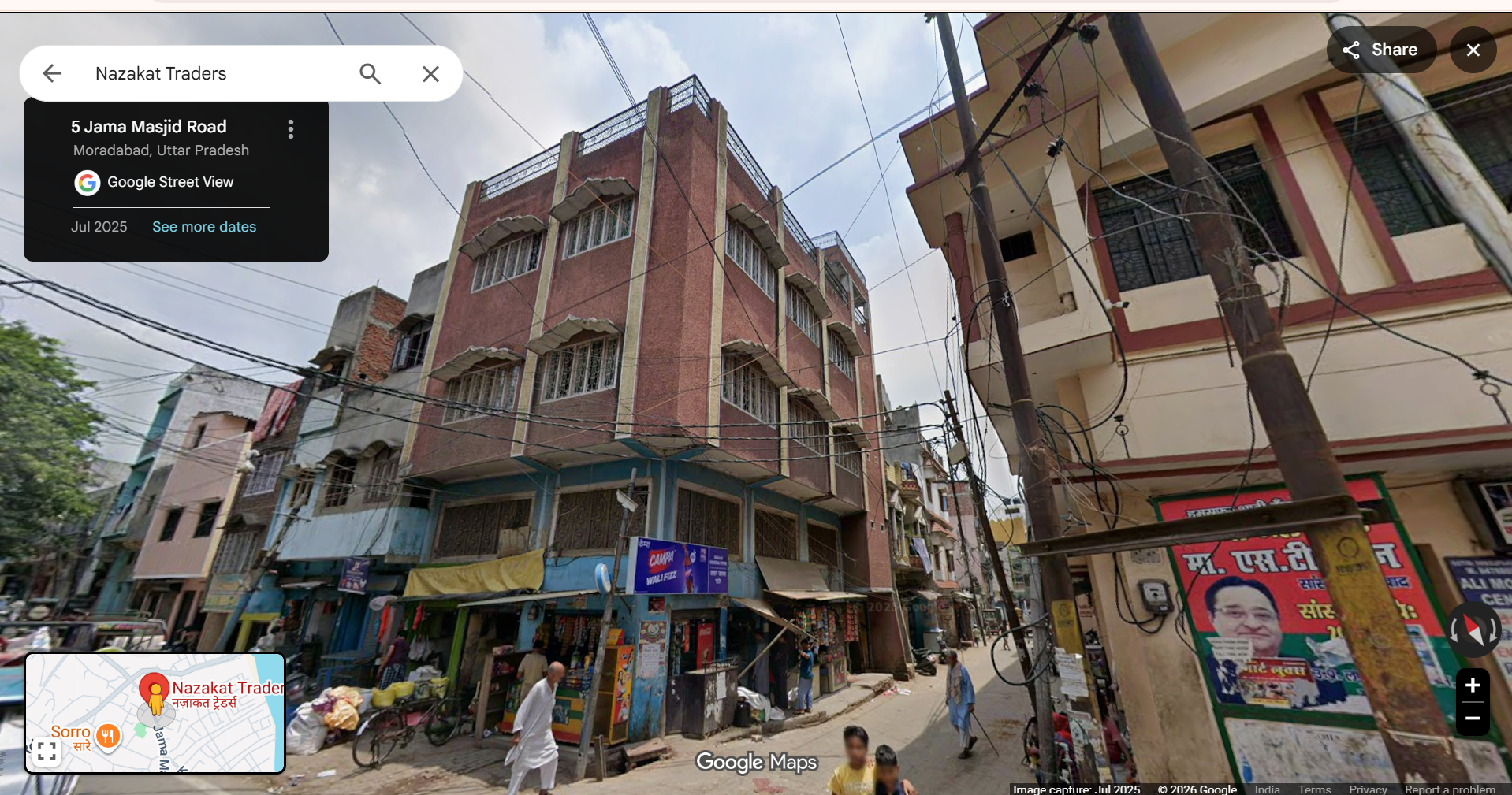
In our research, we also tried to geolocate the building seen collapsing in the viral video. We found that the building was located near Guiyan Bagh on Jama Masjid Road in Moradabad. The location can be seen in the image below.
Conclusion
The evidence gathered during our research clearly establishes that the video being circulated as footage of the tragic building collapse in Satya Niketan, Delhi, is not from Delhi. Our findings show that the viral video actually captures the collapse of a dilapidated four-storey building in the Mughalpura area of Moradabad, Uttar Pradesh, on September 5, 2026, amid heavy rainfall. The video was traced to multiple sources that identified the location as Moradabad, and further verification through media reports and geolocation confirmed that the visuals correspond to the same incident. Therefore, the viral video is being shared with a false context by incorrectly linking an incident in Moradabad to the building collapse in Satya Niketan, Delhi.

Executive Summary
Amid the ongoing conflict involving the US-Israel and Iran in West Asia, a video showing destroyed aircraft at an airport is going viral on social media. The clip is being shared with the claim that it shows an Israeli military base destroyed in an Iranian attack. However, an research by the CyberPeacen found that the viral video is not real but AI-generated.
Claim:
An Instagram user “sakirali8064” shared the video on March 22, 2026, claiming that Iran had demonstrated its military strength by deploying advanced missiles capable of long-range precision strikes.The video also carries a “Breaking News” overlay stating:“Iran attack Israel military base… the entire base destroyed.
Post link and archive link:

Fact Check:
To verify the claim, we extracted keyframes from the viral clip and conducted a reverse image search using Google Lens. We found a longer version of the same video posted on March 5, 2026, by a Facebook user named “With INC,” where it was also falsely linked to an Iranian attack on Israel’s Ben Gurion Airport.

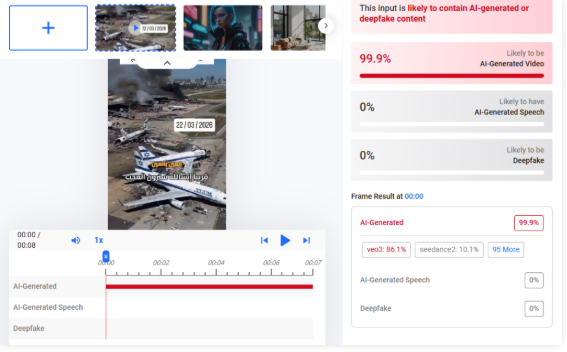
Upon closely examining the video, we observed inconsistencies such as fire changing positions unnaturally, which raised suspicion of AI manipulation. We then analyzed the video using Hive Moderation, which indicated a probability of over 99% that the content is AI-generated.
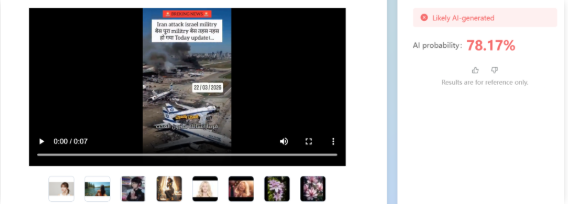
Additionally, analysis using Tencent’s “Zhuque AI” detection tool suggested more than 78% likelihood of the video being AI-generated.
Conclusion:
The viral video claiming that an Iranian attack destroyed an Israeli military base is AI-generated and misleading. While Iran has claimed to have targeted Israel’s Ben Gurion International Airport using drones, the viral footage does not depict a real event.
