
#FactCheck - Viral Video of Sachin Tendulkar Commenting on Joe Root Is AI-Generated
A video circulating on social media claims to show former Indian cricketer Sachin Tendulkar commenting on England batter Joe Root’s batting feats. In the clip, Tendulkar is allegedly heard saying that if Joe Root continues scoring centuries, even his (Tendulkar’s) record would be broken. The video further claims that Tendulkar says if Root scores another century, he would give up the bat’s grip, after which the clip abruptly ends.
Users sharing the video are claiming that Sachin Tendulkar has taken a dig at Joe Root through this remark.
Cyber Peace Foundation’s research found the claim to be misleading. Our research clearly establishes that the viral video is not authentic but has been created using Artificial Intelligence (AI) tools and is being shared online with a false narrative.
CLAIM
On January 5, 2025, several users shared the viral video on Instagram, claiming it shows Sachin Tendulkar making remarks about Joe Root’s century-scoring spree.
(Post link and archive link available.)

FACT CHECK
To verify the claim, we extracted keyframes from the viral video and conducted a Google Reverse Image Search. This led us to an interview of Sachin Tendulkar published on the official BBC News YouTube channel on November 18, 2013. The visuals from that interview match exactly with those seen in the viral clip.
This establishes that the visuals used in the viral video are old and have been repurposed with manipulated audio to create a misleading narrative.
Further, Joe Root made his Test debut in 2012. At that time, he had not scored multiple Test centuries and was nowhere close to Sachin Tendulkar’s record tally of hundreds. This timeline itself makes the viral claim factually incorrect.
(Link to the original BBC interview available.)
https://www.youtube.com/watch?v=v6Rz4pgR9UQ
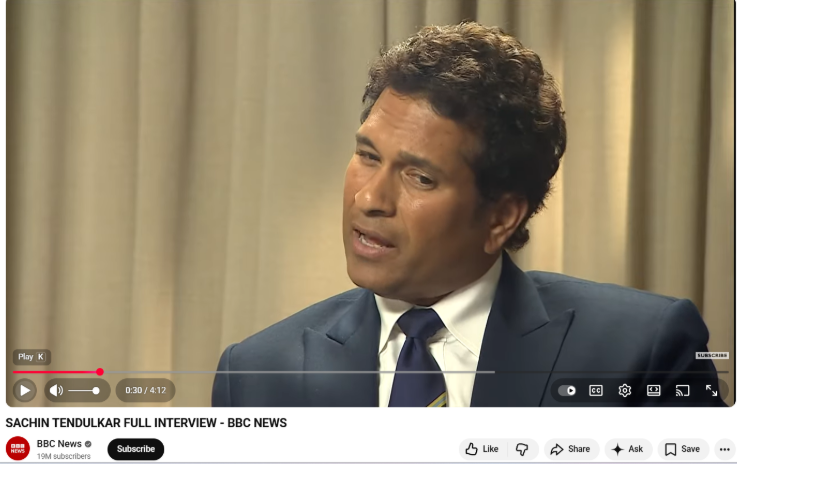
Upon closely examining the viral clip, we noticed that Sachin Tendulkar’s voice sounded unnatural and inconsistent. This raised suspicion of audio manipulation.
We then ran the viral video through an AI detection tool, Aurigin AI. According to the results, the audio in the video was found to be 100 percent AI-generated, confirming that Tendulkar never made the statements attributed to him in the clip.

Conclusion
Our research confirms that the viral video claiming Sachin Tendulkar commented on Joe Root’s centuries is fake. The video has been created using AI-generated audio and misleadingly combined with visuals from a 2013 interview. Users are sharing this manipulated clip on social media with a false claim.

Related Blogs

Executive Summary:
We have identified a post addressing a scam email that falsely claims to offer a download link for an e-PAN Card. This deceptive email is designed to mislead recipients into disclosing sensitive financial information by impersonating official communication from Income Tax Department authorities. Our report aims to raise awareness about this fraudulent scheme and emphasize the importance of safeguarding personal data against such cyber threats.

Claim:
Scammers are sending fake emails, asking people to download their e-PAN cards. These emails pretend to be from government authorities like the Income Tax Department and contain harmful links that can steal personal information or infect devices with malware.
Fact Check:
Through our research, we have found that scammers are sending fake emails, posing as the Income Tax Department, to trick users into downloading e-PAN cards from unofficial links. These emails contain malicious links that can lead to phishing attacks or malware infections. Genuine e-PAN services are only available through official platforms such as the Income Tax Department's website (www.incometaxindia.gov.in) and the NSDL/UTIITSL portals. Despite repeated warnings, many individuals still fall victim to such scams. To combat this, the Income Tax Department has a dedicated page for reporting phishing attempts: Report Phishing - Income Tax India. It is crucial for users to stay cautious, verify email authenticity, and avoid clicking on suspicious links to protect their personal information.

Conclusion:
The emails currently in circulation claiming to provide e-PAN card downloads are fraudulent and should not be trusted. These deceptive messages often impersonate government authorities and contain malicious links that can result in identity theft or financial fraud. Clicking on such links may compromise sensitive personal information, putting individuals at serious risk. To ensure security, users are strongly advised to verify any such communication directly through official government websites and avoid engaging with unverified sources. Additionally, any phishing attempts should be reported to the Income Tax Department and also to the National Cyber Crime Reporting Portal to help prevent the spread of such scams. Staying vigilant and exercising caution when handling unsolicited emails is crucial in safeguarding personal and financial data.
- Claim: Fake emails claim to offer e-PAN card downloads.
- Claimed On: Social Media
- Fact Check: False and Misleading

Introduction
India plans to draft the first AI regulations framework. The draft will be discussed and debated in June-July this year as stated by Union Minister of Skill Development and Entrepreneurship Rajeev Chandrasekhar. He aims to harness AI for economic growth, healthcare, and agriculture, ensuring its significant impact. The Indian government plans to fully utilise AI for economic growth, focusing on healthcare, drug discovery, agriculture, and farmer productivity.
Government Approach to Regulating AI
Chandrasekhar stated that the government's approach to AI regulation involves establishing principles and a comprehensive list of harms and criminalities. They prefer clear platform standards to address bias and misuse during model training rather than regulating AI at specific stages of its development. Union Minister Chandrasekhar also highlights the importance of legal compliance and the risks faced by entrepreneurs who disregard regulations in the digital economy. He warned of "severe consequences" for non-compliance.
Addressing the opening session of the two-day Nasscom leadership summit in Mumbai, the Union minister added that the intention is to harness AI for economic growth and address potential risks and harms. Mr. Chandrasekhar stated that the government is committed to developing AI-skilled individuals. He also highlighted the importance of a global governance framework that deals with the safety and trust of AI.
Union Minister Chandrasekhar also said that 900 million Indians online and 1.3 billion people will be connected to the global internet soon, providing India with both an opportunity and a responsibility to collaborate on regulations to establish legal safeguards that protect consumers and citizens. He further added that the framework is being retrofitted to address the complexity and impact of AI in safety infrastructure. The goal is to ensure legal guardrails for Al, a kinetic enabler of the digital economy, safety and trust, and accountability for those using the AI platform.
Prioritizing Safety and Trust in AI Development
Union minister Chandrasekhar announced that the framework will be discussed at the upcoming Global Partnership on Artificial Intelligence (GPAI) event, a multi-stakeholder initiative with 29 member countries aiming to bridge the gap between theory and practice on AI by supporting research on AI-related priorities. Chandrasekhar emphasises the importance of safety and trust in generative AI development. He believes that every platform must be legally accountable for any harm it causes or enables and should not enable criminality. He advocated for safe and trustworthy AI.
Conclusion
India is drafting its first AI regulation framework, as highlighted by Union Minister Rajeev Chandrasekhar. This framework aims to harness the potential of AI while ensuring safety, trust, and accountability. The framework will focus on principles, comprehensive standards, and legal compliance to navigate the complexities of AI's impact on sectors like healthcare, agriculture, and the digital economy. India recognises the need for robust legal safeguards to protect citizens and foster innovation and economic growth while fostering a culture of trustworthy AI development.
References:
- https://www.livemint.com/ai/artificial-intelligence/india-to-come-up-with-ai-regulations-framework-by-june-july-this-year-rajeev-chandrasekhar-msde-11708409300377.html
- https://timesofindia.indiatimes.com/business/india-business/india-to-develop-draft-ai-framework-by-june-july-chandrasekhar/articleshow/107865548.cms
- https://newsonair.gov.in/News?title=Government-to-come-out-with-draft-regulatory-framework-for-Artificial-Intelligence-by-July-2024&id=477637

Executive Summary
A disturbing video showing a girl placing soil on a grave is going viral on social media. In the video, a young girl can be seen crying as she places soil on a grave in the presence of several people. The video is being shared in connection with Bangladeshi nationals allegedly killed in Saudi Arabia. It is claimed that her parents were killed while making a reel inside a mosque in Saudi Arabia and that she is placing soil on their grave.
CyberPeace Research found that the video of the girl placing soil on a grave dates back to May 2026. In reality, a Bangladeshi national named Sajal died in Saudi Arabia after a tree fell on him while he was eating. The girl seen in the video is Sajal’s daughter. The video is now being shared with a false claim linking it to a man and a woman who were recently sentenced to death in Saudi Arabia.
Claim:
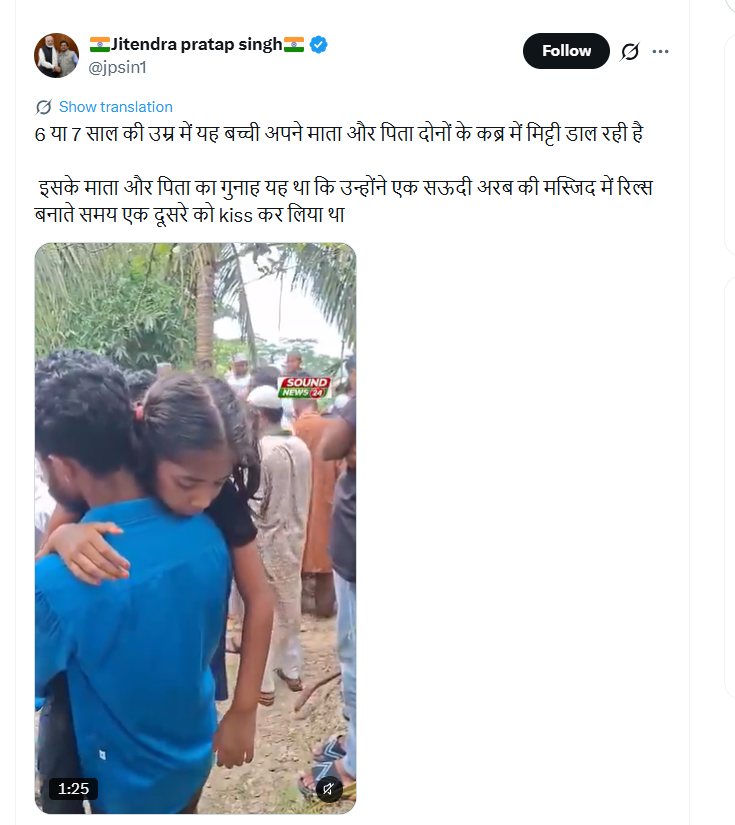
A user on X shared the video with the caption: “At the age of 6 or 7, this little girl is placing soil on the graves of both her mother and father. Their crime was that they kissed each other while making reels inside a mosque in Saudi Arabia.”
https://x.com/jpsin1/status/2112109435393024287
Fact Check
During our research, we found a photograph of the girl seen in the viral video in a report published on May 6, 2026, by another Bangladeshi news website, Bhorer Kagoj (bhorerkagoj.net). The report stated that Sajal Howlader, 31, son of Imadul Howlader, a resident of Ward No. 4 of Khanda village under Rayenda Union No. 3 in Sharankhola Upazila, died after being crushed by a tree in Saudi Arabia.
According to the report, Sajal’s father, Imadul, said that on May 2, at around 4:30 p.m. Saudi Arabia time, Sajal and five other people were sitting under a tree and eating rice when a large she-oak tree fell on them. The five other people sitting under the tree survived, but Sajal died after being crushed by it.
The report also stated that Sajal’s daughter had appealed to Bangladesh Prime Minister Tarique Rahman to bring her father’s body back from Saudi Arabia.
https://www.bhorerkagoj.net/country/786354

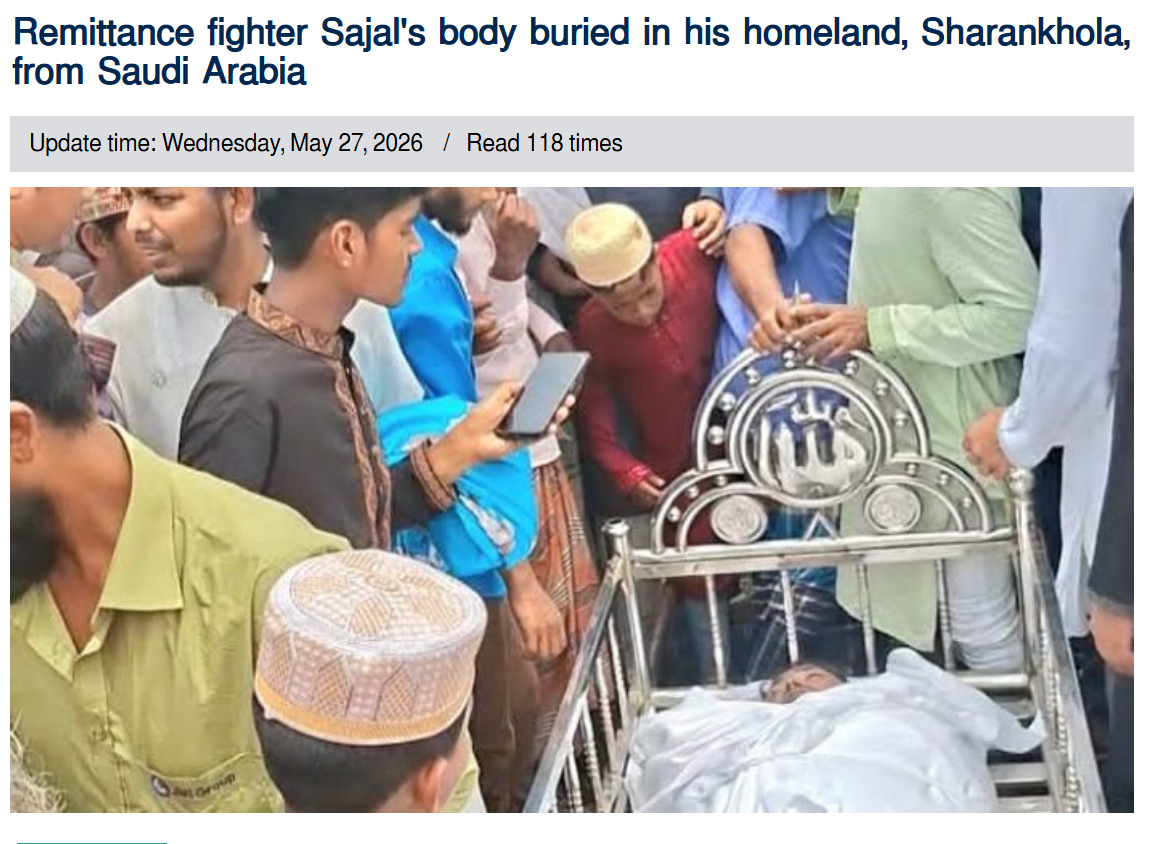
Upon further research, we found a detailed report about the incident published by the Bangladeshi news website Daily Ajker Songram (dailyajkersongram.com). The report stated that 31-year-old Mohammad Sajal died in Saudi Arabia after a tree fell on him.
His body arrived at Hazrat Shahjalal International Airport at around 11 a.m. on May 25, 2026. After the completion of the legal formalities, Sajal’s body reached his hometown of Sharankhola on May 26, 2026.
https://www.dailyajkersongram.com/2026/05/27/
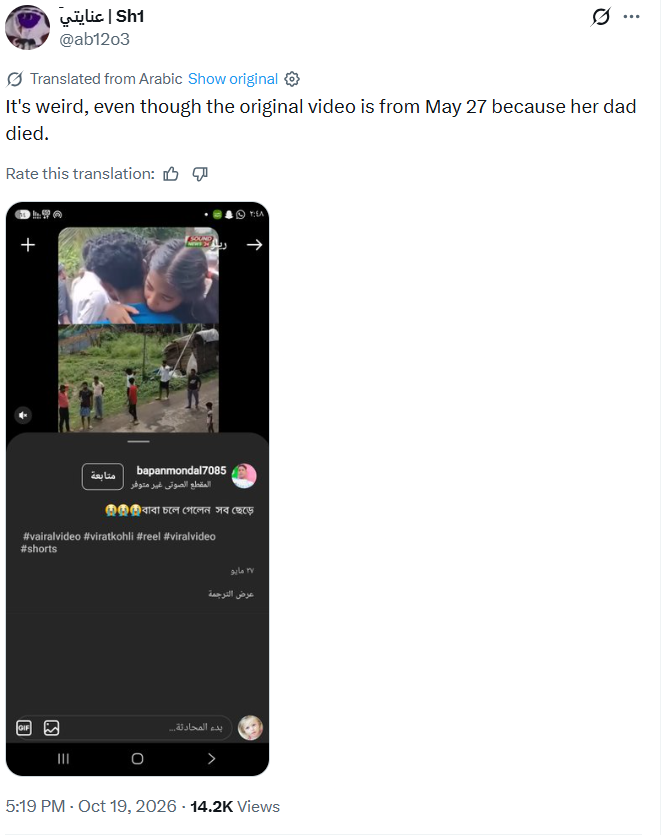
An X account also shared the video, claiming that the original video dates back to May 27, when the girl’s father had died.
https://x.com/ab12o3/status/2112149070764482702
Conclusion
Our research found that the video showing a girl placing soil on a grave dates back to May 2026. In reality, a Bangladeshi national named Sajal died in Saudi Arabia after a tree fell on him while he was eating. The girl seen in the video is Sajal’s daughter. The video is now being shared with a false claim linking it to a man and a woman who were recently sentenced to death in Saudi Arabia.
