
#FactCheck: Viral Video of Moradabad Building Collapse Falsely Linked to Delhi’s Satya Niketan Incident
Executive Summary
A video showing a building collapse is going viral on social media. It is being shared as footage of a tragic incident that took place in Satya Niketan, Delhi. The video is accompanied by claims that it shows the building collapse in Satya Niketan. However, a research by CyberPeace’s Research Wing found that the viral video is not from the incident in Satya Niketan, Delhi. The research revealed that the video is actually from Moradabad, Uttar Pradesh, where a building collapsed on September 5, 2026. Clear similarities were found between the viral video and visuals from the incident in Moradabad. This confirms that an old video is being shared on social media with a false context, linking it to the incident in Satya Niketan, Delhi.
Claim:
A user shared the viral video on YouTube with the caption: “Major accident in Delhi! A five-storey building collapsed.”
https://www.youtube.com/shorts/1qeW-pFoMd4

Fact Check
While investigating the viral video, we conducted a reverse image search using its keyframes. This led us to the same video, which was uploaded on an Instagram account on September 5, 2026. The text visible in the video identified the location as Moradabad, Uttar Pradesh.
https://www.instagram.com/p/Dc54OW2SOh3/

In the next stage of our research, we found the video on Republic Bharat’s Instagram channel, where it was also identified as being from Moradabad.
https://www.instagram.com/reels/Dc8XTlpgaRL/

Based on the information gathered above, a keyword search led us to a report published by Dainik Bhaskar on September 5, 2026. The report also contained visuals matching those seen in the viral video. According to the Dainik Bhaskar report, on September 5, 2026, a four-storey dilapidated building collapsed in the Mughalpura area of Moradabad amid heavy rain, triggering panic in the area. However, the administration had sealed the building a day earlier after assessing its condition. The incident took place at around 3 p.m. The building was owned by a man named Sarfaraz Ali.

In our research, we also tried to geolocate the building seen collapsing in the viral video. We found that the building was located near Guiyan Bagh on Jama Masjid Road in Moradabad. The location can be seen in the image below.

Conclusion
The evidence gathered during our research clearly establishes that the video being circulated as footage of the tragic building collapse in Satya Niketan, Delhi, is not from Delhi. Our findings show that the viral video actually captures the collapse of a dilapidated four-storey building in the Mughalpura area of Moradabad, Uttar Pradesh, on September 5, 2026, amid heavy rainfall. The video was traced to multiple sources that identified the location as Moradabad, and further verification through media reports and geolocation confirmed that the visuals correspond to the same incident. Therefore, the viral video is being shared with a false context by incorrectly linking an incident in Moradabad to the building collapse in Satya Niketan, Delhi.

Related Blogs
Executive Summary
A video of US Secretary of State Marco Rubio is rapidly going viral on social media, in which he can allegedly be heard making a statement regarding the 2025 India-Pakistan conflict. Along with the video, it is being claimed that the US played a crucial role in ending the conflict between the two countries, but India was the first to initiate a ceasefire with Pakistan. Users are sharing this video believing it to be true.
Research by the CyberPeace Research Wing revealed that the video has been digitally manipulated. Rubio did state that the United States played a role in ending the conflict, but he never said that India was the first to request a ceasefire from Pakistan. This alleged statement was not part of the original video and was added later to alter the clip.
Claim
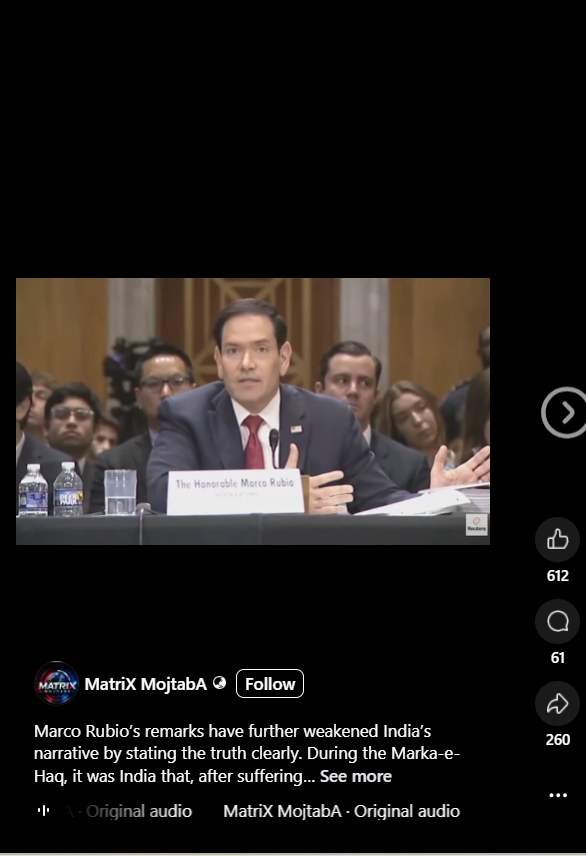
A user on a Facebook page shared the viral video and wrote, "Marco Rubio's statement has clearly brought out the truth, weakening India's claim. During 'Maarka-e-Haq', after suffering heavy losses, India was the first party to request a ceasefire from Pakistan. This highlights the gap between India's public claims and the ground reality, where the military..." The post link, archive link, and screenshot can be seen below. https://www.facebook.com/reel/1015648544746728
https://www.facebook.com/reel/1015648544746728
Fact Check
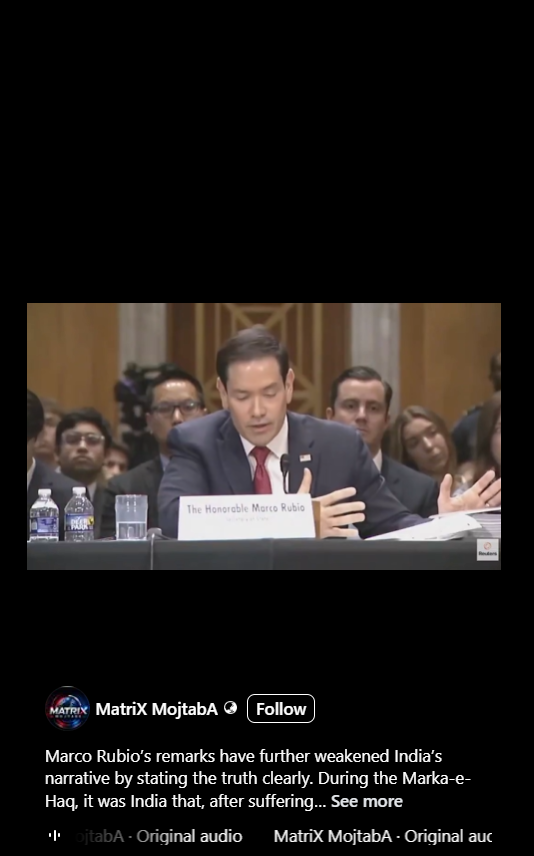
We investigated the viral video using the InVid tool and extracted several of its keyframes. These keyframes were then subjected to a reverse image search via Google Lens. The investigation revealed that the exact same video had been shared on social media previously, showing the same background and setting. The post link and screenshot can be seen below.
https://www.facebook.com/reel/1015648544746728
In the next step of our investigation, we found a video published on Reuters' official YouTube channel on June 2, 2026, whose background matches the viral video. However, nowhere in this original video is Marco Rubio heard saying that India was the first to request a ceasefire from Pakistan. The post link and screenshot can be seen below.
https://www.youtube.com/watch?v=qSpp5IYO6Cs

At the 2-hour 8-minute 55-second mark of the Reuters video, Rubio only states that the US played a role in ending the India-Pakistan conflict. Following this, he discusses the Thailand-Cambodia conflict. This makes it clear that the alleged statement in the viral video was digitally added or edited in, and is not part of the original footage.
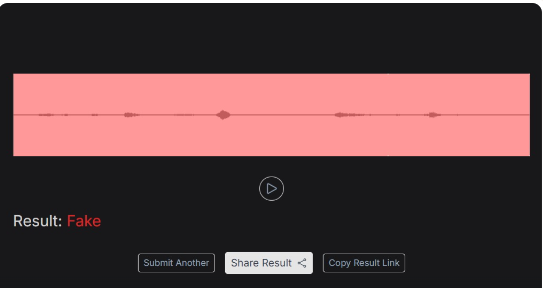
Taking the investigation further, we scanned the suspicious audio portion of the viral video using the AI detection tool 'Resemble AI'. According to the analysis results, clear signs of audio manipulation were detected.
Conclusion:
Our investigation revealed that the video has been digitally manipulated. Rubio did state that the United States played a role in ending the conflict, but he never said that India was the first to request a ceasefire from Pakistan. This alleged statement was not part of the original video and was altered by adding it later.
Introduction
On June 11, 2026, the Ministry of Home Affairs (MHA) India released one of the most critical Indian government advisories concerning cybersecurity by the Indian Cyber Crime Coordination Centre (I4C) under the National Cybercrime Threat Analytics Unit (NCTAU) concerning the immediate and escalating threat posed by the weaponization of generative artificial intelligence to forge synthetic biometric identities capable of bypassing the existing facial verification mechanisms in India. This advisory is arguably one of the most explicit Indian government recognitions of the deep-seated threats associated with AI-generated deepfakes in the country’s digital financial infrastructure. As many Indian financial service providers embrace facial recognition and biometric verification systems for customer onboarding and authentications, the myth that biometric traits are in themselves secure is slowly unraveling.
The advisory states that cybercriminals are deploying sophisticated AI tools to forge such credible digital simulacrums that exhibit such a precise similarity of facial expressions, eye movements, eye blinks, head movements, and voice patterns that they are virtually indistinguishable from the originals for identity verification mechanisms. Such a confluence of easy AI technology, mass onboarding of digital identities, and underdeveloped infrastructure to detect these synthetics requires urgent regulatory, institutional, and technological intervention.
The I4C Advisory: Core Findings and Threat Architecture
In its advisory, NCTAU describes a complex, multi-step attack chain used by scammers to capture biometric information and perpetrate fraud using everyday social interactions. The attackers typically use social media accounts, chat messengers, online job applications, dating applications, or direct phone calls to reach their targets. These interactions are presented as innocuous, such as for video calls, job interviews, identity checks, or just normal conversation with the intention of recording facial and vocal data.
During these interactions, victims may be asked to perform gestures commonly seen in legitimate video calls, such as look directly at the camera, blink, turn their head, or say specific phrases. However, the perpetrators record this video feed without the victim's knowledge and then use deep learning generative AI technologies to process it. Through methods such as Generative Adversarial Networks (GANs) and diffusion models, the scammers create photorealistic synthetic duplicates of the target, capable of mirroring all physical and vocal attributes, such as facial expressions, blinking patterns, head movements, and even voice tones.
The advisory explicitly states that these synthetic identities can be used for a variety of fraudulent activities, such as spoofing face authentication systems, circumventing liveness detection checks, successfully completing video KYC, enabling fraudulent account recovery processes, and illegally accessing bank and financial services. NCTAU also cautions that these voice deepfakes may be paired with facial deepfakes in an attempt to undermine multi-modal authentication methods, and the occurrence of related SIM-swap attacks can eliminate the last layer of security in OTP verification and facilitate a complete account compromise.
The scale of India's Digital Financial Ecosystem
The scale of I4C's detected threat can be better understood by considering India's entire digital financial landscape. In 2025 India has witnessed over 228 billion UPI transactions, with 21.63 billion in December alone, an annual growth rate of 29% from 2024, and an active user base of over 500 million by the beginning of 2026. Furthermore, total e-KYC transactions by April 2025 have exceeded 2,393 crore, and thus, it can be seen the extent to which these aspects of finance (banking, insurance, and credit) are now conducted via remote digital verification. The transformation, although instrumental in increasing financial inclusion, has, according to some analysts, created an attack surface of historic scale. As hundreds of millions more become financially integrated via the very same channels that now form the country's infrastructure and systems of identity, the threat from identity-based fraud becomes astronomically large.
Indian government data further illustrates the extent to which such frauds are a growing concern. Cybercrime cases jumped 42% year-on-year to 2.27 million in 2024, resulting in losses amounting to nearly 228.45 billion. Within that, 1.34 million UPI cases, worth 1,087 crore, occurred in FY2024 alone, while cybercrimes in general soared from 260,000 cases in 2021 to nearly 2.8 million by 2025, totaling cybercrime losses of 22,931 crore.
How Do Deepfakes Defeat Biometric Systems?
Deepfake fraud, in particular, is extremely difficult to counteract due to the direct attack it poses on the assumptions underlying traditional verification systems. Passive techniques for verifying a live person from a static photo or video existed that primarily looked for similarities in textures, lighting, and geometrical properties or challenged subjects to perform an action in real-time. But the generation of real-time face swapping that contains blinks, head motion, and speaking can now be produced on even cheap machines. Cybercriminals can exploit these by using virtual camera drivers to "inject" the false image feed into the live verification session, nullifying any passive liveness checks. Data from the industry clearly shows the extent of this problem: iProov, a leading authenticator, documented a 7.8-fold rise in injection attacks in 2024; Jumio noted an 88% increase in deepfake-induced fraud in 2025; and voice-deepfake attacks on financial call centres saw a 6.8-fold increase in 2024.
Gartner had also predicted that 30% of organizations would have lost trust in facial verification alone by 2026, and work by Kubam (2024) confirmed a lack of multi-factor authentication such as cross-validation of biometric, document, and device integrity signals used within KYC platforms. Such fears have been corroborated by FATF's 2025 Horizon Scan, which classified deepfakes as an emerging threat to the AML/CDD framework and digital identity verification.
Recommendations by I4C
I4C's advisory goes beyond merely warning about threats and lists actionable recommendations to both institutions and citizens. Banks, NBFCs, fintech companies, and onboarding platforms have been advised to incorporate advanced deepfake and synthetic content detection techniques into their verification flows, given that first-generation liveness checks are not enough. They should employ a multi-modal strategy that considers face features along with the device, network signals, behavioral biometrics, and alignment of face and voice. They also have been advised to make a more robust upgrade of their onboarding and verification platforms, as much of the current remote verification architecture was built in a less sophisticated threat context. This aligns with the KYC Master Direction of the RBI that specifies end-to-end encryption, IP-based access controls, geotagging, and technology platforms and systems are to be upgraded frequently. Citizens are advised by I4C to keep their biometric information secure; be careful of unsolicited video calls and online interviews; keep an eye on transaction-related SMS and emails; and report suspicious instances through the National Cybercrime Reporting Portal and through the telephone number 1930. It is clarified that this advisory aims to create awareness of developing AI-based identity fraud schemes, and it is not a declaration that any specific organization, platform, or service is vulnerable.
The Legislative Dimension: India's Evolving Response to Synthetic Media
The problem highlighted by I4C is evolving in a heavily legislated environment, not a legal void. The first-ever legal definition of "synthetic media" in India came into force in the Information Technology Amendment Rules 2026 on February 20, 2026. These rules oblige significant platforms to remove deepfakes and non-consensual intimate media within three hours and two hours, respectively, or lose their safe harbor protection under Section 79 of the IT Act. While the provision focuses on harm stemming from content, this creates a new legal and normative precedent on dealing with AI-induced deception. However, financial frauds facilitated through deepfakes are not content but involve the use of remote identity verification and customer onboarding systems, which require specific technical standards. The overall policy environment when viewed in light of the FATF Horizon Scan, RBI KYC rules, and recent I4C advisory already offers significant scope to define and introduce mandatory deepfake detection and identity assurance standards even before these are explicitly legislated.
Institutional and Technical Recommendations
- For Financial Institutions and Fintech platforms: The existing verification systems (liveness detection) must be replaced with multi-layered deep-fake detection processes, including injection attack detection, behavioral biometrics, cross-modal facial and voice verification, device integrity check, and hardware attestation during onboarding itself.
- For Regulators: The RBI and Ministry of Home Affairs should work together to release technical standards that specify minimum deepfake-detection requirements for video-KYC and remote onboarding systems in line with FATF digital identity guidance and the upcoming EU AI Act.
- For researchers and academia: Dedicated studies on deepfake detection performance across varied demographic, linguistic, and regional populations of India should be prioritized. Current models are mostly trained on Western data.
- For citizens: Face recordings and other biometric information should be treated with the same caution as sensitive financial details. Be wary of unsolicited video calls, remote interviews, or verification requests from unknown people, and report suspicious activities on any account immediately via the National Cybercrime Helpline (1930) or cybercrime.gov.in.
Conclusion
The I4C advisory of June 2026 marks a critical recognition that advances in generative AI have fundamentally challenged the reliability of facial biometric authentication. For a country whose digital financial ecosystem relies heavily on remote identity verification, the implications are significant. The integrity of India's financial inclusion framework now depends on rapidly strengthening identity assurance mechanisms. Addressing this threat will require coordinated action by regulators, financial institutions, technology developers, researchers, and citizens to develop robust technical standards, enhance detection capabilities, and build public awareness at a pace matching the evolution of AI-enabled fraud.
References and Sources
- I4C / NCTAU Advisory, June 2026 — National Cybercrime Threat Analytics Unit, Indian Cyber Crime Coordination Centre, Ministry of Home Affairs, Government of India. Advisory on AI-Enabled Deepfake Identity Fraud. Issued 11 June 2026.
- shuftipro.com/blog/key-takeaways-from-fatf-horizon-scan-report-on-deepfakes
- https://timesofindia.indiatimes.com/india/fraudsters-creating-deepfakes-to-bypass-facial-authentication-i4c/articleshow/131668958.cms
- hyperverge.co/blog/what-is-a-deepfake
- iproov.com/reports/threat-intelligence-report-2026
- arxiv.org/pdf/2601.06241
Executive Summary:
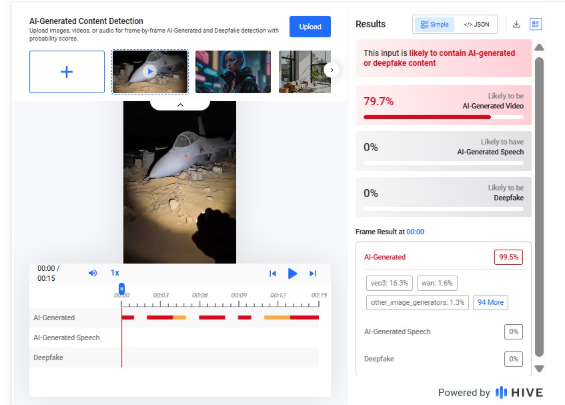
Amid the ongoing conflict involving the US-Israel and Iran, Tehran has claimed that it shot down a US F-35 fighter jet. In this context, a video is going viral on social media showing a crashed American fighter aircraft on the ground. It is being claimed that the footage shows Iran downing a US F-35 jet. However, an research by the CyberPeace found that the viral video is a deepfake and not real. The clip appears to have been created using Google AI tools.
Claim:
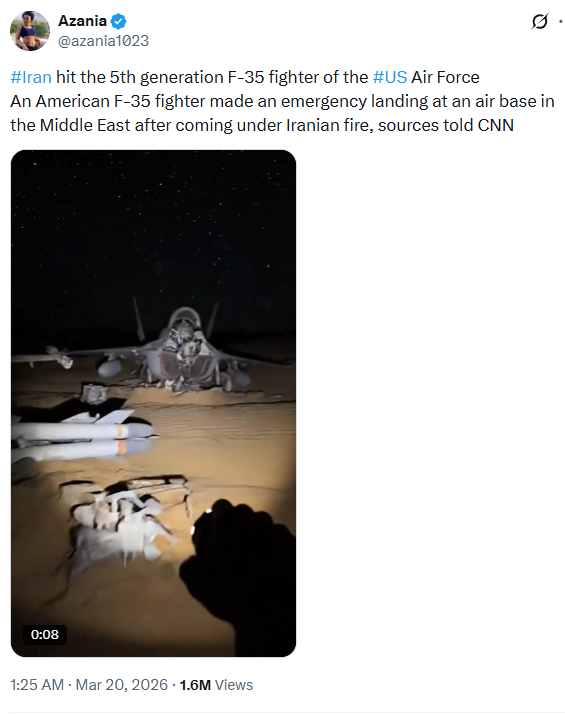
A social media user “Azania” shared the viral video on March 20, 2026, with the caption,“#Iran hit the 5th generation F-35 fighter of the #US Air Force… An American F-35 fighter made an emergency landing at an air base in the Middle East after coming under Iranian fire, sources told CNN.”
Fact Check:
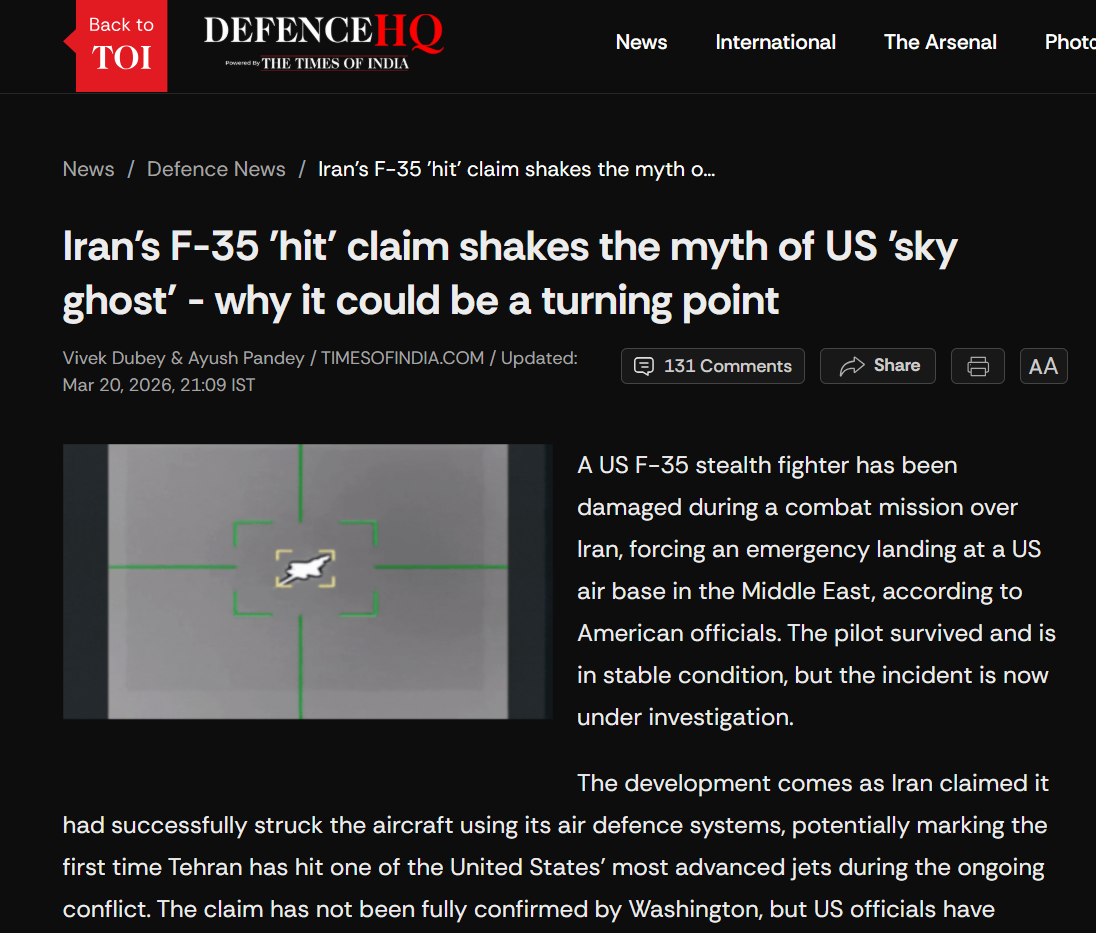
We began our research with a news search and found multiple reports stating that a US F-35 fighter jet was damaged during a combat mission over Iran. According to reports, Iran’s Islamic Revolutionary Guard Corps (IRGC) claimed to have damaged a US F-35 jet and also released a video. As per a CNN report, US officials confirmed that an American F-35 was damaged during a mission over Iran, forcing it to make an emergency landing at a US airbase in the Middle East. The pilot was safe and in stable condition, and the incident is currently under research .
A spokesperson for the US Central Command, Captain Tim Hawkins, also acknowledged that an F-35 made an emergency landing during the mission. However, the US has not officially confirmed that the damage was caused by an Iranian attack.Reports by Fox News and The Times of India also mention the emergency landing of the aircraft.
Upon closely examining the viral video, we noticed several inconsistencies indicating possible AI manipulation. We then analyzed the clip using Hive Moderation, which indicated nearly a 79 percent probability that the video is AI-generated. The analysis also suggests that it was likely created using Google’s AI video generation tools (Veo).
Conclusion:
The viral video claiming to show Iran shooting down a US F-35 fighter jet is AI-generated and not real. While Iran has claimed to have targeted a US F-35, and the US has confirmed an emergency landing during a mission, there is no official confirmation that the aircraft was shot down by Iran.
