
#FactCheck -Viral Video of Electric Car Powered by Generator Is AI-Generated
Executive Summary
A video circulating on social media shows an electric car allegedly being powered by a portable generator attached to it. The clip is being shared with the claim that the generator is directly running the vehicle, suggesting a groundbreaking or unusual technological feat. However, research conducted by the CyberPeace found the viral claim to be false. Our research revealed that the video is not authentic but AI-generated.
Claim
On February 22, 2026, a user on X (formerly Twitter) shared the viral video with the caption: “After watching this video, Newton might turn in his grave.” The post implied that the video demonstrates a scientific impossibility.

Fact Check:
To verify the claim, we conducted a keyword search on Google. However, we found no credible reports from any reputable media organization supporting the assertion made in the viral post. A close examination of the video revealed several visual inconsistencies and unnatural elements, raising suspicion that the footage may have been generated using artificial intelligence. We then analyzed the video using the AI detection tool Hive Moderation. The results indicated a 96 percent probability that the video was AI-generated.
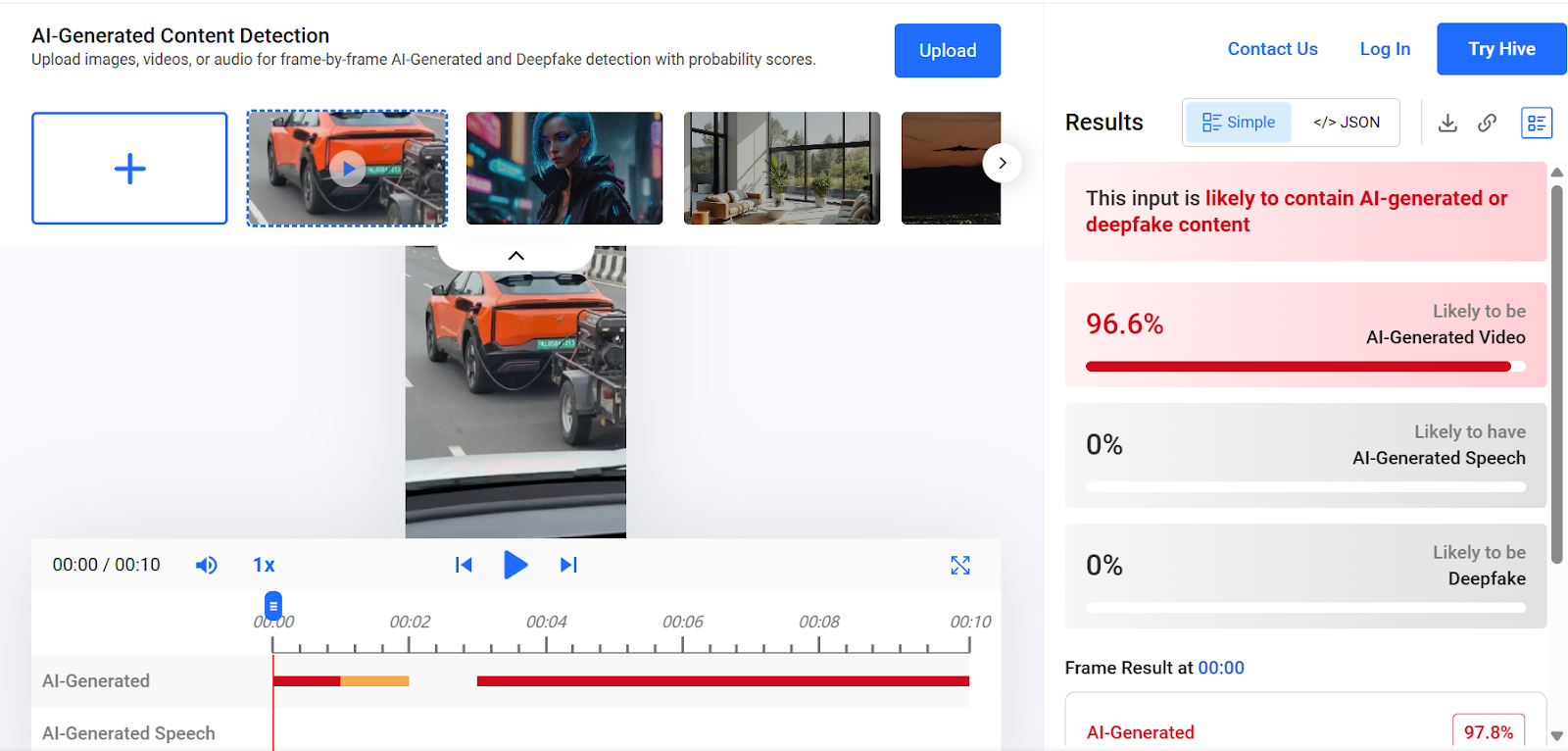
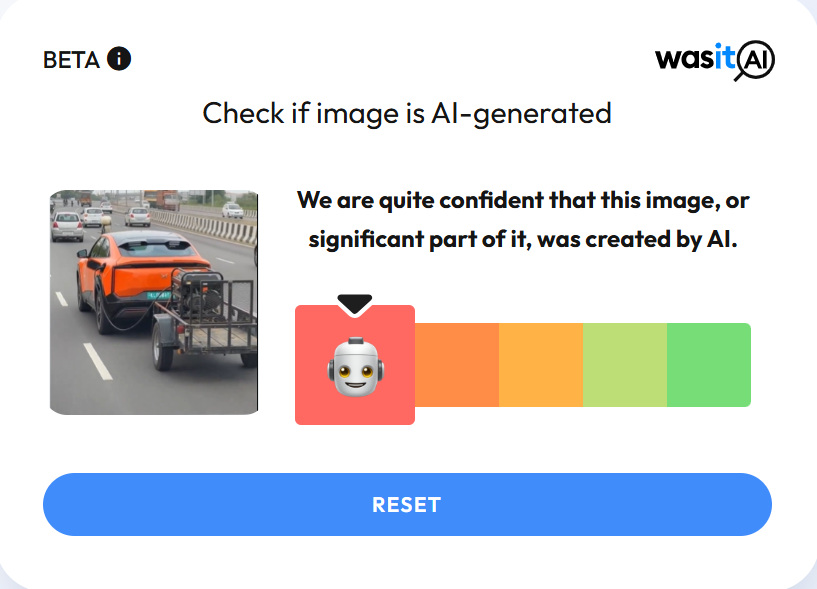
In the next step of our research , we scanned the video using another AI detection platform, WasItAI, which also concluded that the viral video was AI-generated.
Conclusion
Our research confirms that the viral video is not real. It has been artificially created using AI technology and is being circulated with a misleading claim.

Related Blogs

Introduction
Meta's bet that smart glasses will succeed the smartphone as the dominant personal computing device is, commercially, already paying off. EssilorLuxottica, the eyewear manufacturer that builds the Ray-Ban and Oakley Meta product lines, reported selling more than seven million pairs of AI-enabled glasses in 2025 alone, more than tripling the previous year's sales. Chief Executive Mark Zuckerberg has framed the shift as inevitable, comparing it in a recent interview to the transition from flip phones to smartphones and predicting that within a few years, eyewear without embedded AI will put its wearer at a disadvantage.
Yet as adoption accelerates, two features in various stages of internal testing have pulled Meta back into a familiar and uncomfortable position: at the centre of a privacy controversy over exactly how much a camera- and microphone-equipped wearable can quietly learn about the people around it.
NameTag and the return of facial recognition
In June 2026, the technology publication Wired reported that it had found dormant code for a facial-recognition system, internally called NameTag, embedded inside the Meta AI companion app that pairs with the company's smart glasses – an app that had by then been downloaded more than 50 million times. According to that reporting, the system relies on a pipeline of on-device AI models that detect a face, store it locally on the wearer's phone, and match it against previously saved "faceprints", alerting the wearer when it recognises someone they met before. Meta's Chief Technology Officer, Andrew Bosworth, has described the intended design as privacy-conscious: identification data would be encrypted locally, accessible only while the glasses are being worn, and would not populate a centralised company database. He has pitched the feature as a solution to the everyday difficulty of recalling names and past conversations.
Privacy researchers and advocacy groups have been considerably less reassured. One technologist with the Electronic Frontier Foundation’s Threat Lab who analysed the code concluded that despite having been deactivated, it appeared to be near-complete, and more recent reporting connected a portion of Meta’s facial recognition software licensing to Rank One Computing, a vendor that has also licensed similar tech to both U.S. law enforcement and military groups. Meta took the code down immediately after the story’s publication and claims no decision has been made regarding a public rollout.
"Super sensing" and always-on capture
A second, less publicised effort has drawn similar concern. The Financial Times reported in July 2026 that Meta is internally prototyping glasses, under the working concept "super-sensing", designed to capture ambient audio continuously and take still images every few seconds throughout the day, building a searchable log that a wearer's AI assistant could later query to recall where an item was left or what was discussed earlier. Notably, that reporting indicated Meta had discussed shipping the feature without activating the small LED indicator that currently signals when the glasses' camera is capturing photos or video the very light Meta had just reinforced against tampering on its existing hardware. Critics point out that the indicator is already a limited safeguard, since it is easily missed and unfamiliar to most bystanders; removing it during continuous, always-on capture would eliminate the one visible cue currently available to people nearby.
A pattern regulators are watching closely
Both features have emerged against a backdrop of substantial legal exposure. Meta has previously paid roughly two billion dollars combined in biometric-privacy settlements tied to earlier facial-recognition systems on Facebook, including $650 million under Illinois's Biometric Information Privacy Act and $1.4 billion to the state of Texas.
A separate class action filed in early 2026 alleges that footage captured by smart-glasses users, including intimate recordings from inside private homes, was reviewed by outside contractors in Kenya for AI-training purposes, a claim that prompted an inquiry from the United Kingdom's Information Commissioner's Office. The Texas Attorney General has opened its own civil investigation into the glasses' data practices. Because U.S. federal privacy law remains fragmented, enforcement of claims like these is likely to continue playing out state by state through statutes such as BIPA, which allow individuals to sue directly, even as the European Union's AI Act imposes separate restrictions on biometric processing within Europe.
Why this matters beyond Meta
For readers focused on cybersecurity and digital privacy, the common thread running through NameTag and super sensing is consent architecture. The smart glasses take in not just what you’re up to but also the location, face, clothes and conversation patterns of anyone within the glasses’ field of vision – all without their consent. Where raising a smartphone to take a photo leaves no ambiguity to nearby observers, glasses made to look like normal eyewear leaves fewer visual and verbal tells of what is actually occurring behind a set of seemingly average lenses. According to security experts and law professors, wiretap laws and the patchwork of existing statutes addressing biometric data aren't prepared for the kind of invisible monitoring that AI-enabled eyeglasses from Meta, and eventually others, are capable of. It's that imbalance between a technology’s unseen power and the limitations of the average person’s awareness that is sure to be the main source of conflict.
CyberPeace Insights
Wearable AI holds real promise for accessibility and everyday convenience, and Meta's continued investment reflects where personal computing is headed. At the same time, features like NameTag and "super-sensing" show why privacy-by-design must stay foundational, not incidental, as this space matures. The core issue isn't innovation itself but consent — ensuring bystanders retain visible, reliable cues when a device is active. Meta's stated moves toward on-device processing and encryption are worth acknowledging as steps in the right direction. CyberPeace believes continued dialogue between industry, regulators, and researchers, rather than adversarial scrutiny alone, is the surest path to public trust.
Conclusion
Meta maintains that both NameTag and Super Sensing remain unreleased and unconfirmed for commercial launch and are subject to further internal review. Executives have publicly disputed characterisations suggesting either feature is further along than the company has described. Even so, the recurring pattern of infrastructure for sensitive capabilities surfacing through independent reporting rather than company disclosure is what has kept privacy advocates, journalists, and regulators paying close attention. It suggests that as smart glasses move from novelty item to mass-market device, the terms of that transition will be shaped as much by courts, regulators, and public pressure as by Meta's own product roadmap.
References
- https://www.magzter.com/stories/newspaper/Mint-Mumbai/METAS-FLOOD-OF-SMARTGLASSES-HAS-PRIVACY-ADVOCATES-UP-IN-ARMS
- Engadget — Wired found code for an unreleased facial recognition feature in Meta's AI app
- Malwarebytes Labs — Meta's face-recognition code raises new concerns about smart glasses
- Kaspersky Daily — What's wrong with Meta's NameTag feature and why you should be wary of it
- Biometric Update — AI glasses reveal widening gap between Meta's privacy safeguards and AI ambitions
- Fortune — Meta added a privacy-safety feature to its AI glasses but is reportedly testing a 'super-sensing' prototype
- MacRumors — Meta's 'Super Sensing' Prototype Glasses Quietly Record Everything
- TechCrunch — Meta sued over AI smart glasses' privacy concerns, after workers reviewed nudity, sex, and other footage

Executive Summary
A purported video of Lieutenant General Devendra Sharma is being shared on social media, falsely portraying him as saying that “five aviators who participated in Operation Sindoor are missing from our training list. CyberPeace Research Wingresearch found that the viral video is completely fabricated and generated using artificial intelligence. The Ministry of Defence has also dismissed the clip as an AI-generated deepfake. The investigation found that Lieutenant General Devendra Sharma, Commander of the Army Training Command, never made any such statement. The viral clip has been manipulated by inserting fake audio into footage from his original speech to spread a misleading narrative.
Claim
A user on social media platform X shared the viral video with the caption:“Fifty-nine officers were listed at the Combat Army Aviation Training School, but five officers are missing. They were involved in Operation Sindoor as pilots of four Rafale jets and one Su-30 aircraft…”

Fact Check
To verify the claim, we extracted several keyframes from the viral video and conducted a reverse-image search. During the investigation, we found the original video on ANI’s official X account. In the authentic footage, Lt Gen Sharma is seen speaking at a routine event at a training institution. His remarks focused on regular training-related matters, and he made no reference to missing pilots, Operation Sindoor, or any alleged losses.
https://x.com/ANI/status/2061731994971881667

In the next stage of the investigation, we found a post by the Ministry of Defence, Government of India, which also identified the viral clip as a deepfake.
https://www.facebook.com/watch/?v=1697698548109000
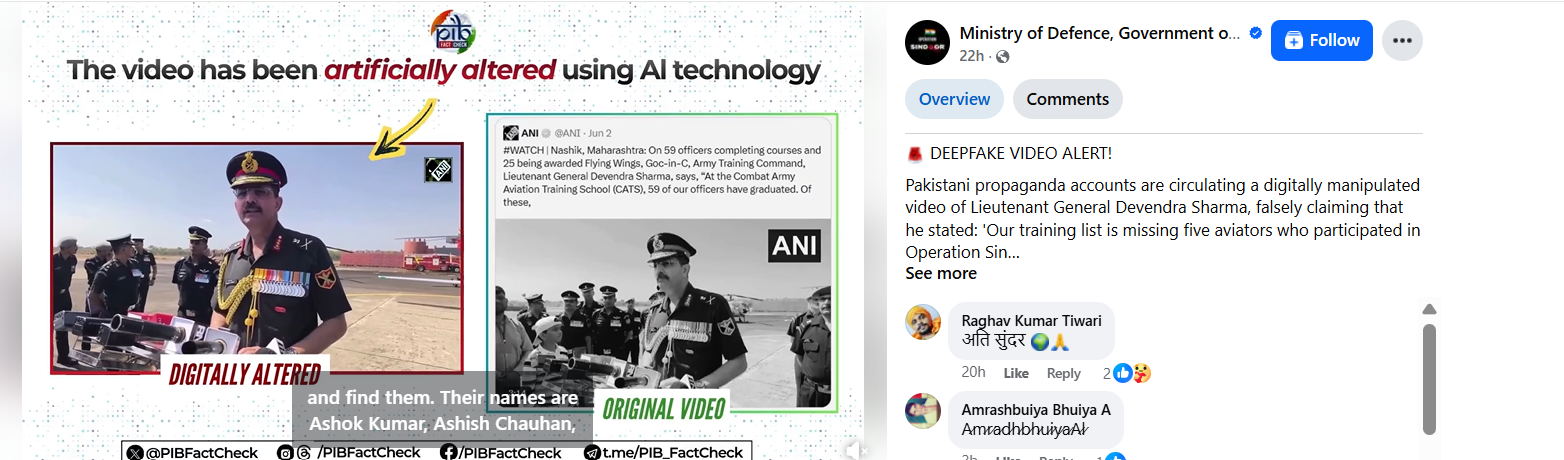
The ministry clarified that the video had been manipulated using AI-generated audio and did not reflect any genuine statement made by Lt Gen Devendra Sharma.
Conclusion
The viral video is a fabricated AI-generated deepfake. Lieutenant General Devendra Sharma never made the statement attributed to him about five missing aviators linked to Operation Sindoor. The original video was altered by inserting fake audio into authentic footage. The manipulated clip is being circulated online to spread misinformation and create confusion regarding the Indian Armed Forces.

Introduction
The emergence of deepfake technology has become a significant problem in an era driven by technological growth and power. The government has reacted proactively as a result of concerns about the exploitation of this technology due to its extraordinary realism in manipulating information. The national government is in the vanguard of defending national interests, public trust, and security as the digital world changes. On the 26th of December 2023, the central government issued an advisory to businesses, highlighting how urgent it is to confront this growing threat.
The directive aims to directly address the growing concerns around Deepfakes, or misinformation driven by AI. This advice represents the result of talks that Union Minister Shri Rajeev Chandrasekhar, had with intermediaries during the course of a month-long Digital India dialogue. The main aim of the advisory is to accurately and clearly inform users about information that is forbidden, especially those listed under Rule 3(1)(b) of the IT Rules.
Advisory
The Ministry of Electronics and Information Technology (MeitY) has sent a formal recommendation to all intermediaries, requesting adherence to current IT regulations and emphasizing the need to address issues with misinformation, specifically those driven by artificial intelligence (AI), such as Deepfakes. Union Minister Rajeev Chandrasekhar released the recommendation, which highlights the necessity of communicating forbidden information in a clear and understandable manner, particularly in light of Rule 3(1)(b) of the IT Rules.
Advise on Prohibited Content Communication
According to MeitY's advice, intermediaries must transmit content that is prohibited by Rule 3(1)(b) of the IT Rules in a clear and accurate manner. This involves giving users precise details during enrollment, login, and content sharing/uploading on the website, as well as including such information in customer contracts and terms of service.
Ensuring Users Are Aware of the Rules
Digital platform suppliers are required to inform their users of the laws that are relevant to them. This covers provisions found in the IT Act of 2000 and the Indian Penal Code (IPC). Corporations should inform users of the potential consequences of breaking the restrictions outlined in Rule 3(1)(b) and should also urge users to notify any illegal activity to law enforcement.
Talks Concerning Deepfakes
For more than a month, Union Minister Rajeev Chandrasekhar had a significant talk with various platforms where they addressed the issue of "deepfakes," or computer-generated fake videos. The meeting emphasized how crucial it is that everyone abides by the laws and regulations in effect, particularly the IT Rules to prevent deepfakes from spreading.
Addressing the Danger of Disinformation
Minister Chandrasekhar underlined the grave issue of disinformation, particularly in the context of deepfakes, which are false pieces of content produced using the latest developments such as artificial intelligence. He emphasized the dangers this deceptive data posed to internet users' security and confidence. The Minister emphasized the efficiency of the IT regulations in addressing this issue and cited the Prime Minister's caution about the risks of deepfakes.
Rule Against Spreading False Information
The Minister referred particularly to Rule 3(1)(b)(v), which states unequivocally that it is forbidden to disseminate false information, even when doing so involves cutting-edge technology like deepfakes. He called on intermediaries—the businesses that offer digital platforms—to take prompt action to take such content down from their systems. Additionally, he ensured that everyone is aware that breaking such rules has legal implications.
Analysis
The Central Government's latest advisory on deepfake technology demonstrates a proactive strategy to deal with new issues. It also highlights the necessity of comprehensive legislation to directly regulate AI material, particularly with regard to user interests.
There is a wider regulatory vacuum for content produced by artificial intelligence, even though the current guideline concentrates on the precision and lucidity of information distribution. While some limitations are mentioned in the existing laws, there are no clear guidelines for controlling or differentiating AI-generated content.
Positively, it is laudable that the government has recognized the dangers posed by deepfakes and is making appropriate efforts to counter them. As AI technology develops, there is a chance to create thorough laws that not only solve problems but also create a supportive environment for the creation of ethical AI content. User protection, accountability, openness, and moral AI use would all benefit from such laws. This offers an opportunity for regulatory development to guarantee the successful and advantageous incorporation of AI into our digital environment.
Conclusion
The Central Government's preemptive advice on deepfake technology shows a great dedication to tackling new risks in the digital sphere. The advice highlights the urgent need to combat deepfakes, but it also highlights the necessity for extensive legislation on content produced by artificial intelligence. The lack of clear norms offers a chance for constructive regulatory development to protect the interests of users. The advancement of AI technology necessitates the adoption of rules that promote the creation of ethical AI content, guaranteeing user protection, accountability, and transparency. This is a turning point in the evolution of regulations, making it easier to responsibly incorporate AI into our changing digital landscape.
References
- https://economictimes.indiatimes.com/tech/technology/deepfake-menace-govt-issues-advisory-to-intermediaries-to-comply-with-existing-it-rules/articleshow/106297813.cms
- https://pib.gov.in/PressReleaseIframePage.aspx?PRID=1990542#:~:text=Ministry%20of%20Electronics%20and%20Information,misinformation%20powered%20by%20AI%20%E2%80%93%20Deepfakes.
- https://www.timesnownews.com/india/centres-deepfake-warning-to-it-firms-ensure-users-dont-violate-content-rules-article-106298282#:~:text=The%20Union%20government%20on%20Tuesday,actors%2C%20businesspersons%20and%20other%20celebrities
