
#FactCheck -Viral Video Falsely Linked to Baramati Plane Crash Involving Ajit Pawar
Executive Summary:
A video claiming to show the plane crash that allegedly killed Maharashtra Deputy Chief Minister Ajit Pawar has been widely circulated on social media. The circulation began soon after reports emerged of a tragic aircraft accident in Baramati, Maharashtra, on January 28, 2026, in which Ajit Pawar and five others were reported to have died. The viral video shows a plane crashing to the ground moments after take-off. Social media users have claimed that the footage captures the exact incident in which Ajit Pawar was on board. However, an research by the CyberPeacehas found that this claim is false.
Claim:
An Instagram user shared the video on January 28, 2026, claiming that it showed the plane crash in Maharashtra in which Deputy Chief Minister Ajit Pawar and others allegedly lost their lives. The caption accompanying the video read:“This morning, Deputy CM Ajit Pawar and six others tragically died in a plane crash in Maharashtra.”
Links to the post and its archived version are provided below.

Fact Check:
To verify the authenticity of the viral video, the CyberPeaceconducted a reverse image search of its keyframes. During this process, the same visuals were found in a video report uploaded on News9 Live’s official YouTube channel on October 23, 2025.

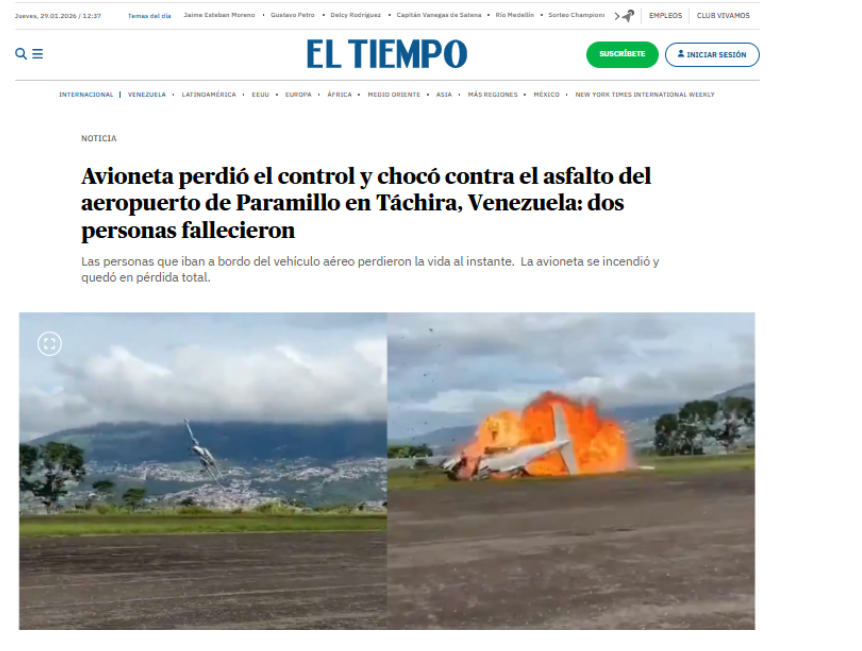
According to the report, the footage shows a plane crash in Venezuela, not India. The incident occurred shortly after a Piper Cheyenne aircraft took off from Paramillo Airport in Táchira, Venezuela. The aircraft crashed within seconds of take-off, killing both occupants on board. The deceased were identified as pilot José Bortone and co-pilot Juan Maldonado. Further confirmation came from a report published on October 22, 2025, by Latin American news outlet El Tiempo. The Spanish-language report also featured the same video visuals and stated that a small aircraft lost control and crashed on the runway at Paramillo Airport in Venezuela, resulting in the deaths of the pilot and co-pilot.
Conclusion
The CyberPeace’s research clearly establishes that the viral video being shared as footage of Ajit Pawar’s alleged plane crash in Baramati is misleading. The video actually shows a plane crash that occurred in Venezuela in October 2025 and has been falsely linked to a tragic claim in India.

Related Blogs

Executive Summary
A graphic widely circulating on social media claims that Union Home Minister Amit Shah has warned, “A major crisis is coming; if possible, skip one meal a day.” The claim has been found to be false in a fact-check conducted by CyberPeace Research Wing. The research revealed that Amit Shah has not made any such statement.
Claim
A Facebook user shared the viral graphic on May 17, 2026, claiming that BJP leader and Home Minister Amit Shah issued a “warning” to the public, allegedly saying people should be prepared for a major crisis and consider skipping one meal a day. The post has been widely circulated on social media, drawing significant attention and discussion.
- https://www.facebook.com/photo.php?fbid=1509406197622070&set=pb.100056581115590.-2207520000&type=3
- https://archive.ph/Z9Tle

Factcheck
A keyword-based search on Google did not return any credible news reports supporting the claim. Further scrutiny of the official account of the Ministry of Home Affairs on X also found no mention or statement matching the viral claim.

A separate review of the official X account of Home Minister Amit Shah also did not show any such statement or post confirming the viral claim.

Conclusion
The viral claim is false. Union Home Minister Amit Shah has not made any such statement.
.webp)
Introduction
On the precipice of a new domain of existence, the metaverse emerges as a digital cosmos, an expanse where the horizon is not sky, but a limitless scope for innovation and imagination. It is a sophisticated fabric woven from the threads of social interaction, leisure, and an accelerated pace of technological progression. This new reality, a virtual landscape stretching beyond the mundane encumbrances of terrestrial life, heralds an evolutionary leap where the laws of physics yield to the boundless potential inherent in our creativity. Yet, the dawn of such a frontier does not escape the spectre of an age-old adversary—financial crime—the shadow that grows in tandem with newfound opportunity, seeping into the metaverse, where crypto-assets are no longer just an alternative but the currency du jour, dazzling beacons for both legitimate pioneers and shades of illicit intent.
The metaverse, by virtue of its design, is a canvas for the digital repaint of society—a three-dimensional realm where the lines between immersive experiences and entertainment blur, intertwining with surreal intimacy within this virtual microcosm. Donning headsets like armor against the banal, individuals become avatars; digital proxies that acquire the ability to move, speak, and perform an array of actions with an ease unattainable in the physical world. Within this alternative reality, users navigate digital topographies, with experiences ranging from shopping in pixelated arcades to collaborating in virtual offices; from witnessing concerts that defy sensory limitations to constructing abodes and palaces from mere codes and clicks—an act of creation no longer beholden to physicality but to the breadth of one's ingenuity.
The Crypto Assets
The lifeblood of this virtual economy pulsates through crypto-assets. These digital tokens represent value or rights held on distributed ledgers—a technology like blockchain, which serves as both a vault and a transparent tapestry, chronicling the pathways of each digital asset. To hop onto the carousel of this economy requires a digital wallet—a storeroom and a gateway for acquisition and trade of these virtual valuables. Cryptocurrencies, with NFTs—Non-fungible Tokens—have accelerated from obscure digital curios to precious artifacts. According to blockchain analytics firm Elliptic, an astonishing figure surpassing US$100 million in NFTs were usurped between July 2021 and July 2022. This rampant heist underlines their captivating allure for virtual certificates. Empowers do not just capture art, music, and gaming, but embody their very soul.
Yet, as the metaverse burgeons, so does the complexity and diversity of financial transgressions. From phishing to sophisticated fraud schemes, criminals craft insidious simulacrums of legitimate havens, aiming to drain the crypto-assets of the unwary. In the preceding year, a daunting figure rose to prominence—the vanishing of US$14 billion worth of crypto-assets, lost to the abyss of deception and duplicity. Hence, social engineering emerges from the shadows, a sort of digital chicanery that preys not upon weaknesses of the system, but upon the psychological vulnerabilities of its users—scammers adorned in the guise of authenticity, extracting trust and assets with Machiavellian precision.
The New Wave of Fincrimes
Extending their tentacles further, perpetrators of cybercrime exploit code vulnerabilities, engage in wash trading, obscuring the trails of money laundering, meander through sanctions evasion, and even dare to fund activities that send ripples of terror across the physical and virtual divide. The intricacies of smart contracts and the decentralized nature of these worlds, designed to be bastions of innovation, morph into paths paved for misuse and exploitation. The openness of blockchain transactions, the transparency that should act as a deterrent, becomes a paradox, a double-edged sword for the law enforcement agencies tasked with delineating the networks of faceless adversaries.
Addressing financial crime in the metaverse is Herculean labour, requiring an orchestra of efforts—harmonious, synchronised—from individual users to mammoth corporations, from astute policymakers to vigilant law enforcement bodies. Users must furnish themselves with critical awareness, fortifying their minds against the siren calls that beckon impetuous decisions, spurred by the anxiety of falling behind. Enterprises, the architects and custodians of this digital realm, are impelled to collaborate with security specialists, to probe their constructs for weak seams, and to reinforce their bulwarks against the sieges of cyber onslaughts. Policymakers venture onto the tightrope walk, balancing the impetus for innovation against the gravitas of robust safeguards—a conundrum played out on the global stage, as epitomised by the European Union's strides to forge cohesive frameworks to safeguard this new vessel of human endeavour.
The Austrian Example
Consider the case of Austria, where the tapestry of laws entwining crypto-assets spans a gamut of criminal offences, from data breaches to the complex webs of money laundering and the financing of dark enterprises. Users and corporations alike must become cartographers of local legislation, charting their ventures and vigilances within the volatile seas of the metaverse.
Upon the sands of this virtual frontier, we must not forget: that the metaverse is more than a hive of bits and bandwidth. It crystallises our collective dreams, echoes our unspoken fears, and reflects the range of our ambitions and failings. It stands as a citadel where the ever-evolving quest for progress should never stray from the compass of ethical pursuit. The cross-pollination of best practices, and the solidarity of international collaboration, are not simply tactics—they are imperatives engraved with the moral codes of stewardship, guiding us to preserve the unblemished spirit of the metaverse.
Conclusion
The clarion call of the metaverse invites us to venture into its boundless expanse, to savour its gifts of connection and innovation. Yet, on this odyssey through the pixelated constellations, we harness vigilance as our star chart, mindful of the mirage of morality that can obfuscate and lead astray. In our collective pursuit to curtail financial crime, we deploy our most formidable resource—our unity—conjuring a bastion for human ingenuity and integrity. In this, we ensure that the metaverse remains a beacon of awe, safeguarded against the shadows of transgression, and celebrated as a testament to our shared aspiration to venture beyond the realm of the possible, into the extraordinary.
References
- https://www.wolftheiss.com/insights/financial-crime-in-the-metaverse-is-real/
- https://gnet-research.org/2023/08/16/meta-terror-the-threats-and-challenges-of-the-metaverse/
- https://shuftipro.com/blog/the-rising-concern-of-financial-crimes-in-the-metaverse-aml-screening-as-a-solution/

A video circulating on social media shows a man allegedly rolling out bhature on his stomach and then frying them in a pan. The clip is being shared with a communal narrative, with users making derogatory remarks while falsely linking the act to a particular community.
CyberPeace Foundation’s research found the viral claim to be false. Our probe confirms that the video is not real but has been created using artificial intelligence (AI) tools and is being shared online with a misleading and communal angle.
Claim
On January 5, 2025, several users shared the viral video on social media platform X (formerly Twitter). One such post carried a communal caption suggesting that the person shown in the video does not belong to a particular community and making offensive remarks about hygiene and food practices..
- The post link and archived version can be viewed here: https://x.com/RightsForMuslim/status/2008035811804291381
- Archive Link: https://archive.ph/lKnX5

Fact Check:
Upon closely examining the viral video, several visual inconsistencies and unnatural movements were observed, raising suspicion about its authenticity. These anomalies are commonly associated with AI-generated or digitally manipulated content.
To verify this, the video was analysed using the AI detection tool HIVE Moderation. According to the tool’s results, the video was found to be 97 percent AI-generated, strongly indicating that it was not recorded in real life but synthetically created.

Conclusion
CyberPeace Foundation’s research clearly establishes that the viral video is AI-generated and does not depict a real incident. The clip is being deliberately shared with a false and communal narrative to mislead users and spread misinformation on social media. Users are advised to exercise caution and verify content before sharing such sensational and divisive material online.
