
#FactCheck- Old Ladakh Protest Video Falsely Shared as Violence Following Sonam Wangchuk’s Arrest
Executive Summary
Last September, protests were held in Ladakh over several demands, including full statehood, extension of Sixth Schedule protections, separate Lok Sabha seats for Leh and Kargil, and reservation in jobs. During that period, some demonstrations turned violent. Since then, talks between stakeholders and the government have continued regarding these demands. Amid this backdrop, Pakistani propaganda handles on social media are sharing a video of a protest and claiming that violent demonstrations have erupted in Ladakh following the arrest of education reformer Sonam Wangchuk. CyberPeace Research Wing research found the claim to be misleading. The claim regarding Sonam Wangchuk’s arrest is false, while the viral video is actually from protests that took place in September last year.
Claim:
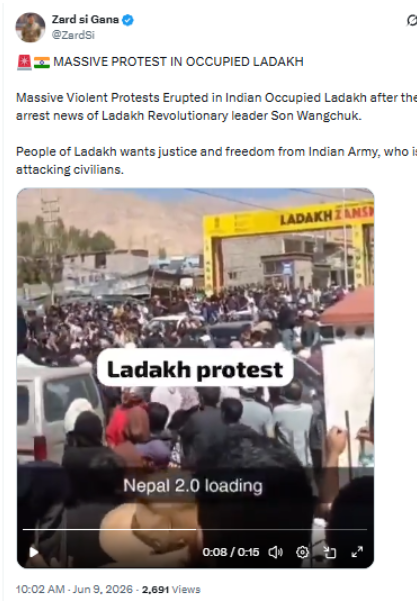
Sharing the video, a user wrote: “Massive protests in Ladakh. Violent demonstrations have erupted after reports of the arrest of Ladakh’s revolutionary leader Sonam Wangchuk. The people of Ladakh seek justice and freedom from the Indian Army, which is attacking civilians.”
https://x.com/ZardSi/status/2064204063248695393?s=20
Fact Check:
Our research found the claim to be misleading. The viral video is from protests held in September last year, and the claim that Sonam Wangchuk has been arrested is also false. We first converted the video into keyframes and conducted a reverse image search using Google Lens. This led us to several videos and news reports covering the same incident. The viral footage was found in a news report uploaded on September 24, 2025, by Asianet News English on YouTube.
https://www.youtube.com/@asianetnewsenglish
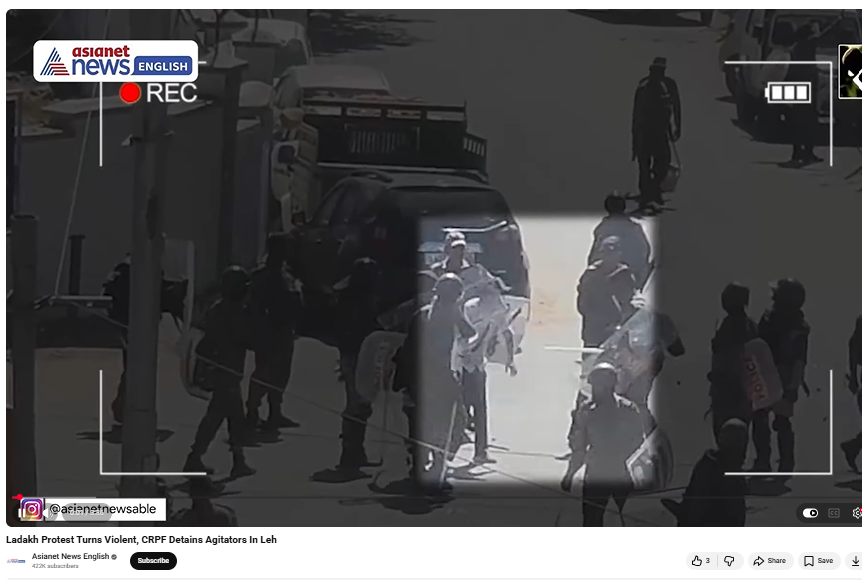
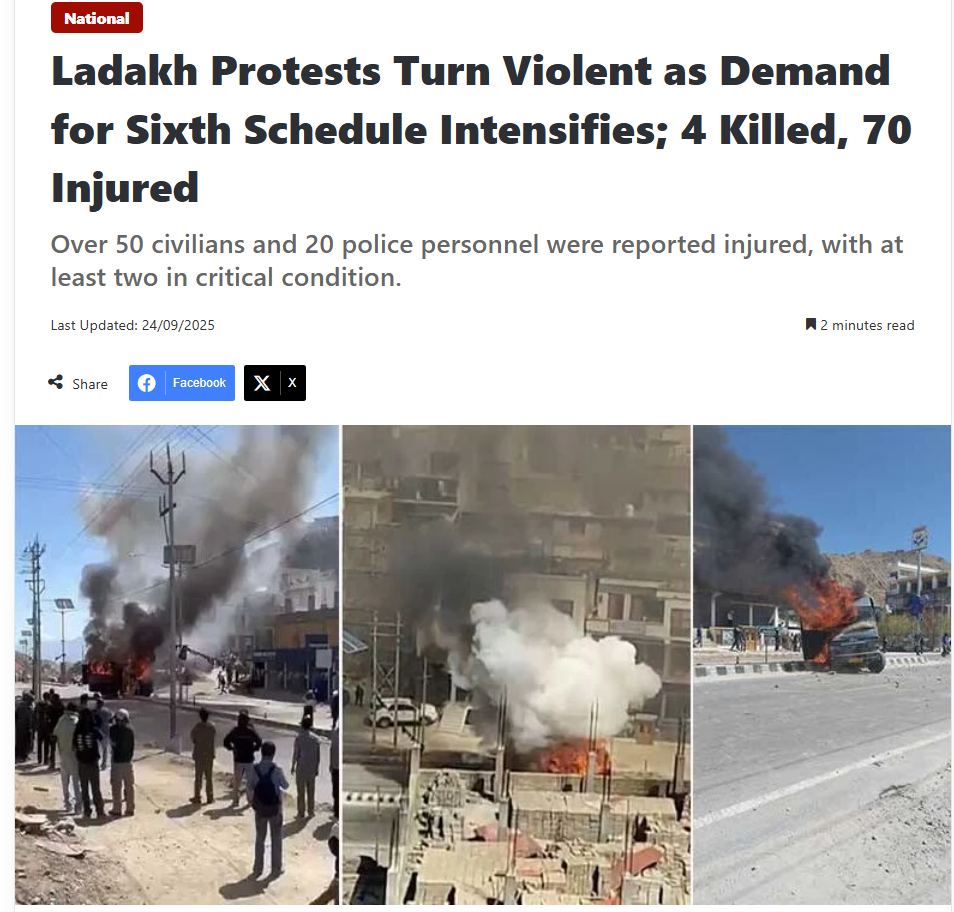
According to the information provided with the video, large-scale protests took place in Leh in support of demands for Sixth Schedule status and full statehood for Ladakh. The movement turned violent following clashes with police, and protesters allegedly set fire to a BJP office in Leh. CRPF personnel and local police later detained several protesters, bringing the situation under control. We also found a report published by Arunachal24, which stated that at least four people were killed and more than 70 injured in violent clashes between protesters demanding statehood and constitutional safeguards for Ladakh and security forces. The report further mentioned that protesters set fire to a local BJP office and a CRPF vehicle, following which authorities imposed a strict curfew across Leh.
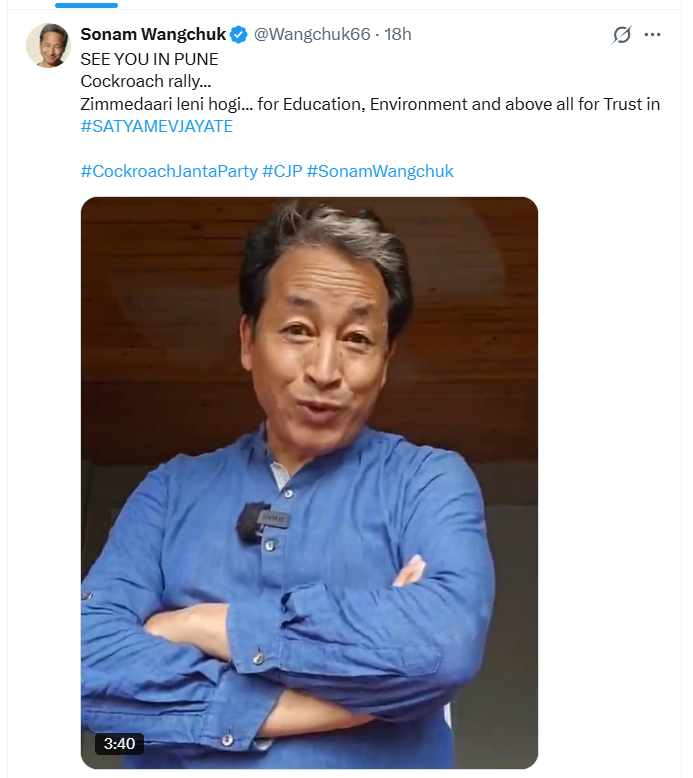
Our team also found that the claim about Sonam Wangchuk’s arrest is entirely false. Wangchuk remains active on social media and had posted an update on June 10, indicating that he had not been detained.
Conclusion:
The fact-check clearly shows that the viral claim is misleading. There is no evidence that Sonam Wangchuk has been arrested. The viral video is not recent and actually shows protests that took place in Ladakh in September 2025.

Related Blogs

Introduction:
This report examines ongoing phishing scams targeting "State Bank of India (SBI)" customers, India's biggest public bank using fake SelfKYC APKs to trick people. The image plays a part in a phishing plan to get users to download bogus APK files by claiming they need to update or confirm their "Know Your Customer (KYC)" info.
Fake Claim:
A picture making the rounds on social media comes with an APK file. It shows a phishing message that says the user's SBI YONO account will stop working because of their "Old PAN card." It then tells the user to install the "WBI APK" APK (Android Application Package) to check documents and keep their account open. This message is fake and aims to get people to download a harmful app.
Key Characteristics of the Scam:
- The messages "URGENTLY REQUIRED" and "Your account will be blocked today" show how scammers try to scare people into acting fast without thinking.
- PAN Card Reference: Crooks often use PAN card verification and KYC updates as a trick because these are normal for Indian bank customers.
- Risky APK Downloads: The message pushes people to get APK files, which can be dangerous. APKs from places other than the Google Play Store often have harmful software.
- Copying the Brand: The message looks a lot like SBI's real words and logos to seem legit.
- Shady Source: You can't find the APK they mention on Google Play or SBI's website, which means you should ignore the app right away.
Modus Operandi:
- Delivery Mechanism: Typically, users of messaging services like "WhatsApp," "SMS," or "email" receive identical messages with an APK link, which is how the scam is distributed.
- APK Installation: The phony APK frequently asks for a lot of rights once it is installed, including access to "SMS," "contacts," "calls," and "banking apps."
- Data Theft: Once installed, the program may have the ability to steal card numbers, personal information, OTPs, and banking credentials.
- Remote Access: These APKs may occasionally allow cybercriminals to remotely take control of the victim's device in order to carry out fraudulent financial activities.
While the user installs the application on their device the following interface opens:


It asks the user to allow the following:
- SMS is used to send and receive info from the bank.
- User details such as Username, Password, Mobile Number, and Captcha.
Technical Findings of the Application:
Static Analysis:
- File Name: SBI SELF KYC_015850.apk
- Package Name: com.mark.dot.comsbione.krishn
- Scan Date: Sept. 25, 2024, 6:45 a.m.
- App Security Score: 52/100 (MEDIUM RISK)
- Grade: B
File Information:
- File Name: SBI SELF KYC_015850.apk
- Size: 2.88MB
- MD5: 55fdb5ff999656ddbfa0284d0707d9ef
- SHA1: 8821ee6475576beb86d271bc15882247f1e83630
- SHA256: 54bab6a7a0b111763c726e161aa8a6eb43d10b76bb1c19728ace50e5afa40448
App Information:
- App Name: SBl Bank
- Package Name:: com.mark.dot.comsbione.krishn
- Main Activity: com.mark.dot.comsbione.krishn.MainActivity
- Target SDK: 34
- Min SDK: 24
- Max SDK:
- Android Version Name:: 1.0
- Android Version Code:: 1
App Components:
- Activities: 8
- Services: 2
- Receivers: 2
- Providers: 1
- Exported Activities: 0
- Exported Services: 1
- Exported Receivers: 2
- Exported Providers:: 0
Certificate Information:
- Binary is signed
- v1 signature: False
- v2 signature: True
- v3 signature: False
- v4 signature: False
- X.509 Subject: CN=PANDEY, OU=PANDEY, O=PANDEY, L=NK, ST=NK, C=91
- Signature Algorithm: rsassa_pkcs1v15
- Valid From: 20240904 07:38:35+00:00
- Valid To: 20490829 07:38:35+00:00
- Issuer: CN=PANDEY, OU=PANDEY, O=PANDEY, L=NK, ST=NK, C=91
- Serial Number: 0x1
- Hash Algorithm: sha256
- md5: 4536ca31b69fb68a34c6440072fca8b5
- sha1: 6f8825341186f39cfb864ba0044c034efb7cb8f4
- sha256: 6bc865a3f1371978e512fa4545850826bc29fa1d79cdedf69723b1e44bf3e23f
- sha512:05254668e1c12a2455c3224ef49a585b599d00796fab91b6f94d0b85ab48ae4b14868dabf16aa609c3b6a4b7ac14c7c8f753111b4291c4f3efa49f4edf41123d
- PublicKey Algorithm: RSA
- Bit Size: 2048
- Fingerprint: a84f890d7dfbf1514fc69313bf99aa8a826bade3927236f447af63fbb18a8ea6
- Found 1 unique certificate
App Permission

1. Normal Permissions
- Access_network_state: Allows the App to View the Network Status of All Networks.
- Foreground_service: Enables Regular Apps to Use Foreground Services.
- Foreground_service_data_sync: Allows Data Synchronization With Foreground Services.
- Internet: Grants Full Internet Access.
2. Signature Permission:
- Broadcast_sms: Sends Sms Received Broadcasts. It Can Be Abused by Malicious Apps to Forge Incoming Sms Messages.
3. Dangerous Permissions:
- Read_phone_numbers: Grants Access to the Device’s Phone Number(S).
- Read_phone_state: Reads the Phone’s State and Identity, Including Phone Features and Data.
- Read_sms: Allows the App to Read Sms or Mms Messages Stored on the Device or Sim Card. Malicious Apps Could Use This to Read Confidential Messages.
- Receive_sms: Enables the App to Receive and Process Sms Messages. Malicious Apps Could Monitor or Delete Messages Without Showing Them to the User.
- Send_sms: Allows the App to Send Sms Messages. Malicious Apps Could Send Messages Without the User’s Confirmation, Potentially Leading to Financial Costs.
On further analysis on virustotal platform using md5 hash file, the following results were retrieved where there are 24 security vendors out of 68, marked this apk file as malicious and the graph represents the distribution of malicious file in the environment.


Key Takeaways:
- Normal Permissions: Generally Safe for Accessing Basic Functionalities (Network State, Internet).
- Signature Permissions: May Pose Risks When Misused, Especially Related to Sms Broadcasts.
- Dangerous Permissions: Provide Sensitive Data Access, Such as Phone Numbers and Device Identity, Which Can Be Exploited by Malicious Apps.
- The Dangerous Permissions Pose Risks Regarding the Reading, Receiving, and Sending of Sms, Which Can Lead to Privacy Breaches or Financial Consequences.
How to Identify the Scam:
- Official Statement: SBI never asks clients to download unauthorized APKs for upgrades related to KYC or other services. All formal correspondence takes place via the SBI YONO app, which may be found in reputable app shops.
- No Immediate Threats: Bank correspondence never employs menacing language or issues harsh deadlines, such as "your account will be blocked today."
- Email Domain and SMS Number: Verified email addresses or phone numbers are used for official SBI correspondence. Generic, unauthorized numbers or addresses are frequently used in scams.
- Links and APK Files: Steer clear of downloading APK files from unreliable sources at all times. For app downloads, visit the Apple App Store or Google Play Store instead.
CyberPeace Advisory:
- The Research team recommends that people should avoid opening such messages sent via social platforms. One must always think before clicking on such links, or downloading any attachments from unauthorised sources.
- Downloading any application from any third party sources instead of the official app store should be avoided. This will greatly reduce the risk of downloading a malicious app, as official app stores have strict guidelines for app developers and review each app before it gets published on the store.
- Even if you download the application from an authorised source, check the app's permissions before you install it. Some malicious apps may request access to sensitive information or resources on your device. If an app is asking for too many permissions, it's best to avoid it.
- Keep your device and the app-store app up to date. This will ensure that you have the latest security updates and bug fixes.
- Falling into such a trap could result in a complete compromise of the system, including access to sensitive information such as microphone recordings, camera footage, text messages, contacts, pictures, videos, and even banking applications and could lead users to financial loss.
- Do not share confidential details like credentials, banking information with such types of Phishing scams.
- Never share or forward fake messages containing links on any social platform without proper verification.
Conclusion:
Fake APK phishing scams target financial institutions more often. This report outlines safety steps for SBI customers and ways to spot and steer clear of these cons. Keep in mind that legitimate banks never ask you to get an APK from shady websites or threaten to close your account right away. To stay safe, use SBI's official YONO app on both systems and get apps from trusted places like Google Play or the Apple App Store. Check if the info is true before you do anything turn on 2FA for all your bank and money accounts, and tell SBI or your local cyber police about any scams you see.

Introduction
Rajeev Chandrasekhar, the Union minister of state for information technology (IT), said that the Global Partnership on Artificial Intelligence (GPAI) Summit, which brings together 29 member governments, including the European Union, announced on 13th December 2023 that the New Delhi Declaration had been adopted. The proclamation committed to developing AI applications for medical treatment and agribusiness jointly and taking the needs of the Global South into account when developing AI.
In addition, signing countries committed to leveraging the GPAI infrastructure to establish a worldwide structure for AI safety and trust, as well as to make AI advantages and approaches accessible to all. In order to complete the recommended structure in six months, India also submitted a proposal to host the GPAI Global Governance Summit.
“The New Delhi Declaration, which aims to place GPAI at the forefront of defining the future of AI in terms of both development and building cooperative AI across the partner states, has been unanimously endorsed by 29 GPAI member countries. Nations have come to an agreement to develop AI applications in healthcare, agriculture, and numerous other fields that affect all of our nations and citizens,” Chandrasekhar stated.
The statement highlights GPAI's critical role in tackling modern AI difficulties, such as generative AI, through submitted AI projects meant to maximize benefits and minimize related risks while solving community problems and worldwide difficulties.
GPAI
Global Partnership on Artificial Intelligence (GPAI) is an organisation of 29 countries from the Americas (North and South), Europe and Asia. It has important players such as the US, France, Japan and India, but it excludes China. The previous meeting took place in Japan. In 2024, India will preside over GPAI.
In order to promote and steer the responsible implementation of artificial intelligence based on human rights, multiculturalism, gender equality, innovation, economic growth, the surroundings, and social impact, this forum was established in 2020. Its goal is to bring together elected officials and experts in order to make tangible contributions to the 2030 Agenda and the UN Sustainable Development Goals (SDGs).
Given the quick and significant advancements in artificial intelligence over the previous year, the meeting in New Delhi attracted particular attention. They have sparked worries about its misuse as well as enthusiasm about its possible advantages.
The Summit
The G20 summit, which India hosted in September 2023, provided an atmosphere for the discussions at the GPAI summit. There, participants of this esteemed worldwide economic conference came to an agreement on how to safely use AI for "Good and for All."
In order to safeguard people's freedoms and security, member governments pledged to address AI-related issues "in a responsible, inclusive, and human-centric manner."
The key tactic devised is to distribute AI's advantages fairly while reducing its hazards. Promoting international collaboration and discourse on global management for AI is the first step toward accomplishing this goal.
A major milestone in that approach was the GPAI summit.
The conversation on AI was started by India's Prime Minister Narendra Modi, who is undoubtedly one of the most tech-aware and tech-conscious international authorities.
He noted that every system needs to be revolutionary, honest, and trustworthy in order to be sustained.
"There is no doubt that AI is transformative, but it is up to us to make it more and more transparent." He continued by saying that when associated social, ethical, and financial concerns are appropriately addressed, trust will increase.
After extensive discussions, the summit attendees decided on a strategy to establish global collaboration on a number of AI-related issues. The proclamation pledged to place GPAI at the leading edge of defining AI in terms of creativity and cooperation while expanding possibilities for AI in healthcare, agriculture, and other areas of interest, according to Union Minister Rajeev Chandrasekhar.
There was an open discussion of a number of issues, including disinformation, joblessness and bias, protection of sensitive information, and violations of human rights. The participants reaffirmed their dedication to fostering dependable, safe, and secure AI within their respective domains.
Concerns raised by AI
- The issue of legislation comes first. There are now three methods in use. In order to best promote inventiveness, the UK government takes a "less is more" approach to regulation. Conversely, the European Union (EU) is taking a strong stance, planning to propose a new Artificial Intelligence Act that might categorize AI 'in accordance with use-case situations based essentially on the degree of interference and vulnerability'.
- Second, analysts say that India has the potential to lead the world in discussions about AI. For example, India has an advantage when it comes to AI discussions because of its personnel, educational system, technological stack, and populace, according to Markham Erickson of Google's Centers for Excellence. However, he voiced the hope that Indian regulations will be “interoperable” with those of other countries in order to maximize the benefits for small and medium-sized enterprises in the nation.
- Third, there is a general fear about how AI will affect jobs, just as there was in the early years of the Internet's development. Most people appear to agree that while many jobs won't be impacted, certain jobs might be lost as artificial intelligence develops and gets smarter. According to Erickson, the solution to the new circumstances is to create "a more AI-skilled workforce."
- Finally, a major concern relates to deepfakes defined as 'digital media, video, audio and images, edited and manipulated, using Artificial Intelligence (AI).'
Need for AI Strategy in Commercial Businesses
Firstly, astute or mobile corporate executives such as Shailendra Singh, managing director of Peak XV Partners, feel that all organisations must now have 'an AI strategy'.
Second, it is now impossible to isolate the influence of digital technology and artificial intelligence from the study of international relations (IR), foreign policy, and diplomacy. Academics have been contemplating and penning works of "the geopolitics of AI."
Combat Strategies
"We will talk about how to combine OECD capabilities to maximize our capacity to develop the finest approaches to the application and management of AI for the benefit of our people. The French Minister of Digital Transition and Telecommunications", Jean-Noël Barrot, informed reporters.
Vice-Minister of International Affairs for Japan's Ministry of Internal Affairs and Communications Hiroshi Yoshida stated, "We particularly think GPAI should be more inclusive so that we encourage more developing countries to join." Mr Chandrasekhar stated, "Inclusion of lower and middle-income countries is absolutely core to the GPAI mission," and added that Senegal has become a member of the steering group.
India's role in integrating agribusiness into the AI agenda was covered in a paragraph. The proclamation states, "We embrace the use of AI innovation in supporting sustainable agriculture as a new thematic priority for GPAI."
Conclusion
The New Delhi Declaration, which was adopted at the GPAI Summit, highlights the cooperative determination of 29 member nations to use AI for the benefit of all people. GPAI, which will be led by India in 2024, intends to influence AI research with an emphasis on healthcare, agriculture, and resolving ethical issues. Prime Minister Narendra Modi stressed the need to use AI responsibly and build clarity and confidence. Legislative concerns, India's potential for leadership, employment effects, and the difficulty of deepfakes were noted. The conference emphasized the importance of having an AI strategy in enterprises and covered battle tactics, with a focus on GPAI's objective, which includes tolerance for developing nations. Taken as a whole, the summit presents GPAI as an essential tool for navigating the rapidly changing AI field.
References
- https://www.thehindu.com/news/national/ai-summit-adopts-new-delhi-declaration-on-inclusiveness-collaboration/article67635398.ece
- https://www.livemint.com/news/india/gpai-meet-adopts-new-delhi-ai-declaration-11702487342900.html
- https://startup.outlookindia.com/sector/policy/global-partnership-on-ai-member-nations-unanimously-adopt-new-delhi-declaration-news-10065
- https://gpai.ai/
Executive Summary
A post claiming that former Indian cricketer Sachin Tendulkar praised Congress leader Rahul Gandhi and urged people to elect him as Prime Minister is being widely circulated on social media.The viral poster falsely attributes a political statement to Sachin Tendulkar, suggesting that he has endorsed Rahul Gandhi for the post of Prime Minister. However, CyberPeace Research Wing research found the claim to be fake. Sachin Tendulkar has not made any such appeal or statement supporting Rahul Gandhi for Prime Minister.
Claim
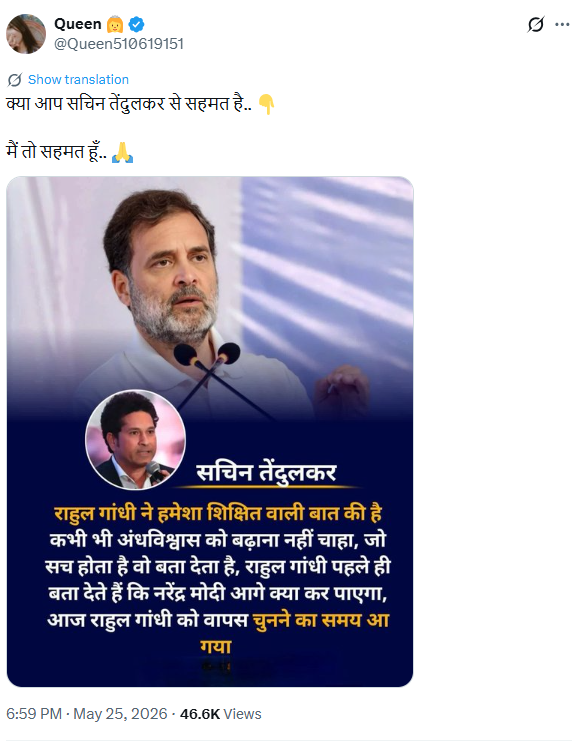
On X (formerly Twitter), a verified user “Queen” shared a viral poster claiming:“Sachin Tendulkar has always supported education and never promoted superstition. Rahul Gandhi always predicts what Narendra Modi will do next. It is time to choose Rahul Gandhi again.”
Fact Check
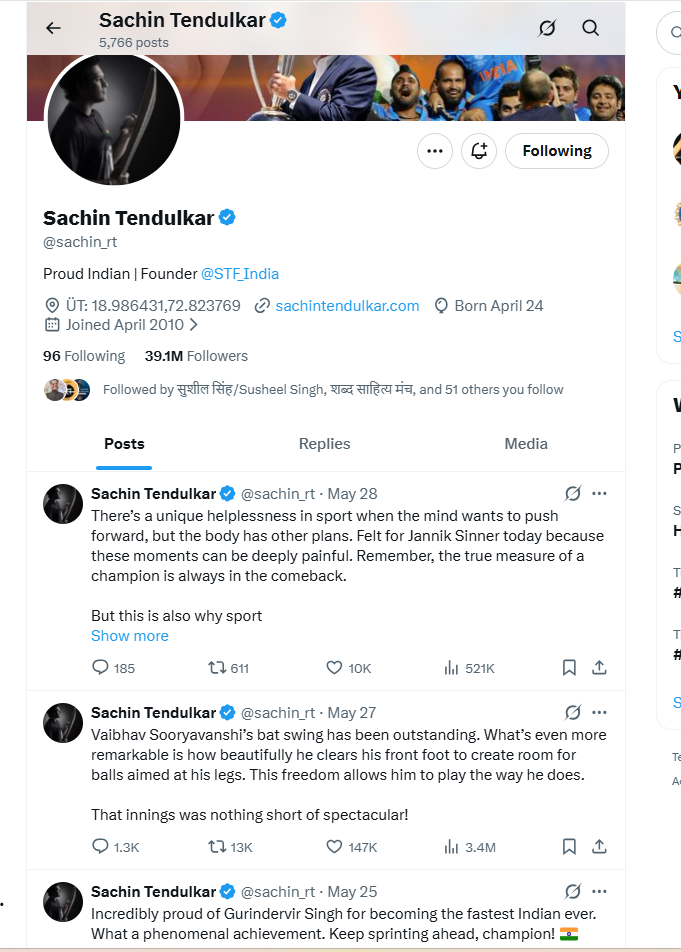
To verify the claim, we first searched for any news reports, interviews, or credible references linking Sachin Tendulkar to such a political statement. However, we found no evidence in any reliable media source or public record suggesting that he made any such remark about Rahul Gandhi or the Prime Ministership. We also reviewed Sachin Tendulkar’s official social media accounts, but found no post, video, or statement endorsing any political leader in this manner.
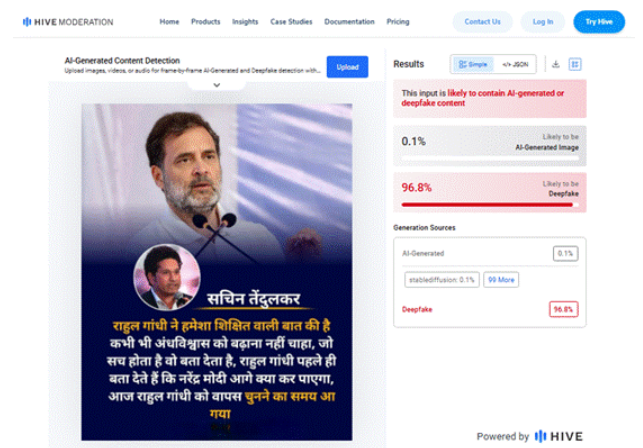
Finally, the viral poster was analysed using the AI detection tool Hive Moderation. The analysis indicated a 96.8% probability that the poster was digitally created or manipulated, suggesting possible AI-generated or edited content.
Conclusion
CyberPeace Research Wing research found the claim to be fake. Sachin Tendulkar has not made any appeal to elect Rahul Gandhi as Prime Minister. The viral poster appears to be digitally fabricated and is being shared to spread misinformation.
