
#FactCheck- Old Gulf War Video Misleadingly Linked to Alleged Capture of U.S. Pilot in Iran
Executive Summary
Amid reports that the U.S. military rescued a missing crew member of a fighter jet in Iran, a video is going viral on social media. The clip is being shared with the claim that it shows a U.S. F-15 pilot captured in Iran after his aircraft was shot down. In the video, the detained officer can be heard identifying himself as “Colonel David William Everly.”
However, research by the CyberPeace has found this claim to be misleading. The viral video is real but not recent. It is from the 1991 Gulf War, when U.S. Air Force Colonel David William Everly was captured in Iraq during Operation Desert Storm.
Claim
A social media user “palestinereports786” shared the video with the caption suggesting that a U.S. F-15 fighter jet was shot down over Iran and that one crew member may have been captured.
Fact Check
In the viral video, the officer is heard responding to questions, stating his name as Colonel David William Everly and identifying himself as a U.S. national and an F-15 pilot from the 4th Tactical Fighter Wing. Using these details, we conducted a news search and found several old reports confirming that this incident dates back to the 1991 Gulf War.
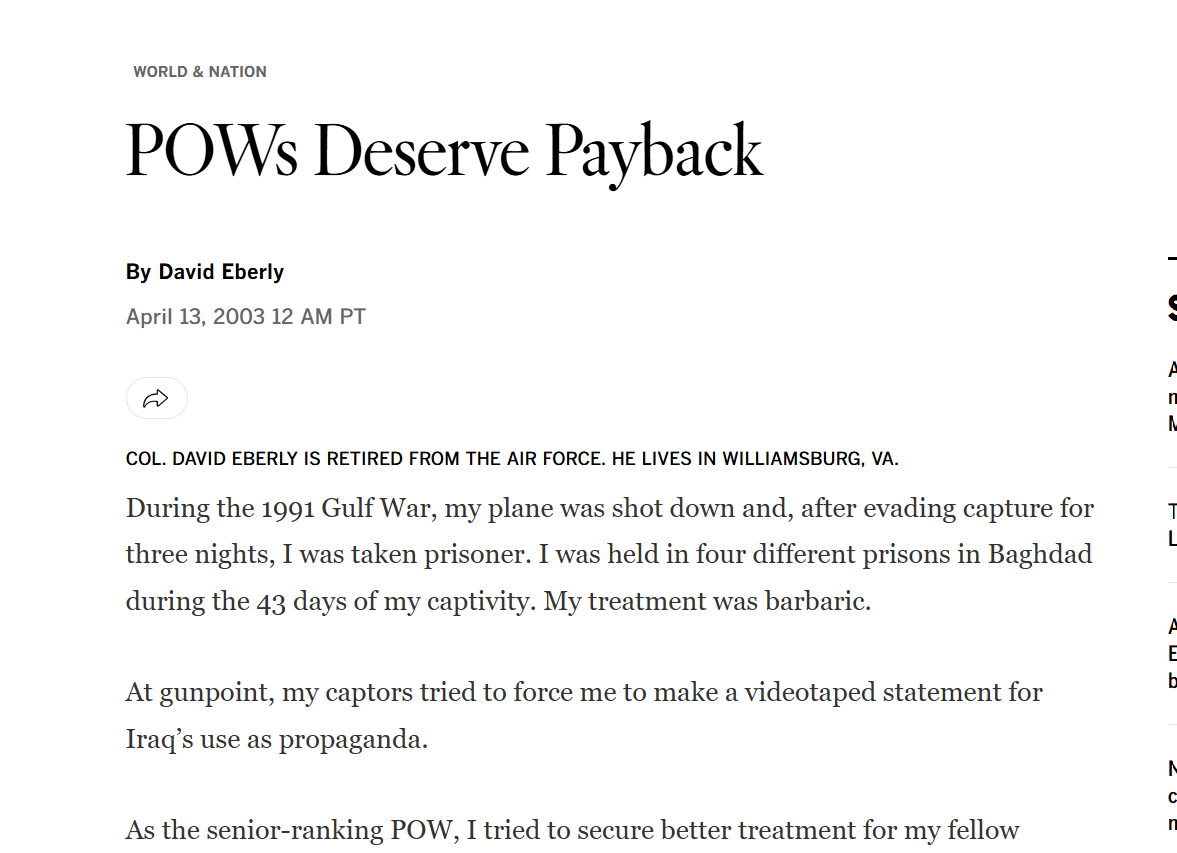
A report by the Los Angeles Times (April 13, 2003) recounts Everly’s experience, stating that his aircraft was shot down during the Gulf War. After evading capture for three nights, he was eventually taken prisoner and held for 43 days in multiple prisons in Baghdad, where he faced harsh treatment.
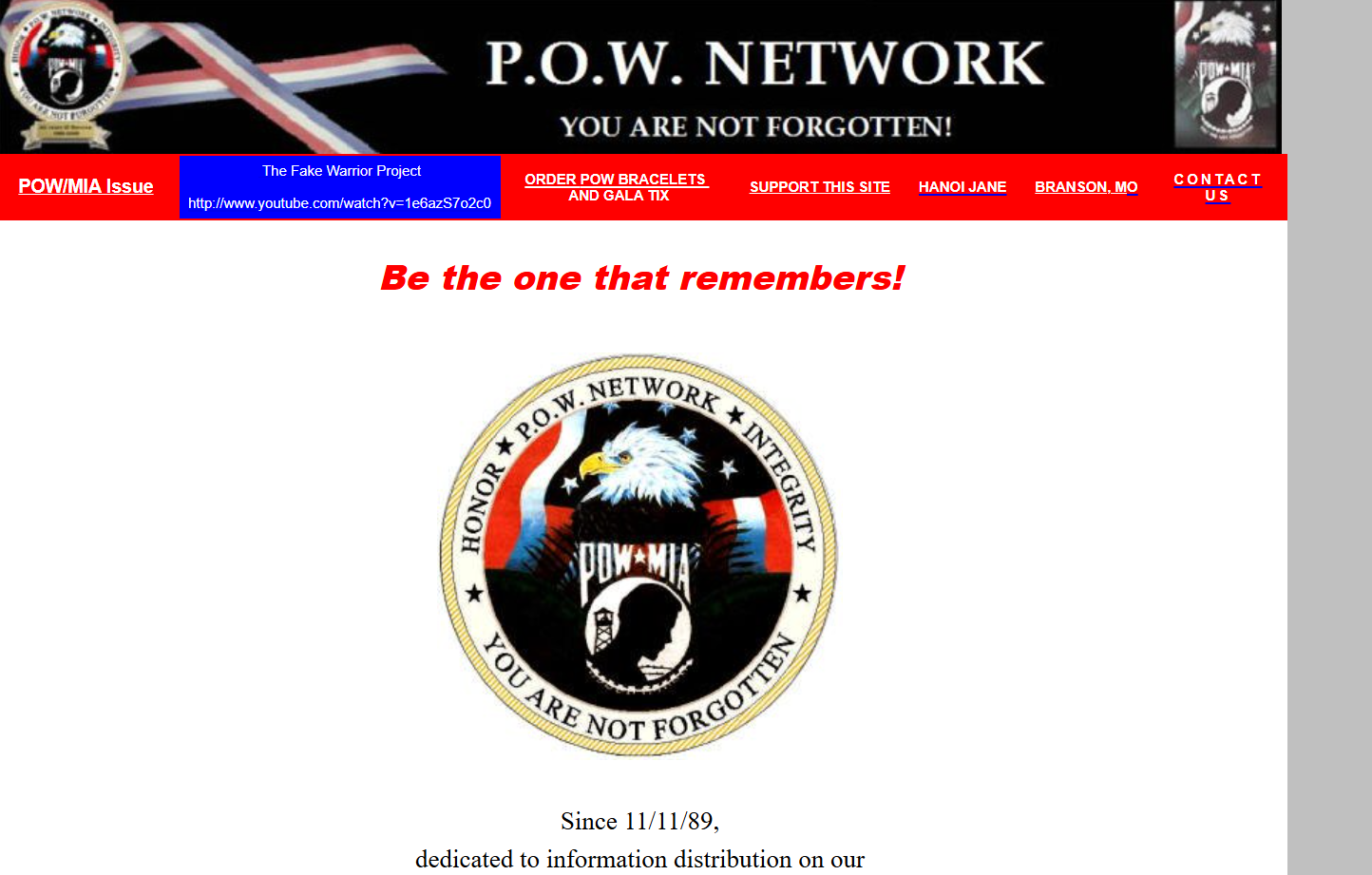
Additional references to the incident were also found on platforms such as pownetwork.org, nara.getarchive.net, and the National Air and Space Museum’s “Wall of Honor,” all documenting Everly’s captivity and eventual return to the United States. We also found an older interview of Everly, where he narrates the same incident.
According to data from acleddata.com, military tensions involving the United States, Israel, and Iran escalated after February 28, 2026, when operations against Iran reportedly began and are ongoing. However, reports indicate that the crew members of the recently downed F-15 aircraft were able to eject safely before the crash. Both crew members survived, and at least one has already been rescued by U.S. forces. There is no confirmed evidence that any pilot has been captured in Iran.

Conclusion
The viral video claiming to show a U.S. pilot captured in Iran is misleading. The footage is not related to any recent incident but originates from the 1991 Gulf War, when Colonel David William Everly was captured in Iraq. The old video has been shared with a false narrative to link it to the current geopolitical situation involving Iran. There is no verified evidence supporting claims that a U.S. pilot has been captured in Iran in the recent conflict.

Related Blogs

Introduction
Recently, the Delhi Police arrested a licensed telecom PoS agent, who identified himself as “Shivam Telecom," from a roadside kiosk adjacent to Hindu Rao Hospital. On the face of it, the headline may have simply read, “One man, one arrest." However, beneath that arrest is the unsettling story of a fully legitimate retail shop actively forging other people’s identification documents into weapons, one SIM card at a time, for as little as ₹500-600 each. This is not an account of an isolated offender; it is a peek into the vulnerability of SIM card security for typical end-users and the reasons why every mobile phone subscriber must pay attention to the unseen journey of his number.
Why SIM Security Matters Now
Erstwhile, a SIM card was only a simple device for sending text messages and making calls. Today, however, it’s also a direct link to most of our lives online, be it online banking to verify it through one-time passwords (OTP) or Unified Payments Interface (UPI); social media platforms; or email accounts to reset a forgotten password, two-factor authentications (2FA), or even numerous other online services. Therefore, losing a SIM card and getting it fraudulently issued under your name, or criminals accessing your identity to buy a SIM, can be a serious cause of concern, as they can then impersonate you, conduct various frauds, bypass checks, or commit acts that can lead to you being wrongly implicated.
According to the investigation, criminals were procuring SIM cards through the authorized outlets of telecom companies, not unlicensed dealers. This clearly proves a deficiency in the Know Your Customer (KYC) process for the SIM card activation. The situation, however, is worse and is also highlighted by the fact that more than 21 lakh mobile numbers from the more than 114 crore mobile numbers reviewed under the Sanchar Saathi initiative launched by the department of telecommunications (DoT) were associated with fake or invalid identity documents. A state police chief of Tamil Nadu claims that 90% of the cyber fraud cases involved SIM cards obtained through misused identity documents.
How Illegally Activated SIMs Fuel Everyday Scams?
Once a SIM is activated using someone else's identity documents or biometric data, without their knowledge, it becomes a disposable, hard-to-trace tool for criminals. Here's how that plays out in practice:
- Phishing and impersonation calls: Using an honest person’s details for a SIM registration allows the scammer to have a “clean” number that won’t tip off victims about a potential scam immediately when carrying out a fake bank call, fake delivery scam, or fake impersonation of an officer.
- OTP and account-takeover fraud: Since the SIM card is used as the anchor to OTP verification, an unauthorized SIM can be used to capture one-time passwords to activate new digital payments, create a new digital payments account, or use other personal information linked to your phone number to reset your service passwords.
- Financial fraud and money mule networks: According to the investigators, such SIMs were extensively being used to open digital payment accounts as well as to flow money across a number of fraud chains, thus enabling the fraudsters to build a layer of financial infrastructure that is not linked with their actual identities.
- Identity theft with real-world consequences: The identity of the Aadhaar holder (whose document was used to activate the SIM card) might be unaware that a SIM exists under his name until the fraud is uncovered during a loan default or a criminal investigation where he is forced to justify a crime committed using “his” number that he is oblivious to.
That is the anonymity that SIM-card fraud has: the fact that the SIM on the face of it seems genuine, but the one operating it and the registered owner have absolutely no relationship whatsoever.
Red Flags Every Mobile User Should Watch For
Most people won't know their identity has been misused until something goes visibly wrong. A few warning signs are worth taking seriously:
- Your SIM suddenly loses network connectivity or displays "No Service" for an extended period without any known outage, SIM replacement request, or billing issue.
- You stop receiving OTPs or verification messages for banking, UPI, or other online services, particularly if login attempts continue to occur on your accounts.
- You receive unexpected OTPs, verification codes, or account alerts for services you never signed up for, indicating that someone may be attempting to use your mobile number.
- You receive calls or messages intended for someone else or asking you to confirm activities you never performed, which may suggest your number has been misused or duplicated.
- Your bank or telecom provider notifies you of unusual account activity, failed identity verification, or changes that you did not authorize.
- You discover multiple mobile connections registered in your name that you never requested, a risk that often remains unnoticed unless you proactively check through the Department of Telecommunications' Sanchar Saathi portal.
None of these guarantee fraud, but any of them is a reason to check further rather than assume it's a glitch.
Practical Steps to Protect Yourself
The good news is that Indian users now have direct tools to check and control this exposure:
- Identify your SIMs: Via the Department of Telecom’s Sanchar Saathi website, you can access a list of all mobile numbers registered in your name. Report and get any SIMs you do not recognize deactivated promptly.
- Safeguard your identity documents and biometrics: Do not disclose your Aadhaar information, OTPs, or biometrics to unofficial persons or retail agents. Ensure your SIM is activated in your presence by an official dealer of the telecom company.
- Tighten the security of your accounts: Wherever possible, use the most secure multi-factor authentication methods; an authenticator app, rather than just SMS, would be ideal. Consider enabling account change or SIM swap notifications from your telecom provider.
- Stay vigilant about your bank accounts and financial activities. Watch for unusual OTP requests, password change requests, login notifications, and unrecognized devices being logged into your online accounts. Being observant early on helps minimize losses.
- Take swift action if a SIM stops working: Contact your telecom provider and report the misuse to the Sanchar Saathi website as well as your nearest cyber station, or file a complaint through the cybercrime helpline number.
A Shared Responsibility
Consumer vigilance is not enough to save the system. Telecom providers must verify customer authenticity and check their retail points sufficiently so that a roadside vendor of the likes of “Shivam Telecom” cannot have their retail outlet anywhere the retail outlets may not need to be established and can be run even from an abandoned car body on the street for weeks. Authorities are ensuring this by making all franchisees and PoS agents and distributors register, such that the individual activating each SIM is perfectly identifiable. Consumers should take precautions and report suspicious patterns and be vigilant for fraud detection and protect themselves by knowing the system, like the use of the Sanchar Saathi platform.
Conclusion
The Delhi fake SIM case proves that even sophisticated technologies are not enough to protect India’s telecom ecosystem. No amount of biometric validation, AI fraud prevention tools, or rigid KYC compliance can offset a single corrupt agent selling SIM cards over the counter. While law enforcement works to clamp down, the responsibility also falls upon consumers, who need to regularly monitor their SIM registrations, safeguard their identity, and report any suspicious transactions in time to minimize the threat of identity theft and SIM-based cybercrime.
Sources
- https://www.prokerala.com/news/articles/a1784141.html
- https://the420.in/dots-sanchar-saathi-initiative-exposes-21-lakh-sim-cards-activated-illegally
- https://www.sancharsaathi.gov.in/
- https://www.pib.gov.in/PressReleasePage.aspx?PRID=2113857
- https://www.business-standard.com/amp/industry/news/nearly-4-million-sims-deactivated-as-govt-cracks-down-on-digital-fraud-125080500300_1.html
- https://www.digit.in/news/telecom/here-are-5-new-sim-card-rules-implemented-by-dot-amid-rising-scams-and-frauds.html

Executive Summary:
The picture of a boy making sand art of Indian Cricketer Virat Kohli spreading in social media, claims to be false. The picture which was portrayed, revealed not to be a real sand art. The analyses using AI technology like 'Hive' and ‘Content at scale AI detection’ confirms that the images are entirely generated by artificial intelligence. The netizens are sharing these pictures in social media without knowing that it is computer generated by deep fake techniques.

Claims:
The collage of beautiful pictures displays a young boy creating sand art of Indian Cricketer Virat Kohli.


Fact Check:
When we checked on the posts, we found some anomalies in each photo. Those anomalies are common in AI-generated images.

The anomalies such as the abnormal shape of the child’s feet, blended logo with sand color in the second image, and the wrong spelling ‘spoot’ instead of ‘sport’n were seen in the picture. The cricket bat is straight which in the case of sand made portrait it’s odd. In the left hand of the child, there’s a tattoo imprinted while in other photos the child's left hand has no tattoo. Additionally, the face of the boy in the second image does not match the face in other images. These made us more suspicious of the images being a synthetic media.
We then checked on an AI-generated image detection tool named, ‘Hive’. Hive was found to be 99.99% AI-generated. We then checked from another detection tool named, “Content at scale”


Hence, we conclude that the viral collage of images is AI-generated but not sand art of any child. The Claim made is false and misleading.
Conclusion:
In conclusion, the claim that the pictures showing a sand art image of Indian cricket star Virat Kohli made by a child is false. Using an AI technology detection tool and analyzing the photos, it appears that they were probably created by an AI image-generated tool rather than by a real sand artist. Therefore, the images do not accurately represent the alleged claim and creator.
Claim: A young boy has created sand art of Indian Cricketer Virat Kohli
Claimed on: X, Facebook, Instagram
Fact Check: Fake & Misleading

Executive Summary
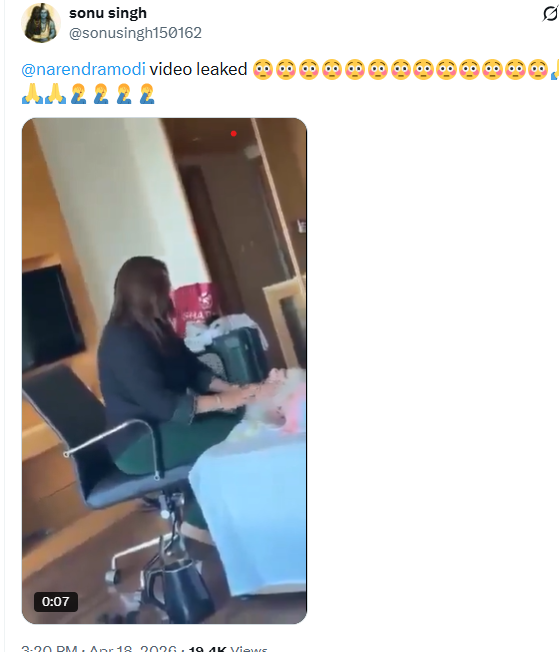
A video showing a woman giving a facial massage to an elderly man with a white beard is going viral on social media, with users claiming that the man is Prime Minister Narendra Modi. Some posts describe it as a “leaked massage video” of the Prime Minister, while others sarcastically link it to the glow on his face. However, research by the CyberPeace Research Wing found that the claim is false. The viral video has no connection to Narendra Modi and is being shared with a misleading narrative.
Claim
An X user named Sonu Singh shared the video with the caption: “Narendra Modi video leaked.”
Fact Check
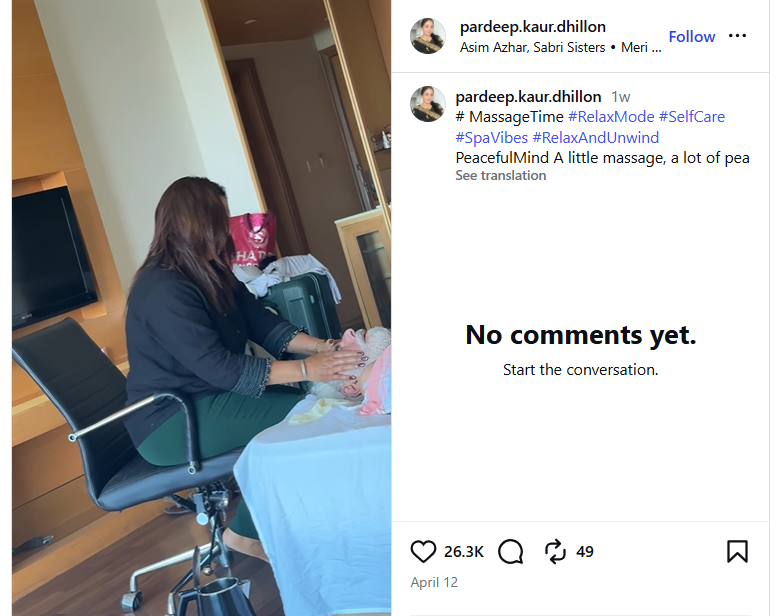
To verify the claim, we extracted keyframes from the viral video and conducted a reverse image search. This led us to the same video uploaded on April 12, 2026, on the Instagram and Facebook pages of content creator Pradeep Kaur Dhillon, where it was captioned “Massage time.”
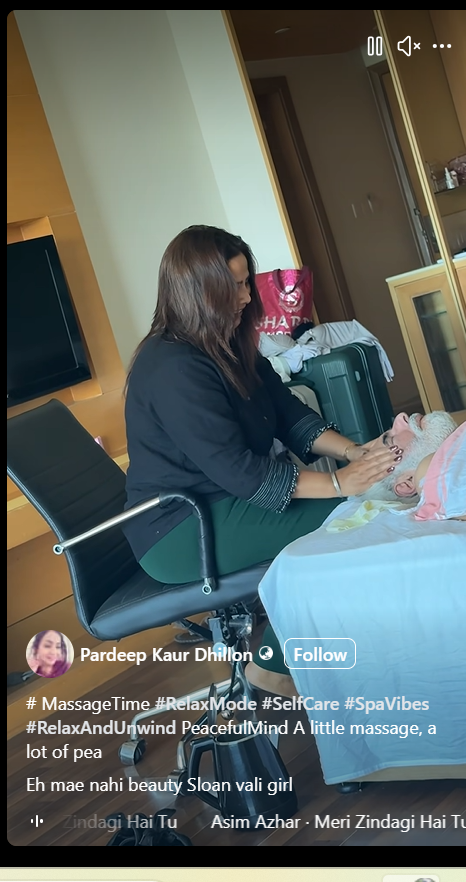
Further checks revealed another similar video posted on March 28, 2026, on the same social media accounts, with the caption: “Stylish, Spa day for him… kyunki self-care sirf ladies layi nahi.”
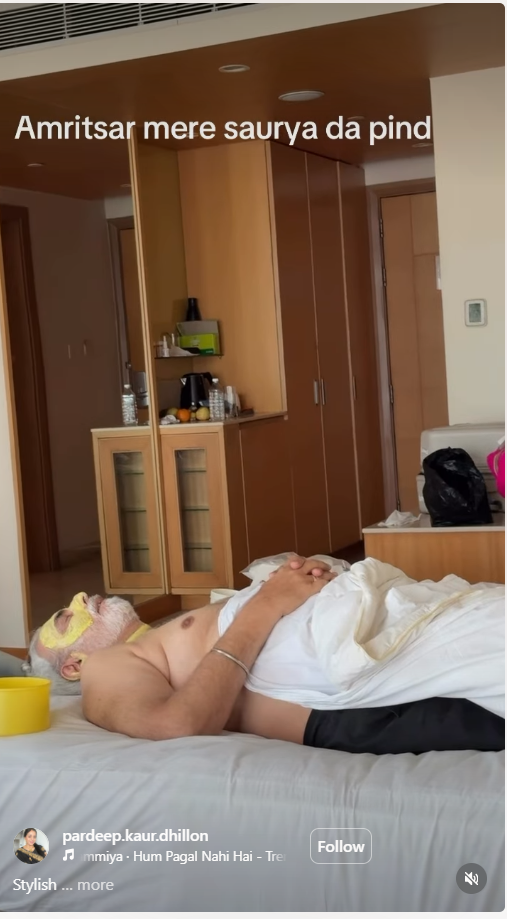
During the research, we also found that the man seen in the video is Jaspal Singh, Dhillon’s partner, who frequently appears in her social media posts. According to publicly available profile details, the duo resides in New Jersey, USA, and originally belongs to Amritsar, Punjab, India.

Conclusion
The viral claim is false. The video does not show Prime Minister Narendra Modi. It features content creators Pradeep Kaur Dhillon and Jaspal Singh and is being circulated online with a false and misleading claim.
