
#FactCheck -AI-Manipulated Clip Misrepresents PM Modi’s Remarks on Iran-Israel Conflict
Executive Summary
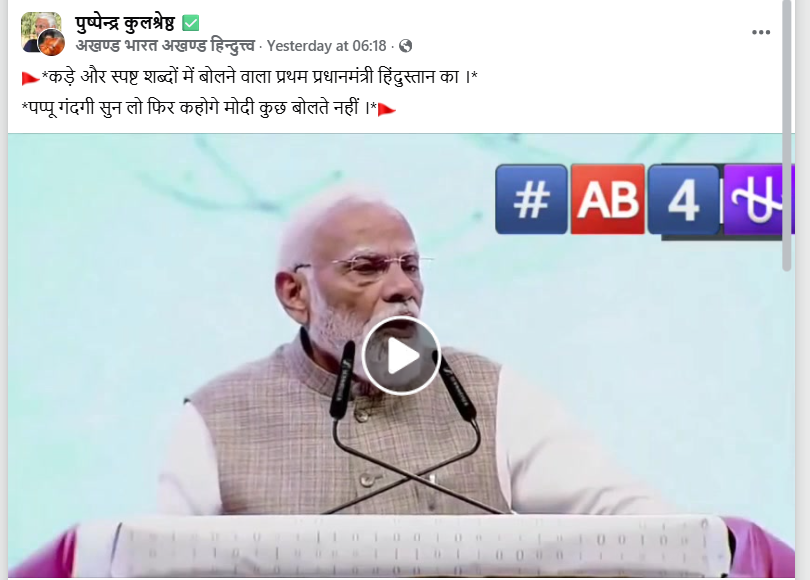
Amid the ongoing conflict between the US-Israel and Iran, a video of Indian Prime Minister Narendra Modi is being widely circulated on social media. In the clip, he is allegedly heard supporting Israel and calling Iran a “terrorist state.” The video also appears to show him speaking about the idea of “Akhand Bharat.” Many users are sharing this video as genuine. However, a detailed research by the CyberPeacefound that the claim is false. The viral video is a deepfake created using AI technology.
Claim:
A Facebook page named “Pushpendra Kulshreshtha” shared the video on March 23, 2026, with a caption suggesting that PM Modi made strong remarks in support of Israel and against Iran.
Fact Check:
To verify the claim, we first conducted a keyword search to find any credible reports or official statements where PM Modi made such remarks. However, no reliable news reports or authentic videos supporting the claim were found. We then extracted keyframes from the viral video and performed a reverse image search using Google Lens. This led us to the original video posted on the X (formerly Twitter) handle of ANI on March 12, 2026.

The visuals, including PM Modi’s attire and the stage setup, matched the viral clip—indicating that the fake video was created using this original footage. However, in the authentic video, PM Modi did not make any statements about Iran, Israel, or “Akhand Bharat” as seen in the viral version. In the original footage, PM Modi is seen addressing the NXT Summit in Delhi, where he spoke about the global energy crisis arising from ongoing conflicts and highlighted the expansion of LPG and PNG facilities in India. Additionally, a customised keyword search led us to a press release issued by the Prime Minister's Office regarding his address at the summit. The statement heard in the viral clip was not found there either.

Conclusion:
The viral video of PM Modi is a deepfake. He did not make any statement calling Iran a “terrorist state” or expressing support for Israel in the manner shown. The original video is from a summit held in Delhi and has been manipulated using AI to spread misleading claims.

Related Blogs
.webp)
Introduction
India is confronting a wake-up call as a recent cyber incident aimed at the aviation sector underscores the fragile nature of digital systems that guide national air travel. The disclosure in Parliament has pushed the conversation on flight safety, signal integrity, and cyber readiness back into urgent focus. In a written response to a Parliamentary question, Civil Aviation Minister Ram Mohan Naidu acknowledged that GPS spoofing, a malicious method employed to alter navigation signals, had been noticed at seven major airports of the country. New Delhi flights had not been affected during the incident, but still, it was an event that again made air travel's safety, GNSS interference, and the overall cyber threat to India's airspace an issue of concern.
The Incident: What Happened?
Initial notices came from Indira Gandhi International Airport in Delhi, where the pilots of the different inbound flights talked about GPS spoofing as the reason for their landing. Spoofing is the process of sending counterfeit GPS signals which mislead the aircraft's navigation systems and may cause a wrong measure of the altitude, the position or the runway alignment. In Delhi, pilots operating under GPS-based landing procedures over Runway 10 experienced errors in their approaches and promptly switched to the alternative procedures without any delay.
The Minister said that apart from Delhi, other airports, viz. Kolkata, Amritsar, Mumbai, Hyderabad, Bengaluru, and Chennai were the 6 airports that recorded similar GNSS interference patterns consisting of both jamming and spoofing. Though no major interruptions or incidents occurred, these occurrences are a sign of a steady and enlarging threat.
Why Is GPS Spoofing So Dangerous?
Satellite navigation and communication systems are the backbone of modern aviation, which is now a matter of great precision. Signal jamming by malicious actors comes with a bunch of risks:
- Diversions and Delays: Pilots may be forced to either give up attempts to land or divert flights, which translates into higher consumption of fuel and more complicated operations due to the case of jamming.
- Threat of Safety Issue: Pilots are trained to deal with such incidents by following the prescribed fallback procedures, but still they depend very much on the GNSS signals that are accurate for safe manoeuvring, especially in low visibility situations.
- Pressure on Old Systems: Indian airports are still in the process of completely converting from ground-based navigation aids to GNSS. Signal disruptions entail the use of older technologies, which results in putting additional pressure on the already overburdened air traffic control systems.
- Opening Up Possibilities for Direct Attacks: Signal jamming can be made a tool for more clever tactics of operation that can include causing confusion during the busy traffic period or performing coordinated attacks to create chaos.
Aviation and Cyber Threats
The disturbances that have been mentioned at the seven airports are not unique. The civil aviation regulators all over the world have already reported an increase in GNSS jamming. The exemplary cases in the Middle East, Eastern Europe, and East Asia have revealed that the safety of airspace has turned into a tactical issue.
Moreover, India's quick adoption of digital technology in the aviation sector could open threat vulnerabilities from state-sponsored groups, hackers. In this instance, the government has not yet announced who was responsible for the spoofing, but the trend points to an adversary with advanced technology.
Government and Regulatory Response
The confirmation from the Civil Aviation Minister underscores a proactive stance by agencies such as:
- Directorate General of Civil Aviation (DGCA)
- Ministry of Civil Aviation
- Airports Authority of India (AAI)
The involved entities are collaborating now to do an inquiry into the cases and set up preventive measures.
The main steps that are taken in response are:
- More thorough observation of GNSS signal anomalies
- More pilot briefings and training on dealing with spoofing situations
- Improving navigation aids to set up a backup
- Working with IT security experts to find out the sources of interference
- Communicating with other global aviation authorities to share the best practices
India, being a significant player in the world aviation market, is not allowed to relax its guard. Cyberattacks on airports show how digital as well as physical security are becoming more and more intertwined.
The Bigger Picture: Protecting Critical Infrastructure
Aviation is a sector that very clearly shows that threats from cyberspace can easily translate into security issues for a nation. The airport system not only becomes more vulnerable to attacks but also the whole aviation industry as the digital ecosystems gain more complex forms together with integrated telecommunications networks, the Internet of Things (IoT)-enabled systems, and cloud-based services.
One of the many threats in the form of GNSS spoofing demonstrates so-called:
- Ransomware attacks on airport systems
- Contamination of air traffic control infrastructure
- Data breaches conducted by insiders
- Passenger data attacks
- Hinderance of airport logistics and baggage systems
What Needs to Happen Next?
India is compelled to embrace a multi-faceted approach in order to manage the intricacies of GNSS interference risk:
- Cybersecurity Measures in Aviation Enforced: New monitoring tools, anomaly detection systems, and instant response plans will be put into service.
- Redundant Technology: The non-GNSS-based navigation system will be expanded to guarantee the continuity of operations in the event of jamming.
- Cyber Drills Across all Sectors: To get pilots, air traffic control personnel, and airport operators ready, the aviation cyber drills will be conducted at the national level.
- Global Cooperation: International organisations will be approached to share the information and standardise the procedures.
- R&D and Innovations: Funding will be directed towards anti-spoofing technology, stronger satellite signals, and the domestic navigation system, like NavIC.
Conclusion
The cyberattack that targeted the seven airports serves as a clear reminder that aviation cybersecurity should not be considered a secondary issue anymore. Even though the quick reaction from the authorities managed to averted any disruptions, the event still shows the vulnerabilities of modern aviation systems. India's air travel infrastructure expansion will be a good time for the country to install its strong cybersecurity frameworks to protect its passengers, maintain the continuity of operations, and secure the airspace of its territory. At CyberPeace, we believe that a coordinated, proactive, and technology-driven approach is no longer an option, it is the new fundamental of aviation security in the digital age.
Reference

Executive Summary:
Recently, our team came across a video on social media that appears to show a saint lying in a fire during the Mahakumbh 2025. The video has been widely viewed and comes with captions claiming that it is part of a ritual during the ongoing Mahakumbh 2025. After thorough research, we found that these claims are false. The video is unrelated to Mahakumbh 2025 and comes from a different context and location. This is an example of how the information posted was from the past and not relevant to the alleged context.

Claim:
A video has gone viral on social media, claiming to show a saint lying in fire during Mahakumbh 2025, suggesting that this act is part of the traditional rituals associated with the ongoing festival. This misleading claim falsely implies that the act is a standard part of the sacred ceremonies held during the Mahakumbh event.

Fact Check:
Upon receiving the post we conducted a reverse image search of the key frames extracted from the video, and traced the video to an old article. Further research revealed that the original post was from 2009, when Ramababu Swamiji, aged 80, laid down on a burning fire for the benefit of society. The video is not recent, as it had already gone viral on social media in November 2009. A closer examination of the scene, crowd, and visuals clearly shows that the video is unrelated to the rituals or context of Mahakumbh 2025. Additionally, our research found that such activities are not part of the Mahakumbh rituals. Reputable sources were also kept into consideration to cross-verify this information, effectively debunking the claim and emphasizing the importance of verifying facts before believing in anything.


For more clarity, the YouTube video attached below further clears the doubt, which reminds us to verify whether such claims are true or not.

Conclusion:
The viral video claiming to depict a saint lying in fire during Mahakumbh 2025 is entirely misleading. Our thorough fact-checking reveals that the video dates back to 2009 and is unrelated to the current event. Such misinformation highlights the importance of verifying content before sharing or believing it. Always rely on credible sources to ensure the accuracy of claims, especially during significant cultural or religious events like Mahakumbh.
- Claim: A viral video claims to show a saint lying in fire during the Mahakumbh 2025.
- Claimed On: X (Formerly Known As Twitter)
- Fact Check: False and Misleading

A video circulating on social media claims to show former Indian cricketer Sachin Tendulkar commenting on England batter Joe Root’s batting feats. In the clip, Tendulkar is allegedly heard saying that if Joe Root continues scoring centuries, even his (Tendulkar’s) record would be broken. The video further claims that Tendulkar says if Root scores another century, he would give up the bat’s grip, after which the clip abruptly ends.
Users sharing the video are claiming that Sachin Tendulkar has taken a dig at Joe Root through this remark.
Cyber Peace Foundation’s research found the claim to be misleading. Our research clearly establishes that the viral video is not authentic but has been created using Artificial Intelligence (AI) tools and is being shared online with a false narrative.
CLAIM
On January 5, 2025, several users shared the viral video on Instagram, claiming it shows Sachin Tendulkar making remarks about Joe Root’s century-scoring spree.
(Post link and archive link available.)

FACT CHECK
To verify the claim, we extracted keyframes from the viral video and conducted a Google Reverse Image Search. This led us to an interview of Sachin Tendulkar published on the official BBC News YouTube channel on November 18, 2013. The visuals from that interview match exactly with those seen in the viral clip.
This establishes that the visuals used in the viral video are old and have been repurposed with manipulated audio to create a misleading narrative.
Further, Joe Root made his Test debut in 2012. At that time, he had not scored multiple Test centuries and was nowhere close to Sachin Tendulkar’s record tally of hundreds. This timeline itself makes the viral claim factually incorrect.
(Link to the original BBC interview available.)
https://www.youtube.com/watch?v=v6Rz4pgR9UQ

Upon closely examining the viral clip, we noticed that Sachin Tendulkar’s voice sounded unnatural and inconsistent. This raised suspicion of audio manipulation.
We then ran the viral video through an AI detection tool, Aurigin AI. According to the results, the audio in the video was found to be 100 percent AI-generated, confirming that Tendulkar never made the statements attributed to him in the clip.

Conclusion
Our research confirms that the viral video claiming Sachin Tendulkar commented on Joe Root’s centuries is fake. The video has been created using AI-generated audio and misleadingly combined with visuals from a 2013 interview. Users are sharing this manipulated clip on social media with a false claim.
