
India’s Emerging Cybercrime Response Ecosystem
The digital ecosystem of India has experienced rapid growth, which has created numerous opportunities for economic development, better governance and increased social connections. The increasing use of digital technology has resulted in a higher incidence of cyber-enabled crimes, which include online fraud and cyber harassment, child exploitation and the spread of misinformation. The Government of India has established multiple initiatives to enhance a complete and unified framework that will help in combatting cybercrime more effectively. The latest updates presented to Parliament demonstrate how different institutional frameworks and legal provisions, capacity building efforts, and public awareness programs work together to handle new cyber threats.
A Coordinated Institutional Framework
The Indian system for investigating and prosecuting cybercrimes assigns responsibility to States and Union Territories, which operate their own Law Enforcement Agencies. The central government established the Indian Cyber Crime Coordination Centre (I4C) to support these operations through its Ministry of Home Affairs.
The I4C functions as a central hub that allows various stakeholders in cybercrime prevention and investigation to share intelligence and build their operational capacities. The initiative establishes a cybersecurity system that will improve its organisational structure through better central and state agency collaboration.
The National Cyber Crime Reporting Portal (NCCRP) serves as a primary project of this framework by providing online cyber incident reporting for citizens. The portal enables users to register complaints more efficiently while enhancing access to crime reporting, which particularly benefits victims of crimes against women and children. The system offers special channels which allow users to report Child Sexual Exploitative and Abuse Material (CSEAM) and rape-related materials while providing options for anonymous reporting and case tracking. After a complaint is lodged, the appropriate state authorities initiate the process to investigate the matter and proceed with legal procedures.
Capacity Building and Cyber Forensics
The response to cybercrime requires both expert investigators and advanced forensic technology systems. The Cyber Crime Prevention against Women and Children (CCPWC) Scheme, which provides financial backing and technical training to states and union territories, was instituted by the Ministry of Home Affairs to address this requirement.
The scheme has authorised the release of ₹132.93 crore for developing cyber forensic facilities and investigative technologies. The funding has supported the establishment of cyber forensic-cum-training laboratories across multiple states and union territories. The total number of operational laboratories has reached 33 at this time.
The organisation has prioritised its training initiatives together with its infrastructure development projects. More than 24,600 law enforcement personnel, prosecutors, and judicial officers have received training on cybercrime investigation, digital evidence handling, and forensic analysis. The capacity-building initiatives were designed to provide investigators and judicial authorities with essential skills needed to handle advanced cyber incidents.
International Cooperation for Child Protection
International cooperation is essential for addressing online child exploitation because these crimes utilise digital networks that connect multiple countries. The National Crime Records Bureau (NCRB) established a partnership with the National Centre for Missing and Exploited Children (NCMEC) of the United States in 2019 through a Memorandum of Understanding, which aims to enhance regional collaboration in this field.
The partnership enables the sharing of tipline reports about online child exploitation, which Indian authorities use for their investigative work. Under the Information Technology Act provisions, NCRB has received official powers to issue removal notices to intermediaries because they oversee child sexual abuse material and other dangerous content.
Promoting Online Safety Awareness
Cybercrime prevention requires two essential elements, which are public knowledge and digital expertise. The National Commission for Protection of Child Rights (NCPCR) has developed several resources to educate children, parents, teachers, and school administrators about online safety. The guidelines include Being Safe Online, together with school safety manuals that protect against cyberbullying and the 2024 updates, which provide new recommendations for cyberbullying prevention. The commission has established multiple conferences and training sessions throughout various states to educate both educators and school administrators about child protection regulations and school security measures, and cyber protection standards.
The digital responsibility programs educate communities about proper online conduct and teach them how to recognise and handle cybersecurity threats.
Legal Framework for Digital Safety
The Information Technology Act of 2000, together with the Information Technology Intermediary Guidelines and Digital Media Ethics Code Rules of 2021, (Updated as of 2026) serve as the core legal foundation through which India combats cybercrime. The laws establish penalties for online distribution of obscene and sexually explicit material while requiring digital intermediaries to block access to illegal content.
The Bharatiya Nyaya Sanhita 2023 contains additional legal provisions that deal with two types of offences that involve disseminating obscene material and spreading dangerous misinformation.
The regulatory framework requires intermediaries to eliminate illegal content within specified timeframes, while they must prevent their platforms from being used to conduct dangerous or unlawful activities.
Conclusion
India establishes its cybercrime response strategy through a multi-layered method that uses different institutional systems, technological systems, legal systems, and public education programs. Cyber threats develop through technological progress, yet authorities must establish effective cybersecurity, which depends on their ability to investigate, their systems for reporting incidents, and their dedication to maintaining proper online conduct.
India needs continuous cooperation among government bodies, police forces, technology companies, and community organisations to maintain secure and strong digital networks that provide equal access to all citizens.
References
- https://www.pib.gov.in/PressReleasePage.aspx?PRID=2238260®=3&lang=2
- https://www.policyedge.in/p/rajya-sabha-strengthening-indias-coordinated-response-to-cyber-crimes

Related Blogs

Introduction
Intricate and winding are the passageways of the modern digital age, a place where the reverberations of truth effortlessly blend, yet hauntingly contrast, with the echoes of falsehood. Within this complex realm, the World Economic Forum (WEF) has illuminated the darkened corners with its powerful spotlight, revealing the festering, insidious network of misinformation and disinformation that snakes through the virtual and physical worlds alike. Gravely identified by the “WEF's Global Risks Report 2024” as the most formidable and immediate threats to our collective well-being, this malignant duo—misinformation and disinformation.
The report published with the solemn tone suitable for the prelude to such a grand international gathering as the Annual Summit in Davos, the report presents a vivid tableau of our shared global landscape—one that is dominated by the treacherous pitfalls of deceits and unverified claims. These perils, if unrecognised and unchecked by societal checks and balances, possess the force to rip apart the intricate tapestry of our liberal institutions, shaking the pillars of democracies and endangering the vulnerable fabric of social cohesion.
Election Mania
As we find ourselves perched on the edge of a future, one where the voices of nearly three billion human beings make their mark on the annals of history—within the varied electoral processes of nations such as Bangladesh, India, Indonesia, Mexico, Pakistan, the United Kingdom, and the United States. However, the spectre of misinformation can potentially corrode the integrity of the governing entities that will emerge from these democratic processes. The warning issued by the WEF is unambiguous: we are flirting with the possibility of disorder and turmoil, where the unchecked dispersion of fabrications and lies could kindle flames of unrest, manifesting in violent protests, hate-driven crimes, civil unrest, and the scourge of terrorism.
Derived from the collective wisdom of over 1,400 experts in global risk, esteemed policymakers, and industry leaders, the report crafts a sobering depiction of our world's journey. It paints an ominous future that increasingly endows governments with formidable power—to brandish the weapon of censorship, to unilaterally declare what is deemed 'true' and what ought to be obscured or eliminated in the virtual world of sharing information. This trend signals a looming potential for wider and more comprehensive repression, hindering the freedoms traditionally associated with the Internet, journalism, and unhindered access to a panoply of information sources—vital fora for the exchange of ideas and knowledge in a myriad of countries across the globe.
Prominence of AI
When the gaze of the report extends further over a decade-long horizon, the prominence of environmental challenges such as the erosion of biodiversity and alarming shifts in the Earth's life-support systems ascend to the pinnacle of concern. Yet, trailing closely, the digital risks continue to pulsate—perpetuated by the distortions of misinformation, the echoing falsities of disinformation, and the unpredictable repercussions stemming from the utilization and, at times, the malevolent deployment of artificial intelligence (AI). These ethereal digital entities, far from being illusory shades, are the precursors of a disintegrating world order, a stage on which regional powers move to assert and maintain their influence, instituting their own unique standards and norms.
The prophecies set forth by the WEF should not be dismissed as mere academic conjecture; they are instead a trumpet's urgent call to mobilize. With a startling 30 percent of surveyed global experts bracing for the prospect of international calamities within the mere span of the coming two years, and an even more significant portion—nearly two-thirds—envisaging such crises within the forthcoming decade, it is unmistakable that the time to confront and tackle these looming risks is now. The clarion is sounding, and the message is clear: inaction is no longer an available luxury.
Maldives and India Row
To pluck precise examples from the boundless field of misinformation, we might observe the Lakshadweep-Malé incident wherein an ordinary boat accident off the coast of Kerala was grotesquely transformed into a vessel for the far-reaching tendrils of fabricated narratives, erroneously implicating Lakshadweep in the spectacle. Similarly, the tension-laden India-Maldives diplomatic exchange becomes a harrowing testament to how strained international relations may become fertile ground for the rampant spread of misleading content. The suspension of Maldivian deputy ministers following offensive remarks, the immediate tumult that followed on social media, and the explosive proliferation of counterfeit news targeting both nations paint a stark and intricate picture of how intertwined are the threads of politics, the digital platforms of social media, and the virulent propagation of falsehoods.
Yet, these are mere fragments within the extensive and elaborate weave of misinformation that threatens to enmesh our globe. As we venture forth into this dangerous and murky topography, it becomes our collective responsibility to maintain a sense of heightened vigilance, to consistently question and verify the sources and content of the information that assails us from all directions, and to cultivate an enduring culture anchored in critical thinking and discernment. The stakes are colossal—for it is not merely truth itself that we defend, but rather the underlying tenets of our societies and the sanctity of our cherished democratic institutions.
Conclusion
In this fraught era, marked indelibly by uncertainty and perched precariously on the cusp of numerous pivotal electoral ventures, let us refuse the role of passive bystanders to unraveling our collective reality. We must embrace our role as active participants in the relentless pursuit of truth, fortified with the stark awareness that our entwined futures rest precariously on our willingness and ability to distinguish the veritable from the spurious within the perilous lattice of falsehoods of misinformation. We must continually remind ourselves that, in the quest for a stable and just global order, the unerring discernment of fact from fiction becomes not only an act of intellectual integrity but a deed of civic and moral imperative.
References
- https://www.businessinsider.in/politics/world/election-fuelled-misinformation-is-serious-global-risk-in-2024-says-wef/articleshow/106727033.cms
- https://www.deccanchronicle.com/nation/current-affairs/100124/misinformation-tops-global-risks-2024.html
- https://www.msn.com/en-in/news/India/fact-check-in-lakshadweep-male-row-kerala-boat-accident-becomes-vessel-for-fake-news/ar-AA1mOJqY
- https://www.boomlive.in/news/india-maldives-muizzu-pm-modi-lakshadweep-fact-check-24085
- https://www.weforum.org/press/2024/01/global-risks-report-2024-press-release/

Introduction
With the increasing frequency and severity of cyber-attacks on critical sectors, the government of India has formulated the National Cyber Security Reference Framework (NCRF) 2023, aimed to address cybersecurity concerns in India. In today’s digital age, the security of critical sectors is paramount due to the ever-evolving landscape of cyber threats. Cybersecurity measures are crucial for protecting essential sectors such as banking, energy, healthcare, telecommunications, transportation, strategic enterprises, and government enterprises. This is an essential step towards safeguarding these critical sectors and preparing for the challenges they face in the face of cyber threats. Protecting critical sectors from cyber threats is an urgent priority that requires the development of robust cybersecurity practices and the implementation of effective measures to mitigate risks.
Overview of the National Cyber Security Policy 2013
The National Cyber Security Policy of 2013 was the first attempt to address cybersecurity concerns in India. However, it had several drawbacks that limited its effectiveness in mitigating cyber risks in the contemporary digital age. The policy’s outdated guidelines, insufficient prevention and response measures, and lack of legal implications hindered its ability to protect critical sectors adequately. Moreover, the policy should have kept up with the rapidly evolving cyber threat landscape and emerging technologies, leaving organisations vulnerable to new cyber-attacks. The 2013 policy failed to address the evolving nature of cyber threats, leaving organisations needing updated guidelines to combat new and sophisticated attacks.
As a result, an updated and more comprehensive policy, the National Cyber Security Reference Framework 2023, was necessary to address emerging challenges and provide strategic guidance for protecting critical sectors against cyber threats.
Highlights of NCRF 2023
Strategic Guidance: NCRF 2023 has been developed to provide organisations with strategic guidance to address their cybersecurity concerns in a structured manner.
Common but Differentiated Responsibility (CBDR): The policy is based on a CBDR approach, recognising that different organisations have varying levels of cybersecurity needs and responsibilities.
Update of National Cyber Security Policy 2013: NCRF supersedes the National Cyber Security Policy 2013, which was due for an update to align with the evolving cyber threat landscape and emerging challenges.
Different from CERT-In Directives: NCRF is distinct from the directives issued by the Indian Computer Emergency Response Team (CERT-In) published in April 2023. It provides a comprehensive framework rather than specific directives for reporting cyber incidents.
Combination of robust strategies: National Cyber Security Reference Framework 2023 will provide strategic guidance, a revised structure, and a proactive approach to cybersecurity, enabling organisations to tackle the growing cyberattacks in India better and safeguard critical sectors. Rising incidents of malware attacks on critical sectors
In recent years, there has been a significant increase in malware attacks targeting critical sectors. These sectors, including banking, energy, healthcare, telecommunications, transportation, strategic enterprises, and government enterprises, play a crucial role in the functioning of economies and the well-being of societies. The escalating incidents of malware attacks on these sectors have raised concerns about the security and resilience of critical infrastructure.
Banking: The banking sector handles sensitive financial data and is a prime target for cybercriminals due to the potential for financial fraud and theft.
Energy: The energy sector, including power grids and oil companies, is critical for the functioning of economies, and disruptions can have severe consequences for national security and public safety.
Healthcare: The healthcare sector holds valuable patient data, and cyber-attacks can compromise patient privacy and disrupt healthcare services. Malware attacks on healthcare organisations can result in the theft of patient records, ransomware incidents that cripple healthcare operations, and compromise medical devices.
Telecommunications: Telecommunications infrastructure is vital for reliable communication, and attacks targeting this sector can lead to communication disruptions and compromise the privacy of transmitted data. The interconnectedness of telecommunications networks globally presents opportunities for cybercriminals to launch large-scale attacks, such as Distributed Denial-of-Service (DDoS) attacks.
Transportation: Malware attacks on transportation systems can lead to service disruptions, compromise control systems, and pose safety risks.
Strategic Enterprises: Strategic enterprises, including defence, aerospace, intelligence agencies, and other sectors vital to national security, face sophisticated malware attacks with potentially severe consequences. Cyber adversaries target these enterprises to gain unauthorised access to classified information, compromise critical infrastructure, or sabotage national security operations.
Government Enterprises: Government organisations hold a vast amount of sensitive data and provide essential services to citizens, making them targets for data breaches and attacks that can disrupt critical services.
Conclusion
The sectors of banking, energy, healthcare, telecommunications, transportation, strategic enterprises, and government enterprises face unique vulnerabilities and challenges in the face of cyber-attacks. By recognising the significance of safeguarding these sectors, we can emphasise the need for proactive cybersecurity measures and collaborative efforts between public and private entities. Strengthening regulatory frameworks, sharing threat intelligence, and adopting best practices are essential to ensure our critical infrastructure’s resilience and security. Through these concerted efforts, we can create a safer digital environment for these sectors, protecting vital services and preserving the integrity of our economy and society. The rising incidents of malware attacks on critical sectors emphasise the urgent need for updated cybersecurity policy, enhanced cybersecurity measures, a collaboration between public and private entities, and the development of proactive defence strategies. National Cyber Security Reference Framework 2023 will help in addressing the evolving cyber threat landscape, protect critical sectors, fill the gaps in sector-specific best practices, promote collaboration, establish a regulatory framework, and address the challenges posed by emerging technologies. By providing strategic guidance, this framework will enhance organisations’ cybersecurity posture and ensure the protection of critical infrastructure in an increasingly digitised world.

Executive Summary
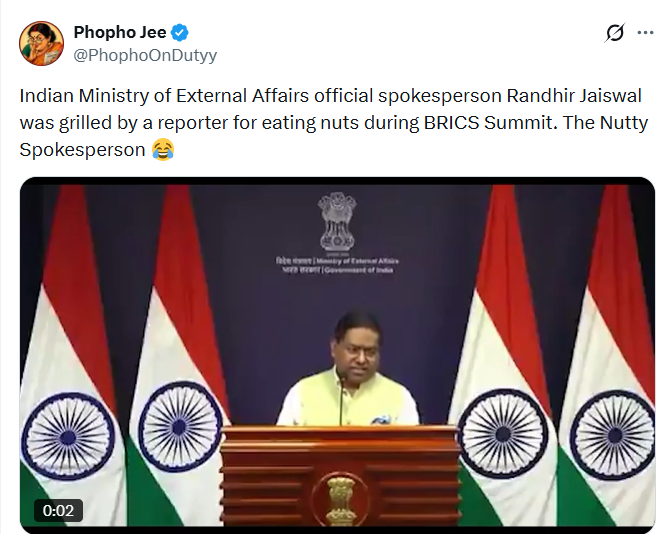
A video is being shared on social media with the claim that Ministry of External Affairs spokesperson Randhir Jaiswal was seen eating nuts during the BRICS Summit. The post claims that a reporter questioned him about eating nuts during the event. The video is also being shared with the sarcastic caption, “The Nutty Spokesperson.” Through the post, an attempt is being made to suggest that a reporter questioned Randhir Jaiswal about eating nuts during a press briefing. CyberPeace Research found that in the original video, Ministry of External Affairs spokesperson Randhir Jaiswal was responding to a question about Pakistan’s announcement of a 7 million Pakistani rupee bounty on Jaish-e-Mohammed chief Masood Azhar. Jaiswal addressed the announcement during the regular media briefing held on September 15, 2026. In his response, Jaiswal said that such announcements by Pakistan were not new and that the country should take concrete action against terrorism. However, the video being circulated on social media has been digitally edited using the original footage to falsely suggest that a reporter had questioned Jaiswal about eating nuts.
Claim:
During the BRICS Summit, a reporter questioned Ministry of External Affairs spokesperson Randhir Jaiswal about eating nuts and confronted him over it.
https://x.com/PhophoOnDutyy/status/2099940769876640084?s=20
Fact Check
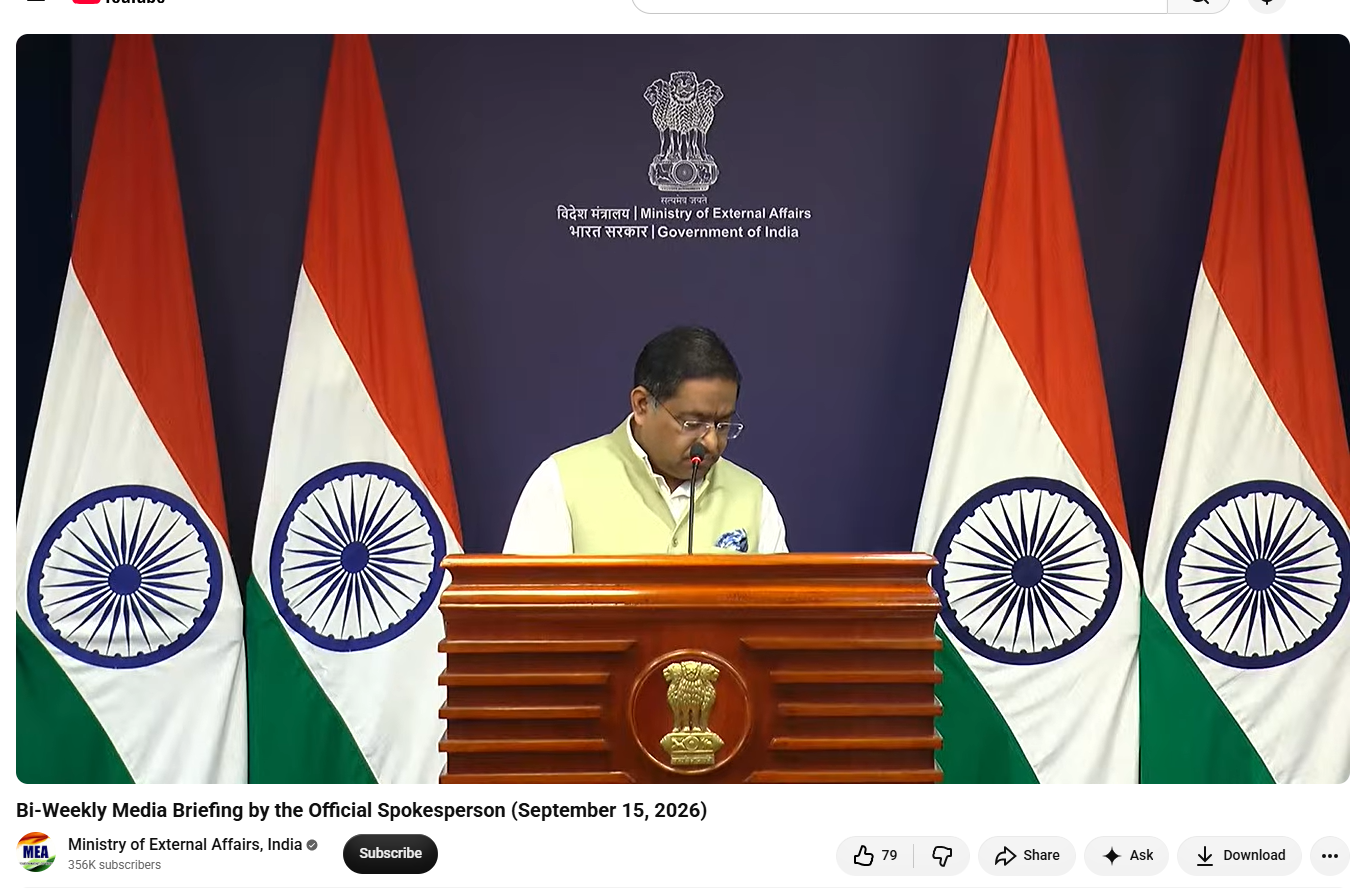
To verify the claim, we conducted a Google search using relevant keywords. During the search, we did not find any credible media report supporting the claim.As part of our research, we conducted a reverse image search of keyframes from the video. We found the original video on the YouTube channel of the Ministry of External Affairs, India. In the original video, Randhir Jaiswal was responding to a question about Pakistan’s announcement of a 7 million Pakistani rupee bounty on Masood Azhar.The reporter does not question Jaiswal about eating nuts anywhere in the original video. This establishes that the original footage has been edited and presented with a false context. Therefore, the claim being circulated on social media is false.
https://www.youtube.com/live/dw-qqLolRgc
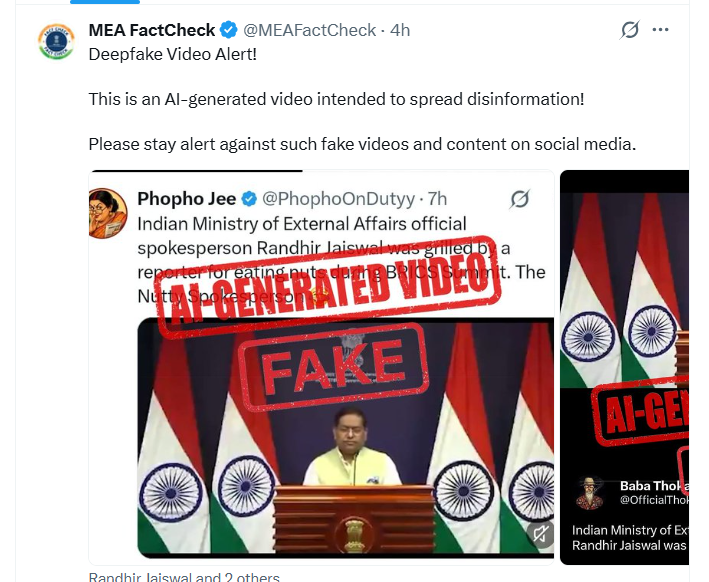
As part of our further research, we checked the official X account of MEA FactCheck. It also identified the video as AI-generated.
https://x.com/MEAFactCheck/status/2100076244805255501?s=20
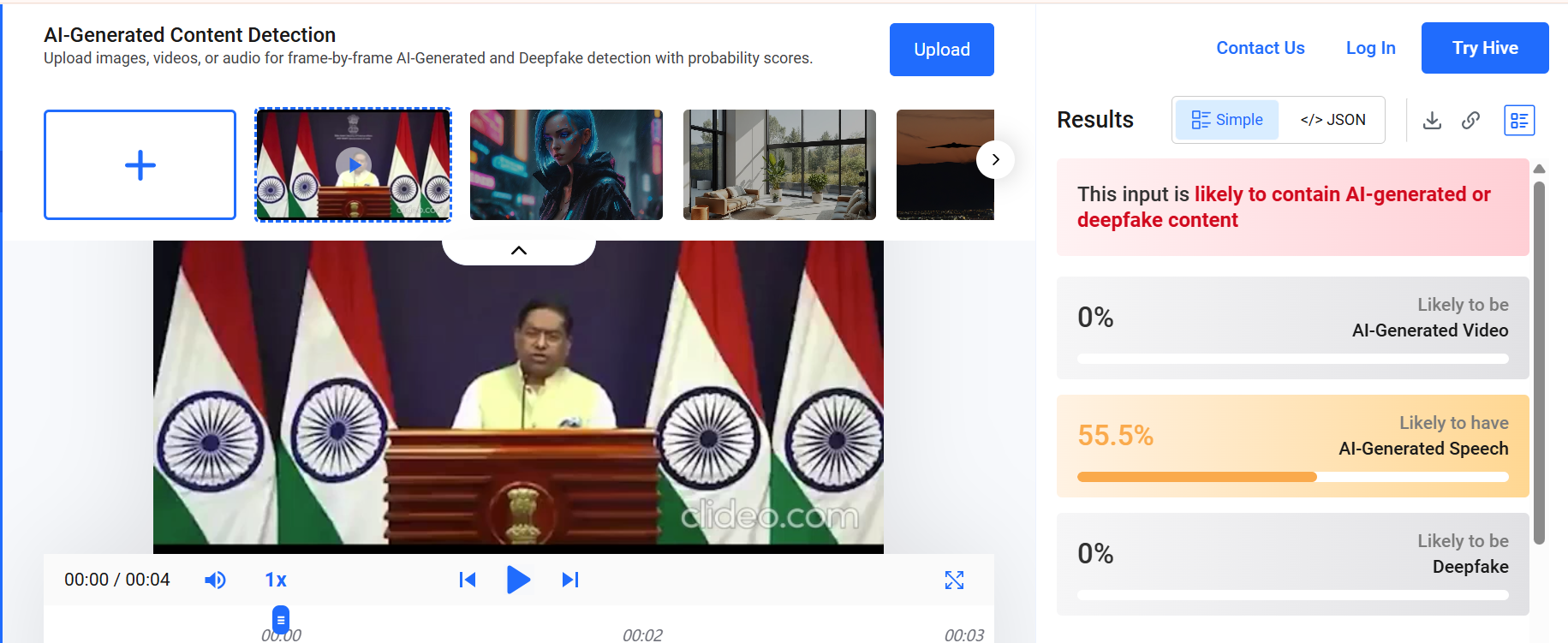
The video was scanned using the AI detection tool Hive Moderation. According to the results, the video has a 55% probability of being AI-generated.
Conclusion
Our research found that the video being shared on social media is fake and edited. In the original video, Ministry of External Affairs spokesperson Randhir Jaiswal was responding to a question about Pakistan’s announcement of a 7 million Pakistani rupee bounty on Masood Azhar.At no point in the original video does the reporter question Jaiswal about eating nuts.
The footage being circulated has been digitally manipulated and presented in a different context. The official X account of MEA FactCheck also identified the video as AI-generated. Therefore, the claim that Jaiswal was questioned by a reporter about eating nuts is false and misleading.
