
#FactCheck- No, Iran’s Supreme Leader Mojtaba Khamenei Is Not Dead—Viral Video Debunked
Executive Summary
A video circulating on social media claims that Iran’s new Supreme Leader Mojtaba Khamenei has passed away, with users attributing the claim to American sources. However, research by the CyberPeace found the claim to be false. Our research confirms that Mojtaba Khamenei is alive and in good health.
Claim
A Facebook user shared the viral video, claiming that Iran’s new Supreme Leader Mojtaba Khamenei had died.

Fact Check
To verify the claim, we conducted keyword searches on Google but found no credible media reports confirming his death. Further research led us to a report published on April 10, 2026, by ABP News. According to the report, amid discussions around a ceasefire, Mojtaba Khamenei issued a statement saying that Iran does not seek war with the United States or Israel, but as a nation, it must defend its rights.

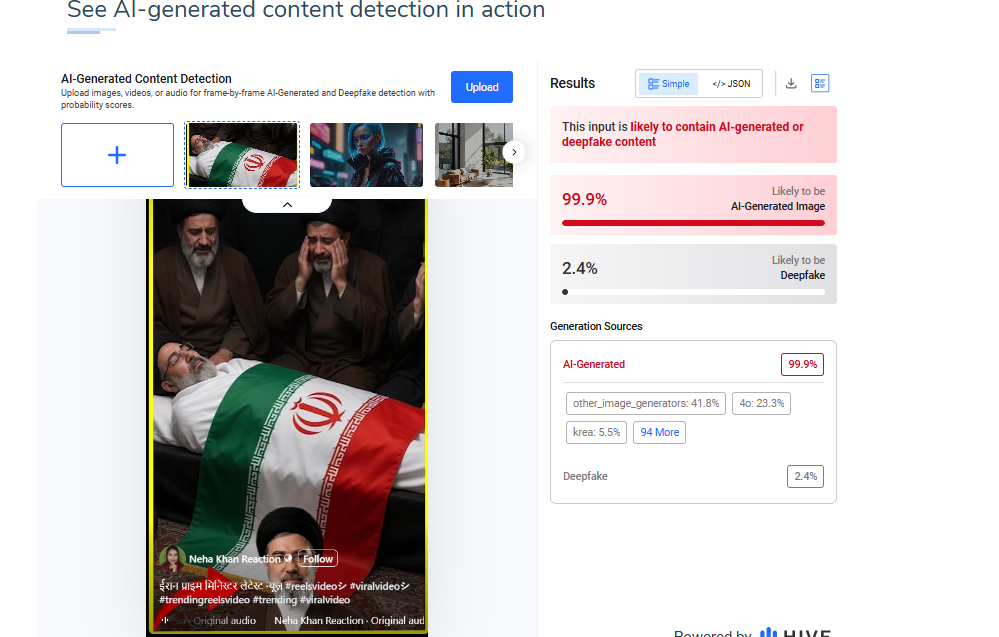
Additionally, the image used in the viral video was analyzed using the AI detection tool HIVE Moderation. The results indicated a 99% probability that the image is AI-generated.
Conclusion
The viral claim is false and misleading. There is no credible evidence to suggest that Mojtaba Khamenei has died. On the contrary, recent verified reports confirm that he is alive and has even issued public statements on ongoing geopolitical developments. The widespread circulation of this claim appears to be driven by misinformation, amplified through social media without verification. The use of AI-generated visuals further adds to the confusion, making the content appear authentic at first glance.

Related Blogs
Introduction
With the increasing reliance on digital technologies in the banking industry, cyber threats have become a significant concern. Cyberlaw plays a crucial role in safeguarding the banking sector from cybercrimes and ensuring the security and integrity of financial systems.
The banking industry has witnessed a rapid digital transformation, enabling convenient services and greater access to financial resources. However, this digitalisation also exposes the industry to cyber threats, necessitating the formulation and implementation of effective cyber law frameworks.
Recent Trends in the Banking Industry
Digital Transformation: The banking industry has embraced digital technologies, such as mobile banking, internet banking, and financial apps, to enhance customer experience and operational efficiency.
Open Banking: The concept of open banking has gained prominence, enabling data sharing between banks and third-party service providers, which introduces new cyber risks.
How Cyber Law Helps the Banking Sector
The banking sector and cyber crime share an unspoken synergy due to the mass digitisation of banking services. Thanks to QR codes, UPI and online banking payments, India is now home to 40% of global online banking transactions. Some critical aspects of the cyber law and banking sector are as follows:
Data Protection: Cyberlaw mandates banks to implement robust data protection measures, including encryption, access controls, and regular security audits, to safeguard customer data.
Incident Response and Reporting: Cyberlaw requires banks to establish incident response plans, promptly report cyber incidents to regulatory authorities, and cooperate in investigations.
Customer Protection: Cyberlaw enforces regulations related to online banking fraud, identity theft, and unauthorised transactions, ensuring that customers are protected from cybercrimes.
Legal Framework: Cyberlaw provides a legal foundation for digitalisation in the banking sector, assuring customers that regulations protect their digital transactions and data.
Cybersecurity Training and Awareness: Cyberlaw encourages banks to conduct regular training programs and create awareness among employees and customers about cyber threats, safe digital practices, and reporting procedures.

RBI Guidelines
The RBI, as India’s central banking institution, has issued comprehensive guidelines to enhance cyber resilience in the banking industry. These guidelines address various aspects, including:
Technology Risk Management
Cyber Security Framework
IT Governance
Cyber Crisis Management Plan
Incident Reporting and Response
Recent Trends in Banking Sector Frauds and the Role of Cyber Law
Phishing Attacks: Cyberlaw helps banks combat phishing attacks by imposing penalties on perpetrators and mandating preventive measures like two-factor authentication.
Insider Threats: Cyberlaw regulations emphasise the need for stringent access controls, employee background checks, and legal consequences for insiders involved in fraudulent activities.
Ransomware Attacks: Cyberlaw frameworks assist banks in dealing with ransomware attacks by enabling legal actions against hackers and promoting preventive measures, such as regular software updates and data backups.
Master Directions on Cyber Resilience and Digital Payment Security Controls for Payment System Operators (PSOs)
Draft of Master Directions on Cyber Resilience and Digital Payment Security Controls for Payment System Operators (PSOs) issued by the Reserve Bank of India (RBI). The directions provide guidelines and requirements for PSOs to improve the safety and security of their payment systems, with a focus on cyber resilience. These guidelines for PSOs include mobile payment service providers like Paytm or digital wallet payment platforms.
Here are the highlights-
The Directions aim to improve the safety and security of payment systems operated by PSOs by providing a framework for overall information security preparedness, with an emphasis on cyber resilience.
The Directions apply to all authorised non-bank PSOs.
PSOs must ensure adherence to these Directions by unregulated entities in their digital payments ecosystem, such as payment gateways, third-party service providers, vendors, and merchants.
The PSO’s Board of Directors is responsible for ensuring adequate oversight over information security risks, including cyber risk and cyber resilience. A sub-committee of the Board may be delegated with primary oversight responsibilities.
PSOs must formulate a Board-approved Information Security (IS) policy that covers roles and responsibilities, measures to identify and manage cyber security risks, training and awareness programs, and more.
PSOs should have a distinct Board-approved Cyber Crisis Management Plan (CCMP) to detect, contain, respond, and recover from cyber threats and attacks.
A senior-level executive, such as a Chief Information Security Officer (CISO), should be responsible for implementing the IS policy and the cyber resilience framework and assessing the overall information security posture of the PSO.
PSOs need to define Key Risk Indicators (KRIs) and Key Performance Indicators (KPIs) to identify potential risk events and assess the effectiveness of security controls. The sub-committee of the Board is responsible for monitoring these indicators.
PSOs should conduct a cyber risk assessment when launching new products, services, technologies, or significant changes to existing infrastructure or processes.
PSOs, including inventory management, identity and access management, network security, application security life cycle, security testing, vendor risk management, data security, patch and change management life cycle, incident response, business continuity planning, API security, employee awareness and training, and other security measures should implement various baseline information security measures and controls.
PSOs should ensure that payment transactions involving debit to accounts conducted electronically are permitted only through multi-factor authentication, except where explicitly permitted/relaxed.

Conclusion
The relationship between cyber law and the banking industry is crucial in ensuring a secure and trusted digital environment. Recent trends indicate that cyber threats are evolving and becoming more sophisticated. Compliance with cyber law provisions and adherence to guidelines such as those provided by the RBI is essential for banks to protect themselves and their customers from cybercrimes. By embracing robust cyber law frameworks, the banking industry can foster a resilient ecosystem that enables innovation while safeguarding the interests of all stakeholders or users.
Introduction
In today’s hyper-connected world, information spreads faster than ever before. But while much attention is focused on public platforms like Facebook and Twitter, a different challenge lurks in the shadows: misinformation circulating on encrypted and closed-network platforms such as WhatsApp and Telegram. Unlike open platforms where harmful content can be flagged in public, private groups operate behind a digital curtain. Here, falsehoods often spread unchecked, gaining legitimacy because they are shared by trusted contacts. This makes encrypted platforms a double-edged sword. It is essential for privacy and free expression, yet uniquely vulnerable to misuse.
As Prime Minister Narendra Modi rightly reminded,
“Think 10 times before forwarding anything,” warning that even a “single fake news has the capability to snowball into a matter of national concern.”
The Moderation Challenge with End-to-End Encryption
Encrypted messaging platforms were built to protect personal communication. Yet, the same end-to-end encryption that shields users’ privacy also creates a blind spot for moderation. Authorities, researchers, and even the platforms themselves cannot view content circulating in private groups, making fact-checking nearly impossible.
Trust within closed groups makes the problem worse. When a message comes from family, friends, or community leaders, people tend to believe it without questioning and quickly pass it along. Features like large group chats, broadcast lists, and “forward to many” options further speed up its spread. Unlike open networks, there is no public scrutiny, no visible counter-narrative, and no opportunity for timely correction.
During the COVID-19 pandemic, false claims about vaccines spread widely through WhatsApp groups, undermining public health campaigns. Even more alarming, WhatsApp rumors about child kidnappers and cow meat in India triggered mob lynchings, leading to the tragic loss of life.
Encrypted platforms, therefore, represent a unique challenge: they are designed to protect privacy, but, unintentionally, they also protect the spread of dangerous misinformation.
Approaches to Curbing Misinformation on End-to-End Platforms
- Regulatory: Governments worldwide are exploring ways to access encrypted data on messaging platforms, creating tensions between the right to user privacy and crime prevention. Approaches like traceability requirements on WhatsApp, data-sharing mandates for platforms in serious cases, and stronger obligations to act against harmful viral content are also being considered.
- Technological Interventions: Platforms like WhatsApp have introduced features such as “forwarded many times” labels and limits on mass forwarding. These tools can be expanded further by introducing AI-driven link-checking and warnings for suspicious content.
- Community-Based Interventions: Ultimately, no regulation or technology can succeed without public awareness. People need to be inoculated against misinformation through pre-bunking efforts and digital literacy campaigns. Fact-checking websites and tools also have to be taught.
Best Practices for Netizens
Experts recommend simple yet powerful habits that every user can adopt to protect themselves and others. By adopting these, ordinary users can become the first line of defence against misinformation in their own communities:
- Cross-Check Before Forwarding: Verify claims from trusted platforms & official sources.
- Beware of Sensational Content: Headlines that sound too shocking or dramatic probably need checking. Consult multiple sources for a piece of news. If only one platform/ channel is carrying sensational news, it is likely to be clickbait or outright false.
- Stick to Trusted News Sources: Verify news through national newspapers and expert commentary. Remember, not everything on the internet/television is true.
- Look Out for Manipulated Media: Now, with AI-generated deepfakes, it becomes more difficult to tell the difference between original and manipulated media. Check for edited images, cropped videos, or voice messages without source information. Always cross-verify any media received.
- Report Harmful Content: Report misinformation to the platform it is being circulated on and PIB’s Fact Check Unit.
Conclusion
In closed, unmonitored groups, platforms like WhatsApp and Telegram often become safe havens where people trust and forward messages from friends and family without question. Once misinformation takes root, it becomes extremely difficult to challenge or correct, and over time, such actions can snowball into serious social, economic and national concerns.
Preventing this is a matter of shared responsibility. Governments can frame balanced regulations, but individuals must also take initiative: pause, think, and verify before sharing. Ultimately, the right to privacy must be upheld, but with reasonable safeguards to ensure it is not misused at the cost of societal trust and safety.
References
- India WhatsApp ‘child kidnap’ rumours claim two more victims (BBC) The people trying to fight fake news in India (BBC)
- Press Information Bureau – PIB Fact Check
- Brookings Institution – Encryption and Misinformation Report (2021)
- Curtis, T. L., Touzel, M. P., Garneau, W., Gruaz, M., Pinder, M., Wang, L. W., Krishna, S., Cohen, L., Godbout, J.-F., Rabbany, R., & Pelrine, K. (2024). Veracity: An Open-Source AI Fact-Checking System. arXiv.
- NDTV – PM Modi cautions against fake news (2022)
- Times of India – Govt may insist on WhatsApp traceability (2019)
- Medianama – Telegram refused to share ISIS channel data (2019)

Executive Summary
A video showing a massive explosion and fire at what appears to be a gas facility is being widely circulated on social media. In the footage, huge flames and thick smoke can be seen rising from the site, while workers and security personnel are seen running around in panic.
The video is being shared with the claim that it shows an attack on the South Pars natural gas field in Iran’s Bushehr province.
CyberPeace Research Wing’s research found the viral claim to be false. The research revealed that the video is not from a real incident but was created using Artificial Intelligence (AI) and is being circulated with a false narrative.
Claim
The viral video is being shared on social media with the claim that it shows an attack on energy facilities at the South Pars natural gas field in Iran’s Bushehr province.
Post Link:
https://www.instagram.com/reel/DanX_iJIfTu/?utm_source=ig_web_button_share_sheet

Fact Check
To verify the claim, we extracted multiple keyframes from the viral video and conducted a reverse image search using Google Lens. During the search, we did not find any credible news report or reliable source confirming that the video was related to any attack on Iran’s South Pars gas field.
In the next step of the research, we analysed the video using the AI detection tool Deepfake-O-Meter. The tool’s results indicated that the viral video was approximately 100% likely to be AI-generated.


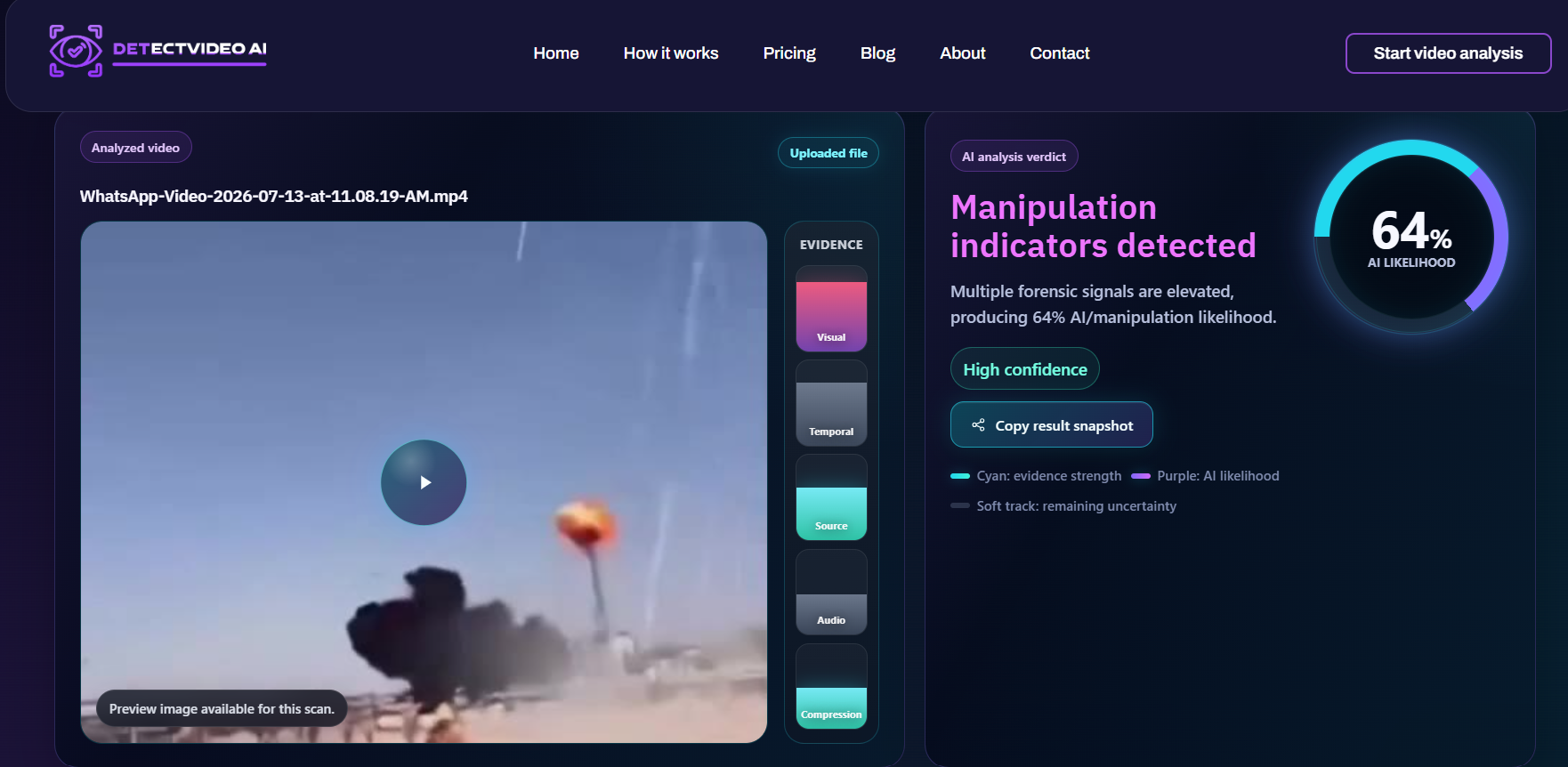
For further verification, we also checked the video using another AI detection tool, DetectVideo AI. The analysis showed that the video had a 64% probability of being AI-generated.
Conclusion
Our research found that the viral claim is false. The video does not show any real attack on Iran’s South Pars natural gas field. The footage was found to be AI-generated and is being shared on social media with a misleading claim.
