
#FactCheck - Bangladesh video falsely shared as BSF arresting an infiltrator at Bengal border
Executive Summary
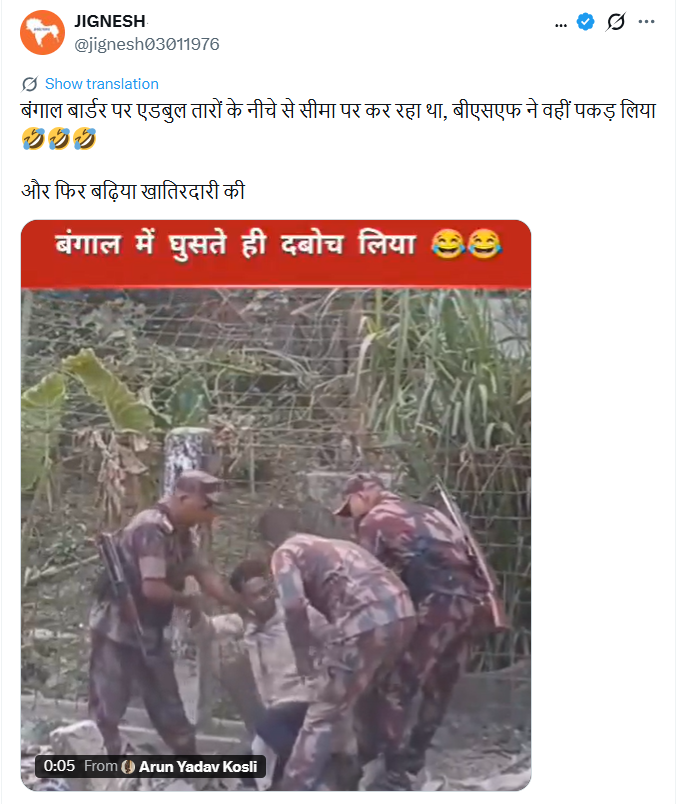
A video showing security personnel overpowering a man is being widely shared on social media with the claim that it shows the Border Security Force (BSF) arresting an infiltrator attempting to cross the India-Bangladesh border in West Bengal. However, research by CyberPeace Research Wing found that the claim is false. The viral video is from Bangladesh and is unrelated to India or the BSF.
Claim
An X user shared the viral video claiming: “He was crossing the Bengal border from beneath the barbed fencing when the BSF caught him on the spot.”
The post was circulated as an incident from the India-Bangladesh border in West Bengal.
Fact Check
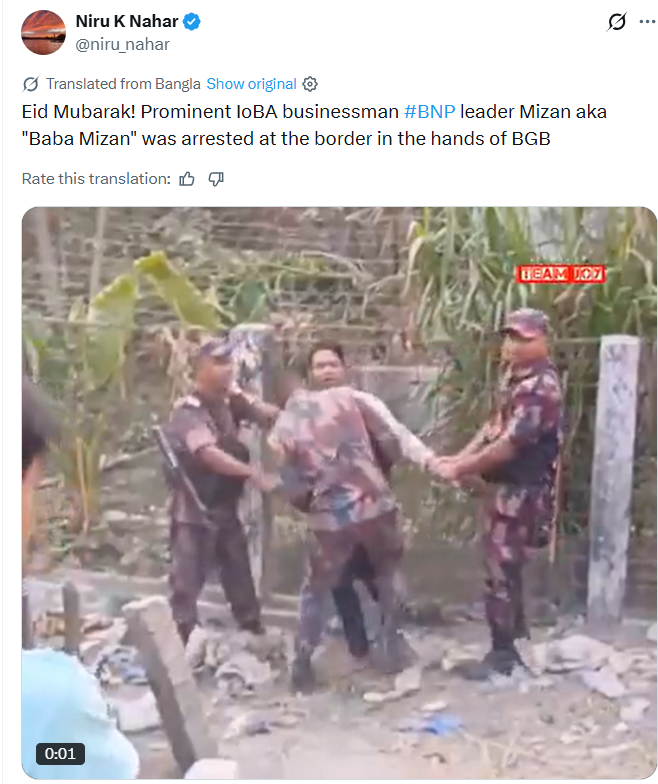
To verify the claim, we extracted keyframes from the viral video and conducted a reverse image search. During the research, we found the same video posted on 21 March 2026 by an X handle named “Niru Nahar.”
According to the caption of that post, the video showed Bangladesh Border Guards arresting BNP leader Mizan, also known as “Baba Mizan,” near the border.
Further research led us to a Facebook post uploaded on 22 March 2026 by Bangladeshi news platform Jono Pulse. The post identified the detained individual as “Juel,” an alleged drug trafficker from Chapainawabganj, and stated that he had been arrested by the Border Guard Bangladesh (BGB).
Chapainawabganj is located in Bangladesh, confirming that the video is unrelated to West Bengal or the BSF.

Conclusion
The viral claim is misleading. The video does not show the BSF arresting an infiltrator at the Bengal border. It is actually from Bangladesh and depicts a separate incident involving Border Guard Bangladesh personnel.

Related Blogs

The World Economic Forum reported that AI-generated misinformation and disinformation are the second most likely threat to present a material crisis on a global scale in 2024 at 53% (Sept. 2023). Artificial intelligence is automating the creation of fake news at a rate disproportionate to its fact-checking. It is spurring an explosion of web content mimicking factual articles that instead disseminate false information about grave themes such as elections, wars and natural disasters.
According to a report by the Centre for the Study of Democratic Institutions, a Canadian think tank, the most prevalent effect of Generative AI is the ability to flood the information ecosystem with misleading and factually-incorrect content. As reported by Democracy Reporting International during the 2024 elections of the European Union, Google's Gemini, OpenAI’s ChatGPT 3.5 and 4.0, and Microsoft’s AI interface ‘CoPilot’ were inaccurate one-third of the time when engaged for any queries regarding the election data. Therefore, a need for an innovative regulatory approach like regulatory sandboxes which can address these challenges while encouraging responsible AI innovation is desired.
What Is AI-driven Misinformation?
False or misleading information created, amplified, or spread using artificial intelligence technologies is AI-driven misinformation. Machine learning models are leveraged to automate and scale the creation of false and deceptive content. Some examples are deep fakes, AI-generated news articles, and bots that amplify false narratives on social media.
The biggest challenge is in the detection and management of AI-driven misinformation. It is difficult to distinguish AI-generated content from authentic content, especially as these technologies advance rapidly.
AI-driven misinformation can influence elections, public health, and social stability by spreading false or misleading information. While public adoption of the technology has undoubtedly been rapid, it is yet to achieve true acceptance and actually fulfill its potential in a positive manner because there is widespread cynicism about the technology - and rightly so. The general public sentiment about AI is laced with concern and doubt regarding the technology’s trustworthiness, mainly due to the absence of a regulatory framework maturing on par with the technological development.
Regulatory Sandboxes: An Overview
Regulatory sandboxes refer to regulatory tools that allow businesses to test and experiment with innovative products, services or businesses under the supervision of a regulator for a limited period. They engage by creating a controlled environment where regulators allow businesses to test new technologies or business models with relaxed regulations.
Regulatory sandboxes have been in use for many industries and the most recent example is their use in sectors like fintech, such as the UK’s Financial Conduct Authority sandbox. These models have been known to encourage innovation while allowing regulators to understand emerging risks. Lessons from the fintech sector show that the benefits of regulatory sandboxes include facilitating firm financing and market entry and increasing speed-to-market by reducing administrative and transaction costs. For regulators, testing in sandboxes informs policy-making and regulatory processes. Looking at the success in the fintech industry, regulatory sandboxes could be adapted to AI, particularly for overseeing technologies that have the potential to generate or spread misinformation.
The Role of Regulatory Sandboxes in Addressing AI Misinformation
Regulatory sandboxes can be used to test AI tools designed to identify or flag misinformation without the risks associated with immediate, wide-scale implementation. Stakeholders like AI developers, social media platforms, and regulators work in collaboration within the sandbox to refine the detection algorithms and evaluate their effectiveness as content moderation tools.
These sandboxes can help balance the need for innovation in AI and the necessity of protecting the public from harmful misinformation. They allow the creation of a flexible and adaptive framework capable of evolving with technological advancements and fostering transparency between AI developers and regulators. This would lead to more informed policymaking and building public trust in AI applications.
CyberPeace Policy Recommendations
Regulatory sandboxes offer a mechanism to predict solutions that will help to regulate the misinformation that AI tech creates. Some policy recommendations are as follows:
- Create guidelines for a global standard for including regulatory sandboxes that can be adapted locally and are useful in ensuring consistency in tackling AI-driven misinformation.
- Regulators can propose to offer incentives to companies that participate in sandboxes. This would encourage innovation in developing anti-misinformation tools, which could include tax breaks or grants.
- Awareness campaigns can help in educating the public about the risks of AI-driven misinformation and the role of regulatory sandboxes can help manage public expectations.
- Periodic and regular reviews and updates to the sandbox frameworks should be conducted to keep pace with advancements in AI technology and emerging forms of misinformation should be emphasized.
Conclusion and the Challenges for Regulatory Frameworks
Regulatory sandboxes offer a promising pathway to counter the challenges that AI-driven misinformation poses while fostering innovation. By providing a controlled environment for testing new AI tools, these sandboxes can help refine technologies aimed at detecting and mitigating false information. This approach ensures that AI development aligns with societal needs and regulatory standards, fostering greater trust and transparency. With the right support and ongoing adaptations, regulatory sandboxes can become vital in countering the spread of AI-generated misinformation, paving the way for a more secure and informed digital ecosystem.
References
- https://www.thehindu.com/sci-tech/technology/on-the-importance-of-regulatory-sandboxes-in-artificial-intelligence/article68176084.ece
- https://www.oecd.org/en/publications/regulatory-sandboxes-in-artificial-intelligence_8f80a0e6-en.html
- https://www.weforum.org/publications/global-risks-report-2024/
- https://democracy-reporting.org/en/office/global/publications/chatbot-audit#Conclusions
.webp)
Introduction
The ongoing armed conflict between Israel and Hamas/ Palestine is in the news all across the world. The latest conflict was triggered by unprecedented attacks against Israel by Hamas militants on October 7, killing thousands of people. Israel has launched a massive counter-offensive against the Islamic militant group. Amid the war, the bad information and propaganda spreading on various social media platforms, tech researchers have detected a network of 67 accounts that posted false content about the war and received millions of views. The ‘European Commission’ has sent a letter to Elon Musk, directing them to remove illegal content and disinformation; otherwise, penalties can be imposed. The European Commission has formally requested information from several social media giants on their handling of content related to the Israel-Hamas war. This widespread disinformation impacts and triggers the nature of war and also impacts the world and affects the goodwill of the citizens. The bad group, in this way, weaponise the information and fuels online hate activity, terrorism and extremism, flooding political polarisation with hateful content on social media. Online misinformation about the war is inciting extremism, violence, hate and different propaganda-based ideologies. The online information environment surrounding this conflict is being flooded with disinformation and misinformation, which amplifies the nature of war and too many fake narratives and videos are flooded on social media platforms.
Response of social media platforms
As there is a proliferation of online misinformation and violent content surrounding the war, It imposes a question on social media companies in terms of content moderation and other policy shifts. It is notable that Instagram, Facebook and X(Formerly Twitter) all have certain features in place giving users the ability to decide what content they want to view. They also allow for limiting the potentially sensitive content from being displayed in search results.
The experts say that It is of paramount importance to get a sort of control in this regard and define what is permissible online and what is not, Hence, what is required is expertise to determine the situation, and most importantly, It requires robust content moderation policies.
During wartime, people who are aggrieved or provoked are often targeted by this internet disinformation that blends ideological beliefs and spreads conspiracy theories and hatred. This is not a new phenomenon, it is often observed that disinformation-spreading groups emerged and became active during such war and emergency times and spread disinformation and propaganda-based ideologies and influence the society at large by misrepresenting the facts and planted stories. Social media has made it easier to post user-generated content without properly moderating it. However, it is a shared responsibility of tech companies, users, government guidelines and policies to collectively define and follow certain mechanisms to fight against disinformation and misinformation.
Digital Services Act (DSA)
The newly enacted EU law, i.e. Digital Services Act, pushes various larger online platforms to prevent posts containing illegal content and also puts limits on targeted advertising. DSA enables to challenge the of illegal online content and also poses requirements to prevent misinformation and disinformation and ensure more transparency over what the users see on the platforms. Rules under the DSA cover everything from content moderation & user privacy to transparency in operations. DSA is a landmark EU legislation moderating online platforms. Large tech platforms are now subject to content-related regulation under this new EU law ‘The Digital Services Act’, which also requires them to prevent the spread of misinformation and disinformation and overall ensure a safer online environment.
Indian Scenario
The Indian government introduced the Intermediary Guidelines (Intermediary Guidelines and Digital Media Ethics Code) Rules, updated in 2023 which talks about the establishment of a "fact check unit" to identify false or misleading online content. Digital Personal Data Protection, 2023 has also been enacted which aims to protect personal data. The upcoming Digital India bill is also proposed to be tabled in the parliament, this act will replace the current Information & Technology Act, of 2000. The upcoming Digital India bill can be seen as future-ready legislation to strengthen India’s current cybersecurity posture. It will comprehensively deal with the aspects of ensuring privacy, data protection, and fighting growing cyber crimes in the evolving digital landscape and ensuring a safe digital environment. Certain other entities including civil societies are also actively engaged in fighting misinformation and spreading awareness for safe and responsible use of the Internet.
Conclusion:
The widespread disinformation and misinformation content amid the Israel-Hamas war showcases how user-generated content on social media shows you the illusion of reality. There is widespread misinformation, misleading content or posts on social media platforms, and misuse of new advanced AI technologies that even make it easier for bad actors to create synthetic media content. It is also notable that social media has connected us like never before. Social media is a great platform with billions of active social media users around the globe, it offers various conveniences and opportunities to individuals and businesses. It is just certain aspects that require the attention of all of us to prevent the bad use of social media. The social media platforms and regulatory authorities need to be vigilant and active in clearly defining and improving the policies for content regulation and safe and responsible use of social media which can effectively combat and curtail the bad actors from misusing social media for their bad motives. As a user, it's the responsibility of users to exercise certain duties and promote responsible use of social media. With the increasing penetration of social media and the internet, misinformation is rampant all across the world and remains a global issue which needs to be addressed properly by implementing strict policies and adopting best practices to fight the misinformation. Users are encouraged to flag and report misinformative or misleading content on social media and should always verify it from authentic sources. Hence creating a safer Internet environment for everyone.
References:
- https://abcnews.go.com/US/experts-fear-hate-extremism-social-media-israel-hamas-war/story?id=104221215
- https://edition.cnn.com/2023/10/14/tech/social-media-misinformation-israel-hamas/index.html
- https://www.nytimes.com/2023/10/13/business/israel-hamas-misinformation-social-media-x.html
- https://www.africanews.com/2023/10/24/fact-check-misinformation-about-the-israel-hamas-war-is-flooding-social-media-here-are-the//
- https://www.theverge.com/23845672/eu-digital-services-act-explained
Executive Summary
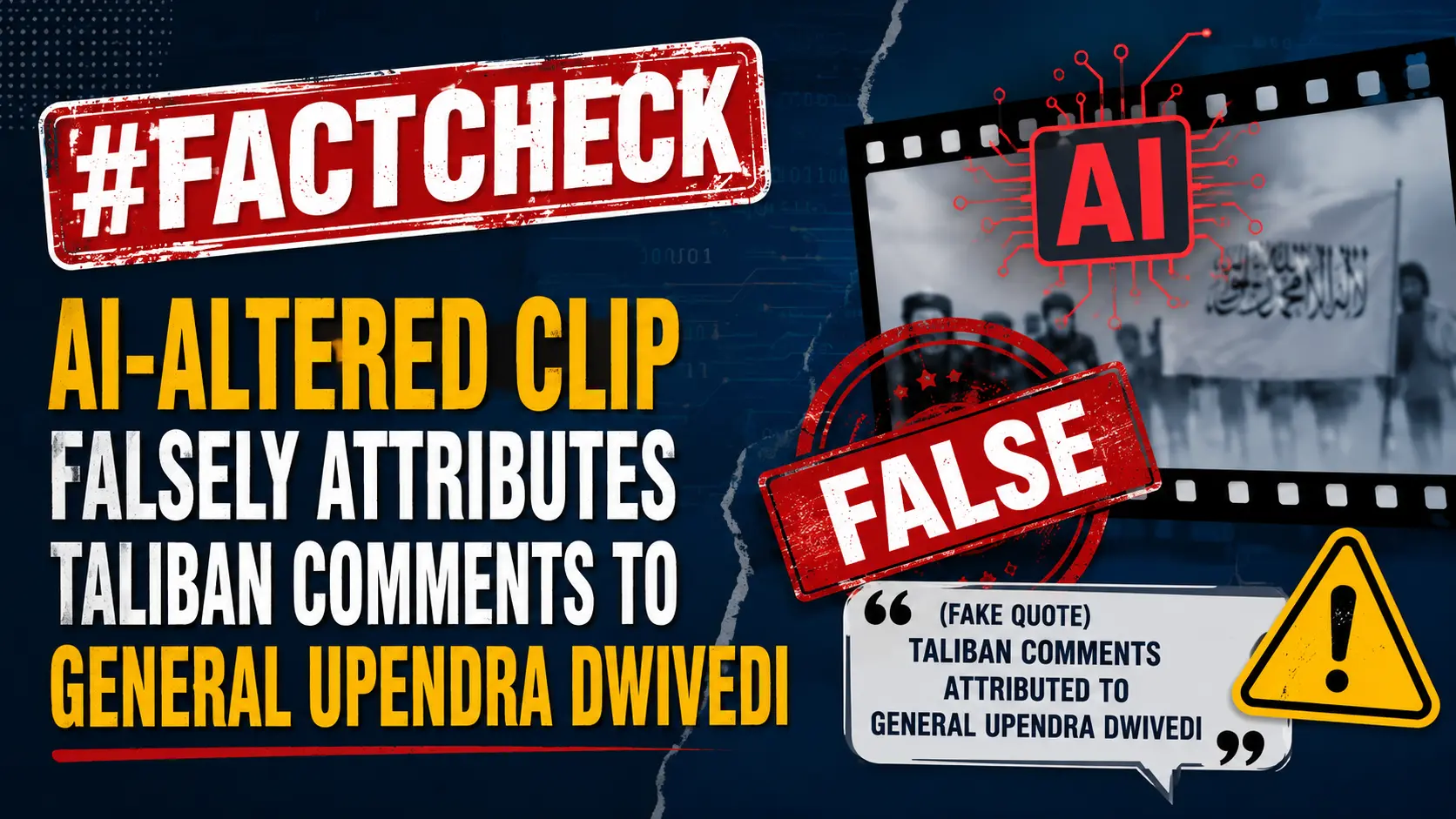
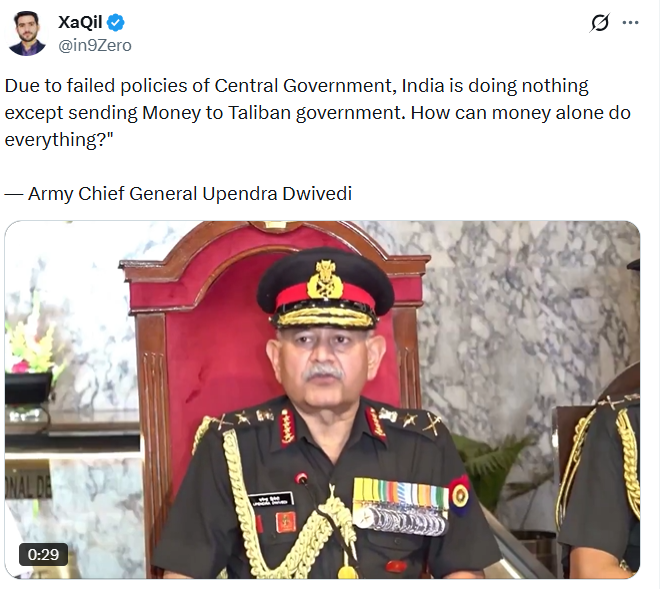
A video clip of Indian Army Chief Upendra Dwivedi is being widely shared across social media platforms with the claim that he criticised the Indian government's policy towards Taliban-ruled Afghanistan. In the viral clip, the Army Chief is allegedly heard saying that India is doing nothing except sending money to the Taliban government due to the Centre’s failed policies.
However, CyberPeace Research Wing research found the claim to be false. The viral video is a deepfake. In the original footage, General Upendra Dwivedi was speaking about Operation Sindoor and the preparedness of the Indian Armed Forces for a possible “Operation Sindoor 2.0.” He made no remarks regarding the Taliban or the government’s Afghanistan policy.
Claim
An X user named “XaQil” shared the viral video on May 31, 2026, with the caption:“Due to failed policies of the Central Government, India is doing nothing except sending Money to Taliban government. How can money alone do everything?” — Army Chief General Upendra Dwivedi.
Fact Check
In the viral video, General Dwivedi is purportedly heard making remarks about India’s Afghanistan policy, the Taliban, Pakistan, Iran, and India’s diplomatic position. To verify the claim, we searched for the original source of the video. A reverse image search of key frames led us to the authentic footage posted by news agency ANI on its official X account on May 30, 2026.
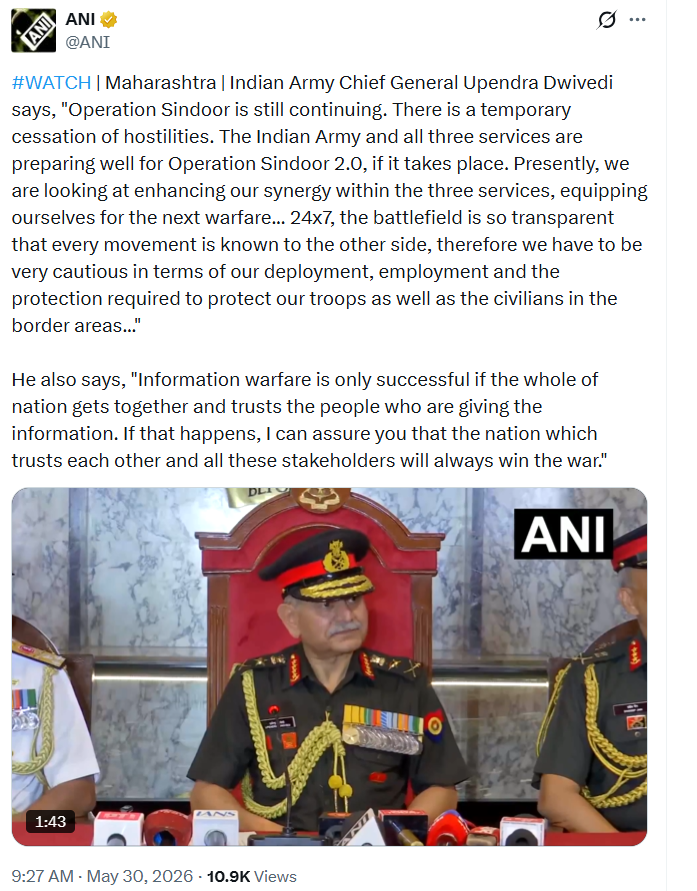
In the original video, General Dwivedi was responding to a question about Operation Sindoor. He stated that the operation was still ongoing, hostilities had only paused temporarily, and that the Indian Armed Forces were fully prepared if “Operation Sindoor 2.0” became necessary.
He also spoke about enhancing coordination among the three services and maintaining operational readiness.”
No part of his statement mentioned the Taliban, Afghanistan, Pakistan, Iran, or criticism of the Central Government.
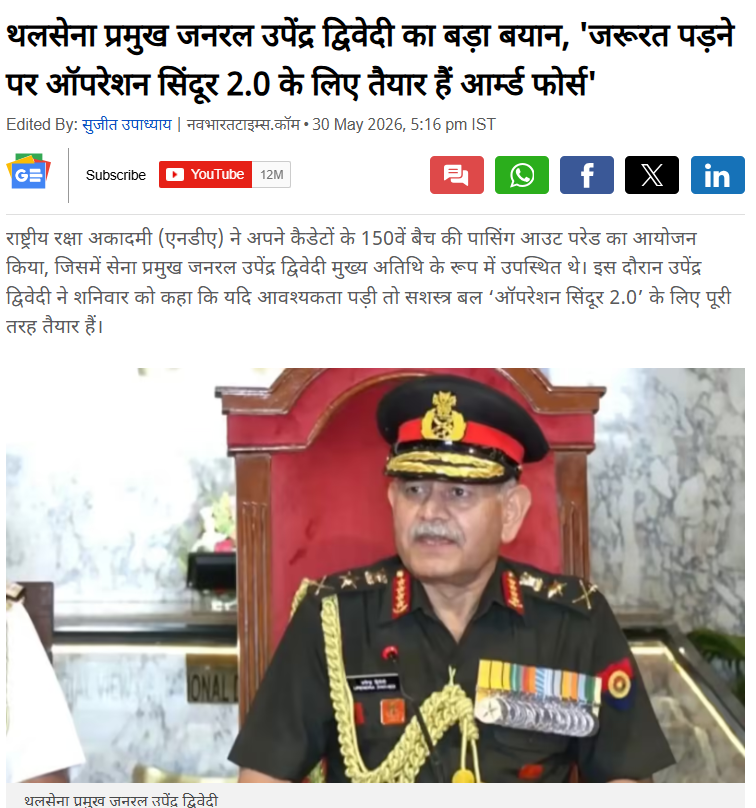
Further corroboration came from media reports covering the same event. According to a report published by Navbharat Times on May 30, 2026, General Dwivedi made the remarks during the passing-out parade of the 150th course of the National Defence Academy (NDA), where he attended as the chief guest. He reiterated that the armed forces were fully prepared for “Operation Sindoor 2.0” if required.
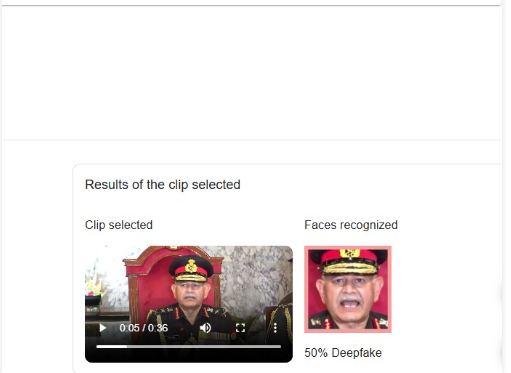
Since the content of the viral clip did not match the original statement, we examined it using InVID’s MeVer Deepfake Detector. The tool flagged signs of AI manipulation and indicated that the video had likely been altered.
Conclusion
Cyber Peace Foundation found that the viral video purportedly showing Army Chief General Upendra Dwivedi criticising the Indian government’s policy towards the Taliban is a deepfake. The Army Chief made no such remarks. The original video was recorded during an NDA event, where he spoke about Operation Sindoor and the preparedness of the Indian Armed Forces for a possible future operation. The viral clip has been manipulated using AI to spread a false narrative.
