
#FactCheck:Viral Video Does Not Show Congress Workers Protesting Against Rahul Gandhi
Executive Summary:
A video circulating on social media shows a group of people tearing Congress posters and raising controversial slogans. The clip is being shared with the claim that the individuals seen in the video are workers of the Congress party who were protesting against Rahul Gandhi and raising slogans against him. However, research by the CyberPeace found the viral claim to be misleading. Our research revealed that the video dates back to February 21, 2026. On that day, members of the Bharatiya Janata Yuva Morcha (BJYM) staged a protest outside a Congress office. During the demonstration, they raised slogans and tore Congress posters. The same video is now being circulated with a false narrative.
Claim
On February 24, 2026, a Facebook user shared the viral video with the caption:“Rebellion against Rahul Gandhi in Congress’ own stronghold! Party workers themselves tore posters and raised slogans — ‘Rahul Gandhi is a thief… a thief!’ This video exposes the internal truth of Congress. Congress itself is Muslim League.”

Fact Check
To verify the claim, we extracted key frames from the viral video and conducted a reverse image search using Google Lens. During the search, we found the same video uploaded on YouTube on February 21, 2026.
According to the description accompanying the video, BJP workers had staged a protest outside a Congress building. The report mentioned vandalism and stone-pelting during the protest, resulting in injuries to several individuals
- https://www.youtube.com/watch?v=pW-13mSvJ2c

Using this lead, we conducted a keyword search on Google and found a report published on February 21, 2026, by the Hindi news website Raj Express. The visuals in the report closely matched those seen in the viral clip.
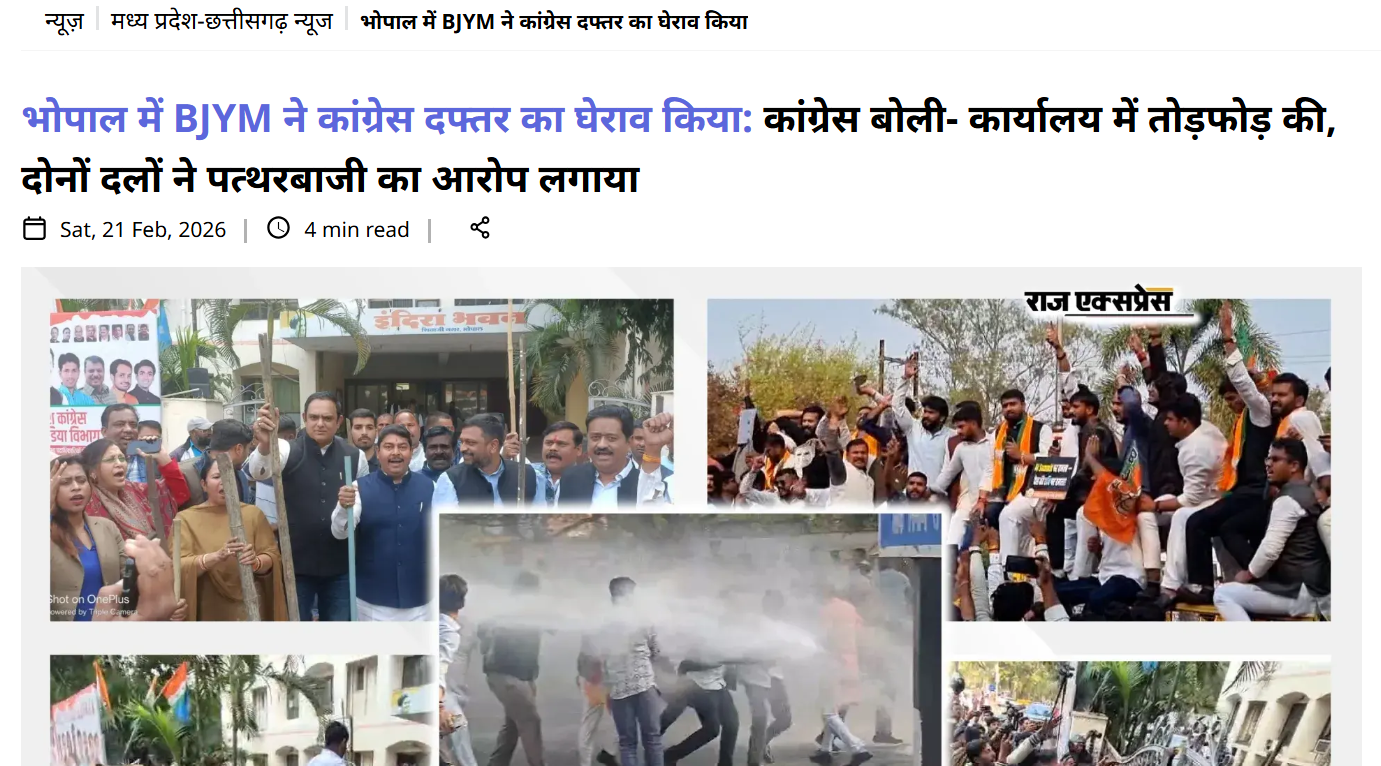
According to the report, the protest in Bhopal was organized by the Bharatiya Janata Yuva Morcha in response to a T-shirt protest staged by the Youth Congress during an AI Summit held at Bharat Mandapam in New Delhi. The situation escalated when protesters marched toward the state Congress office in Shivaji Nagar. Police attempted to disperse the crowd using water cannons, but some protesters reportedly entered the Congress office premises, leading to tension.
Further, we found the same viral video on the official Facebook page of Indian National Congress - Madhya Pradesh, where it was posted on February 26, 2026. In the post, the Congress unit alleged that BJYM workers and BJP-affiliated individuals had entered the Congress office, vandalized property, and created chaos in the presence of police officials.

Conclusion
Our research found that the viral claim is misleading. The video is from February 21, 2026, when BJYM workers protested outside a Congress office and engaged in vandalism. The footage is now being falsely shared as evidence of an internal rebellion by Congress workers against Rahul Gandhi.

Related Blogs

Introduction
On June 11, 2026, the Ministry of Home Affairs (MHA) India released one of the most critical Indian government advisories concerning cybersecurity by the Indian Cyber Crime Coordination Centre (I4C) under the National Cybercrime Threat Analytics Unit (NCTAU) concerning the immediate and escalating threat posed by the weaponization of generative artificial intelligence to forge synthetic biometric identities capable of bypassing the existing facial verification mechanisms in India. This advisory is arguably one of the most explicit Indian government recognitions of the deep-seated threats associated with AI-generated deepfakes in the country’s digital financial infrastructure. As many Indian financial service providers embrace facial recognition and biometric verification systems for customer onboarding and authentications, the myth that biometric traits are in themselves secure is slowly unraveling.
The advisory states that cybercriminals are deploying sophisticated AI tools to forge such credible digital simulacrums that exhibit such a precise similarity of facial expressions, eye movements, eye blinks, head movements, and voice patterns that they are virtually indistinguishable from the originals for identity verification mechanisms. Such a confluence of easy AI technology, mass onboarding of digital identities, and underdeveloped infrastructure to detect these synthetics requires urgent regulatory, institutional, and technological intervention.
The I4C Advisory: Core Findings and Threat Architecture
In its advisory, NCTAU describes a complex, multi-step attack chain used by scammers to capture biometric information and perpetrate fraud using everyday social interactions. The attackers typically use social media accounts, chat messengers, online job applications, dating applications, or direct phone calls to reach their targets. These interactions are presented as innocuous, such as for video calls, job interviews, identity checks, or just normal conversation with the intention of recording facial and vocal data.
During these interactions, victims may be asked to perform gestures commonly seen in legitimate video calls, such as look directly at the camera, blink, turn their head, or say specific phrases. However, the perpetrators record this video feed without the victim's knowledge and then use deep learning generative AI technologies to process it. Through methods such as Generative Adversarial Networks (GANs) and diffusion models, the scammers create photorealistic synthetic duplicates of the target, capable of mirroring all physical and vocal attributes, such as facial expressions, blinking patterns, head movements, and even voice tones.
The advisory explicitly states that these synthetic identities can be used for a variety of fraudulent activities, such as spoofing face authentication systems, circumventing liveness detection checks, successfully completing video KYC, enabling fraudulent account recovery processes, and illegally accessing bank and financial services. NCTAU also cautions that these voice deepfakes may be paired with facial deepfakes in an attempt to undermine multi-modal authentication methods, and the occurrence of related SIM-swap attacks can eliminate the last layer of security in OTP verification and facilitate a complete account compromise.
The scale of India's Digital Financial Ecosystem
The scale of I4C's detected threat can be better understood by considering India's entire digital financial landscape. In 2025 India has witnessed over 228 billion UPI transactions, with 21.63 billion in December alone, an annual growth rate of 29% from 2024, and an active user base of over 500 million by the beginning of 2026. Furthermore, total e-KYC transactions by April 2025 have exceeded 2,393 crore, and thus, it can be seen the extent to which these aspects of finance (banking, insurance, and credit) are now conducted via remote digital verification. The transformation, although instrumental in increasing financial inclusion, has, according to some analysts, created an attack surface of historic scale. As hundreds of millions more become financially integrated via the very same channels that now form the country's infrastructure and systems of identity, the threat from identity-based fraud becomes astronomically large.
Indian government data further illustrates the extent to which such frauds are a growing concern. Cybercrime cases jumped 42% year-on-year to 2.27 million in 2024, resulting in losses amounting to nearly 228.45 billion. Within that, 1.34 million UPI cases, worth 1,087 crore, occurred in FY2024 alone, while cybercrimes in general soared from 260,000 cases in 2021 to nearly 2.8 million by 2025, totaling cybercrime losses of 22,931 crore.
How Do Deepfakes Defeat Biometric Systems?
Deepfake fraud, in particular, is extremely difficult to counteract due to the direct attack it poses on the assumptions underlying traditional verification systems. Passive techniques for verifying a live person from a static photo or video existed that primarily looked for similarities in textures, lighting, and geometrical properties or challenged subjects to perform an action in real-time. But the generation of real-time face swapping that contains blinks, head motion, and speaking can now be produced on even cheap machines. Cybercriminals can exploit these by using virtual camera drivers to "inject" the false image feed into the live verification session, nullifying any passive liveness checks. Data from the industry clearly shows the extent of this problem: iProov, a leading authenticator, documented a 7.8-fold rise in injection attacks in 2024; Jumio noted an 88% increase in deepfake-induced fraud in 2025; and voice-deepfake attacks on financial call centres saw a 6.8-fold increase in 2024.
Gartner had also predicted that 30% of organizations would have lost trust in facial verification alone by 2026, and work by Kubam (2024) confirmed a lack of multi-factor authentication such as cross-validation of biometric, document, and device integrity signals used within KYC platforms. Such fears have been corroborated by FATF's 2025 Horizon Scan, which classified deepfakes as an emerging threat to the AML/CDD framework and digital identity verification.
Recommendations by I4C
I4C's advisory goes beyond merely warning about threats and lists actionable recommendations to both institutions and citizens. Banks, NBFCs, fintech companies, and onboarding platforms have been advised to incorporate advanced deepfake and synthetic content detection techniques into their verification flows, given that first-generation liveness checks are not enough. They should employ a multi-modal strategy that considers face features along with the device, network signals, behavioral biometrics, and alignment of face and voice. They also have been advised to make a more robust upgrade of their onboarding and verification platforms, as much of the current remote verification architecture was built in a less sophisticated threat context. This aligns with the KYC Master Direction of the RBI that specifies end-to-end encryption, IP-based access controls, geotagging, and technology platforms and systems are to be upgraded frequently. Citizens are advised by I4C to keep their biometric information secure; be careful of unsolicited video calls and online interviews; keep an eye on transaction-related SMS and emails; and report suspicious instances through the National Cybercrime Reporting Portal and through the telephone number 1930. It is clarified that this advisory aims to create awareness of developing AI-based identity fraud schemes, and it is not a declaration that any specific organization, platform, or service is vulnerable.
The Legislative Dimension: India's Evolving Response to Synthetic Media
The problem highlighted by I4C is evolving in a heavily legislated environment, not a legal void. The first-ever legal definition of "synthetic media" in India came into force in the Information Technology Amendment Rules 2026 on February 20, 2026. These rules oblige significant platforms to remove deepfakes and non-consensual intimate media within three hours and two hours, respectively, or lose their safe harbor protection under Section 79 of the IT Act. While the provision focuses on harm stemming from content, this creates a new legal and normative precedent on dealing with AI-induced deception. However, financial frauds facilitated through deepfakes are not content but involve the use of remote identity verification and customer onboarding systems, which require specific technical standards. The overall policy environment when viewed in light of the FATF Horizon Scan, RBI KYC rules, and recent I4C advisory already offers significant scope to define and introduce mandatory deepfake detection and identity assurance standards even before these are explicitly legislated.
Institutional and Technical Recommendations
- For Financial Institutions and Fintech platforms: The existing verification systems (liveness detection) must be replaced with multi-layered deep-fake detection processes, including injection attack detection, behavioral biometrics, cross-modal facial and voice verification, device integrity check, and hardware attestation during onboarding itself.
- For Regulators: The RBI and Ministry of Home Affairs should work together to release technical standards that specify minimum deepfake-detection requirements for video-KYC and remote onboarding systems in line with FATF digital identity guidance and the upcoming EU AI Act.
- For researchers and academia: Dedicated studies on deepfake detection performance across varied demographic, linguistic, and regional populations of India should be prioritized. Current models are mostly trained on Western data.
- For citizens: Face recordings and other biometric information should be treated with the same caution as sensitive financial details. Be wary of unsolicited video calls, remote interviews, or verification requests from unknown people, and report suspicious activities on any account immediately via the National Cybercrime Helpline (1930) or cybercrime.gov.in.
Conclusion
The I4C advisory of June 2026 marks a critical recognition that advances in generative AI have fundamentally challenged the reliability of facial biometric authentication. For a country whose digital financial ecosystem relies heavily on remote identity verification, the implications are significant. The integrity of India's financial inclusion framework now depends on rapidly strengthening identity assurance mechanisms. Addressing this threat will require coordinated action by regulators, financial institutions, technology developers, researchers, and citizens to develop robust technical standards, enhance detection capabilities, and build public awareness at a pace matching the evolution of AI-enabled fraud.
References and Sources
- I4C / NCTAU Advisory, June 2026 — National Cybercrime Threat Analytics Unit, Indian Cyber Crime Coordination Centre, Ministry of Home Affairs, Government of India. Advisory on AI-Enabled Deepfake Identity Fraud. Issued 11 June 2026.
- shuftipro.com/blog/key-takeaways-from-fatf-horizon-scan-report-on-deepfakes
- https://timesofindia.indiatimes.com/india/fraudsters-creating-deepfakes-to-bypass-facial-authentication-i4c/articleshow/131668958.cms
- hyperverge.co/blog/what-is-a-deepfake
- iproov.com/reports/threat-intelligence-report-2026
- arxiv.org/pdf/2601.06241
Introduction
In real-time warfare scenarios of this modern age, where actions occur without delay, the relevance of edge computing emerges as paramount. By processing data close to the source in the battlefield with the help of a drone or through video imaging from any military vehicle or aircraft, the concept of edge computing allows the military to point targets faster and strike with accuracy. It also enables local processing to relay central data, helping ground troops get intelligence inputs to act rapidly in critical mission scenarios.
As the global security landscape experiences a significant transformation in different corners of the world, it presents unprecedented challenges in the present scenario. In this article, we will try to understand how countries can maintain their military capabilities with the help of advanced technologies like edge computing.
Edge Computing in Modern Warfare
Edge computing involves the processing and storage of data at the point of collection on the battlefield, for example, through vehicles and drones, instead of relying on centralized data centers. This enables faster decision-making in real-time. This approach creates a resilient and secure network by reducing reliance on potentially compromised external connections, supporting autonomous systems, precision-based targeting, and data sharing among military personnel, drones, and command centers amidst a challenging environment.
A report released by the US Department of Defence in March 2025 found a crucial reality surrounding the operation of hardware relying on outdated industrial-age processes in the digital era. In the case of applications with video, edge computing helps to deliver significant advantages to a wide range of crucial military operations, which include:
- Situational awareness with real-time data processing that provides improved battlefield visibility and proper threat detection.
- Autonomous warfare systems such as drones, which use a tactical edge cloud computing to get the capability to navigate faster.
- Developing a strong communication and networking capability to secure low-latency communication for troops to stay connected in challenging environments.
- Ensuring predictive maintenance with the help of effective sensors to carry out edge detection and attrition at an early point, thereby reducing equipment failures.
- Developing effective targeting and weapons systems to ensure faster processing to enable precision-based targeting and response, besides a strong logistics and supply chain that can provide real-time tracking to improve delivery accuracy and resource management.
This report also highlighted that the DoD is rapidly updating its software and investing in AI enablers like data sets or MLOps tools. This also stresses the breaking down of integration barriers by enforcing MOSA (Modular Open Systems Approaches), APIs (Application Programming Interface), and modular interfaces to ensure interoperability across platforms, sensors, and networks to make software-defined warfare an effective strategy.
Developing Edge with Artificial Intelligence for Future Warfare
A significant insight from the work of the US Department of Defense is its emphasis on the importance of edge computing in shaping the future of warfare. In that context, the Annual Threat Assessment Report highlights a key limitation of traditional AI strategies that rely on centralised cloud computing, since these might not be suitable for modern battlefields with congested networks and limited bandwidth. The need for real-time data processing requires a distributed and edge-based AI solution to address contemporary threats. This report also directly supports the deployment of effective edge with AI in a defined, disrupted, intermittent, and limited-bandwidth (DDIL) environment. In that case, when the communication networks fail, the edge servers at the edge of the network offer crucial advantages that cloud-dependent systems cannot. This ability to analyse data and make decisions without consistent connectivity and operate with limited computational resources is a strategic necessity.
The scenario of warfare is a phenomenon that requires maintaining a strong strategic and tactical approach, which, in the present times, is being examined through the domain of digital platforms. Modern warfare patterns demand faster decision-making and edge computing deliveries by shifting the power of distant servers to the frontlines. The US military is already moving in the direction of deploying edge-enabled systems to prove the nature of sensors and networks to compute at the tactical edge to transform warfighting.
However, it can be understood with the help of an example, as creating fusion in the skies with F-35s. As they have showcased the capability of edge computing by fusing sensor data with MADL (Multi-Functional Advanced Data Link) to create a unified picture, making the squadrons a force multiplier. An example of this was visible when an F-35 relayed real-time tracking data, enabling a navy ship to neutralise a missile beyond its range.
Conclusion: The Way Ahead
As the changing nature of warfare moves towards adopting software-defined systems, where edge computing thrives as a futuristic military technology, it calls for the need for integration across all domains of warfighting. But at the same time, several imperatives do emerge, such as:
- Developing an open architecture that enables both flexibility and innovation.
- Ensuring an effective connectivity that actually combines a confluence of legacy systems.
- Developing interoperability among the systems that can function in synergy with all platforms and can function across all domains.
- Prioritising edge-native AI development systems, where it is also necessary to ensure the shift to adopting cloud-based AI models to create solutions optimised from the ground up for edge deployment.
- Investing in edge infrastructure to establish a robust edge computing infrastructure that enables rapid deployment by testing and updating AI capabilities across diverse hardware platforms. Like the way the military training academies in India are developing training infrastructures for training officer cadets or personnel to handle drones and all forms of advanced warfare tactics emerging in this age.
- Fostering talent and expertise by embracing commercial solutions where software talent could be enabled across the enterprises with expertise in edge computing capabilities and AI. In this case, the role of the commercial sector can help to drive innovations in edge AI, and the only way to move in this direction is by leveraging these advances through partnerships and collaborative efforts.
Taking the example of the ARPANET, which once seeded the modern internet, edge computing can also help to create a transformative network effect within the digital battlespace. In conclusion, future conflicts will be defined by the speed and accuracy provided by the edge, as nations integrating AI and robust edge infrastructures can hold a strong advantage in the multi-domain battlefields in the future.
References
- https://www.idsa.in/mpidsanews/rk-narangs-article-what-the-regions-first-drone-warfare-taught-us-published-in-the-new-indian-express
- https://latentai.com/blog/software-defined-warfare-why-edge-ai-is-critical-to-americas-defense-future/
- https://www.boozallen.com/s/insight/blog/how-the-us-military-is-using-edge-computing.html
- https://capsindia.org/wp-content/uploads/2022/08/RK-Narang-3.pdf
- https://www.newindianexpress.com/opinions/2025/May/12/what-the-regions-first-drone-warfare-taught-us
- https://www.maris-tech.com/blog/edge-computing-in-the-military-challenges-and-solutions/#:~:text=In%20modern%20warfare%2C%20decisions%20need,enables%20precision%20targeting%20and%20response
- https://cassindia.com/digital-soldiers/

Introduction
The world has been riding the wave of technological advancements, and the fruits it has born have impacted our lives. Technology, by its virtue, cannot be quantified as safe or unsafe it is the application and use of technology which creates the threats. Its times like this, the importance and significance of policy framework are seen in cyberspace. Any technology can be governed by means of policies and laws only. In this blog, we explore the issues raised by the EU for the tech giants and why the Indian Govt is looking into probing Whatsapp.
EU on Big Techs
Eu has always been seen to be a strong policy maker for cyberspace, and the same can be seen from the scope, extent and compliance of GDPR. This data protection bill is the holy grail for worldwide data protection bills. Apart from the GDPR, the EU has always maintained strong compliance demographics for the big tech as most of them have originated outside of Europe, and the rights of EU citizens come into priority above anything else.
New Draft Notification
According to the draft of the new notification, Amazon, Google, Microsoft and other non-European Union cloud service providers looking to secure an EU cybersecurity label to handle sensitive data can only do so via a joint venture with an EU-based company. The document adds that the cloud service must be operated and maintained from the EU, all customer data must be stored and processed in the EU, and EU laws take precedence over non-EU laws regarding the cloud service provider. Certified cloud services are operated only by companies based in the EU, with no entity from outside the EU having effective control over the CSP (cloud service provider) to mitigate the risk of non-EU interfering powers undermining EU regulations, norms and values.
This move from the EU is still in the draft phase however, it is expected to come into action soon as issues related to data breaches of EU citizens have been reported on numerous occasions. The document said the tougher rules would apply to personal and non-personal data of particular sensitivity where a breach may have a negative impact on public order, public safety, human life or health, or the protection of intellectual property.
How will it secure the netizens?
Since the EU has been the leading policy maker in cyberspace, it is often seen that the rules and policies of the EU are often replicated around the world. Hence this move comes at a critical time as the EU is looking towards safeguarding the EU netizens and the Cyber security industry in the EU by allowing them to collaborate with big tech while maintaining compliance. Cloud services can be protected by this mechanism, thus ensuring fewer instances of data breaches, thus contributing to a dip in cyber crimes and attacks.
The Indian Govt on WhatsApp
The Indian Govt has decided to probe Whatsapp and its privacy settings. One of the Indian Whatsapp users tweeted a screenshot of WhatsApp accessing the phone’s mic even when the phone was not in use, and the app was not open even in the background. The meta-owned Social messaging platform enjoys nearly 487 million users in India, making it their biggest market. The 2018 judgement on Whatsapp and its privacy issues was a landmark judgement, but the platform is in violation of the same.
The MoS, Ministry of Electronics and Information Technology, Rajeev Chandrashekhar, has already tweeted that the issue will be looked into and that they will be punished if the platform is seen violating the guidelines. The Digital Personal Data Protection Bill is yet to be tabled at the parliament. Still, despite the draft bill being public, big platforms must maintain the code of conduct to maintain compliance when the bill turns into an Act.
Threats for Indian Users
The Indian Whatsapp user contributes to the biggest user base un the world, and still, they are vulnerable to attacks on WhatsApp and now WhatsApp itself. The netizens are under the following potential threats –
- Data breaches
- Identity theft
- Phishing scams
- Unconsented data utilisation
- Violation of Right to Privacy
- Unauthorised flow of data outside India
- Selling of data to a third party without consent
The Indian netizen needs to stay vary of such issues and many more by practising basic cyber safety and security protocols and keeping a check on the permissions granted to apps, to keep track of one’s digital footprint.
Conclusion
Whether it’s the EU or Indian Government, it is pertinent to understand that the world powers are all working towards creating a safe and secured cyberspace for its netizens. The move made by the EU will act as a catalyst for change at a global level, as once the EU enforces the policy, the world will soon replicate it to safeguard their cyber interests, assets and netizens. The proactive stance of the Indian Government is a crucial sign that the things will not remain the same in the Indian Cyber ecosystem, and its upon the platforms and companies to ensure compliance, even in the absence of a strong legislation for cyberspace. The government is taking all steps to safeguard the Indian netizen, as the same lies in the souls and spirit of the new Digital India Bill, which will govern cyberspace in the near future. Still, till then, in order to maintain the synergy and equilibrium, it is pertinent for the platforms to be in compliance with the laws of natural justice.
