
The Black Box of a Car: What It Remembers, What Forensics Can Tell Us
CyberPeace | Automotive Cybersecurity & Digital Forensics
Introduction
After a crash, the story usually comes from the driver, a witness or a police report. But a modern vehicle can leave another version behind - a digital one. An Event Data Recorder (EDR), commonly called a car's black box, can preserve selected information from the seconds around a crash. NHTSA describes EDRs as recording vehicle dynamics, driver inputs, crash characteristics, restraint status and some post-crash information.[1] The exact fields depend on the vehicle. A black box is not a magical device that records everything; it is one evidence source inside a much larger vehicle.
A modern vehicle can also contain safety controllers, diagnostic interfaces, ADAS, telematics and software-update systems. For an investigator, the question is what evidence can be linked to the EDR and what that combined record can actually support.
What Is Actually in the Black Box?
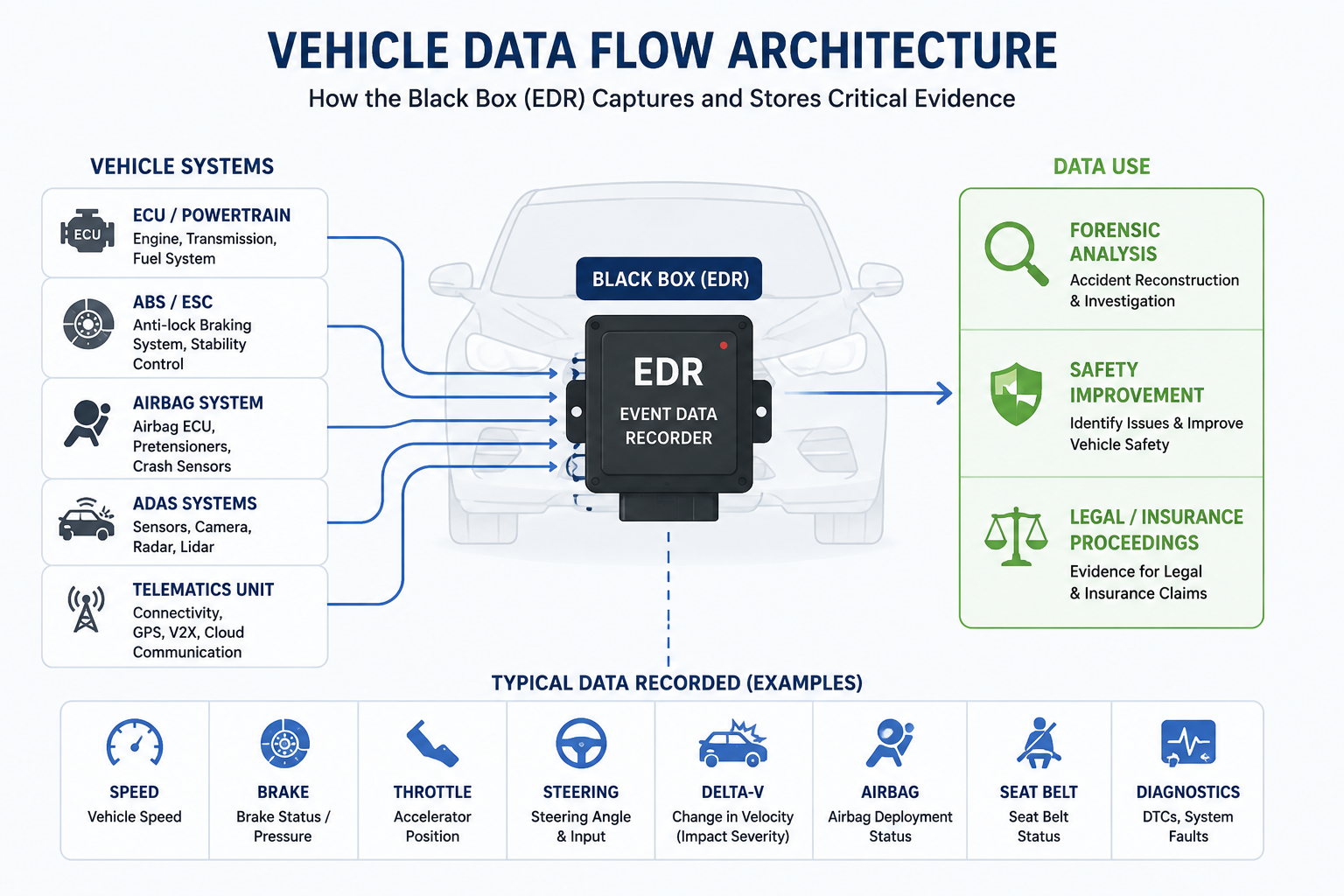
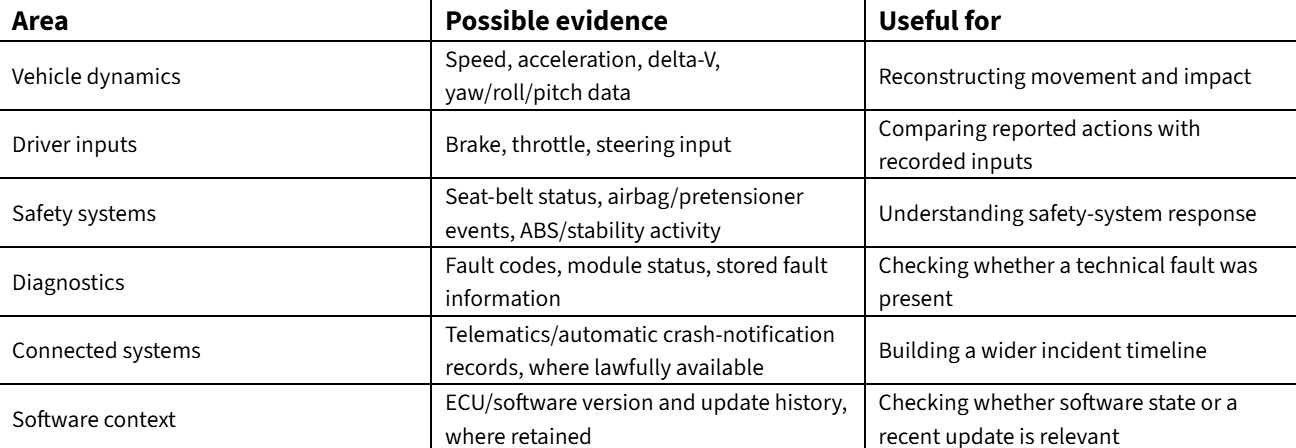
An EDR is best understood as a short event record, not a continuous driving diary. Depending on the vehicle and its configuration, forensic extraction may reveal items such as speed, acceleration, delta-V, engine RPM, throttle position, brake status, steering input, ABS or stability-control activity, seat-belt status and airbag or restraint events. NHTSA's published EDR material shows that data elements can include longitudinal and lateral acceleration, delta-V, vehicle speed, engine speed, throttle, service-brake status, roll/pitch/yaw information and steering input.[2] Do not overread the data: A field that exists in one model should not automatically be assumed to exist in another. A forensic report must identify exactly which module and fields were available and actually recovered.
What Can a Forensic Examination Recover?
A Brake Failure Example
Consider a driver who reports: “I pressed the brake, but nothing happened.” The statement should be preserved, but a forensic investigation should test it. Was brake status captured? What was the speed before the event? Did ABS activate? What were the acceleration and delta-V patterns? Were there relevant fault codes? Was the vehicle recently repaired or updated? Suppose the recovered records show a brake input, ABS activity and a change in vehicle speed before impact. That does not prove the brakes were mechanically perfect. It does, however, make the sentence “nothing happened” too simple. Conversely, a relevant fault appearing just before the event may give investigators a stronger lead. The important part is the comparison: human account, vehicle record, physical evidence and technical history should be examined together.
Smart Vehicles, Digital Evidence and Cybersecurity Investigation
A connected vehicle can communicate through cellular networks, Bluetooth, Wi-Fi, mobile applications, workshop tools and cloud services. If unusual activity appears around a safety-critical incident, investigators may need to look beyond the EDR. Useful questions include:
• Was there unusual diagnostic or service activity before the incident?
• Was a software update or configuration change recently applied?
• Do timestamps from different modules line up, or is there clock drift?
• Can the extracted record be tied back to the original vehicle and module?
• Is there a non-cyber explanation - such as a hardware fault or software defect - that fits the evidence better?
The mindset matters: A cyberattack should be a conclusion supported by evidence, not the default explanation for strange vehicle behaviour.
The Forensic View: From Data to Evidence
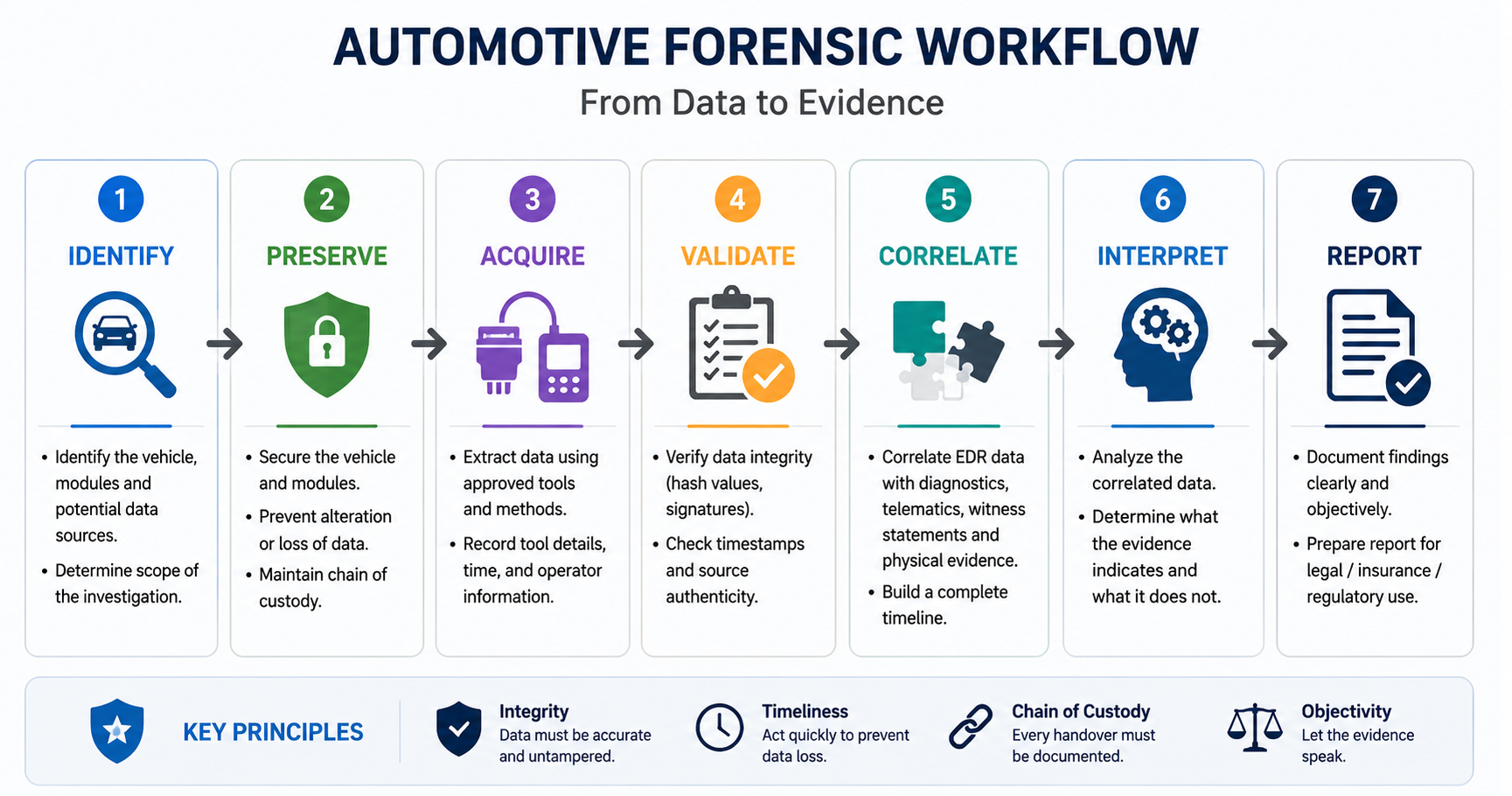
Automotive forensics is not simply plugging in a tool and exporting a report. The investigator should document the vehicle identity, module involved, extraction method, tool version, acquisition time and evidence-preservation steps. The goal is to make the work repeatable and defensible.
• Identify the relevant modules and evidence sources.
• Preserve the vehicle and extracted data against unnecessary alteration.
• Acquire data using a documented and appropriate method.
• Validate provenance, integrity, timestamps and completeness.
• Correlate EDR, diagnostics, software history, connected records and physical evidence.
• Report both findings and uncertainty.
A useful forensic rule: “Recorded” does not mean “proven.” Evidence becomes persuasive when its source, integrity and context are clear.
What the Law and Standards Are Changing
India is moving toward a more formal automotive cybersecurity lifecycle. IS-189 focuses on vehicle cybersecurity and the Cyber Security Management System (CSMS), while AIS-190 deals with software updates and the Software Update Management System (SUMS).[4][5] The wider statutory and type-approval framework is provided by the Motor Vehicles Act, 1988 and the Central Motor Vehicles Rules, 1989. For vehicle prototypes, Rule 126 provides for testing and approval by authorized testing agencies.[6][7]
In June 2026, the Ministry of Road Transport and Highways (MoRTH) came out with draft G.S.R. 503(E). The draft proposes new CMVR Rules 125-T and 125-U covering cybersecurity and software-update requirements. Since G.S.R. 503(E) is still a draft notification, its proposed requirements and the dates from which they may apply should be verified with the latest final notification before treating them as applicable law.[8]
At the international level, UN Regulation No. 155 addresses vehicle cybersecurity, while UN Regulation No. 156 covers software updates and their management.[9][10] This matters to forensics because lifecycle cybersecurity creates an expectation that manufacturers should be able to understand and manage security risks over time. In other words, logs, software-state information, vulnerability records and incident evidence can become part of the security story, not merely post-incident paperwork.
The Real Takeaway
The black box is valuable because it can reduce guesswork. It may tell us how fast the vehicle was moving, whether the driver applied the brake, how the vehicle responded, and what certain safety systems were doing around the event. But it rarely answers the whole case on its own. The strongest investigation is built by joining several pieces: EDR data, diagnostics, software context, connected-system evidence and what was found at the crash scene.
For cybersecurity professionals, the lesson is simple: a secure vehicle should not only resist attacks. It should also leave trustworthy evidence when something goes wrong. Good access controls, reliable timestamps and careful evidence handling help turn “something failed” into a defensible explanation.
Conclusion
The phrase “car black box” sounds simple, but the evidence behind it is not. An EDR can preserve a small but valuable window into a crash. During forensic examination, investigators may also be able to recover diagnostic, safety-system, software and connected-vehicle information, depending on the vehicle and what has been retained. The job is not to collect the largest possible amount of data. It is to collect the right data, preserve it properly and understand what each record can - and cannot - prove.
That is where automotive cybersecurity and digital forensics meet. As vehicles become more connected and software-driven, the ability to reconstruct an incident becomes part of security itself.
References
1. National Highway Traffic Safety Administration (NHTSA), Event Data Recorder (EDR) overview and research resources.
2. NHTSA, Use of Event Data Recorder (EDR) Technology for Highway Crash Data Analysis.
3. NHTSA, Light-Vehicle Event Data Recorder Technologies Update.
4. Automotive Research Association of India (ARAI), AIS-189, Approval of Vehicles with Regards to Cyber Security and Cyber Security Management System, April 2024.
5. Automotive Research Association of India (ARAI), AIS-190, Approval of Vehicles with Regards to Software Update and Software Update Management System, April 2024.
6. Government of India, Motor Vehicles Act, 1988.
7. Government of India, Central Motor Vehicles Rules, 1989, Rule 126.
8. Ministry of Road Transport and Highways, G.S.R. 503(E), 17 June 2026, draft Central Motor Vehicles (Amendment) Rules concerning cybersecurity and software updates.
9. UNECE, UN Regulation No. 155, Cyber Security and Cyber Security Management System.
10. UNECE, UN Regulation No. 156, Software Update and Software Update Management System.
11. NIST, SP 800-86, Guide to Integrating Forensic Techniques into Incident Response.

Related Blogs

Executive Summary
A video is being shared on social media showing several people breaking iron barricades installed along the banks of a water body. The video is being shared with the claim that people broke the barricades after the Karnataka government imposed a ban on idol immersion to prevent pollution in the river. CyberPeace Research found the viral claim to be misleading. Our Research revealed that the video is not from Karnataka but from Hyderabad, Telangana. The video shows members of The Bhagyanagar Ganesh Utsav Committee (BGUS) removing barricades installed at Tank Bund to prevent the immersion of Plaster of Paris (PoP) idols in the water body. The barricades had been installed following the High Court’s directions. Therefore, the claim linking the video to Karnataka is incorrect.
Claim:
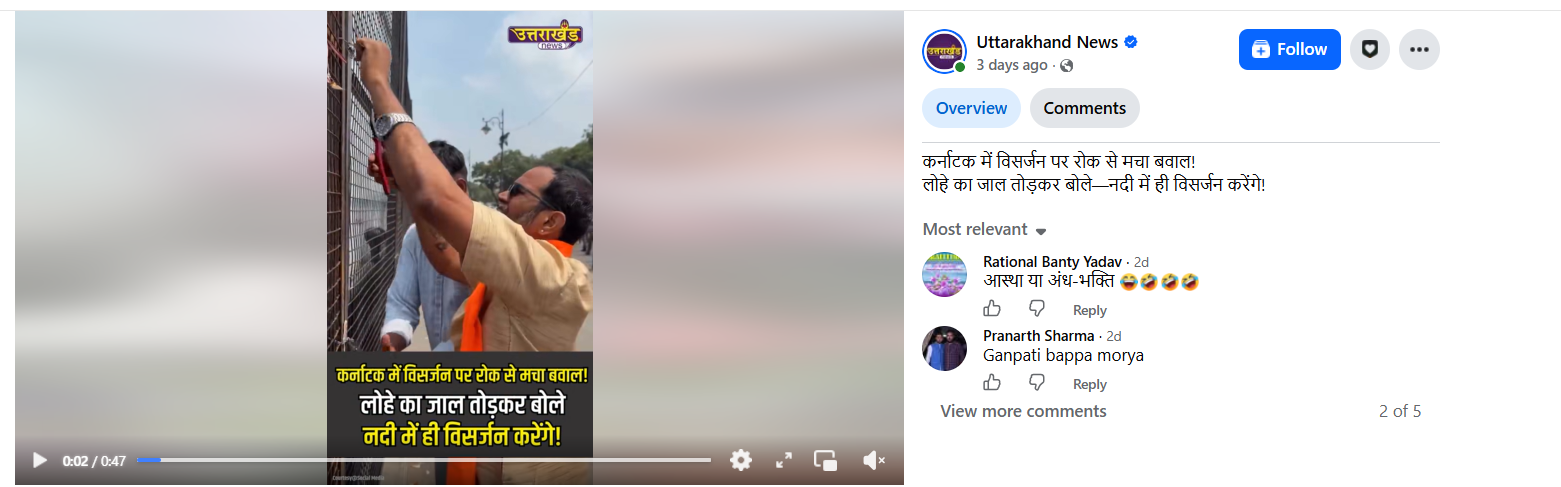
A Facebook user shared the video with the caption: “Chaos erupts in Karnataka over the ban on idol immersion! Breaking the iron barricades, they said — ‘We will immerse the idols in the river itself!’” The post link, archive link, and screenshot are provided below.
https://www.facebook.com/watch/?v=1523733916224661
https://ghostarchive.org/archive/SJgmD
Fact Check
To verify the authenticity of the viral claim, we conducted a reverse image search of keyframes from the video. During the search, we found the same video on the Facebook page of Brut India. According to the post, the video is from Hyderabad. The caption states that despite the restrictions, devotees removed the barricades and made way during the Ganesh idol immersion at Hyderabad’s Tank Bund. The post link and screenshot are provided below.
https://www.facebook.com/watch/?v=2220012475615416
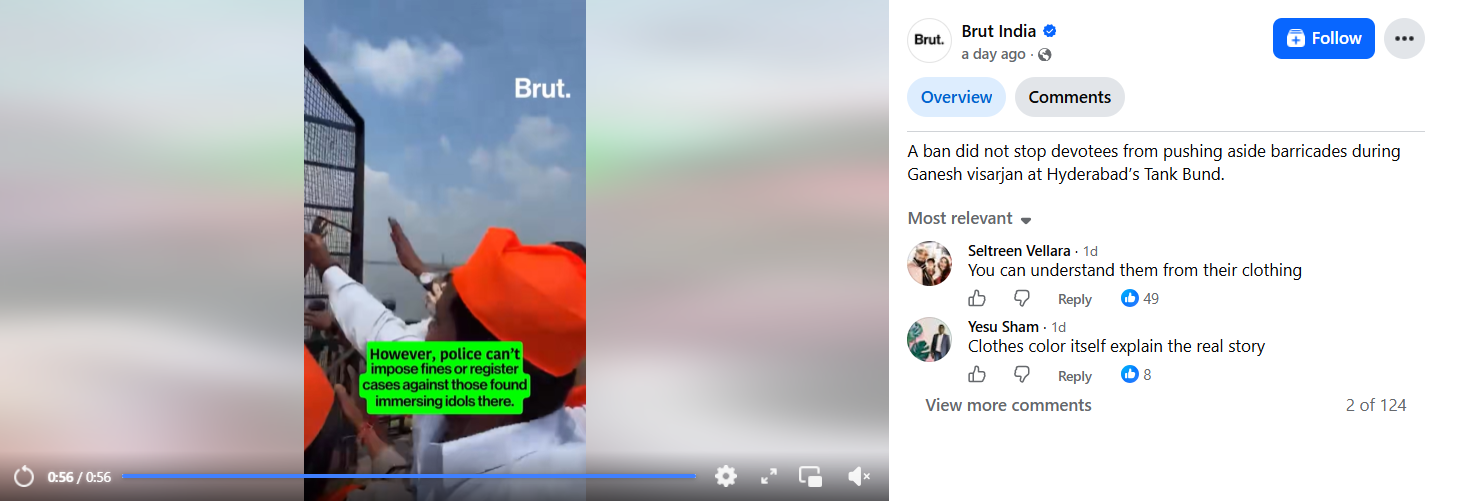
Taking the Research forward, we found the same video in a news report uploaded on the YouTube channel of ‘9Plus News’ on September 21, 2026. The report also includes the portion of the viral clip in which people can be seen breaking the barricades. According to the report, the incident took place in the Tank Bund area of Hyderabad. The post link and screenshot are provided below.
https://www.youtube.com/watch?v=l7GRELjqAwY

Conclusion
Our Research found that the viral video is not from Karnataka but from Hyderabad, Telangana. The video shows members of the Bhagyanagar Ganesh Utsav Committee (BGUS) removing barricades installed at Tank Bund to prevent the immersion of Plaster of Paris (PoP) idols in the water body. These barricades had been installed following the High Court’s directions. Therefore, the claim linking the video to Karnataka is false.

The World Wide Web was created as a portal for communication, to connect people from far away, and while it started with electronic mail, mail moved to instant messaging, which let people have conversations and interact with each other from afar in real-time. But now, the new paradigm is the Internet of Things and how machines can communicate with one another. Now one can use a wearable gadget that can unlock the front door upon arrival at home and can message the air conditioner so that it switches on. This is IoT.
WHAT EXACTLY IS IoT?
The term ‘Internet of Things’ was coined in 1999 by Kevin Ashton, a computer scientist who put Radio Frequency Identification (RFID) chips on products in order to track them in the supply chain, while he worked at Proctor & Gamble (P&G). And after the launch of the iPhone in 2007, there were already more connected devices than people on the planet.
Fast forward to today and we live in a more connected world than ever. So much so that even our handheld devices and household appliances can now connect and communicate through a vast network that has been built so that data can be transferred and received between devices. There are currently more IoT devices than users in the world and according to the WEF’s report on State of the Connected World, by 2025 there will be more than 40 billion such devices that will record data so it can be analyzed.
IoT finds use in many parts of our lives. It has helped businesses streamline their operations, reduce costs, and improve productivity. IoT also helped during the Covid-19 pandemic, with devices that could help with contact tracing and wearables that could be used for health monitoring. All of these devices are able to gather, store and share data so that it can be analyzed. The information is gathered according to rules set by the people who build these systems.
APPLICATION OF IoT
IoT is used by both consumers and the industry.
Some of the widely used examples of CIoT (Consumer IoT) are wearables like health and fitness trackers, smart rings with near-field communication (NFC), and smartwatches. Smartwatches gather a lot of personal data. Smart clothing, with sensors on it, can monitor the wearer’s vital signs. There are even smart jewelry, which can monitor sleeping patterns and also stress levels.
With the advent of virtual and augmented reality, the gaming industry can now make the experience even more immersive and engrossing. Smart glasses and headsets are used, along with armbands fitted with sensors that can detect the movement of arms and replicate the movement in the game.
At home, there are smart TVs, security cameras, smart bulbs, home control devices, and other IoT-enabled ‘smart’ appliances like coffee makers, that can be turned on through an app, or at a particular time in the morning so that it acts as an alarm. There are also voice-command assistants like Alexa and Siri, and these work with software written by manufacturers that can understand simple instructions.
Industrial IoT (IIoT) mainly uses connected machines for the purposes of synchronization, efficiency, and cost-cutting. For example, smart factories gather and analyze data as the work is being done. Sensors are also used in agriculture to check soil moisture levels, and these then automatically run the irrigation system without the need for human intervention.
Statistics
- The IoT device market is poised to reach $1.4 trillion by 2027, according to Fortune Business Insight.
- The number of cellular IoT connections is expected to reach 3.5 billion by 2023. (Forbes)
- The amount of data generated by IoT devices is expected to reach 73.1 ZB (zettabytes) by 2025.
- 94% of retailers agree that the benefits of implementing IoT outweigh the risk.
- 55% of companies believe that 3rd party IoT providers should have to comply with IoT security and privacy regulations.
- 53% of all users acknowledge that wearable devices will be vulnerable to data breaches, viruses,
- Companies could invest up to 15 trillion dollars in IoT by 2025 (Gigabit)
CONCERNS AND SOLUTIONS
- Two of the biggest concerns with IoT devices are the privacy of users and the devices being secure in order to prevent attacks by bad actors. This makes knowledge of how these things work absolutely imperative.
- It is worth noting that these devices all work with a central hub, like a smartphone. This means that it pairs with the smartphone through an app and acts as a gateway, which could compromise the smartphone as well if a hacker were to target that IoT device.
- With technology like smart television sets that have cameras and microphones, the major concern is that hackers could hack and take over the functioning of the television as these are not adequately secured by the manufacturer.
- A hacker could control the camera and cyberstalk the victim, and therefore it is very important to become familiar with the features of a device and ensure that it is well protected from any unauthorized usage. Even simple things, like keeping the camera covered when it is not being used.
- There is also the concern that since IoT devices gather and share data without human intervention, they could be transmitting data that the user does not want to share. This is true of health trackers. Users who wear heart and blood pressure monitors have their data sent to the insurance company, who may then decide to raise the premium on their life insurance based on the data they get.
- IoT devices often keep functioning as normal even if they have been compromised. Most devices do not log an attack or alert the user, and changes like higher power or bandwidth usage go unnoticed after the attack. It is therefore very important to make sure the device is properly protected.
- It is also important to keep the software of the device updated as vulnerabilities are found in the code and fixes are provided by the manufacturer. Some IoT devices, however, lack the capability to be patched and are therefore permanently ‘at risk’.
CONCLUSION
Humanity inhabits this world that is made up of all these nodes that talk to each other and get things done. Users can harmonize their devices so that everything runs like a tandem bike – completely in sync with all other parts. But while we make use of all the benefits, it is also very important that one understands what they are using, how it is functioning, and how one can tackle issues should they come up. This is also important to understand because once people get used to IoT, it will be that much more difficult to give up the comfort and ease that these systems provide, and therefore it would make more sense to be prepared for any eventuality. A lot of times, good and sensible usage alone can keep devices safe and services intact. But users should be aware of any issues because forewarned is forearmed.

Executive Summary
A video showing a massive human pyramid has gone viral on social media. In the clip, dozens of people are seen forming a towering human pyramid that begins to sway violently as if struck by strong winds. Surprisingly, the structure regains balance within seconds and no one falls. Many users are sharing the video as footage of a real-life incident. CyberPeace Research Wing 's research found that the viral video is fake. It does not depict a real incident; rather, it has been created using Artificial Intelligence (AI).
Claim
An X user, "Cockroach Janta Party," shared the viral video on July 10, 2026, with the caption: "The human pyramid started swaying due to strong winds... but surprisingly, no one fell. Would you dare stand at the very top of this human pyramid?"
https://x.com/CJP_for_India/status/2075405269899866415?s=20
https://perma.cc/T993-99RZ
Fact Check
We first carefully examined the viral video. During our visual analysis, we observed several irregularities. The people forming the pyramid appeared to be standing in unnatural positions, and when the structure began to sway, the movements of the individuals looked highly unnatural and robotic. These visual anomalies raised suspicion that the video had been generated using AI. To verify this, we analysed the video using multiple AI detection tools.
The video was first scanned using Hive Moderation, which detected an almost 100% probability that the content was AI-generated. According to Hive's analysis, the video was most likely created using the Seedance2 model, an AI-powered video generation system.

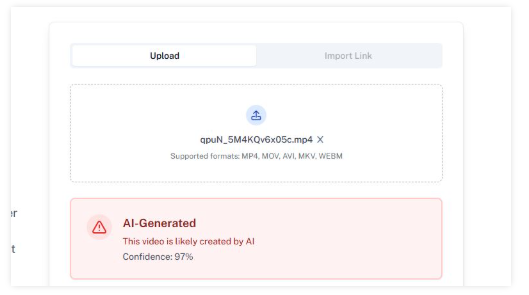
For additional verification, we analysed the video using Undetectable.ai. The tool also concluded that there was a 97% probability that the video had been generated using Artificial Intelligence.
Conclusion
Our research found that the viral human pyramid video is AI-generated. It does not depict a real incident and has been created using artificial intelligence. The video is being circulated on social media without disclosing its AI-generated nature, misleading users into believing it shows an actual event.
