
#FactCheck - AI-Generated Flyover Collapse Video Shared With Misleading Claims
Executive Summary
A video showing a flyover collapse is going viral on social media. The clip shows a flyover and a road passing beneath it, with vehicles moving normally. Suddenly, a portion of the flyover appears to collapse and fall onto the road below, with some vehicles seemingly coming under its impact. The video has been widely shared by users online. However, research by the CyberPeace found the viral claim to be false. The probe revealed that the video is not real but has been created using artificial intelligence.
Claim:
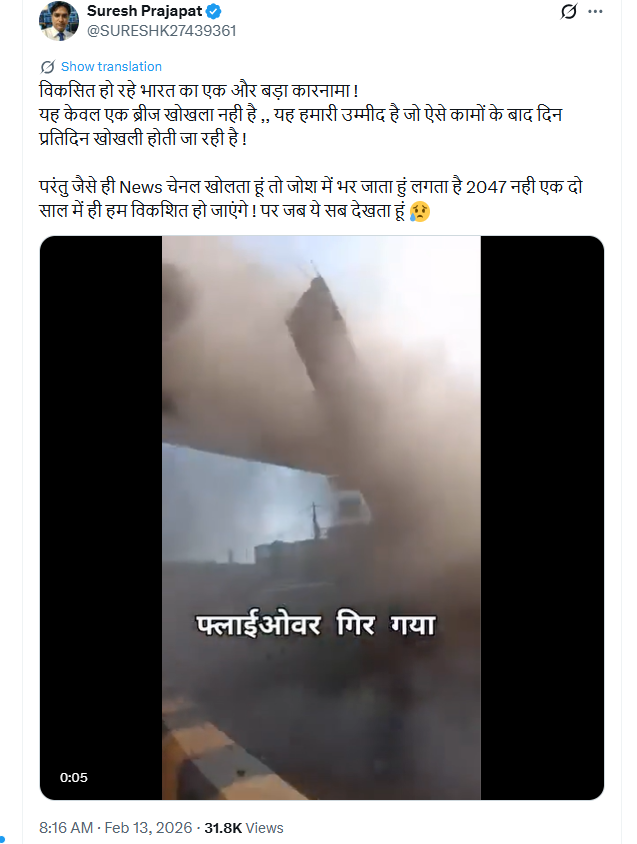
On X (formerly Twitter), a user shared the viral video on February 13, 2026, claiming it showed the reality of India’s infrastructure development and criticizing ongoing projects. The post quickly gained traction, with several users sharing it as a real incident. Similarly, another user shared the same video on Facebook on February 13, 2026, making a similar claim.
Fact Check:
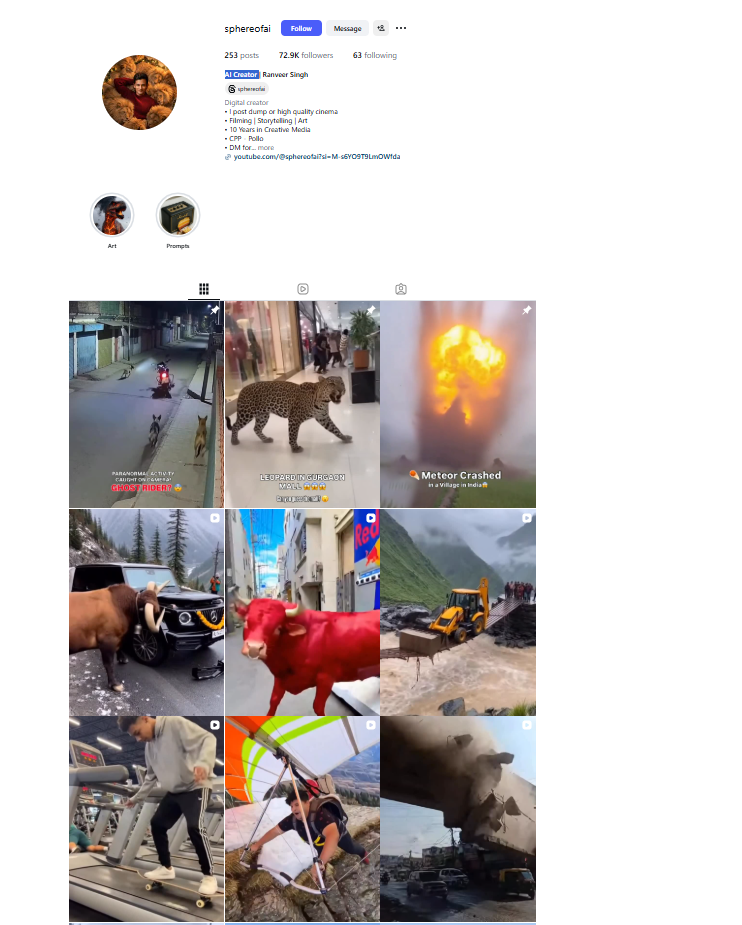
To verify the claim, key frames from the viral video were extracted and searched using Google Lens. During the search, the video was traced to an account named “sphereofai” on Instagram, where it had been posted on February 9. The post included hashtags such as “AI Creator” and “AI Generated,” clearly indicating that the video was created using AI. Further examination of the account showed that the user identifies themselves as an AI content creator.

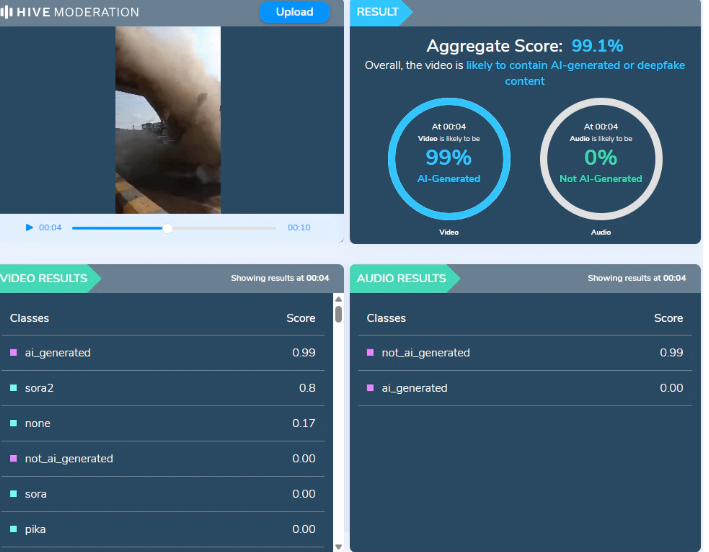
To confirm the findings, the viral video was also analysed using Hive Moderation. The tool’s analysis suggested a 99 percent probability that the video was AI-generated.
Conclusion:
The research established that the viral flyover collapse video is not authentic. It is an AI-generated clip being circulated online with misleading claims.

Related Blogs
Executive Summary
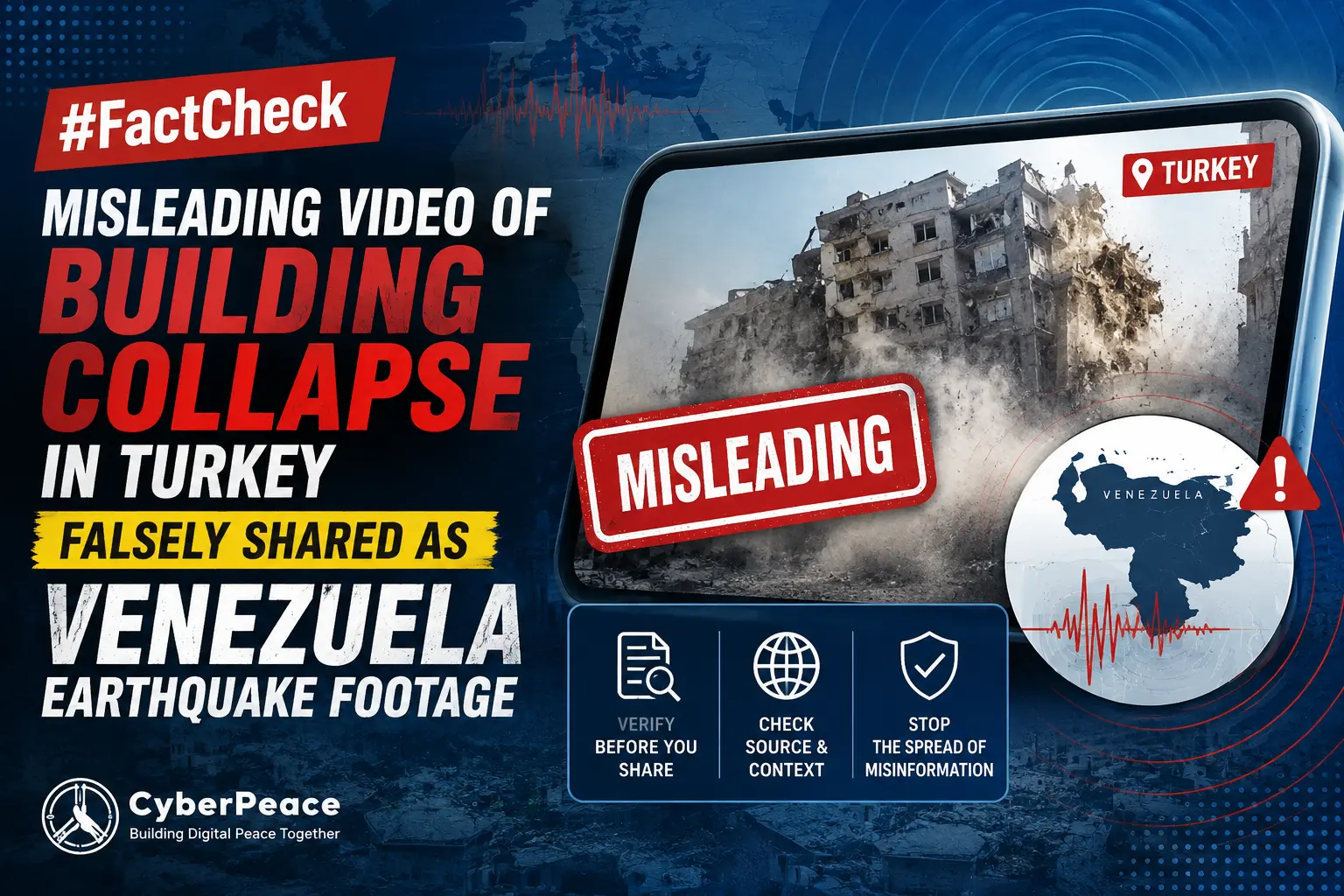
A video is being widely shared on social media, claiming it shows a terrifying scene from a recent earthquake in Venezuela. The 9-second clip shows a multi-storey building collapsing like a house of cards, while people nearby are seen running in panic as chaos unfolds. The video is being widely circulated by users as evidence of massive destruction caused by the alleged earthquake in Venezuela. CyberPeace Research Wing research found the claim to be misleading. The viral video has no connection to any recent earthquake in Venezuela. In fact, the footage is from a completely different event that took place nearly three years ago in Turkey. It is being falsely shared with a wrong context on social media.
Claim:
A Facebook user shared the viral video with the caption: “The most dangerous earthquake in 126 years! At least 10,000 deaths in Venezuela earthquake, shocking claim by USGS. Reports say massive destruction has occurred, Caracas airport has also been destroyed. Statement by Yogi Adityanath after Bharat Tiwari’s encounter.” The post link, archived link, and screenshots are provided below.
https://www.facebook.com/groups/2438255879794217/posts/4830038697282578/
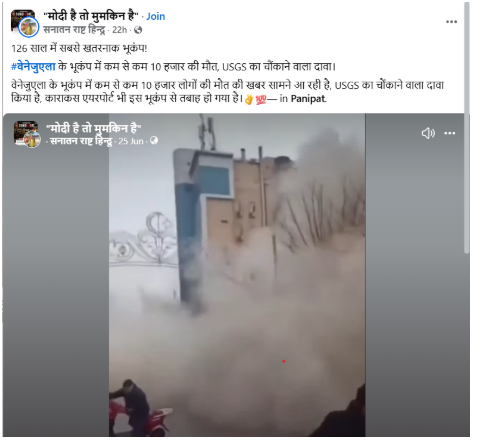
FactCheck
To verify the claim, we performed a reverse image search of the video keyframes using Google Lens. During the search, we found the same video on WION’s Facebook page, where it was published on February 6, 2023. The original post link and screenshots are provided below. https://www.facebook.com/watch/?v=917786002738401
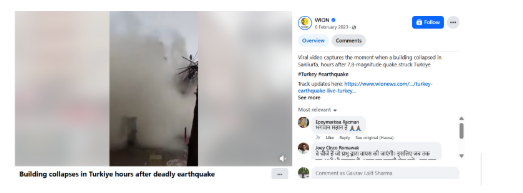
The original caption of the video clearly states that it shows a building collapse in Sanliurfa, Turkey, occurring hours after the 7.8-magnitude earthquake that struck the country. Based on clues from the Facebook post, we further searched using relevant keywords and found a report published by The Guardian on February 6, 2023, which also included the viral footage. https://www.theguardian.com/world/video/2023/feb/06/building-collapses-earthquake-aftershock-turkey-video

The report confirms that the video is from the aftermath of the devastating 2023 Turkey earthquake in Sanliurfa, not Venezuela.
Conclusion:
Our research confirms that the viral video has no connection to any recent earthquake in Venezuela. The footage is actually from the 2023 Turkey earthquake and is being falsely shared with a misleading context on social media.
.webp)
Introduction
The ongoing armed conflict between Israel and Hamas/ Palestine is in the news all across the world. The latest conflict was triggered by unprecedented attacks against Israel by Hamas militants on October 7, killing thousands of people. Israel has launched a massive counter-offensive against the Islamic militant group. Amid the war, the bad information and propaganda spreading on various social media platforms, tech researchers have detected a network of 67 accounts that posted false content about the war and received millions of views. The ‘European Commission’ has sent a letter to Elon Musk, directing them to remove illegal content and disinformation; otherwise, penalties can be imposed. The European Commission has formally requested information from several social media giants on their handling of content related to the Israel-Hamas war. This widespread disinformation impacts and triggers the nature of war and also impacts the world and affects the goodwill of the citizens. The bad group, in this way, weaponise the information and fuels online hate activity, terrorism and extremism, flooding political polarisation with hateful content on social media. Online misinformation about the war is inciting extremism, violence, hate and different propaganda-based ideologies. The online information environment surrounding this conflict is being flooded with disinformation and misinformation, which amplifies the nature of war and too many fake narratives and videos are flooded on social media platforms.
Response of social media platforms
As there is a proliferation of online misinformation and violent content surrounding the war, It imposes a question on social media companies in terms of content moderation and other policy shifts. It is notable that Instagram, Facebook and X(Formerly Twitter) all have certain features in place giving users the ability to decide what content they want to view. They also allow for limiting the potentially sensitive content from being displayed in search results.
The experts say that It is of paramount importance to get a sort of control in this regard and define what is permissible online and what is not, Hence, what is required is expertise to determine the situation, and most importantly, It requires robust content moderation policies.
During wartime, people who are aggrieved or provoked are often targeted by this internet disinformation that blends ideological beliefs and spreads conspiracy theories and hatred. This is not a new phenomenon, it is often observed that disinformation-spreading groups emerged and became active during such war and emergency times and spread disinformation and propaganda-based ideologies and influence the society at large by misrepresenting the facts and planted stories. Social media has made it easier to post user-generated content without properly moderating it. However, it is a shared responsibility of tech companies, users, government guidelines and policies to collectively define and follow certain mechanisms to fight against disinformation and misinformation.
Digital Services Act (DSA)
The newly enacted EU law, i.e. Digital Services Act, pushes various larger online platforms to prevent posts containing illegal content and also puts limits on targeted advertising. DSA enables to challenge the of illegal online content and also poses requirements to prevent misinformation and disinformation and ensure more transparency over what the users see on the platforms. Rules under the DSA cover everything from content moderation & user privacy to transparency in operations. DSA is a landmark EU legislation moderating online platforms. Large tech platforms are now subject to content-related regulation under this new EU law ‘The Digital Services Act’, which also requires them to prevent the spread of misinformation and disinformation and overall ensure a safer online environment.
Indian Scenario
The Indian government introduced the Intermediary Guidelines (Intermediary Guidelines and Digital Media Ethics Code) Rules, updated in 2023 which talks about the establishment of a "fact check unit" to identify false or misleading online content. Digital Personal Data Protection, 2023 has also been enacted which aims to protect personal data. The upcoming Digital India bill is also proposed to be tabled in the parliament, this act will replace the current Information & Technology Act, of 2000. The upcoming Digital India bill can be seen as future-ready legislation to strengthen India’s current cybersecurity posture. It will comprehensively deal with the aspects of ensuring privacy, data protection, and fighting growing cyber crimes in the evolving digital landscape and ensuring a safe digital environment. Certain other entities including civil societies are also actively engaged in fighting misinformation and spreading awareness for safe and responsible use of the Internet.
Conclusion:
The widespread disinformation and misinformation content amid the Israel-Hamas war showcases how user-generated content on social media shows you the illusion of reality. There is widespread misinformation, misleading content or posts on social media platforms, and misuse of new advanced AI technologies that even make it easier for bad actors to create synthetic media content. It is also notable that social media has connected us like never before. Social media is a great platform with billions of active social media users around the globe, it offers various conveniences and opportunities to individuals and businesses. It is just certain aspects that require the attention of all of us to prevent the bad use of social media. The social media platforms and regulatory authorities need to be vigilant and active in clearly defining and improving the policies for content regulation and safe and responsible use of social media which can effectively combat and curtail the bad actors from misusing social media for their bad motives. As a user, it's the responsibility of users to exercise certain duties and promote responsible use of social media. With the increasing penetration of social media and the internet, misinformation is rampant all across the world and remains a global issue which needs to be addressed properly by implementing strict policies and adopting best practices to fight the misinformation. Users are encouraged to flag and report misinformative or misleading content on social media and should always verify it from authentic sources. Hence creating a safer Internet environment for everyone.
References:
- https://abcnews.go.com/US/experts-fear-hate-extremism-social-media-israel-hamas-war/story?id=104221215
- https://edition.cnn.com/2023/10/14/tech/social-media-misinformation-israel-hamas/index.html
- https://www.nytimes.com/2023/10/13/business/israel-hamas-misinformation-social-media-x.html
- https://www.africanews.com/2023/10/24/fact-check-misinformation-about-the-israel-hamas-war-is-flooding-social-media-here-are-the//
- https://www.theverge.com/23845672/eu-digital-services-act-explained

Introduction
The Data Security Council of India’s India Cyber Threat Report 2025 calculates that a staggering 702 potential attacks happened per minute on average in the country in 2024. Recent alleged data breaches on organisations such as Star Health, WazirX, Indian Council of Medical Research (ICMR), BSNL, etc. highlight the vulnerabilities of government organisations, critical industries, businesses, and individuals in managing their digital assets. India is the second most targeted country for cyber attacks globally, which warrants the development and adoption of cybersecurity governance frameworks essential for the structured management of cyber environments. The following global models offer valuable insights and lessons that can help strengthen cybersecurity governance.
Overview of Global Cybersecurity Governance Models
Cybersecurity governance frameworks provide a structured strategy to mitigate and address cyber threats. Different regions have developed their own governance models for cybersecurity, but they all emphasize risk management, compliance, and cross-sector collaboration for the protection of digital assets. Four such major models are:
- NIST CSF 2.0 (U.S.A): The National Institute of Standards and Technology Cyber Security Framework provides a flexible, voluntary, risk-based approach rather than a one-size-fits-all solution to manage cybersecurity risks. It endorses six core functions, which are: Govern, Identify, Protect, Detect, Respond, and Recover. This is a widely adopted framework used by both public and private sector organizations even outside the U.S.A.
- ISO/IEC 27001: This is a globally recognized standard developed jointly by the International Organization for Standardization (ISO) and the International Electrotechnical Commission (IEC). It provides a risk-based approach to help organizations of all sizes and types to identify, assess, and mitigate potential cybersecurity threats to Information Security Management Systems (ISMS) and preserve the confidentiality, integrity, and availability of information. Organizations can seek ISO 27001 certification to demonstrate compliance with laws and regulations.
- EU NIS2 Directive: The Network and Information Security Directive 2 (NIS2) is an updated EU cybersecurity law that imposes strict obligations on critical services providers in four overarching areas: risk management, corporate accountability, reporting obligations, and business continuity. It is the most comprehensive cybersecurity directive in the EU to date, and non-compliance may attract non-monetary remedies, administrative fines up to at least €10 million or 2% of the global annual revenue (whichever is higher), or even criminal sanctions for top managers.
- GDPR: The General Data Protection Regulation (GDPR)of the EU is a comprehensive data privacy law that also has major cybersecurity implications. It mandates that organizations must integrate cybersecurity into their data protection policies and report breaches within 72 hours, and it prescribes a fine of up to €20 million or 4% of global turnover for non-compliance.
India’s Cybersecurity Governance Landscape
In light of the growing nature of cyber threats, it is notable that the Indian government has taken comprehensive measures along with efforts by relevant agencies such as the Ministry of Electronics and Information Technology, Reserve Bank of India (RBI), National Payments Corporation (NPCI) and Indian Cyber Crime Coordination Centre (I4C), CERT-In. However, there is still a lack of an overarching cybersecurity governance framework or comprehensive law in this area. Multiple regulatory bodies in India oversee cybersecurity for various sectors. Key mechanisms are:
- CERT-In Guidelines: The Indian Computer Emergency Response Team, under the Ministry of Electronics and Information Technology (MeitY), is the nodal agency responsible for cybersecurity incident response, threat intelligence sharing, and capacity building. Organizations are mandated to maintain logs for 180 days and report cyber incidents to CERT-In within six hours of noticing them according to directions under the Information Technology Act, 2000 (IT Act).
- IT Act & DPDP Act: These Acts, along with their associated rules, lay down the legal framework for the protection of ICT systems in India. While some sections mandate that “reasonable” cybersecurity standards be followed, specifics are left to the discretion of the organisations. Enforcement frameworks are vague, which leaves sectoral regulators to fill the gaps.
- Sectoral regulations: The Reserve Bank of India (RBI), the Insurance Regulatory and Development Authority of India (IRDAI), the Department of Telecommunications, the Securities Exchange Board of India (SEBI), National Critical Information Infrastructure Protection Centre (NCIIPC) and other regulatory bodies require that cybersecurity standards be maintained by their regulated entities.
Lessons for India & Way Forward
As the world faces unprecedented security and privacy threats to its digital ecosystem, the need for more comprehensive cybersecurity policies, awareness, and capacity building has perhaps never been greater. While cybersecurity practices may vary with the size, nature, and complexity of an organization (hence “reasonableness” informing measures taken), there is a need for a centralized governance framework in India similar to NIST2 to unify sectoral requirements for simplified compliance and improve enforcement. India ranks 10th on the World Cybercrime Index and was found to be "specialising" in scams and mid-tech crimes- those which affect mid-range businesses and individuals the most. To protect them, India needs to strengthen its enforcement mechanisms across more than just the critical sectors. This can be explored by penalizing bigger organizations handling user data susceptible to breaches more stringently, creating an enabling environment for strong cybersecurity practices through incentives for MSMEs, and investing in cybersecurity workforce training and capacity building. Finally, there is a scope for increased public-private collaboration for real-time cyber intelligence sharing. Thus, a unified, risk-based national cybersecurity governance framework encompassing the current multi-pronged cybersecurity landscape would give direction to siloed efforts. It would help standardize best practices, streamline compliance, and strengthen overall cybersecurity resilience across all sectors in India.
References
- https://cdn.prod.website-files.com/635e632477408d12d1811a64/676e56ee4cc30a320aecf231_Cloudsek%20Annual%20Threat%20Landscape%20Report%202024%20(1).pdf
- https://strobes.co/blog/top-data-breaches-in-2024-month-wise/#:~:text=In%20a%20large%2Dscale%20data,emails%2C%20and%20even%20identity%20theft.
- https://www.google.com/search?q=nist+2.0&oq=nist+&gs_lcrp=EgZjaHJvbWUqBggBEEUYOzIHCAAQABiPAjIGCAEQRRg7MgYIAhBFGDsyCggDEAAYsQMYgAQyBwgEEAAYgAQyBwgFEAAYgAQyBwgGEAAYgAQyBggHEEUYPNIBCDE2MTJqMGo3qAIAsAIA&sourceid=chrome&ie=UTF-8
- https://www.iso.org/standard/27001
- https://nis2directive.eu/nis2-requirements/
- https://economictimes.indiatimes.com/tech/technology/india-ranks-number-10-in-cybercrime-study-finds/articleshow/109223208.cms?from=mdr
