
#FactCheck-AI-Altered Video Falsely Claims Indian Army Air Defence Officer Resigned Over ‘Operation Sindoor’
Executive Summary
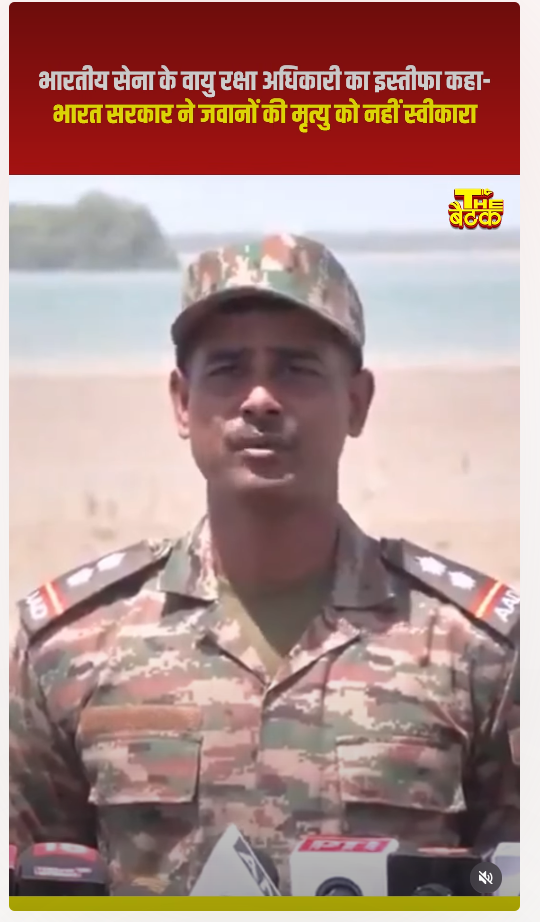
A video of a soldier is being widely circulated on social media with the claim that an Indian Army Air Defence officer named Anurag Thakur resigned, alleging that soldiers martyred during “Operation Sindoor” were ignored by the government. However, research by the CyberPeace Research Wing found the claim to be false. The viral video has been manipulated with AI-generated audio and is being shared with a misleading narrative.
Claim:
Instagram users shared the clip claiming: “Indian Army Air Defence officer Anurag Thakur has resigned. He said the Government of India did not even acknowledge the deaths of soldiers.”
Fact Check:
The research began with keyword searches related to the alleged resignation of an “Indian Army Air Defence JCO Anurag Thakur.” No credible or reputed media report was found supporting such a claim. A reverse image search of a frame from the viral video led to the original footage posted by news agency ANI on its official X account on March 22, 2026. The original video runs for 1 minute and 42 seconds A comparison of both videos showed that in the viral clip, the soldier appears to be speaking in English, whereas in ANI’s authentic video, the same soldier is speaking in Hindi while addressing the media.
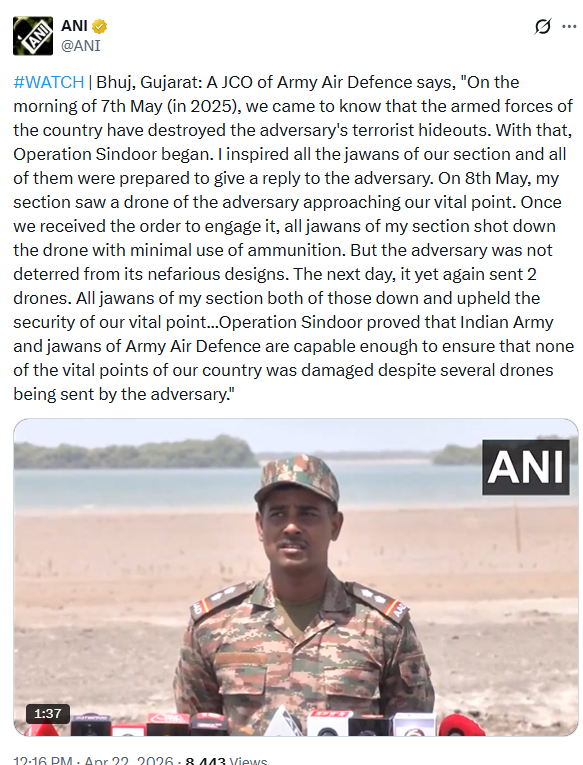
In the original video, shared by ANI from Bhuj, Gujarat, the JCO explained that on the morning of May 7, 2025, they learned that Indian armed forces had destroyed enemy terror launch pads, marking the beginning of “Operation Sindoor.” He said he motivated his unit and they were prepared to respond. He further stated that on May 8, an enemy drone heading toward a vital location was detected and shot down using minimal ammunition. Two more drones were sent the following day and were also neutralised. He added that “Operation Sindoor” demonstrated the capability of the Indian Army and Air Defence units.
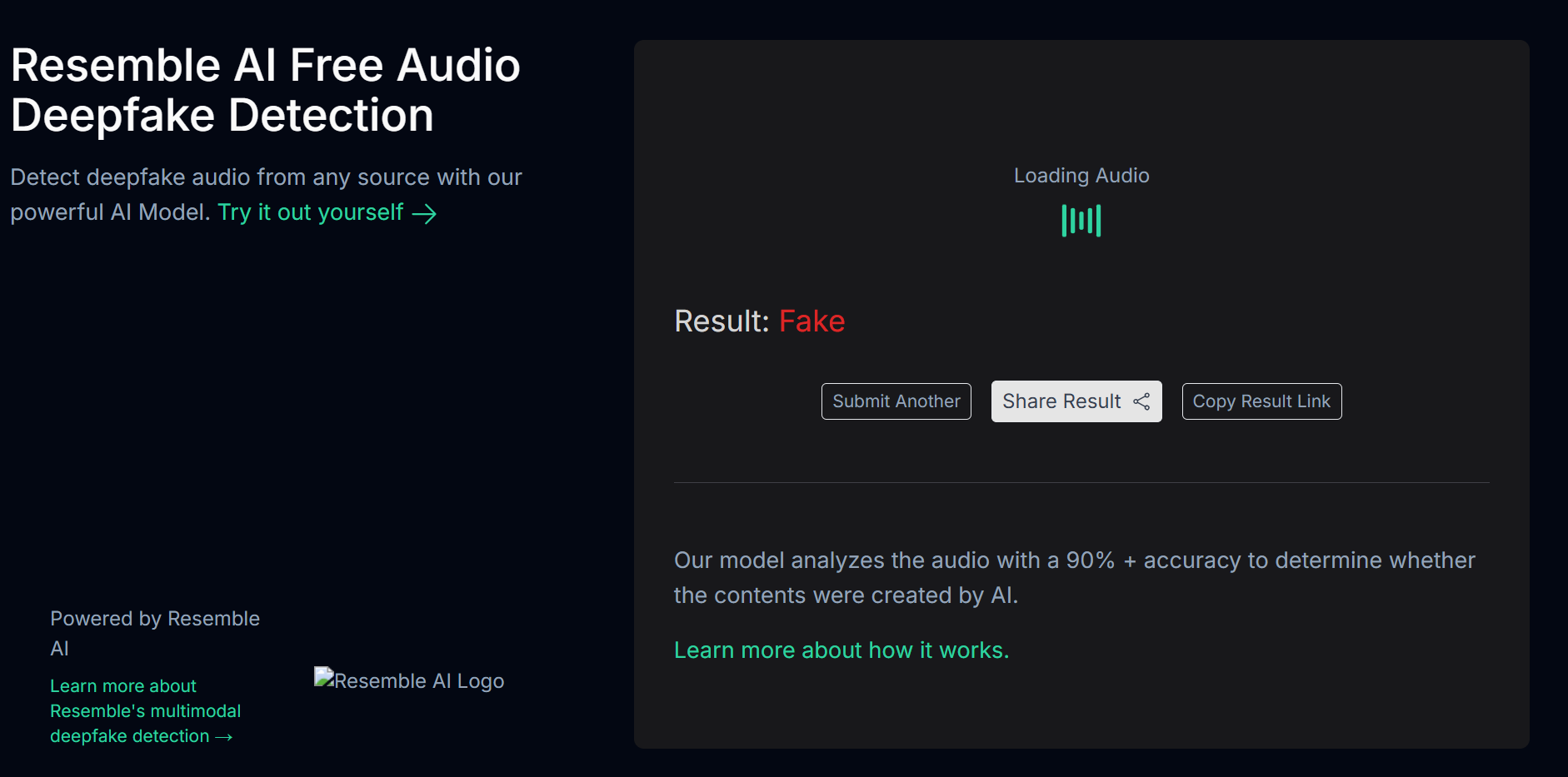
ANI had also summarised the same remarks in English in its post, which further confirmed that the viral version had been tampered with. For additional verification, the audio from the viral clip was examined using AI-based detection tools. Hiya Deepfake Voice Detector flagged it as likely fake, while Resemble AI also identified the audio as manipulated.
Conclusion:
The viral video claiming that an Indian Army Air Defence JCO resigned over ignored martyrs of “Operation Sindoor” is false. The original footage has been altered and artificial AI-generated audio was added to create a misleading narrative.

Related Blogs

Introduction
As India moves full steam ahead towards a trillion-dollar digital economy, how user data is gathered, processed and safeguarded is under the spotlight. One of the most pervasive but least known technologies used to gather user data is the cookie. Cookies are inserted into every website and application to improve functionality, measure usage and customize content. But they also present enormous privacy threats, particularly when used without explicit user approval.
In 2023, India passed the Digital Personal Data Protection Act (DPDP) to give strong legal protection to data privacy. Though the act does not refer to cookies by name, its language leaves no doubt as to the inclusion of any technology that gathers or processes personal information and thus cookies regulation is at the centre of digital compliance in India. This blog covers what cookies are, how international legislation, such as the GDPR, has addressed them and how India's DPDP will regulate their use.
What Are Cookies and Why Do They Matter?
Cookies are simply small pieces of data that a website stores in the browser. They were originally designed to help websites remember useful information about users, such as your login session or what is in your shopping cart. Netscape initially built them in 1994 to make web surfing more efficient.
Cookies exist in various types. Session cookies are volatile and are deleted when the browser is shut down, whereas persistent cookies are stored on the device to monitor users over a period of time. First-party cookies are made by the site one is visiting, while third-party cookies are from other domains, usually utilised for advertisements or analytics. Special cookies, such as secure cookies, zombie cookies and tracking cookies, differ in intent and danger. They gather information such as IP addresses, device IDs and browsing history information associated with a person, thus making it personal data per the majority of data protection regulations.
A Brief Overview of the GDPR and Cookie Policy
The GDPR regulates how personal data can be processed in general. However, if a cookie collects personal data (like IP addresses or identifiers that can track a person), then GDPR applies as well, because it sets the rules on how that personal data may be processed, what lawful bases are required, and what rights the user has.
The ePrivacy Directive (also called the “Cookie Law”) specifically regulates how cookies and similar technologies can be used. Article 5(3) of the ePrivacy Directive says that storing or accessing information (such as cookies) on a user’s device requires prior, informed consent, unless the cookie is strictly necessary for providing the service requested by the user.
In the seminal Planet49 decision, the Court of Justice of the European Union held that pre-ticked boxes do not represent valid consent. Another prominent enforcement saw Amazon fined €35 million by France's CNIL for using tracking cookies without user consent.
Cookies and India’s Digital Personal Data Protection Act (DPDP), 2023
India's Digital Personal Data Protection Act, 2023 does not refer to cookies specifically but its provisions necessarily come into play when cookies harvest personal data like user activity, IP addresses, or device data. According to DPDP, personal data is to be processed for legitimate purposes with the individual's consent. The consent has to be free, informed, clear and unambiguous. The individuals have to be informed of what data is collected, how it will be processed.. The Act also forbids behavioural monitoring and targeted advertising in the case of children.
The Ministry of Electronics and IT released the Business Requirements Document for Consent Management Systems (BRDCMS) in June 2025. Although it is not binding by law, it provides operational advice on cookie consent. It recommends that websites use cookie banners with "Accept," "Reject," and "Customize" choices. Users must be able to withdraw or change their consent at any moment. Multi-language handling and automatic expiry of cookie preferences are also suggested to suit accessibility and privacy requirements.
The DPDP Act and the BRDCMS together create a robust user-rights model, even in the absence of a special cookie law.
What Should Indian Websites Do?
For the purposes of staying compliant, Indian websites and online platforms need to act promptly to harmonise their use of cookies with DPDP principles. This begins with a transparent and simple cookie banner providing users with an opportunity to accept or decline non-essential cookies. Consent needs to be meaningful; coercive tactics such as cookie walls must not be employed. Websites need to classify cookies (e.g., necessary, analytics and ads) and describe each category's function in plain terms under the privacy policy. Users must be given the option to modify cookie settings anytime using a Consent Management Platform (CMP). Monitoring children or their behavioural information must be strictly off-limits.
These are not only about being compliant with the law, they're about adhering to ethical data stewardship and user trust building.
What Should Users Do?
Cookies need to be understood and controlled by users to maintain online personal privacy. Begin by reading cookie notices thoroughly and declining unnecessary cookies, particularly those associated with tracking or advertising. The majority of browsers today support blocking third-party cookies altogether or deleting them periodically.
It is also recommended to check and modify privacy settings on websites and mobile applications. It is possible to minimise surveillance with the use of browser add-ons such as ad blockers or privacy extensions. Users are also recommended not to blindly accept "accept all" in cookie notices and instead choose "customise" or "reject" where not necessary for their use.
Finally, keeping abreast of data rights under Indian law, such as the right to withdraw consent or to have data deleted, will enable people to reclaim control over their online presence.
Conclusion
Cookies are a fundamental component of the modern web, but they raise significant concerns about individual privacy. India's DPDP Act, 2023, though not explicitly referring to cookies, contains an effective legal framework that regulates any data collection activity involving personal data, including those facilitated by cookies.
As India continues to make progress towards comprehensive rulemaking and regulation, companies need to implement privacy-first practices today. And so must the users, in an active role in their own digital lives. Collectively, compliance, transparency and awareness can build a more secure and ethical internet ecosystem where privacy is prioritised by design.
References
- https://prsindia.org/billtrack/digital-personal-data-protection-bill-2023
- https://gdpr-info.eu/
- https://d38ibwa0xdgwxx.cloudfront.net/create-edition/7c2e2271-6ddd-4161-a46c-c53b8609c09d.pdf
- https://oag.ca.gov/privacy/ccpa
- https://www.barandbench.com/columns/cookie-management-under-the-digital-personal-data-protection-act-2023#:~:text=The%20Business%20Requirements%20Document%20for,the%20DPDP%20Act%20and%20Rules.
- https://samistilegal.in/cookies-meaning-legal-regulations-and-implications/#
- https://secureprivacy.ai/blog/india-digital-personal-data-protection-act-dpdpa-cookie-consent-requirements
- https://law.asia/cookie-use-india/
- https://www.cookielawinfo.com/major-gdpr-fines-2020-2021/#:~:text=4.,French%20websites%20could%20refuse%20cookies.
Executive Summary
A video of former Chief of Defence Staff (CDS) General Anil Chauhan is going viral on social media. The video is being shared with the claim that, referring to the losses suffered by India during Operation Sindoor, he said, “Even if we lose four aircraft or 40 aircraft, India will still remain a larger economy. What matters is your ability to recover from the losses. Whatever losses we suffered, we can recover much faster than Pakistan.” A research done by the Research Wing of the CyberPeace examined the claims made in the video and compared them with General Anil Chauhan’s original remarks at the event.The research found that the viral video’s audio has been digitally manipulated. The alleged statement heard in the viral clip does not appear in the original footage.
Claim:
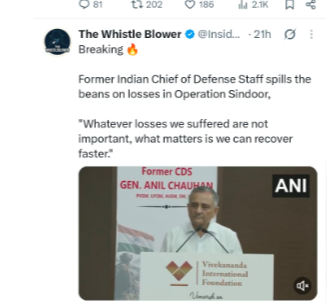
A Pakistani user on social media platform X shared the viral video with the caption: “BREAKING: Former Indian Chief of Defence Staff revealed details about the losses suffered during Operation Sindoor, saying, ‘Whatever losses we suffered are not important. What matters is that we can recover quickly.’”
The link to the post and a screenshot are provided below.
https://x.com/InsiderWB/status/2092559622225940952
Fact Check
Upon closely examining the viral video, we noticed the ANI logo. We then conducted a reverse image search of keyframes from the viral clip. During the search, we found the original video published by ANI, in which General Chauhan discusses the relationship between political objectives and military strategy.
https://x.com/ANI/status/2092217553355743409
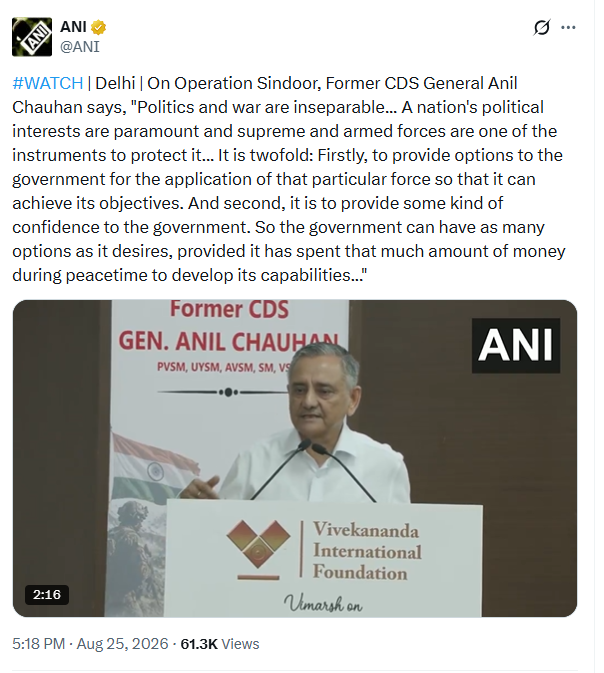
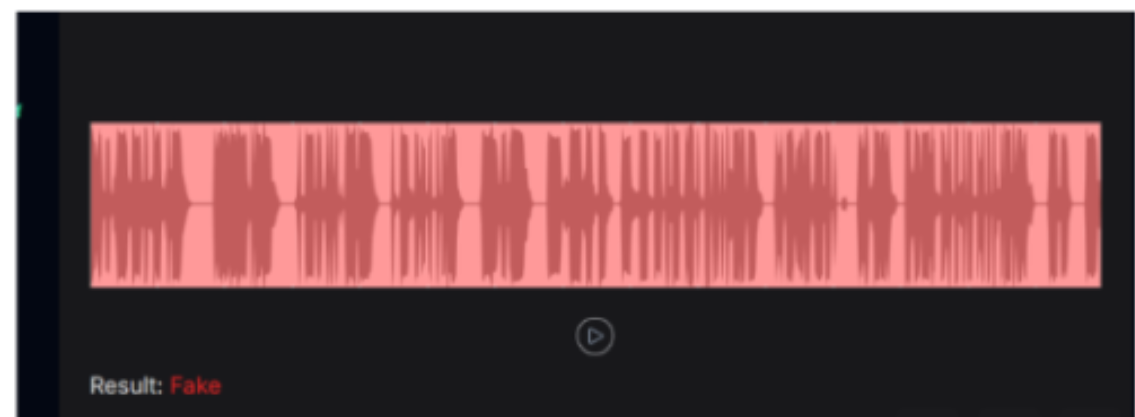
He said, “Politics and war are inseparable.” He further explained that a nation’s political interests are paramount, while the armed forces are one of several instruments used to safeguard those interests. General Chauhan also discussed the role of military leadership in presenting various options to the political leadership, as well as the importance of peacetime preparedness and training. He also spoke about training, contingency planning, and the need to balance military risks with political objectives. Notably, the statement attributed to him in the viral video,“Whatever losses we suffered are not important. What matters is that we can recover quickly” — does not appear anywhere in the original video. Additionally, the audio used in the viral video was also analysed using Resemble AI. The tool’s analysis identified the audio as AI-generated, indicating that the audio in the viral clip had been manipulated.
Conclusion
The research found that General Chauhan’s voice in the viral video has been digitally manipulated. The alleged statement heard in the viral clip does not appear in the original video.
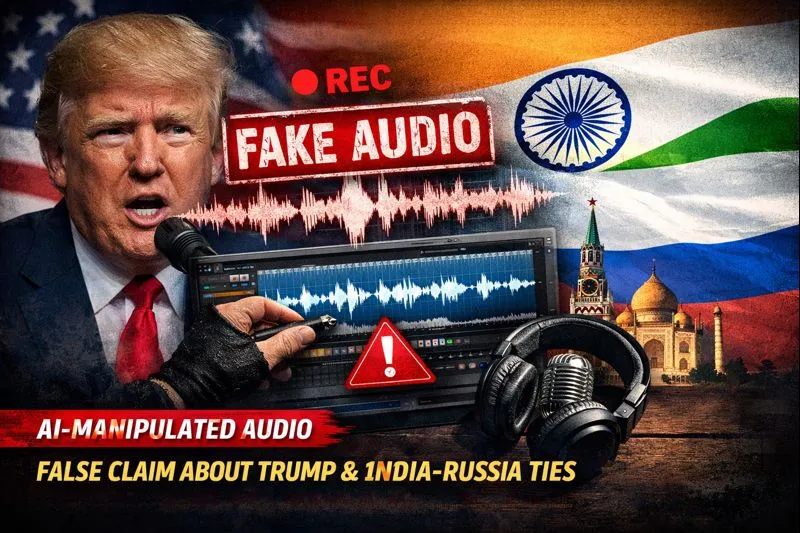
A video circulating widely on social media claims to show former US President Donald Trump issuing a threat to India over its relationship with Russia. In the clip, Trump is allegedly heard warning New Delhi that if it does not cut bilateral ties with Moscow, the United States would “treat India the same way Pakistan did during the May war.”
The reference to the “May war” appears to point to the India-Pakistan military escalation in May 2025, which followed the Pahalgam terror attack and India’s retaliatory strikes under Operation Sindoor targeting terror infrastructure.
However, research done by the Cyber Peace Foundation has found that the video is misleading and digitally manipulated.
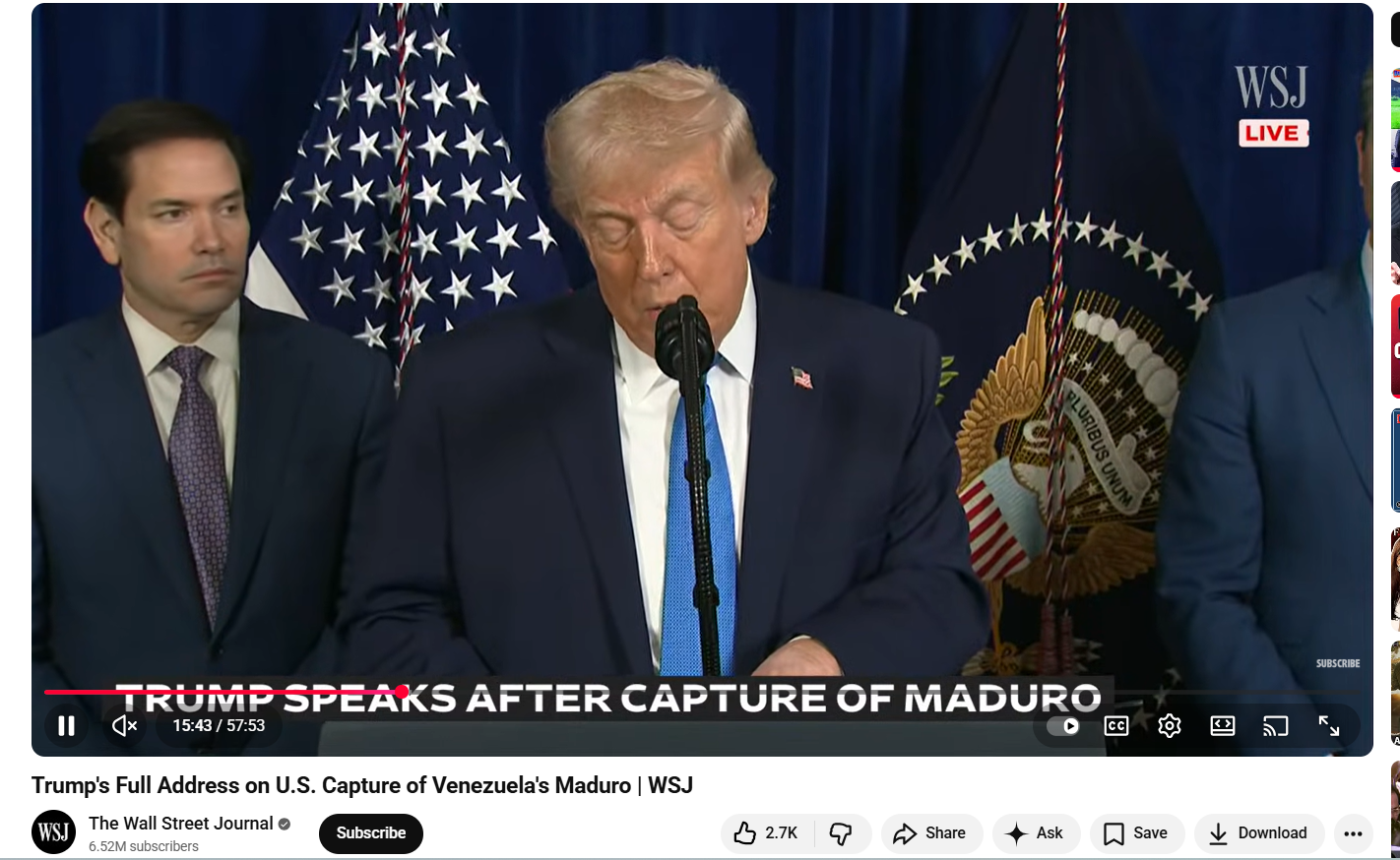
The visuals used in the viral clip are genuine and were taken from a press briefing addressed by Donald Trump on January 3, 2026. However, the audio track accompanying the video has been fabricated and falsely superimposed to
misrepresent his remarks. In the original address, Trump was speaking about a US-led military operation in Caracas that reportedly resulted in the capture of Venezuelan President Nicolás Maduro and his wife. He made no reference to India, Russia, or any geopolitical warning involving New Delhi.
Claim:
On January 10, an X (formerly Twitter) user, Niki Chiri (@cutehunmee), shared a video claiming it showed Donald Trump threatening India over its ties with Russia.
In the clip, Trump is purportedly heard stating that unless India severed its relationship with Moscow, the United States would respond in a manner similar to Pakistan’s actions during the May conflict.
The post quickly gained traction, with several users amplifying the claim. Iink,archive link and screenshot
Research:
To verify the authenticity of the video, the Cyber Peace Foundation conducted a reverse image and video analysis. A Google Lens search led investigators to a longer version of the same footage uploaded on the official YouTube channel of The Wall Street Journal, a prominent US-based news outlet.
A comparison confirmed that both videos shared identical visuals, background elements, and camera angles, establishing that the viral clip was sourced from the same press address.
A review of the full speech, however, showed that Trump did not issue any warning to India, nor did he mention Russia or the May conflict. His remarks were strictly focused on developments in Venezuela.
This confirmed that the viral video had been digitally altered. Here is the link to the original video, along with a screenshot:
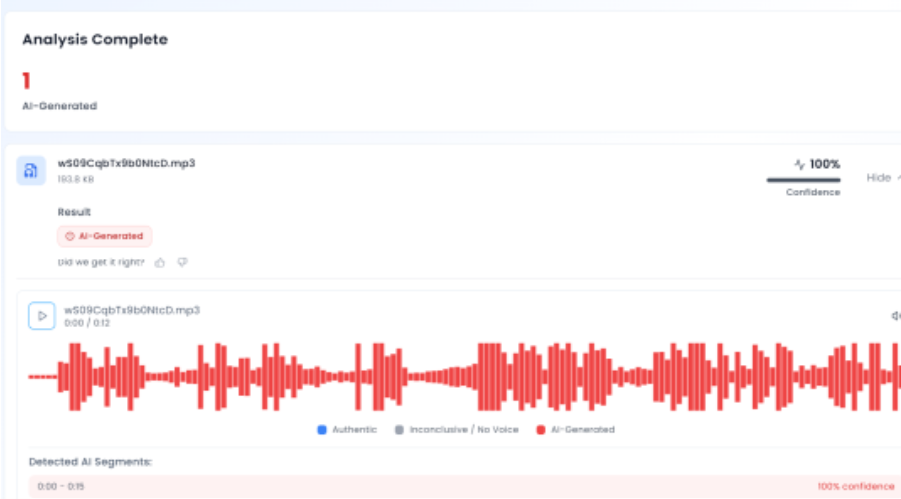
In the next phase of the research, the audio track from the viral clip was extracted and analysed using the AI-based voice detection tool Aurigin. The results indicated a high likelihood that the voice in the video was artificially generated, further confirming that the audio did not originate from Trump’s original speech. A screenshot of the result is provided below.
Conclusion
The claim that a video shows Donald Trump threatening India over its ties with Russia is false. The Cyber Peace Foundation found that while the visuals were taken from a real press address, the audio was fabricated and overlaid to falsely attribute threatening statements to Trump. The manipulated video was circulated online to mislead viewers and spread disinformation.
