
#FactCheck-Viral ‘Nehru Had Courage, Modi Bows Under Pressure’ Quote Is Falsely Attributed to Boris Johnson
Executive Summary
A purported statement attributed to former British Prime Minister Boris Johnson is going viral on social media. The post claims that Johnson said about Prime Minister Narendra Modi, “Modi bows under pressure.” It also attributes a comparison between Jawaharlal Nehru and Modi to Johnson, portraying Nehru as more courageous. A research done by the Research Wing of the CyberPeace found the viral claim to be false. During the research, the team examined Boris Johnson’s interview at the ET World Leaders Forum 2026, along with media reports related to the interview. The available transcript contains no remark by Johnson saying “Modi bows under pressure” or anything similar. On the contrary, he praised the changes and development taking place in India.
Claim:
A user on Instagram shared the viral claim, writing: “The purported statement by former British Prime Minister Boris Johnson has intensified the debate over India’s foreign policy and Prime Minister Narendra Modi’s leadership. The viral claim describes Nehru’s foreign policy as visionary while accusing the Modi government of bowing under pressure and taking shortcuts. The statement has triggered political reactions on social media.” The link to the post, its archive link, and a screenshot are provided below.
https://www.instagram.com/p/Dcdo_TGy-W0/

Fact Check
To verify the authenticity of the viral claim, the Desk examined the available transcript and reports of Boris Johnson’s interview at the ET World Leaders Forum 2026. The Desk found that Johnson also praised India’s current situation. He said that India is going through a “very good period under very strong and stable leadership.” He described India’s progress as “a really wonderful story” and expressed optimism about the country’s future.
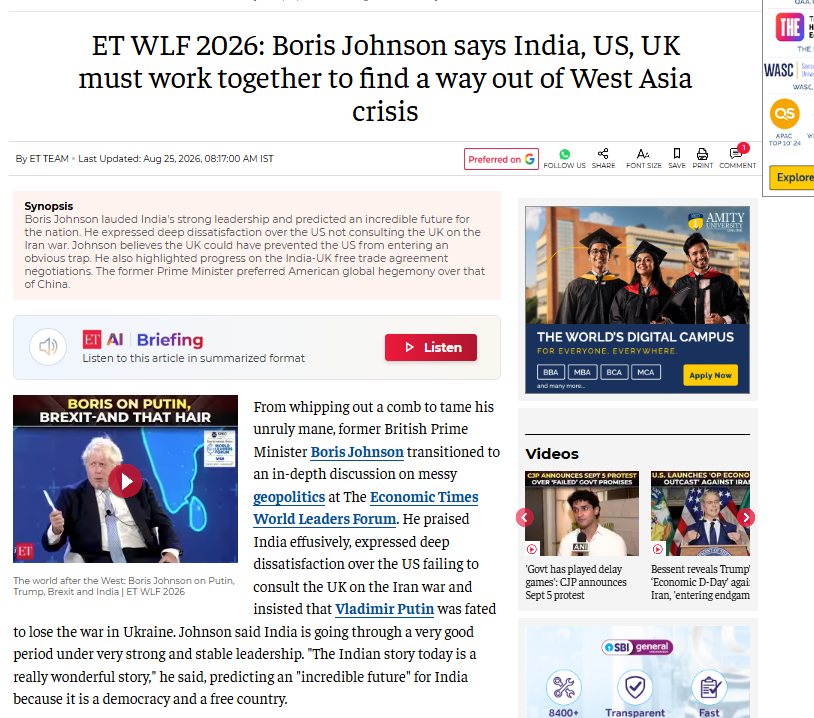
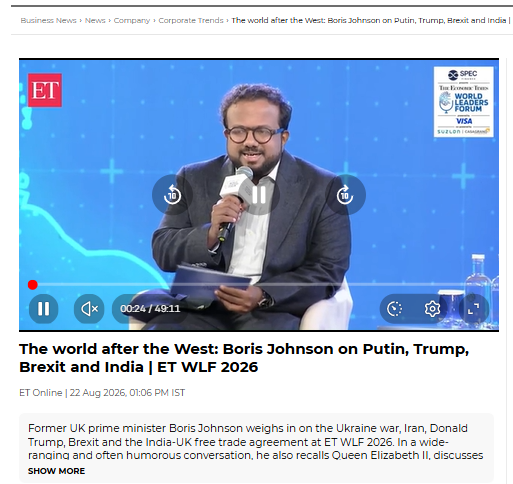
During the interview, Johnson discussed several international issues, including India-UK relations, US-UK ties, NATO defence spending, the Iran war and the Ukraine war. The available interview transcript contains no statement from him saying that “Modi bows under pressure” or that Nehru was more courageous than Modi. Johnson also referred to Jawaharlal Nehru in the context of India-Russia relations. He recalled that the late Queen Elizabeth II had once shared an anecdote about a conversation she had with Nehru in the 1950s, during which Nehru reportedly told her that India would always stand by Russia and that some things never change.
Conclusion
Boris Johnson did not make any statement at the ET World Leaders Forum 2026 suggesting that “Modi bows under pressure” or that “Nehru had courage.” On the contrary, he praised India’s progress and spoke positively about Prime Minister Narendra Modi’s leadership. Johnson did mention Nehru during the conversation, but his reference was in the context of India-Russia relations and an old conversation between Nehru and the late Queen Elizabeth II. He did not compare Nehru with Modi, nor did he criticise Modi. Therefore, the claim circulating on social media attributing the statement “Nehru had courage, Modi bows under pressure” to Boris Johnson is false.

Related Blogs

Introduction
Cyber financial offences in India have experienced an alarming surge both in terms of frequency and complexity. Be it phishing attacks or organised fraud syndicates, the nation has been facing a spurt in online financial threats, which leave the victims at their mercy because of procedural lags on the part of law enforcement agencies. To counter this, the Government of India has stepped up measures to create a Cyber-Secure Bharat, focusing on speedy resolution, accountability, and digital empowerment. A key move in this direction is the introduction of the e-Zero FIR initiative, brought forth by the Ministry of Home Affairs (MHA) with Union Home Minister Amit Shah at the helm. This newly developed digital-first system is expected to revolutionise the way cyber financial crimes, particularly those that result in high monetary losses, are handled and investigated.
What Is the e-Zero FIR Initiative?
The e-Zero FIR program is a technology-based platform that enables the automated registration of Zero FIRs for value cyber financial crimes. Led by the Indian Cybercrime Coordination Centre (I4C), Ministry of Home Affairs, the programme is now piloted in Delhi and aims to fill a pressing lacuna: the time lag involved in transitioning cybercrime complaints to First Information Reports (FIRs).
Complaints of financial frauds worth more than ₹10 lakh, reported through the National Cybercrime Reporting Portal (NCRP) or helpline number 1930, will be automatically turned into e-Zero FIRs under this scheme. Such electronic FIRs are directed to the e-Crime Police Station in Delhi, regardless of jurisdiction, and then relayed to the corresponding territorial cybercrime unit. Complainants can visit the cybercrime Police Station within 3 days and get the Zero FIR converted into a regular FIR.
Key Features of the Initiative
- Pilot Implementation in Delhi
Launched as a pilot project in Delhi, it will later serve as the first use case for the national rollout. The success of the pilot will determine its implementation in other states and Union Territories.
- Seamless Digital Integration
The project provides strong back-end integration between:
- NCRP (National Cybercrime Reporting Portal)
- e-FIR System (Delhi Police)
- CCTNS (Crime and Criminal Tracking Network & Systems – NCRB)
This integrated model enables complaints to pass smoothly between platforms and agencies.
- Zero FIR Auto-Registration and Routing
Now, for complaints lodged through 1930 or the National Cyber Crime Reporting Portal related to financial losses exceeding the threshold of ₹10 lakh, the system will automatically register a Zero FIR to the e-Crime Police Station of Delhi and then route it to the concerned territorial cybercrime police station, triggering immediate case processing.
- Victim-Centric Conversion Mechanism
Complainants are given 3 days from the time of filing to physically report to the police station and transform the e-Zero FIR into a conventional regular FIR under Section 173 (1) and 1(ii) of the newly enacted Bhartiya Nagrik Suraksha Sanhita (BNSS). This ensures legal redress is quicker and easier.
Impact and Significance: The CyberPeace View
The e-Zero FIR system is a significant change in India's cybercrime enforcement, offering quicker response times and improved recovery opportunities. Cyber fraud reported within the "golden hour" can boost recovery levels of financial fraud. The system also eliminates jurisdictional barriers and procedural bottlenecks, making it more victim-friendly. Union Home Minister Amit Shah emphasised the initiative's alignment with Prime Minister Narendra Modi's vision of a digitally resilient India. The system is a scalable national model of tech-based policing supported by organised digital workflows. The initiative allows for real-time analysis of fraud graphs and detection of fraud syndicates through identification and device-based clustering. This is a step towards more automated, context-aware cyber policing, focusing on AI, identity graphs, and velocity to prevent crimes. The system is a step towards a next-generation cyber law enforcement strategy, focusing on AI, identity graphs, and velocity.
Conclusion
The roll-out of the e-Zero FIR program is a turning point in India's battle against cybercrime. By marrying automation with inter-agency coordination and easy-to-use mechanisms, the government has eradicated one of the major stumbling blocks for victims, the delay in taking legal action. Though its pilot phase targets high-value financial frauds in Delhi, its potential for having a countrywide impact is vast. With digital transactions on the upswing and frauds getting more cunning, efforts like these are the key to making a safe, responsive, and victim-centric cyber environment. CyberPeace commends and welcomes this important move towards establishing a Cyber-Secure Bharat, wherein all citizens can make digital transactions with confidence.
References
- https://www.pib.gov.in/PressReleasePage.aspx?PRID=2129715
- https://www.mha.gov.in/en
- https://cybercrime.gov.in/
- https://www.ncrb.gov.in/
- https://economictimes.indiatimes.com/wealth/save/new-e-zero-fir-govt-launches-pilot-for-swift-action-against-cybercrimes-how-it-can-help-you/articleshow/121314437.cms?from=mdr

Executive Summary
A video is going viral on social media showing a woman performing a pre-wedding ritual called “Roka” for a couple at a metro station. Many users are sharing the clip believing it to be a real incident. CyberPeace found in its research that the viral claim is false. The video is actually scripted.
Claim:
An Instagram user posted the video on February 7, 2026, with the caption, “A mother performed her son’s Roka with his girlfriend at a metro station.”

Fact Check:
To verify the claim, we conducted a reverse image search using Google Lens on screenshots from the viral video. We found the same video was first uploaded on February 5, 2026, by an Instagram account named “chalte_phirte098.” The profile belongs to digital content creator Aarav Mavi, who regularly posts relationship and breakup-related videos.

Although the viral clip does not include any disclaimer stating that it is scripted, an older video posted by the creator on December 16, 2025, clarifies that his content is based on real-life stories shared by people but is filmed using professional actors. Several similar staged videos are also available on his profile on Instagram.

Conclusion:
Our research clearly shows that the viral video claiming to show a pre-wedding Roka ceremony at a metro station is not real. It was created by a content creator for entertainment purposes. Therefore, the claim circulating on social media is misleading.
Executive Summary
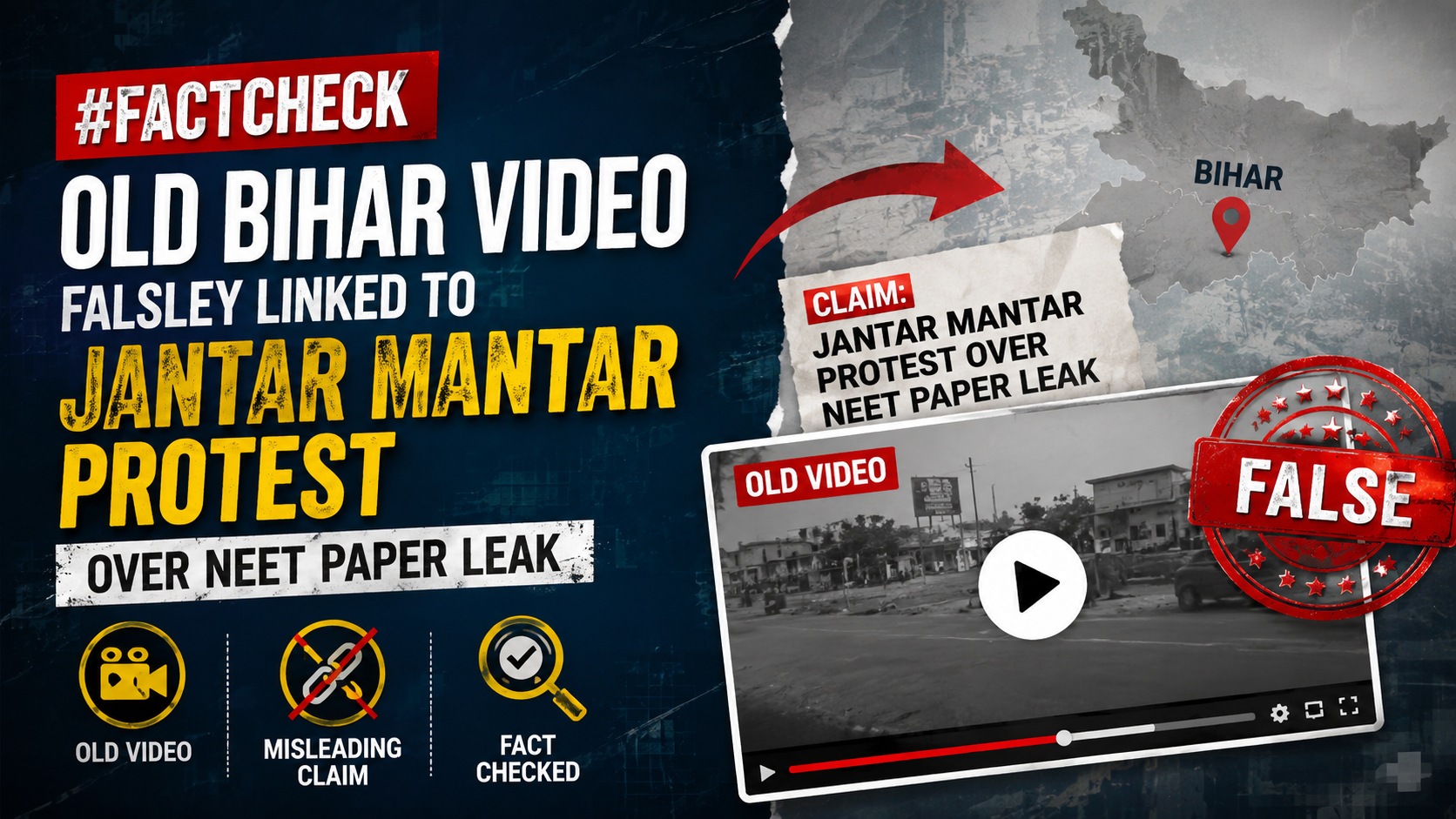
A video is being widely shared on social media with the claim that a person attempted to set a Thar vehicle on fire during the ongoing protest at Jantar Mantar. CyberPeace Research Wing’s research found that the viral video is not from Jantar Mantar, Delhi. The footage is from Gaya, Bihar, where some people allegedly attempted to set a vehicle on fire after a collision involving a Thar and other vehicles on July 16.
Claim:
A 23-second video is being shared on Facebook claiming to show a person attempting to set a Thar vehicle on fire during the ongoing NEET paper leak protest at Jantar Mantar in Delhi. In the video, a man can be seen trying to ignite the vehicle, while police personnel intervene and stop him. However, the crowd continues to attempt to set the vehicle on fire.
https://www.facebook.com/reel/1575765261002644

Fact Check:
To verify the claim, we extracted keyframes from the viral video and conducted a reverse image search. During the research, we found the same video uploaded on the News18 YouTube channel on July 18, 2026. The caption accompanying the video identified the incident as being from Bihar.
https://www.youtube.com/shorts/fzAPajxyi3A
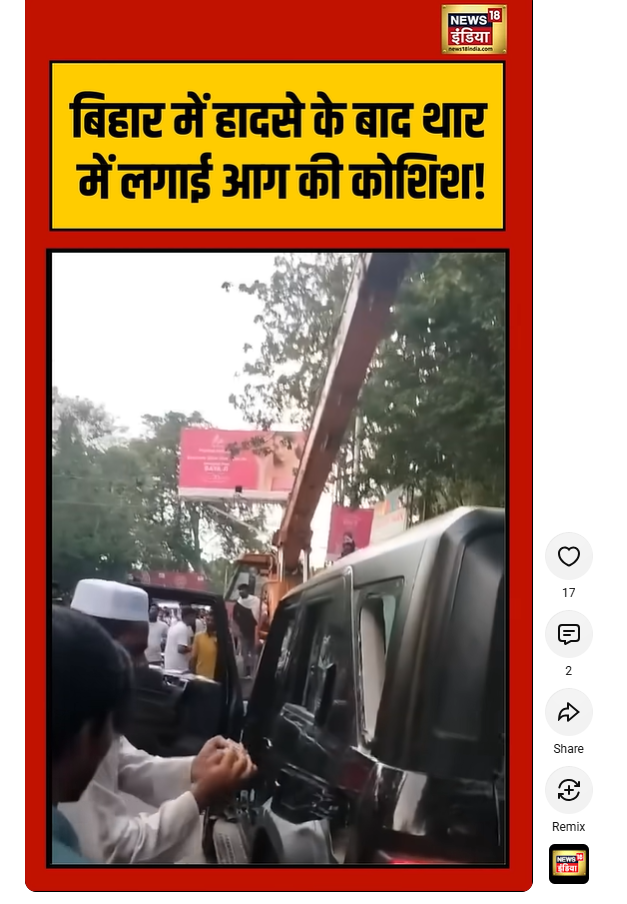
Further, a keyword search led us to a report published by Dainik Bhaskar on July 16, 2026. The report contained visuals matching the viral video, along with the statement of the person seen in the viral footage.

According to the report, the incident took place in Gaya, Bihar, after a collision between a Thar vehicle and other vehicles. Following the accident, some people gathered at the spot and allegedly attempted to set the vehicle on fire.
Conclusion:
CyberPeace Research Wing’s fact check found the viral claim to be misleading. The video does not show an incident from the ongoing Jantar Mantar protest in Delhi. The footage is from Gaya, Bihar, where a Thar vehicle was involved in a collision with other vehicles on July 16, following which some people attempted to set the vehicle on fire.
