#FactCheck -AI-Generated Image Falsely Shared as Iranian Soldiers Standing Near Downed Helicopter
Executive Summary
Amid rising tensions involving Iran, Israel and the United States following reports in early April 2026 that Iran had shot down an American fighter aircraft, a picture is going viral on social media claiming to show Iranian soldiers standing beside the wreckage of a destroyed helicopter while holding the Iranian flag. Research by CyberPeace Research Wing found that the viral claim is false. The image has been created using artificial intelligence and does not depict any real incident. The picture was generated using Google AI tools and is being misleadingly circulated online with different claims.
Claim
A Facebook page named “official salman 09” shared the image on May 1, 2026, along with a lengthy caption describing the scene as a symbol of Iran’s battlefield success. The post portrayed the image as evidence of a helicopter being brought down during ongoing tensions in the Middle East and suggested that the photo reflected strength, morale and victory in war.
- https://www.facebook.com/permalink.phpstory_fbid=pfbid02TAac6JwZha2UU4T8QiCGq4ENmsnNSwvigaz3vKxr9UWLbhghNsnMMpZdQ3dUuQ1rl&id=100092392280139
- https://archive.ph/

Fact Check
To verify the authenticity of the image, we first conducted a reverse image search using Google Lens. The image did not appear in any credible news reports or authentic media coverage. Instead, it was found circulating mainly on social media platforms, raising suspicion about its authenticity. We then analyzed the image using Google’s SynthID detector. The analysis confirmed the presence of a SynthID watermark with a “very high confidence” score, indicating that the image had been generated using Google AI tools. SynthID is Google’s watermarking technology used to identify AI-generated content created through its models.

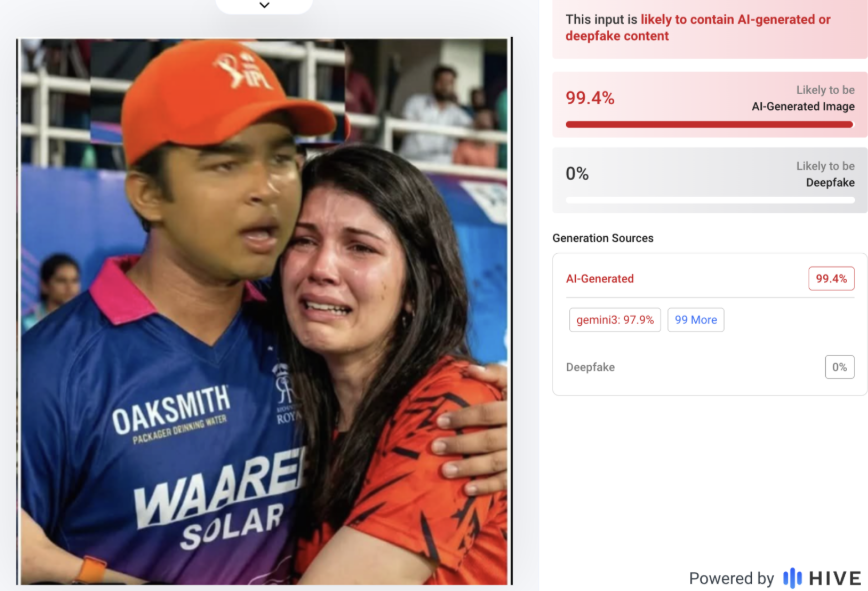
Further verification using another AI-detection platform, Hive Moderation, also indicated a high probability that the image had been generated using AI. The tool identified Gemini as the likely source and assessed the image as overwhelmingly AI-generated.

Conclusion
Our research confirms that the viral image is AI-generated and unrelated to any real-world event. The picture showing soldiers holding the Iranian flag near helicopter wreckage was created using Google AI tools and is being falsely shared on social media to spread misleading claims.
Related Blogs

The recent Promotion and Regulation of Online Gaming Act, 2025, that came into force in August, has been one of the most widely anticipated regulations in the digital entertainment industry. Among provisions such as promoting esports and licensing of online gaming, the legislation notably introduces a blanket ban on real-money gaming (RMG). The rationale behind this was to reduce its addictive effects, protect minors, and limit the circulation of black-money. However, in reality, the Act has spawned apprehension about the legislative process, regulatory redundancy, and unintended consequences that can shift users and revenue to offshore operators.
From Debate to Prohibition: How the Act was Passed
The Promotion and Regulation of Online Gaming Act was passed as a central law, providing the earlier fragmented state laws on online betting and gambling with an overarching framework. Proponents argue that, among other provisions, some kind of unified national framework was needed to deal with the scale of online betting due to its detrimental impact on young users. The current Act is a direct transition to criminalisation rather than the swings of self-regulation and partial restrictions used during the previous decade of incremental experiments in regulation. Stakeholders in the industry believe that this type of sudden, blanket action creates uncertainty and erodes confidence in the system in the long run. Further, critics have pointed out that the Bill was passed without adequate Parliamentary deliberation. A question has been raised about whether procedural safeguards were upheld.
Prohibition of Online RMG
Within the Indian context, a distinction has long been drawn between games of skill and games of chance, with the latter, like a lottery or a casino, being severely prohibited under state laws, whereas the former, like rummy or fantasy sports, have generally been allowed after being recognized as skill-based by court authorities. The Online Gaming Act of 2025 abolishes this distinction on the internet, thus banning all RMG actions that include cash transactions, regardless of skill or chance. The act also criminalises the advertising, facilitation, and hosting of such sites, thereby penalizing offshore operators with an Indian customer focus, and subjecting their payment gateways, app stores, and advertisers under its jurisdiction to penalties.
The Problem of Overlap
One potential issue that the Act presents is its overlap with the existing laws. The IT Rules 2023 mandate intermediaries in the gaming sector to appoint compliance officers, submit monthly reports, and undergo due diligence. The new Act introduces a three-level classification of games, whereas the advisories of the Central Consumer Protection Authority (CCPA) under the Consumer Protection Act treat online betting as an unfair trade practice.
This multiplicity of regulations builds a maze where different Ministries and state governments have overlapping jurisdiction. Policy experts caution that such an overlap can create enforcement challenges, punish players who act within the law, and leave offshore malefactors undetected.
Unintended Consequences: Driving Users Offshore
Outright prohibition will hardly ever remove demand; it will only push it out. Offshore sites have taken advantage of the situation as Indian operators like Dream11 shut down their money games after the ban. It has already been reported that there is aggressive advertising by foreign betting companies that are not registered in India, most of which have backend infrastructure that cannot be regulated by the Act (Storyboard18).
This diversion of users to unregulated markets has two main risks. First, Indian players are deprived of the consumer protection offered to them in local regulation, and their data can be sent to suspicious foreign organizations. Second, the government loses control over the money flow that can be transferred via informal channels or cryptocurrencies or other obscure systems. Industry analysts are alerting that such developments may only worsen the issue of black-money instead of solving it (IGamingBusiness).
Advertising, Age Gating, and Digital Rights
The Act has also strengthened advertisement regulations, aligning with advisories issued by the Advertising Standards Council of India, which prohibits the targeting of minors. However, critics believe that the application remains inadequately enforced, and children can with comparative ease access unregulated overseas applications. In the absence of complementary digital literacy programs and strong parental controls, these limitations can be effectively superficial instead of real.
Privacy advocates also warn that frequent prompts, vague messages, or invasive surveillance can weaken the digital rights of users instead of strengthening them. Overregulation has also been found to create banner blindness in global contexts where users ignore warnings without first clearly understanding them.
Enforcement Challenges
The Act puts a lot of responsibilities on many stakeholders, including the Ministry of Information and Broadcasting (MIB) and the Reserve Bank of India (RBI). Platforms like Google Play and Apple App Store are expected to verify government-approved lists of compliant gaming apps and remove non-compliant or banned ones, as directed by the MIB and the RBI. Although this pressure may motivate intermediaries to collaborate, it may also have a risk of overreach when it is applied unequally or in a political way.
According to the experts, the solution should be underpinned by technology itself. Artificial intelligence can be used to identify illegal advertisements, track illegal gaming in children, and trace payment streams. At the same time, the regulators should be able to issue final lists of either compliant or non-compliant applications to advise the consumers and intermediaries alike. Without such practical provisions, enforcement risks remaining patchy.
Online Gaming Rules
On 1 October 2025, the government issued a draft of the Online Gaming Rules in accordance with the Promotion and Regulation of Online Gaming Act. The regulations focus on the creation of the compliance frameworks, define the classification of the allowed gaming activities, and prescribe grievance-redressal mechanisms aiming to promote the protection of the players and procedural transparency. However, the draft does not revisit or soften the existing blanket prohibition on real-money gaming (RMG) and, hence, the questions about the effectiveness of enforcement and regulatory clarity remain open (Times of India, 2025).
Protecting Consumers Without Stifling Innovation
The ban highlights a larger conflict, i.e., the protection of the vulnerable users without stifling an industry that has traditionally contributed to innovation, jobs, and the collection of tax revenue. Online gaming has significantly added to the GST collections, and the sudden shakeup brings fiscal concerns (Reuters).
Several legal objections to the Act have already been brought, asking whether the Act is constitutional, especially as to whether the restrictions are proportional to the right to trade. The outcome of such cases will define the future trajectory of the digital economy of India (Reuters).
Way Forward
Instead of outright prohibition, a more balanced approach that incorporates regulation and consumer protection is suggested by the experts. Key measures could include:
- A definite difference between games of skill and games of chance, with proportionate regulation.
- Age confirmation and campaign against online illiteracy to protect the underage population.
- Enhanced advertising and payments compliance requirements and enforceable non-compliance penalty.
- Coordinated oversight among different ministries to prevent duplication and regulatory struggle.
- Leveraging AI and fintech to track illegal financial activities (black money flows) and developing innovation.
Conclusion
The Online Gaming Act 2025 addresses social issues, such as addiction, monetary risk, and child safety, that require governance interventions. However, the path it follows to this end, that of total prohibition, is more likely to spawn a new set of issues instead of providing solutions because it will send consumers to offshore sites, undermine consumer rights, and slow innovation.
For India, the real challenge is not whether to prohibit online money gaming but how to create a balanced, transparent, and enforceable framework that protects users while fostering a responsible gaming ecosystem. India can reduce the adverse consequences of online betting without keeping the industry in the shadows with better coordination, reasonable use of technology, and balanced protection.
References:
- India's Dream11, top gaming apps halt money-based games after ban
- India online gambling ban could drive punters to black market
- Offshore betting firms with backend ops in India not covered by online gaming law
- The Great Gamble: India’s Online Gaming Ban, The GST Battle, And What Lies Ahead.
- Game Over for Online Money Games? An Analysis of the Online Gaming Act 2025
- Government gambles heavily on prohibiting online money gaming
- Online gaming regulation: New rules to take effect from October 1; government stresses consultative approach with industry

Overview:
The rapid digitization of educational institutions in India has created both opportunities and challenges. While technology has improved access to education and administrative efficiency, it has also exposed institutions to significant cyber threats. This report, published by CyberPeace, examines the types, causes, impacts, and preventive measures related to cyber risks in Indian educational institutions. It highlights global best practices, national strategies, and actionable recommendations to mitigate these threats.

Significance of the Study:
The pandemic-induced shift to online learning, combined with limited cybersecurity budgets, has made educational institutions prime targets for cyberattacks. These threats compromise sensitive student, faculty, and institutional data, leading to operational disruptions, financial losses, and reputational damage. Globally, educational institutions face similar challenges, emphasizing the need for universal and localized responses.
Threat Faced by Education Institutions:
Based on the insights from the CyberPeace’s report titled 'Exploring Cyber Threats and Digital Risks in Indian Educational Institutions', this concise blog provides a comprehensive overview of cybersecurity threats and risks faced by educational institutions, along with essential details to address these challenges.
🎣 Phishing: Phishing is a social engineering tactic where cyber criminals impersonate trusted sources to steal sensitive information, such as login credentials and financial details. It often involves deceptive emails or messages that lead to counterfeit websites, pressuring victims to provide information quickly. Variants include spear phishing, smishing, and vishing.
💰 Ransomware: Ransomware is malware that locks users out of their systems or data until a ransom is paid. It spreads through phishing emails, malvertising, and exploiting vulnerabilities, causing downtime, data leaks, and theft. Ransom demands can range from hundreds to hundreds of thousands of dollars.
🌐 Distributed Denial of Service (DDoS): DDoS attacks overwhelm servers, denying users access to websites and disrupting daily operations, which can hinder students and teachers from accessing learning resources or submitting assignments. These attacks are relatively easy to execute, especially against poorly protected networks, and can be carried out by amateur cybercriminals, including students or staff, seeking to cause disruptions for various reasons
🕵️ Cyber Espionage: Higher education institutions, particularly research-focused universities, are vulnerable to spyware, insider threats, and cyber espionage. Spyware is unauthorized software that collects sensitive information or damages devices. Insider threats arise from negligent or malicious individuals, such as staff or vendors, who misuse their access to steal intellectual property or cause data leaks..
🔒 Data Theft: Data theft is a major threat to educational institutions, which store valuable personal and research information. Cybercriminals may sell this data or use it for extortion, while stealing university research can provide unfair competitive advantages. These attacks can go undetected for long periods, as seen in the University of California, Berkeley breach, where hackers allegedly stole 160,000 medical records over several months.
🛠️ SQL Injection: SQL injection (SQLI) is an attack that uses malicious code to manipulate backend databases, granting unauthorized access to sensitive information like customer details. Successful SQLI attacks can result in data deletion, unauthorized viewing of user lists, or administrative access to the database.
🔍Eavesdropping attack: An eavesdropping breach, or sniffing, is a network attack where cybercriminals steal information from unsecured transmissions between devices. These attacks are hard to detect since they don't cause abnormal data activity. Attackers often use network monitors, like sniffers, to intercept data during transmission.
🤖 AI-Powered Attacks: AI enhances cyber attacks like identity theft, password cracking, and denial-of-service attacks, making them more powerful, efficient, and automated. It can be used to inflict harm, steal information, cause emotional distress, disrupt organizations, and even threaten national security by shutting down services or cutting power to entire regions
Insights from Project eKawach
The CyberPeace Research Wing, in collaboration with SAKEC CyberPeace Center of Excellence (CCoE) and Autobot Infosec Private Limited, conducted a study simulating educational institutions' networks to gather intelligence on cyber threats. As part of the e-Kawach project, a nationwide initiative to strengthen cybersecurity, threat intelligence sensors were deployed to monitor internet traffic and analyze real-time cyber attacks from July 2023 to April 2024, revealing critical insights into the evolving cyber threat landscape.
Cyber Attack Trends
Between July 2023 and April 2024, the e-Kawach network recorded 217,886 cyberattacks from IP addresses worldwide, with a significant portion originating from countries including the United States, China, Germany, South Korea, Brazil, Netherlands, Russia, France, Vietnam, India, Singapore, and Hong Kong. However, attributing these attacks to specific nations or actors is complex, as threat actors often use techniques like exploiting resources from other countries, or employing VPNs and proxies to obscure their true locations, making it difficult to pinpoint the real origin of the attacks.
Brute Force Attack:
The analysis uncovered an extensive use of automated tools in brute force attacks, with 8,337 unique usernames and 54,784 unique passwords identified. Among these, the most frequently targeted username was “root,” which accounted for over 200,000 attempts. Other commonly targeted usernames included: "admin", "test", "user", "oracle", "ubuntu", "guest", "ftpuser", "pi", "support"
Similarly, the study identified several weak passwords commonly targeted by attackers. “123456” was attempted over 3,500 times, followed by “password” with over 2,500 attempts. Other frequently targeted passwords included: "1234", "12345", "12345678", "admin", "123", "root", "test", "raspberry", "admin123", "123456789"

Insights from Threat Landscape Analysis
Research done by the USI - CyberPeace Centre of Excellence (CCoE) and Resecurity has uncovered several breached databases belonging to public, private, and government universities in India, highlighting significant cybersecurity threats in the education sector. The research aims to identify and mitigate cybersecurity risks without harming individuals or assigning blame, based on data available at the time, which may evolve with new information. Institutions were assigned risk ratings that descend from A to F, with most falling under a D rating, indicating numerous security vulnerabilities. Institutions rated D or F are 5.4 times more likely to experience data breaches compared to those rated A or B. Immediate action is recommended to address the identified risks.


Risk Findings :
The risk findings for the institutions are summarized through a pie chart, highlighting factors such as data breaches, dark web activity, botnet activity, and phishing/domain squatting. Data breaches and botnet activity are significantly higher compared to dark web leakages and phishing/domain squatting. The findings show 393,518 instances of data breaches, 339,442 instances of botnet activity, 7,926 instances related to the dark web and phishing & domain activity - 6711.

Key Indicators: Multiple instances of data breaches containing credentials (email/passwords) in plain text.


- Botnet activity indicating network hosts compromised by malware.

- Credentials from third-party government and non-governmental websites linked to official institutional emails

- Details of software applications, drivers installed on compromised hosts.

- Sensitive cookie data exfiltrated from various browsers.


- IP addresses of compromised systems.
- Login credentials for different Android applications.

Below is the sample detail of one of the top educational institutions that provides the insights about the higher rate of data breaches, botnet activity, dark web activities and phishing & domain squatting.
Risk Detection:
It indicates the number of data breaches, network hygiene, dark web activities, botnet activities, cloud security, phishing & domain squatting, media monitoring and miscellaneous risks. In the below example, we are able to see the highest number of data breaches and botnet activities in the sample particular domain.

Risk Changes:

Risk by Categories:

Risk is categorized with factors such as high, medium and low, the risk is at high level for data breaches and botnet activities.

Challenges Faced by Educational Institutions
Educational institutions face cyberattack risks, the challenges leading to cyberattack incidents in educational institutions are as follows:
🔒 Lack of a Security Framework: A key challenge in cybersecurity for educational institutions is the lack of a dedicated framework for higher education. Existing frameworks like ISO 27001, NIST, COBIT, and ITIL are designed for commercial organizations and are often difficult and costly to implement. Consequently, many educational institutions in India do not have a clearly defined cybersecurity framework.
🔑 Diverse User Accounts: Educational institutions manage numerous accounts for staff, students, alumni, and third-party contractors, with high user turnover. The continuous influx of new users makes maintaining account security a challenge, requiring effective systems and comprehensive security training for all users.
📚 Limited Awareness: Cybersecurity awareness among students, parents, teachers, and staff in educational institutions is limited due to the recent and rapid integration of technology. The surge in tech use, accelerated by the pandemic, has outpaced stakeholders' ability to address cybersecurity issues, leaving them unprepared to manage or train others on these challenges.
📱 Increased Use of Personal/Shared Devices: The growing reliance on unvetted personal/Shared devices for academic and administrative activities amplifies security risks.
💬 Lack of Incident Reporting: Educational institutions often neglect reporting cyber incidents, increasing vulnerability to future attacks. It is essential to report all cases, from minor to severe, to strengthen cybersecurity and institutional resilience.
Impact of Cybersecurity Attacks on Educational Institutions
Cybersecurity attacks on educational institutions lead to learning disruptions, financial losses, and data breaches. They also harm the institution's reputation and pose security risks to students. The following are the impacts of cybersecurity attacks on educational institutions:
📚Impact on the Learning Process: A report by the US Government Accountability Office (GAO) found that cyberattacks on school districts resulted in learning losses ranging from three days to three weeks, with recovery times taking between two to nine months.
💸Financial Loss: US schools reported financial losses ranging from $50,000 to $1 million due to expenses like hardware replacement and cybersecurity upgrades, with recovery taking an average of 2 to 9 months.
🔒Data Security Breaches: Cyberattacks exposed sensitive data, including grades, social security numbers, and bullying reports. Accidental breaches were often caused by staff, accounting for 21 out of 25 cases, while intentional breaches by students, comprising 27 out of 52 cases, frequently involved tampering with grades.
⚠️Data Security Breach: Cyberattacks on schools result in breaches of personal information, including grades and social security numbers, causing emotional, physical, and financial harm. These breaches can be intentional or accidental, with a US study showing staff responsible for most accidental breaches (21 out of 25) and students primarily behind intentional breaches (27 out of 52) to change grades.
🏫Impact on Institutional Reputation: Cyberattacks damaged the reputation of educational institutions, eroding trust among students, staff, and families. Negative media coverage and scrutiny impacted staff retention, student admissions, and overall credibility.
🛡️ Impact on Student Safety: Cyberattacks compromised student safety and privacy. For example, breaches like live-streaming school CCTV footage caused severe distress, negatively impacting students' sense of security and mental well-being.
CyberPeace Advisory:
CyberPeace emphasizes the importance of vigilance and proactive measures to address cybersecurity risks:
- Develop effective incident response plans: Establish a clear and structured plan to quickly identify, respond to, and recover from cyber threats. Ensure that staff are well-trained and know their roles during an attack to minimize disruption and prevent further damage.
- Implement access controls with role-based permissions: Restrict access to sensitive information based on individual roles within the institution. This ensures that only authorized personnel can access certain data, reducing the risk of unauthorized access or data breaches.
- Regularly update software and conduct cybersecurity training: Keep all software and systems up-to-date with the latest security patches to close vulnerabilities. Provide ongoing cybersecurity awareness training for students and staff to equip them with the knowledge to prevent attacks, such as phishing.
- Ensure regular and secure backups of critical data: Perform regular backups of essential data and store them securely in case of cyber incidents like ransomware. This ensures that, if data is compromised, it can be restored quickly, minimizing downtime.
- Adopt multi-factor authentication (MFA): Enforce Multi-Factor Authentication(MFA) for accessing sensitive systems or information to strengthen security. MFA adds an extra layer of protection by requiring users to verify their identity through more than one method, such as a password and a one-time code.
- Deploy anti-malware tools: Use advanced anti-malware software to detect, block, and remove malicious programs. This helps protect institutional systems from viruses, ransomware, and other forms of malware that can compromise data security.
- Monitor networks using intrusion detection systems (IDS): Implement IDS to monitor network traffic and detect suspicious activity. By identifying threats in real time, institutions can respond quickly to prevent breaches and minimize potential damage.
- Conduct penetration testing: Regularly conduct penetration testing to simulate cyberattacks and assess the security of institutional networks. This proactive approach helps identify vulnerabilities before they can be exploited by actual attackers.
- Collaborate with cybersecurity firms: Partner with cybersecurity experts to benefit from specialized knowledge and advanced security solutions. Collaboration provides access to the latest technologies, threat intelligence, and best practices to enhance the institution's overall cybersecurity posture.
- Share best practices across institutions: Create forums for collaboration among educational institutions to exchange knowledge and strategies for cybersecurity. Sharing successful practices helps build a collective defense against common threats and improves security across the education sector.
Conclusion:
The increasing cyber threats to Indian educational institutions demand immediate attention and action. With vulnerabilities like data breaches, botnet activities, and outdated infrastructure, institutions must prioritize effective cybersecurity measures. By adopting proactive strategies such as regular software updates, multi-factor authentication, and incident response plans, educational institutions can mitigate risks and safeguard sensitive data. Collaborative efforts, awareness, and investment in cybersecurity will be essential to creating a secure digital environment for academia.

The Illusion of Digital Serenity
In the age of technology, our email accounts have turned into overcrowded spaces, full of newsletters, special offers, and unwanted updates. To most, the presence of an "unsubscribe" link brings a minor feeling of empowerment, a chance to declutter and restore digital serenity. Yet behind this harmless-seeming tool lurks a developing cybersecurity threat. Recent research and expert discussions indicate that the "unsubscribe" button is being used by cybercriminals to carry out phishing campaigns, confirm active email accounts, and distribute malware. This new threat not only undermines individual users but also has wider implications for trust, behaviour, and governance in cyberspace.
Exploiting User Behaviour
The main challenge is the manipulation of user behaviour. Cyber thieves have learned to analyse typical user habits, most notably the instinctive process of unsubscribing from spam mail. Taking advantage of this, they now place criminal codes in emails that pose as real subscription programs. These codes may redirect traffic to fake websites that attempt to steal credentials, force the installation of malicious code, or merely count the click as verification that the recipient's email address is valid. Once confirmed, these addresses tend to be resold on the dark web or included in additional spam lists, further elevating the threat of subsequent attacks.
A Social Engineering Trap
This type of cyber deception is a prime example of social engineering, where the weakest link in the security chain ends up being the human factor. In the same way, misinformation campaigns take advantage of cognitive biases such as confirmation or familiarity, and these unsubscribe traps exploit user convenience and habits. The bait is so simple, and that is exactly what makes it work. Someone attempting to combat spam may unknowingly walk into a sophisticated cyber threat. Unlike phishing messages impersonating banks or government agencies, which tend to elicit suspicion, spoofed unsubscribe links are integrated into regular digital habits, making them more difficult to recognise and resist.
Professional Disguise, Malicious Intent
Technical analysis determines that most of these messages come from suspicious domains or spoofed versions of valid ones, like "@offers-zomato.ru" in place of the authentic "@zomato.com." The appearance of the email looks professional, complete with logos and styling copied from reputable businesses. But behind the HTML styling lies redirection code and obfuscated scripts with a very different agenda. At times, users are redirected to sites that mimic login pages or questionnaire forms, capturing sensitive information under the guise of email preference management.
Beyond the Inbox: Broader Consequences
The consequences of this attack go beyond the individual user. The compromise of a personal email account can be used to carry out more extensive spamming campaigns, engage in botnets, or even execute identity theft. Furthermore, the compromised devices may become entry points for ransomware attacks or espionage campaigns, particularly if the individual works within sensitive sectors such as finance, defence, or healthcare. In this context, what appears to be a personal lapse becomes a national security risk. This is why the issue posed by the weaponised unsubscribe button must be considered not just as a cybersecurity risk but also as a policy and public awareness issue.
Platform Responsibility
Platform responsibility is yet another important aspect. Email service providers such as Gmail, Outlook, and ProtonMail do have native unsubscribe capabilities, under the List-Unsubscribe header mechanism. These tools enable users to remove themselves from valid mailing lists safely without engaging with the original email content. Yet many users do not know about these safer options and instead resort to in-body unsubscribe links that are easier to find but risky. To that extent, email platforms need to do more not only to enhance backend security but also to steer user actions through simple interfaces, safety messages, and digital hygiene alerts.
Education as a Defence
Education plays a central role in mitigation. Just as cyber hygiene campaigns have been launched to teach users not to click on suspicious links or download unknown attachments, similar efforts are needed to highlight the risks associated with casual unsubscribing. Cybersecurity literacy must evolve to match changing threat patterns. Rather than only targeting clearly malicious activity, awareness campaigns should start tackling deceptive tactics that disguise themselves as beneficial, including unsubscribe traps or simulated customer support conversations. Partnerships between public and private institutions might be vital in helping with this by leveraging their resources for mass digital education.
Practical Safeguards for Users
Users are advised to always check the sender's domain before clicking any link, avoid unknown promotional emails, and hover over any link to preview its true destination. Rather than clicking "unsubscribe," users can simply mark such emails as spam or junk so that their email providers can automatically filter similar messages in the future. For enhanced security, embracing mechanisms such as mail client sandboxing, two-factor authentication (2FA) support, and alias email addresses for sign-ups can also help create layered defences.
Policy and Regulatory Implications
Policy implications are also significant. Governments and data protection regulators must study the increasing misuse of misleading unsubscribe hyperlinks under electronic communication and consent laws. In India, the new Digital Personal Data Protection Act, 2023 (DPDPA), provides a legislative framework to counter such deceptive practices, especially under the principles of legitimate processing and purpose limitation. The law requires that the processing of data should be transparent and fair, a requirement that malicious emails obviously breach. Regulatory agencies like CERT-In can also release periodic notifications warning users against such trends as part of their charter to encourage secure digital practices.
The Trust Deficit
The vulnerability also relates to broader issues of trust in digital infrastructure. When widely used tools such as an unsubscribe feature become points of exploitation, user trust in digital platforms erodes. Such a trust deficit can lead to generalised distrust of email systems, digital communication, and even legitimate marketing. Restoring and maintaining such trust demands a unified response that includes technical measures, user education, and regulatory action.
Conclusion: Inbox Hygiene with Caution
The "unsubscribe button trap" is a parable of the modern age. It illustrates how mundane digital interactions, when manipulated, can do great damage not only to individual users but also to the larger ecosystem of online security and trust. As cyber-attacks grow increasingly psychologically advanced and behaviorally focused, our response must similarly become more sophisticated, interdisciplinary, and user-driven. Getting your inbox in order should never involve putting yourself in cyber danger. But as things stand, even that basic task requires caution, context, and clear thinking.