
Cybersecurity Governance: Policies, Challenges, and the Road Ahead
Introduction
The geographical world has physical boundaries, but the digital one has a different architecture and institutions are underprepared when it comes to addressing cybersecurity breaches. Cybercrime, which may lead to economic losses, privacy violations, national security threats and have psycho-social consequences, is forecast to continuously increase between 2024 and 2029, reaching an estimated cost of at least 6.4 trillion U.S. dollars (Statista). As cyber threats become persistent and ubiquitous, they are becoming a critical governance challenge. Lawmakers around the world need to collaborate on addressing this emerging issue.
Cybersecurity Governance and its Structural Elements
Cybersecurity governance refers to the strategies, policies, laws, and institutional frameworks that guide national and international preparedness and responses to cyber threats to governments, private entities, and individuals. Effective cybersecurity governance ensures that digital risks are managed proactively while balancing security with fundamental rights like privacy and internet freedom. It includes, but is not limited to :
- Policies and Legal Frameworks: Laws that define the scope of cybercrime, cybersecurity responsibilities, and mechanisms for data protection. Eg: India’s National Cybersecurity Policy (NCSP) of 2013, Information Technology Act, 2000, and Digital Personal Data Protection Act, 2023, EU’s Cybersecurity Act (2019), Cyber Resilience Act (2024), Cyber Solidarity Act (2025), and NIS2 Directive (2022), South Africa’s Cyber Crimes Act (2021), etc.
- Regulatory Bodies: Government agencies such as data protection authorities, cybersecurity task forces, and other sector-specific bodies. Eg: India’s Computer Emergency Response Team (CERT-In), Indian Cyber Crime Coordination Centre (I4C), Europe’s European Union Agency for Cybersecurity (ENISA), and others.
- Public-Private Knowledge Sharing: The sharing of the private sector’s expertise and the government’s resources plays a crucial role in improving enforcement and securing critical infrastructure. This model of collaboration is followed in the EU, Japan, Turkey, and the USA.
- Research and Development: Apart from the technical, the cyber domain also includes military, politics, economy, law, culture, society, and other elements. Robust, multi-sectoral research is necessary for formulating international and regional frameworks on cybersecurity.
Challenges to Cybersecurity Governance
Governments face several challenges in securing cyberspace and protecting critical assets and individuals despite the growing focus on cybersecurity. This is because so far the focus has been on cybersecurity management, which, considering the scale of attacks in the recent past, is not enough. Stakeholders must start deliberating on the aspect of governance in cyberspace while ensuring that this process is multi-consultative. (Savaş & Karataş 2022). Prominent challenges which need to be addressed are:
- Dynamic Threat Landscape: The threat landscape in cyberspace is ever-evolving. Bad actors are constantly coming up with new ways to carry out attacks, using elements of surprise, adaptability, and asymmetry aided by AI and quantum computing. While cybersecurity measures help mitigate risks and minimize damage, they can’t always provide definitive solutions. E.g., the pace of malware development is much faster than that of legal norms, legislation, and security strategies for the protection of information technology (IT). (Efe and Bensghir 2019).
- Regulatory Fragmentation and Compliance Challenges: Different countries, industries, or jurisdictions may enforce varying or conflicting cybersecurity laws and standards, which are still evolving and require rapid upgrades. This makes it harder for businesses to comply with regulations, increases compliance costs, and jeopardizes the security posture of the organization.
- Trans-National Enforcement Challenges: Cybercriminals operate across jurisdictions, making threat intelligence collection, incident response, evidence-gathering, and prosecution difficult. Without cross-border agreements between law enforcement agencies and standardized compliance frameworks for organizations, bad actors have an advantage in getting away with attacks.
- Balancing Security with Digital Rights: Striking a balance between cybersecurity laws and privacy concerns (e.g., surveillance laws vs. data protection) remains a profound challenge, especially in areas of CSAM prevention and identifying terrorist activities. Without a system of checks and balances, it is difficult to prevent government overreach into domains like journalism, which are necessary for a healthy democracy, and Big Tech’s invasion of user privacy.
The Road Ahead: Strengthening Cybersecurity Governance
All domains of human life- economy, culture, politics, and society- occur in digital and cyber environments now. It follows naturally, that governance in the physical world translates into governance in cyberspace. It must be underpinned by features consistent with the principles of openness, transparency, participation, and accountability, while also protecting human rights. In cyberspace, the world is stateless and threats are rapidly evolving with innovations in modern computing. Thus, cybersecurity governance requires a global, multi-sectoral approach utilizing the rules of international law, to chart out problems, and solutions, and carry out detailed risk analyses. (Savaş & Karataş 2022).
References
- https://www.statista.com/forecasts/1280009/cost-cybercrime-worldwide#statisticContainer
- https://link.springer.com/article/10.1365/s43439-021-00045-4#citeas
- https://digital-strategy.ec.europa.eu/en/policies/cybersecurity-policies#ecl-inpage-cybersecurity-strategy

Related Blogs

Introduction
In today’s digital world, where everything is related to data, the more data you own, the more control and compliance you have over the market, which is why companies are looking for ways to use data to improve their business. But at the same time, they have to make sure they are protecting people’s privacy. It is very tricky to strike a balance between both of them. Imagine you are trying to bake a cake where you need to use all the ingredients to make it taste great, but you also have to make sure no one can tell what’s in it. That’s kind of what companies are dealing with when it comes to data. Here, ‘Pseudonymisation’ emerges as a critical technical and legal mechanism that offers a middle ground between data anonymisation and unrestricted data processing.
Legal Framework and Regulatory Landscape
Pseudonymisation, as defined by the General Data Protection Regulation (GDPR) in Article 4(5), refers to “the processing of personal data in such a manner that the personal data can no longer be attributed to a specific data subject without the use of additional information, provided that such additional information is kept separately and is subject to technical and organisational measures to ensure that the personal data are not attributed to an identified or identifiable natural person”. This technique represents a paradigm shift in data protection strategy, enabling organisations to preserve data utility while significantly reducing privacy risks. The growing importance of this balance is evident in the proliferation of data protection laws worldwide, from GDPR in Europe to India’s Digital Personal Data Protection Act (DPDP) of 2023.
Its legal treatment varies across jurisdictions, but a convergent approach is emerging that recognises its value as a data protection safeguard while maintaining that the pseudonymised data remains personal data. Article 25(1) of GDPR recognises it as “an appropriate technical and organisational measure” and emphasises its role in reducing risks to data subjects. It protects personal data by reducing the risk of identifying individuals during data processing. The European Data Protection Board’s (EDPB) 2025 Guidelines on Pseudonymisation provide detailed guidance emphasising the importance of defining the “pseudonymisation domain”. It defines who is prevented from attributing data to specific individuals and ensures that the technical and organised measures are in place to block unauthorised linkage of pseudonymised data to the original data subjects. In India, while the DPDP Act does not explicitly define pseudonymisation, legal scholars argue that such data would still fall under the definition of personal data, as it remains potentially identifiable. The Act defines personal data defined in section 2(t) broadly as “any data about an individual who is identifiable by or in relation to such data,” suggesting that the pseudonymised information, being reversible, would continue to require compliance with data protection obligations.
Further, the DPDP Act, 2023 also includes principles of data minimisation and purpose limitation. Section 8(4) says that a “Data Fiduciary shall implement appropriate technical and organisational measures to ensure effective observance of the provisions of this Act and the Rules made under it.” The concept of Pseudonymization fits here because it is a recognised technical safeguard, which means companies can use pseudonymization as one of the methods or part of their compliance toolkit under Section 8(4) of the DPDP Act. However, its use should be assessed on a case to case basis, since ‘encryption’ is also considered one of the strongest methods for protecting personal data. The suitability of pseudonymization depends on the nature of the processing activity, the type of data involved, and the level of risk that needs to be mitigated. In practice, organisations may use pseudonymization in combination with other safeguards to strengthen overall compliance and security.
The European Court of Justice’s recent jurisprudence has introduced nuanced considerations about when pseudonymised data might not constitute personal data for certain entities. In cases where only the original controller possesses the means to re-identify individuals, third parties processing such data may not be subject to the full scope of data protection obligations, provided they cannot reasonably identify the data subjects. The “means reasonably likely” assessment represents a significant development in understanding the boundaries of data protection law.
Corporate Implementation Strategies
Companies find that pseudonymisation is not just about following rules, but it also brings real benefits. By using this technique, businesses can keep their data more secure and reduce the damage in the event of a breach. Customers feel more confident knowing that their information is protected, which builds trust. Additionally, companies can utilise this data for their research or other important purposes without compromising user privacy.
Key Benefits of Pseudonymisation:
- Enhanced Privacy Protection: It hides personal details like names or IDs with fake ones (with artificial values or codes), making it harder for accidental privacy breaches.
- Preserved Data Utility: Unlike completely anonymous data, pseudonymised data keeps its usefulness by maintaining important patterns and relationships within datasets.
- Facilitate Data Sharing: It’s easier to share pseudonymised data with partners or researchers because it protects privacy while still being useful.
However, using pseudonymisation is not as easy as companies have to deal with tricky technical issues like choosing the right methods, such as encryption or tokenisation and managing security keys safely. They have to implement strong policies to stop anyone from figuring out who the data belongs to. This can get expensive and complicated, especially when dealing with a large amount of data, and it often requires expert help and regular upkeep.
Balancing Privacy Rights and Data Utility
The primary challenge in pseudonymisation is striking the right balance between protecting individuals' privacy and maintaining the utility of the data. To get this right, companies need to consider several factors, such as why they are using the data, the potential hacker's level of skill, and the type of data being used.
Conclusion
Pseudonymisation offers a practical middle ground between full anonymisation and restricted data use, enabling organisations to harness the value of data while protecting individual privacy. Legally, it is recognised as a safeguard but still treated as personal data, requiring compliance under frameworks like GDPR and India’s DPDP Act. For companies, it is not only regulatory adherence but also ensuring that it builds trust and enhances data security. However, its effectiveness depends on robust technical methods, governance, and vigilance. Striking the right balance between privacy and data utility is crucial for sustainable, ethical, and innovation-driven data practices.
References:
- https://gdpr-info.eu/art-4-gdpr/
- https://www.meity.gov.in/static/uploads/2024/06/2bf1f0e9f04e6fb4f8fef35e82c42aa5.pdf
- https://gdpr-info.eu/art-25-gdpr/
- https://www.edpb.europa.eu/system/files/2025-01/edpb_guidelines_202501_pseudonymisation_en.pdf
- https://curia.europa.eu/juris/document/document.jsf?text=&docid=303863&pageIndex=0&doclang=EN&mode=req&dir=&occ=first&part=1&cid=16466915
- https://curia.europa.eu/juris/document/document.jsf?text=&docid=303863&pageIndex=0&doclang=EN&mode=req&dir=&occ=first&part=1&cid=16466915

Executive Summary:
Amid the ongoing war involving the United States, Israel, and Iran, a video clip circulating on social media claims to show Iran unveiling a drone resembling the US B-2 stealth bomber. In the viral clip, an aircraft-like object can be seen emerging from a cave before taking off. Several users are sharing the video with the claim that Iran has deployed a B-2-style drone in the conflict.
However, research by the CyberPeace found that the viral video is not real and was generated using artificial intelligence. While the United States has reportedly used B-2 stealth bombers in strikes against Iran during the conflict, the viral clip does not show an actual Iranian drone.
Claim
X user “Muslim_Voice_Space” posted the video on March 3, 2026, claiming that Iran had rolled out a drone resembling the B-2 bomber for use in the war.
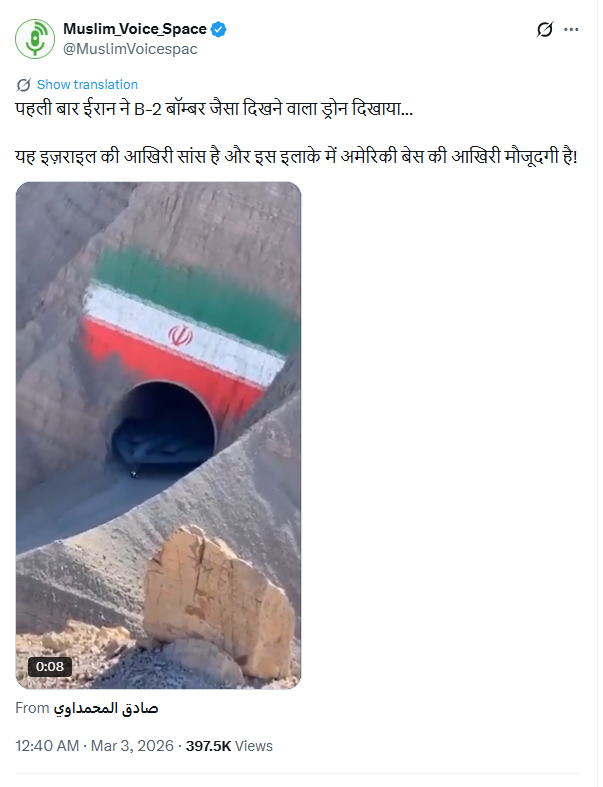
Fact Check
To verify the claim, we first closely examined the viral video. In the opening moments of the clip, the wing of the alleged drone appears to hit the side of the cave while exiting. Despite the apparent collision, the aircraft continues flying smoothly without any visible damage. This unusual detail raised doubts about the authenticity of the footage.
We then analyzed the video using the AI detection tool Hive Moderation, which flagged the clip as likely AI-generated.

Further analysis using the Sightengine AI detection tool also suggested that the video was artificially created. The tool estimated a 75% probability that the footage was generated using AI. It also indicated a 70% likelihood that the clip may have been created using Sora, an AI video-generation tool.

Conclusion
The viral video claiming to show an Iranian drone resembling the US B-2 stealth bomber emerging from a cave is not authentic. Analysis indicates that the clip was created using AI tools and is being misleadingly shared in the context of the ongoing conflict.

Introduction
Have you ever wondered how the internet works? Yes, there are screens and wires, but what’s going on beneath the surface? Every time you open a website, send an email, chat on messaging apps, or stream movies, you’re relying on something you probably don’t think about: the TCP/IP protocol suite. Without it, the internet as we know it wouldn’t exist. Let’s take a look at why this unassuming set of rules allows us to connect to anyone anywhere in the world.
The Problem: Networks That Couldn't Talk to Each Other
The internet is widely called a network of networks. A network is a group of devices that are connected and can share data with each other.
Researchers and governments began building early computer networks in the 1960s and 70s. But as the Cold War intensified, the U.S. military felt the need to establish a robust data-sharing infrastructure through interconnected networks that could withstand attacks. At the time, each network had different standards and protocols, which meant getting networks to communicate wasn’t easy or efficient. One network would have to be subsumed into another. This would lead to major problems in the reliability of data relay, flexibility of including more nodes, scalability of the interconnected network, and innovation.
The Breakthrough: Open Architecture Networking
This changed in the 1970s, when Bob Kahn proposed the concept of open architecture networking. It was a simple but revolutionary idea. He envisioned a system where all networks could talk to each other as equals. In this conceptualisation, all networks, even though unique in design and interface, could connect as peers to facilitate end-to-end communication. End-to-end communication helps deliver data between the source and destination without relying on intermediate nodes to control or modify it. This helps to make data relay more reliable and less prone to errors.
Along with Vint Cerf, he developed a network protocol, the TCP/IP suite, that would go on to enable different networks across satellite, wired, and non-wired domains to communicate with one another.
What Is TCP/IP?
TCP/IP stands for Transmission Control Protocol / Internet Protocol. It’s a set of communication rules that allow computers and devices to exchange information across different networks.
It’s powerful because:
- Layered and open architecture: Each function (like data delivery or routing) is handled by a specific layer. This modular design makes it easy to build new technologies like the World Wide Web or streaming services on top of it.
- Decentralisation: There's no single point of control. Any device can connect to another across the internet, making it scalable and resilient.
- Standardisation: TCP/IP works across all kinds of hardware and operating systems, making it truly universal.
The Core Components
- TCP (Transmission Control Protocol): Ensures that data is delivered accurately and in order. If any piece is lost or duplicated, TCP handles it.
- IP (Internet Protocol): Handles addressing and routing. It decides where each packet of data should go and how it gets there.
- UDP (User Datagram Protocol): A lightweight version of TCP, used when speed is more important than accuracy, such as for video calls or online gaming.
Why It Matters
The TCP/IP protocol suite introduced a set of standardised guidelines that enable networks to communicate, thereby laying the foundation of the Internet. It has made the Internet global, open, reliable, interoperable, scalable, and resilient, — features because of which the Internet has come to become the backbone of modern communication systems. So the next time you open a browser or send a message, remember: it’s TCP/IP quietly making it all possible.
References
- https://www.techtarget.com/searchnetworking/definition/ARPANET
- https://www.internetsociety.org/internet/history-internet/brief-history-internet/
- https://www.geeksforgeeks.org/tcp-ip-model/
- https://www.oreilly.com/library/view/tcpip-network-administration/0596002971/ch01.html
