
#FactCheck - Fake Quote Attributed To Manoj Tiwari On Rupee-Dollar Value Goes Viral Online
Executive Summary
A postcard featuring BJP leader Manoj Tiwari is being widely shared on social media with a purported statement attributed to him. The viral postcard claims that Tiwari suggested that if people stopped using the ₹1 coin and treated ₹2 as ₹1, the value of the dollar would automatically come down to ₹45. Users are sharing the post claiming that the BJP leader made the bizarre suggestion to strengthen the Indian rupee against the US dollar.
However, research by the CyberPeace Research Wing found the claim to be false. Manoj Tiwari never made any such statement regarding the rupee and the dollar. The BJP MP himself has dismissed the viral claim as fake.
Claim
TMC leader Kirti Azad shared the viral postcard on X and wrote, “As received on X, forwarded as it is. India is truly blessed with such brilliant minds.”
https://x.com/KirtiAzaad/status/2055905987115233473?s=20

Fact Check
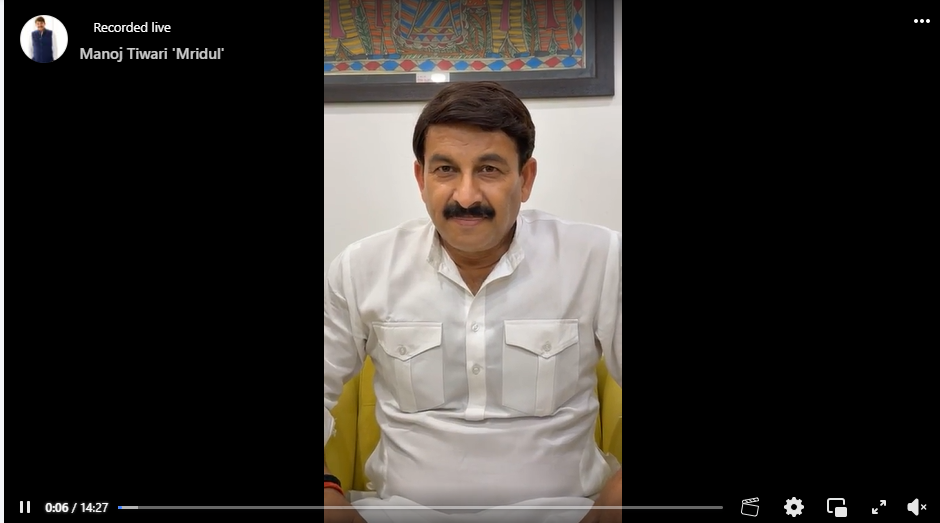
A keyword search on Google did not yield any credible media reports suggesting that Manoj Tiwari had made such a statement. No reliable source was found to support the viral claim. Further research led to a clarification posted on Manoj Tiwari’s official Facebook page. In the video statement, Tiwari categorically denied making any such remark about the rupee and the dollar. He stated that the viral claim being circulated in his name was completely fake.
Manoj Tiwari’s clarification video on Facebook
Conclusion
The viral claim is false. Manoj Tiwari never made any statement suggesting that stopping the use of ₹1 and treating ₹2 as ₹1 would strengthen the rupee against the dollar. He has himself denied the claim and called it fake.

Related Blogs
Executive Summary
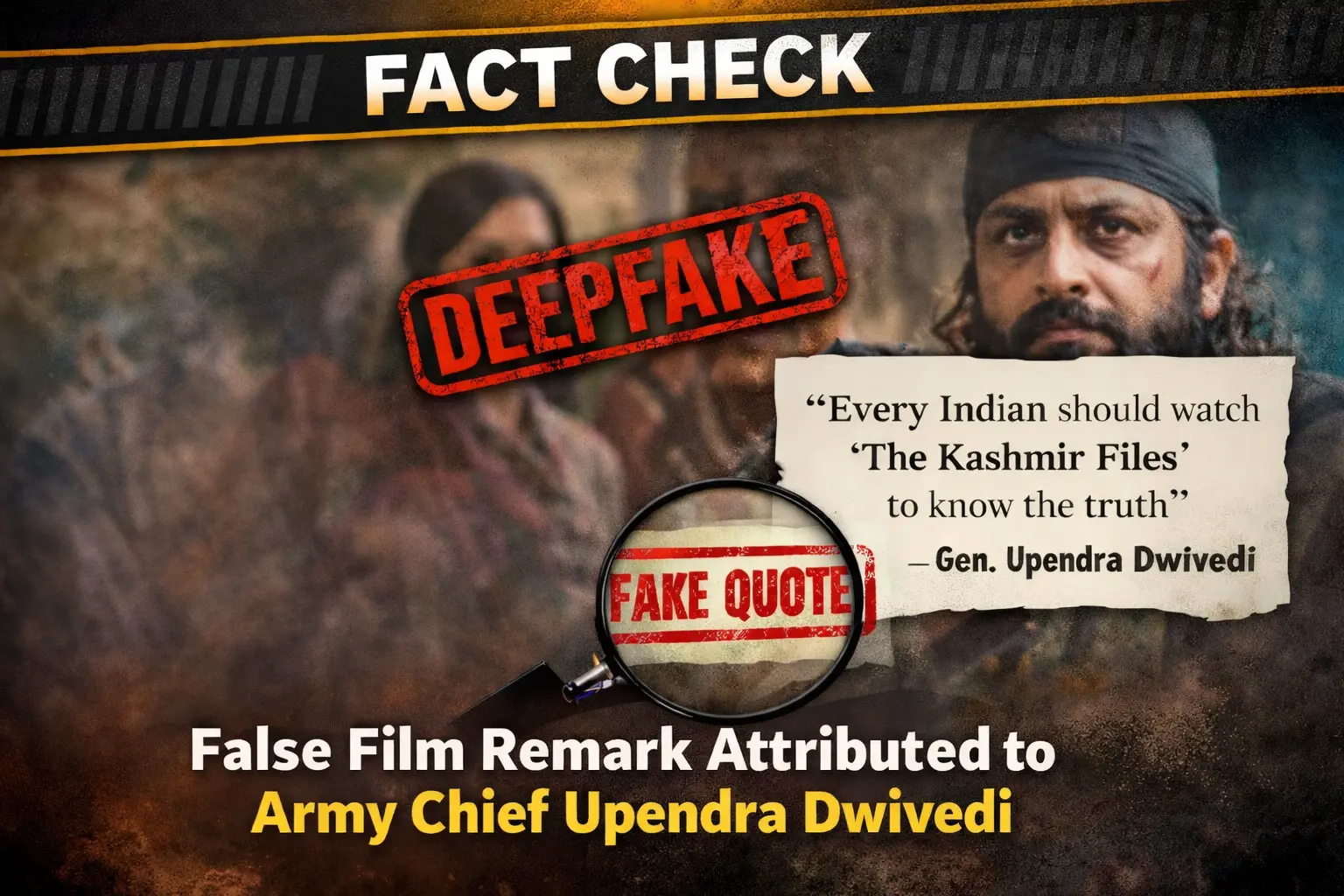
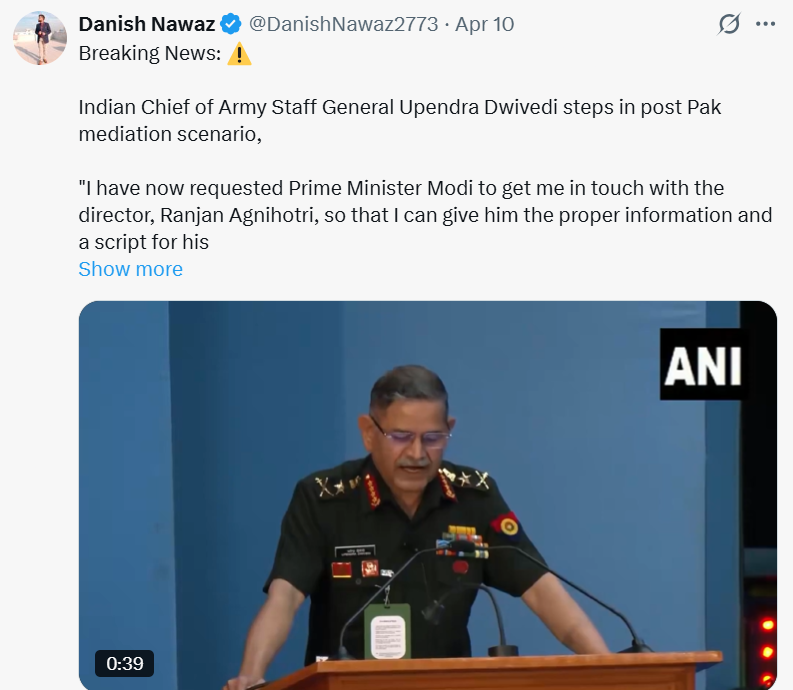
A video circulating on social media, shared by a Pakistani account, claims to show Indian Army Chief General Upendra Dwivedi making a controversial statement. In the clip, he is allegedly heard saying that he requested Prime Minister Narendra Modi to connect him with film director Ranjan Agnihotri so he could provide inputs and a script for a movie on “Operation Sindoor.”
However, research by CyberPeace has found that the viral video is an AI-generated deepfake. General Upendra Dwivedi has made no such statement.
Claim
A Pakistani user shared the viral video on X (formerly Twitter) on April 10, 2026, making the above claim.
Post links:
- https://x.com/DanishNawaz2773/status/2042312967811973225?s=20
- https://archive.ph/kAwoR
Fact Check
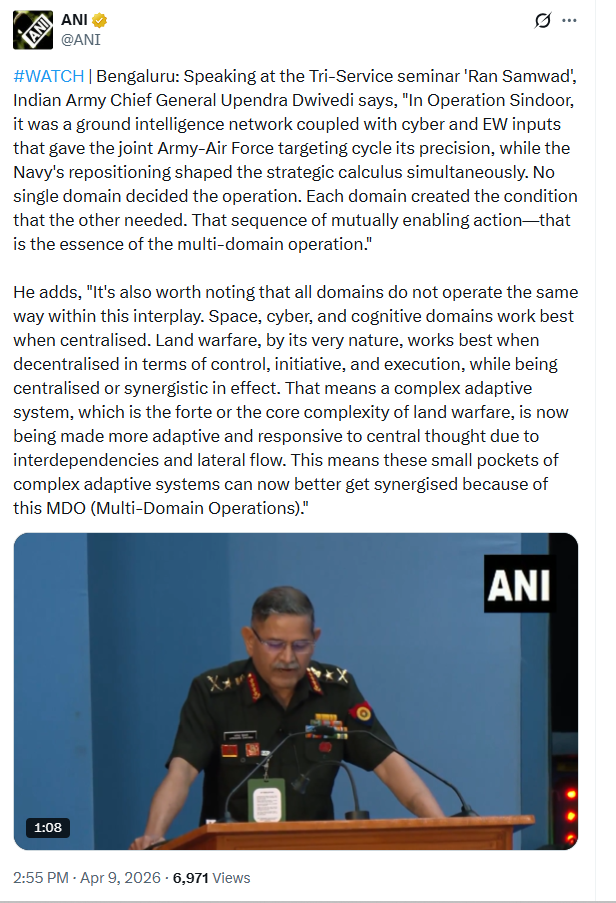
To verify the claim, we conducted keyword searches on Google but found no credible media reports supporting it. Further research led us to the original video posted on the X account of ANI. In this authentic clip, General Upendra Dwivedi is seen speaking at the ‘Ran Samwad’ seminar held in Bengaluru.
In the original video, he discusses the operational aspects of “Operation Sindoor,” including ground intelligence, cyber and electronic warfare inputs, Pakistan’s behaviour, and the challenges of a two-front scenario. There is no mention whatsoever of Pakistan mediation, Prime Minister Modi, Ranjan Agnihotri, any movie script, or a film based on Operation Sindoor.
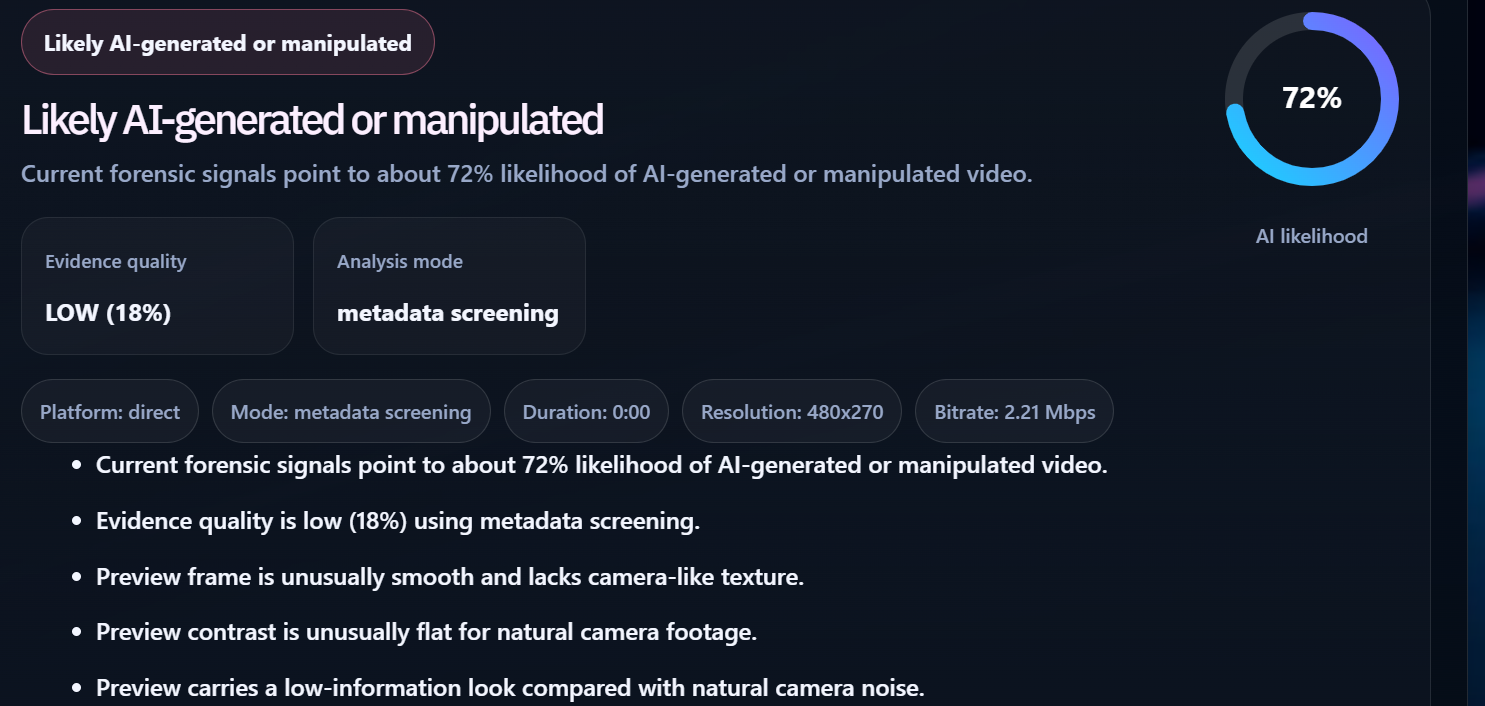
This clearly indicates that the viral clip has been manipulated and taken out of context. The video was further analyzed using the AI detection tool DetectVideo AI, which indicated a 72% probability that the content is AI-generated. This strongly supports the conclusion that the video is a deepfake.
Conclusion
The viral claim is false. The video featuring General Upendra Dwivedi has been digitally altered using AI techniques to insert fabricated statements. The original footage is from the ‘Ran Samwad’ seminar in Bengaluru, where he spoke about military strategy and multi-domain operations, not about any film or director. There is no evidence to suggest that he made any statement regarding contacting a filmmaker or contributing to a movie script. The inclusion of such references in the viral clip is entirely fabricated. This case highlights how AI-generated deepfakes are increasingly being used to spread misinformation, especially in sensitive contexts involving the military and international relations. Viewers are advised to rely on verified sources and exercise caution before sharing such content.

Introduction
In today's era of digitalised community and connections, social media has become an integral part of our lives. we use social media to connect with our friends and family, and social media is also used for business purposes. Social media offers us numerous opportunities and ease to connect and communicate with larger communities. While it also poses some challenges, while we use social media, we come across issues such as inappropriate content, online harassment, online stalking, account hacking, misuse of personal information or data, privacy issues, fake accounts, Intellectual property violation issues, abusive and dishearted content, content against the terms and condition policy of the platform and more. To deal with such issues, social media entities have proper reporting mechanisms and set terms and conditions guidelines to effectively prevent such issues and by addressing them in the best possible way by platform help centre or reporting mechanism.
The Role of Help Centers in Resolving User Complaints:
The help centres are established on platforms to address user complaints and provide satisfactory assistance or resolution. Addressing user complaints is a key component of maintaining a safe and secure digital environment for users. Platform-centric help centres play a vital role in providing users with a resource to seek assistance and report their issues.
Some common issues reported on social media:
- Reporting abusive content: Users can report content that they find abusive, offensive, or in violation of platform policies. These reports are reviewed by the help centre.
- Reporting CSAM (Child Sexual Abuse Material): CSAM content can be reported to platform help centre. Social media platforms have stringent policies in place to address such concerns and ensure a safe digital environment for everyone, including children.
- Reporting Misinformation or Fake News: With the proliferation of misinformation online, users can report content that they find or suspect misleading or false information and Fact-checking bodies are employed to assess the accuracy of reported content.
- Content violating intellectual property rights: If there is a violation or infringement of any intellectual property work, it can be reported on the platform.
- Violence of commercial policies: Products listed on social media platforms are also needed to comply with the platform’s Commercial Policies.
Submitting a Complaint to the Indian Grievance Officer for Facebook:
A user can report his issue through the below-mentioned websites:
The user can go to the Facebook Help Center, where go to the "Reporting a Problem” section, then by clicking on Reporting a Problem, Choose the Appropriate Issue that best describes your complaint. For example, if you have encountered inappropriate or abusive content, select the ‘I found inappropriate or abusive content’ option.
Here is a list of issues which you can report on Facebook:
- My account has been hacked.
- I've lost access to a page or a group I used to manage.
- I've found a fake profile or a profile that's pretending to be me.
- I am being bullied or harassed.
- I found inappropriate or abusive content.
- I want to report content showing me in nudity/partial nudity or in a sexual act.
- I (or someone I am legally responsible for) appear in content that I do not want to be displayed.
- I am a law enforcement official seeking to access user data.
- I am a government official or a court officer seeking to submit an order, notice or direction.
- I want to download my personal data or report an issue with how Facebook is processing my data.
- I want to report an Intellectual Property infringement.
- I want to report another issue.
Then, describe your issues and attach supporting evidence such as screenshots, then submit your report. After submitting a report, you will receive a confirmation that your report has been submitted to the platform. The platform will review the complaint within the stipulated time period, and users can also check the status of their filed complaint. Appropriate action will be taken by platforms after reviewing such complaints. If it violates any standard policy, terms & conditions, or privacy policies of the platform, the platform will take down that content or will take any other appropriate action.
Conclusion:
It is important to be aware of your rights in a digital landscape and report such issues to the platform. It is essential to understand how to report your issues or grievances on social media platforms effectively. By using the help centre or reporting mechanism of the platform, users can effectively file their complaints on the platform and contribute to a safer and more responsible online environment. Social media platforms have their compliance framework and privacy and policy guidelines in place to ensure the compliance framework for community standards and legal requirements. So, whenever you encounter an issue on social media, report it on the platform and contribute to a safer digital environment on social media platforms.
References:
- https://www.cyberyodha.org/2023/09/how-to-submit-complaint-to-indian.html
- https://transparency.fb.com/en-gb/enforcement/taking-action/complaints-handling-process/
- https://www.facebook.com/help/contact/278770247037228
- https://www.facebook.com/help/263149623790594

Introduction
According to a draft of the Digital Personal Data Protection Bill, 2023, the Indian government may have the authority to reduce the age at which users can agree to data processing to 14 years. Companies requesting consent to process children’s data, on the other hand, must demonstrate that the information is handled in a “verifiably safe” manner.
The Central Government might change the age limit for consent
The proposed Digital Personal Data Protection Bill 2022 in India attempts to protect child’s personal data under the age of 14 through several provisions. The proposed lower age of consent in India under the Digital Personal Data Protection Bill 2022 is to loosen relevant norms and fulfil the demands of Internet corporations. After a year, the government may reconsider the definition of a child with the goal of expanding coverage to children under the age of 14. The proposed shift in the age of consent has elicited varied views, with some experts suggesting that it might potentially expose children to data processing concerns.
The definition of a child is understood to have been amended in the data protection Bill, which is anticipated to be submitted in Parliament’s Monsoon session, to an “individual who has not completed the age of eighteen years or such lower age as the central government may notify.” A child was defined as an “individual who has not completed eighteen years of age” in the 2022 draft.
Under deemed consent, the government has also added the 'legitimate business interest' clause
This clause allows businesses to process personal data without obtaining explicit consent if it is required for their legitimate business interests. The measure recognises that corporations have legitimate objectives, such as innovation, that can be pursued without jeopardising privacy.
Change in Data Protection Boards
The Digital Personal Data Protection Bill 2022, India’s new plan to secure personal data, represents a significant shift in strategy by emphasising outcomes rather than legislative compliance. This amendment will strengthen the Data Protection Board’s position, as its judgments on noncompliance complaints will establish India’s first systematic jurisprudence on data protection. The Cabinet has approved the bill and may be introduced in Parliament in the Monsoon session starting on July 20.
The draft law leaves the selection of the Data Protection Board’s chairperson and members solely to the discretion of the central government, making it a central government set-up board. The government retains control over the board’s composition, terms of service, and so on. The bill does specify, however, that the Data Protection Board would be completely independent and will have a strictly adjudicatory procedure to adjudicate data breaches. It has the same status as a civil court, and its rulings can be appealed.
India's first regulatory body in Charge of preserving privacy
Some expected amendments to the law include a blacklist of countries to which Indian data cannot be transferred and fewer penalties for data breaches. The bill’s scope is limited to processing digital personal data within Indian territory, which means that any offline personal data and anything not digitised will be exempt from the legislation’s jurisdiction. Furthermore, the measure is silent on the governance of digital paper records.
Conclusion
The Digital Personal Data Protection Bill 2022 is a much-needed piece of legislation that will replace India’s current data protection regime and assist in preserving individuals’ rights. Central Government is looking for a change in the age for consent from 18 to 14 years. The bill underlines the need for verifiable parental consent before processing a child’s personal data, including those under 18. This section seeks to ensure that parents or legal guardians have a say in the processing of their child’s personal data.
