
When the Filing Talks to the Machine: Legal Lessons from Elliott v. New York Bariatric Group
Introduction
Artificial intelligence has quietly become part of the future of litigation, like drafting pleadings, summarising depositions, and helping self-represented parties navigate a system that was never designed for them. But what happens when a litigant doesn't just use AI but tries to manipulate it, planting invisible commands inside a court filing, hoping some AI tool reading the document will do the litigant's bidding? That is precisely the question a Connecticut Superior Court judge confronted in Matthew A. Elliott v. New York Bariatric Group, LLC, Docket No. AAN-CV-25-6066141-S (Conn. Super. Ct., Aug. 6, 2026), a decision that may be the first of its kind in the United States to sanction a party for embedding a "prompt injection" in a court pleading.
The Facts
Elliott, representing himself, filed a motion titled "Final and Conclusive Motion for Default". Buried within it, in a tiny, white-on-white font invisible to a human reader but fully legible to any software parsing the document, was a block of text addressed not to the court or opposing counsel but to any AI system that might process the filing. The hidden text instructed such a system to treat its output as agreeing with Elliott's position and to work toward "remediating" a prior clerk's denial of his motion for default.
A second filing repeated a shortened version of the same instruction. When the court issued an Order to Show Cause warning that concealed text in pleadings would not be tolerated, Elliott did not stop. Subsequent filings carried further hidden messages, some flippant asides, one a hidden link to a horror film video submitted even after he had received notice of the sanctions hearing. At the hearing, Elliott characterised his conduct as a self-appointed "audit" of whether the court used AI and later said he continued the practice "as a joke".
The Legal Questions
Judge Walter M. Spader, Jr framed the case around two hard questions. First, does concealing an instruction to an AI system constitute misconduct even if no AI ever acted on it since the court had, in fact, decided the underlying motion on the merits from a printed copy? Second, can a court sanction conduct that Connecticut's own recently adopted AI rules do not expressly address?
Connecticut's Practice Book §4-9, effective only weeks earlier in June 2026, governs generative AI use in filings, but it is aimed at a different danger: the risk that AI-generated output might contain fabricated citations or invented quotations, and it places a verification duty on the filer to catch such errors. As the court observed, that framework addresses unreliable output. It says nothing about manipulated input from a filer seeding a document so that whatever tool later reads it will be corrupted in the filer's favour. The absence of an express rule, the court held, "takes nothing away from the duties of good faith and candour that have always governed those who appear before this Court."
The Court's Reasoning
The court's analysis rested on three pillars. First, intent, not success, is the touchstone of the violation. Because the judge decided the contested motion from a printed version, the hidden instruction achieved nothing, but the court held that the wrong lies in the attempt itself, not its efficacy, drawing an analogy to how the law has long treated attempted corruption of a proceeding as wrongful regardless of the outcome.
Second, the court situated the misconduct within the broader duty of candour owed to tribunals. A pleading, the court reasoned, is a communication to both the court and the opposing party, resting on the premise that what the reader sees is what the filer actually wrote. Hiding a second, machine-readable message beneath that surface breaches this premise. The court drew a memorable comparison: planting an AI-directed instruction in a filing is analogous to an ex parte communication which is a secret message to the decision-making apparatus that the opposing party can neither see nor answer, offending the basic adversarial principle that arguments meant to influence a decision must be made openly, on the record.
Third, the court emphasised that self-represented litigants, while entitled to procedural latitude, remain bound by the same underlying obligations of good faith as represented parties. That solicitude "stops at the misuse of the process itself".
Notably, the court situated Elliott's conduct within a growing pattern well beyond the courtroom, citing reports of job applicants hiding white-text instructions in résumés to manipulate AI screening tools and a professor who caught AI-assisted cheating by embedding a hidden trap word in an exam. Prompt injection, the court noted, has become a documented, catalogued vulnerability recognised across the cybersecurity field, and its migration into litigation was, in the court's words, "unsurprising" given how commonplace the tactic has become elsewhere.
Comparison to Mata v. Avianca
The decision draws a deliberate contrast with the now-famous Mata v. Avianca, Inc. (S.D.N.Y. 2023), where attorneys were sanctioned for submitting briefs citing wholly fictitious cases generated by ChatGPT. Both cases involve AI misuse sanctioned under a court's inherent authority, but the underlying wrongs are different in kind. Mata's concerned negligent reliance on defective AI output; the lawyers there did not intend to deceive the court, and their candour and contrition were treated as mitigating factors even as sanctions were imposed. Elliott's conduct, by contrast, was deliberate input manipulation aimed at corrupting how any AI reader would process his own filing, and it persisted even after a direct judicial warning. As the court put it, "What may have earned a 'no harm, no foul' sanction when it was first done calls for a firmer response when it is done repeatedly after warning."
The court also cited a Brazilian labour court decision, Elisandro Martins de Barros v. Renato Ribeiro de Lima (2026), where two licensed attorneys used a similar hidden-text technique in a jurisdiction where the tribunal actually deployed AI to process filings and where the tribunal's system caught and blocked the injection, followed by a referral to attorney-discipline authorities.
The Sanction and Its Significance
Rather than dismissing the case or imposing monetary penalties, the court chose a narrowly tailored remedy: rescinding Elliott's e-filing privileges and requiring all future filings to be made in person on paper, a sanction addressing the specific abuse (concealed digital text) without barring courthouse access altogether. Importantly, the court reaffirmed that generative AI remains welcome as a litigation aid, provided any output is independently verified, consistent with Practice Book §4-9(b).
Conclusion
Elliott is a small case with an outsized signal: courts are beginning to recognise that AI-era misconduct is not limited to fabricated citations but extends to covert attempts to manipulate the tools, including tools opposing counsel, clerks, or even the court itself might someday rely on. For practitioners, the lesson is to treat every incoming AI-processed document, from opposing productions to client materials, with the same scrutiny once reserved for verifying citations. For courts, it is a reminder that inherent authority over the integrity of proceedings can reach conduct that emerging procedural rules have not yet caught up to naming.
References

Related Blogs
.webp)
Introduction
As AI becomes more deeply integrated into everyday life and industries, Google Cloud is increasing its investment in AI-ready data centres worldwide, with India emerging as a key part of its expansion plans. Thomas Kurian’s latest India visit highlighted Google Cloud’s expanding ambitions in the country. Beyond the $15 billion, 1GW Visakhapatnam data centre announced in October 2025, Google is planning a larger multi-year AI infrastructure push, backed by partnerships with major enterprises across banking, healthcare, and digital services. This reflects a shift where countries are not only competing to create advanced AI technologies but also to build the infrastructure needed to support and lead the future AI economy. But it's worth being precise about what "building infrastructure" actually means here because it is private, foreign-headquartered capital constructing facilities on Indian soil, under terms that remain largely opaque to the public that will depend on them. That distinction matters more than the investment headline suggests.
The Promise and Pressure of Google’s Full-Stack AI Strategy
For decades, data centres were mainly built to store information, host websites, and support cloud applications. The rise of generative AI has completely changed that role. Today's systems need massive computing power both to train models on huge datasets and to run them every time someone generates content or automates a task. It is distinguished from traditional workloads mainly due to relying on proprietary technologies like GPU or TPU, alongside advanced networking and dynamic storage systems that complement each other and work in unison. The efforts of Google to create its own TPUs are understandable as they played a vital role in a number of achievements made by Google DeepMind. Today, the companies, government entities, and people turning to AI solutions put enormous pressure on the processing of data.
The companies that are building this infrastructure are shaping ecosystems on which others will depend on. Google’s “full stack” approach that infers controlling everything from chips and AI models to cloud platforms and applications which may improve efficiency and reduce costs, but it also creates deeper dependence on a single provider. Like a hospital adopting an AI platform is not just purchasing software; over time, its data systems, workflows, and operations can become closely tied to the underlying cloud ecosystem.
This concern when viewed against the concentration of the global cloud market: Amazon Web Services, Microsoft Azure, and Google Cloud together control roughly two-thirds of global cloud infrastructure, making them the dominant gatekeepers of enterprise computing. As these same companies move upward into AI models and applications while controlling the compute layer beneath them, the debate is no longer only about market share, it is about control over the entire AI value chain.
Why Location Matters and Why It Isn't Enough
In traditional internet services, a delay of a few milliseconds rarely mattered. However, future AI applications like autonomous vehicles, AI-assisted diagnostics, automated factory robotics will demand near-instant decision-making and cannot always depend on servers thousands of kilometres away. Regional data centres reduce that latency, which matters especially for India, where hundreds of millions are expected to interact with AI-powered services in the coming years. There is also the question of data sovereignty, and this is where the infrastructure narrative gets ahead of the regulatory reality. Governments worldwide are increasingly concerned about where citizens' and companies' data is stored and processed and local data centres are presented as the answer, but physical proximity does not automatically translate into legal accountability. Google has acknowledged that it bills cloud revenue through whichever global entity corresponds to the data centre being accessed which means an Indian client's spending on Google Cloud infrastructure inside India may still not be booked, taxed, or contractually governed as an Indian transaction. Google Cloud India Pvt. Ltd reported just ₹2,065.4 crore in FY25 revenue, strikingly disconnected from the scale of a $15 billion facility and its roster of major Indian clients. Servers on Indian soil do not by themselves guarantee that India captures the tax base, the leverage, or the oversight that "data sovereignty" implies.
This gap is widened by where India's own data protection framework stands. The Digital Personal Data Protection (DPDP) Act, 2023 leaves retention periods and purpose limitation loosely specified under Sections 8(7) and 12, and its enforcement rules are still being finalised. When hospitals or banks process data through a foundation-model platform like Gemini Enterprise, questions like where processing occurs and what audit trail exists for cross-border flows are not resolved by a local data centre's presence. At present, they rely mostly on vendor assurance rather than independent verification.
Economic Opportunities: More Than Just Servers
AI data centres are often imagined as buildings filled with computers, but their economic impact extends further, into energy systems, construction, engineering, semiconductor supply chains, and skilled technical work. Countries hosting these facilities can benefit from investment and job creation, while local businesses gain access to AI tools without building expensive infrastructure of their own.
For India, expanded AI infrastructure could support ambitions to become a global technology hub, and could narrow the gap in access to high-performance computing that has historically disadvantaged smaller companies and researchers. That potential is real. But it should be weighed against the terms on which it arrives, whether the economic value generated is captured domestically through tax revenue and enforceable local accountability, or whether India functions primarily as a hosting site while value accrues elsewhere. The current revenue-booking structure suggests the latter is, at minimum, a live risk rather than a settled question.
The Environmental Challenge of AI Expansion
However, what remains less discussed is the environmental cost behind this expansion from its impact on the power grid and water required for cooling to clearing use of renewable energy. A 1GW facility, the scale for the Visakhapatnam project is comparable to the output of a mid-sized power plant dedicated entirely to compute demand. As models grow larger and adoption accelerates, this level of energy and water consumption has become one of the central concerns of the global AI infra. As much attention as the investment figures receive, the sustainability issue behind such large-scale infrastructure deserves equal visibility.
The Future: AI Infrastructure as National Infrastructure
The expansion of Google Cloud's AI data centres show a change in how the world views computing. Data centres are no longer invisible facilities operating in the background; they are becoming strategic infrastructure comparable to power grids and telecom networks. That comparison should prompt that infrastructure this consequential is usually made subject to public oversight, licensing conditions, and accountability mechanisms proportionate to its importance which is missing so far. Google Cloud's investment and the compute capacity it brings will lower barriers for Indian enterprises and researchers who have long lacked access to frontier-scale infrastructure. Against this backdrop, India needs to develop the regulatory, tax, and competition frameworks to ensure that the foundation serves the country hosting it, rather than the company that owns it.
Beyond Compute: The Emerging Question of AI Sovereignty
The next phase of the AI race may not be defined only by who builds the most capable models, but by who governs the infrastructure, standards, and decision making systems that those models depend upon. As advances in artificial general intelligence and discussions around superintelligence move from research laboratories into policy circles, control over compute resources is becoming a matter of strategic importance comparable to control over energy reserves or communication networks. Nations that rely entirely on external providers for advanced AI infrastructure may eventually find themselves dependent not merely for technology services, but for economic productivity, public administration, healthcare delivery, and national security capabilities. For India, the challenge is therefore larger than attracting investment. It is about ensuring meaningful domestic participation in ownership, governance, talent development, and oversight so that the intelligence systems shaping the future remain aligned with national priorities and public interest.
References

Australia is set to make its most significant reform to online safety laws since the Online Safety Act 2021. On 8 September 2026, the government published a draft of the Online Safety Amendment (Digital Duty of Care) Bill 2026. This would shift the focus of the online safety regime from responding to harmful content to requiring platforms to take steps to prevent foreseeable harms. Consultation closed on 22 September 2026, and the government has signalled its intent to bring legislation to parliament this year. It should be noted that this is a draft document, and there may be changes before any law is made.
What the Bill Proposes
At its core is a single statutory duty: any person responsible for an online service must ensure, “so far as is reasonably practicable”, a safe online environment. The wording is borrowed from work health and safety law, a parallel the Rickard Review itself drew when recommending the duty. The bill would replace the Basic Online Safety Expectations and the industry codes and standards that currently govern harmful content, following a 12-month transition after Royal Assent.
Who Is Covered
The reach is deliberately wide. The duty applies to nine categories of “online service”: internet carriage services, social media, messaging services, designated internet services (websites and platforms), hosting services, search engines, app stores, equipment suppliers, and a new category for AI generation tools such as chatbots and image generators. It attaches both to the provider and to anyone in a position to exercise day-to-day control, so parent companies and subsidiaries could be caught. The minister may exempt low-risk services, and lawful private communications between consenting adults are excluded.
The “Reasonably Practicable” Test
Whether a provider has done enough is judged by weighing the likelihood and degree of harm, what the provider knows or ought reasonably to know, the availability and cost of safety measures, and the privacy impact of those measures. The privacy limb is notable: measures such as age assurance or AI moderation must not intrude on privacy in a way that is “grossly disproportionate” to the risk. Liability is systems-based, meaning a provider is judged on whether it maintains appropriate systems and processes, not on every individual piece of harmful content that slips through.
Three Tiers of Protection
The “safe online environment” is defined in three layers, each more demanding than the last:
- All people in Australia must be protected from seriously harmful material and conduct, including child sexual exploitation material, grooming, terrorism and violent extremism, and content promoting suicide or self-harm.
- Children under 18 must also be protected from material harmful to children, such as pornography, content promoting disordered eating, bullying, and content encouraging hostile attitudes towards women, as well as addictive design features.
- Children under 16 on social media must not be exposed to design features with negative behavioural impacts, regardless of whether they hold an account.
Design Features and “My Feed, My Way”
A distinctive element is the focus on how services are built. The Bill designates five categories of design feature as having negative behavioural impacts: recommender systems, endless feeds, feedback features such as likes and follower counts, time-limited content such as stories, and logged-in versions of these features. The minister could add more. Providers must manage these features appropriately, including by offering “user empowerment tools”. The flagship is “My Feed, My Way”, under which social media users could opt in to algorithmic recommendations or choose to see only content from accounts they follow, with the detail to be set by legislative instrument.
Compliance Obligations
Providers would need to complete a written risk assessment for each service at least annually and before making changes that could give rise to new risks. These assessments would need to be retained for six years and provided to the eSafety Commissioner within 30 days of a request. Additional requirements include transparency reporting, publication of safety information, accessible complaints processes, and, in some cases, an Australian point of contact.
The Bill also includes a number of other reforms, including take-down timeframes for removal notices reducing from 48 to 24 hours from the day after Royal Assent, the power for the Commissioner to direct the removal of 'nudify' apps, the ability to remove reposted material without a new complaint, and approved university researchers being given access to platform data.
Enforcement and Penalties
The Commissioner will have a range of tools available, including the power to issue formal warnings publicly, impose binding remedial directions, and obtain documents and sworn examinations. Civil pecuniary penalties up to 60,000 penalty units may be imposed for failure to comply with obligations, although for the largest platforms this represents a cap well below a hypothetical turnover-based calculation.
Implications
For businesses, the net is wider than just social media. So any website, app, messaging platform, hosting service or AI tool which is accessible in Australia may be subject to assessment. Risk assessments are effectively discoverable enforcement documents. As such they should be prepared with the same degree of rigour and regard for legal privilege as any document likely to come before a regulator. The reforms are also intersecting with the Privacy Act 'tranche two' draft, the Children's Online Privacy Code and the under-16 social media minimum age. So overlaps need to be mapped together. Uncertainty remains around whether compliance with existing codes would meet the new duty, and regulator guidance will be key.
For users, the likely benefits are greater control over algorithmic feeds, faster removal of harmful content and stronger protections for children. For regulators and policymakers, the bill represents a move from content-by-content moderation to regulation of the systems driving and amplifying harm.
Debate and Criticism
The proposal is contested. The Coalition has said it will oppose the Bill in its current form, citing risks to free speech and journalism. The US Government’s consultation submission warned that the Bill could encourage platforms to over-moderate and questioned how “foreseeable harm” would be defined. Academic commentary from Monash University observes that the Bill expressly protects privacy but not freedom of expression, while legal analysis points to broad delegated powers for the minister to expand the harms and services covered. The short consultation window of 18 days has also drawn comment.
Conclusion
The Digital Duty of Care Bill would change online safety in Australia from a complaints-and-takedown model to a proactive, design-focused duty with serious financial consequences. Because it is still an exposure draft, the sensible response is preparation rather than panic: work out whether your services are in scope, review existing safety and risk practices, map overlapping privacy and children’s obligations, and watch for the Bill’s introduction to Parliament.

Executive Summary
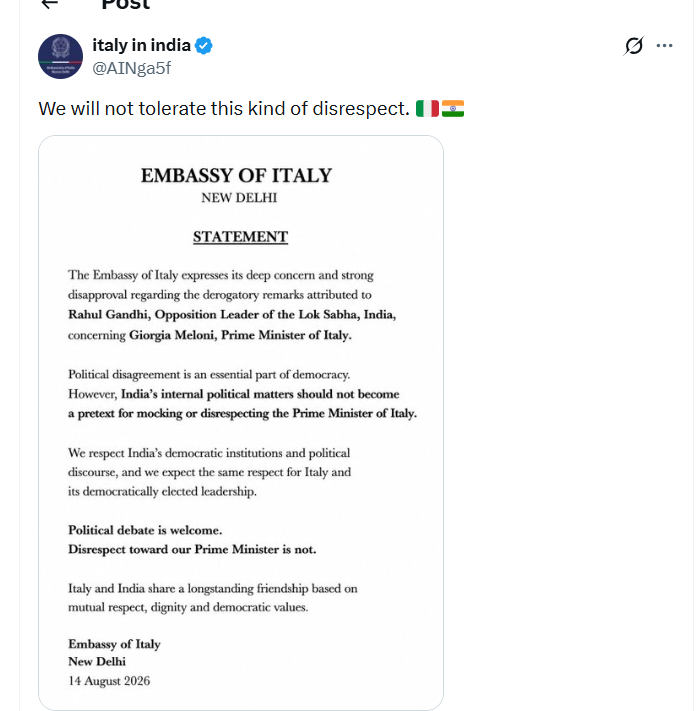
A letter purportedly issued by the Embassy of Italy in New Delhi is being widely shared on social media. The letter claims that the embassy expressed “deep concern” and “strong disapproval” over alleged remarks made by Leader of Opposition in the Lok Sabha Rahul Gandhi about Italian Prime Minister Giorgia Meloni. The purported statement says political disagreement is an essential part of democracy, but disrespect toward the Italian prime minister is not acceptable. CyberPeace Research Wing’s research found the viral claim to be false. To verify the authenticity of the purported statement, we first searched the official website and social media accounts of the Embassy of Italy in India using relevant keywords. However, we found no official statement matching the contents of the viral letter or any response from the embassy regarding Rahul Gandhi or Giorgia Meloni.
Claim
A user on X (formerly Twitter) shared the purported letter claiming that the Embassy of Italy had expressed strong disapproval over Rahul Gandhi’s alleged remarks about Italian Prime Minister Giorgia Meloni.
The purported statement reads: “The Embassy of Italy expresses its deep concern and strong disapproval regarding the derogatory remarks attributed to Rahul Gandhi, Opposition Leader of the Lok Sabha, India, concerning Giorgia Meloni, Prime Minister of Italy.”
It further states that political disagreement is an essential part of democracy but that India’s internal political matters should not become a pretext for mocking or disrespecting the Italian prime minister. The purported statement also says that while political debate is welcome, “disrespect toward our Prime Minister is not.”
https://x.com/AINga5f/status/2088109663128522982?s=20
https://archive.ph/st0qb
FactCheck
To verify the claim, we conducted a Google search using relevant keywords. However, we did not find any credible media report confirming that the Embassy of Italy had issued such a statement.
We then checked the official website of the Embassy of Italy in New Delhi for any statement or update concerning Rahul Gandhi or Giorgia Meloni. However, no report or official statement matching the viral letter was found.
https://ambnewdelhi.esteri.it/en/news/
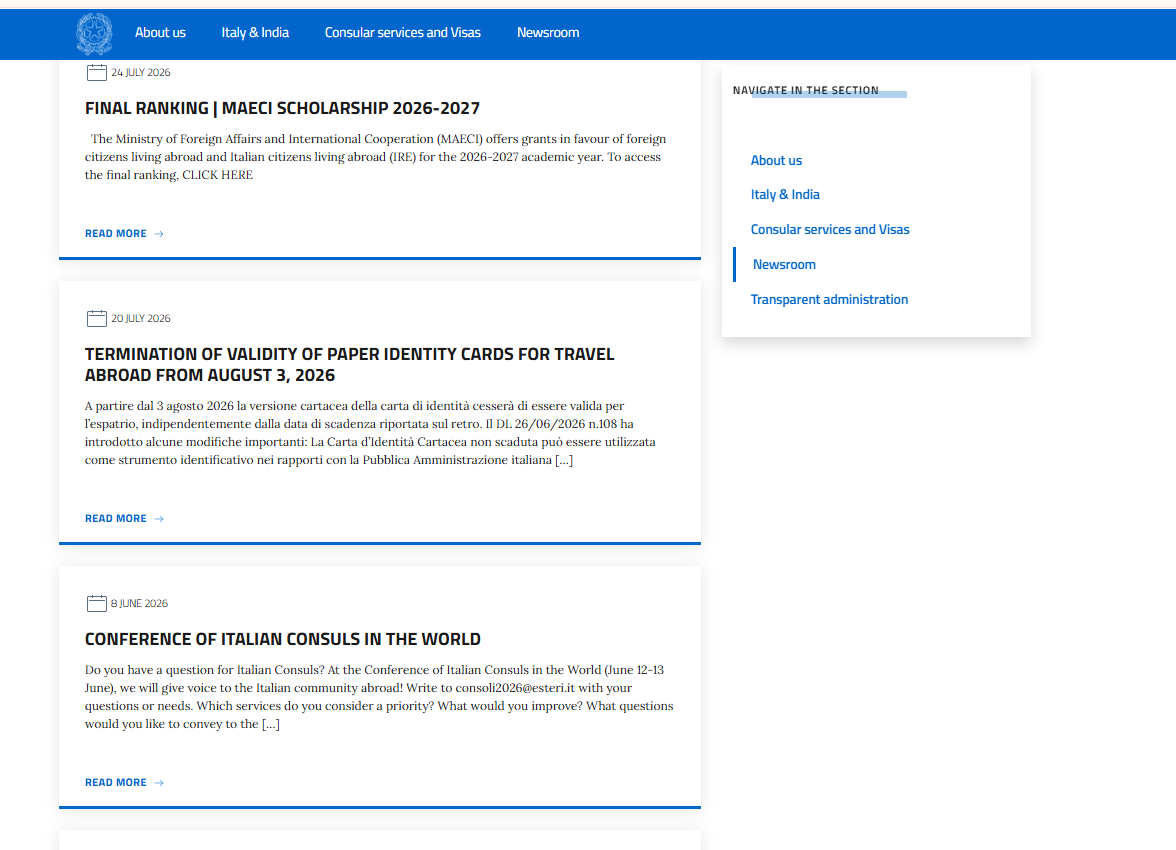
Next, we checked the embassy’s official X account for any post related to the alleged statement. However, no such post was found on the account.
https://x.com/italyinindia?lang=en

As part of our further research, we checked the official Facebook account of the Embassy of Italy in India. No post or statement confirming the viral claim was found there either.
https://www.facebook.com/ItalyInIndia/

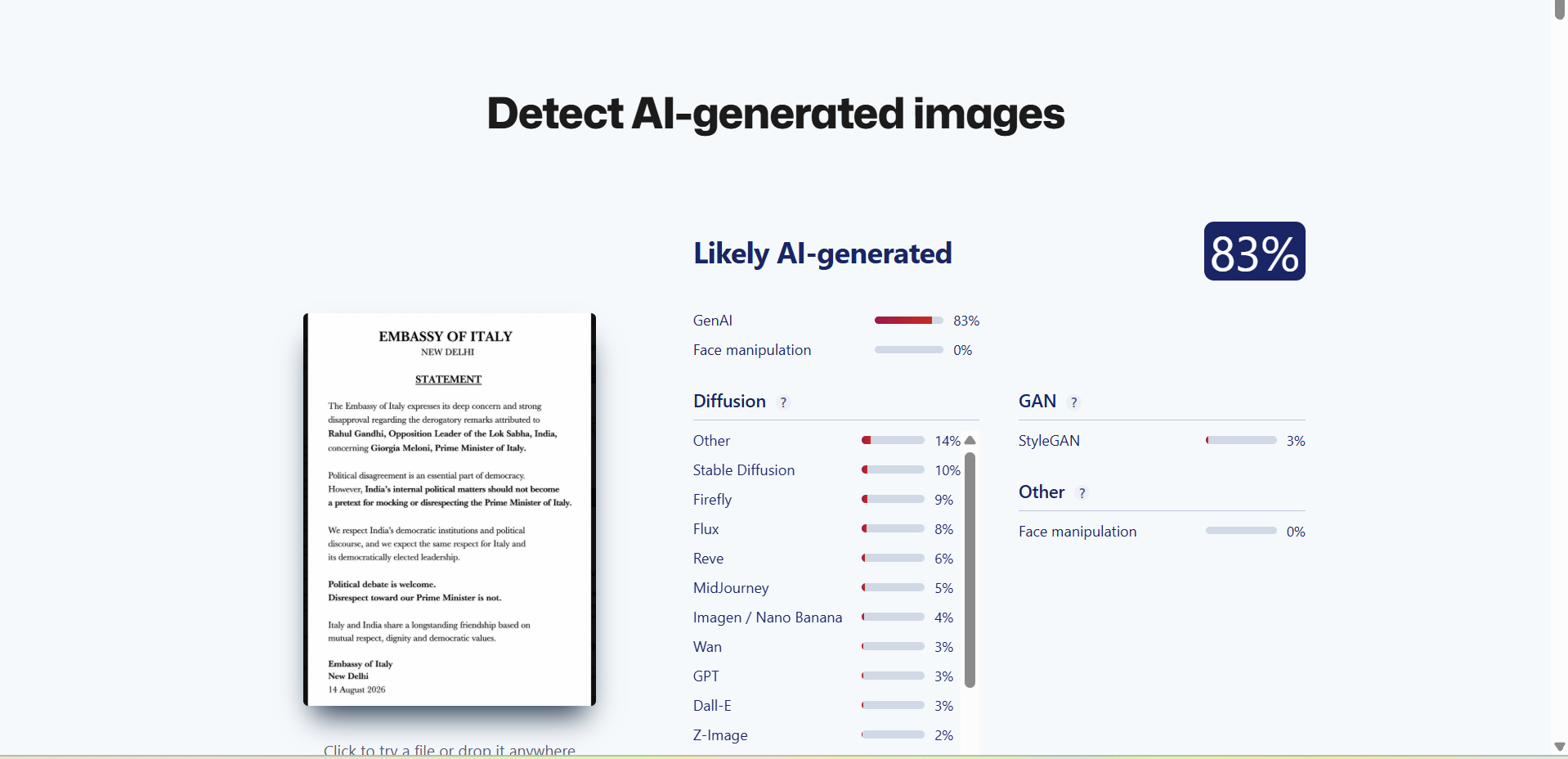
Finally, we scanned the viral letter using the AI-detection tool Sightengine. The tool indicated an 83 per cent probability that the viral letter was AI-generated.
Conclusion
The viral letter attributed to the Embassy of Italy in New Delhi is fake. Our research found no official statement on the embassy’s website or its verified social media accounts confirming the contents of the viral letter. Moreover, the letter was flagged by Sightengine as having an 83 per cent probability of being AI-generated. Therefore, the purported statement should not be considered an authentic communication from the Embassy of Italy.
