
#FactCheck - Viral Video Distorts Rahul Gandhi’s Speech to Push False Religious Claim
Executive Summary
A video of the Leader of the Opposition in the Lok Sabha and Congress MP Rahul Gandhi is being widely shared on social media. In the clip, Gandhi is seen saying that he does not know what “G Gram G” is. Several users are sharing the video with the claim that Rahul Gandhi insulted Lord Ram. However, CyberPeace research found that the claim is misleading. Rahul Gandhi was not referring to Lord Ram in the video. Instead, he was speaking about a newly introduced law titled Viksit Bharat–G RAM G (VB–G RAM G), which has been brought in to replace the Mahatma Gandhi National Rural Employment Guarantee Act (MGNREGA). The viral clip has been shared with a false narrative.
Claim
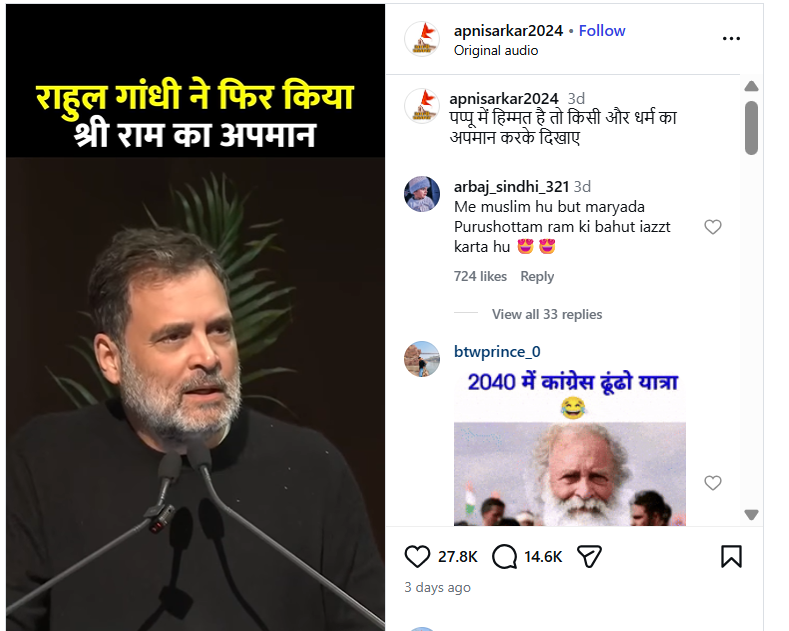
On January 22, 2026, an Instagram user apnisarkar2024 shared the video claiming, “Rahul Gandhi once again insulted Shri Ram.” (Link, archive link, and screenshot available above)
- https://www.instagram.com/reel/DTzeiy0k3l5
- https://perma.cc/J3A3-NGBM?type=standard
Research
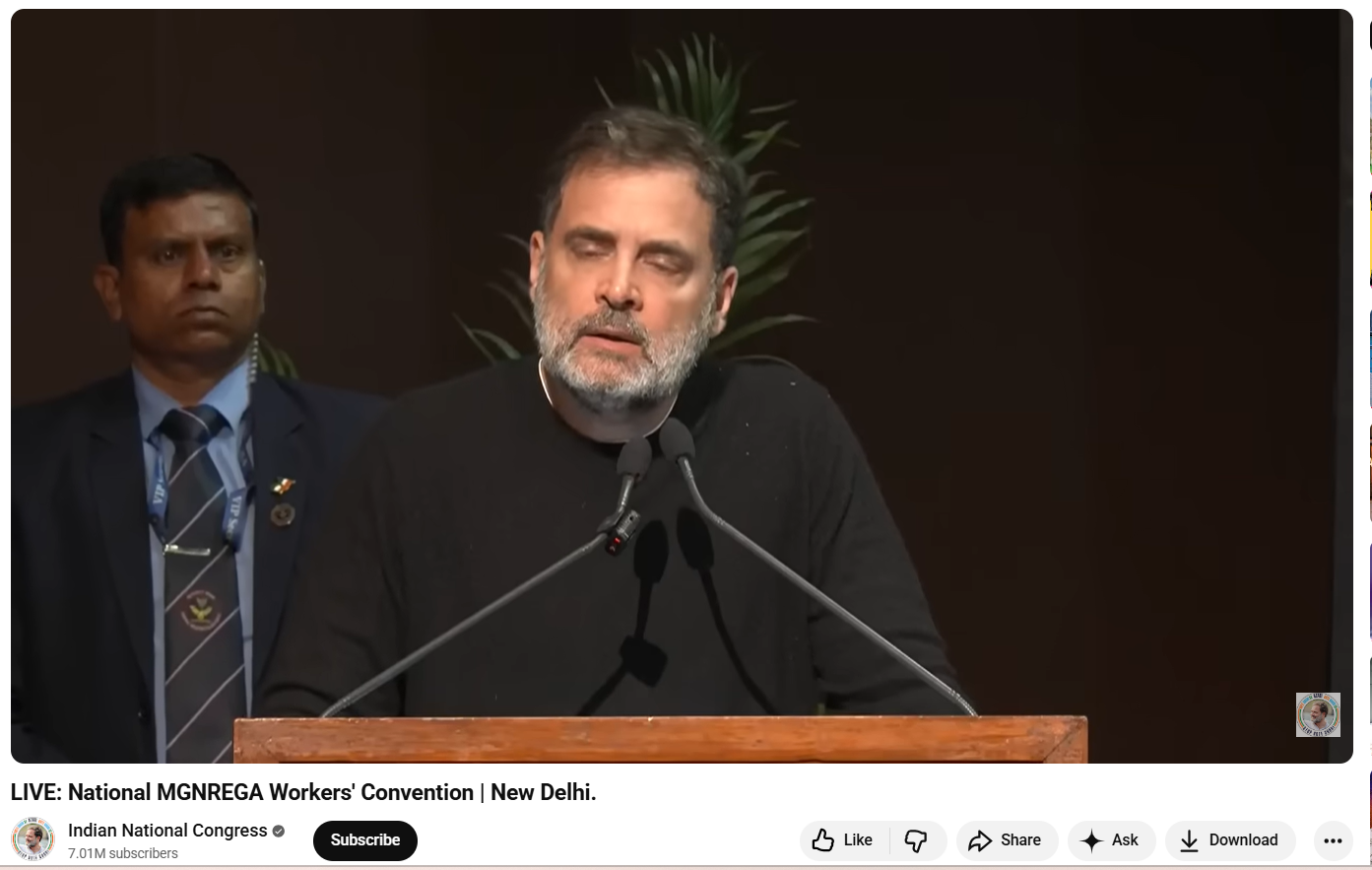
As part of the Research, we first closely examined the viral video. In the clip, Rahul Gandhi is heard saying: “I don’t know what Gram G is. I don’t even know the name of this new law… what is G Gram G…” At no point in the video does Rahul Gandhi mention Lord Ram or make any comment related to religion. To verify the context, we extracted keyframes from the viral clip and conducted a Google Lens search. This led us to a longer version of the same speech uploaded on the official YouTube channel of the Indian National Congress on January 22, 2026. The viral segment appears after the 39:50-minute mark.
The video is from the National MGNREGA Convention held in New Delhi, where Rahul Gandhi criticised the central government over the replacement of MGNREGA with the new VB–G RAM G law. During his speech, he expressed his opposition to the new legislation and stated that he was unfamiliar with its details. Throughout the address, he did not mention or refer to Lord Ram in any manner.
Conclusion
Rahul Gandhi’s remarks in the viral video were related to the newly introduced VB–G RAM G law and were part of his criticism of the central government’s policy decisions. He did not insult Lord Ram. The video is being shared on social media with a misleading and false claim.

Related Blogs
.webp)
Introduction
Imagine spending two years , 730 days of early mornings, missed social events, and relentless mock tests preparing for a single examination. Now imagine that on the morning of that exam, your phone buzzes with a forwarded video claiming the question paper has already leaked. Your heart sinks. You do not know whether to trust it or ignore it. You have about forty minutes before you must enter the hall. This was the reality for a section of the 22 lakh students who sat for the NEET UG 2026 re-examination on June 21, 2026, when a fabricated video alleging a paper leak on Telegram began circulating across WhatsApp groups and X within hours of the exam commencing. The National Testing Agency (NTA) swiftly and categorically denied the claims, activated the Indian Cyber Crime Coordination Centre (I4C), and appealed to the public not to amplify unverified content. The examination concluded without incident. But the episode laid bare a challenge that no security perimeter or surveillance camera can fully address: the weaponisation of misinformation against India's high-stakes examination ecosystem.
The Anatomy of Examination Misinformation
Why Examinations Are a Prime Target
India's national examinations are uniquely fertile ground for misinformation. With over 22 lakh candidates registered for NEET UG 2026 alone, the audience is vast, anxious, and hungry for any update verified or otherwise. Research by MIT has found that false stories spread six times faster than accurate ones on social media, and are seventy percent more likely to be reshared. In India, where over 535 million people use WhatsApp and studies show that most users tend to trust messages forwarded by family and friends, the conditions for viral misinformation are near-ideal. According to a 2020 Microsoft survey, 52 percent of Indian respondents encountered misinformation at least once a day, the highest rate globally.
What makes examination-related misinformation especially dangerous is its timing. Fabricated content is almost always released on examination day itself, the precise moment when candidates are most emotionally vulnerable, official channels are stretched thin, and the window for effective rebuttal is narrowest. The NEET UG 2026 fake video, circulated on Telegram and amplified across closed WhatsApp groups, fits this pattern precisely. It was engineered not to inform, but to destabilise.
A History That Sharpens the Anxiety
This misinformation did not emerge in a vacuum. The shadow of the 2024 NEET UG controversy in which the Supreme Court of India confirmed that at least 155 students had directly benefited from a genuine paper leak, and which triggered nationwide protests, CBI investigations, and a parliamentary uproar — still looms large. Students and parents conditioned by that experience are primed to believe the worst, even when claims are entirely false. In 2026, that residual anxiety became the very vulnerability that bad actors sought to exploit. The government's response which included temporarily restricting access to Telegram in the lead-up to the re-examination underscored just how seriously the threat of examination misinformation is now being taken at the highest levels.
The NTA's Response: Why It Matters
- Speed and Transparency as Governance Tools: In crisis communication, the first credible voice usually wins. The NTA's near-immediate public denial posted on official social media handles and amplified by the Press Information Bureau's PIB Fact Check unit was a meaningful departure from the delayed, defensive responses that characterised earlier examination controversies. By directly labelling the video "FAKE" in capital letters, describing its creation as "a serious offence," and simultaneously appealing to students to rely only on official sources at neet.nta.nic.in, the NTA left little room for the false narrative to consolidate. NTA Director General Abhishek Singh went further, publicly stating that the agency was "100 per cent confident" in the integrity of the process and that no complaints of a genuine paper leak had been received. This matters beyond crisis management. Public trust in examination systems is not rebuilt through official statements alone , it is rebuilt through the consistent, transparent exercise of institutional authority. A swift, fact-based rebuttal, deployed before rumour hardens into public belief, is as much a governance act as it is a communications strategy.
- Cybercrime Coordination as a Structural Shift: Perhaps the most significant development in the NTA's response was its coordination with I4C and law enforcement agencies to trace the origin of the fabricated video. This signals a structural evolution: examination misinformation is no longer being treated as an administrative inconvenience but as cybercrime with legal consequences under the Information Technology Act, 2000. The announcement that legal action would follow also carries a deterrent message to potential future actors — that the machinery of cybercrime enforcement will be activated, and that fabricating content to mislead examination candidates is a prosecutable offence.
The Human and Institutional Cost
The costs of examination misinformation are neither abstract nor trivial. Mental health experts have warned that controversies surrounding national-level examinations can have serious long-term psychological consequences for aspirants. Dr. Mustafa Nadeem Kirmani of Amity University has noted that such crises increase the risk of students taking "extreme steps like suicide attempts, anger toward the system, and hopelessness," and can, in the long run, lead to clinical depression. In the wake of the 2026 paper leak controversy, multiple reports of student deaths by suicide were linked to the compounded pressures of exam cancellation and uncertainty a grim reminder of the real human stakes behind governance failures in this domain. For institutions, every viral misinformation episode generates an avoidable administrative crisis. Helplines are overwhelmed, examination centre staff face panicked queries, and senior officials are pulled into damage control rather than exam administration. The credibility of clarifications issued under pressure is itself questioned by a public already primed for suspicion. This administrative burden, multiplied across 5,440 examination centres in India and 14 abroad, represents a significant and entirely unnecessary cost.
Building a Resilient Ecosystem: What Needs to Change
- Proactive Communication and Platform Coordination: Institutional credibility is built before a crisis, not during one. Examination bodies must invest in sustained pre-examination communication that educates candidates and parents about the existence of misinformation campaigns and tells them exactly where to look for verified updates. This means highly visible, verified social media presences with large followings, real-time update protocols, and formal escalation channels with platforms like WhatsApp, Telegram, X, and YouTube to enable rapid takedown of false examination-related content. The IT Amendment Rules of 2023, which require significant social media intermediaries to act on government-flagged content, provide a legal basis for such coordination but the operational infrastructure to activate it at speed must be built in advance, not improvised on the day.
- Fact-Checking Partnerships and Digital Literacy: Independent organisations such as BOOM Live, Alt News, and Vishvas News have proven their capacity to rapidly debunk examination misinformation. Formalising their role through a structured public-private partnership where examination authorities share real-time verified information with empanelled fact-checkers could close the window during which false content circulates unchallenged. Equally critical is investment in digital media literacy among students and parents. A 2018 survey found that nearly 45 percent of Indian respondents were unaware of any fact-checking organisations. Addressing this gap through school curricula, coaching networks, and the Ministry of Education's DIKSHA platform is a preventive investment far less costly than repeated crisis management.
Conclusion
The NTA's handling of the NEET UG 2026 fake video was, by recent standards, exemplary. It was fast, transparent, authoritative, and backed by the activation of cybercrime enforcement. But a single well-managed episode does not constitute a resilient system. India runs some of the world's largest entrance examinations, and the stakes medical seats, livelihoods, and the aspirations of crores of young people are too high for crisis response alone to suffice. Combating examination misinformation requires permanent structural investment: dedicated rapid-response cells within examination bodies, formalised fact-checking pipelines, proactive platform coordination, and a sustained public education effort around digital verification. Protecting the integrity of India's examination ecosystem is not merely an administrative responsibility. It is a commitment to the millions of students who give everything they have to compete fairly and who deserve a system that protects them not only from cheating, but from the fear of it.
References
- https://timesofindia.indiatimes.com/articleshow/131900261.cms
- https://www.india.com/education/neet-ug-2026-re-exam-paper-leak-claim-goes-viral-nta-says-video-is-fake-and-false-fabricated-examination-conducted-successfully-8453620/
- https://www.republicworld.com/education/neet-ug-re-exam-nta-says-paper-leak-video-fake-test-conducted-successfully-2026-06-22-129346
- https://thefederal.com/category/education/neet-re-exam-paper-leak-admission-system-crisis-247410
- https://www.outlookindia.com/healthcare-spotlight/beyond-the-paper-leak-emotional-trauma-among-neet-aspirants-raises-concern
- https://en.wikipedia.org/wiki/2024_NEET_controversy
- https://kaval.chat/blog/misinformation-scam-statistics-india-2026/
- https://www.ijert.org/the-virality-gap-political-misinformation-and-the-information-crisis-in-india-s-digital-democracy-ijertv15is050041
- https://www.science.org/doi/10.1126/science.aap9559 https://www.microsoft.com/en-us/digital-skills/digital-civility
- https://www.meity.gov.in/content/information-technology-intermediary-guidelines-and-digital-media-ethics-code-amendment
- https://www.indiacode.nic.in/handle/123456789/1999
- https://pib.gov.in/PressReleasePage.aspx
- https://www.careerindia.com/news/addressing-the-mental-health-crisis-sparked-by-net-and-neet-paper-leaked-in-india-041963.html
- https://thediplomat.com/2025/03/indias-growing-misinformation-crisis-a-threat-to-democracy/
Executive Summary
A video of Prime Minister Narendra Modi and Iranian President Masoud Pezeshkian is being shared on social media with the claim that the Prime Minister touched the Iranian President’s feet and thanked him for providing gas, petrol and diesel to India at cheap prices. The post links the video to the 2026 BRICS Summit and claims that the two leaders had this conversation during the summit. CyberPeace Research Wing’s research found that the viral video is not authentic and is AI-generated.It is worth noting that Prime Minister Narendra Modi and Iranian President Masoud Pezeshkian held a bilateral meeting on September 11, 2026, on the sidelines of the BRICS Summit in New Delhi. According to the Prime Minister’s Office, the two leaders discussed various aspects of bilateral relations, the situation in West Asia, the safety of maritime routes, and the need to ensure peace and stability in the region.
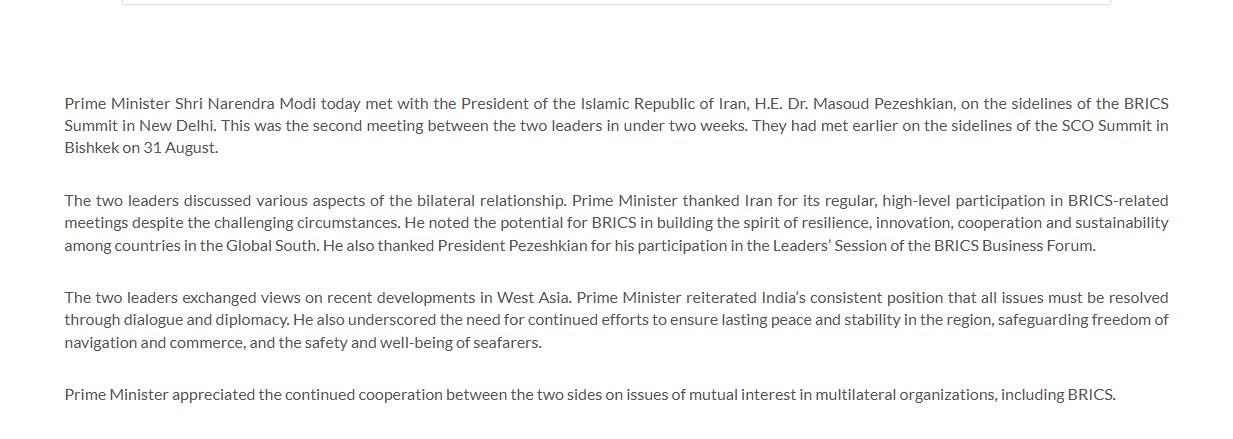
During the meeting, Prime Minister Modi thanked Iran for its regular and high-level participation in BRICS-related meetings. He also thanked President Pezeshkian for participating in the Leaders’ Session of the BRICS Business Forum. However, the official statement issued by the Prime Minister’s Office makes no mention of Modi thanking the Iranian President for providing gas, petrol, diesel or oil at cheap prices.
Claim:
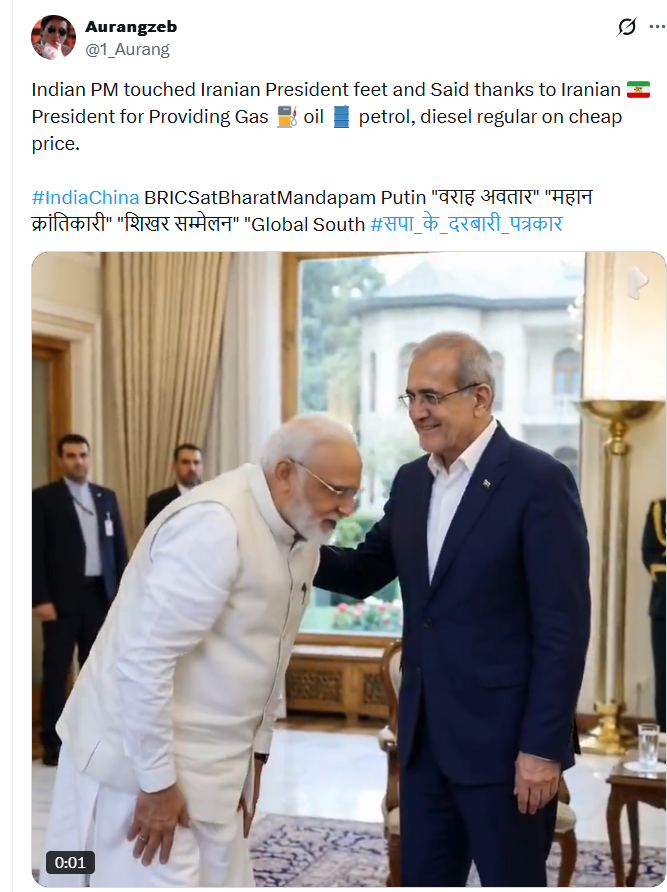
Prime Minister Narendra Modi touched the feet of Iranian President Masoud Pezeshkian and thanked him for providing gas, oil, petrol and diesel to India at cheap prices.
https://x.com/1_Aurang/status/2099001779719749833
Fact Check:
To verify the authenticity of the viral claim, we conducted a Google search using relevant keywords. However, we did not find any credible media report supporting the claim.As part of our research, we found a press release published on the Prime Minister’s Office (PMO) website on September 11, 2026. The release provides details of the meeting between Prime Minister Narendra Modi and Iranian President Masoud Pezeshkian on the sidelines of the BRICS Summit. According to the press release, Prime Minister Modi thanked President Pezeshkian for Iran’s regular and high-level participation in BRICS-related meetings. He also thanked Pezeshkian for participating in the Leaders’ Session of the BRICS Business Forum.The two leaders also discussed bilateral relations and recent developments in West Asia. Prime Minister Modi reiterated India’s position that all issues should be resolved through dialogue and diplomacy and stressed the need to ensure peace and stability in the region. However, the press release makes no mention of Prime Minister Modi thanking the Iranian President for providing gas, oil, petrol or diesel at cheap prices.
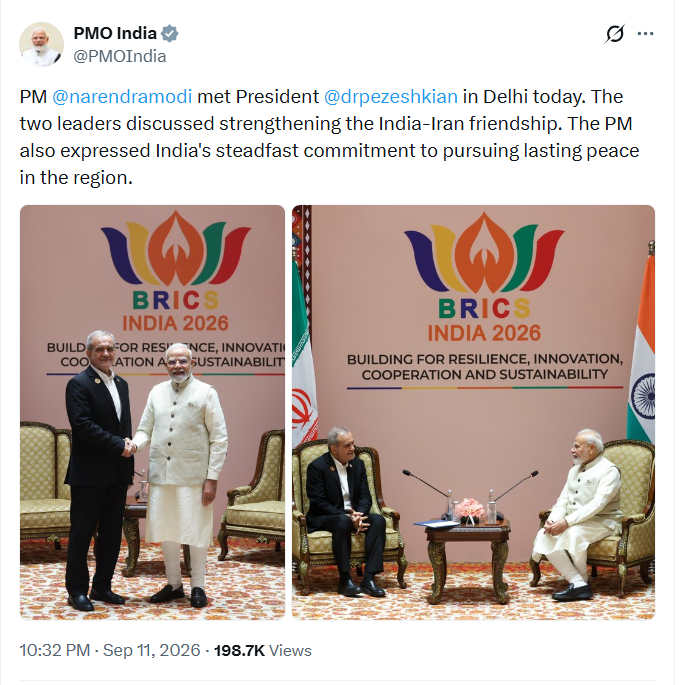
As part of our further research, we found the original photograph of the two leaders on the official X handle of the Prime Minister’s Office (PMO). The photograph shows Prime Minister Narendra Modi and Iranian President Masoud Pezeshkian shaking hands with each other.
https://x.com/PMOIndia/status/2098457126842851492?s=20
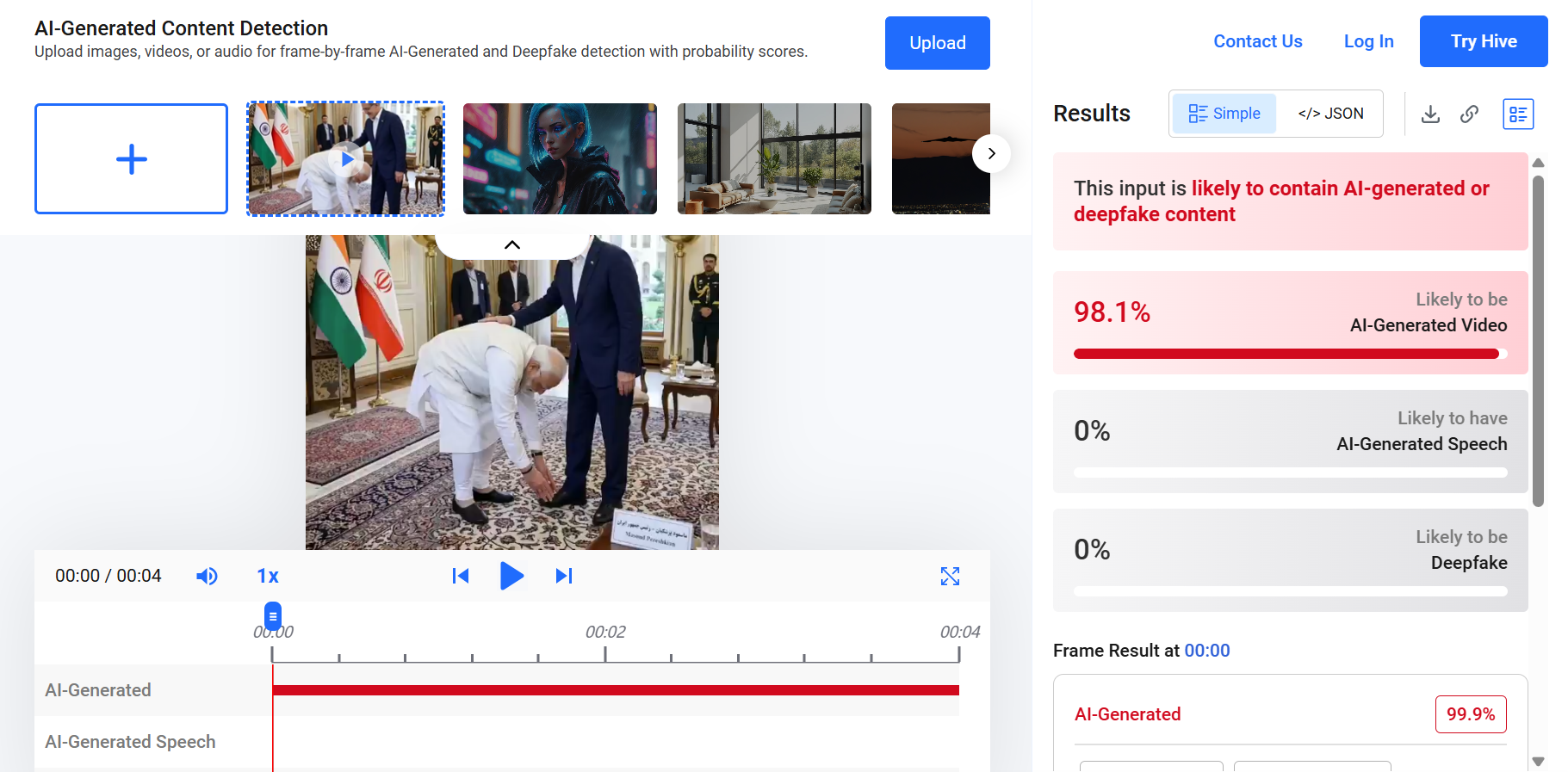
We then examined the video closely and noticed several visual inconsistencies. We subsequently scanned the video using the AI detection tool Hive Moderation. According to the results, the viral video has a 98% probability of being AI-generated.
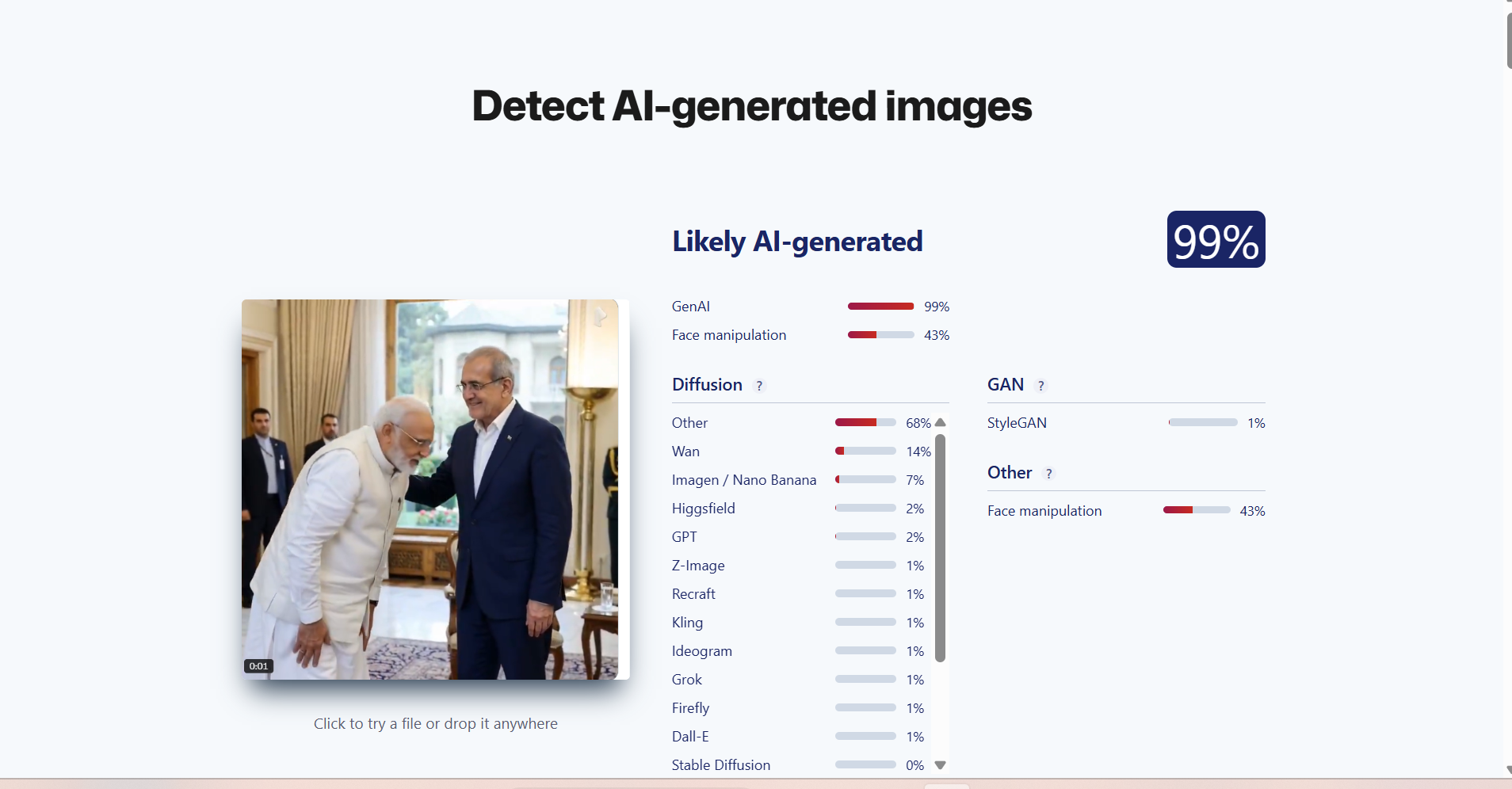
We also scanned the video using another AI detection tool, Sightengine. According to the results, the viral video has a 99% probability of being AI-generated.
Conclusion
Our research found that the viral claim is false. The video claiming that Prime Minister Narendra Modi touched Iranian President Masoud Pezeshkian’s feet and thanked him for providing cheap gas, oil, petrol and diesel to India is AI-generated and does not show a genuine interaction between the two leaders. Our research found several visual inconsistencies in the video. The findings were further supported by AI detection tools, with Hive Moderation identifying a 98% probability of AI generation, while Sightengine indicated a 99% probability. Furthermore, the official information released by the Prime Minister’s Office regarding Modi’s meeting with Pezeshkian contains no reference to the Prime Minister thanking Iran for providing fuel at cheap prices. Therefore, the video is being circulated on social media with a false and misleading claim.
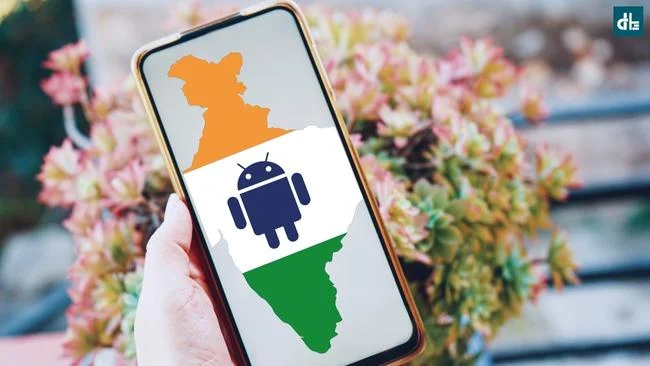
BharOS’s successful testing grabbed massive online attention after Ashwini Vaishnaw, Minister of Communications and Electronics & IT, and Union Education Minister Dharmendra Pradhan unveiled the new mobile operating system. On Data Privacy Day, January 28, it’s appropriate to discuss the safety factors.
The OS is developed by JandKops, which has been incubated by IIT Madras Pravartak Technologies Foundation. It is claimed that BharOS will ensure the prevention of the “execution of any malware” and “execution of any malicious application”.
Even though it is called a Made in India OS, there are many people who disagree with this. It is because the OS is based on an AOSP (Android Open Source Project). It includes similar methodologies, functionalities, and basics used in Google Android.
Global safety factor
Security and data safety has been worldwide issue. A few years ago, Alphabet CEO Sundar Pichai also testified in front of US Congress while facing questions related to privacy, data collection, and location tracking.
While experts say that Android’s app ecosystem is a privacy and security disaster, a study that examined 82,501 apps pre-installed on 1,742 Android smartphones sold by 214 vendors concluded that users are woefully unaware of the significant security and privacy risks posed by pre-installed applications.
Even Apple, which takes cybersafety issues as a top priority, sometimes finds itself in a vulnerable situation. For example, last year Apple users were advised to update their devices to protect against a pair of security flaws that could allow attackers to take complete control.
It was said that one of the software flaws affected the kernel, the deepest layer of the OS shared by all Apple devices, while the other had an impact on WebKit, the technology that powers the Safari web browser.
Security researchers, including NordVPN, said that Apple’s closed development OS makes it more difficult for hackers to develop exploits, while Android raises the threat level since anyone can see its source code to develop exploits.
BharOS is not like iOS but it is kind of similar to Android and based on AOSP. So the question is, how safe would this OS be?
‘Security blanket’
Sandip Kumar Panda, Co-founder and CEO of InstaSafe, told News18: “BharOS acts as a security blanket for devices. The framework is designed in a manner that it prevents the execution of any malicious app and verifies each app on the devices before making it live on the BharOS platform.”
There are no apps without any vulnerabilities, he said. “As the app development progresses, vulnerabilities get introduced either in the form of insecure coding practices or third-party software vulnerabilities integrated with the platform. Since several Android vulnerabilities were discovered over the years, all those bugs would have been fixed now and updates would already have been for AOSP, which will be much more mature now,” he added.
Vineet Kumar, Founder and President of CyberPeace Foundation, believes that “the use of AOSP as the foundation for BharOS is a positive step” as it is a robust platform.
But according to him, it is important to note that no OS can be completely immune to all forms of cyber threats. “The key to staying safe online is to stay vigilant, use security software, keep your software updated, and be mindful of the apps you install and the websites you visit,” he said,
Furthermore, the expert stated that it is possible to make an OS more secure by implementing a variety of security features and technologies such as sandboxing, whitelisting, and application control, as well as rigorous testing and code review processes.
Kumar said: “It would be important for an independent, reputable security firm to evaluate BharOS and test its security features before it can be stated with certainty that it is more secure than other OSs.”
It is difficult to say whether the BharOS will be free of cybersecurity issues without more information about the specific features and security measures that have been implemented, he noted while adding that this OS has to go through a rigorous testing and certification process.
“It will be important to see how it measures up against established security standards and how well it can withstand real-world attacks,” the expert stated.
Reference Link : https://www.news18.com/amp/news/tech/data-privacy-day-how-safe-is-bharos-what-do-cybersecurity-experts-say-you-are-about-to-find-out-6932521.html
