
#FactCheck- Old Dubai Flood Videos Falsely Shared as Recent Storm Footage
Executive Summary
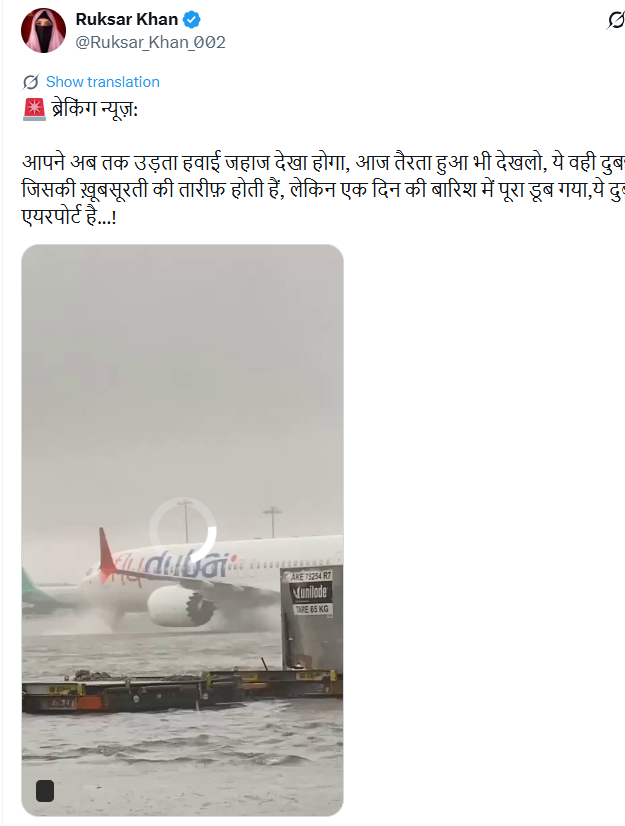
Amid reports of heavy rainfall and flooding in several cities of the United Arab Emirates, a video is being widely circulated on social media claiming to show recent scenes from Dubai. The clip allegedly depicts severe waterlogging at Dubai Airport and inside shopping malls, with users linking it to a “recent storm.”According to research by CyberPeace, the viral footage is not recent. The video is actually a compilation of three different clips stitched together and dates back to 2024, when Dubai experienced unprecedented flooding following heavy rains.
Claim
The misleading post was shared by an X (formerly Twitter) user named ‘Ruksar Khan’ on March 28, 2026, with a caption suggesting that Dubai had been submerged after just one day of rain. The post attempted to sensationalize the situation by portraying the visuals as current.
Fact Check:
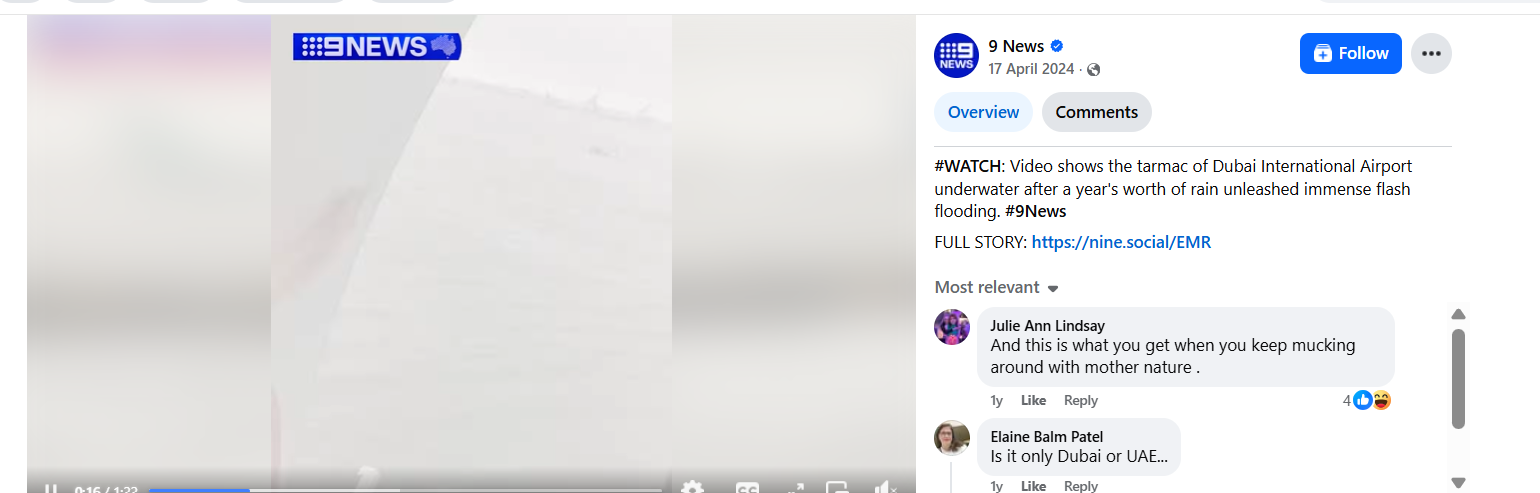
To verify the claim, keyframes from the viral video were extracted using the InVid tool and analyzed through reverse image search. One of the clips was traced to a Facebook post by “9 News,” uploaded on April 17, 2024. The video showed waterlogged runways at Dubai International Airport following intense rainfall and flooding.
Further verification led to a report published by Hindustan Times on April 17, 2024, which featured similar visuals and confirmed that the footage was from the floods that hit Dubai in 2024.

Conclusion:
The viral claim suggesting that the video shows recent flooding in Dubai is false. The footage is nearly two years old and originates from the 2024 floods in Dubai. It is now being reshared with misleading claims to create confusion around current weather events.

Related Blogs

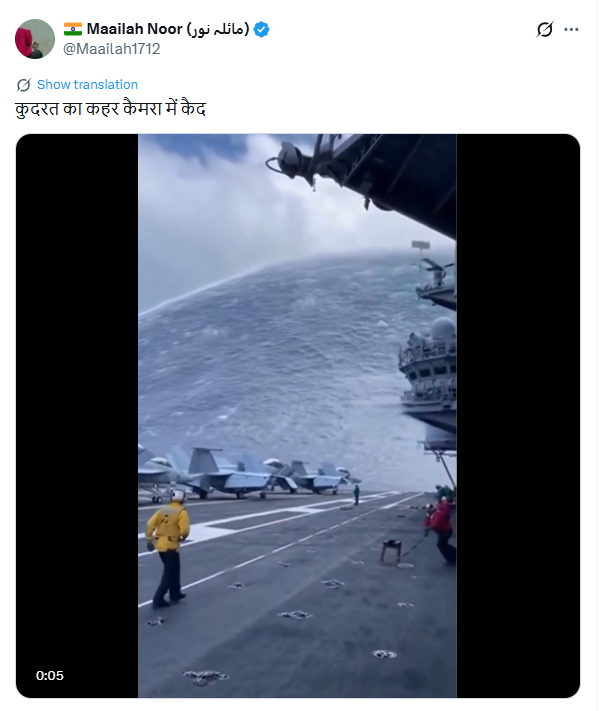
Social media users are widely sharing a video claiming to show an aircraft carrier being destroyed after getting trapped in a massive sea storm. In the viral clip, the aircraft carrier can be seen breaking apart amid violent waves, with users describing the visuals as a “wrath of nature.”
However, CyberPeace Foundation’s research has found this claim to be false. Our fact-check confirms that the viral video does not depict a real incident and has instead been created using Artificial Intelligence (AI).
Claim:
An X (formerly Twitter) user shared the viral video with the caption,“Nature’s wrath captured on camera.”The video shows an aircraft carrier appearing to be devastated by a powerful ocean storm. The post can be viewed here, and its archived version is available here.
https://x.com/Maailah1712/status/2011672435255624090
Fact Check:
At first glance, the visuals shown in the viral video appear highly unrealistic and cinematic, raising suspicion about their authenticity. The exaggerated motion of waves, structural damage to the vessel, and overall animation-like quality suggest that the video may have been digitally generated. To verify this, we analyzed the video using AI detection tools.
The analysis conducted by Hive Moderation, a widely used AI content detection platform, indicates that the video is highly likely to be AI-generated. According to Hive’s assessment, there is nearly a 90 percent probability that the visual content in the video was created using AI.

Conclusion
The viral video claiming to show an aircraft carrier being destroyed in a sea storm is not related to any real incident.It is a computer-generated, AI-created video that is being falsely shared online as a real natural disaster. By circulating such fabricated visuals without verification, social media users are contributing to the spread of misinformation.

Executive Summary
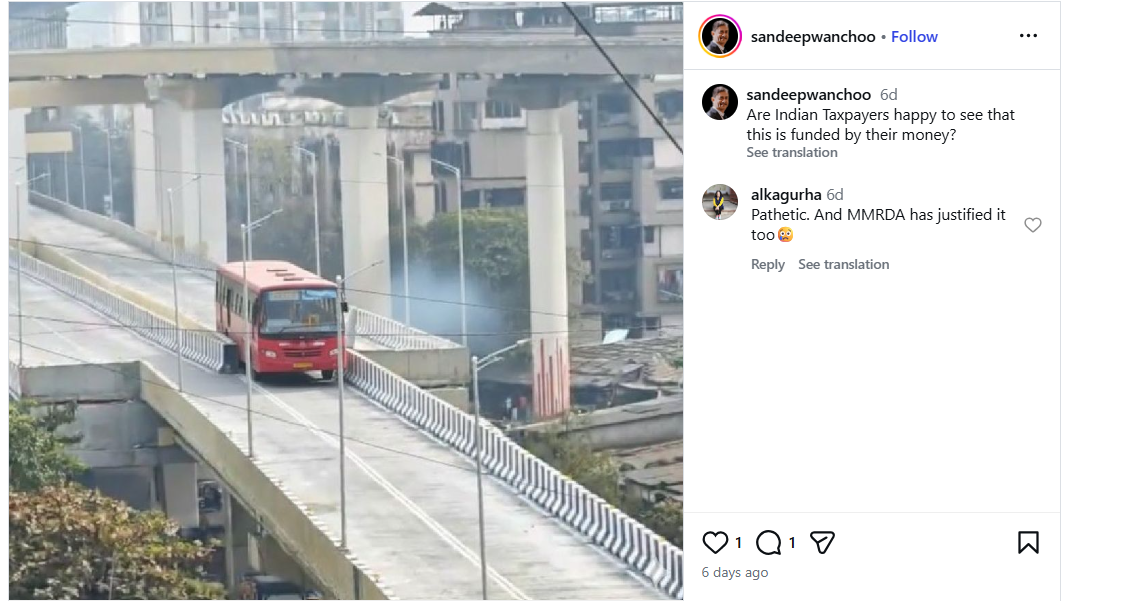
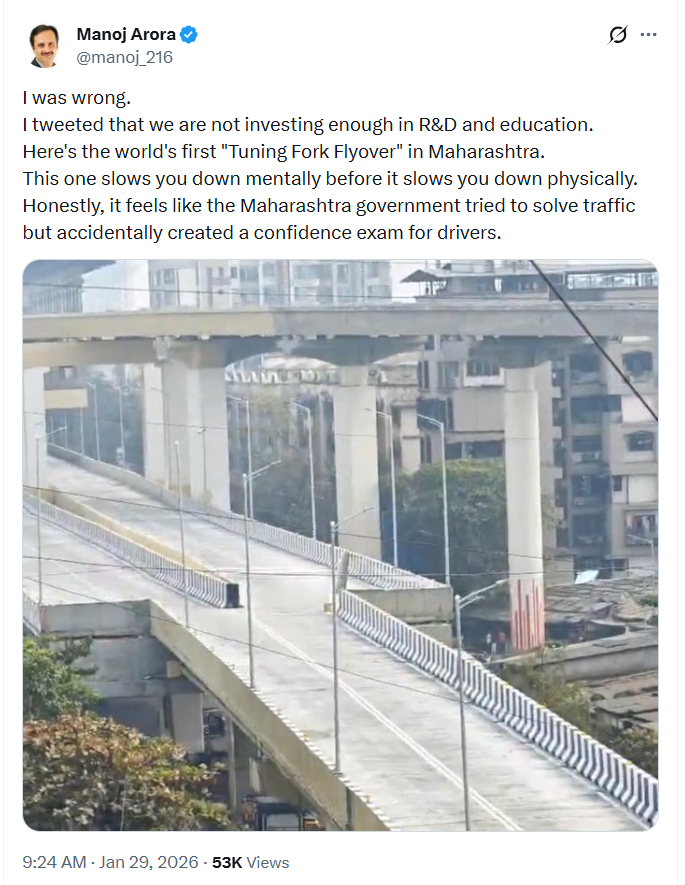
Mumbai’s Mira–Bhayandar bridge has recently been in the news due to its unusual design. In this context, a photograph is going viral on social media showing a bus seemingly stuck on the bridge. Some users are also sharing the image while claiming that it is from Sonpur subdivision in Bihar. However, an research by the CyberPeace has found that the viral image is not real. The bridge shown in the image is indeed the Mira–Bhayandar bridge, which is under discussion because its design causes it to suddenly narrow from four lanes to two lanes. That said, the bridge is not yet operational, and the viral image showing a bus stuck on it has been created using Artificial Intelligence (AI).
Claim
An Instagram user shared the viral image on January 29, 2026, with the caption:“Are Indian taxpayers happy to see that this is funded by their money?” The link, archive link, and screenshot of the post can be seen below.
Fact Check:
To verify the claim, we first conducted a Google Lens reverse image search. This led us to a post shared by X (formerly Twitter) user Manoj Arora on January 29. While the bridge structure in that image matches the viral photo, no bus is visible in the original post.This raised suspicion that the viral image had been digitally manipulated.
We then ran the viral image through the AI detection tool Hive Moderation, which flagged it as over 99% likely to be AI-generated

Conclusion
The CyberPeace research confirms that while the Mira–Bhayandar bridge is real and has been in the news due to its design, the viral image showing a bus stuck on the bridge has been created using AI tools. Therefore, the image circulating on social media is misleading.
Procedural History:
The case started with a 2011 Madras High Court ruling that included the appellant’s personal information. In the case discussed, the court decided in 2024, the appellant went to the Madurai Bench of the Madras High Court to request that his name and other identifying information from that previous ruling be redacted. He argued that his right to privacy under Article 21 of the Indian Constitution was violated by the ongoing release of such private information into the public arena. He claimed that the revelation had hurt him in real ways, such as having his application for an Australian visa denied. Therefore, without compromising the ideals of open justice, the current procedures aimed to have the court recognize a person’s “Right to be Forgotten” within a broader framework of privacy and data protection.
Background and Factual Matrix
The appellant was charged under Sections 417 and 376 of the IPC. The trial court convicted him in 201, but later, the High Court in 2014 fully, completely and unconditionally acquitted him, which was not based on the benefit of doubt. Following the acquittal, he remarried and has three children. The judgment of both the High Court and the Trial Court has personal and intimate details about him. Being available in the public domain has caused him significant repercussions, as he was denied a visa to travel to Australia by authorities, citing the criminal cases. The appellant has filed a plea seeking a mandamus directing the Registrar General, Additional Registrar General, and Registrar (IT-Statistics) as R1, R2, R3 to redact his name and other identities from the acquittal judgment. He has sought a direction from Ikanoon Software Development Private Limited (R4) to reflect the redaction in its publication.
Issue
- Whether a writ of mandamus can lie against a High Court for redaction of personal details from its own judgment, or does such a prayer tantamount to a High Court issuing a writ against itself?
- Whether the High Court, being a Court of Record under Article 215 of the Indian Constitution, is entitled to preserve its record for perpetuity in its original form without any modification or redaction?
- Whether the ‘Right to be Forgotten' can be recognised and enforced in the absence of a specific statutory provision or Supreme Court direction, given that it constitutes an exception to the fundamental principle of open courts and open justice?
Adjudication and Reasoning
The division bench has allowed the Writ appeal and granted the following relief:
- R4 directed to take down the judgment in Crl.A. (MD) No.321 of 2011 dated 30.04.2014 forthwith.
- R1 to R3 directed to redact the name and other details of the Writ Petitioner relating to his identity from the judgment dated 30.04.2014 in Crl.A.(MD) No. 321 of 2011 and ensure that only the redacted judgment is available for publication or for uploading.
Rule
- Courts have a wide discretion in deciding whether to allow redaction or not. Such discretion can either be granted at the request of the party seeking redaction or, in appropriate cases, even suo moto by the court.
- The accused who have earned full, complete and unconditional acquittal without any benefit of doubt have a legitimate claim to move forward for redaction of personal information.
- The open Court doesn’t require absolute disclosure of all personal information, and the courts, while deciding the concern of privacy and the right to ensure that in litigations to leave behind parts of their past which are no longer relevant, have to balance the concept of open Court on the one hand and privacy concerns of a citizen on the other.
- As the High Court is the repository of a wide range of information and is entitled to preserve the original record in perpetuity. However, without diluting the sanctity of the original record, the public reflection of that record can be moderated to preserve the privacy of the person to whom that record pertains.
Reasoning
- Drawing on the judgment K.S. Puttaswamy v. Union of India, the court found Article 21 to protect not only informational privacy but also the "right to be forgotten," which gives individuals the right to request the deletion of any personal data when there is no longer any legitimate public interest in retaining such information. Such irreparable reputational damage is thus an infringement on constitutional privacy that demands judicial redaction.
- The court rejected the argument that a writ against its own order is impermissible, drawing a distinction between challenging the legal correctness of a judgment and seeking redaction of personal information. Allowing redaction will not question the validity of the judgment; rather, it will simply change its public appearance to ensure privacy.
- Since a High Court is a Court of Record with an obligation to preserve its judgments in their unaltered form forever, the court held here that such internal maintenance of complete records was not incompatible with the issuance of a redacted public version. Institutional integrity is maintained when the original kept in the archives is supplemented with a public version that masks the privacy areas.
- Open justice principles work to establish transparency, accountability, and public confidence, but these are not absolute. The court took a proportionality stance: personal identifiers, where they neither educate nor have precedential value and continue to inflict harm, may be expunged without affecting the established legal principles of judgment.
- Although the DPDP Act exempts courts from several statutory obligations, the court held that it can, by virtue of its inherent discretion, protect personal data, and in so doing, exercise that power without the need for any legislative command. Traditionally the Madras High Court rules provide for the possibility of restriction of certified copies, thus establishing redaction as feasible both legally and administratively.
