#FactCheck - Deepfake Video Falsely Shows Aaj Tak Reporting BJP Defeat in Assam Elections
Assembly elections are due to be held in Assam later this year, with polling likely in April or May. Ahead of the elections, a video claiming to be an Aaj Tak news bulletin is being widely circulated on social media.
In the viral video, Aaj Tak anchor Rajiv Dhoundiyal is allegedly seen stating that a leaked intelligence report has issued a warning for the ruling Bharatiya Janata Party (BJP) in Assam. The clip claims that according to this purported report, the BJP may suffer significant losses in the upcoming Assembly elections. Several social media users sharing the video have also claimed that the alleged intelligence report signals the possible removal of Assam Chief Minister Himanta Biswa Sarma from office.
However, an investigation by the Cyber Peace Foundation found the viral claim to be false. Our probe clearly established that no leaked intelligence report related to the Assam Assembly elections exists.
Further, Aaj Tak has neither published nor broadcast any such report on its official television channel, website, or social media platforms. The investigation also revealed that the viral video itself is not authentic and has been created using deepfake technology.
Claim
On social media platform Facebook, a user shared the viral video claiming that the BJP has been pushed on the back foot following organisational changes in the Congress—appointing Priyanka Gandhi Vadra as chairperson of the election screening committee and Gaurav Gogoi as the Assam Pradesh Congress Committee president. The post further claims that an Intelligence Bureau report predicts that the current Assam government will not return to power.
(Link to the post, archive link, and screenshots are available.)
FactCheck:
To verify the claim, we first searched for reports related to any alleged leaked intelligence assessment concerning the Assam Assembly elections using relevant keywords. However, no credible or reliable reports supporting the claim were found. We then reviewed Aaj Tak’s official website, social media pages, and YouTube channel. Our examination confirmed that no such news bulletin has been published or broadcast by the network on any of its official platforms.
- https://www.facebook.com/aajtak/?locale=hi_IN
- https://www.instagram.com/aajtak/
- https://x.com/aajtak
- https://www.youtube.com/channel/UCt4t-jeY85JegMlZ-E5UWtA
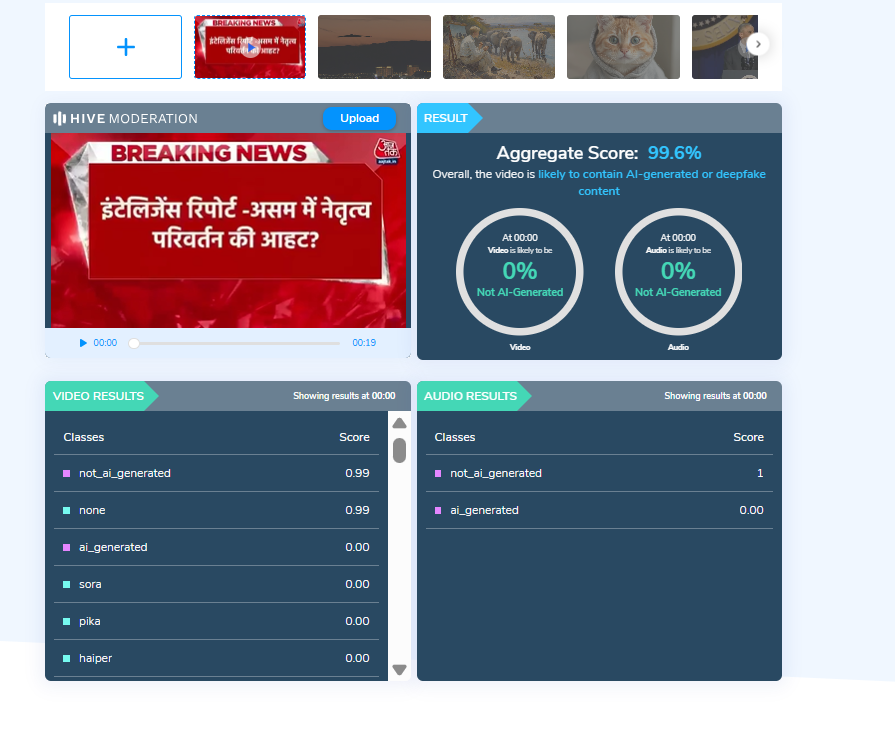
To further verify the authenticity of the video, its audio was scanned using the deepfake voice detection tool HIVE Moderation.
The analysis revealed that the voice heard in the video is 99 per cent AI-generated, clearly indicating that the audio is not genuine and has been artificially created using artificial intelligence.
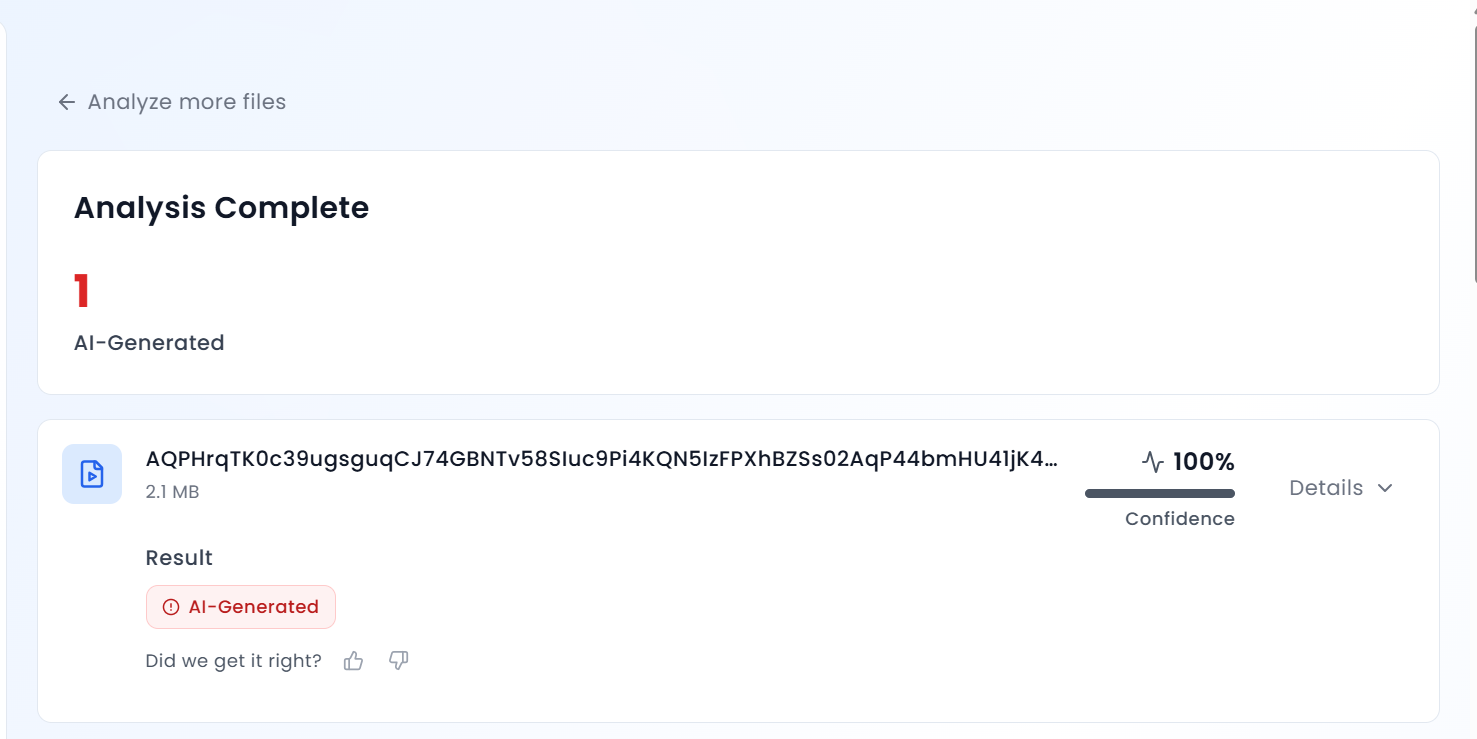
Additionally, the video was analysed using another AI detection tool, Aurigin AI, which also identified the viral clip as AI-generated.
Conclusion:
The investigation clearly establishes that there is no leaked intelligence report predicting BJP’s defeat in the Assam Assembly elections. Aaj Tak has not published or broadcast any such content on its official platforms. The video circulating on social media is not authentic and has been created using deepfake technology to mislead viewers.
Related Blogs
Executive Summary
In September 2025, a joint operation led by the U.S. Secret Service, in coordination with the New York Police Department (NYPD) and other federal partners, dismantled an illicit telecommunications network of unprecedented scale and sophistication operating in the New York tri-state area. The timing of the takedown, occurring just hours before the commencement of high-level proceedings at the United Nations General Assembly (UNGA), underscored the imminent and severe nature of the threat posed by this clandestine infrastructure. This report provides a comprehensive analysis of the operation, the technology involved, the multi-domain threats it presented, the complex ecosystem of actors it served, and the profound strategic implications for U.S. national and homeland security.
The seized assets included over 300 SIM servers and more than 100,000 active Subscriber Identity Module (SIM) cards, constituting a massive "SIM farm." This infrastructure functioned as a parallel, rogue telecommunications system, capable of a wide spectrum of malicious activities. The threat was multi-faceted, representing a dangerous convergence of capabilities that spanned the domains of cybercrime, physical infrastructure disruption, and espionage.
The network possessed the technical capacity to launch a catastrophic denial-of-service (DoS) attack against New York City's cellular infrastructure, potentially disabling emergency communications and creating widespread chaos.
Forensic analysis has confirmed the network's primary function as a secure, anonymous communications platform for a range of illicit actors. Early findings indicate its use by transnational criminal organizations (TCOs)—including drug cartels and human trafficking rings—and nation-state actors. This shared use of a single, powerful infrastructure points to the emergence of a "criminal-as-a-service" model, where state-level capabilities are made available to non-state actors, blurring the lines between traditional crime and state-sponsored operations and vastly complicating attribution and law enforcement response. The network's strategic placement within a 35-mile radius of the UN headquarters during the General Assembly also highlights its inherent potential as a tool for espionage, surveillance, and influence operations against high-value diplomatic targets.
The UNGA SIM farm takedown serves as a watershed moment, exposing the acute vulnerability of the "invisible" critical infrastructure that underpins modern society. The incident demonstrates a strategic shift by adversaries from targeting individual endpoints to compromising the core of our communications networks. This report concludes that this event necessitates a fundamental re-evaluation of national security priorities, mandating the development of new investigative paradigms to address convergent threats, the strengthening of public-private partnerships with the telecommunications sector, and the urgent consideration of updated legal and regulatory frameworks to counter the weaponization of telecommunications technology.
Operation Silent Signal: The Anatomy of a Takedown
The disruption of the New York tri-state SIM farm was not the result of a chance discovery but the culmination of a deliberate and sophisticated protective intelligence investigation. The operation, codenamed for the purposes of this analysis as "Operation Silent Signal," showcases a modern, intelligence-led approach to law enforcement, where the meticulous tracing of seemingly tactical threats led to the neutralization of a strategic national security vulnerability. The anatomy of this takedown reveals the professionalism of both the criminal enterprise and the coordinated multi-agency response required to dismantle it.
The Trigger: From Swatting to a National Security Threat
The investigation's genesis lies in a series of targeted, anonymous threats directed at seniors. U.S. government officials in the spring of 2025.1 These were not idle threats but took the form of sophisticated harassment campaigns, including "swafling" attacks.1 Swafling is a dangerous criminal tactic wherein an individual makes a false report of a serious emergency—such as a hostage situation, bomb threat, or active shooter—at a target's address. The goal is to deceive law enforcement into dispatching a large, heavily armed response, such as a SWAT team, creating a situation that is not only terrifying for the victim but also carries a high risk of unintended violence and diverts critical emergency resources.1
These aflacks, which targeted lawmakers both within and outside of New York, represented a direct challenge to the protective mission of the U.S. Secret Service.1 In response, the agency's newly established Advanced Threat Interdiction Unit—a specialized section created to disrupt the most significant and imminent threats to its protectees—initiated a monthlong investigation.4 The unit's mandate is prevention, and by tracing the origin of these anonymous, fraudulent calls, investigators began to uncover a common technological backbone.6 What began as an inquiry into acts of intimidation against individuals quickly escalated as it became clear that the tools used were not those of a lone actor but were components of a vast, centralized infrastructure. This progression from a tactical law enforcement problem (harassment of officials) to a strategic national security issue (the discovery of a rogue telecom network) exemplifies a critical shift in the modern threat landscape. The infrastructure enabling these threats was not merely a tool for crime but a weaponized system capable of far greater disruption, and its discovery compelled an immediate and large-scale response.
Operational Execution: A Coordinated Multi-Agency Response
Recognizing the multifaceted nature of the threat, the Secret Service orchestrated a comprehensive, multi-agency operation. The complexity of the network—spanning physical locations, cyber infrastructure, and potential links to foreign intelligence—necessitated a collaborative effort that drew upon the unique capabilities of federal, state, and local partners. The core operational team included the U.S. Secret Service and the NYPD, augmented by crucial technical and investigative support from the Department of Homeland Security's Homeland Security Investigations (HSI), the Department of Justice (DOJ), and the Office of the Director of National Intelligence (ODNI).1 This coalition highlights the recognition that the threat was not confined to a single jurisdiction or domain but represented a convergent danger requiring expertise in physical security, cyber forensics, criminal investigation, and national intelligence analysis.
The timing of the operation's climax was critical. The final seizures and dismantling of the network were concluded just hours before President Donald Trump was scheduled to address the UN General Assembly, a period of heightened security in New York City with nearly 150 world leaders in aflendance.4 This deliberate timing indicates that investigators assessed the network as posing a clear, present, and imminent danger, particularly given its potential to disrupt communications during such a high-profile international event.5
The physical raids targeted at least five separate sites across the New York tri-state area, revealing a distributed and carefully concealed operational footprint.1 The operators chose their locations with a clear intent to evade detection, housing the sophisticated equipment in non-descript, abandoned apartment buildings and other properties.1 These locations, which included sites in Armonk, New York; Greenwich, Connecticut; Queens, New York; and parts of New Jersey, were all situated within a strategic 35-mile radius of the UN headquarters in Manhaflan.3 This geographic dispersal was not accidental. It created a resilient, decentralized network that could not be neutralized by a single raid, while simultaneously forming a "circle around New York City's cellular network infrastructure," positioning the SIM farm for maximum potential impact on its target.3 This level of foresight in operational security and strategic placement points to a highly professional and disciplined organization, employing tradecraft more commonly associated with intelligence agencies than with typical criminal enterprises.
The Cache: An Unprecedented Seizure
The material recovered during the raids constituted what officials described as the most extensive telecommunications threat ever discovered on American soil and the largest seizure of its kind.1 The sheer scale of the hardware and its operational readiness painted a stark picture of a well-funded, professional, and rapidly expanding enterprise. The inventory of seized assets included:
- Over 300 Co-located SIM Servers: These devices are the core of the SIM farm, acting as hardware gateways that can house and manage thousands of SIM cards simultaneously. They interface with the internet via Voice over IP (VoIP) and with the cellular network via the installed SIMs, effectively bridging the two systems.4 Photos released by the Secret Service show racks of these servers, laden with antennas and SIM card slots, indicative of a commercial-grade, scalable operation.10
- Over 100,000 Active SIM Cards: The massive number of active SIM cards provided the network with its immense capacity for communication and disruption. This volume allowed operators to rotate through numbers frequently to avoid detection by mobile carriers and to generate the traffic necessary for a large-scale DoS aflack.4 Some of the recovered SIM cards were confirmed to have been produced by MobileX, a wireless provider whose CEO pledged full cooperation with the investigation.9 Critically, investigators also found large stockpiles of additional SIM cards ready for deployment, suggesting the operators were in the process of doubling or even tripling the network's capacity.4 This indicates that the network was not a static asset but a growing infrastructure intended for long-term use.
- Ancillary Criminal Materiel: The discovery of 80 grams of cocaine and illegal firearms at the server sites provided unequivocal evidence of the network's direct connection to traditional, violent organized crime.1 This finding is crucial because it dissolves any ambiguity about the nature of the operators. They were not merely white-collar tech criminals engaged in telecommunications fraud; they were part of a broader criminal ecosystem involved in narcotics trafficking and armed crime. The presence of these items demonstrates a deep and tangible convergence of cybercrime and physical-world criminality.
Investigation Status: The Forensic Challenge and the Hunt fior Operators
In the immediate aftermath of the takedown, the primary objective of law enforcement was the neutralization of the infrastructural threat. Consequently, officials announced that while the network had been dismantled and no longer posed a danger, no arrests had yet been made.4 This operational sequence—prioritizing threat mitigation over immediate arrests—is common in complex national security investigations where the paramount concern is preventing a potential catastrophic event. Officials have indicated, however, that arrests could be forthcoming as the forensic phase of the investigation yields more evidence about the network's operators and users.4
The central focus of the ongoing investigation is the monumental task of conducting a forensic analysis of the more than 100,000 seized SIM cards.7 This effort is far more complex than a standard digital forensics case. As one official noted, it is akin to analyzing the entire contents of 100,000 separate cell phones.1 Investigators must meticulously comb through call detail records, text messages, data usage, and any other stored information to map the network's communications, identify its specific users, and uncover evidence of plots or criminal conspiracies. This process is expected to be lengthy and resource-intensive but holds the key to aflributing the network's operation to specific individuals, criminal organizations, and potentially, foreign governments. The public statements from the Secret Service serve as a clear message to the operators: the physical network has been dismantled, and a methodical digital hunt for those behind it is now underway.4
The Technology ofi Disruption: Deconstructing the SIM Farm
To fully grasp the gravity of the threat neutralized in New York, it is essential to understand the technology at its core. The seized network was not a simple collection of phones but a sophisticated, parallel telecommunications infrastructure. Its design represents a significant evolution, weaponizing technologies originally developed for financial fraud into a multi-purpose tool for disruption, clandestine communication, and espionage. A clear distinction must be made between this hardware-based system and the more commonly understood social engineering tactic of SIM swapping.
SIM Box vs. SIM Swap: Clarifiying the Technology
Public discourse often conflates various forms of SIM-based fraud. However, the technology and threat model of the UNGA network are fundamentally different from those of SIM swapping. Understanding this distinction is critical for developing appropriate countermeasures.
- SIM Swapping (SIM Hijacking): This is a form of identity theft that targets an individual's legitimate mobile phone account. The attacker uses social engineering—impersonating the victim and leveraging stolen personal information—to deceive a mobile carrier's customer service representative into transferring the victim's phone number to a new SIM card controlled by the attacker.18 The primary objective is typically financial. Once in control of the phone number, the attacker can intercept one-time passwords and two-factor authentication (2FA) codes sent via SMS, allowing them to gain unauthorized access to the victim's bank accounts, cryptocurrency wallets, email, and social media profiles.19 This is an issue on an account, not on the network infrastructure itself.
- SIM Box (SIM Farm/GSM Gateway): This is a hardware-based system that does not hijack existing numbers but instead uses a massive pool of its own SIM cards to manipulate telecommunications networks.23 A SIM box, or a larger-scale SIM farm, is a device that holds numerous SIM cards and connects to the internet. Its original and most common illicit use is for "interconnect bypass fraud." In this scheme, international calls are routed over the internet (using VoIP) to the SIM box located in the destination country. The SIM box then uses one of its local SIM cards to place the final leg of the call, making it appear as a domestic call to the local carrier.23 This allows the fraudster to bypass the expensive international termination fees charged by carriers, causing billions of dollars in revenue losses to the telecom industry annually.23 The UNGA network represents a massive, weaponized evolution of this SIM box concept, repurposing it from a tool of financial arbitrage to a platform for national security threats.
The following table provides a clear typology of these distinct threats, clarifying their core technologies, objectives, and modus operandi. This framework is essential for understanding why the UNGA network constituted a threat of an entirely different order of magnitude than a typical SIM swapping scheme.

Architecture of the Seized Network: A Parallel Telecom System
The network dismantled by the Secret Service was, in effect, a private, rogue telecommunications company operating in the shadows. Its architecture was designed for scale, anonymity, and impact, leveraging commercially available technologies in a novel and malicious configuration. The core components functioned as a cohesive system to inject massive amounts of untraceable traffic into the public cellular network.
The system was built around more than 300 SIM servers, which are specialized pieces of hardware designed to manage large banks of SIM cards.4 These servers, functioning as "banks of mock cellphones," were connected to the internet, allowing them to receive commands and data from operators located anywhere in the world.7 The operators would route calls or text messages via VoIP to these servers. Upon receiving the VoIP data, the server would select one of the thousands of installed SIM cards and use it to place a call or send a text through the local cellular network, as if it were an ordinary mobile phone.11
This architecture provided several powerful capabilities:
- Massive Scale and Automation: With over 100,000 SIM cards at its disposal, the network could generate an enormous volume of traffic. The system was automated, allowing operators to manage the entire farm remotely and programmatically rotate through SIM cards to avoid detection algorithms used by carriers to flag suspicious activity.23 The estimated capacity to send up to 30 million text messages per minute highlights a capability far beyond simple fraud, enabling city-scale disruption or mass-messaging campaigns.1
- Anonymity and Spoofing: A key feature of this architecture is the ability to mask the true origin of communications. Calls and texts originating from the SIM farm would display the local phone number of the specific SIM card used for the final leg of the transmission, a technique known as caller ID spoofing.23 This makes the communication appear legitimate and local, bypassing security checks and making it nearly impossible for the recipient or law enforcement to trace it back to its actual international or VoIP source.
- Encrypted and Clandestine Communications: By controlling both the internet-based (VoIP) and cellular-based portions of the communication channel, the operators could offer a highly secure and anonymous communication service to their clients.5 For criminal organizations or intelligence agencies, this provided a bespoke network, physically located within the target country but logically isolated from conventional surveillance, offering a layer of operational security superior to relying on commercial encrypted applications.
The Economics of IIIicit Telecommunications
The sheer scale and sophistication of the UNGA network point to a significant financial investment and a highly organized, professional operation. Officials repeatedly emphasized that this was not an amateur endeavor, describing it as a "well-organized and well-funded" enterprise that cost millions of dollars in hardware and recurring SIM card costs alone.4 This level of capital outlay suggests either the backing of a nation-state or a highly profitable "criminal infrastructure-as-a-service" business model.
In such a model, the network's operators would not necessarily be the end-users of the malicious activity. Instead, they would function as a utility, leasing the network's capabilities—be it for launching a DoS attack, sending mass phishing texts, or providing secure communication channels—to a variety of clients. These clients could range from nation-state intelligence agencies to transnational drug cartels, each paying for a specific service. This business model is highly attractive to illicit actors. It allows the operators to generate substantial revenue to cover their high operational costs and turn a profit, while providing clients with access to sophisticated capabilities without the need to build or maintain the infrastructure themselves. The discovery of drugs and firearms at the sites further suggests that the operators may have been a TCO themselves, using the network for their own activities while also selling access to others as a diversified revenue stream.1 The significant financial backing required for such an operation makes it a formidable challenge for law enforcement, as it implies a resilient and resourceful adversary.
The Threat Matrix: A Multi-Domain Assessment
The UNGA SIM farm was not a single-purpose tool but a versatile platform capable of launching a spectrum of aflacks across multiple domains. Its potential impact ranged from direct, physical-world disruption of critical infrastructure to enabling clandestine criminal and espionage activities. A comprehensive risk assessment requires dissecting this threat matrix into its distinct but interconnected components: the potential for kinetic-cyber effects, its role as a haven for transnational crime, and its utility as a vector for foreign intelligence operations.
Kinetic-Cyber Effects: Denial-of-Service against Critical Infrastructure
The most immediate and alarming threat posed by the network was its capacity to execute a large-scale denial-of-service (DoS) attack against the cellular infrastructure of New York City.5
This capability moves beyond the realm of traditional cybercrime, which targets data, and into the domain of kinetic-cyber effects, which target the availability of physical infrastructure.
Officials warned that the system could "disable cell phone towers," "jam 911 calls," and effectively "shut down the cellular network," creating a communications blackout in one of the world's most critical urban centers 1
The technical execution of such an attack leverages the network's immense scale. A cellular network's capacity is finite; each cell tower can only handle a certain number of simultaneous connections and a specific volume of traffic.31 A DoS attack from the SIM farm would involve programming all 100,000-plus SIM cards to simultaneously attempt to connect to nearby cell towers, flooding them with registration requests, junk calls, or data packets.11 This sudden, massive influx of illegitimate traffic would consume the towers' available resources—including processing power and radio frequency channels—saturating their capacity and leaving no room for legitimate users 31
The real-world impact of such a cellular blackout would be catastrophic, particularly during a high-security event like the UNGA. Legitimate users would be unable to make calls, send texts, or access data. This would cripple the ability of the public to call 911 or receive emergency alerts. It would also severely hamper the communications of first responders—police, fire, and emergency medical services—disrupting their command-and-control capabilities during a potential crisis. The potential for chaos led officials to draw parallels to the spontaneous network collapses that occurred under extreme strain following the September 11th aflacks and the Boston Marathon bombing, but with a key difference: this would be a deliberate, malicious, and targeted event.7 The ability to create such widespread disruption using relatively accessible telecommunications technology represents a new and dangerous form of asymmetric threat against urban infrastructure.
A Haven for Criminals: Secure Communications for Transnational Crime
Beyond its disruptive potential, the SIM farm's primary demonstrated use was as a clandestine communications network for criminal enterprises.5 Early forensic analysis confirmed that the system was actively used to "facilitate anonymous, encrypted communication between potential threat actors and criminal enterprises".5 This capability is of immense value to TCOs, whose survival and success depend on their ability to communicate securely and evade law enforcement surveillance.
Officials specifically identified users of the network as including members of known organized crime gangs, drug cartels, and human trafficking rings.1 These groups have long sought robust and untraceable communication methods. While many TCOs leverage commercially available end-to-end encrypted messaging apps like WhatsApp, Signal, or Telegram, these platforms are not without vulnerabilities.37 Law enforcement can still obtain metadata (who is talking to whom, when, and for how long), and the applications themselves are frequent targets for device-level exploits that can compromise communications.
The UNGA SIM farm offered a superior alternative: a bespoke, private network. By controlling the entire communication chain—from the VoIP origination to the local cellular termination—the operators provided a service that was logically insulated from conventional wiretapping and surveillance techniques. For an organization like the Sinaloa Cartel, which has a documented history of building its own sophisticated, encrypted radio networks to maintain operational security, access to such a service within the United States would be a significant strategic asset.39 Similarly, human trafficking networks, which rely on digital platforms for recruitment and coordination, would benefit immensely from an anonymous communication channel to manage their illicit operations.42 The SIM farm, therefore, was not just a tool; it was a critical piece of enabling infrastructure for the most dangerous criminal organizations operating in the U.S.
The Espionage Vector: A Tool for Foreign Intelligence
The network's high level of sophistication, significant financial backing, and strategic placement in close proximity to the UN General Assembly strongly point to its potential use as a tool for espionage and foreign intelligence gathering.8 The UNGA is a prime target for intelligence activities, an event former officials have dubbed the "Super Bowl of espionage," where delegations from around the world converge in one location.45 A powerful, clandestine communications network operating nearby during this period presents a range of opportunities for a hostile intelligence service.
Cybersecurity expert Anthony J. Ferrante, a former White House and FBI official, stated unequivocally, "My instinct is this is espionage".8 The potential espionage applications of the network are varied:
- Surveillance and Interception: The hardware could potentially be configured to intercept or eavesdrop on the communications of high-value targets, such as diplomats or officials attending the UNGA. Given its ability to interact directly with the local cellular environment, experts have noted its potential for cloning devices as well 11
- Clandestine Communications: The network could serve as a secure "covert channel" for foreign intelligence officers to communicate with their assets on the ground in New York. Using the SIM farm would avoid transmitting over channels that are heavily monitored by U.S. intelligence agencies, providing a valuable layer of operational security.
- Influence and Disinformation: The network's massive messaging capacity—estimated at 30 million texts per minute—could be used to launch a large-scale disinformation campaign during a sensitive geopolitical moment, spreading propaganda or false information to create confusion or influence public opinion.1
While officials have stated they have not uncovered a direct plot to disrupt the UNGA, the sheer potential of the network, combined with early forensic links to "nation-state threat actors," makes the espionage vector a credible and serious concern.5
A Balanced Assessment: Expert Commentary and Nuance
While law enforcement officials rightly emphasized the network's catastrophic potential to command public and political attention, it is important to incorporate a degree of analytical nuance. Some independent cybersecurity experts have expressed skepticism about the official framing of the threat. Prominent security researcher Marcus Hutchins, for example, described the Secret Service's announcement as "super weird framing," suggesting that the claim that the network "could have shut down the entire NY cell network" was likely an exaggeration of the capabilities of what was, at its core, a large-scale SIM farm typically used for generic cybercrime. He characterized the claim as "serious FUD" (fear, uncertainty, and doubt), positing that it was far more likely a criminal service whose ultimate purpose was unknown to investigators at the time of the announcement.29
This perspective is valuable in distinguishing between the network's demonstrated capability and its probable intent. The forensic evidence clearly indicates its primary function was providing anonymous, secure communication services to criminal and state actors. The potential for a city-wide DoS attack, while technically feasible given the scale of the hardware, may have been a secondary feature or a theoretical maximum capability rather than the operators' primary business model or objective. It is possible that the DoS potential was a "value-added" feature for a potential client, or even an unintended consequence of amassing so much hardware in one area. A balanced assessment, therefore, acknowledges the full spectrum of potential threats while recognizing that the network's most immediate and confirmed danger was its role as a powerful enabler for a host of other illicit activities.
The Shadow Ecosystem: Nation-States, Cartels, and the Criminal-as-a-Service Model
The investigation into attribution of the network's users is not a simple matter of identifying a single group, the UNGA SIM farm has illuminated a dark and complex ecosystem where the interests and operations of nation-states and transnational criminal organizations converge. The attribution of the network's users is not a simple mafler of identifying a single group but rather of mapping a web of illicit actors who shared access to a common, powerful infrastructure. This incident serves as a stark case study in the blurring lines between espionage and crime, revealing a sophisticated "criminal-as-a-service" model that poses a formidable challenge to traditional law enforcement and intelligence paradigms.
Attribution Analysis: A Nexus of Illicit Actors
The official statements and preliminary forensic findings from the multi-agency investigation paint a picture of a diverse and dangerous clientele. The evidence points not to a single perpetrator but to a nexus of users spanning the spectrum from state-sponsored operatives to hardened criminals. Early analysis of the communications flowing through the seized devices explicitly indicated "cellular communications between nation-state threat actors and individuals that are known to federal law enforcement.".5
This broad attribution was further detailed by officials, who identified the non-state users as a veritable who's who of transnational threats, including organized crime gangs, drug cartels, and human trafficking rings.1 The presence of these groups confirms the network's utility for traditional, profit-motivated crime. Simultaneously, the reference to "nation-state threat actors" introduces the element of geopolitics and espionage. Cybersecurity experts, analyzing the scale, cost, and sophistication of the operation, have assessed that only a handful of countries possess the technical capabilities and financial resources to stand up such a network. The list of potential state sponsors includes major geopolitical adversaries of the United States, such as Russia, China, or other nations with advanced signals intelligence capabilities.10
The simultaneous use of the network by such disparate groups—from those making swafling calls to TCOs and foreign intelligence services—strongly suggests that the operators were running a service-based platform. This infrastructure was likely made available to any actor willing and able to pay, with the operators acting as agnostic service providers in a clandestine digital marketplace.
The Convergence of Threats: Where Espionage and Crime Intersect
This incident provides a powerful real-world example of the growing convergence of state-sponsored intelligence activities and transnational organized crime—a phenomenon that security analysts have termed the "crime-espionage nexus." This convergence can manifest in several ways, and the UNGA SIM farm could fit one or more of these models:
- State-Run Operation with Criminal Cover: A foreign intelligence agency may have built, funded, and operated the network primarily for its own purposes (e.g., surveillance, covert communications, disruptive capabilities). In this model, the state may have intentionally allowed criminal groups to use the network. This provides a valuable layer of plausible deniability, as any discovery of the network could be initially aflributed to organized crime, and it creates a significant amount of "noise" in the data, making it harder for counterintelligence agencies to isolate the state-sponsored activity.
- Criminal Enterprise as State Proxy: A highly sophisticated TCO could have developed the network as a core part of its criminal business and then leased its services to a nation-state as a contractor. States are increasingly using criminal proxies to conduct plausibly deniable operations, and a TCO with a secure, in-place communications network inside the U.S. would be an invaluable asset to a foreign intelligence service.
- A Shared Criminal-as-a-Service Ecosystem: The most likely model, given the diversity of users, is that of a neutral, service-oriented platform. In this scenario, a highly capable entity—whether a state-backed group or a purely entrepreneurial TCO—established the infrastructure and sold access to its capabilities on the dark web or through private channels. This "criminal-as-a-service" model mirrors legitimate cloud computing platforms, offering "Infrastructure-as-a-Service" (IaaS) or "Platform-as-a-Service" (PaaS) to any client with the funds.
This convergence creates a nightmare scenario for law enforcement and intelligence agencies. An investigation that begins as a counter-narcotics case against a cartel could suddenly pivot into a complex counterintelligence operation against a foreign power, requiring entirely different legal authorities, investigative techniques, and inter-agency coordination. The infrastructure itself becomes a "blended threat," where the tool is agnostic to the user's intent, making motive and ultimate responsibility incredibly difficult to untangle.
Transnational Organized Crime in the Digital Age
For modern TCOs, operational security (OPSEC) and communications security (COMSEC) are paramount. The UNGA SIM farm represented a significant leap forward in its capabilities. It provided a communications infrastructure that was not only encrypted but also anonymized at the network level and physically located within their area of operations—the United States.
This is a crucial distinction from simply using an encrypted app on a commercial mobile network. By using the SIM farm, a cartel's communications would not traverse the networks of major U.S. carriers in a way that could be easily subjected to lawful intercept or metadata analysis. The calls and texts would appear as innocuous, local traffic originating from a vast pool of constantly changing burner numbers.38
This capability is particularly valuable for coordinating complex logistics, such as drug shipments, money laundering operations, and human trafficking routes, all of which require real-time, secure communication among operatives spread across a wide geographic area. The discovery of cocaine and firearms at the server sites is a stark reminder that the users and operators of this high-tech network were not just disembodied cybercriminals but were deeply enmeshed in the violent, physical-world activities of organized crime.1 For these organizations, a SIM server is as much a tool of the trade as a firearm or a kilogram of cocaine, demonstrating the complete integration of digital tools into the modus operandi of modern TCOs. This fusion of the cyber and physical domains demands a similarly fused response from law enforcement, breaking down the traditional barriers between cybercrime units, narcotics divisions, and gang task forces.
Strategic Implications and Future Countermeasures
The successful dismantling of the UNGA SIM farm was a significant operational victory that prevented a potential catastrophe. However, the discovery of the network itself serves as a profound strategic warning. It has exposed critical vulnerabilities at the intersection of telecommunications, cybercrime, and national security, demanding a forward-looking response from policymakers, law enforcement agencies, and the private sector. The incident is not merely a large-scale cybercrime case; it is a watershed moment that should catalyze a fundamental rethinking of how the United States protects its critical infrastructure in an era of converged and asymmetric threats.
The New Frontier: Protecting "Invisible" Critical Infrastructures
The UNGA network has forcefully demonstrated that the definition of "critical infrastructure" must expand beyond tangible assets like power grids, financial systems, and transportation hubs. The "invisible infrastructure that keeps a modern city connected"—the cellular networks, data links, and protocols that underpin daily life—is now a confirmed target for sophisticated adversaries.4 This incident highlights a strategic shift in adversarial tactics, moving from a focus on exploiting endpoints (e.g., hacking an individual's computer or phone) to compromising the foundational integrity of the communications network itself.
This new frontier of risk requires a corresponding evolution in defensive posture. Security strategies that are solely user-centric—focused on phishing awareness, endpoint detection, and account security—are insufficient to counter a threat that operates at the network layer. The challenge is to build resilience into the core telecommunications infrastructure itself, making it more difficult for rogue systems like the SIM farm to operate undetected and at scale. This involves not only technological solutions but also a new level of strategic collaboration between the government and the private sector entities that own and operate this infrastructure. The threat is no longer just about data theft; it is about the denial of a service essential to public safety and societal function.
Policy and Law Enforcement Recommendations
The lessons learned from Operation Silent Signal must be translated into actionable policy and procedural changes to prevent a recurrence and to befler equip the nation to counter similar threats in the future. The following recommendations represent a starting point for this necessary evolution.
- Enhance Public-Private Partnerships: The telecommunications industry is the front line of defense against this type of threat. While providers like MobileX pledged cooperation after the fact, a more proactive and integrated partnership is required.11 This should include the development of formal information-sharing mechanisms where carriers can report anomalous activities—such as bulk purchases of thousands of SIM cards by a single entity or unusual traffic paflerns indicative of a SIM box—to a central federal clearinghouse without violating customer privacy laws. Furthermore, joint task forces composed of law enforcement investigators and carrier network security engineers could work collaboratively to identify and investigate emerging threats in real-time.
- Adapt Investigative Techniques for Converged Threats: The siloed nature of traditional law enforcement is a liability in the face of converged threats. An investigation can no longer be neatly categorized as "cyber," "narcotics," or "counterintelligence" when a single piece of infrastructure serves all three. Federal and local agencies must foster the creation of fused, multi-disciplinary investigative teams. The U.S. Secret Service's Advanced Threat Interdiction Unit serves as an effective model for this approach, combining protective intelligence with advanced technical capabilities.4 This model should be replicated and expanded, ensuring that investigators have the cross-domain training and legal authority to follow leads wherever they go, whether they originate in a drug deal or a swafling aflack.
- Develop New Legal and Regulatory Frameworks: The existing legal landscape may be ill-equipped to address the unique threat posed by weaponized SIM farms. While statutes such as 18 U.S.C. § 1029 address fraud related to telecommunications instruments, and 18 U.S.C. § 1030 (the Computer Fraud and Abuse Act) covers unauthorized access to computers, these laws were not written with a massive, domestically-located rogue telecom network in mind.49 Policymakers should consider new legislation that specifically targets the possession or operation of large-scale SIM farms (e.g., any device or collection of devices capable of managing over a certain threshold of SIM cards) without a legitimate, registered business purpose. Such a law, similar to proposals in the United Kingdom, would create a clear legal tool to dismantle these infrastructures before they can be used for malicious purposes.51 This would shift the legal focus from prosecuting the subsequent crimes (fraud, DoS attacks) to proactively eliminating the enabling infrastructure itself.
Conclusion: A Watershed Moment in Homeland Security
The UNGA SIM farm takedown is a landmark event in the history of U.S. homeland security. It represents the first large-scale, confirmed discovery of a domestically-based, weaponized telecommunications infrastructure operated by a coalition of state and criminal actors. It has moved the threat of a communications blackout from a theoretical possibility to a demonstrated, near-miss reality.
This incident must be treated as a strategic warning. It has revealed a sophisticated and well-funded adversary capable of exploiting the seams in our critical infrastructure with alarming proficiency. The successful, preventative action by the Secret Service and its partners averted a crisis and provided an invaluable look into the evolving tactics of our adversaries. The challenge now is to learn from this warning. The underlying vulnerabilities in our telecommunications ecosystem, and the dangerous actors who seek to exploit them, remain. The United States must move decisively to harden this invisible infrastructure, adapt its law enforcement and intelligence paradigms to the reality of converged threats, and build the legal and collaborative frameworks necessary to ensure that the silent signal of our cellular networks can never be silenced by a malicious actor.
Reference:
- Secret Service says it thwarted device network used to threaten U.S. officials, accessed on September 24, 2025,
https://www.washingtonpost.com/national-security/2025/09/23/secret-service-ce llular-device-network/
- US fioils plot to take out cellular service in New York ahead ofi Trump speech, accessed on September 24, 2025,
https://www.indiatoday.in/world/us-news/story/us-secret-service-dismantles-hid den-telecom-network-ahead-ofi-un-general-assembly-glbs-2792083-2025-09-2 3
- Secret Service Uncovers Network ofi SIM Servers Capable ofi Disabling Cell Towers | PCMag, accessed on September 24, 2025, https://www.pcmag.com/news/secret-service-uncovers-network-ofi-sim-servers
- Secret Service Dismantles Massive SIM Farm Network Threatening ..., accessed on September 24, 2025,
https://breached.company/secret-service-dismantles-massive-sim-fiarm-networ k-threatening-nyc-during-un-general-assembly/
- U.S. Secret Service Dismantles Imminent Telecommunications Threat in New York, accessed on September 24, 2025,
https://contracosta.news/2025/09/23/u-s-secret-service-dismantles-imminent-te lecommunications-threat-in-new-york/
- U.S. Secret Service dismantles imminent telecommunications threat in New York tristate area, accessed on September 24, 2025, https://www.secretservice.gov/newsroom/releases/2025/09/us-secret-service-di smantles-imminent-telecommunications-threat-new-york
- Secret Service dismantles telecom threat around UN capable ofi crippling cell service in NYC, accessed on September 24, 2025, https://www.ajc.com/news/2025/09/secret-service-dismantles-telecom-threat-ar ound-un-capable-ofi-crippling-cell-service-in-nyc/
- Secret Service smashes massive telecom 'network' threat to NYC cell service ahead ofi Trump's United Nations address - Yahoo News Canada, accessed on September 24, 2025,
https://ca.news.yahoo.com/stockpile-devices-capable-shutting-down-114157020. html
- MobileX CEO confirms his company's SIM cards used in NYC clandestine network, accessed on September 24, 2025,
https://www.fierce-network.com/wireless/mobilex-ceo-confirms-his-companys-s im-cards-used-nyc-clandestine-network
- The Secret Service seized a network capable ofi shutting down New York City's cell service, accessed on September 24, 2025, https://www.engadget.com/cybersecurity/the-secret-service-seized-a-network- capable-ofi-shutting-down-new-york-citys-cell-service-164958013.html
- How a SIM fiarm like the one fiound near the UN threatens telecom networks, accessed on September 24, 2025,
https://apnews.com/article/unga-sim-fiarm-threat-explainer-5274ccc927ab180a1 d5e0ffd475ed7c9
- How a SIM fiarm like the one fiound near the UN threatens telecom networks, accessed on September 24, 2025,
https://www.ajc.com/news/2025/09/how-a-sim-fiarm-like-the-one-fiound-near-th e-un-threatens-telecom-networks-5/
- Secret Service dismantles telecom threat around UN capable ofi crippling cell service in NYC, accessed on September 24, 2025, https://apnews.com/article/unga-threat-telecom-service-sim-93734fi76578bc9ca 22d93a8e91fid9c76
- Secret Service dismantles telecom threat around UN capable ofi crippling cell service in NYC - ClickOnDetroit, accessed on September 24, 2025, https://www.clickondetroit.com/news/world/2025/09/23/secret-service-dismantle s-telecom-threat-around-un-capable-ofi-crippling-cell-service-in-nyc/
- US Secret Service dismantled covert communications network near the U.N. in New York, accessed on September 24, 2025, https://securityaffairs.com/182499/intelligence/us-secret-service-dismantled-cov ert-communications-network-near-the-u-n-in-new-york.html
- US Secret Service dismantles “imminent” nation-state threat targeting NYC telecom infirastructure - Cybernews, accessed on September 24, 2025, https://cybernews.com/security/new-york-telecommunications-threat-dismantle d-us-secret-service-critical-infirastucture/
- U.S. Secret Service disrupts telecom network that threatened NYC during U.N. General Assembly - CBS News, accessed on September 24, 2025, https://www.cbsnews.com/news/u-s-secret-service-disrupts-telecom-network-t hreatened-new-york-city-u-n-general-assembly/
- SIM Card Hacking: What It Is, How It Works, and How to Protect Yourselfi - Security Scorecard, accessed on September 24, 2025, https://securityscorecard.com/blog/sim-card-hacking-what-it-is-how-it-works-a nd-how-to-protect-yourselfi/
- The Rise in SIM-Swap Attacks: What Executives Should Know | Woodruff Sawyer, accessed on September 24, 2025,
https://woodruffsawyer.com/insights/cyber-sim-swapping
- Cell Phone SIM Swap Fraud / Identity Theft Lawyer, accessed on September 24, 2025,
https://www.silvermillerlaw.com/current-investigations/cell-phone-sim-swap-firau d-identity-theft/
- NY Man Pleads Guilty in $20 Million SIM Swap Theft - Krebs on Security, accessed on September 24, 2025,
https://krebsonsecurity.com/2021/12/ny-man-pleads-guilty-in-20-million-sim-swa p-theft/
- A deep dive into the growing threat ofi SIM swap firaud - Thomson ..., accessed on September 24, 2025,
https://www.thomsonreuters.com/en-us/posts/corporates/sim-swap-firaud/
- SIMBox Fraud: Challenges and AI-Powered Solutions fior Telecom Operators, accessed on September 24, 2025,
https://www.subex.com/blog/simbox-firaud-challenges-and-ai-powered-solution s-fior-telecom-operators/
- Sim Box Fraud Explained | RedTeam Labs, accessed on September 24, 2025, https://theredteamlabs.com/sim-box-firaud/
- What is SIM Box Fraud? Detection & Prevention Guide | Infiosys BPM, accessed on September 24, 2025,
https://www.infiosysbpm.com/blogs/bpm-analytics/what-is-sim-box-firaud.html
- How a SIM fiarm like the one fiound near the UN threatens telecom networks, accessed on September 24, 2025,
https://www.independent.co.uk/news/new-york-ceo-white-house-fbi-b2832202. html
- What is SIM Box Fraud: Understanding Telecoms' Most Challenging Scam - TNS, accessed on September 24, 2025,
https://tnsi.com/resource/com/what-is-sim-boxing-blog/
- Simbox Fraud Detection - Occam, accessed on September 24, 2025, https://www.occam.cx/simbox-detection/
- Secret Service says it dismantled extensive telecom threat in NYC area - CyberScoop, accessed on September 24, 2025,
https://cyberscoop.com/secret-service-dismantles-nyc-telecom-threat-un-gene ral-assembly/
- Ahead ofi Trump's UNGA address, Secret Service 'dismantles imminent telecommunications threat' in New York, accessed on September 24, 2025, https://indianexpress.com/article/world/ahead-ofi-trumps-unga-address-secret-s ervice-dismantles-imminent-telecommunications-threat-in-new-york-10266972/
- Secret Service Telcom Takedown Raises Concerns About Mobile Net Security, accessed on September 24, 2025,
https://www.technewsworld.com/story/secret-service-telcom-takedown-raises-c oncerns-about-mobile-net-security-179931.html
- Cellular warfiare - NATO Cooperative Cyber Defience Centre ofi ..., accessed on September 24, 2025, https://ccdcoe.org/uploads/2018/10/Podins2009_Cellular_warfiare.pdfi
- Understanding Denial-ofi-Service Attacks | CISA, accessed on September 24, 2025,
https://www.cisa.gov/news-events/news/understanding-denial-service-attacks
- Analysis and detection ofi SIMbox firaud in mobility networks - ResearchGate, accessed on September 24, 2025, https://www.researchgate.net/publication/269298339_Analysis_and_detection_ofi
_SIMbox_firaud_in_mobility_networks
- The Secret Service has dismantled a telecom threat near the UN. It could have disabled cell service in NYC - PBS, accessed on September 24, 2025, https://www.pbs.org/newshour/nation/the-secret-service-has-dismantled-a-tele com-threat-near-the-un-it-could-have-disabled-cell-service-in-nyc
- Secret Service traced swatting threats against officials. They fiound 300 servers capable ofi crippling New York's cell system - Yahoo News Singapore, accessed on September 24, 2025,
https://sg.news.yahoo.com/secret-traced-swatting-threats-against-110105632.ht ml
- DEA Operation Last Mile Tracks Down Sinaloa and Jalisco Cartel Associates Operating within the United States - DEA.gov, accessed on September 24, 2025, https://www.dea.gov/press-releases/2023/05/05/dea-operation-last-mile-tracks- down-sinaloa-and-jalisco-cartel-associates
- TECHNOLOGY AS A TOOL FOR TRANSNATIONAL ORGANIZED CRIME:
NETWORKING AND MONEY LAUNDERING Gurpreet Tung, Canadian Association fior - FIU Digital Commons, accessed on September 24, 2025,
https://digitalcommons.fiu.edu/cgi/viewcontent.cgi?article=1573&context=srhrepo rts
- Los Zetas and Proprietary Radio Network Development - Digital Commons @ USF
- University ofi South Florida, accessed on September 24, 2025, https://digitalcommons.usfi.edu/cgi/viewcontent.cgi?article=1505&context=jss
- Sinaloa Hack ofi FBI Phone Part ofi 'Existential' Tech Surveillance Threat - HSToday, accessed on September 24, 2025,
https://www.hstoday.us/fieatured/sinaloa-hack-ofi-fbi-phone-part-ofi-existential-t ech-surveillance-threat/
- The FBI's Operation Trojan Shield: Infiltrating Criminal Groups through their Phones, accessed on September 24, 2025, https://www.american.edu/sis/centers/security-technology/operation-trojan-shiel d.cfim
- Infiormation Communication Technologies and Trafficking in Persons - Learning Network, accessed on September 24, 2025, https://www.gbvlearningnetwork.ca/our-work/briefis/briefi-07.html
- The challenges ofi countering human trafficking in the digital era - Europol, accessed on September 24, 2025, https://www.europol.europa.eu/cms/sites/defiault/files/documents/the_challenges
_ofi_countering_human_trafficking_in_the_digital_era.pdfi
- Human Trafficking and Social Media - Polaris Project, accessed on September 24, 2025, https://polarisproject.org/human-trafficking-and-social-media/
- Devices seized near U.N. meeting could have shut down cellphone networks | GBH - WGBH, accessed on September 24, 2025, https://www.wgbh.org/news/2025-09-23/devices-seized-near-u-n-meeting-coul d-have-shut-down-cellphone-networks
- How 'SIM fiarms' like the one fiound near the UN could collapse ... - PBS, accessed on September 24, 2025,
https://www.pbs.org/newshour/nation/how-sim-fiarms-like-the-one-fiound-near-t he-un-could-collapse-telecom-networks
- US Secret Service says it dismantled telecom network threat ahead ofi UN General Assembly, accessed on September 24, 2025, https://www.aninews.in/news/world/us/us-secret-service-says-it-dismantled-tele com-network-threat-ahead-ofi-un-general-assembly20250923184922
- (PDF) Communication Security Failures ofi the Sinaloa Cartel and the Silk Road: An Analysis ofi the Encryption Threat Facing the US Drug Enfiorcement Administration
- ResearchGate, accessed on September 24, 2025, https://www.researchgate.net/publication/355361680_Communication_Security_F ailures_ofi_the_Sinaloa_Cartel_and_the_Silk_Road_An_Analysis_ofi_the_Encryption
_Threat_Facing_the_US_Drug_Enfiorcement_Administration
- 18 U.S. Code § 1030 - Fraud and related activity in connection with computers, accessed on September 24, 2025, https://www.law.cornell.edu/uscode/text/18/1030
- Justice Manual | 1025. Fraudulent Production, Use, or Trafficking in ..., accessed on September 24, 2025,
https://www.justice.gov/archives/jm/criminal-resource-manual-1025-firaudulent-p roduction-use-or-trafficking-telecommunications
- What does SIM fiarm mean? - About Words - Cambridge Dictionary blog, accessed on September 24, 2025, https://dictionaryblog.cambridge.org/2025/09/15/new-words-15-september-202 5/
- Preventing the use ofi SIM fiarms fior firaud: consultation (accessible) - GOV.UK, accessed on September 24, 2025, https://www.gov.uk/government/consultations/preventing-the-use-ofi-sim-fiarms- fior-firaud/preventing-the-use-ofi-sim-fiarms-fior-firaud-consultation-accessible
.webp)
Introduction
MEITY’s Indian Computer Emergency Response Team (CERT-In) in collaboration with SISA, a global leader in forensics-driven cyber security company, launched the ‘Certified Security Professional for Artificial Intelligence’ (CSPAI) program on 23rd September. This initiative marks the first of its kind ANAB-accredited AI security certification. The CSPAI also complements global AI governance efforts. International efforts like the OECD AI Principles and the European Union's AI Act, which aim to regulate AI technologies to ensure fairness, transparency, and accountability in AI systems are the sounding board for this initiative.
About the Initiative
The Certified Security Professional for Artificial Intelligence (CSPAI) is the world’s first ANAB-accredited certification program that focuses on Cyber Security for AI. The collaboration between CERT-In and SISA plays a pivotal role in shaping AI security policies. Such partnerships between the public and private players bridge the gap between government regulatory needs and the technological expertise of private players, creating comprehensive and enforceable AI security policies. The CSPAI has been specifically designed to integrate AI and GenAI into business applications while aligning security measures to meet the unique challenges that AI systems pose. The program emphasises the strategic application of Generative AI and Large Language Models in future AI deployments. It also highlights the significant advantages of integrating LLMs into business applications.
The program is tailored for security professionals to understand the do’s and don’ts of AI integration into business applications, with a comprehensive focus on sustainable practices for securing AI-based applications. This is achieved through comprehensive risk identification and assessment frameworks recommended by ISO and NIST. The program also emphasises continuous assessment and conformance to AI laws across various nations, ensuring that AI applications adhere to standards for trustworthy and ethical AI practices.
Aim of the Initiative
As AI technology integrates itself to become an intrinsic part of business operations, a growing need for AI security expertise across industries is visible. Keeping this thought in the focal point, the accreditation program has been created to equip professionals with the knowledge and tools to secure AI systems. The CSPAI program aims to make a safer digital future while creating an environment that fosters innovation and responsibility in the evolving cybersecurity landscape focusing on Generative AI (GenAI) and Large Language Models (LLMs).
Conclusion
This Public-Private Partnership between the CERT-In and SISA, which led to the creation of the Certified Security Professional for Artificial Intelligence (CSPAI) represents a groundbreaking initiative towards AI and its responsible usage. CSPAI can be seen as an initiative addressing the growing demand for cybersecurity expertise in AI technologies. As AI becomes more embedded in business operations, the program aims to equip security professionals with the knowledge to assess, manage, and mitigate risks associated with AI applications. CSPAI as a programme aims to promote trustworthy and ethical AI usage by aligning with frameworks from ISO and NIST and ensuring adherence to AI laws globally. The approach is a significant step towards creating a safer digital ecosystem while fostering responsible AI innovation. This certification will significantly impact the healthcare, finance, and defence sectors, where AI is rapidly becoming indispensable. By ensuring that AI applications meet the requirements of security and ethical standards in these sectors, CSPAI can help build public trust and encourage broader AI adoption.
References
- https://pib.gov.in/PressReleasePage.aspx?PRID=2057868
- https://www.sisainfosec.com/training/payment-data-security-programs/cspai/
- https://timesofindia.indiatimes.com/business/india-business/cert-in-and-sisa-launch-ai-security-certification-program-to-integrate-ai-into-business-applications/articleshow/113622067.cms

Introduction:
The Indian Ministry of Communications has come up with a feature known as "Quick SMS Header Information" to provide citizens with more control over their messaging services. This feature would help users access crucial information about the sender through text message, therefore making the details readily available at their fingertips.
The Quick SMS Header service is the key to providing users with the feature to ensure that they are receiving messages from the correct source. Users can instantly learn all the necessary data about the sender of a certain SMS. This data is invaluable for making the distinction between real messages and suspicious spam or phishing, so the user can have a higher level of defense against online threats and scam activities.
Importance of Checking the Header:
1. Authenticity Verification: SMS header data represents another way to confirm the sender. This feature keeps the end user from wrongly assuming that the SMS is from a trusted source or an unknown sender. Hence, the end user is able to make a choice about the authenticity of the message.
2. Mitigating Spam and Phishing: The rise of SMS and phishing scams has created some significant hurdles for users in the process of differentiating between real and fake messages. Through the Quick SMS Header Information service, people will be able to look up any suspicious messages in order to be able to take appropriate steps to prevent links that lead to malicious websites or requests for personal information.
3. Enhancing User Security: The SMS header information plays an important role in ensuring that the user is secure and has no privacy issues. The checking of the message headers will help us limit the possibilities of bad activities and reduce the chances of being a victim of cybercriminals.
4. Empowering Consumer Awareness: This feature is designed to encourage the people involved to take responsibility for the security of their devices and establish a safer and more dependable digital platform.
Benefits:
- Enhanced Transparency: By giving access to the header information to the users, it is transparency that is promoted within the telecommunications ecosystem.
- Empowered Decision-Making: Now that users have information about the SMS header, they can make informed decisions regarding their communications and privacy.
- Efficient Resolution of Concerns: The Quick SMS Header Information serves the purpose of providing the needed resolution by telling us the message’s origin in cases where users come across any suspicious messages.
- User-Friendly Interface: With its easy and clear process, this feature caters to users of all technical proficiency levels, ensuring accessibility for all.
Working:
1. Compose Your SMS: Write a message with the header you wish to find the information about. For example, if you want to know details about a header labeled "SBIINB," your SMS should be in the format "DETAILS OF SBIINB." Note, all letters are in capital only.

2. Send it to 1909: Once your message is ready, send it to: 1909. Please note, this may charge you depending upon your current plan.

3. Receive Response: The response to your SMS will be sent to you by the concerned telecommunication service provider or directly by 1909, a few seconds after you have sent your message. This response will have the data associated with the header above.

Another method to find SMS header information:
TRAI (Telecom Regulatory Authority of India) has made a tool on the webpage (https://smsheader.trai.gov.in/) to check for the SMS header associated with the message.
TRAI has also mandated header registration for messages pertaining to transactional or promotional purposes. This has helped people identify the SMS header by simply looking into the database as made by TRAI.
Steps:
1. Go to https://smsheader.trai.gov.in/. The page looks like as shown below:

2. Enter your Email, Name and complete the captcha under the Download/View Header Details and click on continue

3. Enter the OTP received on your email with the captcha and click on continue
4. Now enter your SMS header in the format of AA-AAAA, where “AA” is your prefix and “AAAA” is your header name. For example, we have taken “AX-HDFCBK” as our sample header, so “AX” is our prefix and “HDFCBK” is our header name.

5. As soon as we press enter, the site returns the query with the information of the header, as shown below

Conclusion:
The importance of checking SMS headers is something that simply cannot be overemphasized. This is the principal procedure for identifying incoming messages as authentic, and on that basis, the users are able to make informed choices about the messages they receive. It also contributes to the rise of user safety and privacy.
The development of more transparent controls and a stronger decision-making process will make it easier for users to handle their digital lives. The Quick SMS Header Information service is easy and convenient to use, as its interface is simple and understandable for users of all technical levels.
In addition to this, TRAI's attempt to make available an online tool for the maintenance of a comprehensive database of SMS headers strengthens its position towards ensuring security for its users in the telecommunications sector.