
#FactCheck - Deepfake Video Falsely Links Shah Rukh Khan to Rajpal Yadav Case
Executive Summary
A video featuring popular comedian Rajpal Yadav has recently gone viral on social media, claiming that he is currently lodged in Tihar Jail in connection with a loan default and cheque bounce case. In connection with this, another video showing Bollywood superstar Shah Rukh Khan is being widely shared online. In the viral clip, Khan is purportedly seen saying that he would help Rajpal Yadav get out of jail and also offer him a role in his upcoming film. However, research by the CyberPeace found the viral video to be fake. The clip is a deepfake, in which the audio has been manipulated using artificial intelligence. In the original video, Shah Rukh Khan is speaking about his life and personal experiences. Although several prominent Bollywood personalities have expressed support for Rajpal Yadav, the claims made in the viral video are misleading.
Claim
An Instagram user named “ayubeditz” shared the viral video on February 11, 2026, with the caption: “Rajpal Yadav bhai, stay strong, we are all with you — Shah Rukh Khan.” The link to the post and its archived version are provided below.

Fact Check
To verify the claim, we extracted key frames from the viral video and conducted a Google reverse image search. This led us to the original video uploaded on a YouTube channel titled “Locarno Film Festival” on August 11, 2024. According to the available information, Shah Rukh Khan was sharing insights about his life and career during a conversation with the festival’s Artistic Director, Giona A. Nazzaro. This raised strong suspicion that the viral video had been edited using AI.

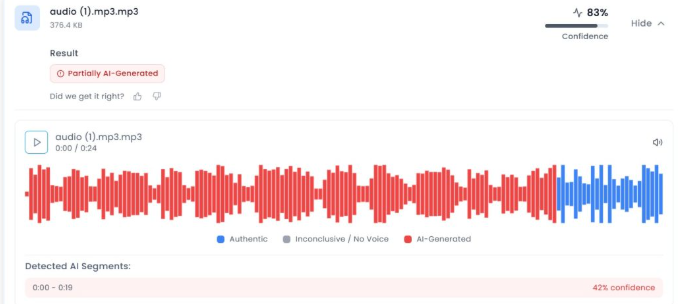
To further examine the authenticity of the audio, we analysed it using AI detection tools. The audio was first checked using Aurigin.ai, which indicated an 83 percent probability that the voice in the viral clip was AI-generated.
Conclusion
The CyberPeace’s research confirmed that the claim associated with Shah Rukh Khan’s viral video is false. The video is a deepfake in which the audio has been altered using artificial intelligence. In the original footage, Khan was discussing his life and experiences, and he did not make any statement about helping Rajpal Yadav.

Related Blogs

Introduction
In today's era of digitalised community and connections, social media has become an integral part of our lives. we use social media to connect with our friends and family, and social media is also used for business purposes. Social media offers us numerous opportunities and ease to connect and communicate with larger communities. While it also poses some challenges, while we use social media, we come across issues such as inappropriate content, online harassment, online stalking, account hacking, misuse of personal information or data, privacy issues, fake accounts, Intellectual property violation issues, abusive and dishearted content, content against the terms and condition policy of the platform and more. To deal with such issues, social media entities have proper reporting mechanisms and set terms and conditions guidelines to effectively prevent such issues and by addressing them in the best possible way by platform help centre or reporting mechanism.
The Role of Help Centers in Resolving User Complaints:
The help centres are established on platforms to address user complaints and provide satisfactory assistance or resolution. Addressing user complaints is a key component of maintaining a safe and secure digital environment for users. Platform-centric help centres play a vital role in providing users with a resource to seek assistance and report their issues.
Some common issues reported on social media:
- Reporting abusive content: Users can report content that they find abusive, offensive, or in violation of platform policies. These reports are reviewed by the help centre.
- Reporting CSAM (Child Sexual Abuse Material): CSAM content can be reported to platform help centre. Social media platforms have stringent policies in place to address such concerns and ensure a safe digital environment for everyone, including children.
- Reporting Misinformation or Fake News: With the proliferation of misinformation online, users can report content that they find or suspect misleading or false information and Fact-checking bodies are employed to assess the accuracy of reported content.
- Content violating intellectual property rights: If there is a violation or infringement of any intellectual property work, it can be reported on the platform.
- Violence of commercial policies: Products listed on social media platforms are also needed to comply with the platform’s Commercial Policies.
Submitting a Complaint to the Indian Grievance Officer for Facebook:
A user can report his issue through the below-mentioned websites:
The user can go to the Facebook Help Center, where go to the "Reporting a Problem” section, then by clicking on Reporting a Problem, Choose the Appropriate Issue that best describes your complaint. For example, if you have encountered inappropriate or abusive content, select the ‘I found inappropriate or abusive content’ option.
Here is a list of issues which you can report on Facebook:
- My account has been hacked.
- I've lost access to a page or a group I used to manage.
- I've found a fake profile or a profile that's pretending to be me.
- I am being bullied or harassed.
- I found inappropriate or abusive content.
- I want to report content showing me in nudity/partial nudity or in a sexual act.
- I (or someone I am legally responsible for) appear in content that I do not want to be displayed.
- I am a law enforcement official seeking to access user data.
- I am a government official or a court officer seeking to submit an order, notice or direction.
- I want to download my personal data or report an issue with how Facebook is processing my data.
- I want to report an Intellectual Property infringement.
- I want to report another issue.
Then, describe your issues and attach supporting evidence such as screenshots, then submit your report. After submitting a report, you will receive a confirmation that your report has been submitted to the platform. The platform will review the complaint within the stipulated time period, and users can also check the status of their filed complaint. Appropriate action will be taken by platforms after reviewing such complaints. If it violates any standard policy, terms & conditions, or privacy policies of the platform, the platform will take down that content or will take any other appropriate action.
Conclusion:
It is important to be aware of your rights in a digital landscape and report such issues to the platform. It is essential to understand how to report your issues or grievances on social media platforms effectively. By using the help centre or reporting mechanism of the platform, users can effectively file their complaints on the platform and contribute to a safer and more responsible online environment. Social media platforms have their compliance framework and privacy and policy guidelines in place to ensure the compliance framework for community standards and legal requirements. So, whenever you encounter an issue on social media, report it on the platform and contribute to a safer digital environment on social media platforms.
References:
- https://www.cyberyodha.org/2023/09/how-to-submit-complaint-to-indian.html
- https://transparency.fb.com/en-gb/enforcement/taking-action/complaints-handling-process/
- https://www.facebook.com/help/contact/278770247037228
- https://www.facebook.com/help/263149623790594

The World Economic Forum reported that AI-generated misinformation and disinformation are the second most likely threat to present a material crisis on a global scale in 2024 at 53% (Sept. 2023). Artificial intelligence is automating the creation of fake news at a rate disproportionate to its fact-checking. It is spurring an explosion of web content mimicking factual articles that instead disseminate false information about grave themes such as elections, wars and natural disasters.
According to a report by the Centre for the Study of Democratic Institutions, a Canadian think tank, the most prevalent effect of Generative AI is the ability to flood the information ecosystem with misleading and factually-incorrect content. As reported by Democracy Reporting International during the 2024 elections of the European Union, Google's Gemini, OpenAI’s ChatGPT 3.5 and 4.0, and Microsoft’s AI interface ‘CoPilot’ were inaccurate one-third of the time when engaged for any queries regarding the election data. Therefore, a need for an innovative regulatory approach like regulatory sandboxes which can address these challenges while encouraging responsible AI innovation is desired.
What Is AI-driven Misinformation?
False or misleading information created, amplified, or spread using artificial intelligence technologies is AI-driven misinformation. Machine learning models are leveraged to automate and scale the creation of false and deceptive content. Some examples are deep fakes, AI-generated news articles, and bots that amplify false narratives on social media.
The biggest challenge is in the detection and management of AI-driven misinformation. It is difficult to distinguish AI-generated content from authentic content, especially as these technologies advance rapidly.
AI-driven misinformation can influence elections, public health, and social stability by spreading false or misleading information. While public adoption of the technology has undoubtedly been rapid, it is yet to achieve true acceptance and actually fulfill its potential in a positive manner because there is widespread cynicism about the technology - and rightly so. The general public sentiment about AI is laced with concern and doubt regarding the technology’s trustworthiness, mainly due to the absence of a regulatory framework maturing on par with the technological development.
Regulatory Sandboxes: An Overview
Regulatory sandboxes refer to regulatory tools that allow businesses to test and experiment with innovative products, services or businesses under the supervision of a regulator for a limited period. They engage by creating a controlled environment where regulators allow businesses to test new technologies or business models with relaxed regulations.
Regulatory sandboxes have been in use for many industries and the most recent example is their use in sectors like fintech, such as the UK’s Financial Conduct Authority sandbox. These models have been known to encourage innovation while allowing regulators to understand emerging risks. Lessons from the fintech sector show that the benefits of regulatory sandboxes include facilitating firm financing and market entry and increasing speed-to-market by reducing administrative and transaction costs. For regulators, testing in sandboxes informs policy-making and regulatory processes. Looking at the success in the fintech industry, regulatory sandboxes could be adapted to AI, particularly for overseeing technologies that have the potential to generate or spread misinformation.
The Role of Regulatory Sandboxes in Addressing AI Misinformation
Regulatory sandboxes can be used to test AI tools designed to identify or flag misinformation without the risks associated with immediate, wide-scale implementation. Stakeholders like AI developers, social media platforms, and regulators work in collaboration within the sandbox to refine the detection algorithms and evaluate their effectiveness as content moderation tools.
These sandboxes can help balance the need for innovation in AI and the necessity of protecting the public from harmful misinformation. They allow the creation of a flexible and adaptive framework capable of evolving with technological advancements and fostering transparency between AI developers and regulators. This would lead to more informed policymaking and building public trust in AI applications.
CyberPeace Policy Recommendations
Regulatory sandboxes offer a mechanism to predict solutions that will help to regulate the misinformation that AI tech creates. Some policy recommendations are as follows:
- Create guidelines for a global standard for including regulatory sandboxes that can be adapted locally and are useful in ensuring consistency in tackling AI-driven misinformation.
- Regulators can propose to offer incentives to companies that participate in sandboxes. This would encourage innovation in developing anti-misinformation tools, which could include tax breaks or grants.
- Awareness campaigns can help in educating the public about the risks of AI-driven misinformation and the role of regulatory sandboxes can help manage public expectations.
- Periodic and regular reviews and updates to the sandbox frameworks should be conducted to keep pace with advancements in AI technology and emerging forms of misinformation should be emphasized.
Conclusion and the Challenges for Regulatory Frameworks
Regulatory sandboxes offer a promising pathway to counter the challenges that AI-driven misinformation poses while fostering innovation. By providing a controlled environment for testing new AI tools, these sandboxes can help refine technologies aimed at detecting and mitigating false information. This approach ensures that AI development aligns with societal needs and regulatory standards, fostering greater trust and transparency. With the right support and ongoing adaptations, regulatory sandboxes can become vital in countering the spread of AI-generated misinformation, paving the way for a more secure and informed digital ecosystem.
References
- https://www.thehindu.com/sci-tech/technology/on-the-importance-of-regulatory-sandboxes-in-artificial-intelligence/article68176084.ece
- https://www.oecd.org/en/publications/regulatory-sandboxes-in-artificial-intelligence_8f80a0e6-en.html
- https://www.weforum.org/publications/global-risks-report-2024/
- https://democracy-reporting.org/en/office/global/publications/chatbot-audit#Conclusions

Executive Summary:
A video is circulating on social media claiming to be footage of the aftermath of Iran's missile strikes on Israel. The video shows destruction, damaged infrastructure, and panic among civilian casualties. After our own digital verification, visual inspection, and frame-by-frame inspection, we have determined that the video is fake. The video is just AI-generated clips and not related to any incident.

Claim:
The viral video claims that a recent military strike by Iran resulted in the destruction of parts of Israel, following an initial missile attack launched by Iran. The footage appears current and depicts significant destruction of buildings and widespread chaos in the streets.

FACT CHECK:
We conducted our research on the viral video to determine if it was AI-generated. During the research we broke the video into individual still frames, and upon closely examining the frames, several of the visuals he showed us had odd-shaped visual features, abnormal body proportions, and flickering movements that don't occur in real footage. We took several still frames and checked them in image search sites to see if they had appeared before. The search results revealed that several clips in the video had appeared previously, in separate and unrelated circumstances, which indicates that they are neither recent nor original.

While examining the Instagram profile, we noticed that the account frequently shares visually dramatic AI content that appears digitally created. Many earlier posts from the same page include scenes that are unrealistic, such as wrecked aircraft in desolate areas or buildings collapsing in unnatural ways. In the current video, for instance, the fighter jets shown have multiple wings, which is not technically or aerodynamically possible in real life. The profile’s bio, which reads "Resistance of Artificial Intelligence," suggests that the page intentionally focuses on sharing AI-generated or fictional content.

We also ran the viral post through Tenorshare.AI for Deep-Fake detection, and the result came 94% AI. All findings resulting from our research established that the video is synthetic and unrelated to any event occurring in Israel, and therefore debunked a false narrative propagated on social media.

Conclusion:
Our research found that the video is fake and contains AI-generated images and is not related to any real missile strike or destruction occurring in Israel. The source is specific to fuel the panic and misinformation in a context of already-heightened geopolitical tension. We call on viewers not to share this unverified information and to rely on trusted sources. When there are sensitive international developments, the dissemination of fake imagery can promote fear, confusion, and misinformation on a global scale.
- Claim: Real Footage of Iran’s Missile Strikes on Israel
- Claimed On: Social Media
- Fact Check: False and Misleading
