
#FactCheck- Old CCTV Video Falsely Shared as Killing of LeT’s Amir Hamza
Executive Summary
A CCTV video showing a man being shot is being widely circulated on social media with the claim that it depicts the killing of Lashkar-e-Taiba terrorist Amir Hamza in Pakistan. However, research by the CyberPeace Research Wing found that the claim is misleading. The viral video existed online even before the reported attack on Amir Hamza.
Claim
Social media users are sharing a CCTV clip claiming that Lashkar-e-Taiba terrorist Amir Hamza was shot dead in Pakistan.
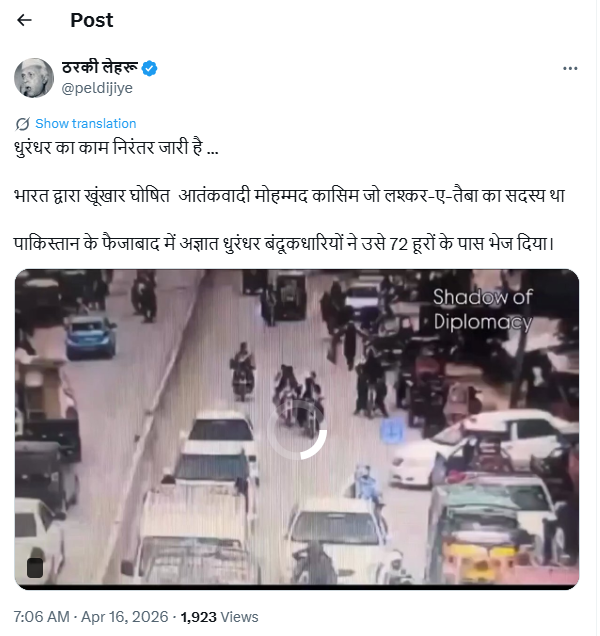
Fact Check
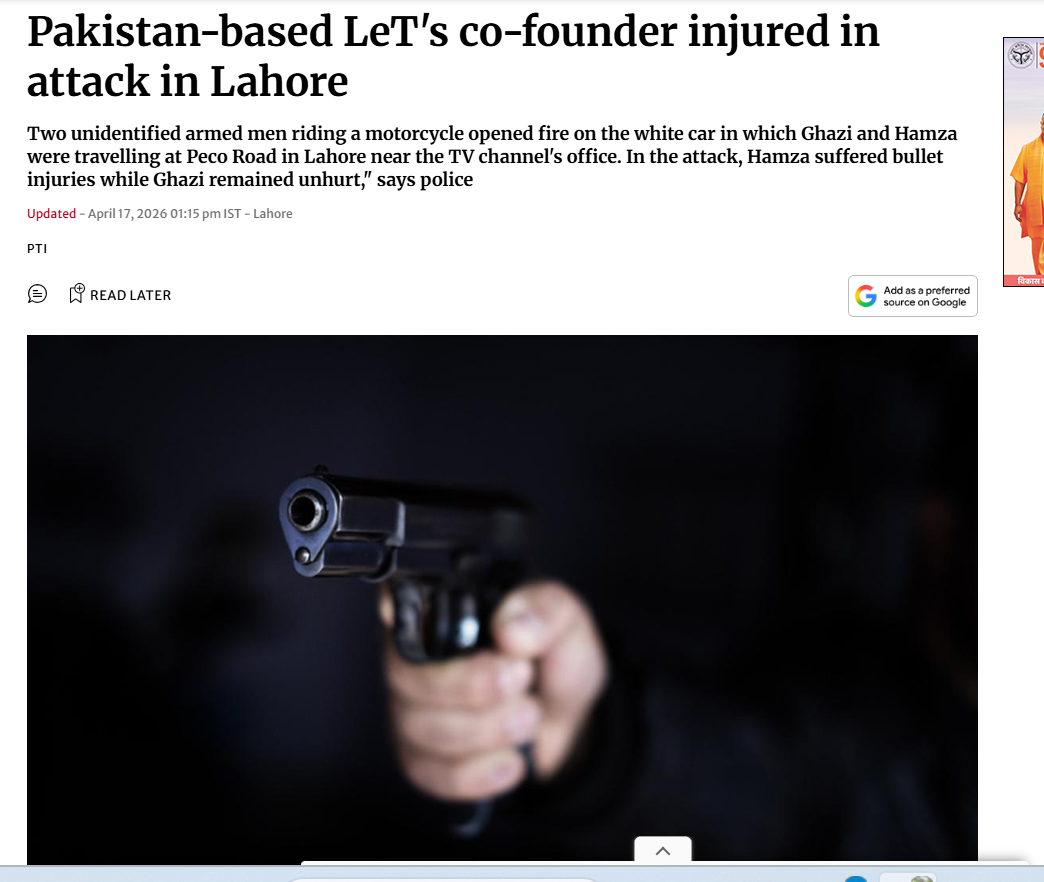
To verify the claim, we first searched relevant keywords such as “Maulana Amir Hamza firing Lahore.” This led us to a report published on April 17, 2026, by The Hindu. Citing Pakistani channel 24 News HD TV, the report stated that unidentified attackers opened fire on the car of TV host Justice Nazir Ahmed Ghazi. Amir Hamza was injured in the incident, not killed.
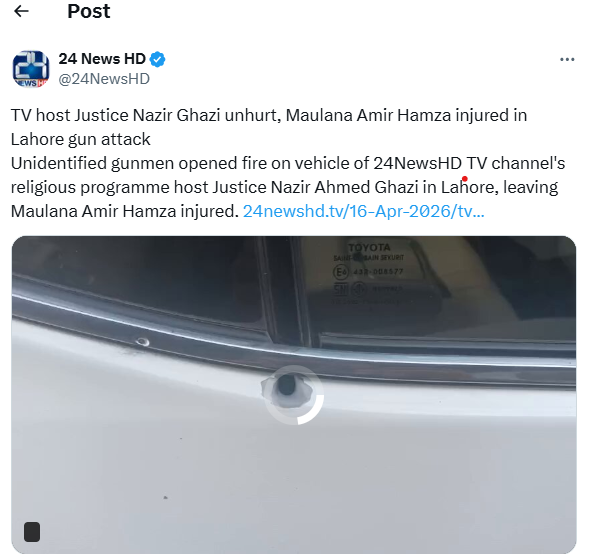
We also reviewed the official social media accounts of 24 News HD TV. A post on its X handle (@24NewsHD) confirmed that Justice Ghazi was safe, while Amir Hamza sustained injuries in the firing incident in Lahore.
For further verification, we extracted keyframes from the viral video and performed a reverse image search. The same clip was found uploaded on March 28, 2026, on a Pakistani Facebook page. According to the post, the CCTV footage was linked to the killing of an individual named Saifullah Malakhel.
Although we could not independently verify the exact origin of the video, our findings clearly indicate that the footage predates the recent attack on Amir Hamza and is unrelated to the incident.
Conclusion
The viral claim is false. Amir Hamza was not killed but reportedly injured in the firing incident, as per credible media reports. The CCTV video being shared in this context is old and unrelated, and has been circulated with a misleading narrative.

Related Blogs

Executive Summary
A picture is going viral on social media in the name of Mexico City, with the claim that the city’s population has grown so much that, due to a shortage of space, people have built houses inside the crater of a dormant volcano. The viral picture shows houses and other structures inside the crater, which several users are sharing as a real photograph. The research by the CyberPeace Research Wing found that AI technology was used to create the image. A fact-check by Vishvas News found that there are no houses inside the crater in Mexico, although farming is carried out there and residential areas are located around its outer sections.
Claim:
Facebook page ‘The Great India’ shared a picture on August 12, 2026, claiming, “Mexico City, with a huge population of around 2.5 crore, is facing a severe shortage of land. Due to the city’s unprecedented expansion, people have found an unusual way to create homes — settlements, houses and even playgrounds have reportedly been built inside the crater of a dormant volcano. The city, located in a high plateau surrounded by volcanic hills, has seen people turn volcanic slopes and depressions into habitable areas due to the declining availability of land and rapidly growing population.”
Several users on X also shared the picture believing the claim to be true.
https://x.com/Kapil_Jyani_/status/2087380670909931602?s=20
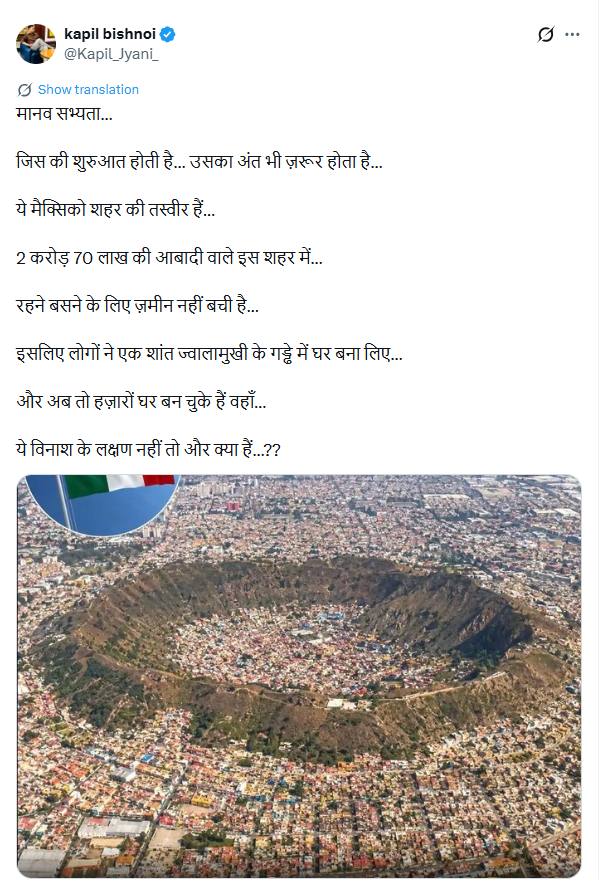
FactCheck
To verify the viral picture, we first scanned it using Google Lens. We found similar pictures on several websites and social media accounts, where they were identified as the crater of Xico Volcano in Mexico.
During the search, we also found a picture on Shutterstock, which identified the location as the crater of Xico Volcano in Chalco, Mexico.

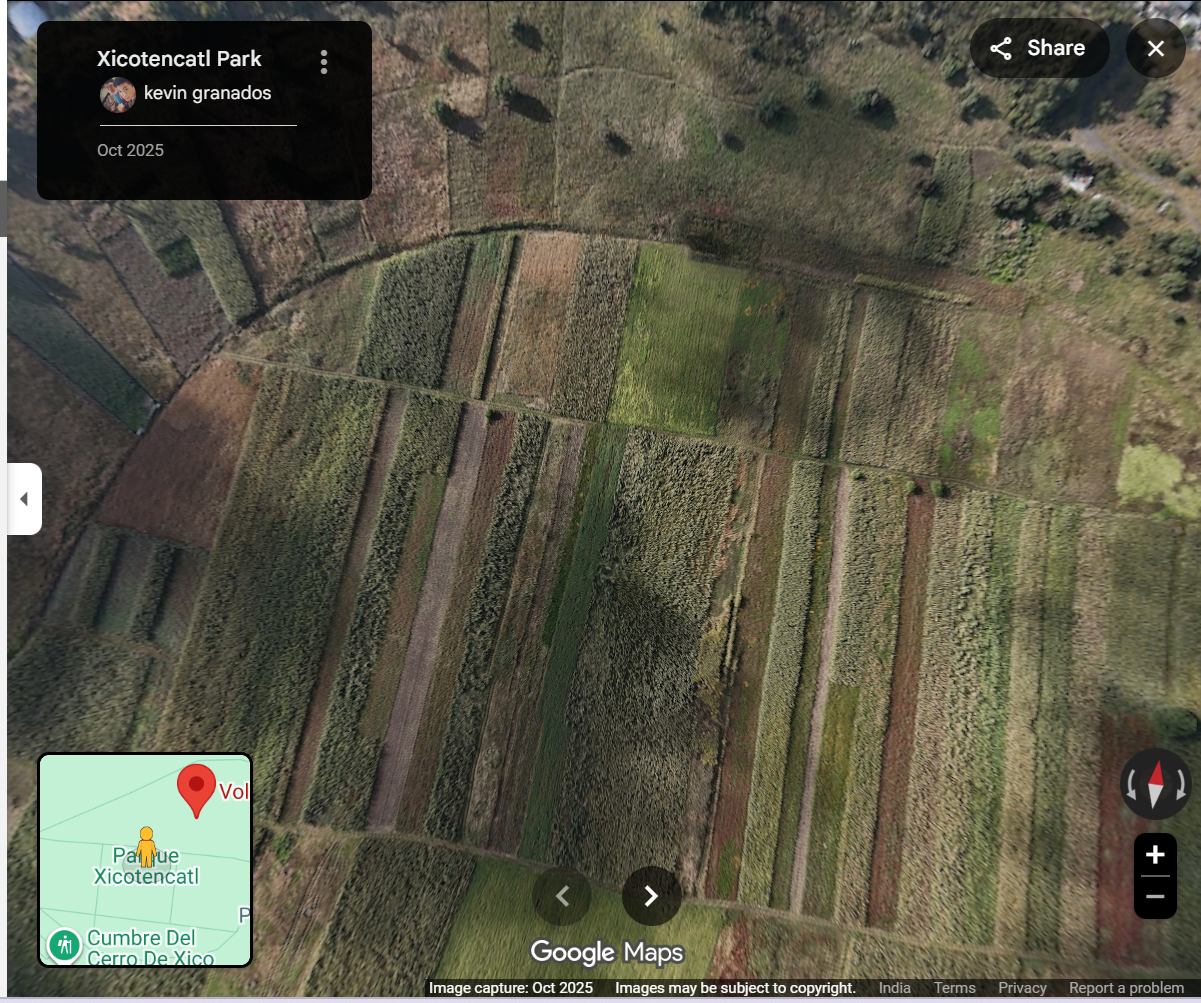
We then used Google Maps to check the location. The search showed that the Xico crater is located on the southern outskirts of Mexico City. Upon checking the area, we found agricultural activity inside the crater, while some houses could be seen in the surrounding areas.
https://maps.app.goo.gl/hszKcR1a8srtYe91A
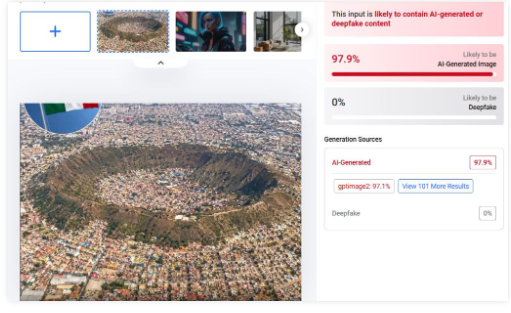
During the next stage of the research, we analysed the viral picture using AI detection tools. We first scanned the image using Hive Moderation. The tool indicated more than a 98 per cent probability that the viral picture was AI-generated.
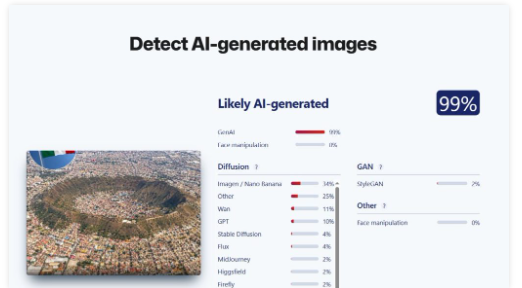
We then checked the picture using another AI detection tool, Sightengine. Its analysis also indicated a 99 per cent probability that the image was AI-generated.
Conclusion
Our research found that the claim that people have built houses inside a volcano crater in Mexico City due to a shortage of land is false. Although farming takes place inside the Xico crater, residential areas are located outside it. The viral picture was created using AI and is being shared with a misleading claim.

In Delhi there is a bank branch where a lot of money was stolen from people over the country. This bank branch is where all the money disappeared. The people who did this did not wear masks. Break in at midnight. They just used a passbook a rubber stamp and a form that nobody checked carefully. This is the truth that the people who investigate cybercrime keep finding. The way that cybercriminals get away with the money is not by using a computer it is by using a bank account. The police in Delhi who investigate cybercrime have found that a lot of accounts were opened at bank branches. These accounts were opened using identity documents that were borrowed bought or stolen. Then these accounts were rented out to groups of criminals. One bank branch keeps coming up in complaints. This is not bad luck it is a sign of a bigger problem with how banks check who is opening an account.
These fake accounts, which are called " accounts" are controlled by criminal groups, not the people whose names are on the accounts. These accounts are a part of the cybercrime problem in India. The mistakes that bank branches make which allow these accounts to be opened raise a lot of questions. These questions are about how banks check who is opening an account how they prevent money laundering and how they work with groups to stop cybercrime. The bank accounts are the way that cybercriminals in India get away with the money they steal from people. The cybercrime investigators keep finding bank accounts like the ones at the bank branch, in Delhi, where the money was stolen.
The Anatomy of a Mule Account Network
The pattern is now familiar to investigators. A fraud complaint on the National Cyber Crime Reporting Portal traces a victim's stolen money to a beneficiary account. When police pull the account-opening file, the person named on the KYC documents often denies ever visiting the branch or signing the forms; signature verification frequently shows a mismatch. In one recent Delhi case, a cooperative bank's deputy manager was arrested after a single account he had helped open surfaced in 159 separate cyber fraud complaints from across the country, with transactions worth nearly Rs 68 crore routed through it before detection. Similar investigations have uncovered supply gangs that procure dozens of accounts at a time using POS machines, stacks of ATM cards, and cheque books belonging to different people and rent them out to fraudsters as ready-made conduits for stolen money.
What makes a single branch or a small cluster of accounts significant is what it reveals about entry-point failure. Investigators do not describe these as sophisticated hacking operations; they describe them as verification failures as are accounts opened without the mandatory in-person checks, video KYC, or document authentication that RBI rules require. When 96, or 700, or 8.5 lakh mule accounts are traced back through a handful of branches and intermediaries, the story is not really about the fraudsters at the far end of the chain. It is about the choke point where honest oversight should have stopped the account from ever existing.
Where the KYC Framework Is Breaking Down
The RBI's Know Your Customer Master Direction requires banks to establish customer identity, verify a genuine business relationship, and apply risk-based due diligence before allowing an account to operate. In practice, investigators have repeatedly found accounts opened through complicit or negligent bank staff, business correspondents, and third-party agents who bypass these checks entirely. Analysts note that mule accounts systematically exploit gaps in customer onboarding, KYC verification, transaction monitoring, and dormant-account surveillance, with criminals using forged or stolen identity documents and layering funds across multiple accounts to escape detection. Economically vulnerable individuals who are daily-wage workers, students, the unemployed are frequently paid a small commission to hand over their documents or existing accounts, often without understanding that they could face criminal liability for transactions they never authorised.
This is compounded by a financial-inclusion paradox that regulators themselves acknowledge: India has expanded banking access faster than it has expanded financial and digital literacy, leaving a population that is easy to recruit knowingly or unknowingly into mule networks. The result is a KYC regime that looks robust on paper but is only as strong as its weakest branch-level implementation, and weak implementation has proved trivially easy for organised networks to locate and exploit at scale.
The Regulatory and Institutional Response
RBI: From Static Compliance to Active Detection
The Reserve Bank of India has moved beyond periodic KYC audits toward technology-driven detection. It has directed banks to tighten onboarding controls, strengthen transaction monitoring, and report suspicious activity more proactively, and it has proposed additional safeguards, including limits on aggregate credits into accounts where a satisfactory business relationship has not yet been established. Its most significant intervention is MuleHunter.ai, an AI and machine-learning system built to flag suspected mule accounts from transaction-behaviour patterns rather than static KYC data alone; the platform is already operational across roughly two dozen banks and is being expanded. The RBI Innovation Hub has also begun working directly with the Indian Cyber Crime Coordination Centre (I4C) to share fraud-risk intelligence and coordinate detection in near real time.
FIU-IND and the PMLA Framework
The Prevention of Money Laundering Act, 2002 (PMLA) is the backbone of India's AML architecture. It mandates KYC verification, Customer Due Diligence, record maintenance, and timely reporting of suspicious transactions to the Financial Intelligence Unit–India (FIU-IND). Banks are required to file Suspicious Transaction Reports (STRs) and Cash Transaction Reports with FIU-IND, which in turn analyses financial intelligence and shares it with law enforcement and regulators. On paper, this creates a feedback loop between banks, the RBI, and enforcement agencies; in practice, the sheer volume of mule-linked transactions are hundreds of thousands of accounts flagged nationally has strained the capacity of this reporting chain to generate timely, actionable freezes before funds are withdrawn or converted to cryptocurrency.
The IT Act, CERT-In, and Cyber Enforcement
The Information Technology Act, 2000, together with provisions of the Bharatiya Nyaya Sanhita, provides the criminal-law basis for prosecuting mule account operators, aggregators, and the fraudsters who direct them. CERT-In's role sits slightly upstream of the banking layer: it issues advisories on phishing, fake payment gateways, and compromised digital infrastructure that fraud syndicates use to recruit mule account holders and move money. The Ministry of Home Affairs' I4C coordinates the National Cyber Crime Reporting Portal and the 1930 helpline, which allow victims to report fraud and trigger a limited window for freezing beneficiary accounts. I4C has also issued direct public alerts against illegal payment gateways built on mule accounts, warning citizens not to rent or sell their bank credentials to intermediaries.
The Coordination Gap
None of these institutions is short of legal authority. The gap is operational: banks, the RBI, FIU-IND, state police cyber cells, the CBI, and I4C each hold a piece of the picture, but no single agency has a real-time, end-to-end view of an account from opening to fraud to freeze. A mule account can be flagged by one bank's internal monitoring, reported through a completely different victim's complaint in another state, and investigated by a third jurisdiction's cyber police with each step introducing delay. The Indian Banks' Association has publicly pushed for the RBI to be given clearer power to directly freeze accounts flagged as mule accounts, rather than requiring each bank to act unilaterally or wait for a police request, precisely because this fragmentation lets fraudsters withdraw or launder funds within hours of a transaction.
Policy Recommendations
1. Mandatory video-KYC and biometric re-verification for all new accounts opened through business correspondents and third-party agents, with personal liability for verifying bank officials found complicit.
2. A statutory, RBI-backed mechanism allowing banks to freeze accounts flagged by MuleHunter.ai-type systems or FIU-IND intelligence within hours, rather than only after a formal police complaint.
3. A unified, interoperable case database linking the National Cyber Crime Reporting Portal, FIU-IND's STR system, and state cyber cells, so that an account flagged once is visible to every agency instantly.
4. Stronger due-diligence audits of banking correspondents and cooperative banks, which recur disproportionately in mule account cases relative to their share of total accounts.
5. Public financial-literacy campaigns targeted at the economically vulnerable groups most often recruited as unwitting mule account holders, paired with clear legal guidance distinguishing victims from willing participants.
Conclusion
The branch-level mule account cases surfacing across Delhi and other cities are not isolated policing stories; they are a live audit of India's AML and KYC architecture. The RBI, FIU-IND, CERT-In, and law enforcement agencies each have credible tools and legal mandates like MuleHunter.ai, PMLA reporting, IT Act prosecutions, and I4C's coordination portal chief among them but fraud syndicates continue to outpace the system by exploiting the seams between institutions rather than any single point of failure. Closing that gap requires less new law and more operational integration: faster account freezes, verified accountability at the point of account opening, and a shared, real-time picture of mule networks across every agency involved. Until banks, regulators, and investigators can act as one system rather than several disconnected ones, every dismantled racket will simply be replaced by the next.
References
- https://aninews.in/news/national/general-news/delhi-police-arrests-bank-deputy-manager-in-83776792-crore-mule-account-case-linked-to-159-cyber-fraud-complaints20260610130737/
- https://the420.in/delhi-bank-manager-mule-account-cyber-fraud-case/
- https://www.business-standard.com/finance/news/what-are-mule-accounts-cybercrime-banking-layer-india-fraud-rbi-126062400855_1.html
- https://www.business-standard.com/india-news/centre-freezes-450-000-mule-bank-accounts-used-in-cyber-fraud-schemes-124111200320_1.html
- https://www.medianama.com/2025/04/223-iba-rbi-cyber-fraud-measures-freeze-bank-accounts-cybercrime/
- https://www.deccanherald.com/amp/story/india%2Fcentre-warns-of-illegal-payment-gateways-and-mule-accounts-3252723
- https://www.deccanherald.com/india/over-85-lakh-mule-accounts-in-700-bank-branches-used-by-cyber-criminals-cbi-3604229
- https://website.rbi.org.in/en/web/rbi/-/notifications/master-direction-know-your-customer-kyc-direction-2016-updated-as-on-may-04-2023-lt-span-gt-11566
- https://www.indiacode.nic.in/bitstream/123456789/15402/1/moneylaunderingact2002.pdf
- https://www.indiacode.nic.in/bitstream/123456789/13116/1/it_act_2000_updated.pdf
- https://www.mha.gov.in/en/division_of_mha/cyber-and-information-security-cis-division/Details-about-Indian-Cybercrime-Coordination-Centre-I4C-Scheme
Executive Summary
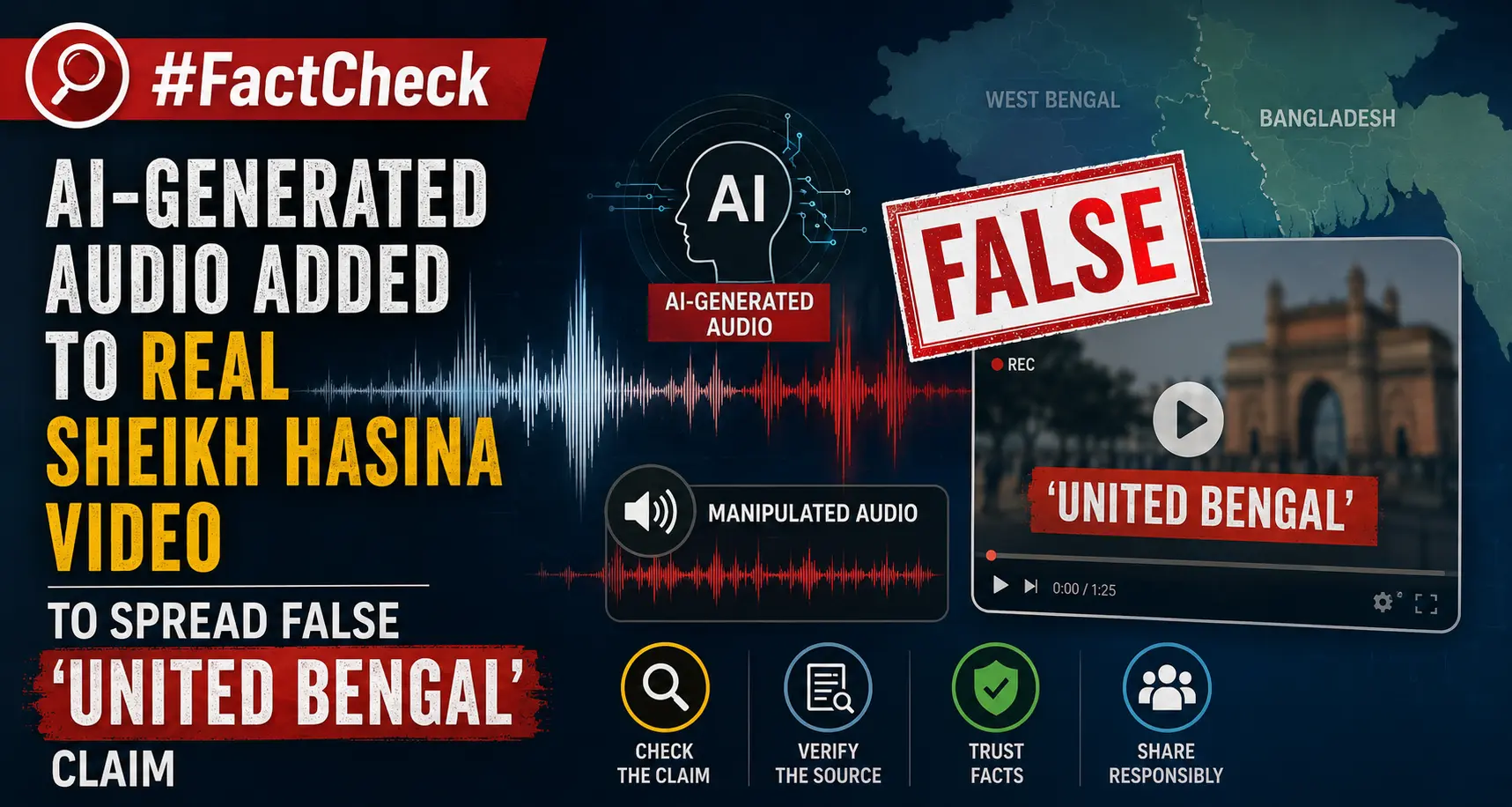
A video clip carrying the logo of news channel Republic is being shared on social media. In the video, former Bangladesh Prime Minister Sheikh Hasina is allegedly heard saying, "If these radical Muslim terrorists do not back off from imposing terror-based governance over Bangladesh, our goal will be to finish them by any means. I will request Prime Minister Narendra Modi to make Bangla a single province by combining East and West Bengal. We will bring back a secular democracy, which I will lead in the future to restore Bangla to its secular roots." The CyberPeace Research Wing found that the visuals in the viral video are genuine, but the audio has been altered using artificial intelligence (AI) and is being circulated with a false claim.
Claim:
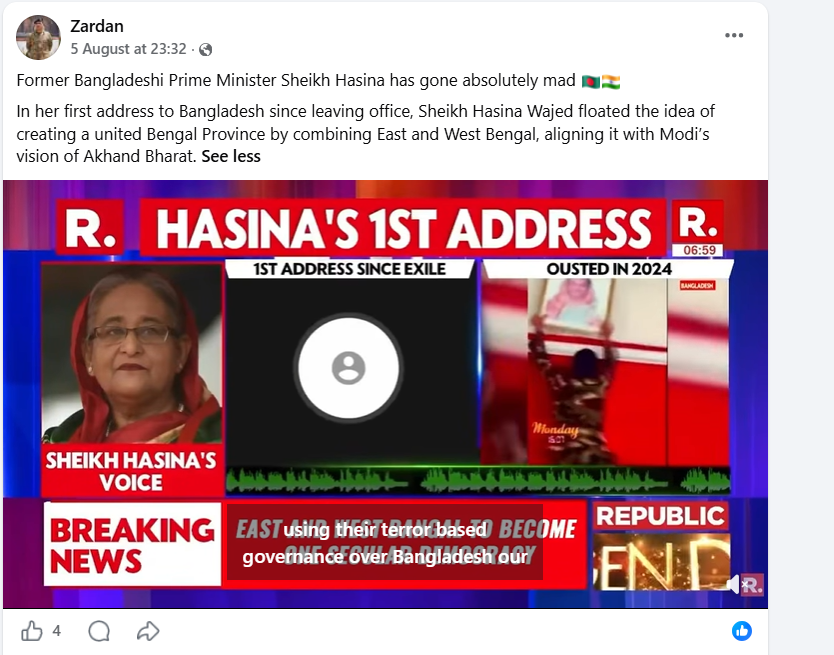
A Facebook user shared the video claiming that Sheikh Hasina proposed merging East and West Bengal to create a single province during her recent address. The link to the post, archive link, and screenshot are provided below.
https://www.facebook.com/reel/1567119714918951
FactCheck
During the research, several key frames from the viral video were extracted and a reverse image search was conducted using Google Lens. The search led us to the original video of Sheikh Hasina’s interaction available on the official social media accounts of Republic News. The link to the post and screenshot are provided below.
https://x.com/republic/status/2084999748755554323?ref_src=twsrc%5Etfw
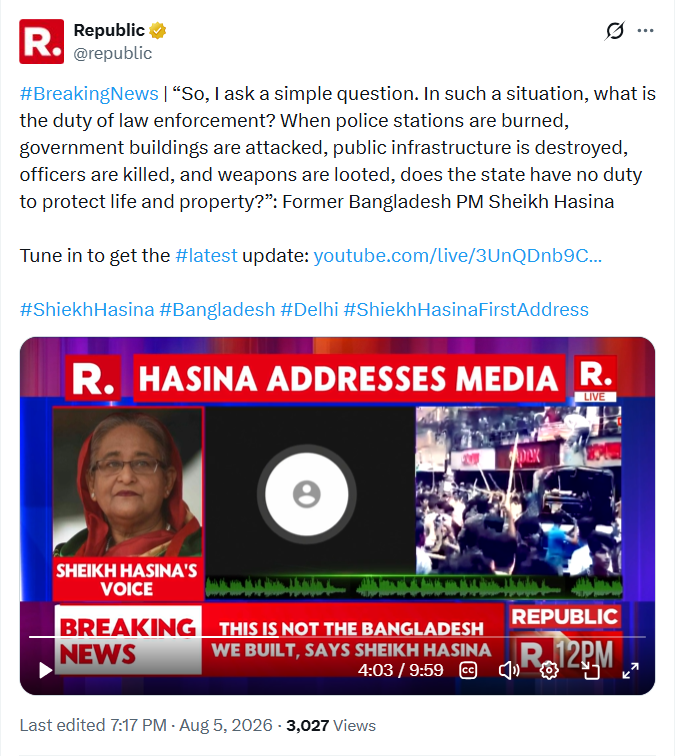
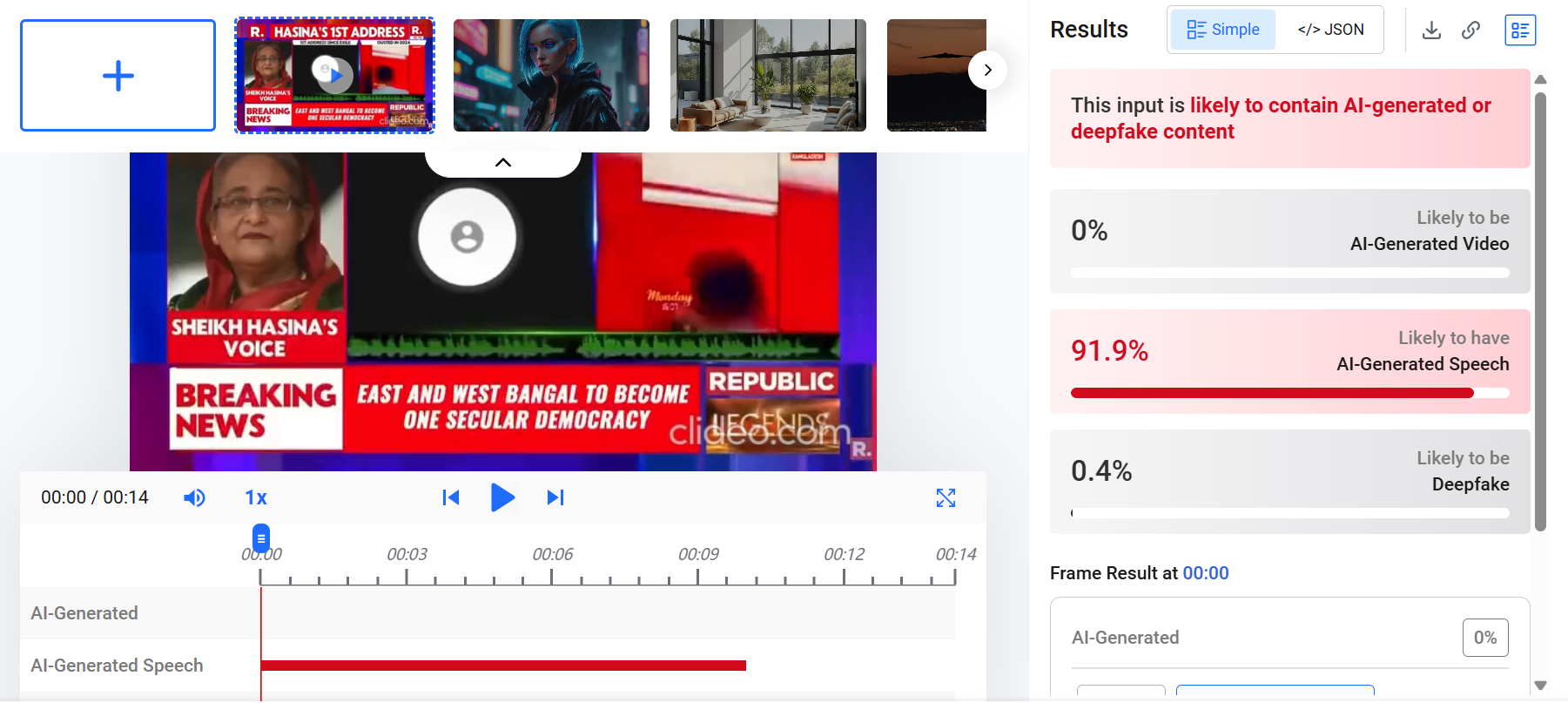
Republic shared the original video on its official X account on August 5, 2026. A comparison between the viral clip and the original footage revealed that the alleged statement about merging East and West Bengal into a single province does not appear anywhere in the authentic video. In the original video, Sheikh Hasina can be heard discussing the responsibilities of law enforcement agencies during periods of unrest. The controversial audio added to the viral clip is not part of the original recording. Further analysis of the viral video’s audio raised suspicion that it was AI-generated. The video was scanned using the AI detection tool Hive Moderation, which indicated a 91 per cent probability that the speech used in the viral video was AI-generated.
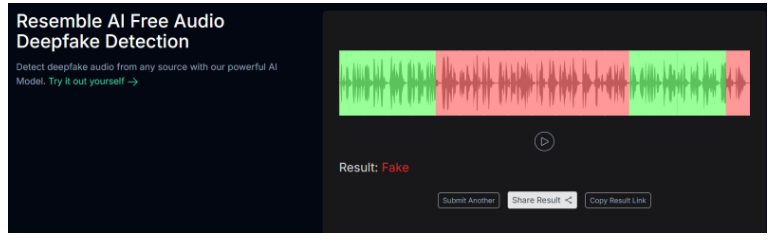
In the next step of the research, the viral audio was analysed using the Resemble AI tool. The results indicated that the audio was likely manipulated, suggesting that it had been altered using artificial intelligence (AI).
Conclusion:
The research found that the visuals used in the viral video are genuine, but the audio has been modified using AI and is being shared with a false claim. The claim that Sheikh Hasina spoke about merging East and West Bengal into a single province is false.
