
PCI DSS Compliance in India, Protecting Payment Data in a Digital Economy
Introduction
India is becoming more digital. People are using cards and phones to pay for things. This means there is a risk of people stealing card information and committing fraud. The Payment Card Industry Data Security Standard or PCI DSS is a set of rules that helps companies keep card information safe. It was created by the PCI Security Standards Council, which was started by Visa, Mastercard, American Express, Discover and JCB. The goal of PCI DSS is to reduce the risk of data breaches and card fraud by making sure companies have security controls in place. For India, where digital payments are becoming more popular, PCI DSS is becoming a thing to do.
Applicability in India
PCI DSS applies to all companies in India that store, process or transmit card information. This includes banks, payment companies like Razorpay, PayU and CCAvenue and online sellers. Even companies that use a hosted payment page are responsible for following the rules. Companies that have their payment forms and handle card information have to follow more rules.
Why PCI DSS Matters
Payment security is very important for customers to trust a company. If a company has a security breach it can expose a lot of card information. Damage the company's reputation. In India, where cybercrime's a big problem, PCI DSS helps companies keep card information safe. It has rules for firewalls, encryption, access controls and regular testing to prevent fraud.
Regulatory Landscape: The RBIs Role
PCI DSS is not a law in India. The Reserve Bank of India or RBI has made it a requirement. The RBI has rules that require companies to follow PCI DSS and have security audits. Non-bank companies have to get permission from the RBI and follow rules to store payment information in India. This makes PCI DSS a standard for keeping card information safe in India.
Key Requirements and the Compliance Process
The current version of PCI DSS has twelve requirements that companies have to follow. These requirements include building a network protecting card information and regular testing. Companies have to start by identifying what parts of their system handle card information. Then do a gap analysis to see what they need to do to comply. Smaller companies can usually do this in a week but bigger companies may take several months.
Common Challenges and Practical Solutions
Some problems companies face when trying to comply with PCI DSS include old computer systems that cannot handle modern encryption and unclear rules that make it hard to know what to do. Some solutions include separating the card information system from the rest of the network using tokens and encryption to keep card information safe and regularly checking for vulnerabilities.
Business and Regulatory Benefits
Following PCI DSS rules can help companies avoid penalties and have security breaches. It can also make it easier for companies to work with banks and card networks and build trust with customers. Regulators also look favorably on companies that follow the rules.
Recent Developments and Trends
The RBI has been making rules and requiring companies to follow PCI DSS more closely. As digital payments become more popular it is likely that the RBI will keep making rules to keep card information safe.
As India's digital economy grows, keeping payment information safe is becoming more important. PCI DSS is a set of rules that helps companies keep card information safe. The RBI has made it a requirement for companies to follow these rules. Companies that follow the rules can build trust with customers. Avoid security breaches.
Conclusion
As India's digital economy deepens, protecting payment data is no longer optional; it is the price of participating in the card ecosystem. PCI DSS gives banks, fintechs, gateways and merchants a common, internationally recognised language for security, while RBI's guidelines add local regulatory teeth. Organisations that treat compliance as a continuous discipline, rather than a once-a-year audit exercise, will find it easier to earn customer trust, avoid costly breaches, and scale with confidence. For every business touching cardholder data in India, the message is clear: PCI DSS compliance is now foundational to running a secure, trustworthy digital payments operation.
References
- https://www.pcisecuritystandards.org/document_library/
- https://www.rbi.org.in/Scripts/BS_ViewMasDirections.aspx
- https://www.rbi.org.in/Scripts/NotificationUser.aspx
- https://www.rbi.org.in/Scripts/NotificationUser.aspx?Id=11822
- https://www.incorpx.io/blog/pci-dss-compliance-ecommerce-fintech-india
- https://cyraacs.com/pci-dss-compliance-checklist
- https://www.skydo.com/blog/pci-dss-compliance-guide
- https://www.cybercrime.gov.in/

Related Blogs
Executive Summary
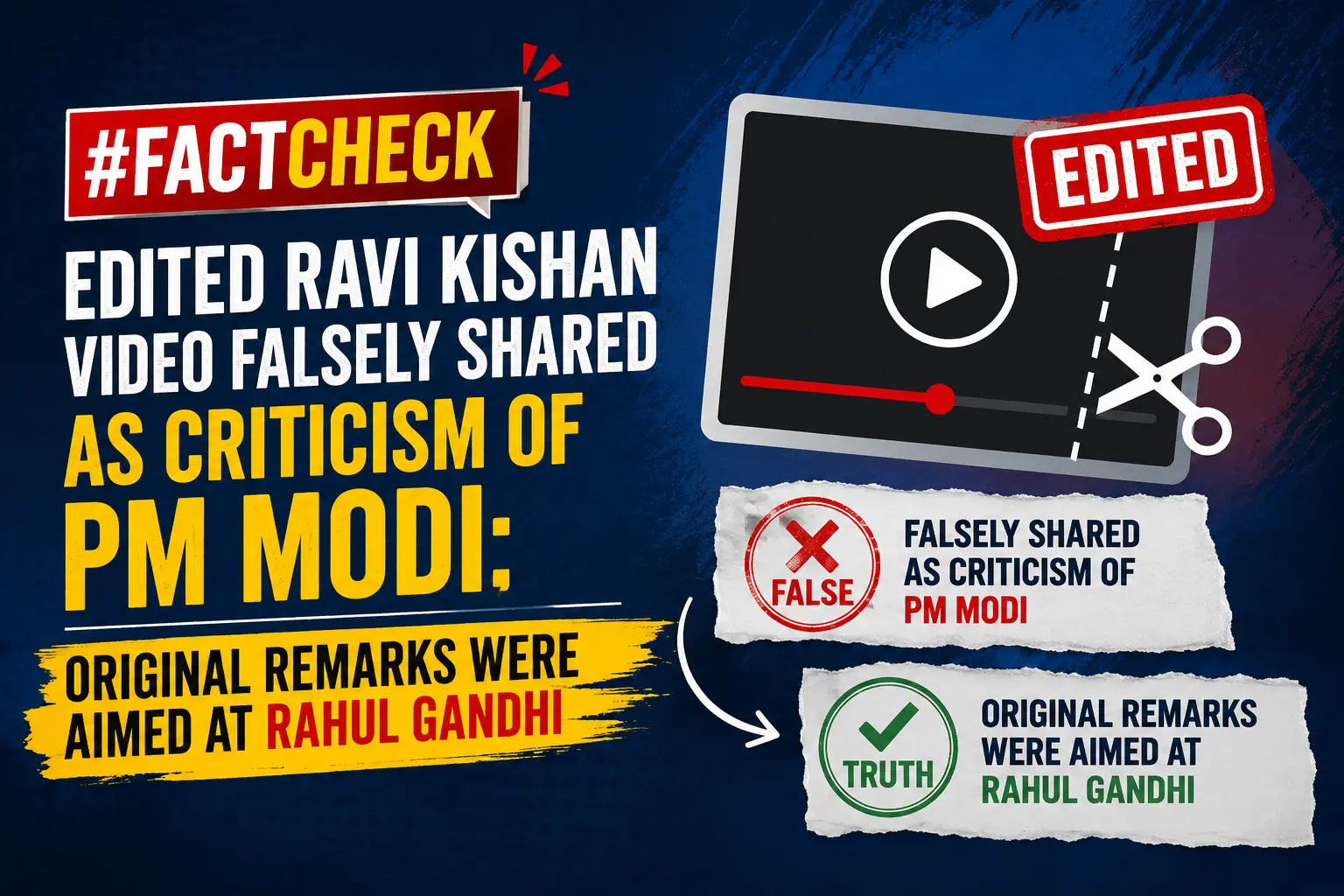
A video of BJP MP Ravi Kishan is being widely circulated on social media with the claim that the Gorakhpur MP was mocking Prime Minister Narendra Modi and criticizing his working style and frequent foreign visits.In the viral clip, Ravi Kishan can be heard saying that “he likes to travel,” “comes to Parliament only for a few minutes,” and does not like pressure or responsibility. The clip also features him using phrases such as “azad panchhi” (free bird) and “azad parinda.” However, CyberPeace Research Wingresearch found the claim to be misleading. The research revealed that in the original video, Ravi Kishan was actually criticizing Congress leader Rahul Gandhi. A cropped portion of his statement is being shared out of context with a false claim.
Claim
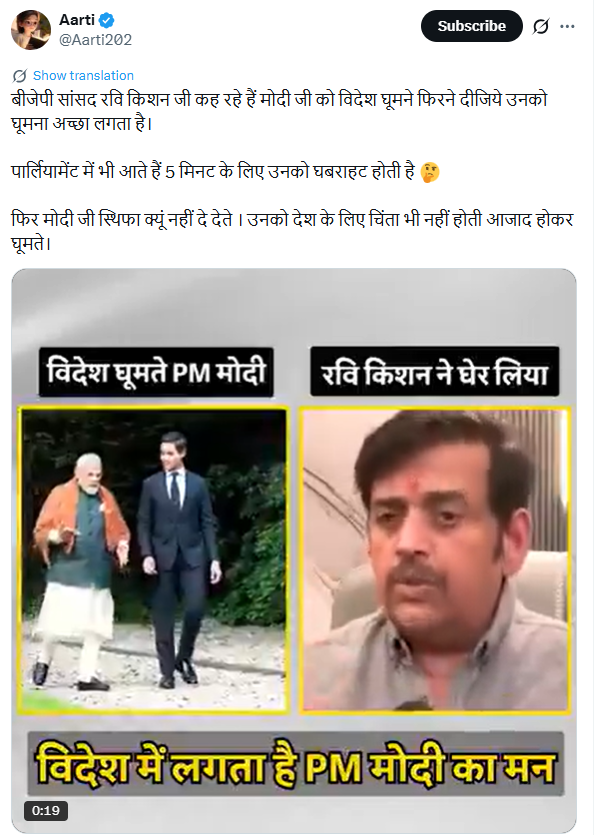
An X (formerly Twitter) user shared the viral clip and wrote that Ravi Kishan was referring to Prime Minister Narendra Modi, alleging that Modi enjoys travelling abroad, spends little time in Parliament, and feels uncomfortable under pressure.
- https://x.com/Aarti202/status/2058523226305900586
- https://archive.ph/j5MaV
Fact Check
To verify the viral claim, we performed a reverse search using key frames from the video. During the research, we found the original video uploaded on the Facebook page of ANI on May 13, 2026.
The caption of the post read:“War does not seem to be ending…” Ravi Kishan warns the country about the ongoing conflict in the Middle East.At around the 4-minute-40-second timestamp, an ANI reporter asks Ravi Kishan about Rahul Gandhi distancing himself from the CBI Director selection process. Responding to that question, Ravi Kishan makes the remarks that later went viral.

This clearly establishes that Ravi Kishan was not referring to Prime Minister Narendra Modi, but was commenting on Rahul Gandhi. In his response, he says that “it is good that he has freed himself” and refers to Rahul Gandhi as an “azad parinda” (free bird).
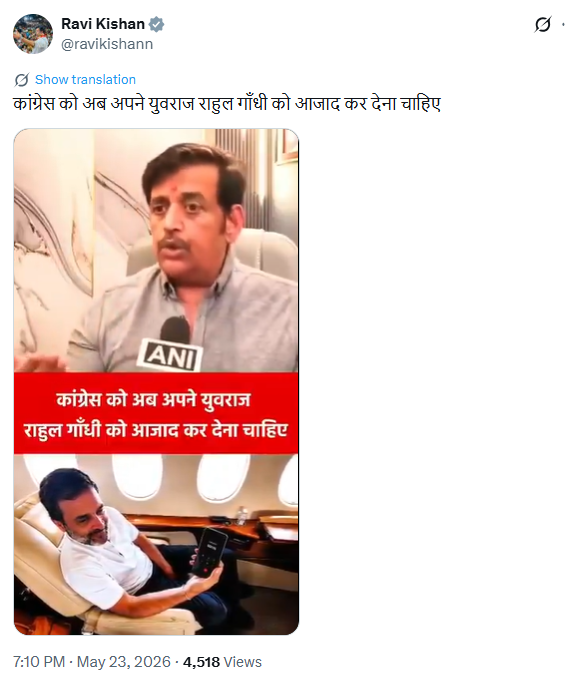
During the research, we also found the same video posted on Ravi Kishan’s official X account on May 23. The caption of the post stated:“Congress should now free its prince Rahul Gandhi.”This further confirms that the viral clip has been misleadingly edited and shared out of context
Conclusion
The research found that Ravi Kishan’s remarks in the original video were directed at Rahul Gandhi, not Prime Minister Narendra Modi. An edited portion of the video has been falsely shared with a misleading claim.

Introduction
Google.org is committed to stepping ahead to enhance Internet safety and responsible online behaviour. ‘Google for INDIA 2023’, an innovative conclave, took place on 19th October 2023. Google.org has embarked on its vision for a safer Internet and combating misinformation, financial frauds and other threats that come from bad actors. Alphabet Big Tech is committed to leading this charter and engaging with all stakeholders, including government agencies. Google.org has partnered with CyberPeace Foundation to foster a safer online environment and empower users on informed decisions on the Internet. CyberPeace will run a nationwide awareness and capacity-building Initiative equipping more than 40 Million Indian netizens with fact-checking techniques, tools, SoPs, and guidance for responsible and safe online behaviour. The campaign will be deployed in 15 Indian regional languages as a comprehensive learning outcome for the whole nation. Together, Google.org and CyberPeace Foundation aim to make the Internet safer for everyone and work in a direction to ensure that progress for everyone is built on a strong foundation of trusted information available on the Internet and pursuing the true spirit of “Technology for Good”.
Google.org and CyberPeace together for enhanced online safety
A new $4 million grant to CyberPeace Foundation will support a nationwide awareness-building program and comprehensive multilingual digital resource hub with content available in up to 15 Indian languages to empower nearly 40 million underserved people across the country in building resilience against misinformation and practice responsible online behaviour. Together, Google.org and CyberPeace are on their way to creating a strong pathway of trusted Internet and a safer digital environment. The said campaign will be undertaken for a duration of 3 years, and the following key components will run at the core of the same:
- CyberPeace Corps Volunteers: This will be a pan India volunteer engagement initiative to create a community of 9 million CyberPeace Ambassadors/First Responders/Volunteers to fight misinformation and promote responsible online behaviour going far into the rural, marginalised and most vulnerable strata of society.
- Digital Resource Hub: In pursuance of the campaign, CyberPeace is developing a cutting-edge platform offering a wealth of resources on media literacy, responsible content creation, and cyber hygiene translated into 15 Indian regional languages for a widespread impact on the ground.
- Public Sensitisation: CyberPeace will be conducting an organic series of online and offline events focusing on empowering netizens to discern fact from fiction. These sensitisation drives will be taken on by start master trainers from different regions of India to ensure all states and UTs are impacted.
- CyberPeace Quick Reaction Team: A specialised team of tech enthusiasts that will work closely with platforms to rapidly address new-age cyber threats and misinformation campaigns in real-time and establish best practices and SoPs for the diverse elements in the industries.
- Engaging Multimedia Content: With CyberPeace’s immense expertise in E-Course and digital content, the campaign will produce a range of multilingual multimedia resources, including informative videos, posters, games, contests, infographics, and more.
- Fact-check unit: Fact-check units will play a crucial role in monitoring, identifying, and doing fact analysis of the suspected information and overall busting the growing incidents of misinformation. Fake news or misinformation has negative consequences on society at large. The fact-check units play a significant role in controlling the widespread of misinformation.
Fight Against Misinformation
Misinformation is rampant all across the world and requires attention. With the increasing penetration of social media and the internet, this remains a global issue. Google.org has taken up the initiative to address this issue in India and, in collaboration with CyberPeace Foundation taken a proactive step to multiple avenues for mass-scale awareness and upskilling campaigns have been piloted to make an impact on the ground with the vision of upskilling over 40 Million people in the country and building resilience against misinformation and practicing responsible online behavior.
Maj Vineet Kumar, Founder of CyberPeace, said,
"In an era in which digital is deeply intertwined with our lives, knowing how to discern, act on, and share the credible from the wealth of information available online is critical to our well-being, and of our families and communities. Through this initiative, we’re committing to help Internet users across India become informed, empowered and responsible netizens leading through conversations and actions. Whether it’s in fact-checking information before sharing it, or refraining from sharing unverified news, we all play an important role in building a web that is a safe and inclusive space for everyone, and we are extremely grateful to Google.org for propelling us forward in this mission with their grant support.”
Annie Lewin, Senior Director of Global Advocacy and Head of Asia Pacific, Google.org said:
“We have a longstanding commitment to supporting changemakers using technology to solve humanity's biggest challenges. And, the innovation and zeal of Indian nonprofit organisations has inspired us to deepen our commitment in India. With the new grant to CyberPeace Foundation, we are proud to support solutions that speak directly to Google’s DNA, helping first-time internet users chart their path in a digital world with confidence. Such solutions give us pride and hope that each step, built on a strong foundation of trusted information, will translate into progress for all.”
Conclusion
Google.org has partnered with government agencies and other Indian organisations with the vision of future-proof India for digital public infrastructure and staying a step ahead for Internet safety, keeping the citizens safe online. Google.org is taking its largest step yet towards online safety in India. There is widespread misinformative content and information in the digital media space or on the internet. This proactive initiative of Google.org in collaboration with CyberPeace is a commendable step to prevent the spread of misinformation and empower users to act responsibly while sharing any information and making informed decisions while using the Internet, hence creating a safe digital environment for everyone.
References:
- https://www.youtube.com/live/-b4lTVjOsXY?feature=shared
- https://blog.google/intl/en-in/products/google-for-india-2023-product-announcements/
- https://blog.google/intl/en-in/partnering-indias-success-in-a-new-digital-paradigm/
- https://telecom.economictimes.indiatimes.com/news/internet/google-to-debut-credit-in-india-announces-a-slew-of-ai-powered-launches/104547623
- https://theprint.in/economy/google-for-india-2023-tech-giant-says-it-removed-2-million-violative-videos-in-q2-2023/1810201/
.webp)
Executive Summary
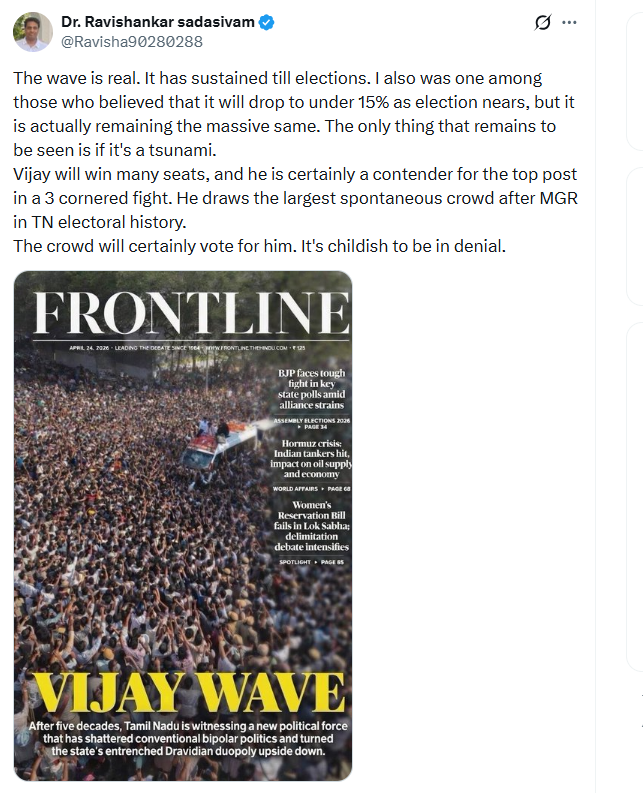
As Tamil Nadu voted in the 2026 Assembly elections, with 84.69 percent polling recorded on April 23, a purported cover page of Frontline magazine began circulating on social media. The viral image featured a massive rally crowd of South Indian actor and Tamilaga Vetri Kazhagam (TVK) chief Joseph Vijay, claiming that a “Vijay Wave” had emerged in the state. The alleged cover also stated that Tamil Nadu was witnessing a new political force after five decades, one that had challenged the dominance of Dravida Munnetra Kazhagam (DMK) and All India Anna Dravida Munnetra Kazhagam (AIADMK).
However, research by the CyberPeace Research Wing found that the viral cover page is fake. Frontline magazine has not published any such edition, and its latest issue is related to health.
Claim:
X user “Dr. Ravishankar Sadasivam” shared the viral image on April 22, 2026, claiming the “wave is real” and suggesting that Vijay could emerge as a top contender in a three-cornered contest. The post further claimed that after MGR, Vijay was drawing the largest spontaneous crowds in Tamil Nadu politics.
Fact Check:
To verify the claim, relevant keyword searches were conducted online. During the research, a clarification post from Frontline magazine’s official X account, shared on April 22, 2026, was found. In the post, the publication clearly stated that the viral cover page was fake and had not been published by the magazine. It further said that the fabricated cover was being circulated online by supporters of TVK.
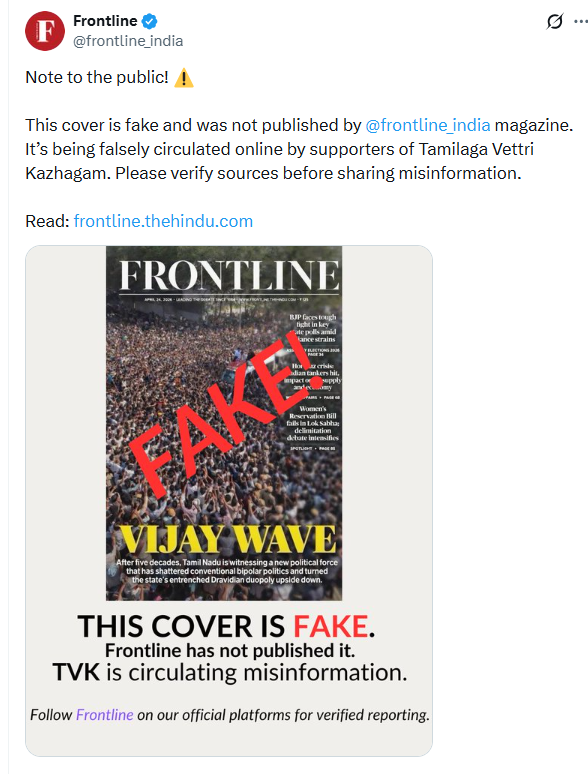
A review of the official Frontline website also found no edition carrying such a cover page.

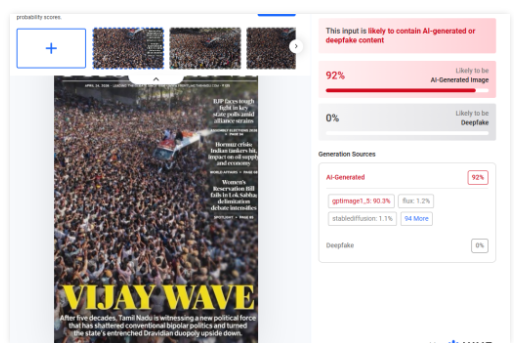
Additionally, the viral image was analyzed using the AI detection tool Hive Moderation, which rated it as 92 percent likely to be AI-generated.
Conclusion:
The claim that Frontline magazine published a cover story on a “Vijay Wave” during the Tamil Nadu Assembly elections is false. The viral cover page is fake and is being circulated online to mislead people.
