
#FactCheck -Edited Ravi Kishan Video Falsely Shared as Criticism of PM Modi; Original Remarks Were Aimed at Rahul Gandhi
Executive Summary
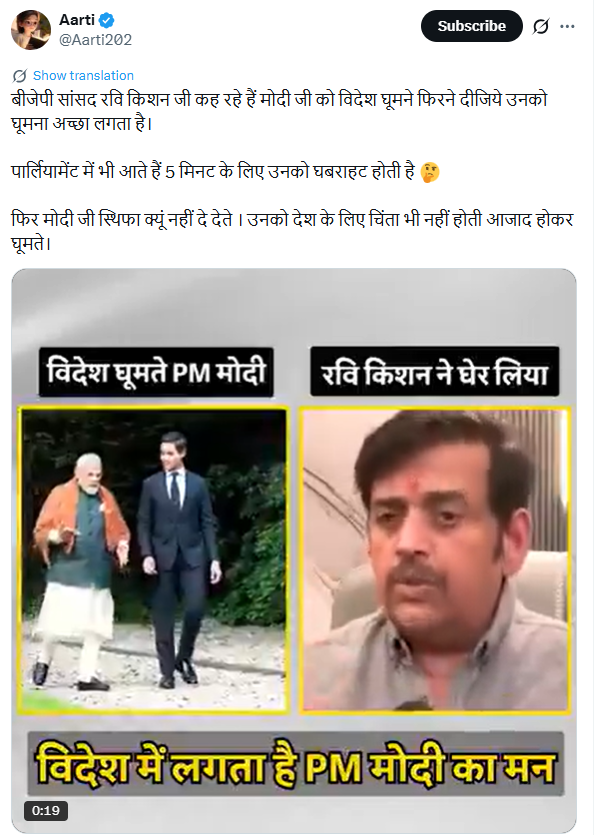
A video of BJP MP Ravi Kishan is being widely circulated on social media with the claim that the Gorakhpur MP was mocking Prime Minister Narendra Modi and criticizing his working style and frequent foreign visits.In the viral clip, Ravi Kishan can be heard saying that “he likes to travel,” “comes to Parliament only for a few minutes,” and does not like pressure or responsibility. The clip also features him using phrases such as “azad panchhi” (free bird) and “azad parinda.” However, CyberPeace Research Wingresearch found the claim to be misleading. The research revealed that in the original video, Ravi Kishan was actually criticizing Congress leader Rahul Gandhi. A cropped portion of his statement is being shared out of context with a false claim.
Claim
An X (formerly Twitter) user shared the viral clip and wrote that Ravi Kishan was referring to Prime Minister Narendra Modi, alleging that Modi enjoys travelling abroad, spends little time in Parliament, and feels uncomfortable under pressure.
- https://x.com/Aarti202/status/2058523226305900586
- https://archive.ph/j5MaV
Fact Check
To verify the viral claim, we performed a reverse search using key frames from the video. During the research, we found the original video uploaded on the Facebook page of ANI on May 13, 2026.
The caption of the post read:“War does not seem to be ending…” Ravi Kishan warns the country about the ongoing conflict in the Middle East.At around the 4-minute-40-second timestamp, an ANI reporter asks Ravi Kishan about Rahul Gandhi distancing himself from the CBI Director selection process. Responding to that question, Ravi Kishan makes the remarks that later went viral.

This clearly establishes that Ravi Kishan was not referring to Prime Minister Narendra Modi, but was commenting on Rahul Gandhi. In his response, he says that “it is good that he has freed himself” and refers to Rahul Gandhi as an “azad parinda” (free bird).
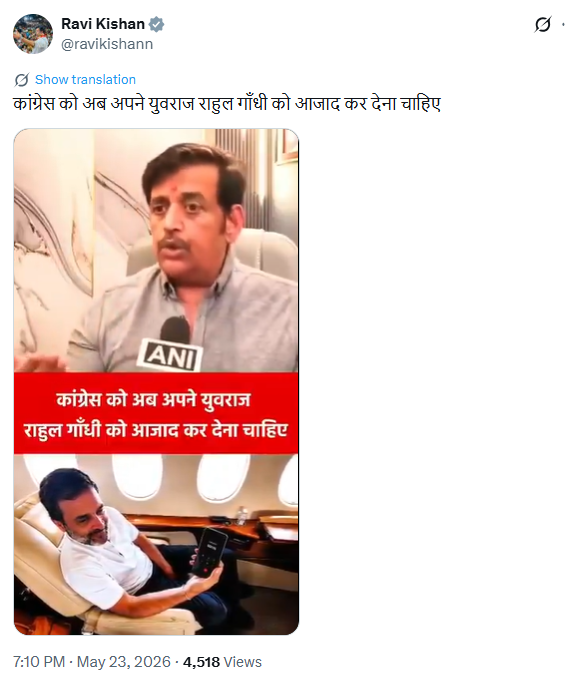
During the research, we also found the same video posted on Ravi Kishan’s official X account on May 23. The caption of the post stated:“Congress should now free its prince Rahul Gandhi.”This further confirms that the viral clip has been misleadingly edited and shared out of context
Conclusion
The research found that Ravi Kishan’s remarks in the original video were directed at Rahul Gandhi, not Prime Minister Narendra Modi. An edited portion of the video has been falsely shared with a misleading claim.

Related Blogs

Executive Summary
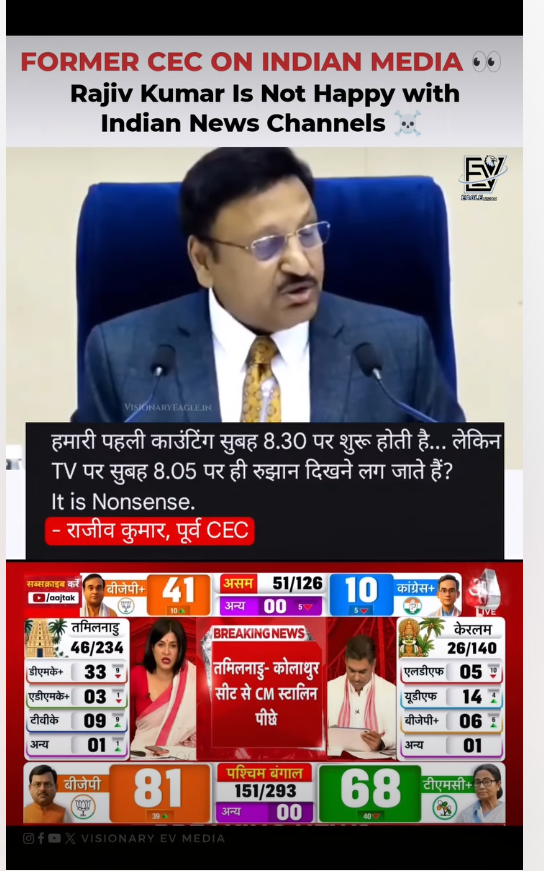
Following the results of the recent West Bengal elections, a video of former Chief Election Commissioner Rajiv Kumar has gone viral on social media. In the clip, Kumar is seen questioning television news channels over their election-result coverage and alleged early “trends” before the actual counting process begins. In the viral video, Rajiv Kumar can be heard saying, “When counting begins, channels start showing trends from 8:05 AM itself, which is nonsense. The first round of counting starts only at 8:30 AM. We have evidence that leads were being shown before that. Is it possible that these early trends are shown just to justify exit polls?”The video is being widely shared with the claim that Kumar made these remarks after the recently concluded West Bengal Assembly elections Research conducted by CyberPeace Research Wing found that a 2024 video of former Chief Election Commissioner Rajiv Kumar is being misleadingly shared as a recent statement made after the West Bengal election results.
Claim
An Instagram user shared the viral clip suggesting that the former Election Commissioner made these comments in the context of the latest West Bengal poll results.
Fact Check
Using relevant keyword searches, we traced the original source of the clip to an official post shared by the Election Commission of Indiaon Facebook on October 15, 2024. The video was part of a press conference announcing the Assembly election schedule for Maharashtra and Jharkhand.
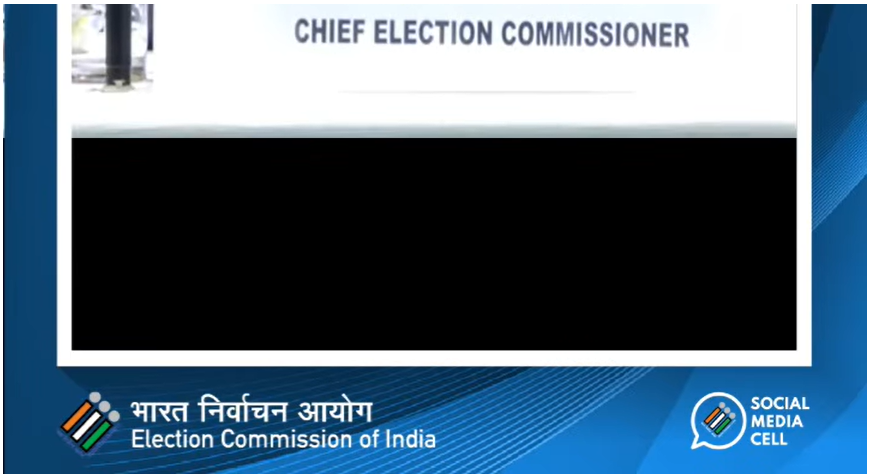
We also found the complete live-streamed press conference on the official YouTube channel of the Election Commission.
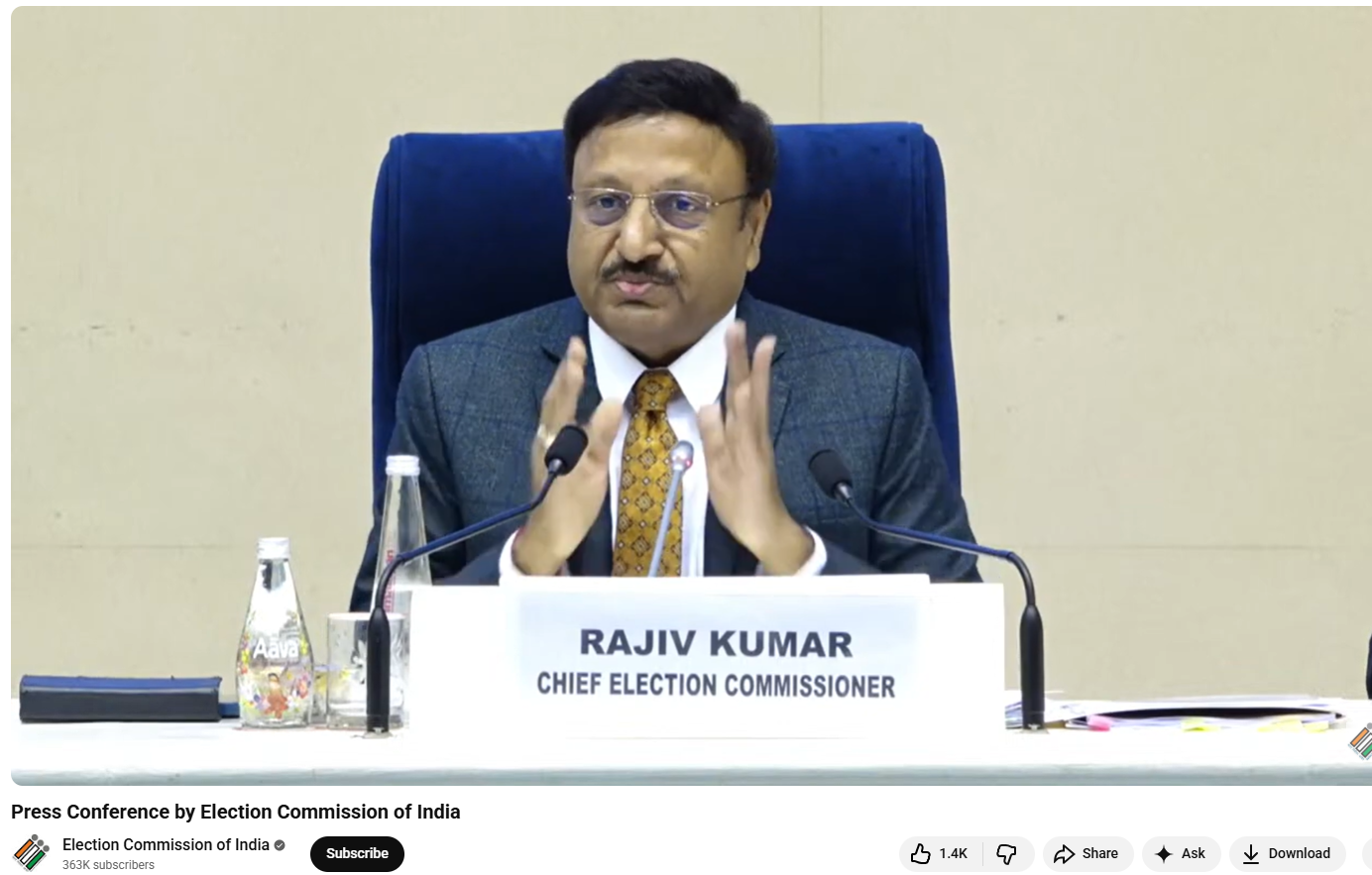
During the press conference, around the 26:45-minute mark, an ANI journalist referred to discrepancies between exit polls and actual Lok Sabha election results and asked whether such situations fuel doubts over EVMs among the public. Responding to the question at around 30:27 minutes, Rajiv Kumar spoke about the need for self-regulation in electronic media and concerns over premature “trends” shown during counting day. He said that exit polls often create public expectations despite lacking a clear scientific basis and questioned why TV channels begin displaying leads even before the first official counting round starts.
Conclusion
The viral claim is misleading. The video of former Chief Election Commissioner Rajiv Kumar is not related to the recent West Bengal election results. The clip is from an October 15, 2024 press conference held to announce the Maharashtra and Jharkhand Assembly election schedule and is now being falsely shared in a misleading context after the West Bengal polls.

Introduction
In today’s digital world, where everything is related to data, the more data you own, the more control and compliance you have over the market, which is why companies are looking for ways to use data to improve their business. But at the same time, they have to make sure they are protecting people’s privacy. It is very tricky to strike a balance between both of them. Imagine you are trying to bake a cake where you need to use all the ingredients to make it taste great, but you also have to make sure no one can tell what’s in it. That’s kind of what companies are dealing with when it comes to data. Here, ‘Pseudonymisation’ emerges as a critical technical and legal mechanism that offers a middle ground between data anonymisation and unrestricted data processing.
Legal Framework and Regulatory Landscape
Pseudonymisation, as defined by the General Data Protection Regulation (GDPR) in Article 4(5), refers to “the processing of personal data in such a manner that the personal data can no longer be attributed to a specific data subject without the use of additional information, provided that such additional information is kept separately and is subject to technical and organisational measures to ensure that the personal data are not attributed to an identified or identifiable natural person”. This technique represents a paradigm shift in data protection strategy, enabling organisations to preserve data utility while significantly reducing privacy risks. The growing importance of this balance is evident in the proliferation of data protection laws worldwide, from GDPR in Europe to India’s Digital Personal Data Protection Act (DPDP) of 2023.
Its legal treatment varies across jurisdictions, but a convergent approach is emerging that recognises its value as a data protection safeguard while maintaining that the pseudonymised data remains personal data. Article 25(1) of GDPR recognises it as “an appropriate technical and organisational measure” and emphasises its role in reducing risks to data subjects. It protects personal data by reducing the risk of identifying individuals during data processing. The European Data Protection Board’s (EDPB) 2025 Guidelines on Pseudonymisation provide detailed guidance emphasising the importance of defining the “pseudonymisation domain”. It defines who is prevented from attributing data to specific individuals and ensures that the technical and organised measures are in place to block unauthorised linkage of pseudonymised data to the original data subjects. In India, while the DPDP Act does not explicitly define pseudonymisation, legal scholars argue that such data would still fall under the definition of personal data, as it remains potentially identifiable. The Act defines personal data defined in section 2(t) broadly as “any data about an individual who is identifiable by or in relation to such data,” suggesting that the pseudonymised information, being reversible, would continue to require compliance with data protection obligations.
Further, the DPDP Act, 2023 also includes principles of data minimisation and purpose limitation. Section 8(4) says that a “Data Fiduciary shall implement appropriate technical and organisational measures to ensure effective observance of the provisions of this Act and the Rules made under it.” The concept of Pseudonymization fits here because it is a recognised technical safeguard, which means companies can use pseudonymization as one of the methods or part of their compliance toolkit under Section 8(4) of the DPDP Act. However, its use should be assessed on a case to case basis, since ‘encryption’ is also considered one of the strongest methods for protecting personal data. The suitability of pseudonymization depends on the nature of the processing activity, the type of data involved, and the level of risk that needs to be mitigated. In practice, organisations may use pseudonymization in combination with other safeguards to strengthen overall compliance and security.
The European Court of Justice’s recent jurisprudence has introduced nuanced considerations about when pseudonymised data might not constitute personal data for certain entities. In cases where only the original controller possesses the means to re-identify individuals, third parties processing such data may not be subject to the full scope of data protection obligations, provided they cannot reasonably identify the data subjects. The “means reasonably likely” assessment represents a significant development in understanding the boundaries of data protection law.
Corporate Implementation Strategies
Companies find that pseudonymisation is not just about following rules, but it also brings real benefits. By using this technique, businesses can keep their data more secure and reduce the damage in the event of a breach. Customers feel more confident knowing that their information is protected, which builds trust. Additionally, companies can utilise this data for their research or other important purposes without compromising user privacy.
Key Benefits of Pseudonymisation:
- Enhanced Privacy Protection: It hides personal details like names or IDs with fake ones (with artificial values or codes), making it harder for accidental privacy breaches.
- Preserved Data Utility: Unlike completely anonymous data, pseudonymised data keeps its usefulness by maintaining important patterns and relationships within datasets.
- Facilitate Data Sharing: It’s easier to share pseudonymised data with partners or researchers because it protects privacy while still being useful.
However, using pseudonymisation is not as easy as companies have to deal with tricky technical issues like choosing the right methods, such as encryption or tokenisation and managing security keys safely. They have to implement strong policies to stop anyone from figuring out who the data belongs to. This can get expensive and complicated, especially when dealing with a large amount of data, and it often requires expert help and regular upkeep.
Balancing Privacy Rights and Data Utility
The primary challenge in pseudonymisation is striking the right balance between protecting individuals' privacy and maintaining the utility of the data. To get this right, companies need to consider several factors, such as why they are using the data, the potential hacker's level of skill, and the type of data being used.
Conclusion
Pseudonymisation offers a practical middle ground between full anonymisation and restricted data use, enabling organisations to harness the value of data while protecting individual privacy. Legally, it is recognised as a safeguard but still treated as personal data, requiring compliance under frameworks like GDPR and India’s DPDP Act. For companies, it is not only regulatory adherence but also ensuring that it builds trust and enhances data security. However, its effectiveness depends on robust technical methods, governance, and vigilance. Striking the right balance between privacy and data utility is crucial for sustainable, ethical, and innovation-driven data practices.
References:
- https://gdpr-info.eu/art-4-gdpr/
- https://www.meity.gov.in/static/uploads/2024/06/2bf1f0e9f04e6fb4f8fef35e82c42aa5.pdf
- https://gdpr-info.eu/art-25-gdpr/
- https://www.edpb.europa.eu/system/files/2025-01/edpb_guidelines_202501_pseudonymisation_en.pdf
- https://curia.europa.eu/juris/document/document.jsf?text=&docid=303863&pageIndex=0&doclang=EN&mode=req&dir=&occ=first&part=1&cid=16466915
- https://curia.europa.eu/juris/document/document.jsf?text=&docid=303863&pageIndex=0&doclang=EN&mode=req&dir=&occ=first&part=1&cid=16466915

Introduction
The Telecommunications Act of 2023 was passed by Parliament in December, receiving the President's assent and being published in the official Gazette on December 24, 2023. The act is divided into 11 chapters 62 sections and 3 schedules. Sections 1, 2, 10-30, 42-44, 46, 47, 50-58, 61 and 62 already took effect on June 26, 2024.
On July 04, 2024, the Centre issued a Gazetted Notification and sections 6-8, 48 and 59(b) were notified to be effective from July 05, 2024. The Act aims to amend and consolidate the laws related to telecommunication services, telecommunication networks, and spectrum assignment and it ‘repeals’ certain older colonial-era legislations like the Indian Telegraph Act 1885 and Indian Wireless Telegraph Act 1933. Due to the advancements in technology in the telecom sector, the new law is enacted.
On 18 July 2024 Thursday, the telecom minister while launching the theme of Indian Mobile Congress (IMC), announced that all rules and provisions of the new Telecom Act would be notified within the next 180 days, hence making the Act operational at full capacity.
Important definitions under Telecommunications Act, 2023
- Authorisation: Section 2(d) entails “authorisation” means a permission, by whatever name called, granted under this Act for— (i) providing telecommunication services; (ii) establishing, operating, maintaining or expanding telecommunication networks; or (iii) possessing radio equipment.
- Telecommunication: Section 2(p) entails “Telecommunication” means transmission, emission or reception of any messages, by wire, radio, optical or other electro-magnetic systems, whether or not such messages have been subjected to rearrangement, computation or other processes by any means in the course of their transmission, emission or reception.
- Telecommunication Network: Section 2(s) entails “telecommunication network” means a system or series of systems of telecommunication equipment or infrastructure, including terrestrial or satellite networks or submarine networks, or a combination of such networks, used or intended to be used for providing telecommunication services, but does not include such telecommunication equipment as notified by the Central Government.
- Telecommunication Service: Section 2(t) entails “telecommunication service” means any service for telecommunication.
Measures for Cyber Security for the Telecommunication Network/Services
Section 22 of the Telecommunication Act, 2023 talks about the protection of telecommunication networks and telecommunication services. The section specifies that the centre may provide rules to ensure the cybersecurity of telecommunication networks and telecommunication services. Such measures may include the collection, analysis and dissemination of traffic data that is generated, transmitted, received or stored in telecommunication networks. ‘Traffic data’ can include any data generated, transmitted, received, or stored in telecommunication networks – such as type, duration, or time of a telecommunication.
Section 22 further empowers the central government to declare any telecommunication network, or part thereof, as Critical Telecommunication Infrastructure. It may further provide for standards, security practices, upgradation requirements and procedures to be implemented for such Critical Telecommunication Infrastructure.
CyberPeace Policy Wing Outlook:
The Telecommunication Act, 2023 marks a significant change & growth in the telecom sector by providing a robust regulatory framework, encouraging research and development, promoting infrastructure development, and measures for consumer protection. The Central Government is empowered to authorize individuals for (a) providing telecommunication services, (b) establishing, operating, maintaining, or expanding telecommunication networks, or (c) possessing radio equipment. Section 48 of the act provides no person shall possess or use any equipment that blocks telecommunication unless permitted by the Central Government.
The Central Government will protect users by implementing different measures, such as the requirement of prior consent of users for receiving particular messages, keeping a 'Do Not Disturb' register to stop unwanted messages, the mechanism to enable users to report any malware or specified messages received, the preparation and maintenance of “Do Not Disturb” register, to ensure that users do not receive specified messages or class of specified messages without prior consent. The authorized entity providing telecommunication services will also be required to create an online platform for users for their grievances pertaining to telecommunication services.
In certain limited circumstances such as national security measures, disaster management and public safety, the act contains provisions empowering the Government to take temporary possession of telecom services or networks from authorised entity; direct interception or disclosure of messages, with measures to be specified in rulemaking. This entails that the government gains additional controls in case of emergencies to ensure security and public order. However, this has to be balanced with appropriate measures protecting individual privacy rights and avoiding any unintended arbitrary actions.
Taking into account the cyber security in the telecommunication sector, the government is empowered under the act to introduce standards for cyber security for telecommunication services and telecommunication networks; and encryption and data processing in telecommunication.
The act also promotes the research and development and pilot projects under Digital Bharat Nidhi. The act also promotes the approach of digital by design by bringing online dispute resolution and other frameworks. Overall the approach of the government is noteworthy as they realise the need for updating the colonial era legislation considering the importance of technological advancements and keeping pace with the digital and technical revolution in the telecommunication sector.
References:
- The Telecommunications Act, 2023 https://acrobat.adobe.com/id/urn:aaid:sc:AP:88cb04ff-2cce-4663-ad41-88aafc81a416
- https://pib.gov.in/PressReleasePage.aspx?PRID=2031057
- https://pib.gov.in/PressReleaseIframePage.aspx?PRID=2027941
- https://economictimes.indiatimes.com/industry/telecom/telecom-news/new-telecom-act-will-be-notified-in-180-days-bsnl-4g-rollout-is-monitored-on-a-daily-basis-scindia/articleshow/111851845.cms?from=mdr
- https://www.azbpartners.com/wp-content/uploads/2024/06/Update-Staggered-Enforcement-of-Telecommunications-Act-2023.pdf
- https://telecom.economictimes.indiatimes.com/blog/analysing-the-impact-of-telecommunications-act-2023-on-digital-india-mission/111828226
