
Google For India 2023
Introduction
Google.org is committed to stepping ahead to enhance Internet safety and responsible online behaviour. ‘Google for INDIA 2023’, an innovative conclave, took place on 19th October 2023. Google.org has embarked on its vision for a safer Internet and combating misinformation, financial frauds and other threats that come from bad actors. Alphabet Big Tech is committed to leading this charter and engaging with all stakeholders, including government agencies. Google.org has partnered with CyberPeace Foundation to foster a safer online environment and empower users on informed decisions on the Internet. CyberPeace will run a nationwide awareness and capacity-building Initiative equipping more than 40 Million Indian netizens with fact-checking techniques, tools, SoPs, and guidance for responsible and safe online behaviour. The campaign will be deployed in 15 Indian regional languages as a comprehensive learning outcome for the whole nation. Together, Google.org and CyberPeace Foundation aim to make the Internet safer for everyone and work in a direction to ensure that progress for everyone is built on a strong foundation of trusted information available on the Internet and pursuing the true spirit of “Technology for Good”.
Google.org and CyberPeace together for enhanced online safety
A new $4 million grant to CyberPeace Foundation will support a nationwide awareness-building program and comprehensive multilingual digital resource hub with content available in up to 15 Indian languages to empower nearly 40 million underserved people across the country in building resilience against misinformation and practice responsible online behaviour. Together, Google.org and CyberPeace are on their way to creating a strong pathway of trusted Internet and a safer digital environment. The said campaign will be undertaken for a duration of 3 years, and the following key components will run at the core of the same:
- CyberPeace Corps Volunteers: This will be a pan India volunteer engagement initiative to create a community of 9 million CyberPeace Ambassadors/First Responders/Volunteers to fight misinformation and promote responsible online behaviour going far into the rural, marginalised and most vulnerable strata of society.
- Digital Resource Hub: In pursuance of the campaign, CyberPeace is developing a cutting-edge platform offering a wealth of resources on media literacy, responsible content creation, and cyber hygiene translated into 15 Indian regional languages for a widespread impact on the ground.
- Public Sensitisation: CyberPeace will be conducting an organic series of online and offline events focusing on empowering netizens to discern fact from fiction. These sensitisation drives will be taken on by start master trainers from different regions of India to ensure all states and UTs are impacted.
- CyberPeace Quick Reaction Team: A specialised team of tech enthusiasts that will work closely with platforms to rapidly address new-age cyber threats and misinformation campaigns in real-time and establish best practices and SoPs for the diverse elements in the industries.
- Engaging Multimedia Content: With CyberPeace’s immense expertise in E-Course and digital content, the campaign will produce a range of multilingual multimedia resources, including informative videos, posters, games, contests, infographics, and more.
- Fact-check unit: Fact-check units will play a crucial role in monitoring, identifying, and doing fact analysis of the suspected information and overall busting the growing incidents of misinformation. Fake news or misinformation has negative consequences on society at large. The fact-check units play a significant role in controlling the widespread of misinformation.
Fight Against Misinformation
Misinformation is rampant all across the world and requires attention. With the increasing penetration of social media and the internet, this remains a global issue. Google.org has taken up the initiative to address this issue in India and, in collaboration with CyberPeace Foundation taken a proactive step to multiple avenues for mass-scale awareness and upskilling campaigns have been piloted to make an impact on the ground with the vision of upskilling over 40 Million people in the country and building resilience against misinformation and practicing responsible online behavior.
Maj Vineet Kumar, Founder of CyberPeace, said,
"In an era in which digital is deeply intertwined with our lives, knowing how to discern, act on, and share the credible from the wealth of information available online is critical to our well-being, and of our families and communities. Through this initiative, we’re committing to help Internet users across India become informed, empowered and responsible netizens leading through conversations and actions. Whether it’s in fact-checking information before sharing it, or refraining from sharing unverified news, we all play an important role in building a web that is a safe and inclusive space for everyone, and we are extremely grateful to Google.org for propelling us forward in this mission with their grant support.”
Annie Lewin, Senior Director of Global Advocacy and Head of Asia Pacific, Google.org said:
“We have a longstanding commitment to supporting changemakers using technology to solve humanity's biggest challenges. And, the innovation and zeal of Indian nonprofit organisations has inspired us to deepen our commitment in India. With the new grant to CyberPeace Foundation, we are proud to support solutions that speak directly to Google’s DNA, helping first-time internet users chart their path in a digital world with confidence. Such solutions give us pride and hope that each step, built on a strong foundation of trusted information, will translate into progress for all.”
Conclusion
Google.org has partnered with government agencies and other Indian organisations with the vision of future-proof India for digital public infrastructure and staying a step ahead for Internet safety, keeping the citizens safe online. Google.org is taking its largest step yet towards online safety in India. There is widespread misinformative content and information in the digital media space or on the internet. This proactive initiative of Google.org in collaboration with CyberPeace is a commendable step to prevent the spread of misinformation and empower users to act responsibly while sharing any information and making informed decisions while using the Internet, hence creating a safe digital environment for everyone.
References:
- https://www.youtube.com/live/-b4lTVjOsXY?feature=shared
- https://blog.google/intl/en-in/products/google-for-india-2023-product-announcements/
- https://blog.google/intl/en-in/partnering-indias-success-in-a-new-digital-paradigm/
- https://telecom.economictimes.indiatimes.com/news/internet/google-to-debut-credit-in-india-announces-a-slew-of-ai-powered-launches/104547623
- https://theprint.in/economy/google-for-india-2023-tech-giant-says-it-removed-2-million-violative-videos-in-q2-2023/1810201/

Related Blogs

Introduction
In the age of social media, the news can spread like wildfire. A recent viral claim contained that police have started a nationwide scheme of free travel service for women at night. It stated that any woman who is alone and cannot find a vehicle to go home between 10 PM and 06 AM can contact the provided numbers and request a free vehicle. The viral message further contained the request to share and forward this information to everyone to get the women to know about the free vehicle service offered by police at night. However, upon fact check the claim was found to be misleading.
Social Impact of Misleading Information
The fact that such misleading information gets viral at a fast speed is because of its ability to impact and influence people through emotional resonance. Especially during a time when women's safety is a topic discussed in media sensationalism due to recently highlighted rape or sexual violence incidents, such fake viral claims often spark widespread public concern, causing emotional resonance to people and they unknowingly share or forward such messages in the spike of emotional and sensational appeal contained in such messages. The emotional nature of these viral texts often overrides scepticism, leading to immediate sharing without verification.
Such nature of viral messages often tends to bring people to protest, raise awareness and create support networks, but in spite of emotional resonance people get targeted by misinformation and become the unintended superspreaders of fake news fueled by emotional and social media-driven reactions. Women’s safety in society is a sensitive topic and when people discover such viral claims to be misleading and fake, it often hurts the sentiments of society leading to significant social impacts, including distrust in social media, unnecessary panic and confusion.
CyberPeace Policy Vertical Advisory for Social Media Users
- Think before Sharing: All netizens must practice caution while sharing anything and double-check its authenticity before sharing/forwarding or reposting it on your social media stories.
- Don't be unintended superspreaders of Misinformation: Misinformation with emotional resonance and widespread sharing by netizens can lead to them becoming "superspreaders of misinformation" and making it viral quickly. Hence you must avoid such unintended consequences by following the best practices of being vigilant and informed by reliable sources.
- Exercise vigilance and scepticism: It is important that netizens exercise vigilance and they build cognitive abilities to recognise the red flags of misleading information. You can do so by following the official communication channels, looking for any discrepancy in the content of susceptible information and double-checking its authenticity before sharing it with anyone.
- Verify the information from official sources: Follow the official communication channels of concerned authorities for any kind of information, circulars, notifications etc. In case of finding any piece of information to be susceptible or misleading, intimate it to the relevant authority and the fact-checking organizations.
- Stay in touch with expert organizations: Cybersecurity experts and civil society organisations possess the unique blend of large-scale impact potential and technical expertise. Netizens can stay updated about recent developments in the tech-policy sphere and learn about internet best practices, and measures to counter misinformation through methods such as prebunking, debunking and more.
Connect with CyberPeace
As an expert organisation, we have the ability to educate and empower huge numbers, along with the skills and policy acumen needed to be able to not just make people aware of the problem but also teach them how to solve it for themselves. At CyberPeace we regularly produce fact-check reports, blogs & advisories, and insights on prebunking & debunking measures and capacity-building programs with the aim of empowering netizens at the heart of our initiatives. CyberPeace has established the largest network of CyberPeace Corps volunteers globally. These volunteers play a crucial role in assisting victims, raising awareness, and promoting proactive measures.
References:
Introduction
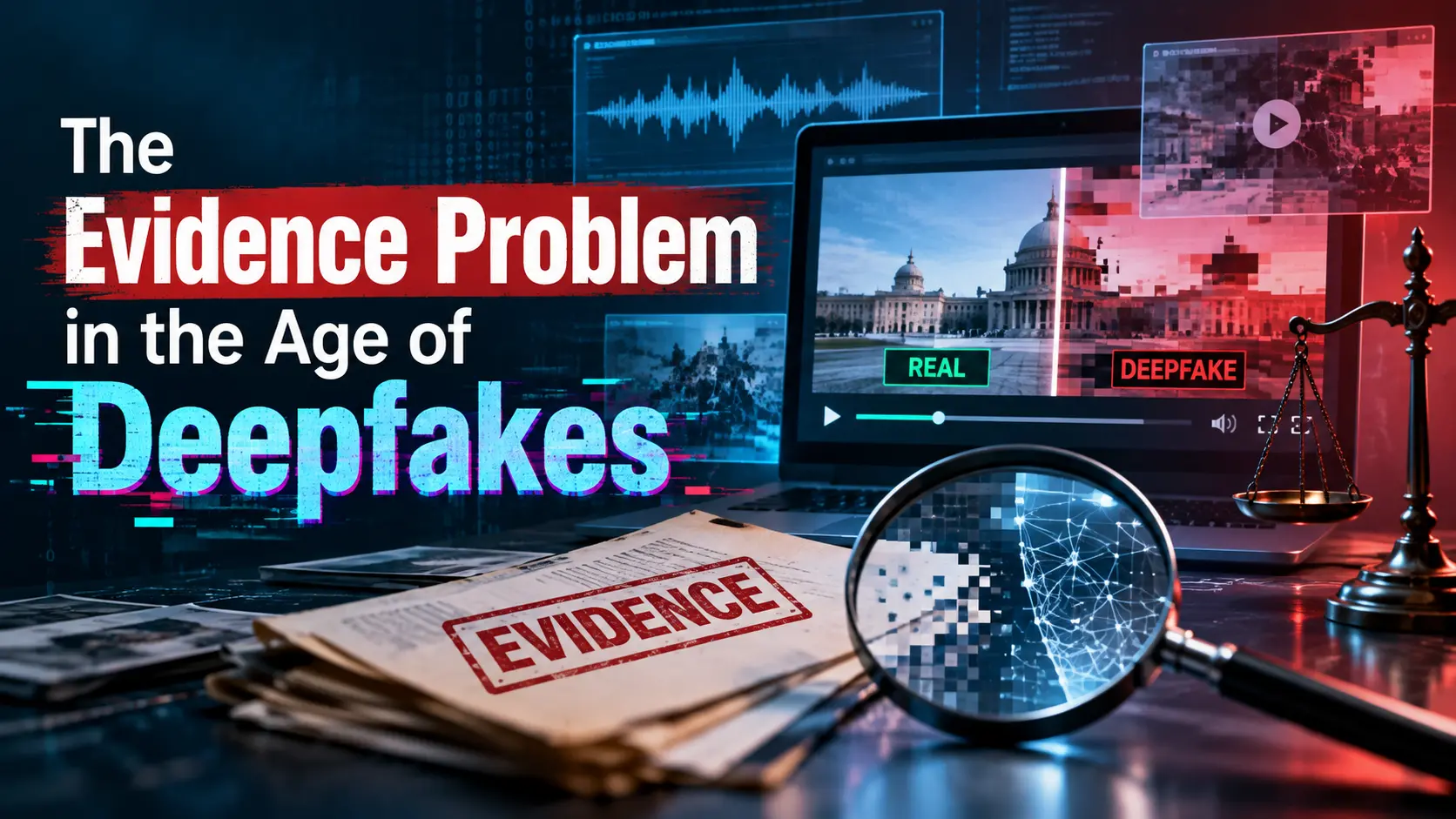
Digital evidence has become part of almost every modern investigation. A photograph can place a person at a location, an audio recording can capture a conversation, and a video can appear to show an event as it happened. For years, the main forensic concern was whether such material had been altered. The rapid growth of generative artificial intelligence has added a harder question: even when a file is preserved exactly as received, can investigators still trust what it appears to show?
Deepfakes have made this question practical rather than theoretical. Synthetic or manipulated audio, video and images can imitate real people and real events with increasing realism. CERT-In describes deepfakes as a high-risk threat because they can support disinformation, fraud, social engineering and reputational harm.[1] NIST research likewise treats AI-generated media as a digital-forensics challenge that requires systematic evaluation of detection technologies.[2]
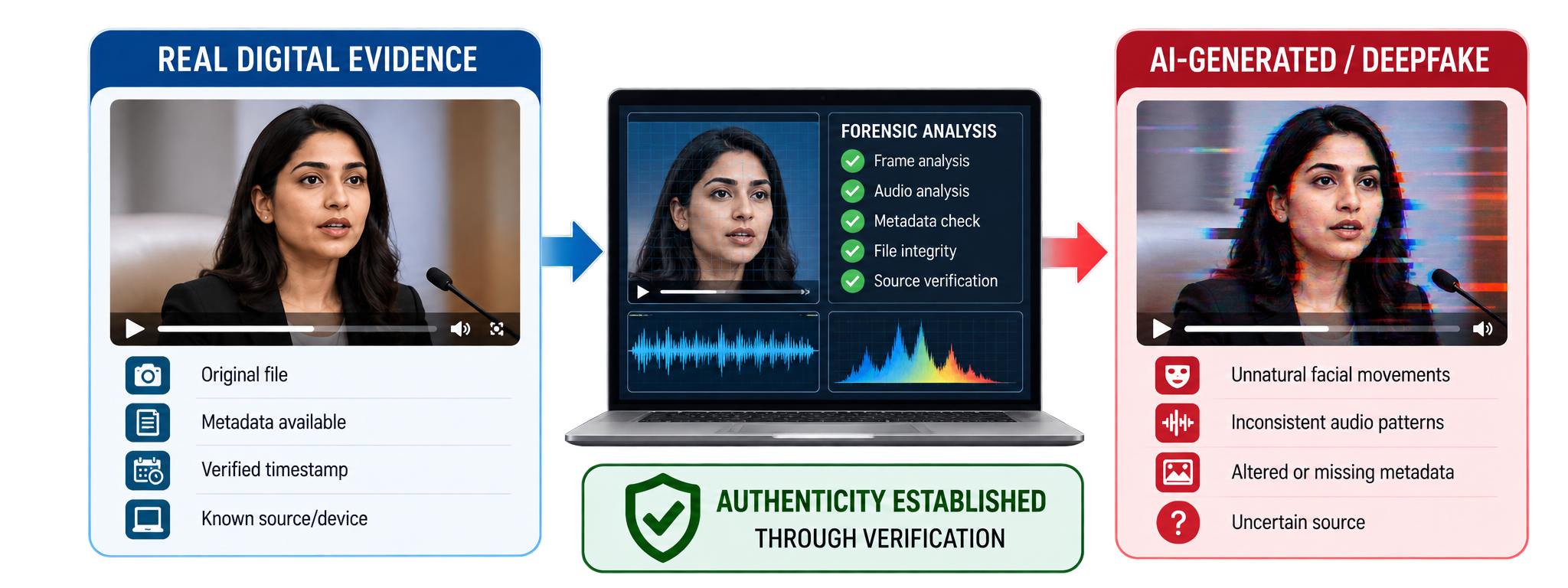
The result is an evidence problem. The answer is not to stop trusting digital evidence, but to become more disciplined about establishing its origin, integrity, context and authenticity.
The evidence problem begins before the laboratory
When a suspicious video reaches an investigator through WhatsApp, Telegram, email or social media, the file may already have passed through several transformations. It may have been compressed, re-encoded, cropped, renamed or stripped of metadata. A screenshot may preserve what is visible but lose the original file structure. A forwarded audio clip may contain no reliable information about where it was first recorded.
For that reason, forensic examination should begin with acquisition and provenance, not with a quick “deepfake detector” result. Investigators should ask: Who supplied the file? Where was it obtained? Is there an original version? What device or account produced it? What happened to the file before it reached the investigator?
Cryptographic hashing remains important because it can demonstrate that an acquired working copy has not changed during examination. But a valid hash does not prove that the underlying event was genuine. A perfectly preserved fake is still a fake.
What a professional examination should look for
A reliable assessment combines several forms of evidence rather than relying on one technical indicator.
Source and acquisition. The original artefact should be preserved whenever possible. Investigators should record the acquisition method, date and time, source account or device, and any known transformations before collection. A documented chain of custody is essential when material may later support a legal, disciplinary or regulatory decision.
Metadata and file structure. Metadata may provide useful clues about creation, encoding, editing software and timestamps. File structure, compression behaviour and related technical characteristics can also reveal inconsistencies. However, these indicators are supporting evidence, not proof on their own, because metadata can be removed or rewritten during normal processing.
Content-level examination. Forensic analysis can include frame-by-frame video review, audio waveform and spectral examination, and inspection for inconsistencies in lighting, reflections, facial movement, lip synchronisation or background elements. Such signs may help guide an investigation, but they are not a permanent checklist. Generative systems continue to improve.
Independent corroboration. This is often the strongest step. If a recording allegedly shows that a person was in a particular place at a particular time, investigators can compare it with CCTV, access-control records, device artefacts, communications, location information, eyewitness accounts or other independent records. The goal is to determine whether the wider evidence supports the event represented by the media.
A real-world lesson: the Pikesville case
The 2024 Pikesville High School incident in Maryland provides a practical example of why authenticity cannot be assumed from appearance alone. An audio recording circulated online that was presented as the principal making racist and antisemitic comments. On January 17, 2024, Baltimore County Public Schools said it could not yet confirm the recording’s veracity and opened an investigation.[3]
Several months later, the school district reported that investigators, with assistance from the FBI and other experts, had verified that the audio had been created using artificial intelligence.[4] Police subsequently arrested the school’s former athletic director in connection with the fabricated recording.[5]
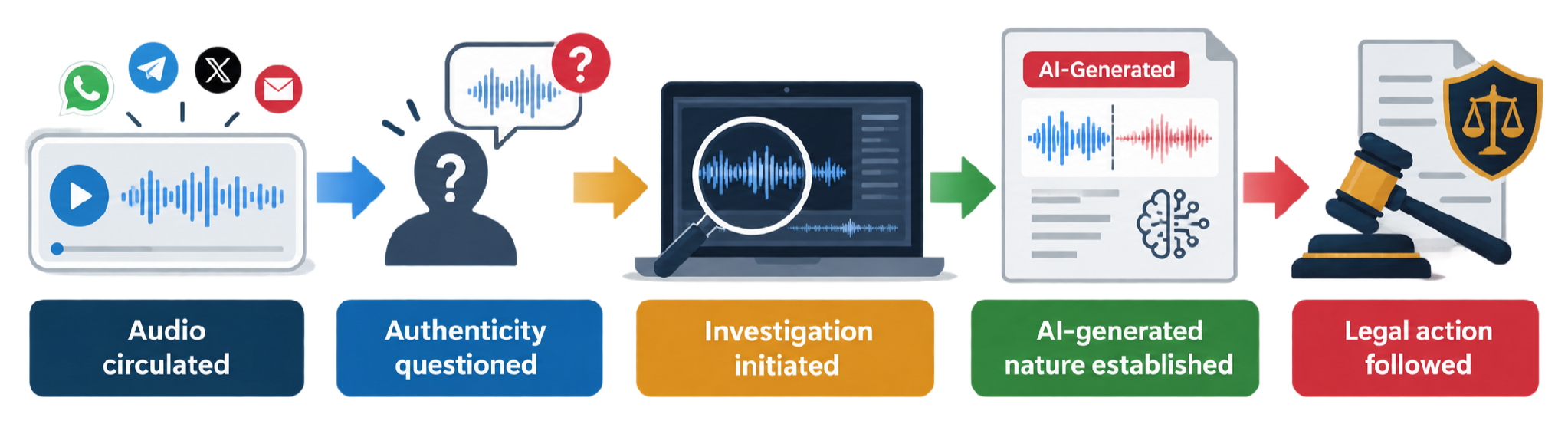
The forensic lesson is larger than the incident itself. The recording had social consequences before its authenticity was established. In a fast-moving online environment, the first version of an event can travel much further than the later correction. Deepfake investigations therefore have to consider not only whether media is authentic, but also how quickly unverified material can influence decisions.
From deepfake detection to content provenance
Detection tools will remain useful, but they should be treated as part of an examination rather than an automatic verdict. NIST’s Guardians of Forensic Evidence work reflects the need to evaluate how analytic systems perform against changing forms of AI-generated media and how well they generalise beyond controlled conditions.[2]
Another important direction is content provenance. The Coalition for Content Provenance and Authenticity (C2PA) has developed a technical framework for recording verifiable information about how digital content was created and changed. Content Credentials can bind provenance information to an asset using cryptographic techniques, allowing later users to inspect a recorded content history when that information is available.[6]
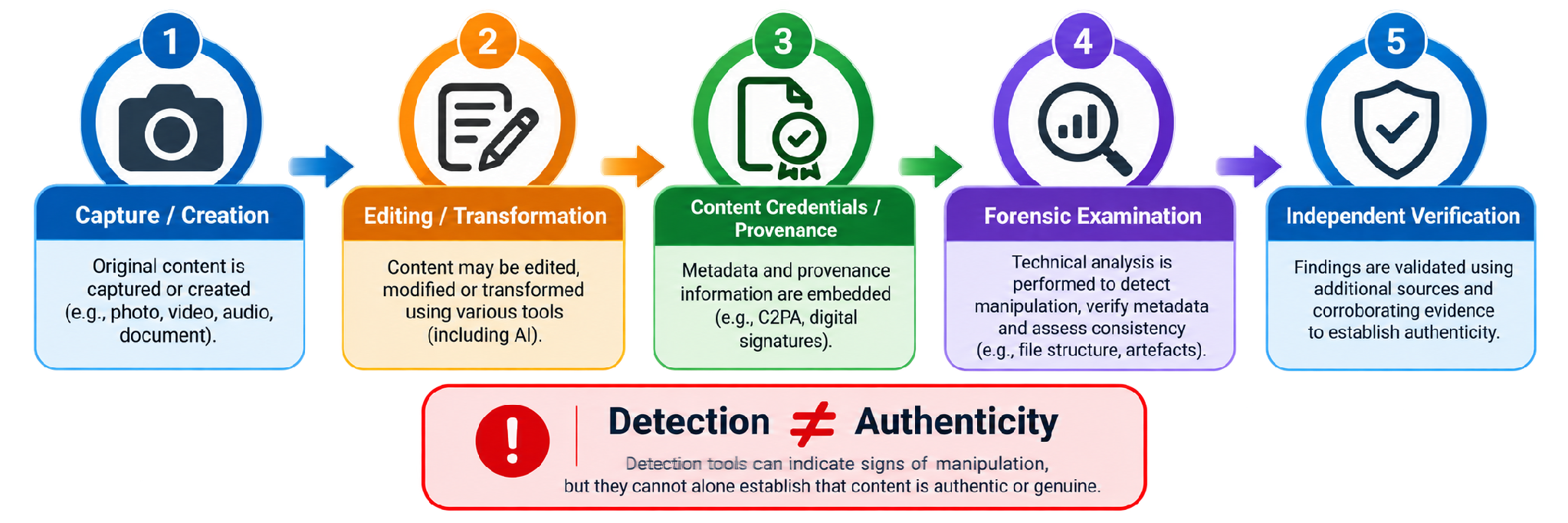
Provenance does not mean that every claim associated with a file is automatically true. It adds context: who created it, what actions were taken and how the asset changed. In a deepfake environment, that context can be as important as the content itself.
Why this matters in India
The issue is especially relevant to India’s fast-growing digital environment. CERT-In’s 2024 advisory identifies misinformation, fraud and reputational damage among the risks associated with synthetic media.[1] In August 2026, the Government of India stated that the regulatory framework addresses AI-generated deepfakes and noted amendments to the IT Rules in February 2026 concerning harms arising from synthetically generated information, including requirements related to labelling and traceable metadata for permissible AI-generated content.[7]
For organisations, deepfake response should therefore not be treated only as a media or public-relations issue. It can become an incident-response and forensic issue. A suspicious executive voice note, a manipulated employee video or a fabricated screen recording may require preservation, technical examination and independent corroboration before any action is taken.
Conclusion
Deepfakes do not make digital evidence useless. Deepfakes make handling of evidence more dangerous. The professional response is not to believe everything or to doubt everything. The professional response is to build a process around evidence: preserve the original where possible document how evidence was acquired, calculate and record hashes, examine metadata and technical characteristics use detection tools while understanding their limitations compare media with independent evidence and examine provenance information where it is available.
Importantly investigators and decision-makers should separate three questions: Is the file intact? Is the content authentic? Does the content actually prove the event being alleged? Deepfakes can pass the test while failing the other two.
In the age of AI evidence will increasingly be judged not only by how convincing it looks but, by how well its origin, integrity, context and history can be demonstrated. That is the standard that can help preserve trust when seeing and hearing're no longer enough.
References
1. CERT-In, “Deepfakes - Threats and Countermeasures,” Advisory CIAD-2024-0060, 27 November 2024. View source
2. NIST, “Guardians of Forensic Evidence: Evaluating Analytic Systems Against AI-Generated Deepfakes,” 27 January 2025. View source
3. Baltimore County Public Schools, “January 17, 2024, Community Update: Message from Superintendent Dr. Myriam Rogers Regarding Pikesville High School.” View source
4. Baltimore County Public Schools, “April 24, 2024 Staff and Community Update: Message from Superintendent Dr. Myriam Rogers Regarding Pikesville High School Investigation.” View source
5. The Baltimore Banner / WYPR, “Ex-athletic director framed principal with AI-generated voice, police say,” 25 April 2024. View source
6. Coalition for Content Provenance and Authenticity (C2PA), “Content Credentials: C2PA Technical Specification,” Version 2.1. View source
7. Government of India, Ministry of Electronics & Information Technology, “Government Strengthens Regulatory Framework to Address AI-Generated Deepfakes,” 6 August 2026. View source
Introduction
For years, Indian companies could get away with vague privacy promises. That window closed on 13 November 2025, when the government notified the Digital Personal Data Protection Rules, giving teeth to the broad principles Parliament had passed back in 2023 under the DPDP Act. The Rules turned soft commitments into specific, auditable duties, and a lot of organisations are only now realising how much that actually changes.
Start with Section 8(4). It requires every Data Fiduciary to put "appropriate technical and organisational measures" in place. Most readers skim past "organisational" and focus on the technical half, but that's a mistake, because the word is doing real work. It's asking for defined roles, written policies, staff training, and someone actually watching whether any of it holds up over time, not just firewalls and encryption keys. Section 8(5) goes further, demanding reasonable security safeguards against breaches, and Rule 6 spells out exactly what that phrase means in practice: encrypt data at rest and in transit, restrict access on a need to know basis, require multi factor authentication, log and monitor activity, run regular vulnerability checks, bind your data processors contractually to the same standard, and keep relevant logs for at least a year.
Then there's Rule 7, and this is where the clock starts running. Once a Data Fiduciary becomes aware of a breach, the Data Protection Board must be told without delay, and a full report has to follow within 72 hours covering what happened, when, why, what's being done about it, and confirmation that affected individuals were notified. Unlike GDPR, there's no minimum severity threshold here. A breach affecting ten people triggers the same obligation as one affecting ten million. And CERT-In's existing six hour reporting window under its 2022 Directions still applies separately, which means a serious incident can trigger two overlapping regulatory clocks running side by side.
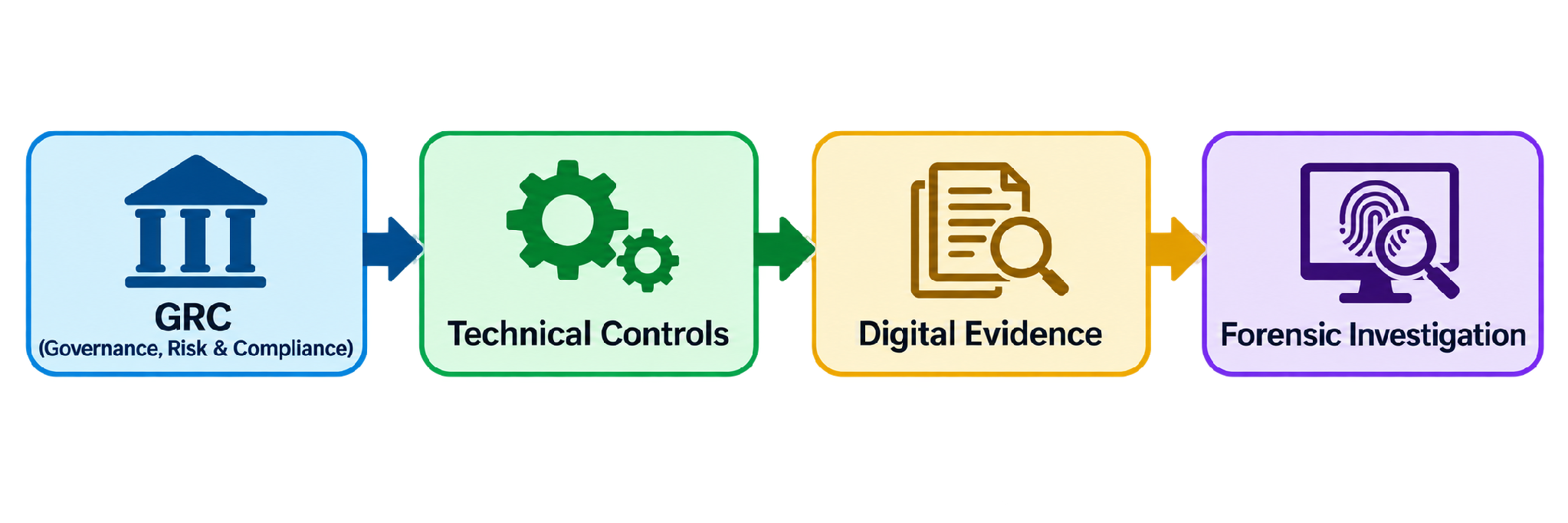
Put all of this together and a pattern emerges. The law assumes an organisation already knows what it's protecting, has actually protected it, kept usable records the whole way through, and can explain clearly what happened the moment something breaks. That coordination job belongs to Governance, Risk and Compliance, or GRC for short. GRC decides who's accountable, which risks actually matter, which controls address them, and how anyone checks whether compliance is real rather than assumed. Skip that structure and security work tends to splinter into a pile of disconnected tasks nobody truly owns.
GRC gives a legal duty somewhere to live. Forensic readiness is what lets an organisation prove, months or years later, that the duty was actually being met.
The Role of Governance, Risk and Compliance
On paper, most cybersecurity programmes look fine. There's an incident response plan somewhere, access control rules exist, logging is "in place," and someone has a title that says they're responsible for security. None of that gets tested until something actually breaks. A phishing compromise, a ransomware infection, a leaked database, a hijacked admin account, whatever the trigger, the questions that follow are always the same, and they're not comfortable ones. What happened, exactly, and when did it start? Which systems, which data, were actually touched? Were the controls the organisation claims to run genuinely functioning at that moment, or just described in a slide deck somewhere? And can anyone produce records solid enough to answer those questions with confidence rather than a shrug?
This is the exact seam where GRC and digital forensics meet. GRC lays out what's expected, who's responsible, and what evidence a control should be generating in the background. Digital forensics is the craft of taking whatever technical traces actually exist and turning them into an account of events that will hold up to scrutiny. Passing an audit was never really the point. Being able to stand in front of a regulator, mid incident, and show that the processes described on paper were real, active, and generating trustworthy evidence, that's the actual bar.
Why Compliance Alone Falls Short
Compliance, in the narrow sense, just means meeting whatever legal, contractual, or internal requirement applies. But a policy sitting in a document repository proves nothing about what actually happens on a Tuesday afternoon when someone requests admin access. A written incident response plan says nothing about whether the team can actually execute it under real pressure, at 2am, with a ransomware note on every screen. A logging policy is close to worthless if the logs it promises were switched off somewhere along the way, or overwritten, or scattered across systems that were never synchronised to the same clock.
NIST's Cybersecurity Framework 2.0 essentially built this concern into its core structure, placing "Govern" alongside Identify, Protect, Detect, Respond, and Recover as one of five equal functions rather than background paperwork sitting off to the side. India's own regulatory posture pushes in the same direction. CERT-In's 2022 Directions require certain incidents to be reported within six hours of discovery, and its guidance for government entities leans heavily on documented incident handling and disciplined evidence practices. The underlying message from both is identical: figure out, before anything goes wrong, whether the evidence you'll eventually need is actually going to exist when someone asks for it.
Where GRC and Forensics Actually Connect
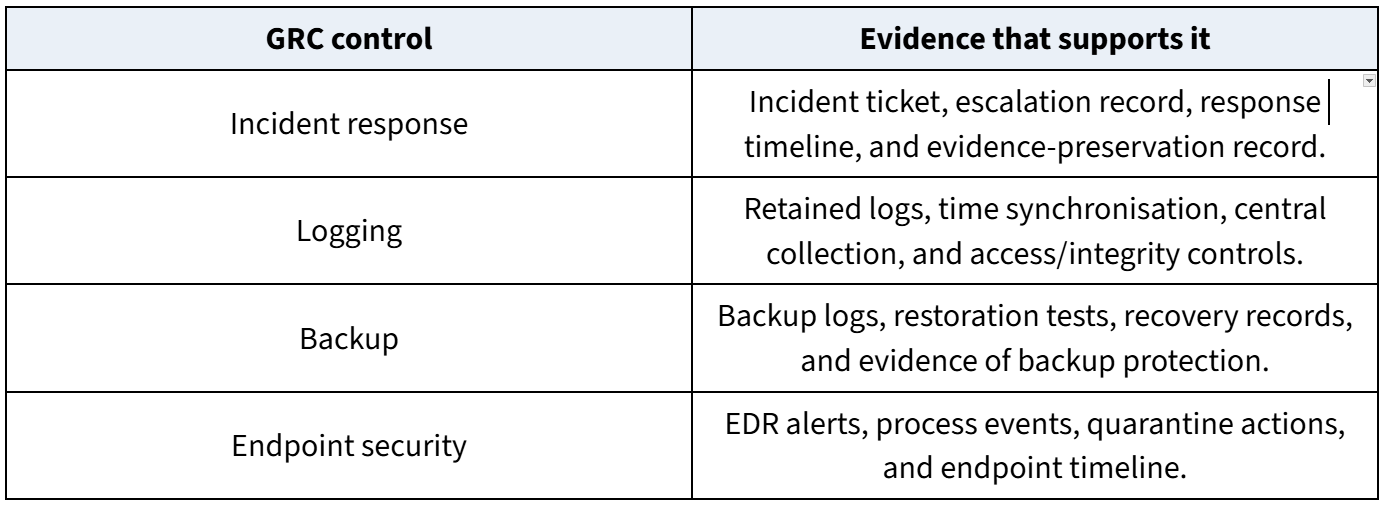
A good GRC programme spells out what's supposed to happen. Forensic readiness is what lets you later prove what actually did.
Access control is a useful example here. On the GRC side, an organisation might require least privilege access, multi factor authentication, periodic reviews of who holds privileged accounts, and prompt removal of access once someone leaves or changes roles. On the forensic side, none of that means anything without the underlying records that let investigators actually test it, authentication logs, MFA usage history, privilege change records, and account activity trails. The table below lines up a few common GRC controls against the specific evidence needed to show they were genuinely operating.
A Practical Scenario: After a Ransomware Incident
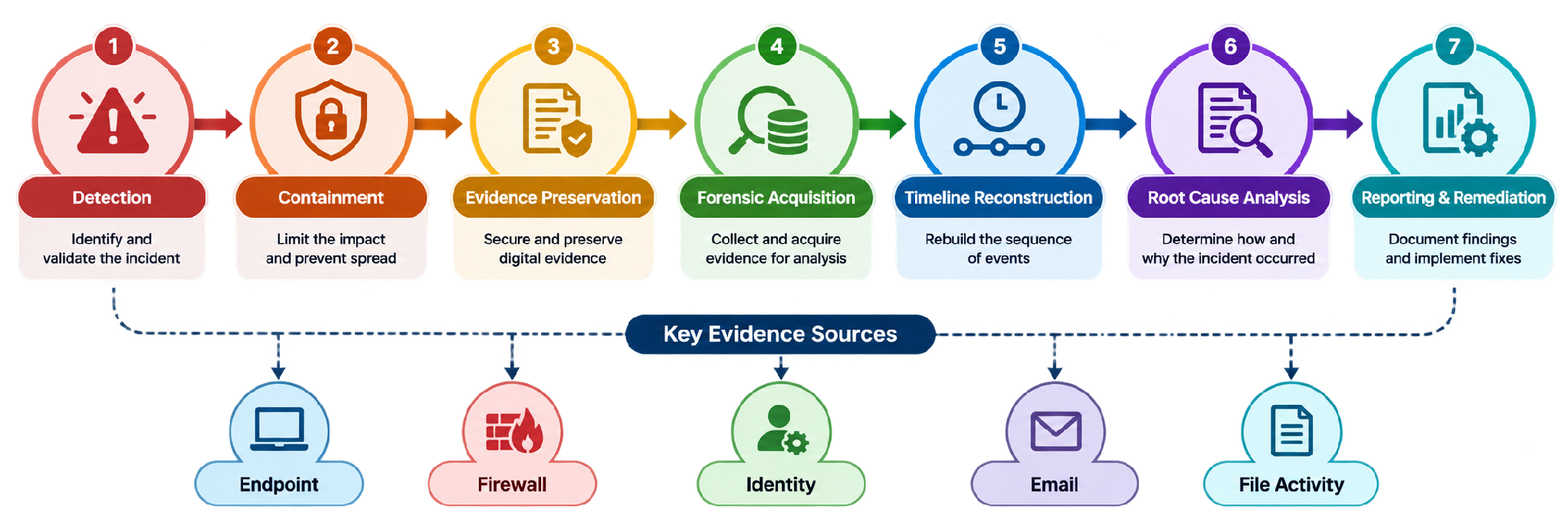
Picture a mid-sized company waking up to find half its file servers encrypted. There's an incident response plan somewhere in the shared drive, technically, but nobody's actually run through it in over a year. The security team isolates the obviously compromised endpoint and starts escalating. Now the forensic side of the house has to reconstruct what happened, working backward through endpoint telemetry, authentication logs, firewall events, email traffic, and file activity, hunting for the original point of entry, how the attacker escalated privileges, how they moved sideways through the network, what data they actually touched, and finally how the ransomware got deployed.
This is where the quality of everything collected beforehand suddenly matters a great deal. If server clocks were never properly synchronised, the timeline investigators build might not line up cleanly enough to trust. If logs only ever lived locally on individual machines rather than being pulled centrally, some of them are probably gone by now. If nobody ever bothered logging administrator actions, there are going to be real, unexplained gaps in the story. And if whatever evidence does exist wasn't collected the right way, its integrity can be challenged later, sometimes fatally, in a legal or regulatory proceeding. CERT-In actually ran a programme on exactly this in July 2026, "Inside the Breach," covering system artefacts, investigative technique, and chain of custody requirements, precisely because this is where real investigations tend to succeed or quietly fall apart.
Building a Forensic Ready GRC Programme
For an organisation starting more or less from scratch, forensic readiness doesn't need to be bolted on as some separate initiative. It can be built straight into the GRC programme that already exists. Start by identifying the systems, applications, cloud services, and privileged accounts that actually matter. Map the real risks and regulatory requirements onto the controls meant to address them. Then get specific about what evidence each control should be generating, and how that evidence gets protected and kept over time. Time synchronisation, centralised logging, tightly controlled access to security records, and clear ownership of preservation, escalation, and investigation all need to exist well before an incident, not be improvised during one. And none of it means much until it's actually been tested, through tabletop exercises and simulated incidents rather than assumed to work because it's written down somewhere. NIST SP 800-61 Revision 3 frames incident response as one continuous loop of preparation, detection, response, recovery, and improvement, rather than a series of separate boxes to check.
There's one question worth asking of every important control an organisation runs: could you actually prove this was working at the moment an incident happened? If the honest answer is no, what you have is a compliance process on paper, and a forensic readiness gap sitting quietly underneath it.
Conclusion
Cyber readiness was never really about how many policies sit in a binder or how many boxes get ticked in an audit. It shows up, or doesn't, in the hours right after something breaks, when an organisation has to move fast, preserve evidence that can actually stand up to scrutiny, explain clearly what happened, and prove that governance and technical controls were genuinely working together rather than just coexisting on paper. GRC sets the direction, the accountability, the risk priorities, and the compliance expectations. Digital forensics does the work of preserving and interpreting the technical evidence once something actually happens. Forensic readiness sits in between the two, making sure they're actually talking to each other long before an incident forces the conversation. The practical task for most organisations comes down to something simple to say, if not always simple to build: design controls that hold up under real incident response, not just an auditor's checklist. The strongest compliance posture was never the one with the thickest binder. It's the one that can back every document up with evidence, on the day it actually matters.
References
- Digital Personal Data Protection Act, 2023, Sections 8(4), 8(5), 8(6). https://www.meity.gov.in/writereaddata/files/Digital%20Personal%20Data%20Protection%20Act%202023.pdf
- Digital Personal Data Protection Rules, 2025, Rules 6 and 7, notified 13 November 2025. https://www.meity.gov.in
- National Institute of Standards and Technology, The NIST Cybersecurity Framework (CSF) 2.0, CSWP 29, 2024. https://csrc.nist.gov/pubs/cswp/29/the-nist-cybersecurity-framework-csf-20/final
- Indian Computer Emergency Response Team (CERT-In), Directions under Section 70B of the Information Technology Act, 2000, dated 28 April 2022. https://www.cert-in.org.in/Directions70B.jsp
- Indian Computer Emergency Response Team (CERT-In), Guidelines on Information Security Practices for Government Entities. https://www.cert-in.org.in/Downloader?fileName=CIPS-2026-0014.pdf&pageid=5&type=2
- National Institute of Standards and Technology, SP 800-86: Guide to Integrating Forensic Techniques into Incident Response, 2006. https://csrc.nist.gov/pubs/sp/800/86/final
- International Organization for Standardization, ISO/IEC 27037:2012, Guidelines for identification, collection, acquisition and preservation of digital evidence. CERT-In, "Inside the Breach: Advanced Cyber Forensics & Incident Investigation," 31 July 2026. https://www.cert-in.org.in/s2cMainServlet?pageid=PRSTNVIEW03&reCode=CIWS-2026-3569
- National Institute of Standards and Technology, SP 800-61 Rev. 3: Incident Response Recommendations and Considerations for Cybersecurity Risk Management, 2025. https://csrc.nist.gov/pubs/sp/800/61/r3/final
- Matters.ai, "DPDP Breach Notification: 72-Hour Rule & ₹200 Cr Penalty." https://www.matters.ai/article/dpdp-breach-notification MediaNama, "Data Breach Reporting Timeline of DPDP Rules 2025 Explained." https://www.medianama.com/2025/11/223-data-breach-reporting-timeline-of-dpdp-rules-2025-explained/
