
How the BRD Shapes Consent Management in India’s Data Protection Era
Introduction
The Digital Personal Data Protection (DPDP) Act 2023 of India is a significant transition for privacy legislation in this age of digital data. A key element of this new law is a requirement for organisations to have appropriate, user-friendly consent mechanisms in place for their customers so that collection, use or removal of an individual's personal data occurs in a clear and compliant manner. As a means of putting this requirement into practice, the Ministry of Electronics and Information Technology (MeitY) issued a comprehensive Business Requirements Document (BRD) in June 2025 to guide organizations, as well as Consent Managers, on how to create a Consent Management System (CMS). This document establishes the technical and functional framework by which organizations and individuals (Data Principals) will exercise control over the way their data is gathered, used and removed.
Understanding the BRD and Its Purpose
BRD represents an optional guide created as part of the "Code for Consent" programme run by MeitY in India. The purpose of the BRD is to provide guidance to startups, digital platforms and other enterprises on how to create a technology system that supports management of user consent per the requirements of the DPDP Act. Although the contents of the BRD do not carry any legal weight, it lays out a clear path for organisations to create their own consent mechanisms using best practices that align with the principles of transparency, accountability and purpose limitation in the DPDP Act.
The goal is threefold:
- Enable complete consent lifecycle management from collection to withdrawal.
- Empower individuals to manage their consents actively and transparently.
- Support data fiduciaries and processors with an interoperable system that ensures compliance.
Key Components of the Consent Management System
The BRD proposes the development of a modular Consent Management System (CMS) that provides users with secure APIs and user-friendly interfaces. This system will allow for a variety of features and modules, including:
- Consent Lifecycle Management – consent should be specific, informed and tied to an explicit purpose. The CMS will manage the collection, validation, renewal, updates and withdrawal of consent. Each transaction of consent will create a tamper-proof “consent artifact,” which will include the timestamp of creation as well as an ID identifying the purpose for which it was given.
- User Dashboard – A user will be able to view and modify the status of their active, expired or withdrawn consent and revoke access at any time via the multilingual user-friendly interface. This would make the system accessible to people from different regions and cultures.
- Notification Engine – The CMS will automatically notify users, fiduciaries and processors of any action taken with respect to consent, in order to ensure real-time updates and accountability.
- Grievance Redress Mechanism – The CMS will include a complaints mechanism that allows users to submit complaints related to the misuse of consent or the denial of their rights. This will enable tracking of the complaint resolution status, and will allow for escalation if necessary.
- Audit and Logging – As part of the CMS's internal controls for compliance and regulatory purposes, the CMS must maintain an immutable record of every instance of consent for auditing and regulatory review. The records must be encrypted, time-stamped, and linked permanently to a user and purpose ID.
- Cookie Consent Management – A separate module will enable users to manage cookie consent for websites separately from any other consents.
Roles and Responsibilities
The BRD identifies the various stakeholders involved and their associated responsibilities.
- Data Principals (Users): The user has full authority to give, withhold, amend, or revoke their consent for the use of their personal data, at any time.
- Data Fiduciaries (Companies): Companies (the fiduciaries) must collect the data principals' consents for each particular reason and must only begin processing a data subject's personal data after validating that consent through the CMS. Companies must also provide the data principals with any information or notifications needed, as well as how to resolve their complaints.
- Data Processors: Data Processors must strictly adhere to the consent stated in the CMS, and Data Processors may only process personal data on behalf of the Data Fiduciary.
- Consent Managers: The Consent Managers are independent entities that are registered with the Data Protection Board. They are responsible for administering the CMS, allowing users to manage their consent across different platforms.
This layered structure ensures transparency and shared responsibility for the consent ecosystem.
Technical Specifications and Security
The following principles of the DPDP Act must be followed to remain compliant with the DPDP Act.
- End-to-End Encryption: All exchanges of data with users must be encrypted using a minimum of TSL 1.3 and also encrypting within that standard.
- API-First Approach: API’s will be utilized to validate, withdraw and update consent in a secured manner using external sources.
- Interoperability/Accessibility: The CMS needs to allow for users to utilize several different languages (e.g. Hindi, Tamil, etc.) and be appropriate for use with various types of mobile devices and different abilities.
- Data Retention Policy: The CMS should also include automatic deletion of consent data (when the consent has expired or has been withdrawn) in order to maintain compliance with data retention limits.
Legal Relevance and Timelines
While the BRD itself is not enforceable, it is directly aligned with the upcoming enforcement of the DPDP Act, 2023. The Act was passed in August 2023 but is expected to come into effect in stages, once officially notified by the central government. Draft implementation rules, including those defining the role of Consent Managers, were released for public consultation in early 2025.
For businesses, the BRD serves as an early compliance tool—offering both a conceptual roadmap and technical framework to prepare before the law is enforced. Legal experts have described it as a critical resource for aligning data governance systems with emerging regulatory expectations.
Implications for Businesses
Organizations that collect and process user data will be required to overhaul their consent workflows:
- No blanket consents: Every data processing activity must have explicit, separate consent.
- Granular audit logs: Companies must maintain tamper-proof logs for every consent action.
- Integration readiness: Enterprises need to integrate their platforms with third-party or in-house CMS platforms via the specified APIs.
- Grievance redress and user support: Systems must be in place to handle complaints and withdrawal requests in a timely, verifiable manner.
Failing to comply once the DPDP Act is in force may expose companies to penalties, reputational damage, and potential regulatory action.
Conclusion
The BRD on Consent Management of India is a forward-looking initiative laying a technological framework that is an essential component of the DPDP Act concerning user consent; Although not yet a legal document, it provides an extent of going into all the necessary discipline for companies to prepare. As data protection grows in importance, developing consent mechanisms based on security, transparency, and the needs of the user is no longer just a regulatory requirement, but rather a requirement for the development of trust. This is the time for businesses to establish or implement CMS solutions that support this objective to be better equipped for the future of data governance in India.
References
- https://d38ibwa0xdgwxx.cloudfront.net/whatsnew-docs/8d5409f5-d26c-4697-b10e-5f6fb2d583ef.pdf
- https://ssrana.in/articles/ministry-releases-business-requirement-document-for-consent-management-under-the-dpdp-act-2023/
- https://dpo-india.com/Blogs/consent-dpdpa/
- https://corporate.cyrilamarchandblogs.com/2025/06/the-ghost-in-the-machine-the-recent-business-requirement-document-on-consent/
- https://www.mondaq.com/india/privacy-protection/1660964/analysis-of-the-business-requirement-document-for-consent-management-system

Related Blogs

Executive Summary
Iran’s official news agencies have denied claims that senior officials, including Foreign Minister Abbas Araghchi and Parliament Speaker Mohammad Bagher Ghalibaf, have arrived in Pakistan for talks. A senior official told Iran’s Tasnim News Agency that Tehran is considering Pakistan’s proposal for peace talks, but any dialogue would depend on the United States fulfilling its commitment to halt military actions on all fronts.
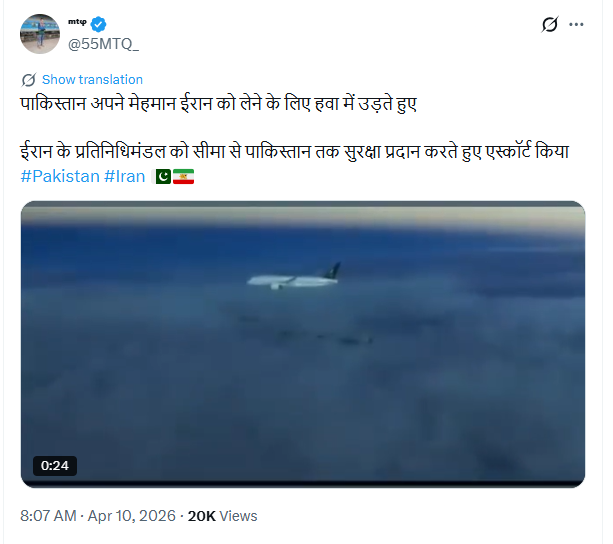
Notably, the United States and Iran had agreed to a two-week ceasefire on April 8, 2026, with discussions reportedly scheduled for April 11 in Islamabad. Amid this backdrop, a video showing fighter jets escorting a large aircraft is being widely circulated on social media. Users claim that Pakistan deployed these jets to escort an Iranian delegation into the country.
However, an research by the CyberPeace found the claim to be false. The viral video is not recent and dates back to 2019.
Claim
An X (formerly Twitter) user shared the video claiming that Pakistan Air Force jets were escorting an Iranian delegation into Pakistan.
Fact Check
Reverse image search of keyframes from the viral video led us to a February 18, 2019 report by Radio Free Europe/Radio Liberty. The report stated that the fighter jets were deployed by Pakistan to escort the aircraft of Saudi Crown Prince Mohammed bin Salman during his visit to Pakistan on February 17, 2019.
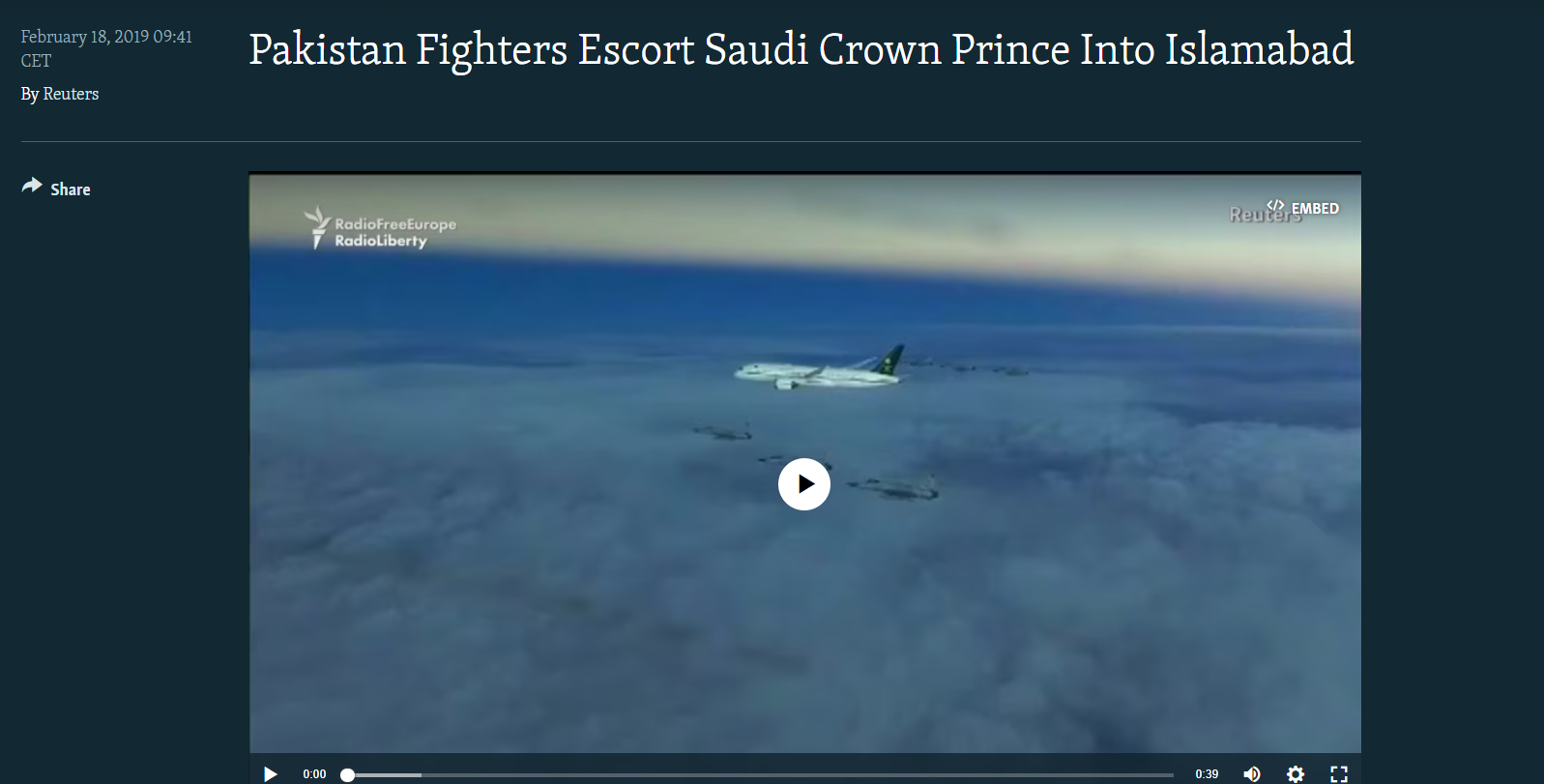
Further verification led us to the same footage uploaded on YouTube by the channel “SCMP Archive” on July 6, 2020. At the time, Pakistan’s Air Force had described the escort as part of a ceremonial welcome tradition for visiting dignitaries.

Conclusion
The viral claim is misleading. The video does not show Pakistani fighter jets escorting an Iranian delegation amid ongoing ceasefire talks. Instead, it is an old clip from 2019, when Pakistan deployed JF-17 fighter jets to welcome Saudi Crown Prince Mohammed bin Salman during his official visit. There is no evidence linking the video to current geopolitical developments involving Iran and Pakistan. The footage has been taken out of context and reshared with a false narrative to mislead viewers.
.webp)
Introduction
We were all stunned and taken aback when multiple photos of streets in the U.S. surfaced with heavily drugged individuals loosely sitting on the streets, victims of a systematically led drug operation that has recently become a target of the Trump-led “tariff” war, which he terms as a war on drug cartels. The drug is a synthetic opioid, fentanyl, which is highly powerful and addictive. The menace of this drug is found in a country that has Wall Street and the largest and most powerful economy globally. The serious implications of drug abuse are not about a certain economy; instead, it has huge costs to society in general. The estimated cost of substance misuse to society is more than $820 billion each year and is expected to continue rising.
On June 26, the International Day against Drug Abuse and Illicit Trafficking is observed globally. However, this war is waged daily for millions of people, not on streets or borders, but in bloodstreams, behind locked doors, and inside broken homes. Drug abuse is no longer a health crisis; it is a developmental crisis. The United Nations Office on Drugs and Crime has launched a campaign against this organised crime that says, “Break the Cycle’ attributing to the fact that de-addiction is hard for individuals.
The Evolving Drug Crisis: From Alleyways to Algorithms
The menace of Drug abuse and illicit trafficking has also taken strides in advancement, and what was once considered a street-side vice has made its way online in a faceless, encrypted, and algorithmically optimised sense. The online drug cartels operate in the shadows and often hide in plain sight, taking advantage of the privacy designed to benefit individuals. With the help of darknet markets, cryptocurrency, and anonymised logistics, the drug trade has transformed into a transnational, tech-enabled industry on a global scale. In an operation led by the U.S. Department of Justice’s Joint Criminal Opiod and Darknet Enforcement (JCODE) and related to Operation RapTor, an LA apartment was only to find an organised business centre that operated as a hub of one of the most prolific methamphetamine and cocaine distributors in the market. Aaron Pinder, Unit Chief of the FBI Hi-Tech Organised Crime Unit, said in his interview, “The darknet vendors that we investigate, they truly operate on a global scale.” On January 11, 2025, during the Regional Conference on “Drug Trafficking and National Security,” it was acknowledged how cryptocurrency, the dark web, online marketplaces, and drones have made drug trafficking a faceless crime. Reportedly, there has been a seven-fold increase in the drugs seized from 2004-14 to 2014-24.
India’s Response: Bridging Borders, Policing Bytes
India has been historically vulnerable due to its geostrategic placement between the Golden Crescent (Afghanistan-Iran-Pakistan) and Golden Triangle (Myanmar-Laos-Thailand), and confronts a fresh danger from “click-to-consume’ narcotics. Although India has always adopted a highly sensitised approach, it holds an optimistic future outlook for the youth. Last year, to commemorate the occasion of International Day against Drug Abuse and Illicit Trafficking, the Department of Social Justice & Empowerment organised a programme to engage individuals for the cause. The Indian authorities are often seen coming down heavily on the drug peddlers and cartels, and to aid the cause, the Home Minister Amit Shah inaugurated the new office complex of the NCB’s Bhopal zonal unit and extension of the MANAS-2 helpline to all 36 states and UTs. The primary objectives of this step are to evaluate the effectiveness of the Narcotics Coordination Mechanism (NCORD), assess the progress of states in fighting drug trafficking, and share real-time information from the National Narcotics Helpline ‘MANAS’ portal with the Anti-Narcotics Task Force (ANTF) of states and UTs.
The United Nation’s War on Narcotics: From Treaties to Technology
The United Nations Office on Drugs and Crime (UNODC) is leading the international response. It offers vital data, early warning systems, and technical support to the states fighting the drug problem. The UNODC incorporates cooperation in cross-border intelligence, overseeing the darknet activities, encouraging the treatment and harm reduction, and using anti-money laundering mechanisms to stop financial flows. India has always pledged its support to the UN led activities, and as per reports dated 26th March, 2025, India chaired the prestigious UN-backed Commission on Narcotic Drugs (CND) meeting held in vienna, wherein India highlighted the importance of opioids for medical purposes as well as the nation’s notable advancements in the field.
Resolution on June 26: From Commemoration to Commitment
Let June 26 be more than a date on the calendar- let it echo as a call to action, a day when awareness transforms into action, and resolve becomes resistance. On this day, CyberPeace resolves the following:
- To treat addicts as victims rather than criminals and to pitch for reforms to provide access to reasonably priced, stigma-free rehabilitation.
- To integrate anti-drug awareness into digital literacy initiatives and school curricula in order to teach frequently and early.
- To demand responsibility and accountability from online marketplaces and delivery services that unwittingly aid traffickers
- To tackle the demand side through employment, mental health services, and social protection, particularly for at-risk youth.
References
- https://www.gatewayfoundation.org/blog/cost-of-drug-addiction/#:~:text=The%20estimated%20cost%20for%20substance,Alcohol%3A%20%24249%20billion
- https://www.unodc.org/unodc/en/drugs/index-new.html
- https://www.fbi.gov/news/stories/global-operation-targets-darknet-drug-trafficking
- https://www.thehindu.com/news/national/dark-web-crypto-drones-emerge-as-challenges-in-fight-against-drug-trafficking-amit-shah/article69088383.ece
- https://www.pib.gov.in/PressReleaseIframePage.aspx?PRID=2028704
- https://www.newindianexpress.com/nation/2025/Mar/26/in-a-first-india-chairs-un-forum-on-narcotics-pledges-to-improve-access-to-pain-relief-and-palliative-care
Executive Summary
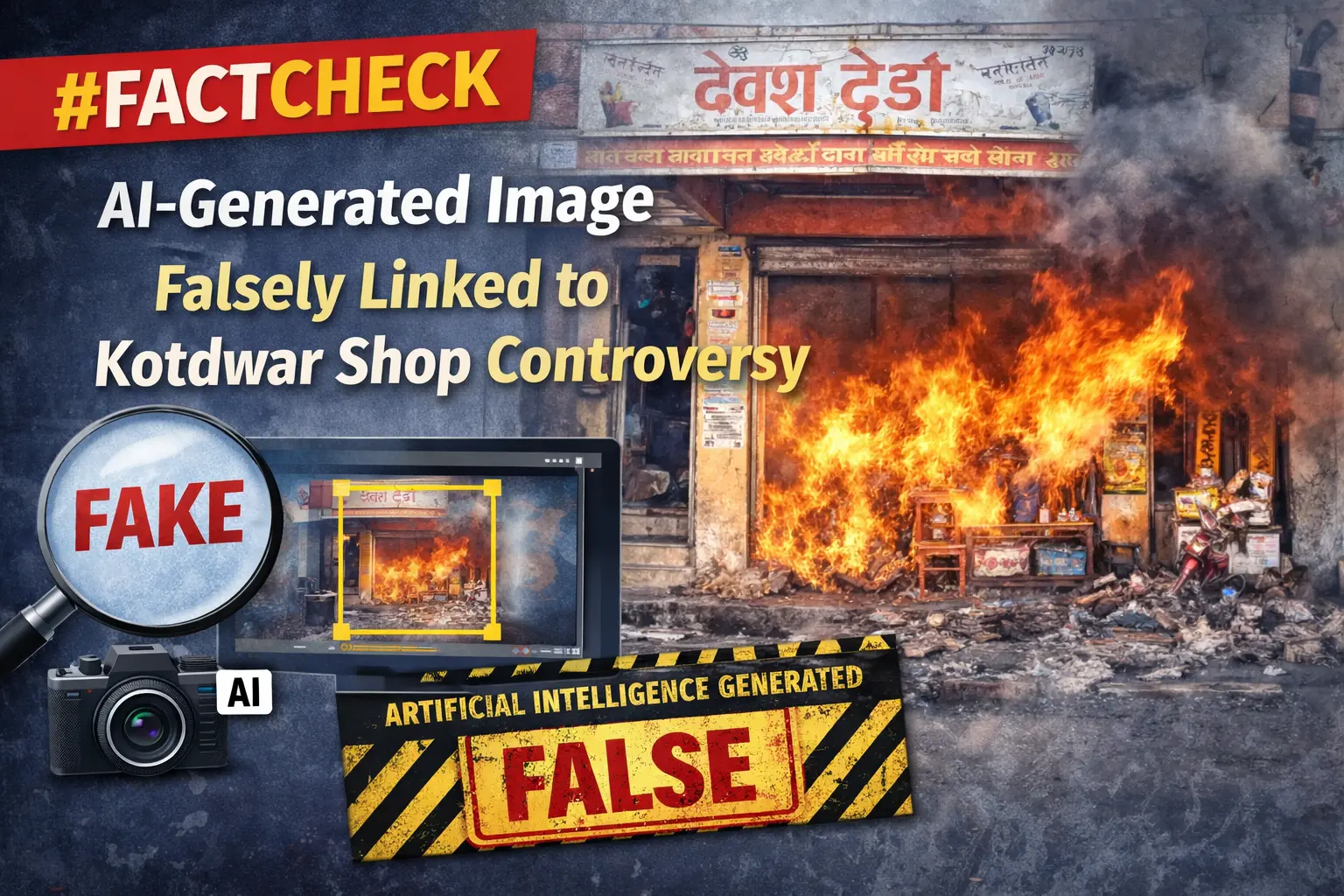
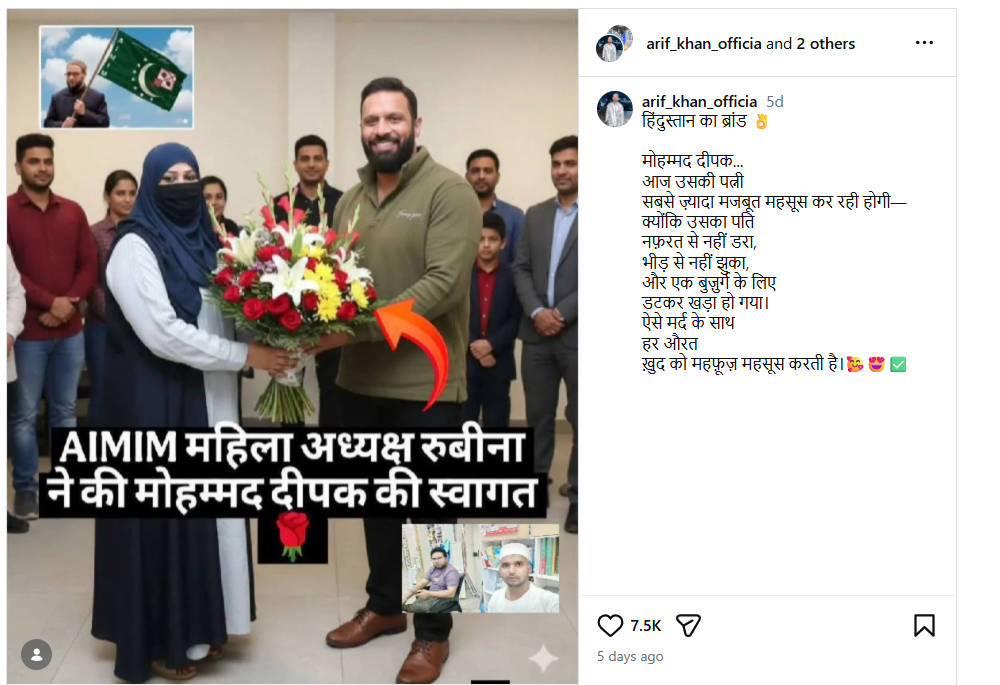
A dispute had recently emerged in Kotdwar, Uttarakhand, over the name of a shop. During the controversy, a local youth, Deepak Kumar, came forward in support of the shopkeeper. The incident subsequently became a subject of discussion on social media, with users expressing varied reactions. Meanwhile, a photo began circulating on social media showing a burqa-clad woman presenting a bouquet to Deepak Kumar. The image is being shared with the claim that All India Majlis-e-Ittehadul Muslimeen (AIMIM)’s women’s president, Rubina, welcomed “Mohammad Deepak Kumar” by presenting him with a bouquet. However, research conducted by the CyberPeace found the viral claim to be false. The research revealed that users are sharing an AI-generated image with a misleading claim.
Claim:
On social media platform Instagram, a user shared the viral image claiming that AIMIM’s women’s president Rubina welcomed “Mohammad Deepak Kumar” by presenting him with a bouquet. The link to the post, its archived version, and a screenshot are provided below.
Fact Check:
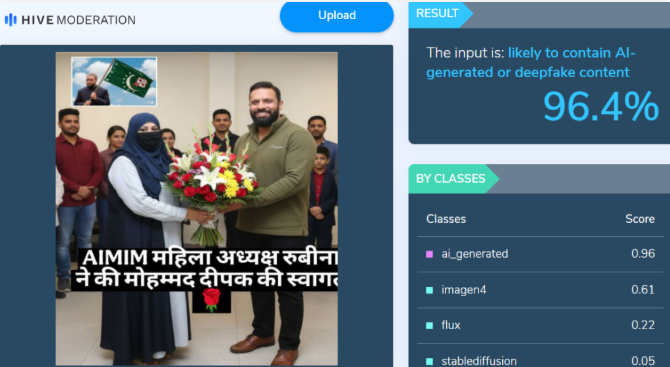
Upon closely examining the viral image, certain inconsistencies raised suspicion that it could be AI-generated. To verify its authenticity, the image was analysed using the AI detection tool Hive Moderation, which indicated a 96 percent probability that the image was AI-generated.
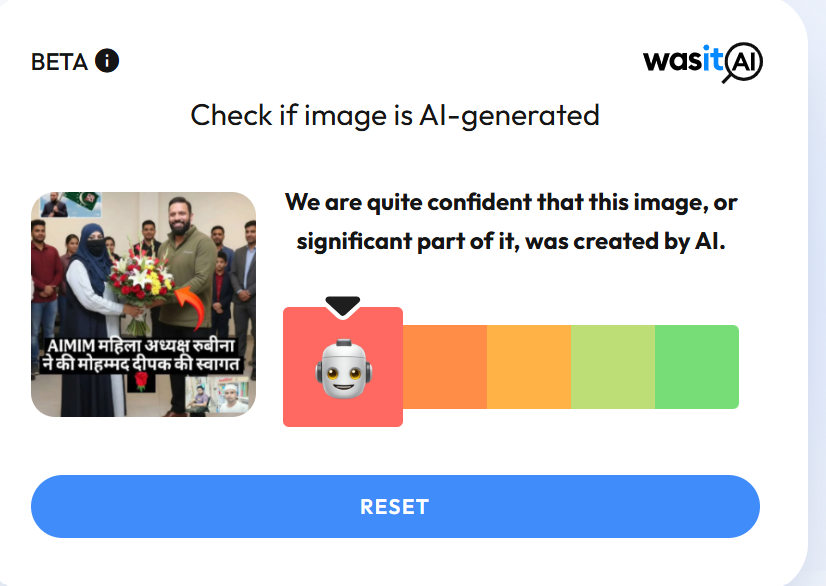
In the next stage of the research , the image was also analysed using another AI detection tool, Wasit AI, which likewise identified the image as AI-generated.
Conclusion
The research establishes that users are circulating an AI-generated image with a misleading claim linking it to the Kotdwar controversy.
