
Curtailing FinCrime on Metaverse
Introduction
On the precipice of a new domain of existence, the metaverse emerges as a digital cosmos, an expanse where the horizon is not sky, but a limitless scope for innovation and imagination. It is a sophisticated fabric woven from the threads of social interaction, leisure, and an accelerated pace of technological progression. This new reality, a virtual landscape stretching beyond the mundane encumbrances of terrestrial life, heralds an evolutionary leap where the laws of physics yield to the boundless potential inherent in our creativity. Yet, the dawn of such a frontier does not escape the spectre of an age-old adversary—financial crime—the shadow that grows in tandem with newfound opportunity, seeping into the metaverse, where crypto-assets are no longer just an alternative but the currency du jour, dazzling beacons for both legitimate pioneers and shades of illicit intent.
The metaverse, by virtue of its design, is a canvas for the digital repaint of society—a three-dimensional realm where the lines between immersive experiences and entertainment blur, intertwining with surreal intimacy within this virtual microcosm. Donning headsets like armor against the banal, individuals become avatars; digital proxies that acquire the ability to move, speak, and perform an array of actions with an ease unattainable in the physical world. Within this alternative reality, users navigate digital topographies, with experiences ranging from shopping in pixelated arcades to collaborating in virtual offices; from witnessing concerts that defy sensory limitations to constructing abodes and palaces from mere codes and clicks—an act of creation no longer beholden to physicality but to the breadth of one's ingenuity.
The Crypto Assets
The lifeblood of this virtual economy pulsates through crypto-assets. These digital tokens represent value or rights held on distributed ledgers—a technology like blockchain, which serves as both a vault and a transparent tapestry, chronicling the pathways of each digital asset. To hop onto the carousel of this economy requires a digital wallet—a storeroom and a gateway for acquisition and trade of these virtual valuables. Cryptocurrencies, with NFTs—Non-fungible Tokens—have accelerated from obscure digital curios to precious artifacts. According to blockchain analytics firm Elliptic, an astonishing figure surpassing US$100 million in NFTs were usurped between July 2021 and July 2022. This rampant heist underlines their captivating allure for virtual certificates. Empowers do not just capture art, music, and gaming, but embody their very soul.
Yet, as the metaverse burgeons, so does the complexity and diversity of financial transgressions. From phishing to sophisticated fraud schemes, criminals craft insidious simulacrums of legitimate havens, aiming to drain the crypto-assets of the unwary. In the preceding year, a daunting figure rose to prominence—the vanishing of US$14 billion worth of crypto-assets, lost to the abyss of deception and duplicity. Hence, social engineering emerges from the shadows, a sort of digital chicanery that preys not upon weaknesses of the system, but upon the psychological vulnerabilities of its users—scammers adorned in the guise of authenticity, extracting trust and assets with Machiavellian precision.
The New Wave of Fincrimes
Extending their tentacles further, perpetrators of cybercrime exploit code vulnerabilities, engage in wash trading, obscuring the trails of money laundering, meander through sanctions evasion, and even dare to fund activities that send ripples of terror across the physical and virtual divide. The intricacies of smart contracts and the decentralized nature of these worlds, designed to be bastions of innovation, morph into paths paved for misuse and exploitation. The openness of blockchain transactions, the transparency that should act as a deterrent, becomes a paradox, a double-edged sword for the law enforcement agencies tasked with delineating the networks of faceless adversaries.
Addressing financial crime in the metaverse is Herculean labour, requiring an orchestra of efforts—harmonious, synchronised—from individual users to mammoth corporations, from astute policymakers to vigilant law enforcement bodies. Users must furnish themselves with critical awareness, fortifying their minds against the siren calls that beckon impetuous decisions, spurred by the anxiety of falling behind. Enterprises, the architects and custodians of this digital realm, are impelled to collaborate with security specialists, to probe their constructs for weak seams, and to reinforce their bulwarks against the sieges of cyber onslaughts. Policymakers venture onto the tightrope walk, balancing the impetus for innovation against the gravitas of robust safeguards—a conundrum played out on the global stage, as epitomised by the European Union's strides to forge cohesive frameworks to safeguard this new vessel of human endeavour.
The Austrian Example
Consider the case of Austria, where the tapestry of laws entwining crypto-assets spans a gamut of criminal offences, from data breaches to the complex webs of money laundering and the financing of dark enterprises. Users and corporations alike must become cartographers of local legislation, charting their ventures and vigilances within the volatile seas of the metaverse.
Upon the sands of this virtual frontier, we must not forget: that the metaverse is more than a hive of bits and bandwidth. It crystallises our collective dreams, echoes our unspoken fears, and reflects the range of our ambitions and failings. It stands as a citadel where the ever-evolving quest for progress should never stray from the compass of ethical pursuit. The cross-pollination of best practices, and the solidarity of international collaboration, are not simply tactics—they are imperatives engraved with the moral codes of stewardship, guiding us to preserve the unblemished spirit of the metaverse.
Conclusion
The clarion call of the metaverse invites us to venture into its boundless expanse, to savour its gifts of connection and innovation. Yet, on this odyssey through the pixelated constellations, we harness vigilance as our star chart, mindful of the mirage of morality that can obfuscate and lead astray. In our collective pursuit to curtail financial crime, we deploy our most formidable resource—our unity—conjuring a bastion for human ingenuity and integrity. In this, we ensure that the metaverse remains a beacon of awe, safeguarded against the shadows of transgression, and celebrated as a testament to our shared aspiration to venture beyond the realm of the possible, into the extraordinary.
References
- https://www.wolftheiss.com/insights/financial-crime-in-the-metaverse-is-real/
- https://gnet-research.org/2023/08/16/meta-terror-the-threats-and-challenges-of-the-metaverse/
- https://shuftipro.com/blog/the-rising-concern-of-financial-crimes-in-the-metaverse-aml-screening-as-a-solution/

Related Blogs

Executive Summary:
Amid the ongoing conflict involving the United States, Israel, and Iran, a video showing a building engulfed in flames is being widely circulated on social media. In the clip, a large fire can be seen inside a building while several people appear to be running in panic. The video is being shared with the claim that Iran fired a hypersonic missile targeting a ceremony in Tel Aviv, Israel, allegedly killing several Israeli military generals and other prominent figures.
However, research by the CyberPeace found that the claim is false. The video being circulated as footage of an attack in Israel actually predates the current conflict and shows a fire that broke out during a wedding ceremony.
Claim
A Facebook user named “Syed Asif Raza Jafri” shared the video on March 13, 2026, claiming that an Iranian hypersonic missile had struck a grand ceremony in Tel Aviv, where several Israeli military officers, generals, soldiers, and other important personalities were present. According to the post, the attack resulted in multiple casualties.
Source:
- https://www.facebook.com/reel/902182825912364
- https://ghostarchive.org/archive/rZryr

Fact Check
To verify the claim, we began our research using the Google Lens reverse image search tool. Several key frames from the viral video were extracted and searched online.
During the search, we found the same video shared earlier on multiple foreign social media accounts. A Facebook user named “Es de Bombero” from Chile had posted the video on January 17, 2026, describing it in Spanish as footage of a fire that broke out during a wedding celebration.

Our research shows that the viral video had been circulating on social media since at least January 15, 2026, well before the escalation of the current conflict. According to a report published on March 1, 2026, by BBC, the large-scale attacks on Iran by the United States and Israel began on February 28, 2026, after which Iran’s Supreme Leader Ali Khamenei was reported dead.
Additionally, a March 12, 2026 report by Al Jazeera stated that a house near Tel Aviv in central Israel was damaged by a rocket reportedly fired by Hezbollah, which has previously carried out joint attacks in coordination with Iran.

Conclusion
The viral video being shared as footage of an Iranian hypersonic missile strike in Tel Aviv is misleading. The clip is an older video of a fire that reportedly broke out during a wedding ceremony and was circulating online before the current conflict began.
While the exact location of the incident shown in the video cannot be independently verified, it is clear that the footage has no connection to the ongoing war between the United States, Israel, and Iran.

A video purportedly showing Prime Minister Narendra Modi delivering a politically charged warning during a public address has been widely circulated on social media. The clip is being shared with claims that the Prime Minister spoke about the “saffronisation” of the Indian Army and issued a stern message to Bangladesh by invoking India’s role in the 1971 war.
A detailed verification by the CyberPeace Foundation found these claims to be misleading. The investigation revealed that the viral video has been digitally altered, and the statements attributed to the Prime Minister do not appear in the original speech. The misleading narrative appears to have been created by inserting manipulated audio into authentic video footage.
Claim
An X user, “@Pakpulse247,” shared a video on December 26 claiming that Prime Minister Narendra Modi, while addressing a public gathering, made remarks about the “saffronisation” of the Indian Army and issued a warning to Bangladesh by invoking India’s role in the 1971 war.
The post’s caption alleged that the Prime Minister made these statements during the inauguration of the Rashtra Prerna Sthal in Lucknow, suggesting that Bangladesh should not expect support from Pakistan in the event of an Indian offensive and should remember India’s contribution during the 1971 conflict.
The link to the post is provided below, along with a screenshot of the viral claim.

Fact Check:
During the verification process, the Desk carried out a targeted keyword search and located the complete, original version of the video on the official YouTube channel of the Bharatiya Janata Party, uploaded on December 26, 2025. The video description confirmed that Prime Minister Narendra Modi was addressing the gathering at the inauguration of the Rashtra Prerna Sthal in Lucknow.
A comparison of the visuals showed that the venue, backdrop, and the Prime Minister’s attire were identical to those seen in the viral clip circulating on social media. However, after carefully reviewing the full speech, the Desk found no reference to Pakistan, Bangladesh, or the claims being attributed to him in the viral post.
The link to the original video is provided below, along with a relevant screenshot.
https://www.youtube.com/watch?v=L9rbzU0m30o
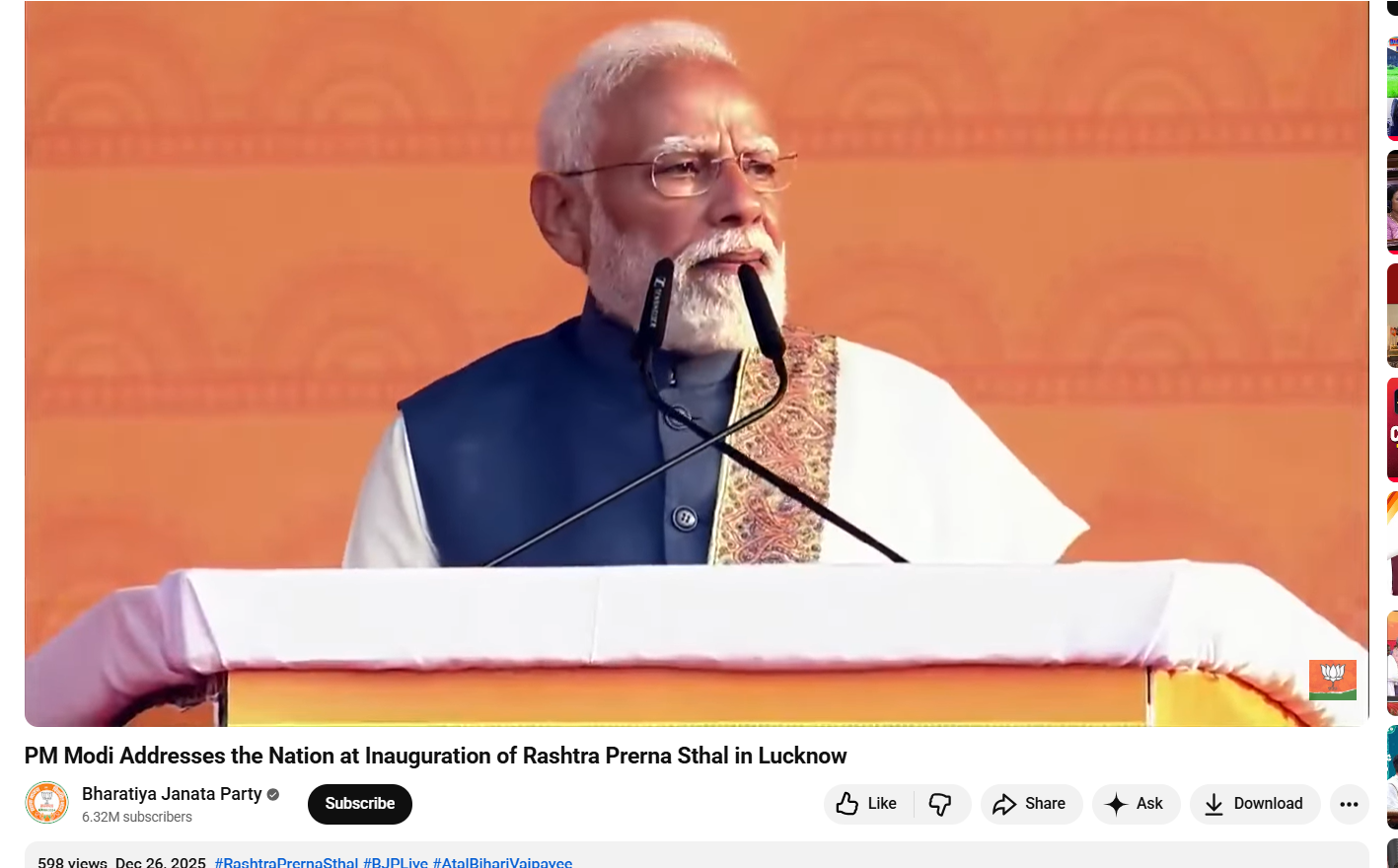
Upon further examination of the search results, the Desk located the official English transcript of Prime Minister Narendra Modi’s speech on the PM India website. A thorough review of the complete transcript revealed no mention of the statements attributed to him in the viral social media post.
The link to the official transcription is provided below.
On further examination of the search results, the Desk accessed the official English transcript of Prime Minister Narendra Modi’s speech published on the PM India website. A careful review of the complete transcript confirmed that none of the claims made in the viral social media post appear in the official record.
The link to the transcription is provided below.
Building on these findings, the Desk extracted the audio track from the viral video and analysed it using Resemble AI, an audio-detection tool. The analysis flagged the audio as fake, indicating that it had been digitally manipulated.

Conclusion
The CyberPeace Foundation’s research clearly establishes that the viral video claiming Prime Minister Narendra Modi made remarks about the saffronisation of the Indian Army and issued warnings to Bangladesh is false and misleading. The full original video and official transcript of the speech contain no such references to Pakistan, Bangladesh, or the 1971 war. Furthermore, audio analysis using AI-detection tools confirms that the voice in the viral clip has been digitally manipulated.

Introduction
The advent of AI-driven deepfake technology has facilitated the creation of explicit counterfeit videos for sextortion purposes. There has been an alarming increase in the use of Artificial Intelligence to create fake explicit images or videos for sextortion.
What is AI Sextortion and Deepfake Technology
AI sextortion refers to the use of artificial intelligence (AI) technology, particularly deepfake algorithms, to create counterfeit explicit videos or images for the purpose of harassing, extorting, or blackmailing individuals. Deepfake technology utilises AI algorithms to manipulate or replace faces and bodies in videos, making them appear realistic and often indistinguishable from genuine footage. This enables malicious actors to create explicit content that falsely portrays individuals engaging in sexual activities, even if they never participated in such actions.
Background on the Alarming Increase in AI Sextortion Cases
Recently there has been a significant increase in AI sextortion cases. Advancements in AI and deepfake technology have made it easier for perpetrators to create highly convincing fake explicit videos or images. The algorithms behind these technologies have become more sophisticated, allowing for more seamless and realistic manipulations. And the accessibility of AI tools and resources has increased, with open-source software and cloud-based services readily available to anyone. This accessibility has lowered the barrier to entry, enabling individuals with malicious intent to exploit these technologies for sextortion purposes.
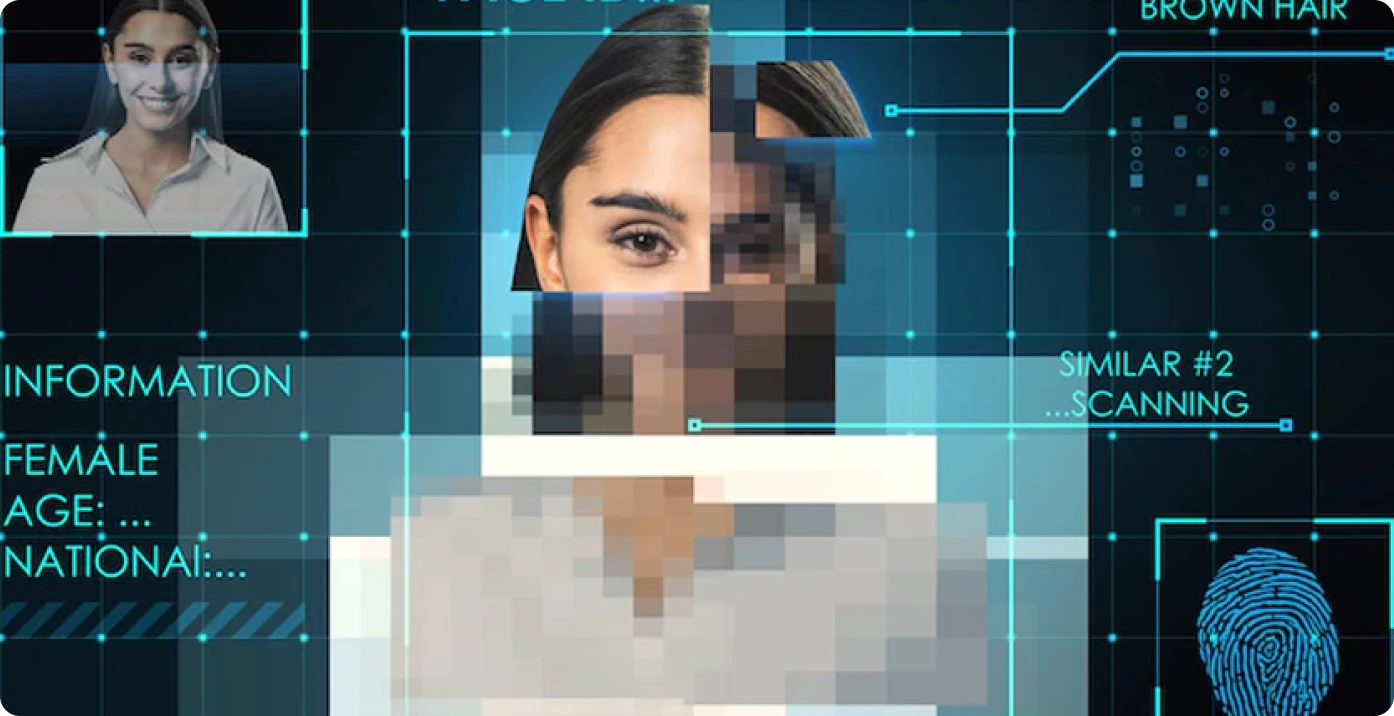
The proliferation of sharing content on social media
The proliferation of social media platforms and the widespread sharing of personal content online have provided perpetrators with a vast pool of potential victims’ images and videos. By utilising these readily available resources, perpetrators can create deepfake explicit content that closely resembles the victims, increasing the likelihood of success in their extortion schemes.
Furthermore, the anonymity and wide reach of the internet and social media platforms allow perpetrators to distribute manipulated content quickly and easily. They can target individuals specifically or upload the content to public forums and pornographic websites, amplifying the impact and humiliation experienced by victims.
What are law agencies doing?
The alarming increase in AI sextortion cases has prompted concern among law enforcement agencies, advocacy groups, and technology companies. This is high time to make strong Efforts to raise awareness about the risks of AI sextortion, develop detection and prevention tools, and strengthen legal frameworks to address these emerging threats to individuals’ privacy, safety, and well-being.
There is a need for Technological Solutions, which develops and deploys advanced AI-based detection tools to identify and flag AI-generated deepfake content on platforms and services. And collaboration with technology companies to integrate such solutions.
Collaboration with Social Media Platforms is also needed. Social media platforms and technology companies can reframe and enforce community guidelines and policies against disseminating AI-generated explicit content. And can ensure foster cooperation in developing robust content moderation systems and reporting mechanisms.
There is a need to strengthen the legal frameworks to address AI sextortion, including laws that specifically criminalise the creation, distribution, and possession of AI-generated explicit content. Ensure adequate penalties for offenders and provisions for cross-border cooperation.
Proactive measures to combat AI-driven sextortion
Prevention and Awareness: Proactive measures raise awareness about AI sextortion, helping individuals recognise risks and take precautions.
Early Detection and Reporting: Proactive measures employ advanced detection tools to identify AI-generated deepfake content early, enabling prompt intervention and support for victims.
Legal Frameworks and Regulations: Proactive measures strengthen legal frameworks to criminalise AI sextortion, facilitate cross-border cooperation, and impose offender penalties.
Technological Solutions: Proactive measures focus on developing tools and algorithms to detect and remove AI-generated explicit content, making it harder for perpetrators to carry out their schemes.
International Cooperation: Proactive measures foster collaboration among law enforcement agencies, governments, and technology companies to combat AI sextortion globally.
Support for Victims: Proactive measures provide comprehensive support services, including counselling and legal assistance, to help victims recover from emotional and psychological trauma.
Implementing these proactive measures will help create a safer digital environment for all.

Misuse of Technology
Misusing technology, particularly AI-driven deepfake technology, in the context of sextortion raises serious concerns.
Exploitation of Personal Data: Perpetrators exploit personal data and images available online, such as social media posts or captured video chats, to create AI- manipulation violates privacy rights and exploits the vulnerability of individuals who trust that their personal information will be used responsibly.
Facilitation of Extortion: AI sextortion often involves perpetrators demanding monetary payments, sexually themed images or videos, or other favours under the threat of releasing manipulated content to the public or to the victims’ friends and family. The realistic nature of deepfake technology increases the effectiveness of these extortion attempts, placing victims under significant emotional and financial pressure.
Amplification of Harm: Perpetrators use deepfake technology to create explicit videos or images that appear realistic, thereby increasing the potential for humiliation, harassment, and psychological trauma suffered by victims. The wide distribution of such content on social media platforms and pornographic websites can perpetuate victimisation and cause lasting damage to their reputation and well-being.
Targeting teenagers– Targeting teenagers and extortion demands in AI sextortion cases is a particularly alarming aspect of this issue. Teenagers are particularly vulnerable to AI sextortion due to their increased use of social media platforms for sharing personal information and images. Perpetrators exploit to manipulate and coerce them.
Erosion of Trust: Misusing AI-driven deepfake technology erodes trust in digital media and online interactions. As deepfake content becomes more convincing, it becomes increasingly challenging to distinguish between real and manipulated videos or images.
Proliferation of Pornographic Content: The misuse of AI technology in sextortion contributes to the proliferation of non-consensual pornography (also known as “revenge porn”) and the availability of explicit content featuring unsuspecting individuals. This perpetuates a culture of objectification, exploitation, and non-consensual sharing of intimate material.
Conclusion
Addressing the concern of AI sextortion requires a multi-faceted approach, including technological advancements in detection and prevention, legal frameworks to hold offenders accountable, awareness about the risks, and collaboration between technology companies, law enforcement agencies, and advocacy groups to combat this emerging threat and protect the well-being of individuals online.
