
#FactCheck-Viral Video Falsely Attributes Remarks on US Leaders to CDS Anil Chauhan
Executive Summary
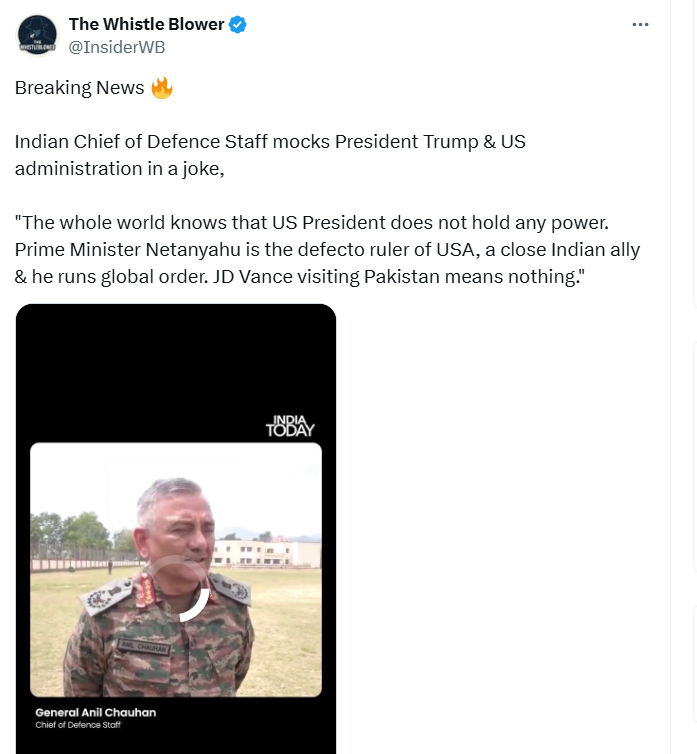
A video circulating on social media claims that Chief of Defence Staff Anil Chauhan described US leaders as “toothless rulers” and said that US President Donald Trump cannot disobey Israeli Prime Minister Benjamin Netanyahu. The clip is being widely shared as a recent statement. However, research by the CyberPeace Research Wing found the claim to be misleading. A review of the full interview revealed that Chauhan was speaking about the need for India to prepare for the next phase of ‘Operation Sindoor’. He emphasised that the armed forces must move beyond past operations and gear up for future challenges.
Claim
Social media users have shared the video claiming that CDS Anil Chauhan referred to US leaders as “toothless rulers” and stated that Donald Trump cannot act against the wishes of Benjamin Netanyahu.
- Link: https://x.com/InsiderWB/status/2046263000928330130
- Archive: https://archive.ph/j8CeL
Fact Check
A detailed keyword search using terms such as “CDS Anil Chauhan, Donald Trump, JD Vance, Pakistan” did not yield any credible reports or verified statements supporting the viral claim. A reverse image search of keyframes from the clip traced it back to a post shared by India Today on April 18, 2026, where the same visuals and setting were used.
https://x.com/IndiaToday/status/2045531069647327240
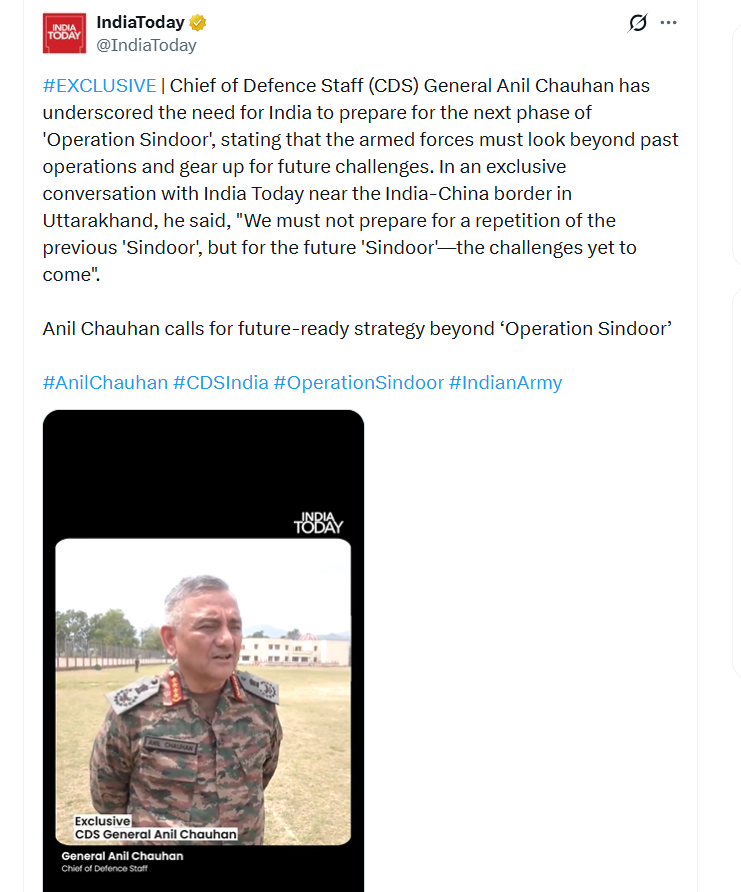
In the original interview, Chauhan focused on military preparedness and the future course of ‘Operation Sindoor’. He did not make any remarks about US leadership, Donald Trump, or Benjamin Netanyahu. The complete version of the interaction, also aired on Aaj Tak, was reviewed in full and similarly contains no such controversial or political statements.

Conclusion
The viral claim is misleading. The video has been edited or taken out of context to falsely attribute remarks to CDS Anil Chauhan that he never made. In reality, his statements were limited to India’s military preparedness and did not include any comments on US or Israeli leadership.

Related Blogs

Introduction
The emergence of deepfake technology has become a significant problem in an era driven by technological growth and power. The government has reacted proactively as a result of concerns about the exploitation of this technology due to its extraordinary realism in manipulating information. The national government is in the vanguard of defending national interests, public trust, and security as the digital world changes. On the 26th of December 2023, the central government issued an advisory to businesses, highlighting how urgent it is to confront this growing threat.
The directive aims to directly address the growing concerns around Deepfakes, or misinformation driven by AI. This advice represents the result of talks that Union Minister Shri Rajeev Chandrasekhar, had with intermediaries during the course of a month-long Digital India dialogue. The main aim of the advisory is to accurately and clearly inform users about information that is forbidden, especially those listed under Rule 3(1)(b) of the IT Rules.
Advisory
The Ministry of Electronics and Information Technology (MeitY) has sent a formal recommendation to all intermediaries, requesting adherence to current IT regulations and emphasizing the need to address issues with misinformation, specifically those driven by artificial intelligence (AI), such as Deepfakes. Union Minister Rajeev Chandrasekhar released the recommendation, which highlights the necessity of communicating forbidden information in a clear and understandable manner, particularly in light of Rule 3(1)(b) of the IT Rules.
Advise on Prohibited Content Communication
According to MeitY's advice, intermediaries must transmit content that is prohibited by Rule 3(1)(b) of the IT Rules in a clear and accurate manner. This involves giving users precise details during enrollment, login, and content sharing/uploading on the website, as well as including such information in customer contracts and terms of service.
Ensuring Users Are Aware of the Rules
Digital platform suppliers are required to inform their users of the laws that are relevant to them. This covers provisions found in the IT Act of 2000 and the Indian Penal Code (IPC). Corporations should inform users of the potential consequences of breaking the restrictions outlined in Rule 3(1)(b) and should also urge users to notify any illegal activity to law enforcement.
Talks Concerning Deepfakes
For more than a month, Union Minister Rajeev Chandrasekhar had a significant talk with various platforms where they addressed the issue of "deepfakes," or computer-generated fake videos. The meeting emphasized how crucial it is that everyone abides by the laws and regulations in effect, particularly the IT Rules to prevent deepfakes from spreading.
Addressing the Danger of Disinformation
Minister Chandrasekhar underlined the grave issue of disinformation, particularly in the context of deepfakes, which are false pieces of content produced using the latest developments such as artificial intelligence. He emphasized the dangers this deceptive data posed to internet users' security and confidence. The Minister emphasized the efficiency of the IT regulations in addressing this issue and cited the Prime Minister's caution about the risks of deepfakes.
Rule Against Spreading False Information
The Minister referred particularly to Rule 3(1)(b)(v), which states unequivocally that it is forbidden to disseminate false information, even when doing so involves cutting-edge technology like deepfakes. He called on intermediaries—the businesses that offer digital platforms—to take prompt action to take such content down from their systems. Additionally, he ensured that everyone is aware that breaking such rules has legal implications.
Analysis
The Central Government's latest advisory on deepfake technology demonstrates a proactive strategy to deal with new issues. It also highlights the necessity of comprehensive legislation to directly regulate AI material, particularly with regard to user interests.
There is a wider regulatory vacuum for content produced by artificial intelligence, even though the current guideline concentrates on the precision and lucidity of information distribution. While some limitations are mentioned in the existing laws, there are no clear guidelines for controlling or differentiating AI-generated content.
Positively, it is laudable that the government has recognized the dangers posed by deepfakes and is making appropriate efforts to counter them. As AI technology develops, there is a chance to create thorough laws that not only solve problems but also create a supportive environment for the creation of ethical AI content. User protection, accountability, openness, and moral AI use would all benefit from such laws. This offers an opportunity for regulatory development to guarantee the successful and advantageous incorporation of AI into our digital environment.
Conclusion
The Central Government's preemptive advice on deepfake technology shows a great dedication to tackling new risks in the digital sphere. The advice highlights the urgent need to combat deepfakes, but it also highlights the necessity for extensive legislation on content produced by artificial intelligence. The lack of clear norms offers a chance for constructive regulatory development to protect the interests of users. The advancement of AI technology necessitates the adoption of rules that promote the creation of ethical AI content, guaranteeing user protection, accountability, and transparency. This is a turning point in the evolution of regulations, making it easier to responsibly incorporate AI into our changing digital landscape.
References
- https://economictimes.indiatimes.com/tech/technology/deepfake-menace-govt-issues-advisory-to-intermediaries-to-comply-with-existing-it-rules/articleshow/106297813.cms
- https://pib.gov.in/PressReleaseIframePage.aspx?PRID=1990542#:~:text=Ministry%20of%20Electronics%20and%20Information,misinformation%20powered%20by%20AI%20%E2%80%93%20Deepfakes.
- https://www.timesnownews.com/india/centres-deepfake-warning-to-it-firms-ensure-users-dont-violate-content-rules-article-106298282#:~:text=The%20Union%20government%20on%20Tuesday,actors%2C%20businesspersons%20and%20other%20celebrities

Introduction
We consume news from various sources such as news channels, social media platforms and the Internet etc. In the age of the Internet and social media, the concern of misinformation has become a common issue as there is widespread misinformation or fake news on the Internet and social media platforms.
Misinformation on social media platforms
The wide availability of user-provided content on online social media platforms facilitates the spread of misinformation. With the vast population on social media platforms, the information gets viral and spreads all over the internet. It has become a serious concern as such misinformation, including rumours, morphed images, unverified information, fake news, and planted stories, spread easily on the internet, leading to severe consequences such as public riots, lynching, communal tensions, misconception about facts, defamation etc.
Platform-centric measures to mitigate the spread of misinformation
- Google introduced the ‘About this result’ feature’. This allows the users to help with better understand the search results and websites at a glance.
- During the covid-19 pandemic, there were huge cases of misinformation being shared. Google, in April 2020, invested $6.5 million in funding to fact-checkers and non-profits fighting misinformation around the world, including a check on information related to coronavirus or on issues related to the treatment, prevention, and transmission of Covid-19.
- YouTube also have its Medical Misinformation Policy which prevents the spread of information or content which is in contravention of the World Health Organization (WHO) or local health authorities.
- At the time of the Covid-19 pandemic, major social media platforms such as Facebook and Instagram have started showing awareness pop-ups which connected people to information directly from the WHO and regional authorities.
- WhatsApp has a limit on the number of times a WhatsApp message can be forwarded to prevent the spread of fake news. And also shows on top of the message that it is forwarded many times. WhatsApp has also partnered with fact-checking organisations to make sure to have access to accurate information.
- On Instagram as well, when content has been rated as false or partly false, Instagram either removes it or reduces its distribution by reducing its visibility in Feeds.
Fight Against Misinformation
Misinformation is rampant all across the world, and the same needs to be addressed at the earliest. Multiple developed nations have synergised with tech bases companies to address this issue, and with the increasing penetration of social media and the internet, this remains a global issue. Big tech companies such as Meta and Google have undertaken various initiatives globally to address this issue. Google has taken up the initiative to address this issue in India and, in collaboration with Civil Society Organisations, multiple avenues for mass-scale awareness and upskilling campaigns have been piloted to make an impact on the ground.
How to prevent the spread of misinformation?
Conclusion
In the digital media space, there is a widespread of misinformative content and information. Platforms like Google and other social media platforms have taken proactive steps to prevent the spread of misinformation. Users should also act responsibly while sharing any information. Hence creating a safe digital environment for everyone.

Executive Summary
Two powerful earthquakes measuring 7.2 and 7.5 in magnitude struck Venezuela on June 24, 2026, within a span of one minute, causing widespread destruction. Hundreds of buildings were reportedly reduced to rubble. Against this backdrop, a video is being widely shared on social media showing two high-rise buildings colliding with each other before collapsing. Several users have claimed that the footage shows the aftermath of the recent earthquake in Venezuela. CyberPeace Research Wing team conducted a detailed research and found that the viral video is not authentic. The footage was generated using artificial intelligence and is being falsely shared as real visuals from the Venezuela earthquake.
Claim
A Facebook user, “Rana Yashwant,” shared the video on June 26, 2026, with the caption: "Venezuela: The high-rise buildings fell as if they were fast-moving train coaches. How long could they withstand such a powerful earthquake? Both collapsed face-first. What happened to the people? Who knows." https://www.facebook.com/reel/1036186612182534 ,https://perma.cc/98PE-DFKB

Fact Check
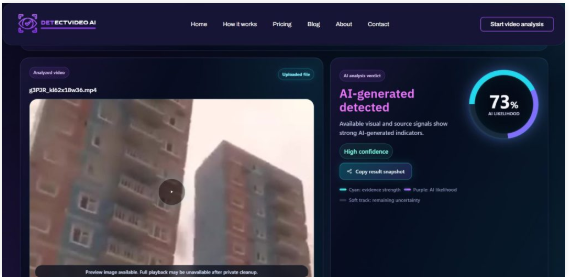
We first extracted several keyframes from the viral video and conducted reverse image searches using Google Lens. However, we found no credible news reports or evidence linking the footage to the recent earthquakes in Venezuela. A closer examination of the video revealed several anomalies. Despite the intense shaking and collision of the buildings, the windows and structural features remained unchanged throughout the footage. No visible deformation or damage appeared in the buildings before they collapsed, which is highly unrealistic and raised suspicions that the video had been generated using AI. To verify this, we analyzed the video using the AI detection tool detectvideo.ai. The results indicated a 73 percent probability that the footage was AI-generated.
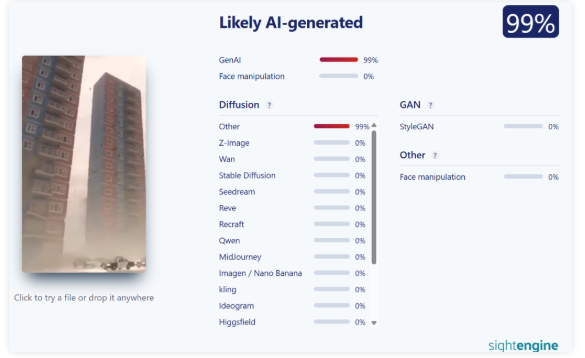
Similarly, analysis conducted using Sightengine found a 99 percent probability that the video had been created using artificial intelligence.
Conclusion
Our research found the viral claim to be false. The video showing two buildings colliding and collapsing is not related to the recent earthquakes in Venezuela. The footage was generated using artificial intelligence and is being misleadingly shared as real disaster footage.
