
#FactCheck -Scripted Video of Pre-Wedding Roka at Metro Station Misleads Users
Executive Summary
A video is going viral on social media showing a woman performing a pre-wedding ritual called “Roka” for a couple at a metro station. Many users are sharing the clip believing it to be a real incident. CyberPeace found in its research that the viral claim is false. The video is actually scripted.
Claim:
An Instagram user posted the video on February 7, 2026, with the caption, “A mother performed her son’s Roka with his girlfriend at a metro station.”

Fact Check:
To verify the claim, we conducted a reverse image search using Google Lens on screenshots from the viral video. We found the same video was first uploaded on February 5, 2026, by an Instagram account named “chalte_phirte098.” The profile belongs to digital content creator Aarav Mavi, who regularly posts relationship and breakup-related videos.

Although the viral clip does not include any disclaimer stating that it is scripted, an older video posted by the creator on December 16, 2025, clarifies that his content is based on real-life stories shared by people but is filmed using professional actors. Several similar staged videos are also available on his profile on Instagram.

Conclusion:
Our research clearly shows that the viral video claiming to show a pre-wedding Roka ceremony at a metro station is not real. It was created by a content creator for entertainment purposes. Therefore, the claim circulating on social media is misleading.

Related Blogs

Executive Summary
An image is being widely circulated on social media with the claim that it shows the destruction caused by an explosion at a mall in Japan following a 7.1-magnitude earthquake in July 2026. The viral image shows a shopping complex in a severely damaged condition, allegedly after the incident. CyberPeace Research Wing’s research found that the viral image does not show damage caused by an explosion or earthquake at any mall in Japan. The visuals in the image do not match authentic photographs of the affected shopping complex. The research further revealed that the viral image was created using Artificial Intelligence (AI).
Claim
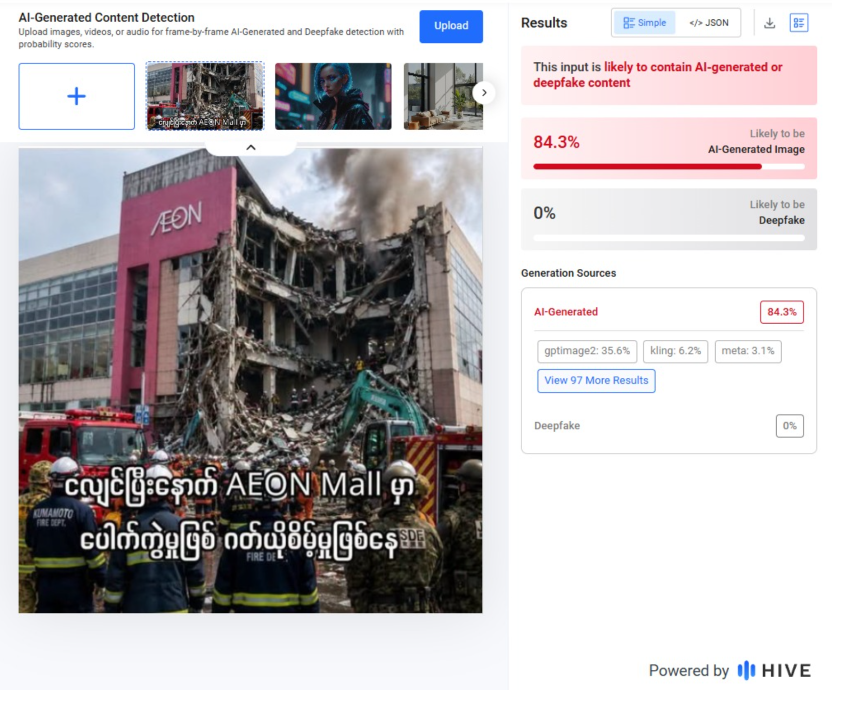
A social media post claims that the AEON Mall in Japan exploded after the Kumamoto earthquake and a gas leak was suspected. The post, published in Burmese language on Facebook on July 29, 2026, shared an image claiming to show the aftermath of the incident at the mall.

FactCheck
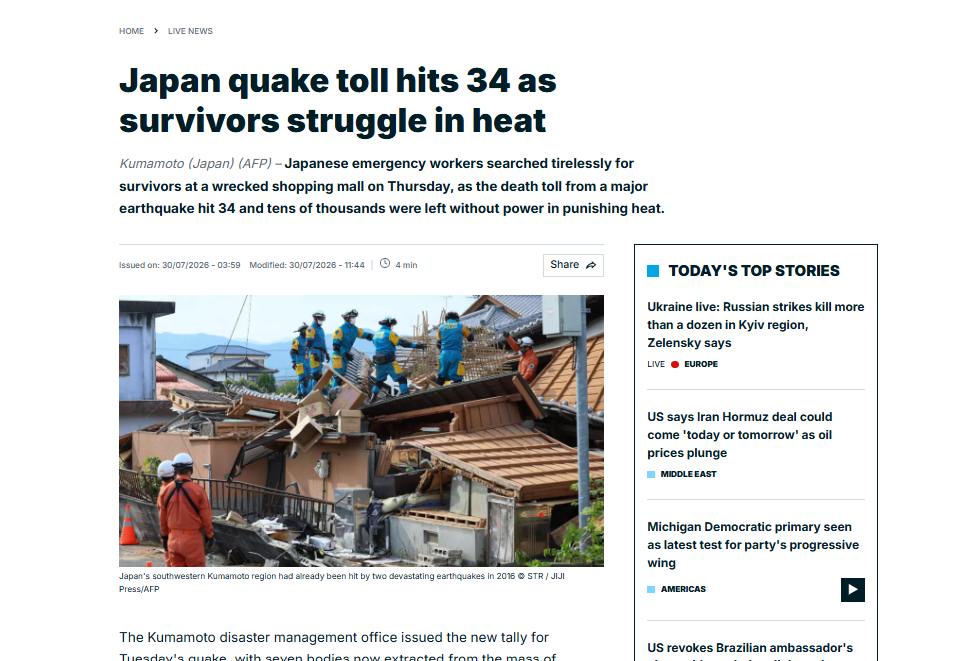
To verify the authenticity of the viral claim, we conducted a Google search using relevant keywords. During the search, we found a report published by France24, which stated that the Kumamoto disaster management office released updated figures following the earthquake. According to the report, seven bodies were recovered from the debris, steel and wires of the Aeon shopping mall after a suspected gas blast. The report further stated that eight people were confirmed dead at the Nippon Paper Industries factory in Yatsushiro city, where part of a red-and-white smokestack collapsed. Following the 7.1-magnitude earthquake, five others were reported to be in critical condition, while around 9,500 residents were staying in evacuation centres in Kyushu, southwestern Japan.
http://france24.com/en/live-news/20260730-up-to-23-feared-dead-in-japan-quake
However, the viral image showed several visual inconsistencies and was flagged as AI-generated.
To further examine the authenticity of the image, we scanned it using the AI detection tool Hive Moderation. The results indicated that the image had an 84 percent probability of being AI-generated.
We also analysed the image using Human Meter, where the results showed a 75 percent probability that the image was AI-generated.

In the final stage of the research, we scanned the image using another AI detection tool, AI Image Detector. The tool indicated that the image had a 95 percent probability of being AI-generated.

Conclusion:
The research established that the viral image is not an authentic photograph of the damage caused by the Kumamoto earthquake or any explosion at an Aeon Mall in Japan. The image contains multiple inconsistencies and was found to be AI-generated. Therefore, the claim linking the image to the Japan earthquake incident is false.
.webp)
Introduction
India is confronting a wake-up call as a recent cyber incident aimed at the aviation sector underscores the fragile nature of digital systems that guide national air travel. The disclosure in Parliament has pushed the conversation on flight safety, signal integrity, and cyber readiness back into urgent focus. In a written response to a Parliamentary question, Civil Aviation Minister Ram Mohan Naidu acknowledged that GPS spoofing, a malicious method employed to alter navigation signals, had been noticed at seven major airports of the country. New Delhi flights had not been affected during the incident, but still, it was an event that again made air travel's safety, GNSS interference, and the overall cyber threat to India's airspace an issue of concern.
The Incident: What Happened?
Initial notices came from Indira Gandhi International Airport in Delhi, where the pilots of the different inbound flights talked about GPS spoofing as the reason for their landing. Spoofing is the process of sending counterfeit GPS signals which mislead the aircraft's navigation systems and may cause a wrong measure of the altitude, the position or the runway alignment. In Delhi, pilots operating under GPS-based landing procedures over Runway 10 experienced errors in their approaches and promptly switched to the alternative procedures without any delay.
The Minister said that apart from Delhi, other airports, viz. Kolkata, Amritsar, Mumbai, Hyderabad, Bengaluru, and Chennai were the 6 airports that recorded similar GNSS interference patterns consisting of both jamming and spoofing. Though no major interruptions or incidents occurred, these occurrences are a sign of a steady and enlarging threat.
Why Is GPS Spoofing So Dangerous?
Satellite navigation and communication systems are the backbone of modern aviation, which is now a matter of great precision. Signal jamming by malicious actors comes with a bunch of risks:
- Diversions and Delays: Pilots may be forced to either give up attempts to land or divert flights, which translates into higher consumption of fuel and more complicated operations due to the case of jamming.
- Threat of Safety Issue: Pilots are trained to deal with such incidents by following the prescribed fallback procedures, but still they depend very much on the GNSS signals that are accurate for safe manoeuvring, especially in low visibility situations.
- Pressure on Old Systems: Indian airports are still in the process of completely converting from ground-based navigation aids to GNSS. Signal disruptions entail the use of older technologies, which results in putting additional pressure on the already overburdened air traffic control systems.
- Opening Up Possibilities for Direct Attacks: Signal jamming can be made a tool for more clever tactics of operation that can include causing confusion during the busy traffic period or performing coordinated attacks to create chaos.
Aviation and Cyber Threats
The disturbances that have been mentioned at the seven airports are not unique. The civil aviation regulators all over the world have already reported an increase in GNSS jamming. The exemplary cases in the Middle East, Eastern Europe, and East Asia have revealed that the safety of airspace has turned into a tactical issue.
Moreover, India's quick adoption of digital technology in the aviation sector could open threat vulnerabilities from state-sponsored groups, hackers. In this instance, the government has not yet announced who was responsible for the spoofing, but the trend points to an adversary with advanced technology.
Government and Regulatory Response
The confirmation from the Civil Aviation Minister underscores a proactive stance by agencies such as:
- Directorate General of Civil Aviation (DGCA)
- Ministry of Civil Aviation
- Airports Authority of India (AAI)
The involved entities are collaborating now to do an inquiry into the cases and set up preventive measures.
The main steps that are taken in response are:
- More thorough observation of GNSS signal anomalies
- More pilot briefings and training on dealing with spoofing situations
- Improving navigation aids to set up a backup
- Working with IT security experts to find out the sources of interference
- Communicating with other global aviation authorities to share the best practices
India, being a significant player in the world aviation market, is not allowed to relax its guard. Cyberattacks on airports show how digital as well as physical security are becoming more and more intertwined.
The Bigger Picture: Protecting Critical Infrastructure
Aviation is a sector that very clearly shows that threats from cyberspace can easily translate into security issues for a nation. The airport system not only becomes more vulnerable to attacks but also the whole aviation industry as the digital ecosystems gain more complex forms together with integrated telecommunications networks, the Internet of Things (IoT)-enabled systems, and cloud-based services.
One of the many threats in the form of GNSS spoofing demonstrates so-called:
- Ransomware attacks on airport systems
- Contamination of air traffic control infrastructure
- Data breaches conducted by insiders
- Passenger data attacks
- Hinderance of airport logistics and baggage systems
What Needs to Happen Next?
India is compelled to embrace a multi-faceted approach in order to manage the intricacies of GNSS interference risk:
- Cybersecurity Measures in Aviation Enforced: New monitoring tools, anomaly detection systems, and instant response plans will be put into service.
- Redundant Technology: The non-GNSS-based navigation system will be expanded to guarantee the continuity of operations in the event of jamming.
- Cyber Drills Across all Sectors: To get pilots, air traffic control personnel, and airport operators ready, the aviation cyber drills will be conducted at the national level.
- Global Cooperation: International organisations will be approached to share the information and standardise the procedures.
- R&D and Innovations: Funding will be directed towards anti-spoofing technology, stronger satellite signals, and the domestic navigation system, like NavIC.
Conclusion
The cyberattack that targeted the seven airports serves as a clear reminder that aviation cybersecurity should not be considered a secondary issue anymore. Even though the quick reaction from the authorities managed to averted any disruptions, the event still shows the vulnerabilities of modern aviation systems. India's air travel infrastructure expansion will be a good time for the country to install its strong cybersecurity frameworks to protect its passengers, maintain the continuity of operations, and secure the airspace of its territory. At CyberPeace, we believe that a coordinated, proactive, and technology-driven approach is no longer an option, it is the new fundamental of aviation security in the digital age.
Reference

Introduction
Cybercrimes have been traversing peripheries and growing at a fast pace. Cybercrime is known to be an offensive action that either targets or operates through a computer, a computer network or a networked device, according to Kaspersky. In the “Era of globalisation” and a “Digitally coalesced world”, there has been an increase in International cybercrime. Cybercrime could be for personal or political objectives. Nevertheless, Cybercrime aims to sabotage networks for motives other than gain and be carried out either by organisations or individuals. Some of the cybercriminals have no national boundaries and are considered a global threat. They are likewise inordinately technically adept and operate avant-garde strategies.
The 2023 Global Risk Report points to exacerbating geopolitical apprehensions that have increased the advanced persistent threats (APTs), which are evolving globally as they are ubiquitous. Christine Lagarde, the president of the European Central Bank and former head of the International Monetary Fund (IMF), in 2020 cautioned that a cyber attack could lead to a severe economic predicament. Contemporary technologies and hazardous players have grown at an exceptional gait over the last few decades. Also, cybercrime has heightened on the agenda of nation-states, establishments and global organisations, as per the World Economic Forum (WEF).
The Role of the United Nations Ad Hoc Committee
In two shakes, the United Nations (UN) has a major initiative to develop a new and more inclusive approach to addressing cybercrime and is presently negotiating a new convention on cybercrime. The following convention seeks to enhance global collaboration in the combat against cybercrime. The UN has a central initiative to develop a unique and more inclusive strategy for addressing cybercrime. The UN passed resolution 74/247, which designated an open-ended ad hoc committee (AHC) in December 2019 entrusted with setting a broad global convention on countering the use of information and Communication Technologies (ICTs) for illicit pursuits.
The Cybercrime treaty, if adopted by the UN General Assembly (UNGA) would be the foremost imperative UN mechanism on a cyber point. The treaty could further become a crucial international legal framework for global collaboration on arraigning cyber criminals, precluding and investigating cybercrime. There have correspondingly been numerous other national and international measures to counter the criminal use of ICTs. However, the UN treaty is intended to tackle cybercrime and enhance partnership and coordination between states. The negotiations of the Ad Hoc Committee with the member states will be completed by early 2024 to further adopt the treaty during the UNGA in September 2024.
However, the following treaty is said to be complex. Some countries endorse a treaty that criminalises cyber-dependent offences and a comprehensive spectrum of cyber-enabled crimes. The proposals of Russia, Belarus, China, Nicaragua and Cuba have included highly controversial recommendations. Nevertheless, India has backed for criminalising crimes associated with ‘cyber terrorism’ and the suggestions of India to the UN Ad Hoc committee are in string with its regulatory strategy in the country. Similarly, the US, Japan, the UK, European Union (EU) member states and Australia want to include core cyber-dependent crimes.
Nonetheless, though a new treaty could become a practical instrument in the international step against cybercrime, it must conform to existing global agencies and networks that occupy similar areas. This convention will further supplement the "Budapest Cybercrime Convention" on cybercrime that materialised in the 1990s and was signed in Budapest in the year 2001.
Conclusion
According to Cyber Security Ventures, global cybercrime is expected to increase by 15 per cent per year over the next five years, reaching USD 10.5 trillion annually by 2025, up from USD 3 trillion in 2015. The UN cybercrime convention aims to be more global. That being the case, next-generation tools should have state-of-the-art technology to deal with new cyber crimes and cyber warfare. The global crevasse in nation-states due to cybercrime is beyond calculation. It could lead to a great cataclysm in the global economy and threaten the political interest of the countries on that account. It is crucial for global governments and international organisations. It is necessary to strengthen the collaboration between establishments (public and private) and law enforcement mechanisms. An “appropriately designed policy” is henceforward the need of the hour.
References
- https://www.kaspersky.co.in/resource-center/threats/what-is-cybercrime
- https://www.cyberpeace.org/
- https://www.interpol.int/en/Crimes/Cybercrime
- https://www.bizzbuzz.news/bizz-talk/ransomware-attacks-on-startups-msmes-on-the-rise-in-india-cyberpeace-foundation-1261320
- https://www.financialexpress.com/business/digital-transformation-cyberpeace-foundation-receives-4-million-google-org-grant-3282515/
- https://www.chathamhouse.org/2023/08/what-un-cybercrime-treaty-and-why-does-it-matter
- https://www.weforum.org/agenda/2023/01/global-rules-crack-down-cybercrime/
- https://www.weforum.org/publications/global-risks-report-2023/
- https://www.imf.org/external/pubs/ft/fandd/2021/03/global-cyber-threat-to-financial-systems-maurer.htm
- https://www.eff.org/issues/un-cybercrime-treaty#:~:text=The%20United%20Nations%20is%20currently,of%20billions%20of%20people%20worldwide.
- https://cybersecurityventures.com/hackerpocalypse-cybercrime-report-2016/
- https://www.coe.int/en/web/cybercrime/the-budapest-convention
- https://economictimes.indiatimes.com/tech/technology/counter-use-of-technology-for-cybercrime-india-tells-un-ad-hoc-group/articleshow/92237908.cms?utm_source=contentofinterest&utm_medium=text&utm_campaign=cppst
- https://consultation.dpmc.govt.nz/un-cybercrime-convention/principlesandobjectives/supporting_documents/Background.pdf
- https://unric.org/en/a-un-treaty-on-cybercrime-en-route/
