
#FactCheck-Viral Rescue Video From Prayagraj Falsely Shared as Nepal Flood Footage
Executive Summary
A video is being shared on social media showing several people attempting to rescue a young man trapped under a pile of soil and debris. The video is being shared as footage of the recent floods in Nepal. A research done by the Research Wing of the CyberPeace found the viral claim to be misleading. The research revealed that the video dates back to March 2026 and has no connection with the floods in Nepal. The video is actually from an incident in Prayagraj, Uttar Pradesh, and is being falsely shared as recent footage of the devastation caused by the floods in Nepal.
Claim:
On Facebook, a user shared the viral video with the caption: “These scenes are horrifying. The floods in Nepal have claimed countless lives, but there are also people who are still fighting for their lives even 24 hours after the floodwaters have receded. Seeing this person sends chills down the spine.” The archived post link and screenshot are provided below.
https://www.facebook.com/reel/1104511315422755

FactCheck
To verify the authenticity of the viral claim, we first extracted keyframes from the video and conducted a reverse image search using Google Lens. During the search, we found the same video uploaded on the YouTube account ‘Prayagraj Live 24’ on March 24, 2026.
According to the video description, the footage shows the relief and rescue operation carried out following an accident at a cold storage facility in Phaphamau, Prayagraj. The report link and screenshot are provided below.
https://www.youtube.com/shorts/D6ADJzxZUGQ

Based on the clue obtained from YouTube, we conducted a Google search using relevant keywords. During the search, we found a report published on the Dainik Bhaskar website on March 24, 2026, which featured the same visuals seen in the viral video. The report link and screenshot are provided below.

According to a report by Dainik Bhaskar, a major accident occurred at Adarsh Cold Storage in the Phaphamau police station area of Prayagraj on March 23, 2026. At around 1:30 pm, an ammonia gas chamber used for cooling at the cold storage exploded, causing the building’s walls and roof to collapse. Several workers were trapped under the debris in the accident.
Conclusion
Our research found that the viral video dates back to March 2026 and has no connection with the floods in Nepal. The video is actually from an incident in Prayagraj, Uttar Pradesh, and is being falsely shared on social media as recent footage of the devastation caused by the floods in Nepal.

Related Blogs
.webp)
Introduction
In the fast-paced digital age, misinformation spreads faster than actual news. This was seen recently when inaccurate information on social media was spread, stating that the Election Commission of India (ECI) had taken down e-voter rolls for some states from its website overnight. The rumour confused the public and caused political debate in states like Maharashtra, MP, Bihar, UP and Haryana, resulting in public confusion. But the ECI quickly called the viral information "fake news" and made sure that voters could still get access to the electoral rolls of all States and Union Territories, available at voters.eci.gov.in. The incident shows how electoral information could be harmed by the impact of misinformation and how important it is to verify the authenticity.
The Incident and Allegations
On August 7, 2025, social media posts on platforms like X and WhatsApp claimed that the Election Commission of India had removed e-voter lists from its website. The posts appeared after public allegations about irregularities in certain constituencies. However, the claims about the removal of voter lists were unverified.
The Election Commission’s Response
In a formal tweet posted on X, it stated categorically:
“This is a fake news. Anyone can download the Electoral Roll for any of 36 States/UTs through this link: https://voters.eci.gov.in/download-eroll.”
The Commission clarified that no deletion has been done at all and that all the voters' rolls are intact and accessible to the public. Keeping with the spirit of transparency, the ECI reaffirmed its overall practice of public access to electoral information by clarifying that the system is intact and accessible for inspection.
Importance of Timely Clarifications
By countering factually incorrect information the moment it was spread on a large scale, the ECI stopped possible harm to public trust. Election officials rely upon being trusted, and any speculation concerning their honesty can prove harmful to democracy. Such prompt action stops false information from becoming a standard in public discourse.
Misinformation in the Electoral Space
- How False Narratives Gain Traction
Election misinformation increases in significant political environments. Social media, confirmation bias, and increased emotional states during elections enable rumour spread. On this occasion, the unfounded report struck a chord with widespread political distrust, and hence, people easily believed and shared it without checking if it was true or not.
- Risks to Democratic Integrity
When misinformation impacts election procedures, the consequences can be profound:
- Erosion of Trust: People can lose faith in the neutrality of election administrators quite easily.
- Polarization: Untrue assertions tend to reinforce political divides, rendering constructive communication more difficult.
- The Role of Media Literacy
Combating such mis-disinformation requires more than official statements. Media skills training courses can equip individuals with the ability to recognise warning signs in suspect messages. Even basic actions like checking official sources prior to sharing can move far in keeping untruths from being spread.
Strategies to Counter Electoral Misinformation
Multi-Stakeholder Action
Effective counteracting of electoral disinformation requires coordination among election officials, fact-checkers, media, and platforms. Actions that are suggested include:
- Rapid Response Protocols: Institutions should maintain dedicated monitoring teams for quick rebuttals.
- Confirmed Channels of Communication: Providing official sites and pages for actual electoral news.
- Proactive Transparency: Regular publication of electoral process updates can anticipate rumours.
- Platform Accountability: Social media sites must label or limit the visibility of information found to be false by credentialed fact-checkers.
Conclusion
The recent allegations of e-voter rolls deletion underscore the susceptibility of contemporary democracies to mis-disinformation. Even though the circumstances were brought back into order by the ECI's swift and unambiguous denunciation, the incident itself serves to emphasise the necessity of preventive steps to maintain election faith. Even though fact-checking alone might not work in an environment where the information space is growing more polarised and algorithmic, the long-term solution to such complications is to grow an ironclad democratic culture where everyone, every organisation, and platforms value the truth over clickbait. The lesson is clear: in the age of instant news, accurate communication is vital for maintaining democratic integrity, not extravagances.
References
- https://www.newsonair.gov.in/election-commission-dismisses-fake-news-on-removal-of-e-voter-rolls/
- https://economictimes.indiatimes.com/news/india/eci-dismisses-claims-of-removing-e-voter-rolls-from-its-website-calls-it-fake-news/articleshow/123190662.cms
- https://www.thehindu.com/news/national/vote-theft-claim-of-congress-factually-incorrect-election-commission/article69921742.ece
- https://www.thehindu.com/opinion/editorial/a-crisis-of-trust-on-the-election-commission-of-india/article69893682.ece
.webp)
Introduction
To every Indian’s pride, the maritime sector has seen tremendous growth under various government initiatives. Still, each step towards growth should be given due regard to security measures. Sadly, cybersecurity is still treated as a secondary requirement in various critical sectors, let alone to protect the maritime sector and its assets. Maritime cybersecurity includes the protection of digital assets and networks that are vulnerable to online threats. Without an adequate cybersecurity framework in place, the assets remain at risk from cyber threats, such as malware and scams, to more sophisticated attacks targeting critical shore-based infrastructure. Amid rising global cyber threats, the maritime sector is emerging as a potential target, underscoring the need for proactive security measures to safeguard maritime operations. In this evolving threat landscape, assuming that India's maritime domain remains unaffected would be unrealistic.
Overview of India’s Maritime Sector
India’s potential in terms of its resources and its ever-so-great oceans. India is well endowed with its dynamic 7,500 km coastline, which anchors 12 major ports and over 200 minor ones. India is strategically positioned along the world’s busiest shipping routes, and it has the potential to rise to global prominence as a key trading hub. As of 2023, India’s share in global growth stands at a staggering 16%, and India is reportedly running its course to become the third-largest economy, which is no small feat for a country of 1.4 billion people. This growth can be attributed to various global initiatives undertaken by the government, such as “Sagarmanthan: The Great Oceans Dialogue,” laying the foundation of an insightful dialogue between the visionaries to design a landscape for the growth of the marine sector. The rationale behind solidifying a security mechanism in the maritime industry lies in the fact that 95% of the country’s trade by volume and 70% by value is handled by this sector.
Current Cybersecurity Landscape in the Maritime Sector
All across the globe, various countries are recognising the importance of their seas and shores, and it is promising that India is not far behind its western counterparts. India has a glorious history of seas that once whispered tales of Trade, Power, and Civilizational glory, and it shall continue to tread its path of glory by solidifying and securing its maritime digital infrastructure. The path brings together an integration of the maritime sector and advanced technologies, bringing India to a crucial juncture – one where proactive measures can help bridge the gap with global best practices. In this context, to bring together an infallible framework, it becomes pertinent to incorporate IMO’s Guidelines on maritime cyber risk management, which establish principles to assess potential threats and vulnerabilities and advocate for enhanced cyber discipline. In addition, the guidelines that are designed to encourage safety and security management practices in the cyber domain warn the authorities against procedural lapses that lead to the exploitation of vulnerabilities in either information technology or operational technology systems.
Anchoring Security: Global Best Practices & Possible Frameworks
The Asia-Pacific region has not fallen behind the US and the European Union in realising the need to have a dedicated framework, with the growing prominence of the maritime sector and countries like Singapore, China, and Japan leading the way with their robust frameworks. They have in place various requirements that govern their maritime operations and keep in check various vulnerabilities, such as Cybersecurity Awareness Training, Cyber Incident Reporting, Data Localisation, establishing secure communications, Incident management, penalties, etc.
Every country striving towards growth and expanding its international trade and commerce must ensure that it is secure from all ends to boost international cooperation and trust. On that note, the maritime sector has to be fortified by placing the best possible practices or a framework that is inclined towards its commitment to growth. The following four measures are indispensable to this framework, and in the maritime industry, they must be adapted to the unique blend of Information Technology (IT) and Operational Technology (OT) used in ships, ports, and logistics. The following mechanisms are not exhaustive in nature but form a fundamental part of the framework:
- Risk Assessment: Identifying, analysing, and ensuring that all systems that are susceptible to cyber threats are prioritized and vulnerability scans are conducted of vessel control systems and shore-based systems. The critical assets that have a larger impact on the whole system should be kept formidable in comparison to other systems that may not require the same attention.
- Access Control: Restrictions with regard to authorisation, wherein access must be restricted to verified personnel to reduce internal threats and external breaches.
- Incident Response Planning: The nature of cyber risks is inherently dynamic in nature; there are no calls for cyber attacks or warfare techniques. Such attacks are often committed in the shadows, so as to require an action plan to respond to and to recover from cyber incidents effectively.
- Continuous Staff Training: Regularly educating all levels of maritime personnel about cyber hygiene, threat trends, and secure practices.
CyberPeace Suggests: Legislative & Executive Imperatives
It can be said with reasonable foresight that the Indian maritime sector is in need of a national maritime cybersecurity framework that operates in cooperation with the international framework. The national imperatives will include robust cyber hygiene requirements, real-time threat intelligence mechanisms, incident response obligations, and penalties for non-compliance. The government must strive to support Indian shipbuilders through grants or incentives to adopt cyber-resilient ship design frameworks.
The legislative quest should be to incorporate the National Maritime Cybersecurity Framework with the well-established CERT-In guidelines and data protection principles. The one indispensable requirement set under the framework should be to mandate Cybersecurity Awareness Training to help deploy trained personnel equipped to tackle cyber threats. The rationale behind such a requirement is that there can be no “one-size-fits-all” approach to managing cybersecurity risk, which is dynamic and evolving in nature, and the trained personnel will play a key role in helping establish a customised framework.
References
- https://pib.gov.in/PressNoteDetails.aspx?NoteId=153432®=3&lang=1
- https://bisresearch.com/industry-report/global-maritime-cybersecurity-market.html#:~:text=Maritime%20cybersecurity%20involves%20safeguarding%20digital,and%20protection%20against%20potential%20risks.
- https://www.shipuniverse.com/2025-maritime-cybersecurity-regulations-a-simplified-breakdown/#:~:text=Japan%3A,for%20incident%20response%20and%20recovery.
- https://wwwcdn.imo.org/localresources/en/OurWork/Security/Documents/MSC-FAL.1-Circ.3-Rev.2%20-%20Guidelines%20On%20Maritime%20Cyber%20Risk%20Management%20(Secretariat)%20(1).pdf
Introduction
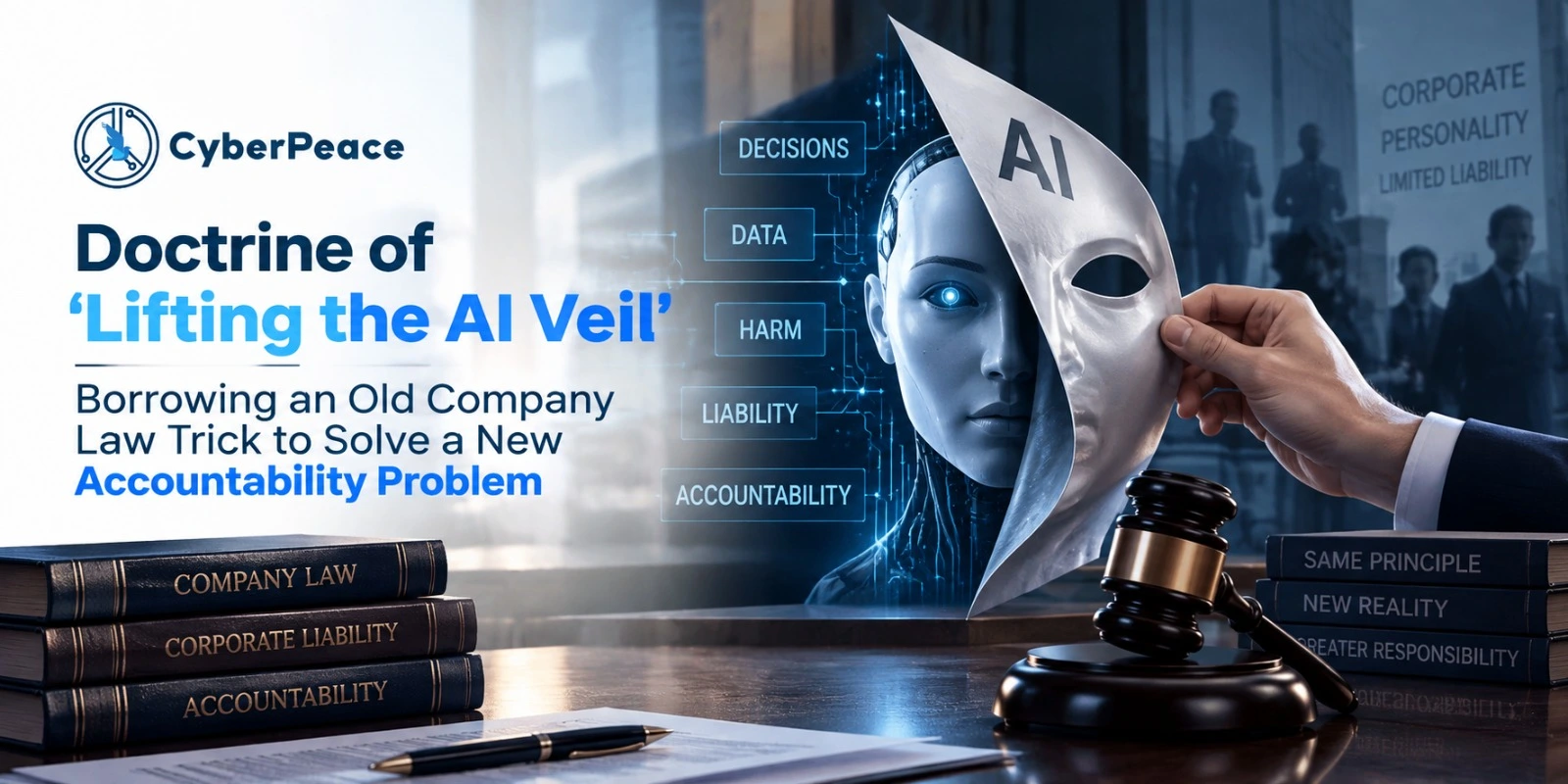
Company law solved a version of this problem more than a century ago, and artificial intelligence regulation is now quietly borrowing the solution. When something goes wrong inside a company, the law generally cannot reach past the corporate entity to punish the people who ran it, because the company is treated as a legal person entirely separate from its shareholders and directors. Courts developed an exception for exactly the cases where that separation becomes a shield for wrongdoing, and lawyers now call it lifting, or piercing, the corporate veil. A growing body of legal scholarship argues that AI systems present a strikingly similar problem, and needs a strikingly similar fix. That emerging idea has come to be called lifting the AI veil.
Where the original doctrine comes from
The doctrine of lifting the corporate veil traces directly to the House of Lords decision in Salomon v. Salomon & Co. Ltd. in 1897. Aron Salomon, a leather and boot manufacturer, incorporated his existing business, sold it to the new company, and structured share ownership so that he and his family held nearly all the shares. When the company later failed, creditors argued Salomon should be held personally liable, since the company was effectively just him operating under a different name. The House of Lords disagreed, holding decisively that once validly incorporated, a company is a person in law entirely distinct from its subscribers, with its own rights and liabilities. That ruling established what remains company law's foundational principle: separate legal personality.
Separate personality is not, however, unconditional. Courts across common law jurisdictions, including India, carved out an exception for cases where the corporate form is used as a facade for fraud, to evade a statutory obligation, or to circumvent a legal duty that would otherwise apply to the individuals behind it. In such cases, a court will "lift the veil," looking past the company's separate legal identity to attribute liability directly to the directors or shareholders actually in control. India's Supreme Court, in Life Insurance Corporation of India v. Escorts Ltd., reaffirmed that this remains an exception applied only in narrow, exceptional circumstances, generally where a statute contemplates it, or fraud or improper conduct needs to be prevented. The doctrine has since found application well beyond fraud alone, including in tax matters, as seen in cases like State of U.P. v. Renusagar Power Co., where courts treated closely related corporate entities as one for the purpose of a specific statutory benefit.
Why AI creates the same structural problem
Scholarship examining AI liability has increasingly pointed to a near identical structural gap. As AI systems take on functions once reserved for human decision makers, board level analytics, automated lending decisions, algorithmic hiring, even proposed "robo-director" advisory roles, a familiar question resurfaces: who answers for the outcome when the AI system, rather than a named individual, produced the decision. A 2025 academic paper titled Lifting the AI Veil in Company Law argues explicitly that AI liability should be approached through an extension of existing doctrines, including directors' duty of care and precisely the piercing of the veil doctrine traditionally reserved for shareholders, rather than inventing an entirely new liability regime from scratch.
The concern driving this argument is not abstract. Commentary in outlets like MIT Technology Review has warned that granting AI systems anything resembling legal personhood risks handing companies a genuinely dangerous new shield, allowing a company to argue that a harmful outcome was the AI's autonomous decision, disconnected from any human actor's intent or negligence, much as a company might once have argued a harmful outcome was simply "the company's" doing and not any individual's. Critics of AI personhood proposals, writing in journals examining AI as legal persons, make the parallel explicit: while corporate veil piercing exists precisely to stop the corporate form being misused as a liability shield, the justification for extending similar legal personhood to AI is considerably weaker, since corporate personhood serves a clear economic purpose, enabling investment and risk pooling, that AI personhood does not obviously replicate.
How regulators have actually responded
The European Union's experience is instructive precisely because it shows the doctrine's underlying logic being adopted through legislation rather than judicial precedent. The European Commission originally proposed a dedicated AI Liability Directive in September 2022, intended to ease the burden of proof on claimants harmed by AI systems, including a rebuttable presumption of causality where a claimant could show an AI system breached EU AI Act obligations. That proposal was formally withdrawn in 2025, with the withdrawal notice published in the Official Journal on 6 October 2025, after member states failed to reach agreement. In its place, the revised EU Product Liability Directive now does much of the same underlying work through a different legal mechanism, explicitly treating AI software as a "product" for the purposes of manufacturer liability, meaning AI providers face strict liability for defective AI products without claimants needing to prove fault, applicable to AI products placed on the EU market from 9 December 2026 onward. Functionally, this achieves something close to piercing the AI veil by statute: instead of allowing a company to attribute harm to an autonomous algorithmic process and stop the inquiry there, liability is anchored back to the entity that built, trained, or deployed the system.
The Indian angle, and why it matters here
India has no AI specific liability statute at present, and no reported judicial decision has yet applied the corporate veil piercing doctrine by analogy to an AI system. But the underlying legal architecture is already familiar territory for Indian courts. India's jurisprudence on lifting the corporate veil, built through Escorts, Renusagar, and subsequent cases, already establishes the judicial comfort with looking past a formal legal structure to find the real, controlling actor when justice demands it. Indian courts have been consistently clear that this remains an exceptional remedy rather than a routine one, generally invoked where a statute contemplates it, where fraud or improper conduct needs to be prevented, or where a taxing or beneficial statute would otherwise be defeated by rigid adherence to corporate form. That same cautious, fact specific posture is likely to shape how any future Indian AI liability doctrine develops, applied sparingly rather than as a blanket rule.
As AI systems increasingly mediate lending decisions, insurance claims processing, and algorithmic hiring in Indian companies, the same reasoning that let Indian courts see through a corporate facade could plausibly extend to seeing through an "AI made the decision" defence, attributing responsibility to whichever human actor, developer, deployer, or governing board, exercised actual control over how that system was built and used. Given how central technology sector employment and AI deployment already are to India's economy, the absence of a clear domestic answer to this question is unlikely to remain untested for long.
The larger point
The doctrine of lifting the AI veil is less a wholly new legal invention and more a recognition that AI systems and corporations create the same essential problem: a formally separate entity that can, if left unchecked, absorb blame that properly belongs to the humans directing it. Company law solved this by refusing to let the corporate form become an alibi. AI law, whether through judicial doctrine, statute, or a hybrid of both as the EU's experience suggests, will likely need to reach the same conclusion, because the alternative is allowing genuine harm to disappear into a system nobody can be made to answer for.
References
- Bird & Bird, "Proposed EU AI liability rules withdrawn." https://www.twobirds.com/en/insights/2025/proposed-eu-ai-liability-rules-withdrawn
- LegalClarity, "AI Liability Directive: What It Was and Why It Was Withdrawn." https://legalclarity.org/ai-liability-directive-what-it-was-and-why-it-was-withdrawn/
- WCR Legal, "EU AI Liability Directive: Withdrawn, What Now Applies?" https://wcr.legal/eu-ai-liability-directive-withdrawn-pld/
- Verfassungsblog, "Anatomy of a Fall: On the Anticipated Withdrawal of the AI Liability Directive Proposal." https://verfassungsblog.de/anatomy-of-a-fall-aiact-aild-pld/
- MIT Technology Review, "Debates over AI consciousness are a trap." https://www.technologyreview.com/2026/08/20/1142571/ai-consciousness-debate-trap/
- ResearchGate, "Lifting the AI Veil in Company Law." https://www.researchgate.net/publication/393305638_Lifting_the_AI_veil_in_company_law
- Review of Law and Regulation, "Lifting the AI Veil in Company Law." https://rlr.iup.rs/wp-content/uploads/2025/07/04.pdf
- Bhatt & Joshi Associates, "Decoding the Jurisprudence on Lifting the Corporate Veil in Indian Court. https://bhattandjoshiassociates.com/decoding-the-jurisprudence-on-lifting-the-corporate-veil-in-indian-court/
- Mondaq, "Analysis Of Standard Of Proof For Lifting Of The Corporate Veil In Cases Of Fraud." https://www.mondaq.com/india/corporate-and-company-law/1259382/analysis-of-standard-of-proof-for-lifting-of-the-corporate-veil-in-cases-of-fraud
- Record Of Law, "Analysis of the theory of corporate veil lifting." https://recordoflaw.in/analysis-of-the-theory-of-corporate-veil-lifting/
- Suren Uppal Offices, "Lifting of Corporate Veil: Navigating Judicial Precedents." https://www.suolaw.com/lifting-of-corporate-veil-navigating-judicial-precedents/
