
#FactCheck-Viral Mother-Child Image Linked to Bargi Dam Tragedy Is AI-Generated
Executive Summary
Following the tragic cruise accident at Bargi Dam in Jabalpur, a heartbreaking image of a woman lying unconscious in a river with a child resting on top of her has gone viral on social media. Users are claiming that the picture shows victims of the recent Bargi Dam accident. Research by CyberPeace Research Wing found that the viral claim is false. The circulating image was created using AI (Artificial Intelligence) and is now being misleadingly linked to the real tragedy. However, reports indicate that a similar real-life image of a mother and child did emerge after the accident.
Claim
An X user shared the viral image on May 1, 2026, claiming that despite wearing a life jacket, the mother lost her life while trying to save her child. The emotional post praised mothers’ sacrifice and linked the image directly to the Bargi Dam cruise mishap An X user shared the viral image on May 1, 2026, claiming that despite wearing a life jacket, the mother lost her life while trying to save her child. The emotional post praised mothers’ sacrifice and linked the image directly to the Bargi Dam cruise mishap
Fact Check
To verify the claim, we searched relevant keywords on Google but found no credible news reports connecting the viral image to the Bargi Dam accident. A closer examination of the image revealed multiple visual inconsistencies. The hands of the woman and child appear unnaturally merged at one point, while the woman’s eyebrows seem split into two sections. Such distortions are common indicators of AI-generated imagery.
We then analyzed the picture using AI detection tool Hive Moderation, which estimated nearly a 90% probability that the image was AI-generated.

During the research , we also found a clarification post from the official Facebook account of the Jabalpur District Collector, who stated that the viral image was AI-generated or sourced elsewhere and had no connection with the Bargi cruise accident.

According to a report published by NDTV on May 2, 2026, the accident occurred on April 30 near Khamaria Island when an overloaded tourist cruise capsized amid strong winds, heavy rain, and rising waves. At least nine people died, while 28 others were rescued.

Conclusion
Our research confirms that the viral mother-child image being linked to the Bargi Dam tragedy is fake. The picture was created using AI and falsely circulated in connection with the real cruise accident.

Related Blogs

Introduction
युद्धे सूर्यास्ते युध्यन्तः समाप्तयन्ति, In ancient times, after the day’s battle had ended and the sun had set, warriors would lay down their arms and rest, allowing their minds and bodies to recover before facing the next challenge, and giving warriors time to rest and prepare mentally and physically for the next day. Today, as we remain endlessly connected to work through screens and notifications, the Right to Disconnect bill seeks to restore that same rhythm of rest and renewal in the digital age. By giving individuals the space to disconnect, it aims to restores balance, protects psychological health, and acknowledges that human resilience is not limitless, even in a world dominated by technology.
The Right to Disconnect Bill, 2025, was recently introduced in the lower house of Parliament during the winter session, which began on 1st December 2025, as a private member’s bill by Ms. Supriya Sule, Lok Sabha MP.
Understanding the Psychology Behind the Proposed Right to disconnect Bill
The purpose of this law is based on neuroscience for humans. When workers are always in a state of being "always on", the situation of their bodies gets to the chronic stress response state where they are getting overwhelmed with cortisol, which is the main human stress hormone. The constant vigilance that the body and mind are under forces the nervous system into always being in a state of sympathetic activation, while depriving it of the restorative (parasympathetic) states that are necessary for genuine recovery. Neuroscience studies show that 96% of heavy users of technology suffer from anxiety and lack of sleep due to technology. This phenomenon is known medically as "bytemares." The brain tries to attend to several things at once, and this way its cognitive capacity becomes thinner, so there is a reduction in focus, productivity is decreased, and the stress level is increased considerably.
Increasingly, the mental suffering that people get through is not only the physical and psychological aspects of it. The digital fatigue generated by the "always-on culture" getting chronic takes its toll on the emotional capacity of the staff, interrupts their sleep cycles (particularly depriving them of REM sleep), and leads to lower melatonin secretion.
Employees in such environments have a 23% increased chance of suffering from burnout, which the World Health Organisation defines as an occupational syndrome consisting of emotional exhaustion, depersonalization, and downgrading of performance. Mental health is the silent destruction that goes on without anyone noticing; the individuals who are affected show productive performance while their neuroendocrine systems are dying little by little.
Hence, the intent of the Indian legislature is clear, which is to prioritize the human dimension, allowing employees, the warriors of the digital age, to pause and recover, fostering work‑life balance without compromising commitment or productivity, and reflecting a thoughtful, humane approach in the modern technology driven world.
The proposed Right to Disconnect Bill takes position as a law that can greatly help with the mental health of employees and therefore keep them healthy. The bill allows employees to legally disconnect from electronic communication related to their jobs outside of the working hours set by the employer; this way, it recognises more or less that the human brain was never meant to be always connected.
The Need for Digital Detox from a Scientific Perspective
Digital detoxification is the process through which the brain resets its dopamine receptors, hence stopping the process of instant gratification that is constantly reinforced through notifications. The employees who cut off their connection can focus better, remain emotionally stable, and lead healthier lives, the effect of which is measurable. Not only on single persons, but also the World Health Organisation, through its studies, has declared that mental health interventions in workplaces can yield a return of 4:1 on investment through increased productivity and decline in absenteeism.
Digital Detox: Structured Disconnection, Not Digital Rejection
One of the most important aspects of the proposed bill is the acknowledgment of digital detox as a supportive tool. However, it is very important to note that digital detox does not mean completely cutting off technology. It is the rule-based disengagement that brings back cognitive balance. Measures like limiting notifications after work hours, protecting weekends and holidays from routine communication and creating offline time zones facilitate the brain's resetting process. Psychological studies associate such practices with better concentration, emotional control, sleep quality and finally productivity in the long run. The initiative of having digital detox centres and offering counselling services is an indication that the issue of overexposure is not just a matter of personal lack of discipline, but rather a problem of modern working designs.
Positioning Mental Well-Being as Core
The fundamental aspect of the bill is based on the constitutional assurance provided by Article 21 (Constitution of India), the Right to Life and personal Liberty, which has been interpreted by the courts to cover health of mind and body as well as time for leisure. This law reform grants a right to not be available at work, which means that employers will not be able to require constant availability at work without suffering legal consequences. The Right to Disconnect Bill finally illustrates society's unanimity that, amidst our digital age, mental well-being protection is no more a nice-to-have it is a must-have. The bill permits the guarding of the recovery periods, and at the same time, it recognises that the productivity that is sustainable comes from employees who are rested and mentally healthy, not from the constantly depleted workforce in the digital chains.
The psychological Rationale
Psychological analysis indicates that this always-on condition impacts productivity in measurable ways. The human brain may get overloaded to distinguish between important and unimportant information due to the uninterrupted flow of alerts and communications. The whole process leads to a situation, continuous exposure to alerts diminishes the ability to notice the really important events thus allowing the critical ones to go unnoticed. Burnout results as a natural consequence. Research shows that the psychological state resulting from digital overstimulation is anxiety, sleep problems, tiredness, and inability to focus.
Work Culture in the Cybersecurity Realm and Analysis of the Right to Disconnect
Although every sector today demands high productivity and significant commitment from its workforce, the Cybersecurity professionals, IT engineers, SOC analysts, incident responders, cyberseucrity researchers, cyber lawyers and digital operations teams are often engage in 24x7 loop because they deal with uniquely critical responsibilities, if ignored or delayed, can compromise sensitive systems, data integrity, and national security.
It is notable that the flow of activities has been silently but significantly changing the paradigm. Availability has replaced accountability, and often responsiveness is regarded as performance. The “on duty” and “off duty” line blurs when a client escalation or a suspected breach alert calls the phone at midnight. This way, an unspoken rule develops that the worker has to be reachable irrespective of the time as being reachable has become part of the job.
In India, the 48-hour work week that is already among the world's most demanding has been made even more intense by digital connectivity. The work intensity of remote and hybrid models has further crossed spatial and temporal boundaries producing a psychologically endless workday. Hence, the cyber workforce lives in a constant state of low-grade alertness, i.e., never fully sleeping, never fully offline. For professionals working in cyber security, this issue of wellbeing is not just a personal issue but also a business issue. Mental fatigue may lead to poor decision making, slower response time in case of incidents, and more errors being made unintentionally by people.
Hence comes the relevance of the proposed Right to Disconnect bill, Implementing it in the cybersecurity realm may require employers to plan for additional task forces so that productivity remains unaffected, while ensuring that employees receive the rest and balance they need. This approach not only protects mental well‑being but also creates opportunities for new roles, distributes workloads fairly, and strengthens the overall resilience and efficiency of the organization.
Legislature Intent - The Right to Disconnect as a preventive control
In this scenario, the Right to Disconnect Bill, 2025, which was presented in the Lok Sabha as a private member's bill, can be seen as a precautionary measure in the digital risk ecosystem instead of merely as a employee welfare initiative. It intends to create legally enforceable lines of demarcation between the demands of a job and one's personal life. The bill provisions, like the right not to answer work calls and texts after office hours, protection from being fired, pay for overtime, and agreed-upon emergency protocols, are all tools to set new norms rather than to impose restrictions on the output.
This can be seen as security logic that has been established in the cyber governance sphere. Even the best systems require planned downtimes for patching, upgrading, and recovery. Humans cannot be treated differently. Loss of operation without recovery will only increase the likelihood of failure. The Right to Disconnect works as a human-layer security, which reduces the risk of incidents caused by fatigue and burnout among employees.
The Legislative Recognition of Human Needs
The Right to Disconnect Bill is a landmark change of thinking, moving from the perception of disconnection as unprofessional to the acknowledgement of it as a basic requirement for human dignity and health. The Indian legislation, which was passed through a private member's bill, clearly defines the limits of professional and personal time. By providing the employees with the legal right to disconnect, the bill affirms what psychological science has been telling us for a long time: people need real breaks to be at their best.
Conclusion
The Proposed Right to Disconnect Bill, 2025, is a progressive move in law, which, among others confirms that a digital world, constant connectivity may undermines both individual health and company/orgnisation’s buisness continuity. A balanced approach is essential, with clearly agreed-upon emergency norms to guide situations where employees may need to work extra hours in a reasonable and lawful manner. It recognises that people are the backbone of the digital ecosystem and need time off to work effectively and securely. In a connected economy, protecting mental bandwidth is as crucial as protecting technical networks, making the Right to Disconnect a key element of sustainable resilience.
From a cybersecurity perspective, no secure digital future can emerge from exhausted minds. A strong digital and cyber‑India will have laws like the Right to Disconnect Bill, signaling a shift in policy thinking. This law moves the burden from individuals having to adapt to always-on technologies onto systems, organisations, and governance structures to respect human limits. By recognising mental well-being as an essential factor of employee’s wellbeing, the bill reinforces that resilient work ecosystems depend not only on robust infrastructure and controls but also on well-rested, focused, and secure individuals.
References
- https://www.shankariasparliament.com/blogs/pdf/right-to-disconnect-bill-2025
- https://ijlr.iledu.in/wp-content/uploads/2025/04/V5I653.pdf
- https://timesofindia.indiatimes.com/education/news/no-calls-and-emails-after-office-hours-right-to-disconnect-bill-introduced-in-lok-sabha-to-set-workplace-boundaries/articleshow/125806984.cms
- https://www.hindustantimes.com/india-news/what-is-right-to-disconnect-bill-introduced-in-lok-sabha-and-can-it-clear-parliament-101765025582585.html
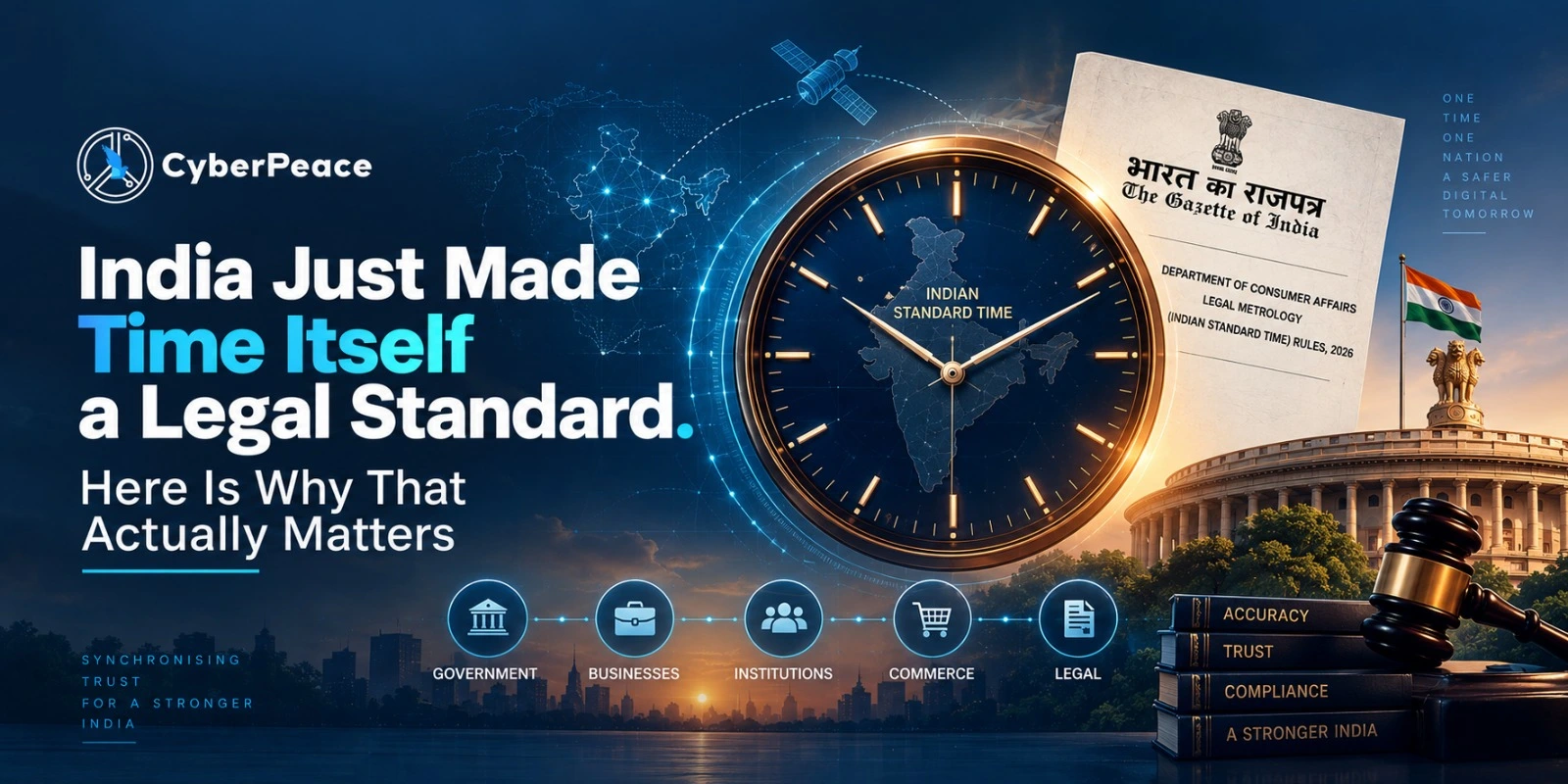
Most laws regulate what people do. This one regulates what clock everyone is doing it by, and once you sit with that idea for a moment, it stops sounding like a bureaucratic footnote and starts sounding like something genuinely foundational.
On 27 August 2026, India's Department of Consumer Affairs notified the Legal Metrology (Indian Standard Time) Rules, 2026, making Indian Standard Time the single legally binding reference for every legal, administrative, commercial, and official purpose across the country. The Rules will come into force 180 days after their publication in the Official Gazette, giving government departments, businesses, and institutions a compliance runway to align their systems before the requirement actually bites.
Why time needed a law at all
It might seem strange that a country needs legislation to tell everyone what time it is. India has used IST, a single time zone five and a half hours ahead of Coordinated Universal Time, since 1947. But using a time zone informally and legally mandating it as the sole authoritative reference for every official and commercial transaction are two very different things, and the gap between them is exactly where this rule lives.
The government's own reasoning, laid out in its official statement, centres on a shift most people experience daily without ever thinking about its plumbing. Banking and digital payments, telecommunications networks, railways, power grids, and government record systems all depend on accurate, synchronised time stamps to function correctly. When different systems quietly draw their time from different sources, even by fractions of a second, the resulting inconsistencies can affect the coordination and recording of transactions in ways that are invisible until something goes wrong. A trade executed on a stock exchange, a UPI payment cleared between banks, a railway signal handoff between two junctions, and an emergency service dispatch all depend on every clock in the chain agreeing with every other clock, and until now, India had no single rule compelling that agreement.
The quieter, more interesting part of the rule
Buried inside the announcement is a detail that matters more than the headline. The Rules do not simply declare IST the law of the land; they also authorise the use of NavIC, India's own satellite navigation system, alongside other approved domestic timing sources, as legitimate means of disseminating that time. The government's stated rationale is candid about the current state of affairs: several critical Indian systems presently draw their time from foreign satellite based sources, and building domestic timing infrastructure through NavIC and legal metrology laboratories is intended to reduce that dependence going forward.
That single sentence carries real weight once you consider how global positioning and timing systems actually work. Most of the world's precise digital time synchronisation ultimately traces back to GPS, the American satellite constellation, whose signals also happen to be notoriously easy to disrupt. GPS and other satellite navigation signals arrive at receivers on Earth as extremely weak radio transmissions, weak enough that they can be jammed with cheap equipment or spoofed, meaning an attacker broadcasts a counterfeit signal that mimics a legitimate one closely enough to fool a receiver into accepting false position or timing data. Researchers and government reports going back years have flagged that a large share of critical infrastructure sectors, power grids, financial markets, telecommunications, and transport among them, carry meaningful dependence on GPS derived timing, and a 2017 UK government assessment specifically warned that systematic satellite signal jamming could cause serious disruption to a country's financial, electricity, and communications systems all at once. Cybersecurity researchers have separately demonstrated proof of concept attacks where a deliberately falsified timing signal, rather than a falsified position, was enough to destabilise systems that assumed their clock could always be trusted.
Seen against that backdrop, embedding NavIC as an approved domestic timing source inside a legal metrology framework is not merely a nationalistic footnote about self reliance. It is a genuine resilience decision. A country that can generate, verify, and distribute its own trusted time signal, independent of a foreign satellite constellation that it does not control and cannot secure on its own, has a meaningfully smaller attack surface for an entire category of infrastructure disruption that rarely makes headlines until it actually happens.
Who actually built this, and why that composition matters
The drafting process itself offers a useful clue about how seriously this was treated. Reports on the rule making process indicate the Rules were shaped by a high powered inter ministerial committee chaired by the Secretary of Consumer Affairs, with representation from the National Physical Laboratory and the Indian Space Research Organisation for the underlying science and satellites, IIT Kanpur for engineering expertise, the National Informatics Centre and CERT In for network infrastructure and its security, the Securities and Exchange Board of India for financial market implications, and the Railways, Telecom, and Financial Services departments for the systems that will actually have to run on this new standard day to day. That is not a committee assembled around a single ministry's convenience; it is a committee assembled around the actual shape of the problem, spanning physics, engineering, finance, and network security together. As part of the broader One Nation, One Time initiative, a White Rabbit Technology based IST Dissemination Demonstration Network was already commissioned at the Regional Reference Standard Laboratory in Bengaluru back in July 2026, suggesting the infrastructure groundwork was underway well before the legal framework caught up to it.
What the 180 day window actually means in practice
It is worth being precise about what compliance actually requires here. This is not a deadline demanding new hardware overnight; for most organisations, it means auditing which internal systems currently reference time from an unverified or foreign source and ensuring they align with certified IST going forward, alongside institutions preparing to receive that certified time through the domestic infrastructure the government is simultaneously building out. The six month runway exists precisely because this touches an unusually wide spread of sectors at once, and forcing an abrupt cutover would create more operational risk than the rule is designed to remove.
The bigger picture
A rule about what time it is legally does not sound like cybersecurity news, and on the surface, it is not. But underneath the administrative language sits a genuinely forward looking recognition: as more of daily life, banking, communication, transport, and governance runs on systems that must agree, down to the second, on a shared reference point, the integrity of that reference point becomes critical infrastructure in its own right. India choosing to build, verify, and legally anchor its own trusted time source, rather than continuing to quietly rely on a foreign satellite system it cannot secure independently, is less about symbolism and more about closing a vulnerability most people never knew existed until they were asked to think about it.
References
- OpenGov Asia, "India Issues Rules to Standardise National Time Reference Systems." https://opengovasia.com/india-issues-rules-to-standardise-national-time-reference-systems/?c=us
- Daily Excelsior, "Centre notifies rules mandating IST as common time reference; 180 day window for compliance." https://www.dailyexcelsior.com/centre-notifies-rules-mandating-ist-as-common-time-reference-180-day-window-for-compliance/
- Greater Kashmir, "Department of Consumer Affairs notifies Legal Metrology Rules, 2026." https://www.greaterkashmir.com/national/department-of-consumer-affairs-notifies-legal-metrology-rules-2026-12454447
- Insights on India, "Legal Metrology (Indian Standard Time) Rules, 2026." https://www.insightsonindia.com/2026/08/31/legal-metrology-indian-standard-time-rules-2026/
- Blitz India Media, "Indian Standard Time Rules 2026: NavIC, Legal Metrology." https://blitzindiamedia.com/news/indian-standard-time-rules-2026-navic-legal-metrology/
- Observer Voice, "India Establishes Legal Framework for Standard Time." https://observervoice.com/india-establishes-legal-framework-for-standard-time-225958/
- The Live Nagpur, "Govt notifies rules to make IST the common time reference." https://thelivenagpur.com/2026/08/31/govt-notifies-rules-to-make-ist-the-common-time-reference/
- Safran Navigation and Timing, "GNSS Security and Cybersecurity: What are the Parallels?" https://safran-navigation-timing.com/gnss-security-and-cybersecurity-what-are-the-parallels/
- Safran Navigation and Timing, "Securing Critical Infrastructures from Jamming and Spoofing Cyberattacks." https://safran-navigation-timing.com/securing-critical-infrastructures-from-jamming-and-spoofing-cyberattacks/
- Combain, "The Silent Threat In The Sky: GPS Jamming, GPS Spoofing." https://combain.com/gps-jamming-spoofing/

Executive Summary:
BrazenBamboo’s DEEPDATA malware represents a new wave of advanced cyber espionage tools, exploiting a zero-day vulnerability in Fortinet FortiClient to extract VPN credentials and sensitive data through fileless malware techniques and secure C2 communications. With its modular design, DEEPDATA targets browsers, messaging apps, and password stores, while leveraging reflective DLL injection and encrypted DNS to evade detection. Cross-platform compatibility with tools like DEEPPOST and LightSpy highlights a coordinated development effort, enhancing its espionage capabilities. To mitigate such threats, organizations must enforce network segmentation, deploy advanced monitoring tools, patch vulnerabilities promptly, and implement robust endpoint protection. Vendors are urged to adopt security-by-design practices and incentivize vulnerability reporting, as vigilance and proactive planning are critical to combating this sophisticated threat landscape.
Introduction
The increased use of zero-day vulnerabilities by more complex threat actors reinforces the importance of more developed countermeasures. One of the threat actors identified is BrazenBamboo uses a zero-day vulnerability in Fortinet FortiClient for Windows through the DEEPDATA advanced malware framework. This research explores technical details about DEEPDATA, the tricks used in its operations, and its other effects.
Technical Findings
1. Vulnerability Exploitation Mechanism
The vulnerability in Fortinet’s FortiClient lies in its failure to securely handle sensitive information in memory. DEEPDATA capitalises on this flaw via a specialised plugin, which:
- Accesses the VPN client’s process memory.
- Extracts unencrypted VPN credentials from memory, bypassing typical security protections.
- Transfers credentials to a remote C2 server via encrypted communication channels.
2. Modular Architecture
DEEPDATA exhibits a highly modular design, with its core components comprising:
- Loader Module (data.dll): Decrypts and executes other payloads.
- Orchestrator Module (frame.dll): Manages the execution of multiple plugins.
- FortiClient Plugin: Specifically designed to target Fortinet’s VPN client.
Each plugin operates independently, allowing flexibility in attack strategies depending on the target system.
3. Command-and-Control (C2) Communication
DEEPDATA establishes secure channels to its C2 infrastructure using WebSocket and HTTPS protocols, enabling stealthy exfiltration of harvested data. Technical analysis of network traffic revealed:
- Dynamic IP switching for C2 servers to evade detection.
- Use of Domain Fronting, hiding C2 communication within legitimate HTTPS traffic.
- Time-based communication intervals to minimise anomalies in network behavior.
4. Advanced Credential Harvesting Techniques
Beyond VPN credentials, DEEPDATA is capable of:
- Dumping password stores from popular browsers, such as Chrome, Firefox, and Edge.
- Extracting application-level credentials from messaging apps like WhatsApp, Telegram, and Skype.
- Intercepting credentials stored in local databases used by apps like KeePass and Microsoft Outlook.
5. Persistence Mechanisms
To maintain long-term access, DEEPDATA employs sophisticated persistence techniques:
- Registry-based persistence: Modifies Windows registry keys to reload itself upon system reboot.
- DLL Hijacking: Substitutes legitimate DLLs with malicious ones to execute during normal application operations.
- Scheduled Tasks and Services: Configures scheduled tasks to periodically execute the malware, ensuring continuous operation even if detected and partially removed.
Additional Tools in BrazenBamboo’s Arsenal
1. DEEPPOST
A complementary tool used for data exfiltration, DEEPPOST facilitates the transfer of sensitive files, including system logs, captured credentials, and recorded user activities, to remote endpoints.
2. LightSpy Variants
- The Windows variant includes a lightweight installer that downloads orchestrators and plugins, expanding espionage capabilities across platforms.
- Shellcode-based execution ensures that LightSpy’s payload operates entirely in memory, minimising artifacts on the disk.
3. Cross-Platform Overlaps
BrazenBamboo’s shared codebase across DEEPDATA, DEEPPOST, and LightSpy points to a centralised development effort, possibly linked to a Digital Quartermaster framework. This shared ecosystem enhances their ability to operate efficiently across macOS, iOS, and Windows systems.
Notable Attack Techniques
1. Memory Injection and Data Extraction
Using Reflective DLL Injection, DEEPDATA injects itself into legitimate processes, avoiding detection by traditional antivirus solutions.
- Memory Scraping: Captures credentials and sensitive information in real-time.
- Volatile Data Extraction: Extracts transient data that only exists in memory during specific application states.
2. Fileless Malware Techniques
DEEPDATA leverages fileless infection methods, where its payload operates exclusively in memory, leaving minimal traces on the system. This complicates post-incident forensic investigations.
3. Network Layer Evasion
By utilising encrypted DNS queries and certificate pinning, DEEPDATA ensures that network-level defenses like intrusion detection systems (IDS) and firewalls are ineffective in blocking its communications.
Recommendations
1. For Organisations
- Apply Network Segmentation: Isolate VPN servers from critical assets.
- Enhance Monitoring Tools: Deploy behavioral analysis tools that detect anomalous processes and memory scraping activities.
- Regularly Update and Patch Software: Although Fortinet has yet to patch this vulnerability, organisations must remain vigilant and apply fixes as soon as they are released.
2. For Security Teams
- Harden Endpoint Protections: Implement tools like Memory Integrity Protection to prevent unauthorised memory access.
- Use Network Sandboxing: Monitor and analyse outgoing network traffic for unusual behaviors.
- Threat Hunting: Proactively search for indicators of compromise (IOCs) such as unauthorised DLLs (data.dll, frame.dll) or C2 communications over non-standard intervals.
3. For Vendors
- Implement Security by Design: Adopt advanced memory protection mechanisms to prevent credential leakage.
- Bug Bounty Programs: Encourage researchers to report vulnerabilities, accelerating patch development.
Conclusion
DEEPDATA is a form of cyber espionage and represents the next generation of tools that are more advanced and tunned for stealth, modularity and persistence. While Brazen Bamboo is in the process of fine-tuning its strategies, the organisations and vendors have to be more careful and be ready to respond to these tricks. The continuous updating, the ability to detect the threats and a proper plan on how to deal with incidents are crucial in combating the attacks.
