#FactCheck: Viral Gambhir Video Predates T20 World Cup 2026, Claim Is Misleading
Executive Summary:
Following India’s heavy defeat to South Africa in the T20 World Cup 2026, the team has been facing intense trolling on social media. Amid this backdrop, a video of Indian cricket team head coach Gautam Gambhir has gone viral. In the clip, Gambhir can be heard saying,“Even people who have nothing to do with cricket have made comments. An IPL owner also wrote about split coaching. It’s surprising. People must stay in their own domain. If we don’t interfere in someone else’s domain, they have no right to interfere in ours.”The video is being shared with the claim that Gambhir made these remarks recently in response to trolling after India’s loss to South Africa in the T20 World Cup 2026. However, research by the CyberPeace found the claim to be misleading. The viral video is not related to the T20 World Cup 2026. It is from December 2025 and pertains to India’s Test series defeat against South Africa. An old video is being circulated with a misleading context.
Claim
An Instagram user, ‘rns_news200’, shared the viral video on February 23, 2026, claiming that after the loss to South Africa, head coach Gautam Gambhir issued a stern warning to Indian fans. The caption stated that Suryakumar Yadav was heavily trolled on social media after the match, and Gambhir responded strongly, saying players should not be unfairly targeted and the team deserves support, especially during difficult times.

Fact Check
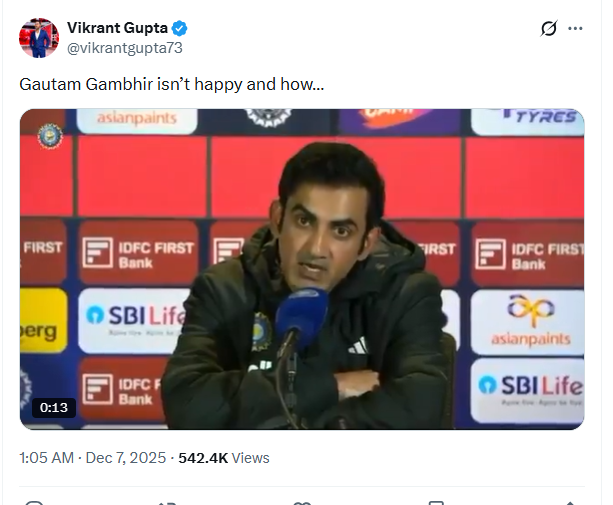
To verify the claim, we conducted a keyword search on Google. We found the same video on the official X (formerly Twitter) account of sports journalist Vikrant Gupta. The video was posted on December 7, 2025. According to the caption, Gambhir was expressing dissatisfaction following India’s performance.
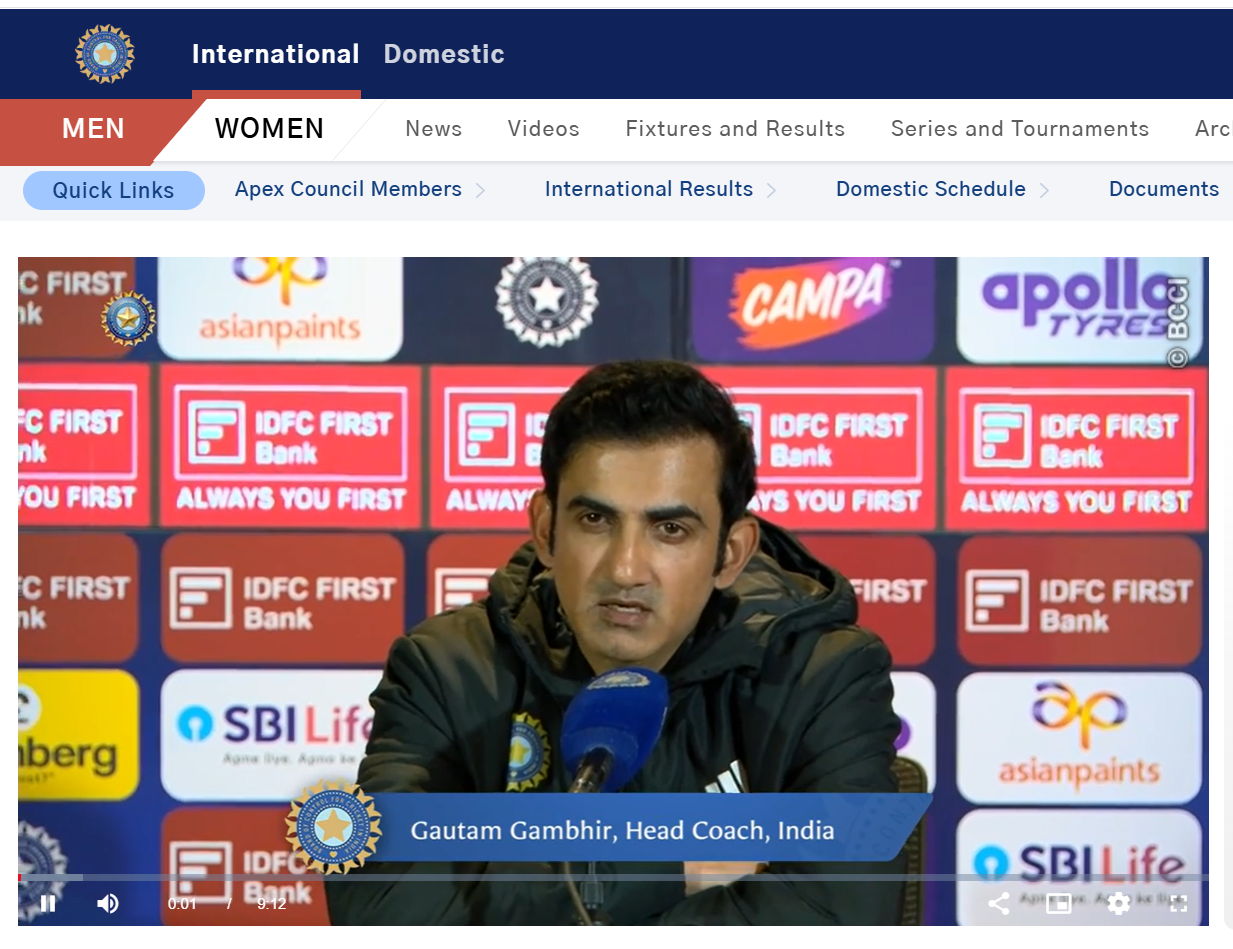
We also found the longer version of the video on the official website of the Board of Control for Cricket in India (BCCI), where it was published on December 6, 2025. In the full video, Gambhir is clearly seen speaking about India’s defeat to South Africa in a Test match. The specific segment that went viral appears around the 1 minute 58 second mark.
Conclusion
Our research found that the viral claim about Gautam Gambhir’s video being linked to trolling after the T20 World Cup 2026 is misleading. The clip is from December 2025 and relates to India’s Test series defeat against South Africa — not the T20 World Cup 2026.An old video is being reshared with a false and misleading context.
Related Blogs

Introduction
Taj Hotels Group is well known for its luxurious ambience and old-world grace and charm, blended with contemporary comforts and amenities for its guests or customers. But what can make all the netizens perplexed is the recent data breach incident which took place in Tata-owned Taj hotels. The hotel suffer from a data breach that compromises nearly 1.5 million customers' data which includes addresses, membership IDs, mobile numbers and other personally identifiable information, according to sources. This news was brought to light which raised concerns about the privacy and data protection of personal data of individuals. We are living in a space influenced by advanced technology and digital communication which throws a concern or challenge to secure the personal information of individuals.
Unveiling the incident
Tata-owned Taj Hotels group has suffered a data breach that compromise information of over 1.5 million customers, according to a news report. A bad actor or entity going by the name “Dnacookies” claimed data set contains data from the 2014-2020 period and has not been disclosed anywhere till now. Such personal data includes name, address, customer ID, mobile number and other personally identifiable information. This shows the risks or challenges of data protection and security. The incidents raise an alarm about the risks and vulnerabilities that might be faced even by the big corporate giants. The bad actor with the handle “Dnacookies” also demanded a ransom of a sum of about Rs 4.16 lakh from the Taj hotel group. In response to the incident, a spokesperson from the concerned hotel group said that we have been made aware of someone claiming possession of a limited data customer data set, which is non-sensitive in nature. Investigation is underway and relevant authorities have been notified about the incident.
A demand for ransom
The report from CNBC-TV18 clears that the bad actor not only purloined the data but also demanded around 4.16 lakh as a ransom for the database. Along with this, the bad actor kept three conditions ahead. Firstly there has to be a middleman for a negotiable deal secondly the data cannot be split either the entire data has to be taken with the ransom demand or no data at all. Thirdly additional samples of data will not be provided. Further, the spokesperson of Indian Hotel Company Limited mentioned that they have been escalated with the fact that someone is claiming authority in a limited data set. The bad actor claimed that the database contains information from 2014- 2020 which has been kept confidential till now. The audacity of the bad actor went to such an extent that the sample containing one thousand rows of unique entries from the bad actor dataset was also provided by the bad actor as proof of the deed. This incident underlines the growing threat in cyberspace and the urgency for individuals, organizations or entities to priorities data security measures and maintain cyber resilience.
Personal Data on Stake
Such data is the personal information of the individuals and also constitutes the personal tastes and preferences of individuals which can be exploited. The biggest gush of winds the hotel and individuals face by such a data breach is not only the volume of data compromised but also the potential ways it can get misused and exploited against the hotel or its customers by cyber crooks. This paves the way for cybercriminals to put forward any demand knowing the sensitivity of the data. Followed by creating a dilemmatic situation for the affected entities to either accept the ransom demands or to stand against ransom. Since the risks are high, going ahead with any of these situations can have an adverse impact on the security of personal data. The organisation or entities holding the personal data need to make sure that data under their realm is well protected and secured.
While the organisation has to sail through the aftermath of this breach, such incidents also pose a challenge for the organisation to maintain the trust and reputation of the organization since these incidents question the cyber security posture of the organisation. It is suggested to be transparent with its stakeholders, and open about the vulnerabilities and steps taken against this. They should also discuss the amplified step added for safeguarding their customer's personal data. Since Taj is well known for its out-of-the-box luxury and for providing comfort to its customers it should take a step ahead to reinforce its digital infrastructure to ensure the security of data.
Digital Personal Data Protection Act, 2023
The newly enacted Digital Personal Data Act, 2023 put certain obligations on data fiduciaries to take reasonable measures to maintain the security of personal data. The Act also requires to inform about the data breach to the data protection board constituted under the Act. The Act aims to protect the individual's digital personal data. The Act casts certain obligations on data principals and data fiduciaries. The Act provides penalty upto 250 crores in case of a data breach. The Act aims to provide consent-based data collection techniques. The Act also establishes the Data Protection Board to ensure compliance with the provisions of the Act and address grievances.
Conclusion
Data breach in such a big giant in the market serves as an alarming concern to be more cautious and proactively take precautionary measures to protect the security of data and compliance with data protection laws and regulations. We are living in an era where digital security is as important as the basic fundamental rights of an individual. Taj Hotels Group has actively taken steps to handle the aftermath of the data breach by informing the incident to law enforcement agencies and taking necessary steps. It is also on our part to be more aware, and vigilant about our personal data. Entities need to ensure compliance and measures to protect personal data and overall ensure a true cyber-safe & digital environment.
References
.webp)
Introduction
In India, the rights of children with regard to protection of their personal data are enshrined under the Digital Personal Data Protection Act, 2023 which is the newly enacted digital personal data protection law of India. The DPDP Act requires that for the processing of children's personal data, verifiable consent of parents or legal guardians is a necessary requirement. If the consent of parents or legal guardians is not obtained then it constitutes a violation under the DPDP Act. Under section 2(f) of the DPDP act, a “child” means an individual who has not completed the age of eighteen years.
Section 9 under the DPDP Act, 2023
With reference to the collection of children's data section 9 of the DPDP Act, 2023 provides that for children below 18 years of age, consent from Parents/Legal Guardians is required. The Data Fiduciary shall, before processing any personal data of a child or a person with a disability who has a lawful guardian, obtain verifiable consent from the parent or the lawful guardian. Section 9 aims to create a safer online environment for children by limiting the exploitation of their data for commercial purposes or otherwise. By virtue of this section, the parents and guardians will have more control over their children's data and privacy and they are empowered to make choices as to how they manage their children's online activities and the permissions they grant to various online services.
Section 9 sub-section (3) specifies that a Data Fiduciary shall not undertake tracking or behavioural monitoring of children or targeted advertising directed at children. However, section 9 sub-section (5) further provides room for exemption from this prohibition by empowering the Central Government which may notify exemption to specific data fiduciaries or data processors from the behavioural tracking or target advertising prohibition under the future DPDP Rules which are yet to be announced or released.
Impact on social media platforms
Social media companies are raising concerns about Section 9 of the DPDP Act and upcoming Rules for the DPDP Act. Section 9 prohibits behavioural tracking or targeted advertising directed at children on digital platforms. By prohibiting intermediaries from tracking a ‘child's internet activities’ and ‘targeted advertising’ - this law aims to preserve children's privacy. However, social media corporations contended that this limitation adversely affects the efficacy of safety measures intended to safeguard young users, highlighting the necessity of monitoring specific user signals, including from minors, to guarantee the efficacy of safety measures designed for them.
Social media companies assert that tracking teenagers' behaviour is essential for safeguarding them from predators and harmful interactions. They believe that a complete ban on behavioural tracking is counterproductive to the government's objectives of protecting children. The scope to grant exemption leaves the door open for further advocacy on this issue. Hence it necessitates coordination with the concerned ministry and relevant stakeholders to find a balanced approach that maintains both privacy and safety for young users.
Furthermore, the impact on social media platforms also extends to the user experience and the operational costs required to implement the functioning of the changes created by regulations. This also involves significant changes to their algorithms and data-handling processes. Implementing robust age verification systems to identify young users and protect their data will also be a technically challenging step for the various scales of platforms. Ensuring that children’s data is not used for targeted advertising or behavioural monitoring also requires sophisticated data management systems. The blanket ban on targeted advertising and behavioural tracking may also affect the personalisation of content for young users, which may reduce their engagement with the platform.
For globally operating platforms, aligning their practices with the DPDP Act in India while also complying with data protection laws in other countries (such as GDPR in Europe or COPPA in the US) can be complex and resource-intensive. Platforms might choose to implement uniform global policies for simplicity, which could impact their operations in regions not governed by similar laws. On the same page, competitive dynamics such as market shifts where smaller or niche platforms that cater specifically to children and comply with these regulations may gain a competitive edge. There may be a drive towards developing new, compliant ways of monetizing user interactions that do not rely on behavioural tracking.
CyberPeace Policy Recommendations
A balanced strategy should be taken into account which gives weightage to the contentions of social media companies as well as to the protection of children's personal information. Instead of a blanket ban, platforms can be obliged to follow and encourage openness in advertising practices, ensuring that children are not exposed to any misleading or manipulative marketing techniques. Self-regulation techniques can be implemented to support ethical behaviour, responsibility, and the safety of young users’ online personal information through the platform’s practices. Additionally, verifiable consent should be examined and put forward in a manner which is practical and the platforms have a say in designing the said verification. Ultimately, this should be dealt with in a manner that behavioural tracking and targeted advertising are not affecting the children's well-being, safety and data protection in any way.
Final Words
Under section 9 of the DPDP Act, the prohibition of behavioural tracking and targeted advertising in case of processing children's personal data - will compel social media platforms to overhaul their data collection and advertising practices, ensuring compliance with stricter privacy regulations. The legislative intent behind this provision is to enhance and strengthen the protection of children's digital personal data security and privacy. As children are particularly vulnerable to digital threats due to their still-evolving maturity and cognitive capacities, the protection of their privacy stands as a priority. The innocence of children is a major cause for concern when it comes to digital access because children simply do not possess the discernment and caution required to be able to navigate the Internet safely. Furthermore, a balanced approach needs to be adopted which maintains both ‘privacy’ and ‘safety’ for young users.
References
- https://www.meity.gov.in/writereaddata/files/Digital%20Personal%20Data%20Protection%20Act%202023.pdf
- https://www.firstpost.com/tech/as-govt-of-india-starts-preparing-rules-for-dpdp-act-social-media-platforms-worried-13789134.html#google_vignette
- https://www.business-standard.com/industry/news/social-media-platforms-worry-new-data-law-could-affect-child-safety-ads-124070400673_1.html
.webp)
Introduction
In the labyrinthine world of digital currencies, a new chapter unfolds as India intensifies its scrutiny over the ethereal realm of offshore cryptocurrency exchanges. With nuance and determination that virtually mirrors the Byzantine complexities of the very currencies they seek to regulate, Indian authorities embark on a course of stringent oversight, bringing to the fore an ever-evolving narrative of control and compliance in the fintech sector. The government's latest manoeuvre—a directive to Apple Inc. to excise the apps of certain platforms, including the colossus Binance, from its App Store in India—signals a crescendo in the nation's efforts to rein in the unbridled digital bazaar that had hitherto thrived in a semi-autonomous expanse of cyberspace.
The directive, with ramifications as significant and intricate as the cryptographic algorithms that underpin the blockchain, stems from the Ministry of Electronics and Information Technology, which has cast eight exchanges, including Bitfinex, HTX, and Kucoin, into the shadows, rendering their apps as elusive as the Higgs boson in the vast App Store universe. The movement of these exchanges from visibility to obscurity in the digital storefront is cloaked in secrecy, with sources privy to this development remaining cloaked in anonymity, their identities as guarded as the cryptographic keys that secure blockchain transactions.
The Contention
This escalation, however, did not manifest from the vacuum of the ether; it is the culmination of a series of precipitating actions that began unfolding on December 28th, when the Indian authorities unfurled a net over nine exchanges, ensnaring them with suspicions of malfeasance. The spectre of inaccessible funds, a byproduct of this entanglement, has since haunted Indian crypto traders, prompting a migration of deposits to local exchanges that operate within the nation's regulatory framework—a fortress against the uncertainties of the offshore crypto tempest.
The extent of the authorities' reach manifests further, beckoning Alphabet Inc.'s Google to follow in Apple's footsteps. Yet, in a display of the unpredictable nature of enforcement, the Google Play Store in India still played host to the very apps that Apple's digital Eden had forsaken as of a nondescript Wednesday afternoon, marked by the relentless march of time. The triad of power-brokers—Apple, Google, and India's technology ministry—has maintained a stance as enigmatic as the Sphinx, their communications as impenetrable as the vaults that secure the nation's precious monetary reserves.
Compounding the tightening of this digital noose, the Financial Intelligence Unit of India, a sentinel ever vigilant at the gates of financial propriety, unfurled a compliance show-cause notice to the nine offshore platforms, an ultimatum demanding they justify their elusive presence in Indian cyberspace. The FIU's decree echoed with clarity amidst the cacophony of regulatory overtures: these digital entities were tethered to operations sequestered in the shadows, skirting the reach of India's anti-money laundering edicts, their websites lingering in cyberspace like forbidden fruit, tantalisingly within reach yet potentially laced with the cyanide of non-compliance.
In this chaotic tableau of constraint and control, a glimmer of presence remains—only Bitstamp has managed to brave the regulatory storm, maintaining its presence on the Indian App Store, a lone beacon amid the turbulent sea of regimentation. Kraken, another leviathan of crypto depths, presented only its Pro version to the Indian connoisseurs of the digital marketplace. An aura of silence envelops industry giants such as Binance, Bitfinex, and KuCoin, their absence forming a void as profound as the dark side of the moon in the consciousness of Indian users. HTX, formerly known as Huobi, has announced a departure from Indian operations with the detached finality of a distant celestial body, cold and indifferent to the gravitational pull of India's regulatory orbit.
Compliances
In compliance with the provisions of the Money Laundering Act (PMLA) 2002 and the recent uproar on crypto assessment apps, Apple store finally removed these apps namely Binance and Kucoin from the store after receiving show cause notice. The alleged illegal operation and failure to comply with existing money laundering laws are major reasons for their removal.
The Indian Narrative
The overarching narrative of India's embrace of rigid oversight aligns with a broader global paradigm shift, where digital financial assets are increasingly subjected to the same degree of scrutiny as their physical analogues. The persistence in imposing anti-money laundering provisions upon the crypto sector reflects this shift, with India positioning its regulatory lens in alignment with the stars of international accountability. The preceding year bore witness to seismic shifts as Indian authorities imposed a tax upon crypto transactions, a move that precipitated a downfall in trading volumes, reminiscent of Icarus's fateful flight—hubris personified as his waxen appendages succumbed to the unrelenting kiss of the sun.
On a local scale, trading powerhouses lament the imposition of a 1% levy, colloquially known as Tax Deducted at Source. This fiscal shackle drove an exodus of Indian crypto traders into the waiting, seemingly benevolent arms of offshore financial Edens, absolved of such taxational rites. As Sumit Gupta, CEO of CoinDCX, recounted, this fiscal migration witnessed the haemorrhaging of revenue. His estimation that a staggering 95% of trading volume abandoned local shores for the tranquil harbours of offshore havens punctuates the magnitude of this phenomenon.
Conclusion
Ultimately, the story of India's proactive clampdown on offshore crypto exchanges resembles a meticulously woven tapestry of regulatory ardour, financial prudence, and the inexorable progression towards a future where digital incarnations mirror the scrutinised tangibility of physical assets. It is a saga delineating a nation's valiant navigation through the tempestuous, cryptic waters of cryptocurrency, helming its ship with unwavering determination, with eyes keenly trained on the farthest reaches of the horizon. Here, amidst the fusion of digital and corporeal realms, India charts its destiny, setting its sails towards an inextricably linked future that promises to shape the contour of the global financial landscape.
References
- https://www.business-standard.com/markets/cryptocurrency/govt-escalates-clampdown-on-offshore-crypto-venues-like-binance-report-124011000586_1.html
- https://www.cnbctv18.com/technology/india-escalates-clampdown-on-offshore-crypto-exchanges-like-binance-18763111.htm
- https://economictimes.indiatimes.com/tech/technology/centre-blocks-web-platforms-of-offshore-crypto-apps-binance-kucoin-and-others/articleshow/106783697.cms?from=mdr