
#FactCheck-Viral Clip Misleadingly Attributes Altered Remarks to Former CDS Anil Chauhan
Executive Summary
A video of former Chief of Defence Staff (CDS) General Anil Chauhan is going viral on social media. The video is being shared with the claim that, referring to the losses suffered by India during Operation Sindoor, he said, “Even if we lose four aircraft or 40 aircraft, India will still remain a larger economy. What matters is your ability to recover from the losses. Whatever losses we suffered, we can recover much faster than Pakistan.” A research done by the Research Wing of the CyberPeace examined the claims made in the video and compared them with General Anil Chauhan’s original remarks at the event.The research found that the viral video’s audio has been digitally manipulated. The alleged statement heard in the viral clip does not appear in the original footage.
Claim:
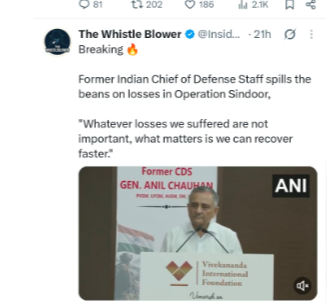
A Pakistani user on social media platform X shared the viral video with the caption: “BREAKING: Former Indian Chief of Defence Staff revealed details about the losses suffered during Operation Sindoor, saying, ‘Whatever losses we suffered are not important. What matters is that we can recover quickly.’”
The link to the post and a screenshot are provided below.
https://x.com/InsiderWB/status/2092559622225940952
Fact Check
Upon closely examining the viral video, we noticed the ANI logo. We then conducted a reverse image search of keyframes from the viral clip. During the search, we found the original video published by ANI, in which General Chauhan discusses the relationship between political objectives and military strategy.
https://x.com/ANI/status/2092217553355743409
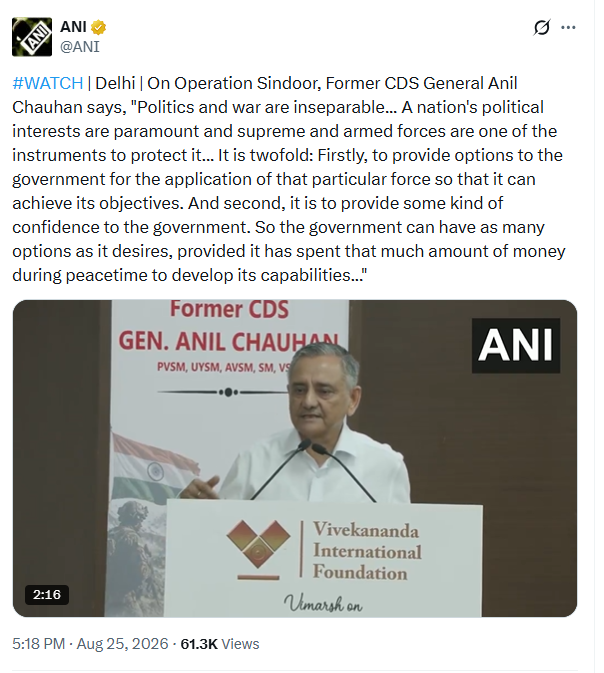
He said, “Politics and war are inseparable.” He further explained that a nation’s political interests are paramount, while the armed forces are one of several instruments used to safeguard those interests. General Chauhan also discussed the role of military leadership in presenting various options to the political leadership, as well as the importance of peacetime preparedness and training. He also spoke about training, contingency planning, and the need to balance military risks with political objectives. Notably, the statement attributed to him in the viral video,“Whatever losses we suffered are not important. What matters is that we can recover quickly” — does not appear anywhere in the original video. Additionally, the audio used in the viral video was also analysed using Resemble AI. The tool’s analysis identified the audio as AI-generated, indicating that the audio in the viral clip had been manipulated.

Conclusion
The research found that General Chauhan’s voice in the viral video has been digitally manipulated. The alleged statement heard in the viral clip does not appear in the original video.

Related Blogs

Introduction
The European Union has fined the meta $ 1.3 billion for infringing the EU privacy laws by transferring the personal data of Facebook users to the United States. The EU fined Meta’s business in Ireland. As per the European Union, transferring Personal data to the US is a breach of the General data protection Regulation or European Union law on data protection and privacy.
GDPR Compliance
The terms of GDPR promise to gather users’ personal information legally and under strict conditions. And those who collect and manage personal data must protect users’ personal data from exploitation. The GDPR restricts an organisation’s capacity to transfer personal data outside the EU if the transfer is solely based on that body’s evaluation of the sufficiency of the personal data’s protection. Transfers should only be made where European authorities have determined that a third country, a territory within that third country, or an international organisation provides acceptable protection for data protection.
Violation by Meta
The punishment, announced by Ireland’s Data Protection Commission, might be one of the most significant in the five years since the European Union passed the landmark General Data Protection Regulation. According to regulators, Facebook failed to comply with a 2020 judgment by the European Union’s top court that Facebook data transferred over the Atlantic was not sufficiently safeguarded from American espionage agencies. However, whether Meta will ever need to encrypt Facebook users’ data in Europe is still being determined. Meta announced it would appeal the ruling, launching a potentially legal procedure.
Simultaneously, European Union and American officials are negotiating a new data-sharing pact that would provide legal protections for Meta and scores of other companies to continue moving information between the US and Europe. This pact could overturn much of the European Union’s Monday ruling.
Article 46(1) GDPR Has been violated by the meta, And as per the Irish privacy.
What is required by the GDPR before transferring personal information across national boundaries?

Personal data transfers to countries outside the European Economic Area are generally permitted if these nations are regarded to provide a sufficient degree of data protection. According to Article 45 of the GDPR, the European Commission evaluates the degree of personal data protection in third countries.
The European Union judgment demonstrates how government rules are upending the borderless way data has traditionally migrated. Companies are increasingly being pressed to store data within the country where it is acquired rather than allowing it to transfer freely to data centres around the world as a result of data-protection requirements, national security laws, and other regulations.
The US internet giant had previously warned that if forced to stop using SCCs (standard contractual clauses) without a proper alternative data transfer agreement in place, it would be compelled to shut down services such as Facebook and Instagram in Europe.
What will happen next for Facebook in Europe?
The ruling includes a six-month transition period before it must halt data flows, meaning the service will continue to operate in the meantime. (More specifically, Meta has been given a five-month transition period to freeze any future transfer of personal data to the United States and a six-month deadline to terminate the unlawful processing and/or storage of European user data it has previously transferred without a legitimate legal basis. Meta has also stated that it will appeal and appears to seek a stay of execution while it pursues its legal arguments in court.
Conclusion
The GDPR places restrictions on transferring personal data outside the European Union to third-party nations or international bodies to ensure that the GDPR’s level of protection for individuals is not jeopardised. But the meta violated the European Union’s privacy laws by the user’s personal information to the US. Under the compliance of GDPR, transferring and sending personal information to users intentionally is an offence. and presently, the personal data of Facebook users has been breached by the Meta, as they shared the information with the US.
Executive Summary
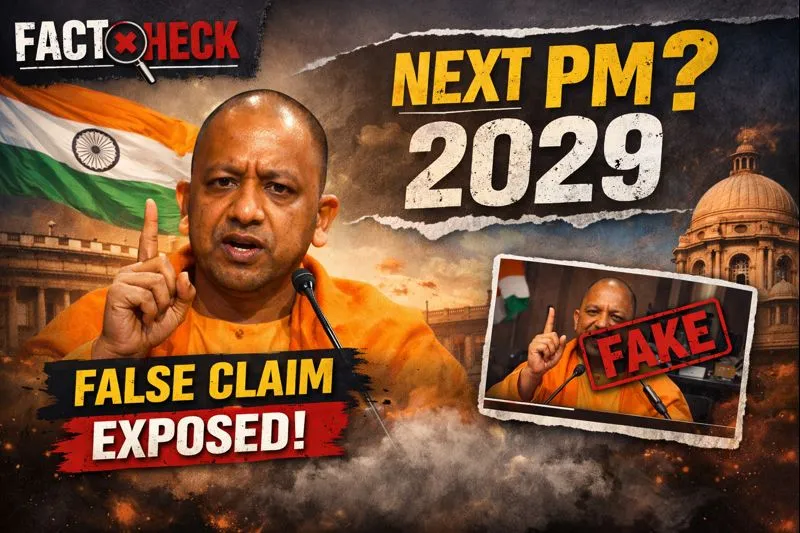
A video featuring Uttar Pradesh Chief Minister Yogi Adityanath is being widely shared on social media. In the video, Adityanath can be heard saying, “Let me become the Prime Minister, and Pakistan-occupied Kashmir will also become a part of India.” The video also carries an on-screen text that reads “Next PM 2029.” By sharing this clip, social media users are claiming that Yogi Adityanath is set to become India’s Prime Minister in 2029.
However, CyberPeace research found the viral claim to be misleading. Our research revealed that the video circulating online has been edited and is being shared out of context. The original video dates back to May 2024. In the original footage, Yogi Adityanath is not speaking about himself. Instead, he is referring to Prime Minister Narendra Modi.
In the original statement, Adityanath says:
“Let Modi ji become Prime Minister for the third time, and within the next six months, Pakistan-occupied Kashmir will also become a part of India.”
It is evident that the video has been trimmed and misleading text has been added to falsely portray the statement as a declaration about Yogi Adityanath becoming Prime Minister in 2029.
Claim
A YouTube user shared the viral video on January 29, 2026, claiming that Yogi Adityanath said, “Let me become Prime Minister, and Pakistan-occupied Kashmir will be part of India.” The video carries the caption “Next PM 2029,” suggesting that Adityanath is set to become the Prime Minister in 2029.
Link to the post n archive

Fact Check:
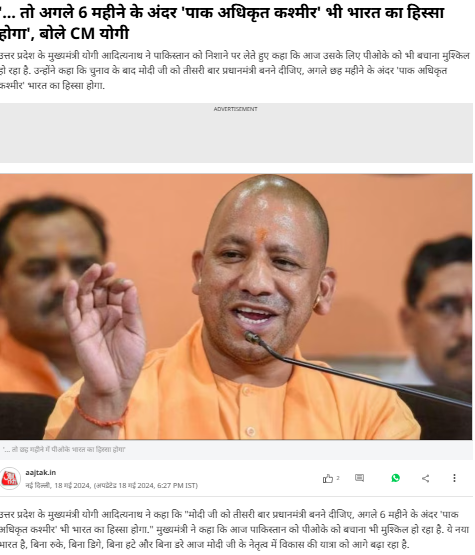
To verify the viral claim, we first conducted a keyword search on Google. During this process, we found a report published by Aaj Tak on May 18, 2024. According to the report, Yogi Adityanath stated that if Narendra Modi becomes Prime Minister for the third time, Pakistan-occupied Kashmir would become part of India within six months.
Report link:
Next, we extracted keyframes from the viral video and ran them through Google Lens. This led us to the official YouTube channel of Yogi Adityanath, where the same video was uploaded on May 18, 2024.
Original video link:
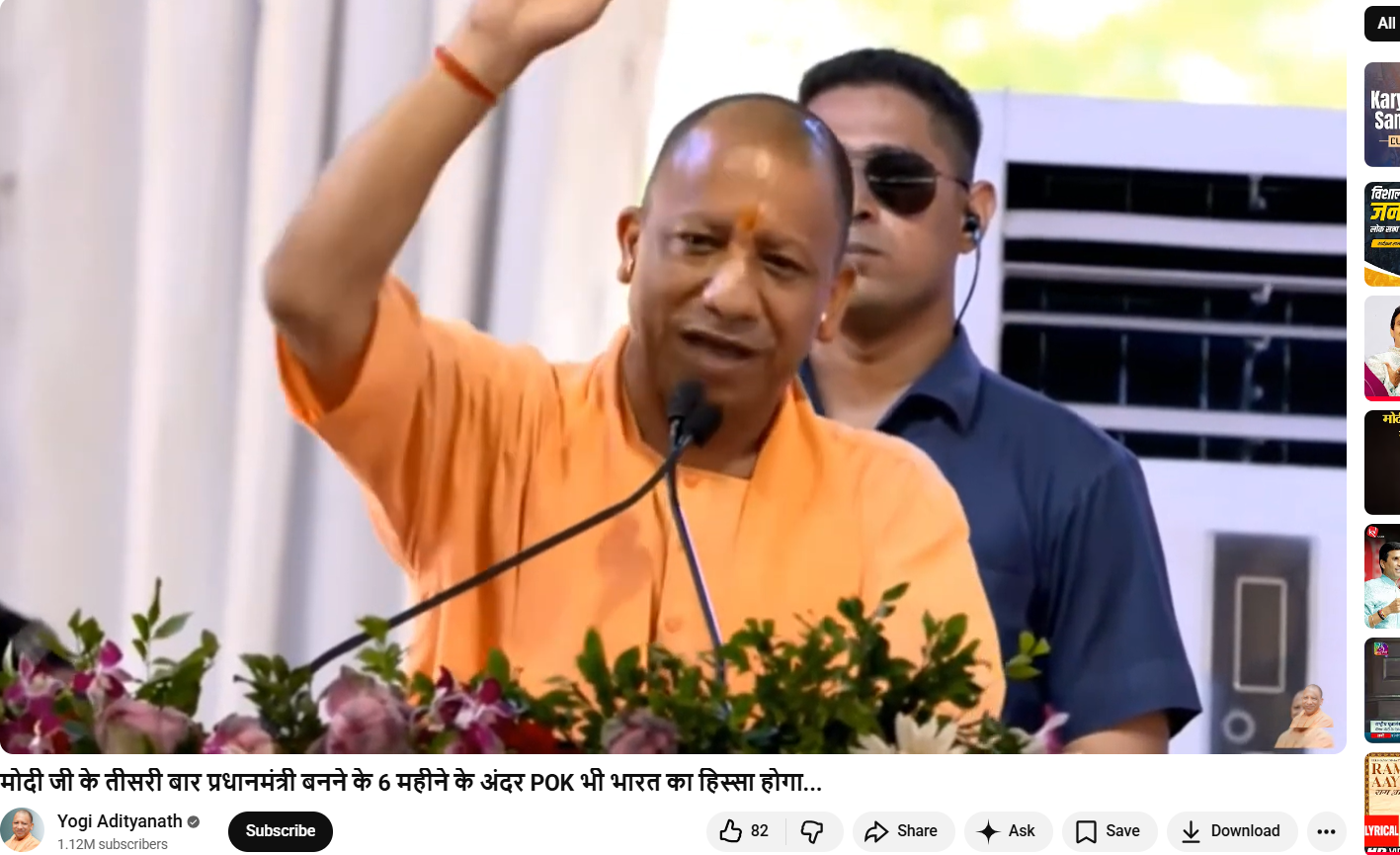
In the original video, Yogi Adityanath clearly makes the statement in reference to Prime Minister Narendra Modi, not himself.Finally, we compared the viral clip with the original footage. The visuals in both videos are identical; however, the viral version has been edited and overlaid with misleading text to change the meaning of the statement.
Conclusion
Our research confirms that the viral video is edited and misleading. The original video is from May 2024, in which Yogi Adityanath was speaking about Prime Minister Narendra Modi, not about himself becoming Prime Minister in 2029. The video has been falsely altered and shared with a deceptive claim on social media.
Executive Summary
A video is being shared on social media showing several people attempting to rescue a young man trapped under a pile of soil and debris. The video is being shared as footage of the recent floods in Nepal. A research done by the Research Wing of the CyberPeace found the viral claim to be misleading. The research revealed that the video dates back to March 2026 and has no connection with the floods in Nepal. The video is actually from an incident in Prayagraj, Uttar Pradesh, and is being falsely shared as recent footage of the devastation caused by the floods in Nepal.
Claim:
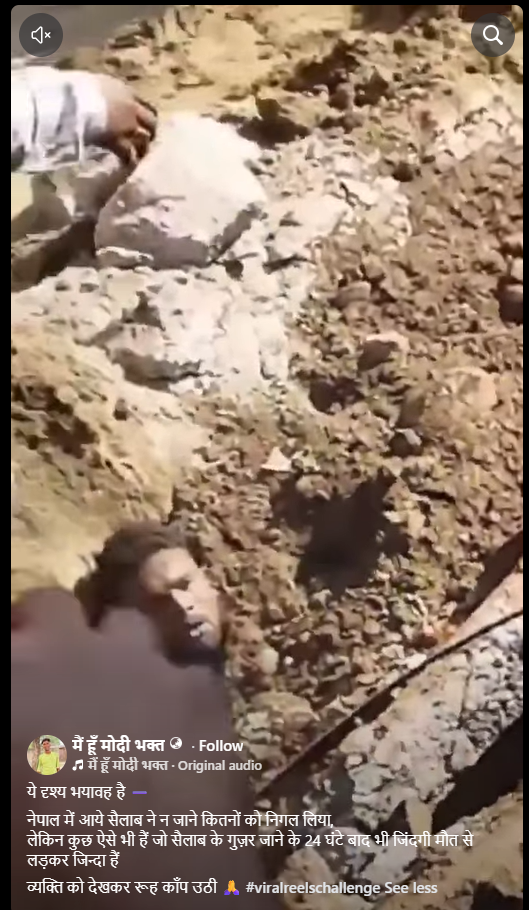
On Facebook, a user shared the viral video with the caption: “These scenes are horrifying. The floods in Nepal have claimed countless lives, but there are also people who are still fighting for their lives even 24 hours after the floodwaters have receded. Seeing this person sends chills down the spine.” The archived post link and screenshot are provided below.
https://www.facebook.com/reel/1104511315422755
FactCheck
To verify the authenticity of the viral claim, we first extracted keyframes from the video and conducted a reverse image search using Google Lens. During the search, we found the same video uploaded on the YouTube account ‘Prayagraj Live 24’ on March 24, 2026.
According to the video description, the footage shows the relief and rescue operation carried out following an accident at a cold storage facility in Phaphamau, Prayagraj. The report link and screenshot are provided below.
https://www.youtube.com/shorts/D6ADJzxZUGQ
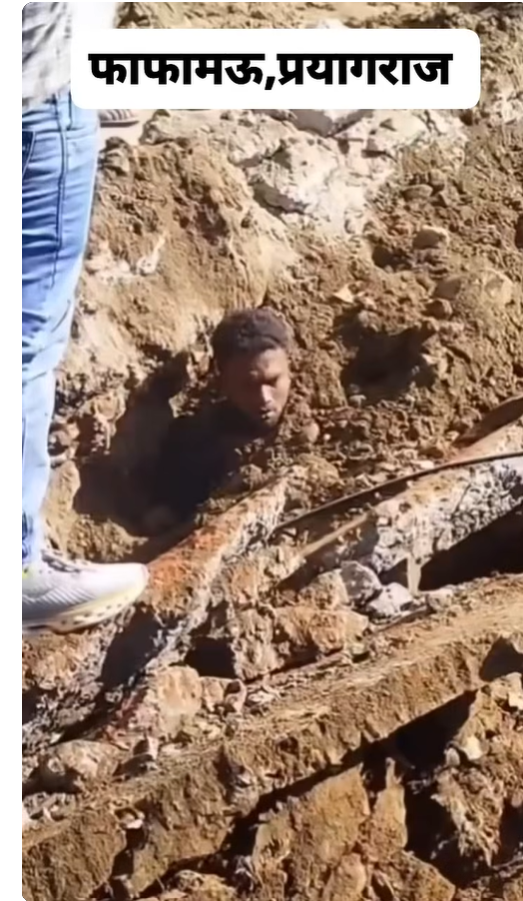
Based on the clue obtained from YouTube, we conducted a Google search using relevant keywords. During the search, we found a report published on the Dainik Bhaskar website on March 24, 2026, which featured the same visuals seen in the viral video. The report link and screenshot are provided below.

According to a report by Dainik Bhaskar, a major accident occurred at Adarsh Cold Storage in the Phaphamau police station area of Prayagraj on March 23, 2026. At around 1:30 pm, an ammonia gas chamber used for cooling at the cold storage exploded, causing the building’s walls and roof to collapse. Several workers were trapped under the debris in the accident.
Conclusion
Our research found that the viral video dates back to March 2026 and has no connection with the floods in Nepal. The video is actually from an incident in Prayagraj, Uttar Pradesh, and is being falsely shared on social media as recent footage of the devastation caused by the floods in Nepal.
